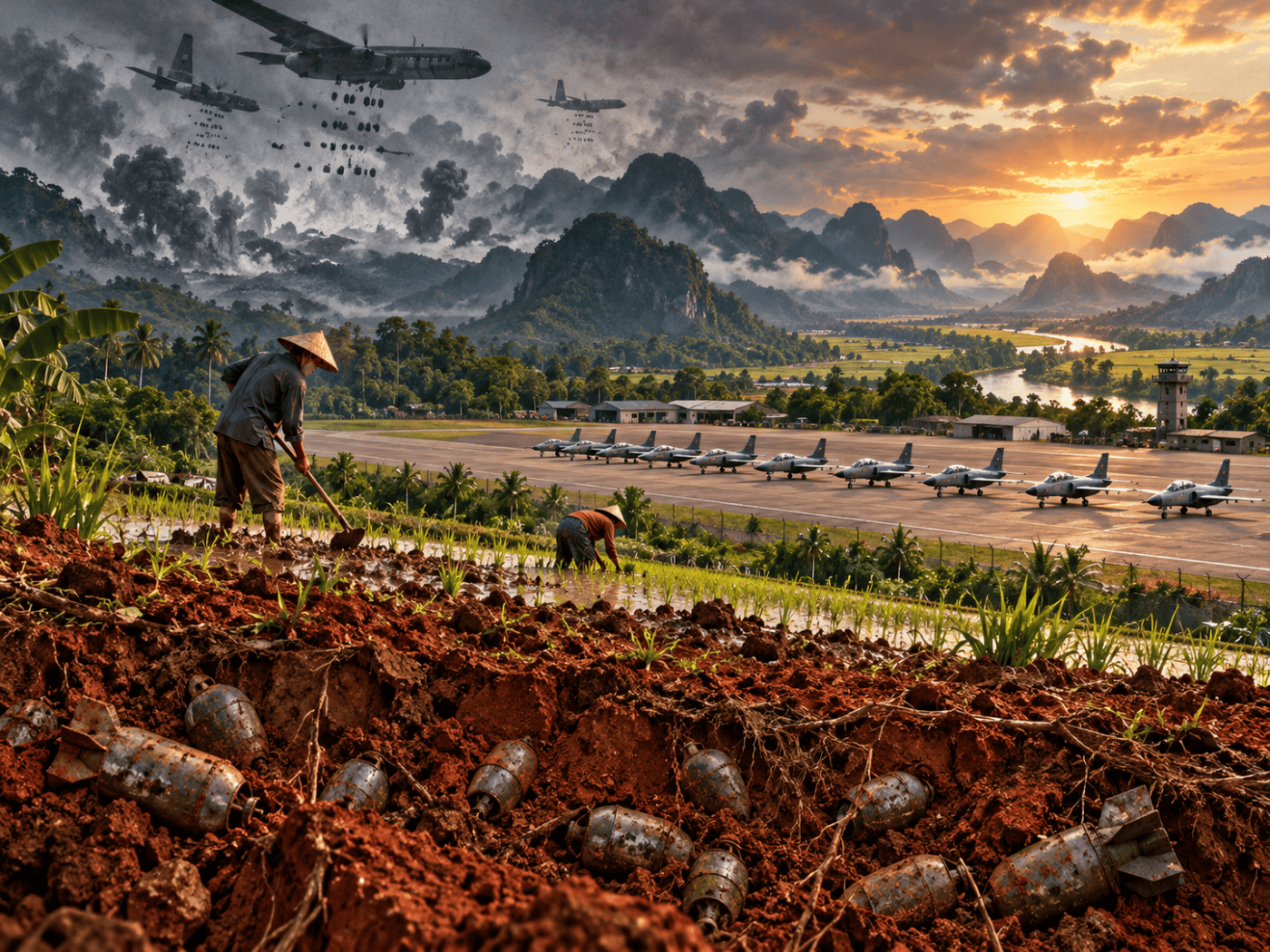
The New York Times turns eight Chinese jets in Laos into a looming military threat while erasing the country’s sovereignty. Beneath the runway lies a history of American warfare, revolutionary struggle, and national reconstruction. China’s cooperation exposes the contradictions of building independence through unequal economic and military relationships. The struggle demands opposition to American militarism and solidarity with the Lao people.
Prince Kapone | Weaponized Information | October 8, 2026
The Bomber That Hasn’t Landed
Eight small jets have landed in Laos, and already the machinery of American threat inflation is working overtime. In his October 8, 2026, New York Times report, “China Expands Its Military Reach by Building a Base in Laos,” Chris Buckley, accompanied by graphics from Josh Holder, describes a newly opened Chinese-Lao military facility at Ban Keun, north of Vientiane. Satellite photographs show eight aircraft, sixteen military vehicles, and a runway approximately 1.2 miles long. That’s the observable military development. What follows is an exercise in making the reader fear everything that hasn’t happened yet.
The aircraft are believed to be K-8 jets, principally used for training but capable of light attack missions. Their presence is newsworthy enough. Buckley, however, quickly moves beyond what’s sitting on the tarmac toward what might arrive someday. The runway could be extended. Larger aircraft might follow. Bombers and surveillance planes become possibilities worth watching. Before a single bomber has landed, its shadow is already stretching across Southeast Asia. The satellite photographs establish what exists; the speculation teaches readers what to fear.
The article’s experts give that fear a respectable uniform. Taiwanese military scholar Ying Yu Lin discusses China’s potential ability to project air power across the region. Former Pentagon official Drew Thompson offers a less alarming assessment, acknowledging the facility’s limited immediate military value. Their disagreement is real, but notice where the discussion takes place. Both are asked to interpret the installation primarily through Chinese strategic capabilities and their consequences for neighboring states. Laos, whose territory and armed forces are directly involved, receives no comparable examination of its own military requirements.
That disappearance is the article’s most revealing maneuver. China builds, expands, finances, and projects power. Thailand watches. Vietnam worries. Laos occupies the land and carries the debt. The Thai defense spokesperson’s acknowledgment of Laos’ sovereign authority appears briefly, as does Beijing’s explanation that the facility will be jointly maintained and isn’t directed against another country. Neither interrupts the governing narrative for long. The Lao government becomes strangely peripheral to a decision involving its own territory.
Buckley then introduces Chinese lending, railway construction, and electricity infrastructure. These are legitimate subjects for scrutiny, but the article establishes no specific connection between Laos’ financial obligations and the military agreement. No documented coercion, no financing condition, no evidence that Beijing demanded an airfield in exchange for debt relief. The facts are arranged so the reader can supply the accusation himself. Debt becomes the insinuation, and proximity does the work that evidence should’ve done.
Buried near the end is a detail that threatens to upset the whole performance. Ban Keun once served American covert military operations under Air America during the Vietnam War. Buckley acknowledges it, then moves along. Washington’s military history in Laos receives a passing reference, while China’s new facility receives an entire geography of hypothetical danger. American military relationships elsewhere appear as reassuring counterweights to Beijing. The old military order is treated as the furniture of the room; China’s arrival becomes the intruder. By the final paragraph, the reader has learned plenty about what China might do from Laos and remarkably little about Laos itself.
The Country Beneath the Runway
Ban Keun has carried foreign aircraft before. During Washington’s war against the revolutionary movements of Indochina, the airfield was known as Lima Site 44, one of the covert installations used by Air America, the CIA-owned airline that transported American-backed Hmong forces and military supplies across Laos. By 1968, helicopters were carrying troops from Ban Keun into combat zones. The airfield belonged to a much larger American operation that devastated the country while Washington publicly maintained the fiction of respecting its neutrality. Between 1964 and 1973, the United States dropped more than two million tons of munitions on Laos. The unexploded American ordnance continues to kill and maim civilians, restrict farming, and obstruct rural development. Entire generations have lived with a war Washington never bothered to clean up.
Out of that devastation emerged the Lao People’s Democratic Republic in December 1975, following the revolutionary struggle against colonial rule and American intervention. The Lao People’s Revolutionary Party established a new state whose institutions were charged with defending national independence and rebuilding a battered country. Its revised constitution explicitly commits the government to modernizing the armed forces, improving technical equipment, and developing the professional capabilities of military personnel. These aren’t mysterious ambitions manufactured in Beijing. They’re responsibilities the Lao state has formally assigned to its own institutions.
That brings us to what actually opened at Ban Keun. On September 29, Lao Defense Minister Khamlieng Outhakaysone and representatives of the Chinese People’s Liberation Army inaugurated the Joint Aviation Training and Support Center alongside the Laos-China Friendship Aviation College. The Lao government’s stated purpose is to improve military pilot training and develop aviation personnel. Both countries describe the facilities as jointly maintained. Satellite photographs subsequently showed eight aircraft believed to be K-8 trainer-light attack jets and continuing runway construction. The aircraft’s ownership, permanent deployment status, and the precise division of operational authority haven’t been publicly established. The Laotian Times reported that details concerning stationed personnel and equipment remained undisclosed. Those are important unanswered questions, but they don’t erase the training institutions the two governments have actually established.
The arrangement also has a history longer than the construction schedule. Chinese and Lao forces have conducted joint exercises, medical training, and personnel exchanges. In June 2026, Presidents Xi Jinping and Thongloun Sisoulith discussed expanding cooperation in defense, public security, infrastructure, agriculture, and technology. Their leadership discussions included a proposed strategic dialogue linking foreign affairs, defense, and public security. Ban Keun emerged within this developing relationship between two states governed by communist parties, although the available record doesn’t establish that the June discussions directly determined the facility’s construction.
Nor has Laos confined its future to China. Vietnam, whose revolutionary history is deeply connected to that of Laos, has been expanding its own development and security cooperation with Vientiane. Vietnamese scholar Nguyen Khac Giang documents plans for a railway to Vung Ang Port, intended to give landlocked Laos a commercial route to the sea, alongside educational and digital-government cooperation. Hanoi has its own reasons for wanting strong ties with Laos, including concern about China’s growing economic influence. Yet Vietnam and China also maintain direct political and military dialogue, including their March 2026 ministerial meeting involving foreign affairs, defense, and public security. The relationships are neither frictionless nor divided into two neat enemy camps.
China’s economic role, meanwhile, becomes clearer when examined through the infrastructure itself. The 414-kilometer Laos-China Railway opened in December 2021 after five years of construction, connecting Vientiane with the Chinese border and onward to Yunnan. Built at an estimated cost of $5.9 billion, the project operates through a Chinese-Lao joint venture in which Chinese interests hold 70 percent and the Lao side holds 30 percent. Chinese financing, engineering, and equipment made a major contribution to a transport system Laos had long sought. The railway carries passengers and freight through mountainous terrain that previously made movement expensive and difficult. Its construction also placed significant financial obligations on the Lao state.
Those obligations matter. Laos has struggled with public debt, foreign-exchange shortages, and the finances of major infrastructure projects. China is a substantial creditor, but the relationship includes repayment accommodations as well as lending. The IMF’s 2026 assessment records Chinese debt-service deferrals that helped relieve immediate financial pressure. Such arrangements don’t eliminate dependence, and the size of China’s share changes depending on which liabilities and reporting periods are counted. They do make the financial relationship considerably more complicated than a creditor simply issuing orders to a helpless debtor.
The people building these grand projects have their own accounts of what development costs. Researchers Wanjing Chen and Jessica DiCarlo found that financing delays during railway construction led Chinese contractors to withhold wages from Lao workers. Many left, and employers increasingly brought in Chinese laborers whose payment arrangements allowed construction to continue despite delayed reimbursements. Those workers eventually experienced withheld wages themselves, producing labor unrest. The same field investigation documented land acquisition affecting more than 4,000 households, delayed compensation, and villagers who lost access to farmland while struggling to obtain adequate payment. Lao government agencies administered the land-acquisition process. The disputes involved foreign contractors, domestic officials, workers, and peasants, each occupying a different position in the project.
Yet the railway’s benefits are no fiction either. A 2026 regional study found that 87 percent of surveyed Lao railway users reported an improved impression of China after using the service, while 80.8 percent expressed concern about debt exposure. The survey covered infrastructure users rather than a representative sample of the entire population, but its findings capture something important: people can welcome a railway that makes their lives easier while worrying about the financial burden attached to it. They can benefit from new infrastructure while others lose wages, land, or livelihoods during its construction.
These are the conditions surrounding Ban Keun: a revolutionary state rebuilding from colonial war, armed forces seeking technical development, neighboring socialist countries maintaining overlapping relationships, and infrastructure projects that have brought both productive gains and bitter disputes over their costs. The runway sits inside that living history. Understanding its place in Laos requires considerably more than counting aircraft and imagining what might land there next.
Independence Has to Be Built
A flag can fly over a country long before that country possesses the means to control its own future. Political independence establishes the right to govern, but exercising that right requires something considerably more substantial than a constitution and a seat at the United Nations. A government needs the means to move goods, produce electricity, train engineers, maintain aircraft, and defend its territory. Without those capabilities, independence remains vulnerable to the decisions of whoever controls the machinery, the credit, and the technical knowledge. Laos knows this history intimately. Its revolution secured the political authority that colonialism and American intervention had sought to destroy. The harder struggle was building the material foundations that would allow that authority to endure.
Colonial domination leaves behind more than ruined villages and stolen resources. It organizes an entire society around dependence, restricting the development of industries, institutions, and productive capacities that might allow the colonized to stand on their own feet. Formal liberation breaks the political chains, but the economic inheritance doesn’t disappear with the retreating army. The new government must build with whatever resources history has left it. For Laos, that has meant acquiring industrial infrastructure, transportation networks, technical expertise, and military capabilities under conditions it didn’t freely choose. The revolutionary state inherited the responsibility for national development without inheriting the accumulated wealth and machinery that make development possible.
China enters this history as a country possessing capabilities Laos needs and cannot yet fully produce for itself. Cooperation offers a way to shorten the long and expensive road toward national modernization. A railway creates possibilities for movement and production that previously remained beyond reach. Technical training allows domestic personnel to operate equipment that would otherwise require foreign specialists. Military cooperation can develop the knowledge necessary to maintain an independent defense. Yet the same process contains a contradiction. A country may acquire new machinery while remaining dependent on another country for the financing, replacement parts, technical systems, or expertise required to keep it running. The struggle for independence continues inside the very institutions built to strengthen it.
That contradiction cannot be settled by examining the nationality of the lender or counting the flags at an inauguration. What matters is the actual relationship through which the capability is produced and maintained. Who owns the equipment? Who controls its operation? Who trains the people who will eventually replace the foreign specialists? Who decides what happens when the financing runs short? These questions determine whether cooperation gradually enlarges a country’s freedom of action or reproduces the dependence it was intended to overcome. They also explain why the development of productive capacity is a political struggle rather than a simple matter of pouring concrete and cutting ribbons.
China’s participation has its own historical character. It is a socialist-rooted state whose strategic industries, planning institutions, and political leadership developed through a revolutionary process fundamentally different from the imperial expansion of the Western capitalist powers. Its cooperation with Laos takes place through longstanding political and developmental relationships between two countries governed by communist parties. To erase those distinctions and classify every Chinese overseas undertaking as imperial conquest is to substitute a political accusation for historical analysis. Yet China’s enterprises, banks, and contractors don’t all operate through identical social relations. Their conduct must be understood through the particular powers they exercise, the obligations they create, and the interests they serve.
The railway exposes why this distinction matters. Its existence expands the productive possibilities available to Laos, but the workers who constructed it didn’t all experience that development as a triumph. Contractors facing financial difficulties passed the pressure downward through delayed wages. Peasants surrendered land while compensation became a struggle of its own. Chinese workers suffered exploitation alongside Lao workers. The contradiction ran through the project itself, between its national developmental purpose and the particular relations through which construction was organized. A railway may serve the country’s future while the men building it have to fight for yesterday’s pay. There’s no contradiction in recognizing both realities. The contradiction lies in the material process that produces them.
Nor did these conflicts occur entirely outside Lao state institutions. Domestic authorities participated in land acquisition, compensation, financing, and the administration of development. National sovereignty therefore cannot be treated as though the government and every worker or peasant automatically possess identical interests. The state may pursue infrastructure that enlarges the country’s productive powers while particular enterprises and officials distribute its costs unequally. A serious defense of national independence must be capable of examining those internal relations without handing imperial powers the authority to pass judgment on a country’s right to govern itself. The people whose labor builds development have a material stake in determining who benefits from it.
Military cooperation introduces another dimension because the instruments involved aren’t simply machines that move commodities or generate electricity. They carry organized force. Training pilots can increase the Lao military’s capacity to defend its territory, while recurring foreign technical assistance can establish lasting institutional relationships between armed forces. The decisive distinction concerns command. Learning to operate an aircraft strengthens domestic capacity; retaining the authority to determine how, when, and for whose purposes it operates gives that capacity sovereign meaning. Ban Keun’s declared training function belongs to the first process. Whether the facility eventually develops broader Chinese operational functions depends on arrangements and decisions that the available evidence hasn’t established. Inventing those arrangements in advance would explain nothing.
This is where the New York Times’ picture begins to fall apart. Its narrative makes China’s emerging military presence the disturbance while the existing American military order stands quietly in the background, almost as though it were a natural feature of Asian geography. But that order was constructed through wars, interventions, military agreements, and the enormous concentration of industrial and financial resources in the imperial center. The foreign military presence once established at Ban Keun served an American intervention against Laos’ revolutionary struggle. The present cooperation was authorized by the state that emerged from that struggle. Treating the two relationships as historical equivalents because foreign aircraft used the same airfield would make geography do the work of political economy.
China’s growing capabilities nevertheless alter the region’s military relationships. Its institutions can now sustain forms of overseas cooperation previously concentrated among the established imperial powers. This development expands the possibilities available to countries seeking alternatives to American predominance, while creating fresh questions about the character of their relationships with China. Laos’ continuing cooperation with Vietnam shows that these relationships needn’t develop into exclusive camps. Smaller states can cultivate multiple connections, negotiate different sources of technical assistance, and seek greater room for independent decisions. Their actual freedom depends on the material alternatives they possess, not simply the number of diplomatic partnerships they announce.
The historical struggle at Ban Keun is therefore larger than the question of eight aircraft. Laos is working to develop capabilities that colonialism and war helped deny it, within a world where the machinery of development and military power remains profoundly unequal. Chinese cooperation offers genuine opportunities to enlarge those capabilities, and the contradictions of finance, technology, property, and labor remain part of determining what that development becomes. Multipolarity weakens the monopoly of the old imperial powers over the available choices; it doesn’t settle who will command the new institutions or who will receive the fruits of their labor. Independence has to be built, maintained, and reproduced. Its deepest measure lies in whether a people can increasingly command the material conditions of their own existence, rather than merely watch another country’s aircraft take off from their soil.
The Bill Comes Due in Washington
Washington has spent generations teaching Americans to mistake its military supremacy for international security. Let another country acquire the means to defend itself, and suddenly every runway becomes a provocation, every aircraft a warning, every independent partnership a threat demanding an American response. That machinery runs on public consent, congressional appropriations, and the quiet assumption that the Pentagon has some God-given right to patrol the planet. Breaking that consensus requires organization. CODEPINK’s China Is Not Our Enemy campaign provides an existing avenue for political education, local organizing, and opposition to Washington’s military escalation across the Pacific. Its congressional advocacy campaign gives Americans a means to confront their representatives directly. The demand should be unmistakable: stop pouring public wealth into preparations for another imperial war.
Americans also have an outstanding debt to Laos, and this one wasn’t issued by a Chinese bank. It lies beneath the country’s fields, roads, and villages, where unexploded American bombs continue threatening people whose grandparents endured Washington’s war. Before Congress spends another dollar manufacturing fear over Chinese aircraft, it ought to answer for the destruction American aircraft already delivered. Legacies of War organizes public education and advocacy for unexploded-ordnance clearance and survivor assistance. Its advocacy programs connect community organizers with congressional efforts to sustain that work. Join those efforts, bring the history into workplaces and classrooms, and pressure representatives to fund clearance and survivor support. Land made safe for farming and families protected from buried explosives would accomplish considerably more for Laotian security than another American warship.
Solidarity also means taking the workers and peasants of Laos seriously. Defending their country’s sovereignty requires more than applauding agreements signed by governments. The people building railways, cultivating farmland, and maintaining public infrastructure have their own demands for wages, compensation, safe conditions, and a decent livelihood. The railway field research provides material for political education that neither dismisses Chinese development achievements nor conceals the struggles of workers who helped produce them. Study those experiences, circulate the findings, and make them part of the discussions through which working people learn to recognize their common interests across national borders. Internationalism loses its meaning when the people doing the work disappear behind the governments signing the contracts.
The Lao people fought to free their country from foreign domination. They don’t need Washington appointing itself guardian of their sovereignty because Beijing helped build an airfield. Their right to determine their own development belongs to them, along with the struggle to ensure its benefits reach the people whose labor sustains it. Our responsibility in the imperial center is concrete: challenge the war propaganda, confront the military budgets, demand accountability for the destruction already inflicted, and stand with working people defending their livelihoods. Laos has buried enough victims of American power. The last thing its people need is another generation of Americans being taught that their country’s independence is a threat.


Leave a comment