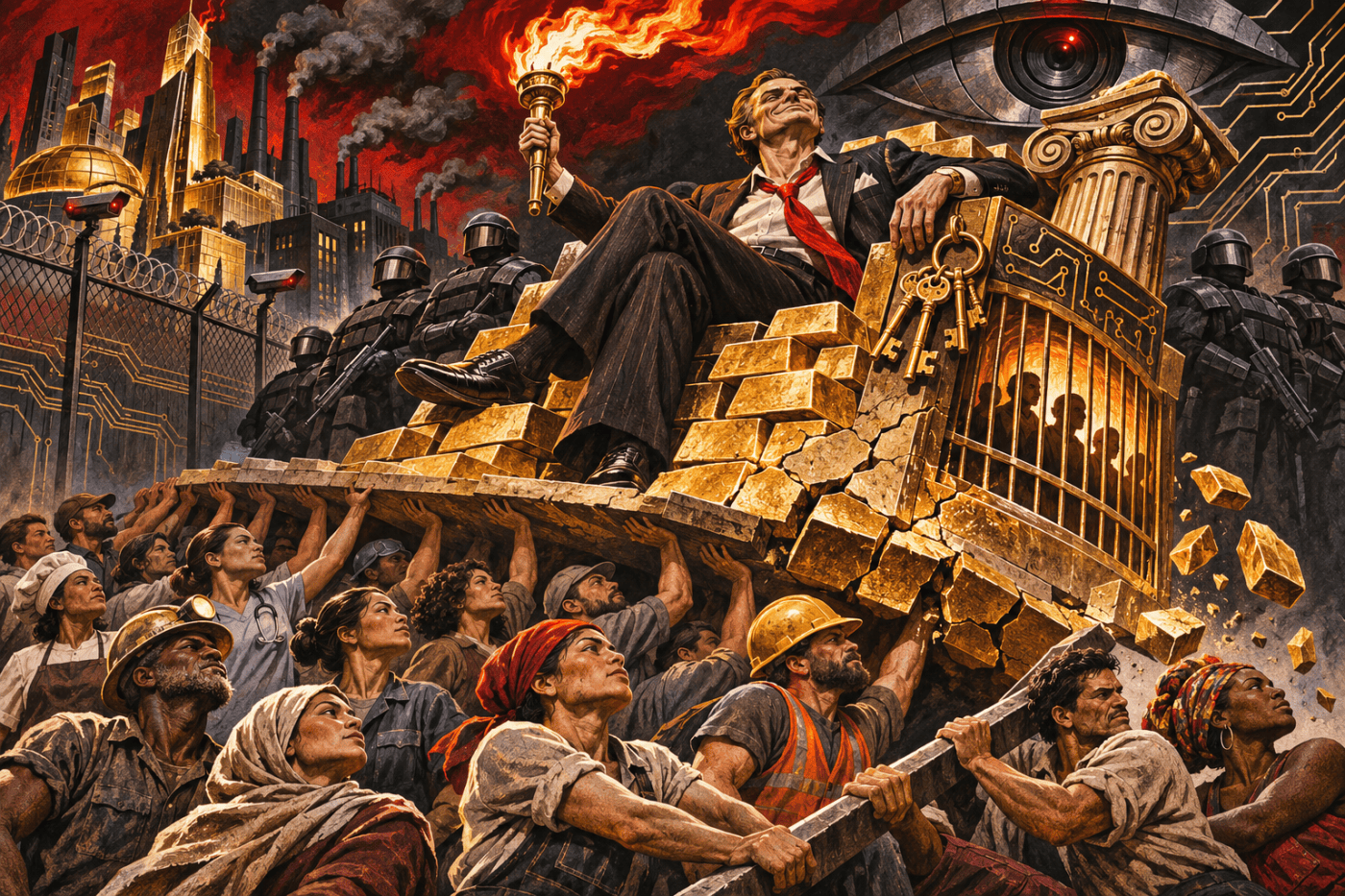
In Hayek’s Bastards, Quinn Slobodian follows the thinkers, patrons, and political operators who turned capitalist command into a cause dressed as rebellion. Race, IQ, and evolutionary stories make dispossession look deserved, while borders and private communities separate useful labor from the right to challenge its conditions. Gold promises shelter from collective demands, and the self-appointed technological aristocracy discovers that its superior intelligence needs a police force. Weaponized Information takes this history into the struggle it illuminates: who commands the wealth and capacities working people create—and how we can organize to take that command ourselves.
Prince Kapone | Weaponized Information | Weaponized Intellects Book Review | November 8, 2026
I. The Revolt That Keeps the Boss
The boss has discovered rebellion. He’s sick of the establishment, furious with the bureaucrats, and ready to tear the whole rotten system down—as soon as someone explains how to preserve his property, discipline his workers, and keep the police on call. The spectacle would be funny if working people weren’t being recruited to pay for it. Quinn Slobodian’s Hayek’s Bastards: Race, Gold, IQ, and the Capitalism of the Far Right gets beneath this performance. He follows the economists, patrons, political organizers, and professional provocateurs who’ve helped turn the defense of capitalist power into an insurgent cause. Their quarrel with the existing order concerns who commands it, which obligations owners must shoulder, and how much room remains for everyone else to fight back.
Slobodian locates their problem in the survival of demands they’d expected victory in the Cold War to bury. “Confounded by persistent demands for the redress of inequality at the expense of efficiency, stability, and order,” he writes, neoliberals turned toward nature to defend hierarchy (p. 9). Those demands had faces and organizations. Black people demanded redress. Women fought subordination. Workers expected the wealth they produced to support lives beyond exhaustion and debt. Environmental struggles challenged the supposed right to poison whatever stood between an investor and his return. For the people making these demands, freedom required changes in their conditions. For the men Slobodian follows, those changes threatened to make property answerable to people.
The historical outlook he reconstructs needs to remain visible as theirs. His references to a world in which “communism was dead” and capitalism had become “the only surviving economic system” appear within his account of the neoliberals’ predicament after the Cold War (p. 9). Read in that setting, the phrases convey the triumph they believed they’d achieved—and the puzzle of why demands for collective provision wouldn’t disappear. Their imagined victory exceeded the historical one. China, Cuba, Vietnam, Laos, and the DPRK hadn’t disappeared with the Soviet Union. Nor had workers and oppressed nations surrendered the struggle to determine their own futures. The Soviet defeat altered the balance of forces catastrophically; it didn’t turn capitalist rule into humanity’s permanent address. Slobodian’s account exposes the anxiety beneath the celebrations: even after that defeat, people kept making claims that capitalist ownership couldn’t satisfy without surrendering some of its command.
The persistence of those struggles helps explain the turn Slobodian calls “new fusionism.” Arguments drawn from psychology, evolution, and genetics supplied fresh authority for old relations of command. “New fusionism uses the language of science to justify the extension of competitive dynamics ever deeper into social life,” he writes (p. 10). The direction matters. These thinkers weren’t retreating from a society organized around competition. They wanted its judgments to reach further, into the explanation of poverty, the distribution of rights, and the limits of political possibility. A worker’s insecurity could become evidence of personal inadequacy. A demand to change the rules could become an attack on the conditions of civilization. The employer’s preferred settlement acquired the dignity of a law of life.
Turning hardship into support for that settlement takes political work. Utsa Patnaik’s account of finance and reaction identifies how contractionary policies, unemployment, and attacks on living standards prepare dangerous political ground. Anger still has to be organized and given an enemy. Someone must explain why the household can’t make rent, why the job offers less security, and why the future feels like a bill arriving before payday. Reactionary organizers enter that struggle over explanation. They offer people a target they can recognize while protecting the relations they need to confront. The immigrant, the welfare recipient, or the organized worker becomes the thief. The owner gets another chance to play the victim.
Rothbard understood that a political project needed more than a shelf of books. Slobodian describes his proposed reversal of elite persuasion: “to use the masses to disempower the elites” (p. 58). Here was a language capable of catching real fury. Yet the program depended on deciding which powers counted as the enemy. Bureaucrats, public institutions, and people receiving support could be bundled into an establishment allegedly living off the productive population. Meanwhile, the employer’s command over the working day remained a private entitlement. Workers were invited to rise against dependence by accepting deeper dependence on owners. Some fucking liberation: the people who could fire you were offering protection from the people demanding that you have rights.
Slobodian also identifies changes that helped this appeal find a hearing. He connects weakened unions, retirement tied to financial markets, and the language of “makers and takers” to a politics of individual advancement (p. 58). These arrangements shape how people experience their interests. A worker whose retirement depends on rising share prices can be pulled toward defending corporate decisions that weaken workers elsewhere—or eventually destroy their own job. Such conflicts don’t erase class. They show the work required to organize workers around their common power when even their protection against old age depends on returns from capital. Reaction exploits the fracture, promising each person a place among the winners while keeping the power to decide in the same hands.
The book’s task, Slobodian insists, isn’t “to salvage the honor of the Austrian school sages,” but to show how their ideas are adapted and weaponized (p. 17). That’s its value for revolutionary readers. It helps identify a political project beneath the costume of revolt and follow its arguments into the relations they protect. Once people demand a say over the wealth they produce, the defenders of property need more than an explanation of why the owners won yesterday. They need an argument that everyone else must remain subordinate tomorrow. History records how the advantage was acquired. Nature can be summoned to declare that nobody has the power to change it.
II. They Called the Theft Human Nature
A deed records who owns the land. It doesn’t necessarily record whose village stood there, whose crops fed its inhabitants, or whose blood settled the argument. Once possession has acquired the protection of law, the owner can appear before the world as the starting point of the story. His wealth proves his enterprise. The dispossessed family’s poverty proves its failure. Slobodian’s account of neoliberal arguments about nature exposes a similar trick performed on the scale of whole societies. Relations built through conquest, labor, and political struggle reappear as the achievements of superior cultures or the consequences of inferior people. History leaves the courtroom, and the landlord’s expert witness takes the stand: human nature.
Hayek explicitly distinguished cultural development from genetic inheritance. The process he described was “not genetic evolution of innate qualities, but cultural evolution through learning” (p. 28). Learned practices can spread between populations; they aren’t locked inside a hereditary racial boundary. That leaves a historical question his defenders can’t settle by invoking evolution: which practices prevailed, under what conditions, and with whose enforcement? Colonial authorities could impose property laws, seize land, and compel people to work within an order they hadn’t chosen. Calling the resulting order an evolutionary success doesn’t explain how it prevailed. The language of learning can conceal the difference between adopting a useful practice and submitting to institutions that have destroyed the means of living otherwise.
The difficulty becomes sharper when survival itself supplies the proof of superiority. Slobodian shows how Hayek’s account could turn the order’s capacity to sustain a growing population into a justification for its authority. On page 30, Jean-Pierre Dupuy identifies the circle: “If the greatest number becomes the criterion of truth and efficiency, then whatever evolution may do, it will always be right.” The winner’s existence becomes the explanation of why the winner deserved to prevail. We’re left with a philosophy that can admire the finished mansion without asking who laid the bricks or why the builders sleep outside. Capitalism’s enormous productive powers are real. Their existence doesn’t establish that capitalist ownership created every capacity it commands, or that those capacities couldn’t serve different ends.
Slobodian finds the strain inside Hayek’s desired society: “communal cohesion without a sense of community” (p. 30). Production requires people to cooperate, follow shared practices, and depend upon one another. Yet that dependence can also teach them to organize for purposes the owners haven’t authorized. In the workplace, the contradiction becomes concrete: workers must coordinate closely enough to keep the factory running, but apparently they’ve misunderstood civilization if they coordinate to control it. The useful community delivers the goods. The troublesome community asks who gets them. Hayek’s problem, as Slobodian reconstructs it, is how to sustain the shared practices upon which the market order depends while resisting demands to subject its outcomes to collective decision.
Some of his followers reached for more direct assistance from the animal kingdom. Gerard Radnitzky declared that property had “a genetic basis” and was respected among chimpanzees; elsewhere, he discovered an “entrepreneurial spirit” extending down to bacteria (p. 30). Apparently the microbe had been waiting all these years for someone to recognize its contribution to free enterprise. This move crossed the distinction Hayek had drawn: an argument about learned practices acquired the supposed authority of inherited behavior. But territorial behavior isn’t a land registry. An animal defending food doesn’t explain a corporation owning the means through which thousands of people must earn their living. By stretching “property” across radically different relationships, Radnitzky makes a particular human institution look like a universal requirement of life. The institution’s history vanishes inside the word.
That disappearance becomes politically vicious when the discussion turns to oppressed nations. Slobodian quotes Peter Bauer’s judgment: “What holds back many poor countries is the people who live there” (p. 79). Here the people who worked the fields, dug the mines, and supplied generations of cheap labor become the obstacle to development. The question of what happened to the wealth they produced drops away. So does the question of who controlled investment, land, trade, and the uses of public revenue. A relationship between those who accumulate and those whose labor sustains accumulation becomes a defect located inside the poorer population. The exploited are handed the bill for their exploitation and informed that their character explains the balance.
Ruth First’s study of southern African labor proceeds in the opposite direction. She examines how appropriation of better land, taxation, coercion, and the disruption of existing production helped force people into dependence on wage labor. Poverty enters that account through identifiable acts and relationships. Colonial authorities and employers helped produce the dependence from which they profited. Responsibility becomes something we can trace through control of land, demands for labor, and the enforcement of both. “The people who live there” explains nothing about why one class owns the mine while another must work underground to survive.
Bauer’s argument nevertheless offered a convenient release from precisely those questions. “Most problems besetting the poorer countries are of their own making,” Brimelow summarized on the same page. The phrase turns countries into single households, concealing the antagonism between those who profit from an arrangement and those who endure it. A plantation owner and a plantation worker become members of one supposedly deficient national personality. A foreign investor disappears from the picture altogether. What a comfortable account of the world for anyone collecting the proceeds: take the wealth, then blame the people you took it from for being broke. The people at the receiving end need instruction, discipline, perhaps better habits—anything except power over the bloody arrangements producing their deprivation.
The differences among these arguments matter because each offers a different defense against demands for change. Cultural evolution can make inherited institutions appear wiser than those who challenge them. Genetic claims can make unequal capacities appear fixed before a person ever enters a classroom or workplace. Judgments about national character can transfer responsibility from owners and rulers to entire populations. Their political force lies in how they turn the results of history into reasons to preserve them. WI’s answer begins with the people whose labor and struggle these stories erase. They haven’t merely suffered history; they’ve made it, fought its rulers, and changed its direction. Denying that power becomes easier when a judgment about their supposed limitations arrives wearing the authority of measurement. The test score promises to give inherited domination a number.
III. A Test Score for Your Place in the World
“The Bell Curve is usually engaged on the terrain of science,” Slobodian writes. “I engage it on the terrain of capitalism” (p. 100). That decision takes the argument beyond its statistical tables and into the institutions that gave it political force. Who paid for the research? Which institutions gave it standing? What changes did its authors want governments to make? A theory can remain contested among researchers while its conclusions circulate through newspapers, foundations, and legislative offices as settled wisdom. The people holding the purse strings don’t need every scientific dispute resolved before recognizing an argument that serves their purposes.
Slobodian follows the money through institutions whose names confer respectability. On page 113, he documents Charles Murray’s support from the Bradley Foundation while affiliated with the Manhattan Institute, Richard Herrnstein’s position at Harvard, and additional grants supporting their work. These arrangements supplied time, income, professional standing, and access to an audience. They helped turn an argument into a public event. The funding establishes how wealthy patrons helped particular claims acquire reach and authority; the findings still stand or fall on their evidence. The working mother blamed for depending on public support doesn’t enjoy a foundation stipend while she writes a book explaining why the foundation’s trustees deserve their fortunes.
Those relationships also connect worlds that could otherwise appear separate. Across pages 112–113, Slobodian traces support for Richard Lynn’s research from the Pioneer Fund through the Atlas Economic Research Foundation, drawing on correspondence and grant records. He also documents intermediaries’ concerns about adverse publicity. Research promoting racial hierarchy could receive assistance through organizations associated with market advocacy, while those handling the money worried about the reputation of the channel. Lynn’s work didn’t have to win universal acceptance among economists to become politically useful. Patrons and institutions could sustain it, circulate it, and put it before audiences receptive to arguments against collective provision and equality.
What changed when those classifications entered the explanation of poverty? Slobodian states the reversal precisely: “Individuals constrained previously by an external deficiency of resources were now constrained by an a priori internal deficiency” (p. 117). Follow that change through the decisions it invites. If people lack resources, there’s a fight to be had over resources. If their deprivation expresses an inherited incapacity, opponents of redistribution can dismiss the fight before it begins. Better schools, secure housing, adequate nutrition, and control over working conditions become expensive gestures against a verdict supposedly delivered before birth. The classification moves the boundary of the possible. Those demanding change are told they’ve misunderstood the people they intend to help.
That’s why the promise of simplicity carries such force. Slobodian notes that “simple” appears more than fifty times in The Bell Curve (p. 117). Complicated relations among ownership, education, employment, and income become explainable through an individual attribute. Attention shifts from employers setting wages and landlords collecting rent toward the supposed deficiencies of the person struggling to pay the bills. This explanation asks very little of those collecting the proceeds. They can acknowledge suffering, regret it sincerely, and oppose the measures through which its victims might acquire the power to change their lives. Compassion comes cheap when the diagnosis excuses you from surrendering a damn thing.
Slobodian also identifies a specific political target: affirmative action. On page 117, he connects Herrnstein and Murray’s arguments to their opposition to it, including evidence of Herrnstein’s hostility before the book’s publication. Claims about capacity entered an existing fight over access to institutions whose doors had never opened equally. Applicants demanding changes in admissions or hiring faced scrutiny over whether they possessed the required ability. Institutions distributing opportunity could defend their arrangements as the reward of performance. The examination ran in one direction. The applicant received a score, while the schools, employers, and property relations shaping the opportunity to develop those abilities escaped the same interrogation.
Equality doesn’t require identical abilities. People’s rights to food, shelter, dignity, and political power aren’t prizes awarded after an intelligence contest. Nor can an individual’s present performance tell us everything they could accomplish under different social arrangements. In his critique of biological determinism, Richard Lewontin explains how collective organization changes human capacities. Human beings fly through the accumulated work of science, engineering, production, and coordination, despite lacking wings. That example cuts beneath the ranking game. Social cooperation doesn’t merely distribute the abilities people already possess; it makes new abilities possible.
The scientist at a laboratory bench depends on people who manufacture instruments, maintain electricity, clean rooms, transport supplies, and teach the next generation. Scientific skill develops and operates through that cooperation. The claim to self-created superiority erases it. The same society that celebrates the brilliant individual routinely pushes the labor sustaining that brilliance out of sight. Slobodian’s account of the knowledge economy on page 126 brings this problem into focus: intelligence becomes a supposed explanation of economic success just as knowledge becomes a prized source of competitive advantage. Owners and highly rewarded professionals can imagine themselves as humanity’s brain while treating the people who sustain their institutions as an unfortunate maintenance expense.
Slobodian gives the resulting classification its sharpest name: “IQ as a biologized credit score” (p. 126). A single number offers the appearance of a clean decision. Behind it disappear the questions of what was measured, under which conditions, and whether the measurement warrants the use now being made of it. The number travels more easily than the qualifications. Advocates can use it as shorthand for an entire person, then a population, then the limits of a society’s future. A contested account of performance becomes an apparent permission slip for withholding opportunity. Those whose lives will be narrowed by the judgment don’t get to negotiate the terms of the examination. They’re expected to recognize their place.
Turning a ranking into a program of rule still requires political choices. “The neurocaste is an epistemology in search of a philosophy of governance,” Slobodian writes, before contrasting Lynn’s interventionism with Murray’s libertarianism (p. 122). In plain language, a scheme for sorting people still needs a scheme for ruling them. Lynn’s approach calls upon the state to shape the population. Murray’s points toward withdrawing collective provision and leaving needs to local arrangements that may or may not meet them. One demands intervention; the other demands withdrawal from particular social obligations. Both make alleged differences in capacity grounds for deciding what people should receive and what power they should possess. Their differences determine the institutions through which that judgment would operate.
Researchers and activists had organized against this political use of science well before The Bell Curve became a publishing event. A 1976 report in Science for the People describes a 1975 gathering challenging biological explanations of poverty, racial inequality, and women’s subordination. Their work joined criticism of the evidence to criticism of its political use. That remains the task: examine the claims, identify the institutions advancing them, and contest the decisions they’re used to justify. Scientific inquiry gains nothing from accepting the rotten proposition that a person’s place in humanity depends on satisfying the people who already command its wealth.
Slobodian’s chapter exposes the organized work behind the apparently impersonal verdict. Patrons finance research, institutions confer authority, and publications carry judgments into public life, where political actors turn them into arguments about provision, opportunity, and rights. The classification becomes powerful through those decisions. Calling it realism doesn’t make it less brutal: people are told to accept a future somebody else has already budgeted for them. At the border, the same promise of measuring human worth acquires another use. Employers and governments can demand the labor they consider valuable while withholding the rights that would let those workers challenge the terms.
IV. Your Labor May Enter. Your Rights May Not.
Once people have been assigned an economic worth, the border offers a place to judge their usefulness. Slobodian ends his discussion of immigration with a revealing convergence. Opponents of Peter Brimelow’s racial nationalism could challenge his preferred admissions policy while retaining economic usefulness as their measure. The alternative, Slobodian writes, was “the selection of immigrants according to their economic utility, regardless of cultural background” (p. 91). The disagreement concerned which people would make the best investment. The prospective immigrant stood before competing recruitment officers, one inspecting ancestry, another estimating productivity. The selection criteria changed. The person being evaluated still appeared chiefly as an input into somebody else’s economy.
Slobodian recounts a challenge to Brimelow’s preference for English over Zulu immigrants: what if the English arrivals were thugs and the Zulu arrivals were doctoral candidates in computer science? (p. 91). The question punctures the racial presumption by showing how ancestry can conflict with the economic advantage these thinkers claim to defend. Admission under the alternative rule could transform someone’s life. But the argument wins that opening by presenting a more desirable recruit. The credential does the work. Whoever lacks it remains outside the exchange, waiting for someone to discover a sufficiently lucrative use for their existence. The employer’s preference acquires the dignity of a judgment about who deserves to enter.
Brimelow widened the calculation. “The free market necessarily exists within a societal framework,” he argued, suggesting that “ethnic and cultural coherence” might belong among its necessary conditions (p. 83). His term was the “metamarket”: the social arrangements he believed markets required. An immigrant might supply valuable labor and still be judged a threat to those arrangements. Brimelow’s argument therefore puts limits on the employer’s immediate calculation: hiring a productive worker could supposedly undermine the wider order protecting property. That opens a political question his language of coherence tries to settle in advance. Newcomers can claim services, organize, and join struggles over the society their work sustains. Their usefulness to an employer doesn’t exhaust the consequences of their presence.
On page 124, Slobodian describes Thilo Sarrazin and Erich Weede defending international trade and investment while demanding restrictions on immigration. His summary is blunt: “People must remain fixed so that capital and goods could be free.” Freedom here belongs to particular movements across the earth. Goods may travel toward buyers; investment may travel toward returns. Workers face restrictions that capital’s defenders celebrate removing from investment. The people whose labor enters the international economy aren’t thereby entitled to move through it on comparable terms. The border separates more than territories. It separates permissions, granting owners access to labor and markets while limiting workers’ access to the places where wealth accumulates.
Capitalists can also demand that workers move, sometimes over enormous distances, while opposing their freedom to settle, organize, or determine the terms of employment. Their competing proposals reveal different ways of securing command over labor: exclusion in one case, selective recruitment in another. Employers may need the worker’s presence without accepting the worker’s claim to equal standing. Being indispensable to production offers no guarantee of protection for the person who produces. A recruitment system can cross borders efficiently while keeping those recruited dependent. The labor arrives; the power to decide its conditions remains elsewhere.
Ruth First’s study of Mozambican miners gives that distinction a concrete history. South African mining companies drew workers from the surrounding region through concentrated recruitment and agreements between states. Rural production supplied part of what workers and their families needed to live, allowing the mining industry to avoid bearing the full costs of sustaining its labor force. Movement served the mines, while households elsewhere carried part of the cost of making that movement possible. First explains why an economy organized through racial domination could actively import African labor. Recruitment and exclusion from equal standing worked together: the industry needed workers without assuming responsibility for the full lives of the people it employed.
That history changes the question we ask of the border. Counting entries and exits won’t tell us who commands the relationship. Can workers leave an employer without losing their right to remain? Can families stay together? Can workers organize without giving the boss another means to threaten them? Does the wealth their labor creates sustain their lives, or must households elsewhere absorb the costs? These questions expose what disappears when immigration becomes a contest between national generosity and national selfishness. An employer can welcome a worker’s arrival and fight every measure that would strengthen that worker’s position. The welcome mat can lead straight to the service entrance.
The same attention to class power must govern how we understand national boundaries. An oppressed nation defending its land, resources, and development against imperial command confronts a different struggle from a wealthy ruling class selecting useful labor while protecting accumulated privilege. Who controls investment, who commands production, and who bears the costs give a boundary its political meaning. The phrase “national interest” can conceal those conflicts by asking workers to imagine that the employer’s profits and their families’ survival always require the same choices. National liberation challenges external command; employers can invoke the nation to defend their command over workers. The flag alone won’t tell us which struggle we’re looking at.
Slobodian’s evidence shows defenders of capitalism arguing over how to maintain the social order on which their preferred freedoms depend. Brimelow makes cultural cohesion a condition of market stability. Advocates of “designer immigration” select for economic utility. Both approaches place the authority to judge the newcomer elsewhere. Yet workers don’t arrive with a fixed quantity of usable skill packed beside their belongings. They form relationships, develop capacities, raise children, and organize. The person recruited to fill a vacancy can join others in challenging wages, housing conditions, or political exclusion. Employers acquire labor without acquiring complete command over the human beings who perform it. That’s the contradiction no admissions formula can finally resolve.
A working-class answer builds solidarity across the divisions employers and states use to price and discipline labor. It confronts the attempt to make one group’s insecurity another group’s fault, while rejecting the pleasant bullshit that treats circulation alone as freedom. A person can cross an ocean and remain trapped in dependence. Collective organization gives workers the means to contest that dependence wherever they live. The border arguments in this book show property’s defenders trying to separate economic participation from political standing: work here, produce here, but accept that others decide the terms. That principle can travel beyond the frontier. Once participation confers no independent claim to a voice, owners can ask why anyone’s rights should extend beyond the conditions attached to their permission to stay.
V. The Landlord Takes the Ballot
“Citizenship would be replaced by ownership,” Slobodian writes of the society Murray Rothbard and Lew Rockwell wanted to build (p. 52). Ownership wouldn’t merely buy greater influence over government, as wealth already does. It would become the basis on which governing rights were assigned. Rothbard imagined privatized land and streets organized through contracts among owners, with access purchased rather than secured through citizenship. The person who lives somewhere, works there, and helps sustain its collective life would possess no automatic claim to decide how it’s governed. The deed would carry the authority. Everyone else would have to negotiate with whoever held it.
Rothbard was explicit about where that left the ballot. “The voting process should be considered trivial and unimportant at best, and never a ‘right,’” except where it followed from an agreed contract (p. 52). Slobodian identifies the preferred model: a shareholders’ meeting, where a larger ownership stake brings more votes. Applied to the government of a community, this arrangement turns accumulated wealth into an entitlement to greater command. You could spend your life maintaining the place and still count for less than an investor who’d never set foot in it. The investor’s money would speak with authority; your presence would establish only that you’d been permitted to stay.
This gives privatization a meaning beyond selling a public building or contracting out a service. It places decisions about collective life within relationships where owners issue terms and others seek access. Streets matter here. A street connects homes, workplaces, meeting places, and the routes through which people organize a common existence. If every street becomes someone’s property, its use becomes another question for the proprietor. Freedom of assembly starts to look like an application to management. Abolishing public authority wouldn’t make these decisions disappear. It would place them in hands whose claim to rule arose from possession, with obligations defined by property and contract rather than equal political membership.
The contract supplies the appearance of consent. Sign here, accept the conditions, enter voluntarily. But a signature can’t tell us what power each party possesses or what alternatives exist beyond the paper. A worker needing somewhere to live faces a different decision from an owner choosing which tenants to admit. Calling both parties free doesn’t erase that difference. Nor does the possibility of departure settle it. Leaving can mean losing employment, severing relationships, disrupting children’s lives, and finding the money to begin again. Where owners control admission and renewal, residents must calculate what challenging them could cost. Apparently freedom is abundant, provided you can afford the moving truck.
Hans-Hermann Hoppe made the authority behind these arrangements unmistakable. Slobodian quotes his defense of private property as a right to “expulsion, exclusivity, discrimination and ostracism” (p. 149). Here the pleasant language of voluntary association gives way to the proprietor’s power to remove. Hoppe’s examples include discrimination against Black people, gay people, and communists. These examples reveal what his principle authorizes: owners could make access to housing and community life depend on racial exclusion, sexual conformity, or political obedience. The question concerns the power to decide who can inhabit the spaces on which ordinary life depends. Calling that decision a private preference doesn’t make its consequences private.
Hoppe’s appeal to property prices exposes how readily an existing injustice can manufacture its own justification. He argues that white owners act economically rationally when they discriminate because the arrival of Black residents reduces property values (p. 149). His reasoning turns racist expectations into instructions for owners. If prospective buyers devalue a neighborhood because Black people live there, their prejudice supplies the financial justification for excluding Black residents. Owners can then enforce racial domination while announcing that they’re merely protecting an investment. The racial order reproduces itself under the respectable heading of asset management. The price becomes an alibi for the practice that produced it.
Communists present a particularly revealing case. A movement demanding collective control over property would threaten the governing principle of the entire arrangement. Expelling its organizers could therefore be defended as an exercise of the very rights they challenged. Hoppe’s proposed communities, owned by developers and occupied by tenants, would give that conflict a direct institutional form. Slobodian quotes his dismissal of the consequences: “Certain forms of behavior, even when they are non-aggressive,” “lead to expulsion and into the ghetto. So what?” (p. 149). There’s the answer waiting beneath the contract. Peaceful conduct offers no protection when the proprietor claims the right to exclude. Your freedom to disagree lasts until the disagreement threatens the owner’s terms.
Hoppe’s willingness to enlist force also appears in his treatment of political opponents outside these proposed communities. Slobodian records his demand that public anger be mobilized against antifa so that police would be “unleashed” and the movement “beaten into submission” (p. 64). The advocate of proprietary freedom calls on public coercive power when antifascists become the target. This gives the argument a named actor, an identified enemy, and an institution expected to do the beating. It also exposes what the celebration of voluntary arrangements leaves unresolved: who enforces the owner’s command when people refuse it? Someone must carry out an eviction, prevent a return, or suppress resistance. A private uniform doesn’t turn an eviction into a philosophical discussion, and a public uniform doesn’t trouble this libertarian when it’s swinging at his enemies.
Against this arrangement stands a different basis for political authority: the organized demands of people who live and work together. Ruth First’s account of the South African liberation struggle describes the Freedom Charter emerging through meetings in villages, factories, mines, and townships. People gathered grievances, formulated demands, and elected delegates. The government answered their organizing with repression. These were people asserting authority over the country their labor sustained, against a state that denied the majority that authority. They made ownership and the right to govern subjects of collective struggle. No proprietor had authorized the demand, and no proprietor’s permission could settle it.
The ballot opens a field of struggle; workers still have to contest the ownership and command of production. Rothbard’s proposal would make that struggle answerable to the owners from the outset, distributing political voice through the unequal property holdings people might otherwise organize to challenge. That’s the bloody point. The landlord’s terms become the constitution, and the propertyless are invited to admire their freedom to leave. Slobodian exposes an ambition to protect ownership by stripping political membership of its independent standing. That ambition also extends beyond proposed private communities. Owners seeking insulation from popular demands confront governments that can still tax, spend, and place claims upon accumulated wealth. The search for protection leads from the deed to the vault.
VI. Their Safe Haven Is Someone Else’s Ruin
The catastrophe arrives with an investment opportunity. On page 131, Slobodian describes libertarians who imagined buying a block of Manhattan with a twenty-dollar gold piece after the monetary system collapsed. They welcomed the prospect of an emergency that would transfer extraordinary purchasing power into their hands. A society’s disaster could become an owner’s clearance sale. The families losing homes, wages, and savings supplied the conditions of someone else’s bargain. Slobodian identifies the twin attractions as “the vindication of winning an argument and the payday of economic enrichment.” The prophet would be proved right, and the people who hadn’t listened would discover that their misfortune had become his purchasing opportunity.
Workers have every reason to fear the destruction of their savings. A lifetime of putting something aside can disappear much faster than it accumulated. The fantasy Slobodian describes turns unequal preparation into a claim on the wreckage. Those with resources can purchase protection before the crisis; those already struggling must meet today’s expenses. When the collapse comes, their different positions can be presented as evidence of foresight and foolishness. The wealthy survivor gets to admire his judgment while acquiring what other people can no longer keep. His advantage began before the emergency, in the resources that allowed him to prepare. The story of superior judgment erases that starting point.
The gold business can profit before any predicted collapse occurs. Fear creates demand in the present. Slobodian’s account of the AfD’s gold sales shows a political organization joining its warnings about monetary danger to a product promising protection. The party could denounce the euro while selling supporters an asset presented as security against its failure. “Party identification was transmuted into speculation in precious metals,” he writes (p. 153). Supporters were purchasing something whose promised value appeared to confirm their political judgment. The transaction joined conviction to a financial stake. A sales receipt could become reassurance that the buyer understood the world more clearly than the people still trusting its institutions.
The connection between doctrine and commerce also ran through employment and publicity. Slobodian follows the people around Degussa’s bullion business, while German antifascist reporting documented overlapping personnel, premises, and publishing relationships around the company and the German Mises Institute. These relationships gave monetary arguments a commercial channel: organizations warning about currency collapse operated alongside a business selling protection against it. An economist’s warning could educate a political audience and recruit customers through the same appearance. The company had a product to sell, and the doctrine supplied reasons to buy it. That connection explains how the argument could sustain an operation before its promised catastrophe ever arrived.
Gold’s political authority in this world rests partly on the promise that its supply escapes government discretion. Governments can issue currency, but they can’t issue an unlimited supply of metal. The vault appears to offer shelter from political decisions. Yet Slobodian’s discussion of Mises exposes the purpose beneath the attachment to the substance. What mattered was gold’s ability to restrain government spending; if its supply could expand without limit, another standard would have to replace it (p. 162). The requirement was discipline. A monetary arrangement should make certain public choices harder to pursue. The appeal to nature supplied authority for a political objective: limit what governments could do in response to collective demands.
The costs of that discipline don’t fall evenly. Utsa Patnaik’s account of financial power and austerity examines the preference for controlling inflation through contraction, with pressure falling on employment and mass purchasing power. Her argument identifies the class conflict concealed when monetary restraint becomes a virtue in itself. Creditors seek protection for the value of their claims. Workers need wages, employment, and public provision. Policies that suppress demand can defend the former by squeezing the latter. “Soundness” then describes whose security receives priority. The money is pronounced healthy while people depending on wages are told to tighten a belt that’s already cutting into them.
Markus Krall’s proposed political settlement makes the division explicit. Slobodian records his demand that recipients of government assistance surrender their voting rights, including students receiving grants, people relying on welfare, and businesses receiving subsidies (p. 160). The rule would reach subsidized businesses, but the cost of refusing assistance would remain radically unequal. Someone with ample private resources could preserve a political voice without sacrificing necessities; someone who needed support would face a choice between meeting those needs and participating. Krall turns receipt of assistance into grounds for political exclusion. The person needing help must prove independence by refusing it. Apparently hunger can administer the citizenship examination.
That proposal seeks to weaken the political power of people whose needs might become demands on public resources. In the same discussion, Slobodian describes Thorsten Polleit welcoming collapse as an opening for rebuilding the economy around sound money (p. 160). Disaster becomes a political opportunity as well as a market opportunity. The institutions people rely on would be weakened, while advocates of monetary discipline would arrive with a program for reconstruction. The fantasy treats the ruins as a fresh beginning, concealing the unequal resources carried into it. Those able to protect their holdings would have both purchasing power and a doctrine explaining why everyone else should accept their terms.
On page 162, Slobodian gives this politics its international reach: governments would face “the continual audit of asset-holders with the ability to move.” Owners able to withdraw assets can pressure governments concerned about investment, revenue, and access to finance. Workers whose homes, relationships, and livelihoods are rooted in a place can’t necessarily answer with a comparable threat. A policy supported by a population can face punishment through investment decisions made elsewhere. Asset holders don’t have to persuade every voter. Their capacity to leave can help determine which proposals officials treat as affordable before the population gets to decide. The creditor acquires a veto without the inconvenience of standing for election.
The political meaning lies in those relationships, not in the metal itself. An oppressed nation protecting reserves from imperial seizure seeks to defend its capacity to act against external command. The goldbugs examined here seek monetary arrangements that strengthen owners against collective claims on wealth. A household preserving its savings raises another question again: how people protect what they need to live. Ownership, purpose, and the power secured by the arrangement distinguish these cases. Slobodian’s subjects make their project visible where protection for assets joins restrictions on public authority and political participation. The advertised escape is personal. The discipline they seek to impose reaches everyone.
The safe haven becomes a program for making other people bear the costs of security. In the project Slobodian reconstructs, owners protect their holdings through restraints that can intensify unemployment, undermine provision, and exclude recipients of assistance from political life. Its fantasy of collapse ends with the prepared acquiring the possessions of the desperate and calling the result justice. That’s a hell of a rescue plan: the lifeboat comes equipped with an auctioneer. Yet assets stored beyond immediate reach don’t enforce their own claims. Ownership still requires institutions that uphold it, officials who implement restrictions, and force against those who refuse the settlement. The vault promises distance from social conflict. The owners’ order still needs power over those left outside it.
VII. The Genius Wants a Police Force
The self-appointed genius eventually encounters a problem his intelligence can’t solve: other people won’t accept his right to rule them. They organize, demand services, challenge discrimination, and insist that the society they sustain belongs to them too. At that point, the argument about superior minds becomes a question of force. Slobodian’s conclusion follows this turn through Curtis Yarvin’s proposal to exclude people with an IQ below 120 from voting in South Africa (p. 173). The ranking becomes a qualification for political membership. Those excluded wouldn’t merely receive fewer rewards in a competition. They’d lose the power to contest the rules under which the winners govern.
A score that supposedly measures capacity becomes permission to command. The enormous leap between those propositions disappears beneath the prestige of the test. Even a demonstrated ability to solve a particular problem wouldn’t establish a right to determine another person’s living conditions. Yet the imagined cognitive aristocracy treats participation by the people it ranks beneath itself as an obstruction. Their demands interfere with the superior order its members believe they could build. Democracy becomes intolerable precisely where it allows people without the approved credentials to challenge those who possess them. The genius wants an audience that can’t answer back.
Peter Thiel’s endorsement of Richard Hanania’s book makes the appetite for force explicit: “DEI will never d-i-e from words alone—Hanania shows we need the sticks and stones of government violence to exorcise the diversity demon” (p. 174). Corporate diversity programs can leave the employer’s command intact; workers have ample reason to challenge that arrangement. Thiel’s endorsement supplies another answer: enlist the state’s violence against the programs themselves. Employees acquire no greater authority over hiring, promotion, or production through the demand he celebrates. The owner calls for coercive power to defeat arrangements he despises. So much for the marketplace of ideas. Apparently it needs an armed supervisor when the customers choose incorrectly.
The claim to superior achievement also conceals the conditions that made achievement possible. Slobodian places technological fortunes within the financial environment that helped sustain them (p. 174). Individual ability operates through institutions, labor, and resources; it can’t explain those conditions away. The person who owns a platform didn’t personally produce every capacity it contains. Yet ownership lets that person claim authority over the collective achievement and dismiss resistance as resentment of excellence. Society supplies the conditions; the owner invoices society for dependence on his genius. The same appropriation occurs twice: first in the ownership of the product, then in the story of who deserves credit for creating it.
Yarvin’s imagined “Friscorp” carries this contempt into a proposal for governing people declared unproductive. Slobodian recounts his suggestion that they could be permanently confined and supplied with an immersive virtual world (p. 175). In this speculative city, the people being confined have no say over the judgment or their treatment. Their existence appears as a burden for rulers to administer. Technology promises to make captivity tolerable while the proprietors retain command over the world outside. The proposal reveals what happens when the authority to judge usefulness includes the authority to dispose of those who fail the test.
The captive receives experiences; the proprietor retains power. Technological comfort softens the presentation of a relationship built on a locked door. Yarvin imagines removing potential opponents from political life while managing their needs without their participation. That’s the obscenity: society’s productive capacities become means of neutralizing people whom its rulers refuse to recognize as equals. The promise of limitless technological possibility ends in permanent subordination. His fantasy supplies an image of the desired order, while the material question concerns how owners and state institutions acquire powers to classify populations and act upon those classifications.
WI’s theory of technofascism locates that question within monopoly capital’s response to imperial crisis. The state organizes privately owned technological capacity through procurement, investment, and security institutions, strengthening military command, labor discipline, and the administration of unequal claims to protection. Owners retain profits and proprietary control as public agencies acquire new means to identify, classify, and act upon people. Tricontinental’s account of corporate power identifies Palantir’s military work alongside its role in developing ImmigrationOS for U.S. immigration enforcement. That relationship gives the review a concrete point of contact with WI’s framework: a private company supplies systems used in coercive state functions. Slobodian traces arguments legitimizing unequal command; WI directs attention to the institutions building and operating its technological means. Connecting them requires examining those relationships, rather than treating an ideological fantasy as the blueprint behind every contract.
Software, technical support, accumulated information, and operating procedures can give a company a durable position inside public institutions. Agencies purchase capacity; the supplier gains revenue and an entrenched role in how that capacity functions. The state remains an organizer and user of coercive power, while private owners accumulate through its expansion. A system’s technical efficiency therefore tells us little about whether its purpose serves the people subjected to it. Better engineering can make a repressive operation more effective. The question reaches the officials issuing orders, the firms supplying the means, and the political decisions that turn a person into a target. An elegant interface doesn’t make the order behind it any less brutal.
Workers are confronting these connections through institutions they know from the inside. Nurses’ protests against Palantir, organized by National Nurses United in August 2026, brought together concerns about healthcare, immigration enforcement, and pension investment. The actions described in this socialist reporting made procurement and investment subjects of organized struggle. Nurses challenged the separation of corporate business lines that their patients’ lives continually crossed. The patient frightened by an immigration raid is still a patient. The worker’s retirement fund is still accumulated labor. What appears on one desk as a contract and on another as a portfolio holding enters a shared world where people can recognize the connection and fight over it.
Those nurses expose the weakness in the fantasy of government by superior minds. People classified as expenses, users, or cases can organize through the very institutions that depend on their labor. They can contest what gets purchased, how their savings are invested, and whose purposes technology serves. Slobodian’s final pages reveal a ruling ambition that would deny them that authority while appropriating society’s knowledge and productive strength. The genius wants the people’s work without their interference. His problem is that the people keep turning up with demands of their own—and no fucking test score can settle the struggle over who should command the world they’ve made.
VIII. We Make the World. We Can Take Command.
Slobodian’s conclusion names the enemy with a precision that much commentary on the far right avoids. These supposed rebels are often “agents less of a backlash against global capitalism than a frontlash within it” (p. 176). The distinction changes what fighting them requires. Their project advances the owners’ command over work, resources, and political life. Defeating an immediate attack or driving its spokesman from office can protect lives and preserve room to organize. But the powers to withhold investment, close workplaces, and make survival depend on obedience remain available for another offensive. The ruling class can replace a spokesman more easily than workers can replace a lost livelihood.
The book’s account of Javier Milei’s reception at Davos makes the relationship visible. Denouncing an assortment of supposed collectivists, Milei reserved his praise for the wealthy before him: “You are the true protagonists of this story,” he declared. “You are heroes” (p. 176). There’s the audience to whom the insurgent reports for duty. The people who produce the wealth disappear behind the people who own it. The worker endures the adjustment; the proprietor receives the ovation. Milei gives theatrical form to a class demand: remove the protections that obstruct employers, weaken the organizations that resist them, and call the resulting freedom universal. The chainsaw has a handle, and somebody gets to hold it.
The Argentine CTA’s analysis of labor restructuring identifies what that freedom means at work. It connects changes benefiting employers to attacks on collective action and intensified workplace discipline. The dispute concerns who can determine the working day, contest a dismissal, defend an agreement, and refuse conditions that damage a life. An employer’s expanded discretion becomes someone else’s reduced ability to say no. Bargaining and strike rights matter because workers can use them to interrupt decisions management would otherwise impose. What Davos applauds as liberation, workers encounter as a struggle over how much of their lives the boss can command.
Slobodian offers another formulation on page 169: the far right can be understood as “an investment strategy in a world of unequally distributed assets.” His account of a flight to safety explains the promise made to people who fear losing their position. Protection comes through defending what they own, securing an advantage, or withdrawing behind barriers against those presented as threats. The promise recruits people with unequal resources into a project that preserves the authority of ownership. It can offer reassurance to participants while leaving the production of insecurity untouched. The collective alternative must therefore change both who commands society’s resources and what people can count on when an employer, creditor, or landlord says no.
That struggle begins wherever people build an enforceable claim upon the means of life. Unions can contest the employer’s control of wages, time, and conditions. Tenant organizations can challenge the landlord’s power to turn housing into a threat. Universal public provision can keep illness or unemployment from becoming an immediate sentence of deprivation. Socialist construction carries these struggles into ownership and the direction of production: what gets built, whose needs receive resources, and who decides. Its promise requires institutions through which working people can exercise authority over those decisions. Changing the name above the office door won’t place the office under their command.
The work of sustaining life belongs inside that struggle. On page 175, Slobodian places Milei’s opposition to abortion alongside his proclaimed defense of freedom and property, while recalling the long mobilization through which abortion was legalized in Argentina. Women appear as an organized force that changed the conditions of their lives and confronted efforts to reverse that victory. Their authority over their bodies can’t be surrendered to calculations about how many future workers an economy needs. Collective command over production must include freedom from compulsory pregnancy and the shared provision of care. Otherwise, the people reproducing society remain subject to commands that the language of emancipation leaves standing.
For oppressed nations, command over the means of life also requires confronting imperial power over land, finance, technology, and the destination of the wealth their workers produce. Independence opens a struggle over what national resources will serve and which classes will direct them. WI joins the defense of national sovereignty to the fight for workers and peasants to shape that development. Workers in the imperial centers have obligations within the same struggle: oppose the wars, sanctions, and coercive institutions that enforce their ruling classes’ claims abroad. Security purchased through another people’s subordination ties workers to the owners whose power they need to break.
This is where Slobodian’s achievement becomes useful beyond exposure. His research identifies people, arguments, patrons, and projects that the public performance of rebellion conceals. It shows how defenses of unequal command are financed, adapted, and put into circulation. Revolutionary readers can use that knowledge to recognize what an attack seeks to accomplish and which institutions give it force. The book supplies a history of the enemy’s organizing; it doesn’t supply a strategy for transferring power to those the enemy would subordinate. That further task belongs to movements rooted in workplaces, communities, and struggles against imperial rule, where people can develop the capacity to act together and sustain it beyond a single confrontation.
A more respectable ruling class offers no substitute. Its polite defenders may recoil from the language of the men Slobodian follows while protecting the ownership through which those men expect to rule. Working people need organizations able to survive retaliation, political education that makes their circumstances intelligible, and institutions through which they can make and enforce collective decisions. They need the resources and solidarity to withstand the employer’s threat, the landlord’s notice, and the state’s repression. That’s harder work than applauding a clever denunciation. It’s also where the ruling class’s claim to superior capacity encounters people learning to govern through the struggle against it.
Hayek’s Bastards helps us see why that capacity draws such determined hostility. Its subjects seek to turn wealth into political entitlement and judgments about human difference into limits on what people may demand. Their doctrines meet a contradiction they can’t settle: the people expected to obey sustain the world the owners claim. Dependence on their labor creates openings for struggle, although victory requires organization strong enough to use them. No deed, test score, or bullion receipt settles who should command society’s accumulated powers. The owners’ answer is to make their advantage permanent. Ours must be to place those powers under the collective authority of the people who create and sustain them. We make the world. We don’t owe its owners a goddamn eternity.


Leave a Reply