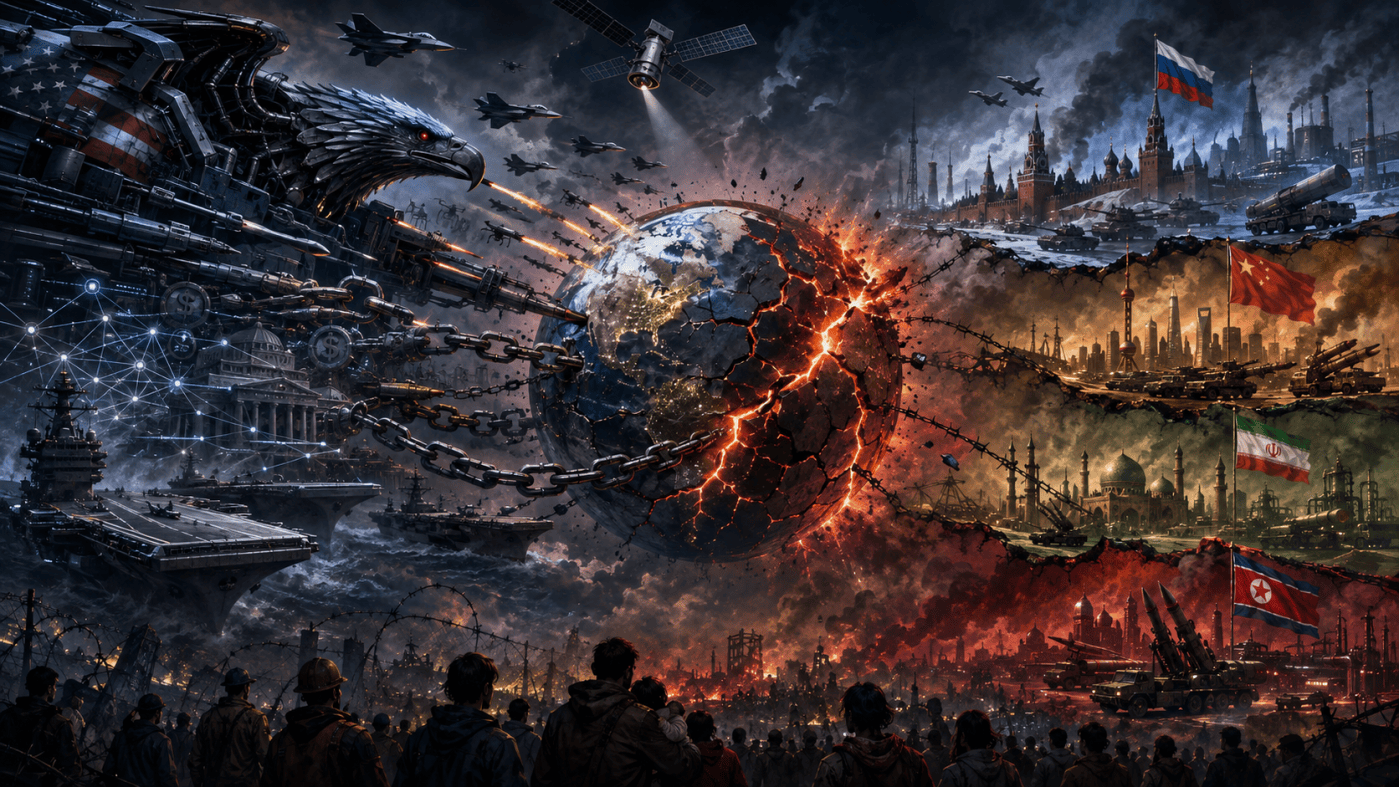
The Hill blames Russia, China, Iran and the DPRK for pushing the world toward World War III. The historical record shows decades of U.S. military expansion, regime change, sanctions and coercion helped produce the very counter-alignment now being called an authoritarian axis. As the New Cold War intensifies, those pressures and responses are increasingly binding separate conflicts into one dangerous global confrontation. The task is to expose that causal inversion and organize against the war machinery driving the escalation.
Prince Kapone | Weaponized Information
August 11, 2026
The Empire Discovers the War It Has Been Manufacturing
Joseph Bosco opens his August 11 Hill column, “World War III is already here, and Trump must rise to the challenge,” with the sort of sentence designed to make history surrender before the argument has even begun: “The early stages of what could become World War III are already upon us.” From there, the reader is marched backward to 1917, where the Russian Revolution is cast as the opening shot in a century-long struggle between American democracy and an apparently hereditary disease called authoritarianism. Lenin becomes Stalin, Stalin becomes Mao, Mao becomes Kim Il-sung, and by the time Bosco reaches Putin, Xi Jinping and Kim Jong-un, history has been flattened into a police lineup. Iran is simply added to the photograph. Different revolutions, states, social systems, wars, national questions and historical epochs are dissolved into one convenient enemy personality.
The trick is not that Bosco invents every conflict he mentions. Russia is at war. China is confronting the United States across an increasingly militarized Pacific. The DPRK has deepened military cooperation with Moscow. Iran is fighting the United States directly. The propaganda lies in the arrangement. Bosco places every movement by Washington’s adversaries in the foreground while leaving the machinery surrounding them outside the frame. Russia “seizes.” Iran “takes on” America. North Korea possesses a “perennial lust” for conquest. China waits to absorb Taiwan into an empire. The United States, meanwhile, simply appears—already standing there, immaculate and bewildered, defending “the free world” from a collection of inexplicably hostile foreigners.
That innocence has to be manufactured, so language does much of the heavy lifting. Governments Washington opposes become “tyrannies,” their leaders “deranged,” their cooperation an “authoritarian cabal,” their objectives expansionist almost by definition. By contrast, America possesses allies, partners, democratic values and a “U.S.-led international order.” Israel is inserted among the democracies requiring defense without Palestine appearing as a political subject at all. American power is treated not as a force acting upon the world but as the natural atmosphere through which everybody else moves.
The final maneuver is the most dangerous. After announcing that World War III has effectively begun, Bosco uses the emergency he has rhetorically constructed to launder the very policies capable of widening it. Trump must strengthen commitments from Ukraine to Taiwan, Japan, South Korea and Israel; Washington must confront the “hydra-headed challenge”; and, most revealingly, the administration must devise “the most prudent and effective way” to impose regime change on Iran. Once the empire declares itself already under attack, escalation becomes defense, intervention becomes prudence, and regime change becomes peace through strength.
This is the ideological work of the article. Bosco does not merely describe an emerging bloc confrontation. He supplies it with a morality play in which Washington can have power without history, armies without aggression, alliances without expansion and enemies without grievances. The central question his article cannot permit is therefore the one this excavation must recover: what happened before the so-called authoritarian axis began moving closer together?
The History Bosco Has to Cut Away
Bosco’s “authoritarian axis” begins from something real: Russia, China, Iran and the DPRK are drawing closer. But the relationships he compresses into one ideological bloc are materially different. Russia and the DPRK have a treaty providing immediate military assistance if either is attacked. The Iran-Russia strategic treaty combines defense cooperation with banking, energy, transport and national-currency settlement. China and Russia, meanwhile, have built a much larger economic relationship, with bilateral trade above $200 billion for the third consecutive year in 2025. Bosco is looking at a genuine convergence, but calling it one authoritarian military axis conceals more than it explains.
Take Russia. Bosco says Putin seized territory in Georgia, devastated Ukraine and now seeks to reconstruct a Russian empire. What disappears is the movement of NATO through the same post-Soviet space. In 2008, NATO formally declared that Ukraine and Georgia “will become members of NATO”. By July 2026, the alliance was committing €70 billion in military equipment, assistance and training to Ukraine for the year. Russian actions remain Russian actions. But they did not unfold outside an expanding Western military system. Bosco removes that system and then presents Moscow’s response to the altered security environment as though it arose entirely from Putin’s appetite.
The same trick is sharper with Iran. Bosco says Tehran has “directly taken on the U.S.” while the United States itself is openly waging war against Iran. Operation Epic Fury began on March 1, 2026, targeting Iranian missile forces, naval capabilities and regional military networks. Bosco then recommends regime change in Tehran without mentioning that declassified U.S. records document the planning and execution of Operation TPAJAX, the 1953 overthrow of Prime Minister Mohammad Mossadegh. The policy he offers as the cure for Iranian hostility is already part of the history that produced it.
With the DPRK, Bosco points to troops, missiles and a supposed “perennial lust” to conquer the South. Missing is the fact that the Korean War never formally ended. Korea emerged from Japanese colonial rule divided into Soviet and U.S. occupation zones along the 38th parallel; the 1953 armistice was never replaced by a peace treaty; and 28,500 U.S. troops remain stationed in South Korea. Pyongyang’s military posture therefore developed inside an unfinished war and a permanent opposing military presence, not inside the psychological vacuum Bosco creates for it.
His treatment of Taiwan follows the same pattern. Bosco calls formal Chinese sovereignty over Taiwan part of an imperial project while deleting the civil war and foreign intervention that produced the present division. After the Communist victory on the mainland, Truman sent the Seventh Fleet into the Taiwan Strait in 1950. That U.S. security role continues today: in July 2026, Taiwan’s president called for cooperation with Washington to move from weapons purchases toward joint defense research, development and production. Whatever position one takes on Taiwan’s future, Bosco’s story begins only after the military history that produced the present arrangement has been erased.
Israel is simply placed among the democracies Washington must defend, while Palestine nearly vanishes. Yet more than 800,000 Palestinians were displaced during the 1948 Nakba, and by August 2026 thousands more had been displaced in the West Bank through settler violence, demolitions and evictions amid more than 1,400 settler-violence incidents during the year. Bosco’s “free world” therefore contains a colonial and territorial conflict that his democracy-versus-autocracy map simply cannot accommodate.
Even his century-long history is incomplete at the starting gate. After the 1917 Russian Revolution, the United States and other Allied powers intervened militarily in revolutionary Russia. The confrontation Bosco traces back to Bolshevism therefore contained Western armed intervention from its early years. And when the Soviet Union disappeared seven decades later, the strategic question inside Washington became what to do with the resulting imbalance. The 1992 Defense Planning Guidance centered the prevention of another power capable of challenging U.S. predominance.
That post-Cold War power was exercised, not merely discussed. In 2011, Washington, London and Paris publicly declared that Muammar Qaddafi had to leave power, while Washington demanded that Bashar al-Assad “step aside” and imposed sweeping sanctions on Syria. In 2026, U.S. coercion extends through finance and technology as well: Washington’s Iran policy authorizes penalties against countries purchasing Iranian goods or services, while U.S. controls restrict Chinese access to advanced computing chips and semiconductor-manufacturing technology. These are not side stories to Bosco’s article. They are part of the material environment in which the cooperation he calls an authoritarian axis has been taking shape.
The Empire Meets the Limits It Refused to Recognize
Bosco’s mistake is larger than bad history. He mistakes the visible shape of the present crisis for its cause. Four states are drawing closer, so their convergence must have produced the confrontation. The possibility that the confrontation helped produce the convergence is placed outside the permitted field of thought.
That reversal protects the central political fact of the post-Cold War era: the extraordinary concentration of power that followed the Soviet collapse was never merely a military advantage. It was the ability to decide which governments could be isolated, which states could be disciplined, which security interests would be recognized, which borders could become military frontiers, which currencies and technologies could be turned into instruments of pressure, and which governments might be told that their continued existence was negotiable. The language changed from administration to administration. The privilege did not.
Here is the contradiction that drives the whole story. A hegemonic power cannot preserve a world without counterweights merely by possessing superior strength. It must repeatedly use that strength to prevent counterweights from forming. But every use of power teaches those on the receiving end something about the price of remaining vulnerable.
If access to finance can be withdrawn, independence from that financial architecture becomes valuable. If critical technologies can be withheld, building separate capacities becomes a strategic necessity. If isolation can be imposed country by country, relationships capable of making isolation harder become more attractive. If military superiority depends upon keeping potential rivals divided, those rivals acquire material reasons to cooperate.
No grand ideological covenant is necessary. Empire supplies the incentive.
This is the historical joke buried inside Bosco’s alarm. For decades, U.S. strategy sought to prevent the emergence of any power or combination capable of seriously constraining American freedom of action. Now that combinations are emerging, their existence is offered as proof that American freedom of action must be defended still more aggressively. The physician prescribes the disease as the cure and appears genuinely offended when the patient deteriorates.
That does not make Russia, China, Iran and the DPRK one revolutionary camp. They are not. Their societies contain different class forces, different political projects and different contradictions. Multipolarity is not socialism wearing diplomatic clothes. A world containing several centers of power can still contain exploitation, inequality and reaction.
But neither can working people in the oppressed nations be expected to confuse monopoly imperial command with liberation simply because the commanding power calls itself democratic. The weakening of one state’s ability to dictate the acceptable political and economic boundaries of everybody else creates room for sovereignty, development and struggle that does not exist under unquestioned domination. What fills that room remains a political question. The existence of the room matters.
Bosco’s democracy-versus-autocracy vocabulary is designed precisely to conceal this material question. “Democracy” becomes a geopolitical credential attached to the states incorporated into the dominant security system. “Autocracy” becomes the explanation for resistance to it. The empire acquires alliances; its adversaries form cabals. The empire has strategic interests; its adversaries harbor ambitions. The empire possesses deterrence; the adversary possesses aggression. History itself becomes a privilege distributed according to membership in the club.
Once that ideological sorting is accepted, causality becomes almost impossible to recover. The pressures generated by the dominant order disappear into the background as normality. Only the reaction remains visible. A country trying to reduce its vulnerability becomes hostile. Two targeted states trading with one another become a bloc. A military partnership formed under pressure becomes evidence that the pressure was necessary from the beginning.
This is how the New Cold War reproduces itself. The attempt to preserve superior freedom of action generates resistance to that freedom. Resistance increases the value of coordination. Coordination is interpreted as a threat to the existing order. The defense of that order therefore demands additional pressure, which increases the need for coordination again. What begins as the preservation of hegemony becomes a machine for producing the counter-hegemony it fears.
And now the contradiction is becoming dangerous enough to escape the compartments in which it was built. The various fronts do not have to share one history to become connected politically, economically and militarily. Once they are connected through strategic partnerships, sanctions systems, military commitments and competing infrastructures, escalation in one arena can place pressure on relationships far beyond it. The danger of world war lies not in four villains reciting the same authoritarian creed, but in historically separate contradictions being pulled into increasingly interconnected systems of confrontation.
There is nothing inevitable about the outcome. Negotiation survives alongside preparation for war because ruling classes capable of producing catastrophe are also capable of recognizing its cost. History remains open. But an open contradiction can still close badly.
For working people, the crucial question is therefore not which flag to wave in a contest among states. It is who benefits from preserving a system in which domination must constantly reproduce itself through military expenditure, sanctions, technological control and permanent crisis. The worker does not sit at the table where these instruments are commanded. He gets the tax bill, the austerity program, the recruiting poster and, when diplomacy finally collapses beneath the weight of accumulated arrogance, the order to bleed.
The real story is not that an authoritarian axis suddenly pushed the world toward World War III. It is that the struggle to preserve a world organized around superior Western freedom of command has generated increasingly organized resistance to that command. The old monopoly is weakening; the counter-power is becoming harder to isolate; and the attempt to restore yesterday’s hierarchy through greater coercion is raising the cost of every new confrontation. Bosco sees the smoke and points accusingly at the people building firebreaks. What he cannot allow his readers to see is the empire standing behind him with the gasoline can.
Break the War Machine Where We Stand
If the danger is that several regional confrontations are being welded into a wider war system, then opposition cannot wait until the missiles cross some imaginary threshold and television anchors finally announce that history has become serious. The task is to confront the machinery of escalation now: regime-change policy, sanctions warfare, military recruitment, weapons production, alliance expansion and the propaganda that teaches workers to mistake imperial predominance for their own security.
That work already has an organizational foothold. The Minnesota Anti-War Committee organizes protests, political education, anti-recruitment activity and campaigns against U.S. wars and interventions, while its fundraising materials state that its work is supported by individual donors rather than the imperial-state funding structures that so often domesticate professional “peace” organizations. That model matters because anti-war politics cannot be subcontracted to think tanks that debate the humane administration of empire. It has to be rooted among people capable of disrupting the political consent on which permanent war depends.
The labor movement is another battlefield. The United Electrical, Radio and Machine Workers of America publicly opposed the 2026 U.S. military attack on Iran, grounding anti-war opposition inside an organization financed through member dues and local per-capita contributions. That precedent should be multiplied. Union locals can debate and pass resolutions opposing unauthorized wars and regime-change operations, organize political education on sanctions and militarization, and force the question usually excluded from contract meetings: why workers are endlessly told there is no money for housing, schools, healthcare or wages while billions materialize instantly for weapons, bases and another front.
Political education has to attack the historical amnesia that makes Bosco’s story possible. Teach-ins, workplace discussions, community forums and independent media should connect today’s headlines to the unfinished Korean War, the history of intervention in Iran, NATO’s movement through the post-Soviet space, the unresolved Taiwan question and the continuing colonization of Palestine. The point is not to produce specialists reciting dates. It is to arm ordinary people with enough historical memory to recognize the oldest imperial trick in the book: erase everything that happened before the retaliation and then begin the story with the retaliation.
That education should lead toward material pressure. The Anti-War Committee’s organizing around military recruitment, weapons systems and divestment campaigns demonstrates how opposition can move from moral objection toward interference with the institutions that reproduce war. Workers can challenge militarization inside their unions, students can contest recruitment and weapons-industry relationships on their campuses, and communities can expose the corporations and public institutions tied to the expanding war economy.
None of this requires pretending that every government resisting Washington is revolutionary. Anti-imperialism is not choosing another ruling class to worship. It is understanding where we stand in the world system and what machinery we are actually positioned to obstruct. Workers inside the imperial center do not command Tehran, Moscow, Beijing or Pyongyang. But we do live beneath the state whose sanctions, weapons, alliances and regime-change apparatus encircle the planet. If the New Cold War is being driven toward a third world war, our first responsibility is to put sand in the gears of the machine closest to our own hands.


Leave a comment