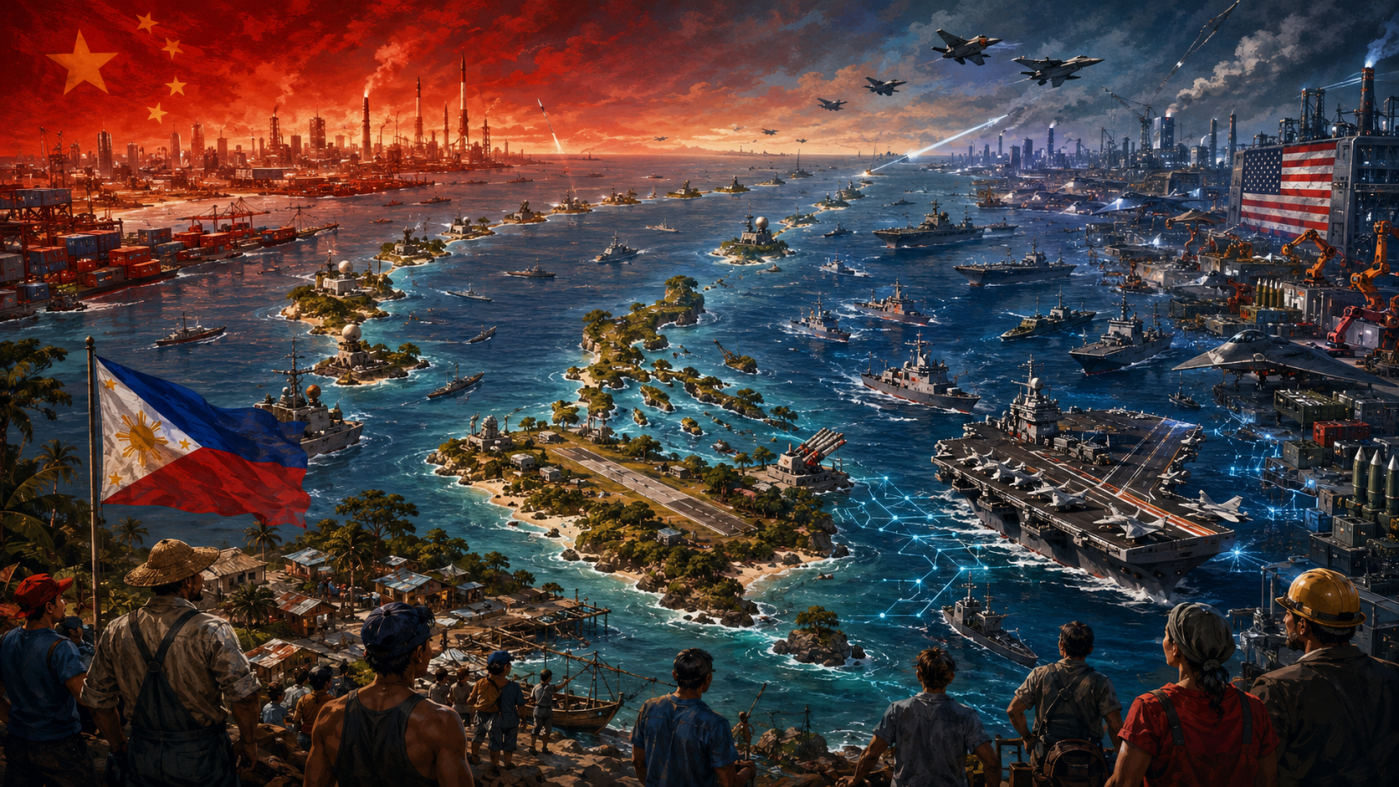
Defense News turns Elbridge Colby’s declaration of American “apex predator” readiness into a story where China moves, Washington merely responds, and U.S. military supremacy disappears into the innocent background called the “status quo.” Beneath that language sits a material architecture of EDCA access, hardened infrastructure, logistics, munitions production, allied industrial integration and real sustainment pressures that no Pentagon reassurance can make vanish. The deeper contradiction is that preserving U.S. predominance now requires ever more weapons, territory, infrastructure and allied capacity, while that very expansion generates greater industrial burdens, Philippine sovereignty tensions and Chinese counter-pressure that make the hierarchy increasingly costly to reproduce. The answer is not to choose a better apex predator, but to organize where grand strategy touches the ground—military access, weapons appropriations, infrastructure, procurement and the political institutions through which the peoples of the region are made to carry the machinery of great-power confrontation.
Prince Kapone | Weaponized Information | August 12, 2026
The “Apex Predator” and the Invisible Status Quo
There is something almost comic about the way Defense News introduces Elbridge Colby’s argument. The Pentagon’s policy chief lands in Manila while reports are circulating that Operation Epic Fury has put pressure on U.S. weapons stocks, and his answer is essentially: don’t believe your lying eyes. “Please don’t be misinformed,” he says. Just like that, a material question—does Washington actually possess enough weapons and industrial depth to keep carrying every military burden it has piled onto itself?—gets transformed into a communications problem. The arsenal may be under pressure, but apparently the real shortage is public confidence. And the chief witness for American readiness is, naturally, the American official whose job requires him to say America is ready.
From there, the article lays the pieces on the table in a very particular order. Chinese ships move. Chinese forces act. China appears as the source of danger. The Philippines appears exposed. Then doubts arise about whether Washington still has enough muscle left after fighting elsewhere. Enter Colby with the imperial reassurance: America is capable, its allies are safe, and whatever military expansion comes next is merely necessary to defend the “status quo.” The choreography is neat. China acts; Washington reacts. China disturbs; Washington restores. China creates history; America merely cleans up afterward. By the time the reader reaches the conclusion, the politics have already been smuggled in through the chronology.
The verbs tell the same story. Beijing deploys, fires, confronts, presses. American military power, meanwhile, floats through the article wrapped in the soft cotton of Pentagon bureaucracy: “forward posture,” “priority missions,” “combat-credible forces,” measures being established “quietly.” China gets ships, missiles and motion. Washington gets nouns. One power becomes visible as a force acting upon the world; the other dissolves into administrative mist, as though American military presence in the western Pacific grew there naturally, somewhere between the coral reefs and the monsoon winds.
Colby’s vocabulary then becomes the article’s vocabulary. “Defensive.” “Denial.” “Respect.” “Status quo.” He assures his audience that Washington has no desire to “dominate this whole region,” while in the same breath insisting that the United States must prevent any other power from becoming the regional hegemon. Apparently domination stops being domination when Washington already possesses it. The contradiction barely earns a raised eyebrow because American predominance has been granted the oldest privilege of empire: the privilege of presenting its own power as normality and everybody else’s power as aggression.
And then, almost mercifully, Colby drops the diplomatic perfume and tells us what kind of animal we are dealing with. The U.S. military, he says, remains at “apex predator status.” Well, there it is. For a moment the language becomes more truthful than the argument. An apex predator is not a neutral referee standing between competing animals. It occupies the top of a food chain. It dominates because it can. Yet Defense News asks the reader to swallow both propositions at once: Washington is the biggest predator in the Pacific, and Washington is merely defending an innocent little thing called the “status quo.” Imperialism has always loved this magic trick. The lion eats first, then writes the rules of the jungle and calls them peace.
That is the ideological labor being performed here. American supremacy is quietly lifted out of history, removed from the chain of cause and consequence, and installed as the neutral starting point called stability. Once that sleight of hand is accepted, the rest becomes easy. Maintaining U.S. dominance is “defense.” Challenging that dominance is “assertiveness.” Expanding the military apparatus needed to enforce it becomes “readiness.” And the empire, while sharpening its claws in full view of everybody, gets to introduce itself as the poor frightened creature trying to keep the neighborhood calm.
What Readiness Has to Be Made Of
Colby’s “strategy of denial” becomes considerably less abstract when his Manila remarks are placed beside Washington’s own policy documents. The United States is not merely promising assistance to the Philippines after another maritime confrontation. The 2025 National Security Strategy calls for military capabilities able to deny aggression throughout the First Island Chain, greater U.S. access to allied ports and facilities, and increased allied defense spending and capability. The FY2027 defense budget likewise identifies “Deter China in the Indo-Pacific” as a primary objective and funds First Island Chain denial, forward posture, infrastructure, exercises, missile defense and advanced weapons through the Pacific Deterrence Initiative.
The Philippines already occupies a concrete place in that posture. Washington and Manila expanded the Enhanced Defense Cooperation Agreement in 2023 by announcing four additional agreed locations, bringing the total to nine, alongside infrastructure investment and greater interoperability. In his fuller Manila remarks, Colby discussed operationalizing those locations, improving resilient infrastructure, adding rotational capabilities and strengthening military integration. What Defense News calls “forward posture” therefore includes specific access sites, facilities, logistics and deployments on Philippine territory.
The China focus is also embedded in force planning beyond Colby’s tour. The Marine Corps has publicly explained that its force redesign was built around the China pacing challenge, including long-range fires, sensors, unmanned systems and other capabilities intended to strengthen deterrence and defeat China if deterrence fails. Pentagon leadership in 2026 likewise called for a distributed and resilient Pacific posture, greater allied industrial capacity and the ability to build and sustain weapons for a “high-end fight”. Colby later compared organizing U.S. forces around the First Island Chain to the Cold War buildup once organized against Warsaw Pact forces in Europe. These statements establish preparation for a possible China conflict; they do not establish that such a war has already been decided upon.
That gives the stockpile question a more concrete setting. On the same day as the Manila report, Defense News reported that combat against Iran had pressured U.S. munitions inventories and that an August 5 Pentagon memorandum gave major producers 21 days to submit plans for significantly faster weapons deliveries and expanded production capacity. Official readiness assessments have also documented maintenance and repair weaknesses, fuel risks, prepositioned-equipment problems and unresolved Guam sustainment challenges. These findings do not show that U.S. Indo-Pacific missions are presently impossible. They show documented pressure on the production, maintenance and logistics systems supporting those missions.
Washington is also expanding allied weapons production. Regional partners are being asked not only to purchase more military equipment but to enlarge their own defense-industrial capacity and develop forces able to operate alongside U.S. forces. In March 2026, Washington and Tokyo agreed to deepen their denial posture while exploring increased Japanese production of AMRAAM missiles and rapid expansion of SM-3 Block IIA production. Colby’s calls for greater allied military spending and industrial capacity therefore coincide with concrete efforts to expand weapons production outside the United States.
The confrontation also reaches into strategic technology. U.S. policy has imposed controls on advanced computing semiconductors and semiconductor-manufacturing technology destined for China, while Treasury regulates or prohibits specified U.S. investments involving Chinese semiconductors, microelectronics, quantum technologies and artificial intelligence. These restrictions are substantial but do not amount to complete technological severance. In 2026, Commerce continued case-by-case license review for specified semiconductor exports to China while maintaining broader advanced-computing controls.
Chinese military activity remains part of the record. The July 20 confrontation near Second Thomas Shoal injured a Philippine Navy sailor, although Philippine and Chinese accounts dispute who initiated the physical clash. China also confirmed a July 2026 submarine-launched strategic missile test. American military activity was occurring in the same regional space: the USS George Washington carrier strike group entered the South China Sea later that month. Beijing has publicly described expanded EDCA access, particularly sites nearer Taiwan, as part of an American effort to encircle and contain China. That establishes Beijing’s stated assessment of the military environment, not the cause of every Chinese military program or maritime action.
Philippine sovereignty also shapes the legal form of U.S. military access. After the earlier bases arrangement ended, constitutional restrictions limited the conditions under which foreign military bases, troops and facilities could operate. EDCA was later challenged before the Philippine Supreme Court, which upheld it as an executive agreement implementing the Mutual Defense Treaty and Visiting Forces Agreement. Current U.S. access is therefore substantial without being legally identical to restoration of the former permanent bases system. Philippine institutions remain directly involved in authorizing the arrangements through which that access operates.
The economic dimension is also present in Washington’s own statements. Colby has described Asia as central to the world’s future markets and to longstanding U.S. interests in the region, while the National Security Strategy connects Taiwan and the South China Sea to semiconductor production, maritime commerce and wider U.S. economic interests. Those documents place economic access inside the strategic picture. The factual record does not establish that commercial interests alone, or any single capitalist fraction, are the singular cause of the military confrontation.
The “Status Quo” Is the War Machine
The New Cold War does not begin with whichever Chinese ship happens to make the evening news. Its material conditions are already there before the camera arrives. Washington has organized its military planning around China, built the First Island Chain into a line of containment, pulled allied territory deeper into its preparations, expanded weapons production with its partners and tightened control over strategic technologies. That changes the causal story completely. China is not moving through an empty Pacific while the United States watches from some innocent shoreline. It is moving inside a region Washington is actively preparing for confrontation.
This is where the phrase “status quo” earns its paycheck. Once American military power is treated as the natural background, everything Washington has already built disappears from history. Bases become geography. Carrier groups become routine. Military access becomes stability. War preparation becomes deterrence. Then China develops the ability to push against those limits and suddenly movement has entered the world. The empire gets to build the fence before the story begins and then point to whatever happens on the other side as the disturbance.
The contradiction is not simply that two powerful states want strategic advantage. The United States is trying to keep American supremacy in the Pacific alive at the same moment that China has become powerful enough to make that job harder and more expensive. That supremacy is not magic. It has to be supplied through ports, runways, missiles, repair systems, fuel, factories, logistics and access to territory outside the United States. Every promise of military dominance eventually has to become something somebody can build, move, maintain and replace.
That is what the stockpile question really exposes. The record does not show that Washington is suddenly incapable of fighting in Asia. It shows that military domination has a material cost and that the cost is rising. Weapons used elsewhere have to be replaced. Ships and aircraft have to be maintained. Guam has to be supplied. Production has to expand. Allies have to manufacture more. The Pentagon can declare China the “pacing challenge” with a press release. Industry still has to produce enough weapons to keep pace.
This is the loss of cheap command at the heart of the present imperialist recalibration. China has accumulated enough industrial, technological and military capacity that Washington cannot simply assume its commands will be obeyed or its pressure will produce submission. Chinese sovereign development has narrowed the old imbalance. That forces the United States to spend more, deploy more, build more with its allies and use technological restrictions more aggressively just to preserve advantages that can no longer be taken for granted. American supremacy has not vanished. It has become more expensive to enforce.
And the New Cold War feeds on that contradiction. The stronger Washington makes the military cordon around China, the more seriously Beijing has to plan for overcoming the limits that cordon imposes. Those Chinese capabilities then return to Washington as fresh proof that China is becoming more dangerous, which becomes the argument for still more containment. The arsonist points to the smoke and asks Congress for a larger gasoline budget. Containment helps produce the counter-power that is then used to justify deeper containment.
That does not mean every Chinese missile is Washington’s fault or every decision made in Beijing should receive a revolutionary standing ovation. China has its own state interests, territorial claims and contradictions. But refusing to romanticize China is not the same thing as pretending the pressure surrounding it does not exist. A state facing an openly declared effort to constrain its military freedom of action and restrict parts of its technological development is going to organize itself around those conditions. That is not an excuse for every Chinese action. It is the historical ground on which those actions have to be understood.
The Philippines sits directly inside that struggle. Manila has real disputes with Beijing and makes security decisions of its own. Calling the Philippines a puppet would flatten those contradictions instead of explaining them. But Philippine agency does not turn the American empire into an equal partnership. The decisions Manila makes about access, facilities and military cooperation are being folded into a wider U.S. strategy centered on China. Philippine sovereignty is therefore being exercised inside a relationship where Washington’s war planning reaches far beyond the immediate Philippine dispute.
The polite term for spreading the cost of this system is “burden-sharing.” Washington wants its allies to spend more, manufacture more and become militarily stronger. That can increase their own capacity. But the capabilities being expanded are also being designed to work alongside the U.S. war machine. The burden gets spread outward while Washington remains at the center of the strategy. This is imperial burden-shifting in plain clothes: allies are expected to build more of the weapons, host more of the infrastructure and carry more of the material load required to keep American supremacy functioning.
Technology belongs to the same fight. Semiconductors, advanced computing and artificial intelligence are not a separate economic subplot running beside the military confrontation. They are part of the struggle over sovereign development itself. A country that can produce advanced technology, industrialize on its own terms and defend that capacity is harder to discipline from outside. That is why technological warfare matters here. The battlefield is not only a reef, a shipping lane or a missile battery. It is also the productive ability to keep developing without Washington deciding how high you are allowed to climb.
This is also where multipolarity has to be understood without either liberal hysteria or revolutionary fantasy. China’s ability to resist U.S. domination matters because it makes unilateral imperial command harder and more expensive. That opens space in a world where one power has been accustomed to exercising enormous coercive reach. But multipolarity does not become socialism because another flag has entered the room. Chinese state interests are not automatically the interests of workers in China, the Philippines or anywhere else. The weakening of American domination creates possibilities. What those possibilities become depends on political struggle.
Now return to the “status quo.” Washington is not standing still while China advances toward it. Washington is spending more, building more, integrating more allied military capacity and preparing more seriously for the possibility of war because the old conditions of American supremacy are becoming harder to maintain. Then all of that motion gets renamed “defense,” while China’s efforts to overcome the constraints placed around it are presented as the disruption that began the crisis.
That is the sleight of hand at the center of the story. The “status quo” is not some peaceful Pacific equilibrium being disturbed from outside. It is American military supremacy being rebuilt under the pressure of a China that can increasingly resist it. The New Cold War is the process through which Washington is trying to keep that supremacy alive. And the harder the empire works to contain China, the more it helps create the very resistance that makes the old command harder to restore.
Break the Machine Where It Touches the Ground
If this whole military architecture has to pass through access agreements, government budgets, construction projects, weapons factories and political consent, then that is exactly where resistance has to meet it. Peace cannot remain a beautiful word printed on a placard while the machinery of the next war is poured into concrete behind us. Sentiment does not stop a runway from being expanded. Moral outrage does not cancel a procurement contract. The political line has to be harder than that: defend Philippine sovereignty against coercion without accepting Washington’s proposition that the only protection available is deeper incorporation into its forward war machine, and without pretending that every move made by Beijing becomes progressive merely because Washington opposes it. The Filipino people do not need to choose which great power gets to speak in their name.
In the Philippines, that means following EDCA down from the language of “deterrence” to the ground where it becomes real. A military agreement eventually has to become a facility. Somebody has to approve the construction. Somebody has to pay for it. Somebody has to decide which forces rotate through it, which weapons arrive, what infrastructure gets hardened and what new commitments are quietly attached to yesterday’s commitments. Those are not details for generals alone. They are points of political struggle. The International League of Peoples’ Struggle bases its operations on membership dues and contributions from member organizations, and its 2024 International Assembly reported that membership dues remained the principal source of its central fund. That gives organizers an existing anti-imperialist vehicle through which to demand the obvious questions that imperial strategy prefers buried beneath acronyms: What exactly is being built at these EDCA sites? What weapons and forces are moving through them? Who pays? Who authorized it? And how much Philippine territory is being committed today to a war Washington says it hopes never happens tomorrow?
Inside the United States, the machine touches the ground somewhere else. The Pentagon can issue all the heroic declarations it wants, but a missile does not materialize because a defense official gives a speech. Congress has to appropriate the money. Contracts have to be issued. Production lines have to expand. Public resources have to be redirected. That gives antiwar organizers, veterans, unions and ordinary constituents something far more useful than another abstract argument about whether war is bad: choke points. Demand hearings. Challenge the appropriations. Drag procurement expansion into daylight. Make legislators explain why every escalation abroad arrives back home carrying another invoice for the working class. The enemy here is not the worker machining a component or assembling a missile because a paycheck is due Friday. The target is the policy that keeps converting geopolitical confrontation into an endless command upon public wealth, industrial labor and productive capacity.
Political education belongs right beside that struggle because empire survives partly by laundering material violence through clean language. A base becomes “access.” A weapons buildup becomes “readiness.” Encirclement becomes “denial.” Military supremacy becomes the “status quo.” The trick is to put the polite Pentagon vocabulary back beside the concrete things it conceals: the runway, the missile battery, the weapons contract, the factory shift, the tax dollar, the foreign troops, the territory placed inside somebody else’s war plan. Make every abstraction show its hands. Make “deterrence” tell us what it weighs, what it costs, who builds it and who is expected to die if it fails.
That is where grand strategy stops floating above the people like some mysterious weather system and becomes something human beings actually reproduce. An access agreement. An appropriation. A construction contract. A missile order. A deployment decision. None of these by itself is the empire, just as one gear is not the whole machine. But the machine does not run without its gears. Every one of these decisions is a point where the architecture has to be authorized, financed, built and defended all over again. And there is the opening. What rulers must continually reproduce, organized people can interrupt. What has to be built can be blocked. What has to be funded can be fought. What depends upon consent can have that consent withdrawn.


Leave a comment