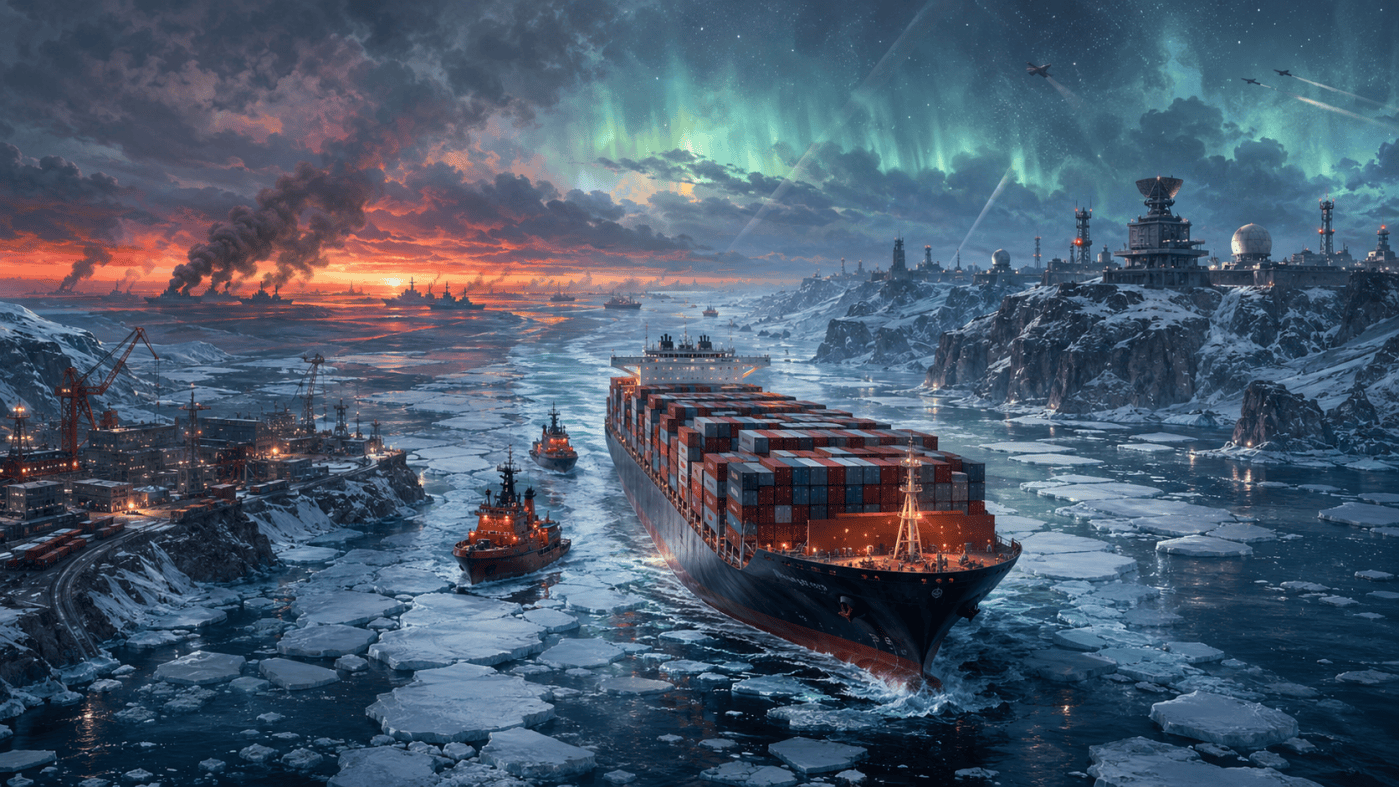
The Financial Times turns China’s Ice Silk Road into a tidy story about faster shipping, leaving the political power buried inside the very chokepoints China is trying to bypass conveniently outside the frame. Behind the container schedules lies a decade-long Russia-China Arctic buildout unfolding under sanctions while Washington, NATO, NORAD and Pituffik harden the northern approaches of the American Pole. The Northern Sea Route is not the conquest of the Arctic or the arrival of a finished multipolar world, but an emerging form of logistical redundancy against an imperial order whose power has long rested partly on commanding the arteries through which the world moves. The answer is neither NATO militarization nor worship of a new capitalist shipping lane, but organized power among dockworkers, seafarers and Indigenous peoples capable of contesting who controls the routes, whose land they cross and whether the Arctic becomes another highway to war.
Prince Kapone | Weaponized Information | August 10, 2026
The Shortcut That Never Asks Who Built the Roadblock
The Financial Times announces its argument before Alice Hancock has written the first sentence. “China bypasses shipping chokepoints with ‘Ice Silk Road’ through Arctic”, published August 10, 2026, tells us that Sea Legend is preparing scheduled container voyages from Ningbo to Felixstowe along Russia’s Northern Sea Route. The commercial arithmetic is seductive. What normally takes roughly forty days could take about twenty. Less time at sea means less fuel, lower operating costs and less exposure to places where somebody might decide that world commerce should not proceed according to the timetable printed in a European shipping office.
The article’s first maneuver is therefore narrative framing. The Arctic arrives chiefly as a shortcut. Melting ice makes passage easier; shipping companies discover an opportunity; insurers calculate risk; cargo moves. History enters as weather. Politics enters as inconvenience. The reader is invited to admire the cleverness of capital finding a shorter road without being asked why avoiding the established roads has acquired such urgency. A chokepoint, in this telling, is simply an unfortunate place where commerce can become delayed.
Then comes historical compression. “Ice Silk Road” is introduced as Sea Legend’s branding for its new service, leaving the phrase suspended inside the article like an advertising slogan with no political ancestry worth discussing. Whether this voyage represents improvisation, continuity or the maturation of an older strategy is never made part of the reader’s problem. The route simply appears, conveniently enough, when the market requires it.
The article’s source hierarchy performs similar work. The principal interpretive voices are an Allianz marine-risk consultant, a former Canadian environment minister and a European Arctic-shipping specialist. Chinese and Russian actors mostly enter the story as companies, regulators, permits, vessels and strategic objects. The people organizing the route are present materially but largely absent intellectually. Western experts retain the privilege of explaining what everyone else is doing.
Security is arranged with equal care. The FT gives the reader a specific danger in the south: Bab al-Mandab, the Red Sea and renewed Houthi threats. In the north, however, the political struggle becomes the antiseptic phrase “geopolitical rivalry.” This is selective securitization: conflict becomes vivid when describing the route China wishes to avoid and strangely bloodless when describing the region into which that commerce is moving.
Finally, there is the peculiar treatment of climate catastrophe. The article does not deny it; in fact, it documents the melting ice, ecological risks and dangers of Arctic navigation. Yet even planetary breakdown is quickly translated into commercial possibility. The ice retreats, and shipping capital reaches for the timetable. The contradiction sits there in plain sight, but the article leaves it politely unmolested.
The ideological work is subtle precisely because most of the individual facts need not be false. The trick is arrangement. A profound change in the geography of circulation becomes a logistics story about shaving days from a voyage. China is “bypassing chokepoints,” but the reader is never invited to linger over the dangerous question hiding inside those two words: what kind of power makes a chokepoint worth bypassing in the first place?
The Route Was Being Built Before the Headlines Arrived
The Northern Sea Route service did not begin with this week’s announcement. In October 2025, the Istanbul Bridge completed the first direct China-to-Europe container transit through the route, sailing from Ningbo-Zhoushan to Felixstowe in roughly twenty days before continuing to other European ports. Rosatom recorded the voyage as the first direct container transit between China and Europe through the Northern Sea Route. The advantage was substantial: the Arctic passage cut roughly twenty days from the conventional Suez itinerary. Sea Legend’s 2026 operation therefore represents a move from trial navigation toward scheduled seasonal service, not the sudden invention of an Arctic corridor.
Container traffic was already moving in that direction. Twenty-four container transit voyages passed through the Northern Sea Route in 2025, up from fourteen in 2024, while overall voyages along the route reached 1,521. The corridor remains constrained by ice conditions, seasonal navigation and the specialized demands of polar shipping. It is not replacing Suez tomorrow morning. But the commercial logic is straightforward enough: when the northern passage is open, ships moving between East Asia and northern Europe can eliminate thousands of nautical miles from the journey.
The attraction becomes easier to understand when the southern route is examined materially. In early August, renewed threats around the Red Sea produced another sharp disruption in traffic. Only one vessel crossed Bab al-Mandab on August 5, down from twenty the previous day, amid Houthi claims of attacks on Saudi tankers. Saudi authorities had not confirmed those particular attacks, but the immediate effect on merchant movement was visible in the shipping data. For carriers moving containers between China and Europe, route diversification is not an abstract geopolitical exercise when a narrow sea passage can suddenly become commercially unusable.
China had been planning for that diversification long before the present Red Sea crisis. Its 2018 Arctic Policy formally called for building a “Polar Silk Road” through Arctic shipping routes and encouraged Chinese enterprises to participate in infrastructure construction and commercial trial voyages with the stated objective of preparing for eventual regularized operation. The document also identified China’s own advantages in capital, technology, markets and commercial demand while recognizing the jurisdiction of Arctic states and the requirements of international maritime law. What is appearing today as scheduled container shipping was written into Chinese policy eight years ago.
On the Russian side, the material requirements are considerable. Rosatom operates Russia’s nuclear icebreaker fleet and the infrastructure system supporting navigation along the Northern Sea Route; by 2025, eight nuclear icebreakers were operating while additional vessels were under construction. Russia supplies the Arctic coastline, ports, ice-navigation system and much of the specialized physical infrastructure. Chinese trade supplies an expanding portion of the commercial traffic moving through it. A Russia-China roadmap adopted in Harbin set a target of raising bilateral Northern Sea Route cargo traffic to twenty million tonnes by 2030. The growth in Chinese container voyages is therefore taking place inside an already institutionalized bilateral program.
That expansion is also occurring under direct economic pressure. Western sanctions have targeted Russian Arctic energy development, particularly Arctic LNG 2, restricting access to specialized technology, vessels, finance and markets. By 2026, Arctic LNG 2 remained only partially completed, unsold cargoes had accumulated and Chinese buyers were reportedly receiving sanctioned Russian LNG at discounts of roughly thirty to forty percent. The sanctions did not eliminate Arctic development, but they altered who could supply equipment, insure or service shipping, purchase cargoes and finance expansion.
At the same time, U.S. and allied defense infrastructure across the Arctic is expanding. The Pentagon’s Arctic strategy calls for greater domain awareness, communications capability, exercises and cooperation with allies while identifying increasing Russian activity and China’s growing Arctic presence as strategic concerns. Greenland already hosts one of the most important U.S. installations in the region. Pituffik Space Base performs missile-warning, missile-defense, space-surveillance and satellite command-and-control missions from Greenland’s far northwest.
Canada is undergoing a parallel northern military buildup through NORAD modernization. Its Arctic Foreign Policy links expanded northern surveillance and defense infrastructure directly to continental defense and NATO’s northern and western flanks. New radar systems, space-based surveillance and northern operating infrastructure are being developed across territory that Ottawa itself acknowledges bears a colonial history. The same policy recognizes forced Inuit relocations and other state actions that produced intergenerational harm; earlier High Arctic relocations were undertaken in part to reinforce Canadian sovereignty over the North.
Climate change runs through every part of this transformation. Canadian Arctic policy explicitly connects warming temperatures and diminishing ice with greater future access to shipping routes and natural resources, while governments simultaneously expand surveillance and defense capacity across the same geography. Commercial vessels, energy projects, military sensors and Indigenous communities are therefore being drawn into the same rapidly changing physical space. The ice is retreating. The ships are following. And the states surrounding the Arctic are already building around the routes that retreat is making possible.
The Ice Road and the Empire That Cannot Afford Alternatives
The real story begins where the Financial Times stops: with the chokepoint itself. A chokepoint is not important merely because it is narrow. It is important because enormous quantities of social labor, commodities, fuel and manufactured goods have been organized to pass through a handful of narrow corridors. Concentrate circulation and you concentrate vulnerability. Concentrate vulnerability and you create political power. The Northern Sea Route matters because Russia and China are beginning to construct another road around that concentration.
That road is still small. Twenty-four container transits through the Northern Sea Route in 2025 do not overturn the maritime geography of world capitalism. A seasonal route through dangerous ice does not suddenly replace Suez. But dialectics begins precisely where advertising and propaganda end: quantity can accumulate toward qualitative change. What matters is not whether Sea Legend can replace the southern route tomorrow. What matters is that a commercial route between East Asia and Europe can now move cargo in roughly half the time of the conventional itinerary during the navigable season, and that Russia and China are deliberately expanding the infrastructure and traffic required to make such voyages increasingly regular.
This is logistical redundancy—the construction of alternatives where dependence once appeared natural. China had already placed regularized Arctic commerce into its strategy years before the present crisis around Bab al-Mandab. Russia developed the ports, navigation administration and icebreaking capacity without which the route would remain a line drawn hopefully across a frozen map. Chinese commercial demand increasingly supplies the cargo. The bilateral target of twenty million tonnes by 2030 gives that material complementarity an institutional direction. Russia has the Arctic road. China has growing reason to travel it.
None of this requires pretending that Beijing and Moscow have built some liberated socialist sea lane floating outside capitalism. Cargo is still cargo. Profits remain profits. Energy is sold for money. Sanctions have forced Russian Arctic LNG into discounted markets rather than abolished the commodity form. Chinese importers receiving cheaper Russian gas are participating in trade, not storming the Winter Palace. The significance lies elsewhere: economic coercion intended to isolate Russian Arctic development simultaneously increases the material incentive to deepen commercial relations beyond the markets and infrastructure controlled by the states imposing that coercion. Pressure creates adaptation. Adaptation creates new relationships. Those new relationships are then cited as evidence that more pressure is necessary.
Here the New Cold War begins to manufacture part of the enemy formation it claims merely to observe. Russia faces restrictions on technology, vessels, financing and market access. China possesses capital, markets and growing demand for an alternative shipping corridor. The Pentagon then points toward growing Russia-China Arctic cooperation as a strategic concern and expands surveillance, communications and military exercises across the region. Each side responds to conditions created partly by the other. The sanctions push commerce toward alternative partners; the new commerce becomes proof of a geopolitical threat; the threat justifies greater military consolidation; the consolidation strengthens the incentive to build alternatives. The snake does not merely eat its tail. It files a national security memorandum explaining why the tail forced it to bite.
This is where the Arctic enters the architecture of the American Pole. Fortress America is not simply a wall around the continental United States. Its northern perimeter runs through surveillance systems, military bases, alliance structures and the strategic approaches to North America. Pituffik in Greenland watches missiles and space from the roof of the world. Canada expands northern radar and surveillance through NORAD while tying Arctic defense to NATO’s northern and western flanks. The Pentagon increases domain awareness and military coordination as shipping lanes become more usable and Russia-China traffic expands. The northern wall is being constructed not from concrete but from sensors, bases, communications systems, alliance obligations and political control over territory.
That matters because imperial power is never only the possession of weapons. It is the capacity to organize the conditions under which other societies must move. Command the port and you influence commerce. Command the market and you discipline sellers. Command the financing and you shape investment. Command the route and you possess another lever over circulation. The emerging Northern Sea Route does not destroy that system, but it introduces another possibility into it. Every commercially viable alternative weakens the absolute character of dependence even when it does not eliminate dependence itself.
That is why the Arctic cannot be understood as a remote contest among flags planted in snow. It is becoming part of the material struggle over how Eurasia connects to itself and to the rest of the world. The established order was built around routes, markets and military architectures developed under overwhelming Western power. The emerging order is more contradictory. Russia remains under sanctions but continues Arctic development. China remains deeply entangled in world trade while pursuing additional routes. Western power remains enormous while becoming more expensive to exercise. Multipolarity therefore appears here not as a completed new world but as an unfinished struggle over whether alternative centers of circulation can become durable enough to survive pressure.
And beneath all of this lies the ugliest contradiction of all. The Arctic becomes more commercially accessible because the climate is warming. The same historical system that treated the atmosphere as a sewer now looks upon the retreating ice and discovers a shipping opportunity. States install radars. Corporations calculate shortened voyages. Energy projects move north. The planet burns, and capital complains only that the new road still requires an icebreaker.
For the Indigenous peoples whose land is being reorganized as strategic depth, this is not an abstract chessboard. Canadian policy itself acknowledges that sovereignty in the North was historically asserted through forced Inuit relocation. Now the same geography is being refitted with surveillance, military infrastructure and expanding commercial access. The old colonial contradiction therefore survives inside the new geopolitical one: states speak of securing territory whose peoples have already experienced what “security” can mean when defined from distant capitals.
The Ice Silk Road should therefore be neither feared as Chinese conquest nor celebrated as the finished highway of a liberated multipolar world. It is something more historically interesting: an emerging artery inside a system whose old arteries have become instruments of vulnerability and coercion. Russia and China are building redundancy. The United States and its allies are hardening the northern perimeter around that emerging capacity. Climate change is opening the physical terrain on which both processes advance.
The Financial Times sees a ship saving twenty days. The materialist sees something larger moving beneath the hull: the geography of circulation itself becoming contested. The struggle over the Arctic is therefore not simply about who sails through the ice. It is about whether the routes through which the world reproduces itself will remain concentrated enough to be commanded from one fortified pole—or whether alternative roads, however contradictory and unfinished, are beginning to make that command more difficult.
The People Who Move the World Can Refuse to Move It Toward War
If the Arctic is becoming a new corridor of commerce and military rivalry, then the struggle over it cannot be left to admirals, shipping executives, energy corporations and ministers drawing lines across maps. The workers who load the containers, crew the vessels, operate the ports and keep the arteries of circulation alive possess a material power that no geopolitical strategy document can manufacture. The task is to turn that structural position into conscious political force.
The International Dockworkers Council offers one existing vehicle for that work. It is organized as an independent international association of dockworker organizations, with a structure sustained through affiliation and solidarity contributions rather than the state-security and foundation networks that so often turn “civil society” into subcontracted foreign policy. Independent labor research has documented how the IDC uses affiliation fees and cross-border solidarity to strengthen dockworker organization across uneven national conditions. That model matters because capital has already internationalized the logistics chain. Labor cannot confront a global shipping system one isolated port at a time.
The International Longshore and Warehouse Union provides another concrete tradition. Its power comes from dues-paying workers controlling strategically concentrated workplaces, and that power has not always been confined to wages and contracts. In 2008, West Coast longshore workers shut down ports in an anti-war action opposing the wars in Iraq and Afghanistan. That history should be studied seriously—not as nostalgic labor folklore, but as evidence that workers positioned inside circulation can intervene politically where the empire is materially vulnerable.
That same strategic imagination is needed in the Arctic. Dockworkers, seafarers, rail workers and warehouse workers should be organizing political education around how civilian logistics become military logistics, how commercial ports become strategic nodes, and how supposedly neutral supply chains are reorganized for confrontation. Anti-war labor work cannot wait until missiles are flying. By then the contracts are signed, the routes established and the machinery already moving.
Indigenous sovereignty must be treated with the same seriousness. Canada’s own Arctic policy acknowledges the history of forced Inuit relocation and recognizes that Indigenous peoples must participate in decisions affecting the North. That principle should be pushed beyond consultation theater. Communities whose lands are being transformed by surveillance systems, shipping expansion, extraction and military infrastructure need political authority over what is built, where it is built and whose interests it serves.
Worker power and ecological defense belong in the same fight. Expanded Arctic shipping must mean enforceable polar-navigation standards, emergency-response capacity, pollution prevention and protections for crews and northern communities—not another deregulated frontier where corporations pocket the savings while workers and Indigenous peoples absorb the danger.
The dead ends are already familiar: NATO threat inflation that turns every Russian or Chinese vessel into another excuse for militarization; corporate greenwashing that celebrates melting ice as opportunity; and multipolar triumphalism that mistakes an alternative capitalist route for emancipation. The answer is not to choose which state bloc gets to command the Arctic. It is to organize the people whose labor and land make the Arctic usable at all—and build enough power that neither empire nor capital can move through it without answering to them.


Leave a comment