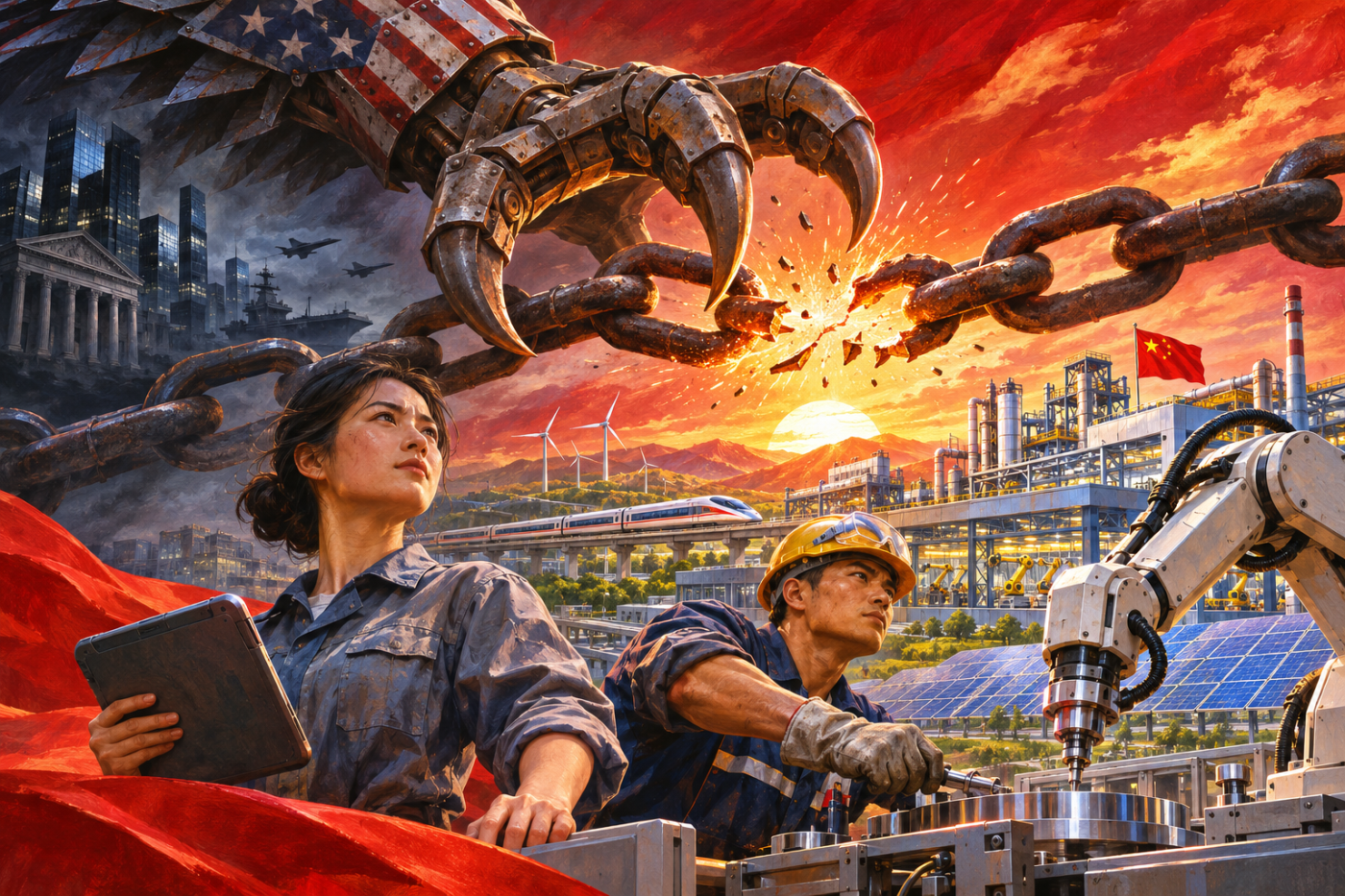
Thomas Friedman tours China’s factories, admires what he sees, and calls for rebuilding Western power to compel Beijing’s obedience. Behind the machinery stands a revolutionary history of socialist construction that’s helped break the imperial centers’ grip on advanced production. Washington’s technological restrictions defend the power to decide who develops, on whose terms, and for whose profit. Workers and oppressed peoples have another task: defeat the New Cold War and organize to make productive wealth serve human needs instead of imperial privilege.
By Prince Kapone | Weaponized Information | November 2, 2026
I. China Builds. Friedman Reaches for the Leash.
Thomas Friedman went to China and found factories that worked, engineers who knew their business, and infrastructure built for something beyond the next quarterly earnings report. He returned urging cooperation over AI dangers and a recovery of Western power to compel Chinese accommodation. His November 2 column in The New York Times turns an encounter with Chinese achievement into an argument for rebuilding American leverage. The workshop has learned to make its own tools, and the old boss wants a meeting.
Friedman establishes his authority through access. He tours production lines, drinks tea with executives, watches demonstrations, and brings the reader along as his guest. These encounters contain useful information. Their arrangement also establishes who gets to explain the world. Corporate leaders speak; workers appear chiefly as numbers that automation has reduced. At Huawei, the reported reduction from 86 workers per shift to nine becomes a measure of technological prowess. We hear little about the people behind those numbers. The factory enters through management’s eyes, while labor—the human activity that makes every demonstration possible—waits outside the interview room.
Then comes the ideological insurance policy. Friedman recognizes that Chinese planning and coordination help produce impressive results, yet preserves his verdict that China has a bad political system. American dysfunction leaves the goodness of its system intact. The institutions receive different rules of evidence. Chinese success can demonstrate competence without earning political legitimacy; American failure can demonstrate incompetence without forfeiting it. It’s a convenient accounting system. The judge has examined the evidence and determined that his own country’s ruling order remains innocent of being the wrong kind of government.
The sleight of hand grows larger when a European business representative’s alarm becomes the voice of humanity. Friedman warns that “the rest of the world will not let that happen.” Which world? The executive defending market share, the worker threatened with dismissal, and the family seeking affordable electricity have different interests. He bundles them into one aggrieved customer confronting China across the counter. Western commercial authority receives a planetary mandate without the inconvenience of asking the planet.
By the conclusion, the destination is clear: rebuild the competitiveness needed to compel China to accommodate Western priorities. Friedman can criticize Trump’s incompetence and still embrace the ambition advertised on his red cap. He wants the restoration managed by people who know their business. That’s the column’s political work: making renewed American command sound like practical wisdom. The history that enabled China to build those factories remains outside the frame. Bring it back, and the question of who holds the leash becomes harder to evade.
II. The Revolution Behind the Factory Floor
The history begins with a people fighting to recover command over their country. Foreign concessions, landlord power, invasion, and civil war formed the terrain from which the Chinese Revolution emerged. After 1949, land reform, public institutions, industrial construction, and expanded education and healthcare helped build the foundations of national development. The connection to today’s factories runs through those institutions: people could acquire technical knowledge, infrastructure could support production, and investment could serve purposes extending beyond an individual firm’s return. Tricontinental’s history of Chinese modernization restores this revolutionary foundation to the story.
Reform brought foreign investment, private accumulation, and new inequalities into that process. China also retained instruments for directing development. Public enterprises, state-owned finance, investment funds, and government coordination helped organize industries requiring sustained commitments. Meng Jie and Zhang Zibin’s study of Chinese industrial policy explains how these institutions construct markets rather than simply wait for them. It also identifies a conflict within public finance: chasing financial returns can undermine industrial learning and long-term objectives. State ownership provides an instrument of direction; political decisions determine how it’s used.
Even Washington’s policy establishment recognizes parts of this machinery. A CSIS comparison of China’s EV and aviation industries identifies state direction, enterprise competition, and support for production and demand behind the EV advance. Aviation’s component dependencies and technical difficulties show why progress varies across sectors. “Cowboy capitalism” supplies atmosphere where an account of institutions belongs.
The international stakes extend beyond sales of finished goods. Control over advanced equipment, intellectual property, and technical systems can generate revenue while keeping other producers dependent on their suppliers. Bappa Sinha’s technological-monopoly analysis locates China’s industrial advance within that relationship. Acquiring the capacity to develop technologies changes what foreign owners can charge, withhold, and demand. The accumulated knowledge inside an industrial system matters as much as the latest machine displayed to a visitor.
Washington has acted directly against that capacity. Its December 2024 restrictions covered 24 types of semiconductor-manufacturing equipment, three types of software tools, and high-bandwidth memory, alongside 140 Entity List additions. The Commerce Department expressly identified impairing China’s indigenous semiconductor ecosystem as an objective. Officials invoked military and security concerns; their instruments reached equipment, software, manufacturers, and investment companies. These measures extended earlier restrictions. Tricontinental’s New Cold War chronology traces the confrontation across Obama’s pivot, Trump’s trade offensive, and Biden’s technological controls. The project survives changes of cast.
Corporate and government institutions connect through identifiable channels. Deborah Veneziale’s contribution to the 2022 New Cold War study documents technology companies’ military contracts and the WestExec consultancy’s role linking corporate clients with officials moving between government and private employment. Its examples include clients such as Boeing, Palantir, and Google, and the subsequent service of WestExec figures in the Biden administration. Procurement turns public expenditure into corporate revenue; consulting turns political access into a business service. National security comes with an invoice.
The confrontation also reaches the Americas. The Black Alliance for Peace’s hemispheric analysis connects arms sales, police and military training, and SOUTHCOM’s activities to Washington’s renewed emphasis on confronting China and Russia. It situates these mechanisms within the longer Monroe Doctrine claim to regional supremacy. This is the concrete connection between an overseas confrontation and the effort to keep neighboring peoples inside a US-dominated political and military order.
Back in China, Friedman’s claim that manufacturing has displaced pension support requires correction. The 2026 work report specified another 20 yuan per month in minimum basic old-age benefits for rural and non-working urban residents, alongside higher medical-insurance subsidies. It’s a modest increase, directed at a specific population. Its existence matters when the government’s response is reduced to ordering people to endure deprivation. The consequential questions concern coverage, adequacy, and the distribution of resources.
Investment also has to be examined by its social purpose. A power network and an apartment bought for resale perform different economic functions. Tricontinental’s development study distinguishes productive, ecologically sustainable investment from property speculation and warns against depressing immediate consumption intolerably. Building future capacity and meeting present needs require deliberate coordination. The label “investment” can conceal as much as it explains.
Pakistan makes the international stakes tangible. Renewables First’s 2025 electricity review identifies China as the principal source of its recent solar-panel imports and records approximately 16 gigawatts imported in fiscal year 2024. Imports aren’t completed installations, but they supplied an expanding solar sector. Its 2026 review examines the tension between distributed generation and a grid burdened by legacy costs. Cheaper equipment opens possibilities; financing, infrastructure, and tariff arrangements determine how those possibilities reach people.
China’s AI-governance proposals likewise precede Friedman’s anticipated emergency. Its November 2025 arms-control white paper addresses human responsibility, human control of weapons, international humanitarian law, and multilateral governance. It also defends developing countries’ access to peaceful technologies. These declared commitments establish that the debate already includes who governs and who receives access. The struggle over technology’s social purposes was underway before the columnist arrived.
III. The Crime Is Developing Without Permission
A factory contains more history than a visiting columnist can see from its observation deck. There’s the worker who learned a trade, the teacher who prepared the engineer, the electricity that makes the machinery turn, and the public decisions that brought these capacities together. There’s also the struggle over who gets to decide what the factory produces and where its wealth goes. China’s revolutionary history matters because it changed the institutions through which those decisions could be made. The people whose country had been subjected to foreign command acquired means of organizing production on a national scale. Today’s industrial capabilities carry that history forward.
For the owners of a technological monopoly, dependence is a source of income. Producers who need their equipment or knowledge must meet their prices and conditions. Control over a crucial input can help its owner claim a larger share of the wealth produced throughout a supply chain. When another country develops that capability, the owner faces more than a competing product. Its customers gain alternatives. Its prices face pressure. Its ability to dictate terms weakens. That’s why the spread of productive knowledge can look like progress from a factory floor and a fucking emergency from a boardroom.
The US state intervenes where these commercial interests meet its own imperial priorities. Restrictions can obstruct the emergence of alternative suppliers and force Chinese institutions to spend more resources overcoming denied access. Corporate advantage receives political protection, while the state preserves an instrument for disciplining development abroad. Friedman’s demand for restored leverage approaches the same objective through renewed Western productive strength. His preferred method is to recover the capacity to compel accommodation. The right to demand that accommodation remains unquestioned.
Yet coercion changes the conditions it seeks to preserve. A supplier that threatens exclusion teaches its customers that dependence carries political costs. China’s accumulated industrial capabilities give it resources with which to pursue alternatives. The pressure to escape, however, doesn’t manufacture engineers, finance, or equipment by itself. Countries with weaker productive institutions can face the same threat with far fewer means of resisting it. China’s development therefore has an international significance: additional sources of technology can widen other nations’ choices. Whether those choices become durable independence depends on what they enable people to build.
Imperialist recalibration develops through this collision. As inherited advantages become harder to defend through commerce alone, governments organize restrictions, procurement, corporate expertise, and allied pressure around their preservation. The contracts and revolving careers connect private accumulation to public coercion. Firms can compete for business while converging around institutions that protect their position. This is one institutional foundation of WI’s technofascist analysis: the concentration of technological capacity alongside coercive state power. Abroad, hyper-imperialism puts those capacities to work enforcing unequal access. The machinery has owners and beneficiaries, even when its operators speak in the name of the nation.
The hemispheric dimension follows from that effort to secure dependable power. Military relationships and political subordination in the Americas give Washington means of constraining alternatives close to home while confronting them abroad. Fortress America names the drive to fortify that base; the American Pole is the bloc Washington seeks to consolidate around its command. The peoples living within that projected order have their own aspirations. Their refusal to accept permanent subordination is part of the same struggle over who determines development. The map on an imperial planner’s wall is somebody else’s home.
Friedman’s appeal recruits American workers through the pronoun “we.” We must regain leverage. We must prevail. But the return on a military contract belongs to its owners; the worker’s claim on society concerns wages, housing, healthcare, and time to live. National competitiveness supplies no mechanism guaranteeing those needs. Workers are asked to strengthen institutions whose command over them remains intact, then trust that victory abroad will produce generosity at home. They’re supposed to tighten their belts while the people holding the belt explain the national interest.
China’s socialist construction confronts a different political task: making productive advance serve social reproduction. The tension identified within public finance is consequential. Funds directed toward profitable assets can pull away from long-term industrial learning; resources committed to future production must also sustain the people whose labor makes that future possible. Pension provision, public services, and productive investment meet within this struggle over the allocation of social wealth. Socialist institutions supply means to intervene. Their emancipatory purpose advances through decisions that subordinate accumulation to people’s needs, rather than treating people as inputs to an endlessly expanding balance sheet.
This gives workers’ demands over automation their place inside development. A machine that reduces necessary labor creates the possibility of more time and greater security. Whether workers receive those gains depends on the authority governing production and distribution. The political struggle concerns who claims the benefit and who absorbs the disruption. Turning that struggle into a warrant for Washington to restrict China hands the question of workers’ emancipation to institutions defending imperial privilege. Apparently the workers must first be denied the tools of development so the empire can save them from their use.
Pakistan’s solar expansion shows another part of the same problem. More accessible equipment can loosen one constraint while exposing another: a financing system built around existing electricity arrangements still has to meet its costs. The resulting conflict concerns who pays, who gains access, and who directs investment. External alternatives create room for domestic struggle; popular organization determines what can be won within it. This is the revolutionary content of multipolarity—an opening in relations of dependence that workers and oppressed peoples can use to transform their conditions.
China’s achievements and contradictions thus belong within a living struggle over socialism and development. Friedman turns them into reasons the West must recover command. Our standpoint begins with the people whose lives depend on breaking that command and directing productive wealth toward collective needs. Defending China’s sovereignty protects an opening against imperial coercion. Fighting for workers’ power gives that defense its emancipatory direction. The future becomes ours through organization capable of deciding what the machinery is for.
IV. Our Labor Won’t Build Their New Cold War
Refusing the empire’s recruiting pitch has to become organized work. Bring this argument into a union meeting, a political collective, or a community study group. Start with a concrete question: when a columnist demands that “we” regain power over China, whose interests disappear inside that “we”? Compare his closing demand with the restrictions and institutions examined here. Then choose an action, assign responsibility, and set a date to report back. A discussion that produces another discussion can become a very comfortable waiting room.
CODEPINK’s China working group offers an existing route into political education, campaign discussion, and coordinated antiwar activity. Join its organizing conversations, identify a current campaign action, and bring a proposal to people you already work with. Use the materials to challenge anti-China scapegoating and explain how technological restrictions operate. The aim is to build people’s capacity to recognize and resist the next demand for confrontation, rather than leave them dependent on whichever respectable voice appears on television.
Connect that work to the struggle against imperial command in the Americas. The Black Alliance for Peace’s Zone of Peace campaign invites individuals and organizations into a movement against militarization and for self-determination. Bring an endorsement proposal to your collective and establish contact through the campaign’s published channels. Follow endorsement with participation. The peoples Washington expects to subordinate within its American Pole are potential comrades in resistance, with struggles and political demands of their own.
At work, give internationalism a material program. Propose collective demands over technological change: paid training, income protection, shorter hours without reduced pay, and worker participation before new systems are deployed. Put opposition to the New Cold War alongside those demands. If machinery allows more to be produced with less labor, workers should fight for the resulting time and security. We shouldn’t surrender our livelihoods and then thank the company for making the country more competitive. The productivity lecture sounds different when its authors are never asked to survive on less.
Defend China’s right to pursue socialist development. Oppose the economic coercion and military confrontation used to enforce imperial privilege. Build organizations capable of making technical knowledge and productive capacity serve the people whose labor sustains them. That work requires commitment beyond a slogan: meetings kept, responsibilities carried, solidarity practiced, and demands pursued together. Our future belongs in the hands of workers and oppressed peoples with the strength to shape it. The empire’s restoration project can find its own damn volunteers.


Leave a Reply