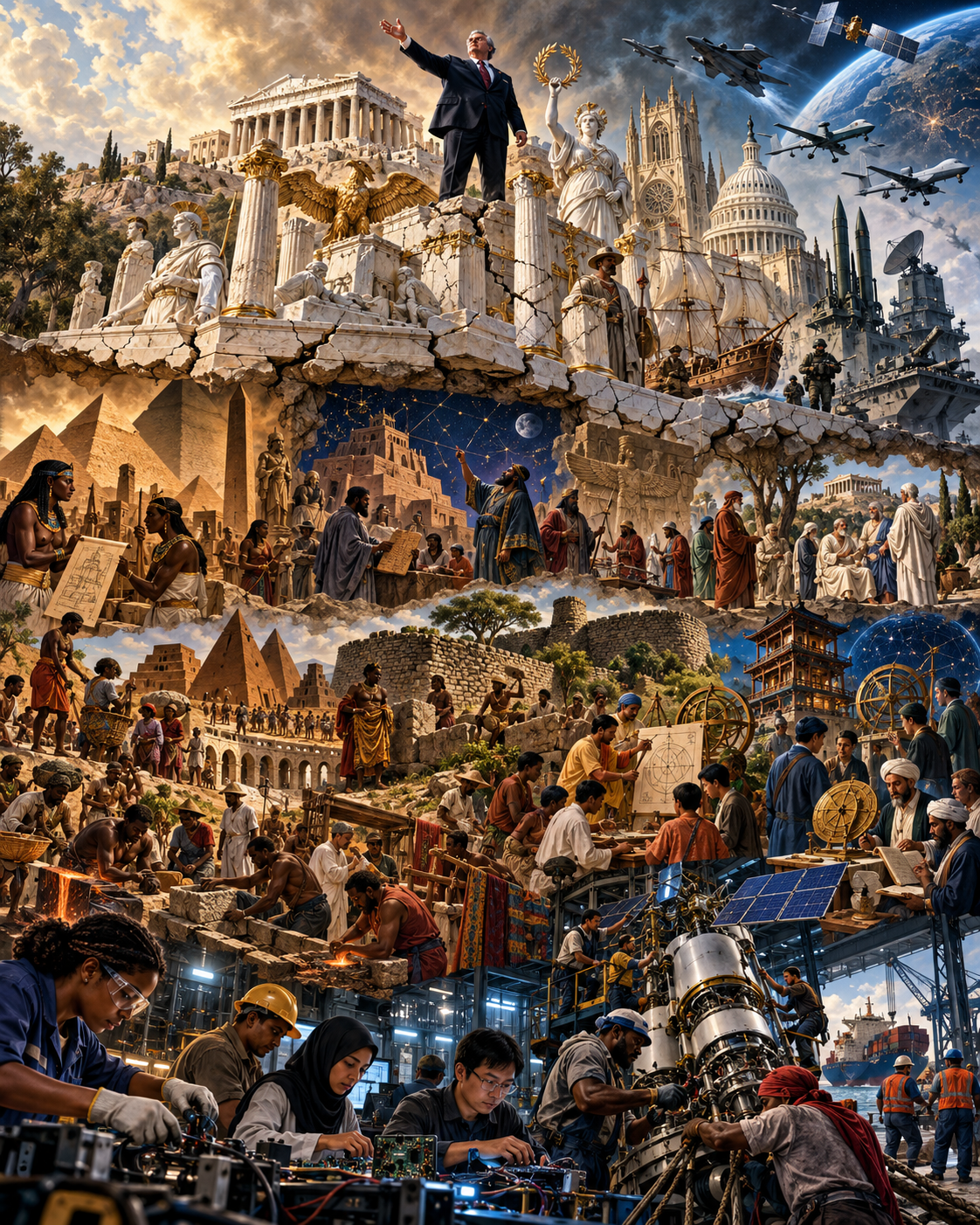
From ancient Greece to modern America, Marco Rubio manufactures a Western inheritance that turns conquest into greatness and empire into civilization. The real history runs through African and Asian achievements, colonial plunder, socialist revolutions, and anti-colonial struggles that shattered Europe’s imperial supremacy. Behind Washington’s civilizational mythology stands a historically constructed imperial bloc fighting to preserve its command over labor, resources, technology, and military power. But the peoples who built civilization and fought to liberate themselves from colonial domination remain the force capable of reclaiming humanity’s future.
Prince Kapone | Weaponized Information | October 12, 2026
A Family Tree Built for Empire
On October 7, 2026, Secretary of State Marco Rubio stood on the Pnyx in Athens and delivered a civilizational manifesto for American imperial power. Beneath the Acropolis, he assembled philosophers, emperors, conquerors, saints, and scientists into one magnificent Western family. Greece became its birthplace, Rome its political inheritance, Christianity its spiritual destiny, and the United States its rightful heir. Twenty-five centuries of conflict, conquest, and historical transformation disappeared into a genealogy conveniently ending in Washington. Quite a family reunion. Humanity supplied the achievements, but the empire claimed the inheritance.
Rubio’s first maneuver is to transform historical influence into inherited superiority. Curiosity, rational inquiry, ambition, courage, and the pursuit of excellence become distinctive Western qualities, supposedly revealed in ancient Greece and transmitted across generations. Other civilizations appear as inward-looking societies content with stability and subsistence. He offers no serious historical comparison. He simply appoints the Greeks humanity’s intellectual aristocracy and declares their alleged descendants entitled to the estate. His celebration of exceptional men supplies the social philosophy: greatness comes through competition, while concern for the “comfort of the worst” supposedly drags civilization toward mediocrity. The workers who sustained those celebrated achievements barely exist in his account.
The fraud becomes particularly revealing when Rubio decides which conquerors deserve admiration. He opens by condemning Xerxes and the Persian destruction of Athens, presenting Greek resistance as civilization defending itself against barbarism. Yet Alexander, Caesar, Charlemagne, and Cortés enter his pantheon as embodiments of heroic ambition. Persian conquest is devastation; European conquest is greatness. Apparently, invasion becomes a virtue once the invader belongs to Rubio’s preferred family.
His treatment of the Americas completes the colonial erasure. Columbus receives credit for discovery, Indigenous homelands become an “open and wild land,” and territorial conquest becomes the American frontier spirit. Rubio even identifies himself through Spanish settler ancestry, placing his own lineage inside the historical procession. The people whose lands were seized disappear so the conqueror can inherit their world without confronting those who inhabited it.
Then pagan Greece undergoes an equally convenient conversion. Greek philosophy supposedly prepares the ground for the “empire of Christendom,” which passes its intellectual inheritance through European science to modern America. Rubio compresses distinct religions, societies, and centuries of historical conflict into one continuous Western consciousness. The contradictions vanish because the destination has already been chosen.
That destination is unmistakable. Rubio moves from ancient greatness to reindustrialization, critical minerals, artificial intelligence, military expansion, and the unapologetic pursuit of national power. A modern imperial alliance acquires an ancient pedigree, and its struggle to preserve global supremacy becomes a sacred obligation to civilization. Rubio has turned history into a title deed, with Washington listed as the beneficiary. The trouble for his magnificent inheritance is that neither humanity’s achievements nor the political West he claims to represent emerged through the family history he’s invented.
The World the Parthenon Didn’t Build
Long before Athens became the marble monument of Rubio’s imagination, African and Asian peoples were measuring the earth, treating the sick, studying the heavens, and recording their histories. Around 1550 BCE, the Egyptian scribe Ahmose copied eighty-four mathematical problems into the Rhind Mathematical Papyrus, preserving methods of calculation, measurement, and geometry. The Edwin Smith Surgical Papyrus, surviving from around 1600 BCE, documented forty-eight medical cases involving examination, diagnosis, and treatment. These weren’t philosophical ornaments. They were bodies examined, fields measured, buildings raised, and knowledge accumulated by generations of African workers and specialists. Classical Greek medicine still lay centuries in the future.
Mesopotamian scribes were preserving political memory while developing mathematical methods for understanding celestial movements. The Sumerian King List organized the succession of rulers and cities long before Herodotus, mixing historical recollection with mythology and royal legitimacy. Babylonian astronomers later developed numerical observations and predictive techniques that entered Greek astronomical traditions. The history of science already crossed languages, kingdoms, and generations before Rubio’s supposedly exceptional Western mind appeared on the scene.
Greece developed within that larger world. The alphabet carrying its poetry and philosophy emerged through the adaptation of Phoenician writing. Greek speakers transformed that inheritance, notably through the representation of vowels. Persian and Greek societies fought devastating wars while exchanging goods, artistic practices, and political influences. Even the celebrated freedom of Athens rested within a society where enslaved people worked and most inhabitants lacked citizen rights. The Athenian slave economy belongs to the same history as its philosophers and democratic assemblies. Someone had to quarry the marble while the gentlemen contemplated excellence.
Africa’s development extended far beyond Egypt. Kushite rulers governed Egypt during the Twenty-Fifth Dynasty, while the later royal center at Meroë sustained monumental architecture, ironworking, religious institutions, and exchanges across the Middle Nile. The surviving Meroitic archaeological record preserves the scale of that African civilization. Centuries later, the inhabitants of Great Zimbabwe organized agriculture, cattle raising, craftsmanship, and commerce around a remarkable stone-built settlement. Archaeologist Shadreck Chirikure’s research on local production restores African households and working communities to the history of its development. Neither society requires a European ancestor to explain its achievements.
Across Asia, equally formidable intellectual traditions developed through their own institutions. Joseph Needham’s research recovered the breadth of Chinese mathematics, astronomy, engineering, medicine, and technology. Under the Song dynasty, Su Song designed a water-powered astronomical clock, documented in 1092, integrating mechanical engineering with celestial observation. In seventh-century India, Brahmagupta formulated rules involving zero and negative quantities. These achievements arose under different political and economic conditions. Their existence exposes the poverty of a history that distributes rational intelligence according to civilizational ancestry.
Rubio’s march from pagan Greece into Christian Europe conceals another immense intellectual world. Christianity itself emerged in West Asia. Greek-speaking Eastern Christianity developed through Byzantine institutions, while Syriac Christian scholars working under Islamic rule helped transmit Greek medicine and philosophy into Arabic. The ninth-century physician Hunayn ibn Ishaq and his collaborators translated and revised Greek scientific manuscripts within this multilingual scholarly environment. Muslim scholars then challenged inherited explanations and developed original knowledge. George Saliba’s history of Islamic astronomy traces innovations extending into the sixteenth century, including mathematical techniques with parallels in later European astronomy. Their precise transmission routes remain debated. Their originality doesn’t.
European Christendom’s own intellectual history was hardly the uninterrupted celebration of scientific freedom Rubio describes. In 1633, the Roman Inquisition condemned Galileo over his defense of the Earth’s motion. The same religious world contained scholars, patrons, universities, and institutions of censorship. Meanwhile, Greek lands passed through Byzantine, Latin, and Ottoman political formations, with Orthodox traditions developing a history distinct from Western Catholicism. The history of Mystras alone preserves several of these transformations. Rubio compresses this contested inheritance into a procession in which everybody apparently knew they were working toward Washington.
European colonial expansion brought another transformation. Conquerors entered lands already occupied, cultivated, and governed by Indigenous peoples. Colonial states seized territory, turned it into settler property, and compelled enslaved Africans to produce commodities for Atlantic markets. Merchants, creditors, shipowners, and plantation proprietors accumulated wealth through these relationships. Walter Rodney’s reconstruction of Africa’s colonial underdevelopment identifies the destruction and distortion of productive relationships behind Europe’s expanding wealth. Europe’s ruling powers meanwhile fought one another over colonies, markets, and territories. Two world wars made a graveyard of the supposed civilizational family.
But the colonized didn’t sit quietly awaiting another European settlement of their future. Socialist revolutions and national liberation movements challenged imperial rule across the twentieth century. In 1955, representatives of twenty-nine African and Asian countries gathered at Bandung, asserting sovereignty and cooperation against colonial domination. In January 1966, revolutionaries and liberation movements from Africa, Asia, and Latin America assembled at the Havana Tricontinental Conference, connecting struggles against colonialism, exploitation, and imperial war. These were organized forces confronting the political and economic relationships through which foreign powers commanded their countries.
Rubio himself acknowledged their historical impact. In his February Munich address, he described European colonial empires entering terminal decline, accelerated by communist revolutions and anti-colonial uprisings. The peoples who fought to break colonial domination appeared in his account of Western retreat. Yet the twentieth century didn’t simply replace European colonial rule with universal economic independence. The United States emerged as the leading capitalist power, and the postwar Atlantic order developed new military, commercial, and political institutions.
Greece offers the most revealing example. After resisting fascist occupation, Greek workers, peasants, and communists confronted the reestablishment of bourgeois political authority. During the 1946–1949 civil war, the Democratic Army of Greece fought a government supported first by Britain and then decisively by the United States. The Communist Party of Greece preserves this history as a struggle over class power and the country’s political future. Greece subsequently entered NATO in 1952, and American military bases followed under a bilateral agreement in 1953. Modern Greece’s place inside the Atlantic alliance was established through political conflict, foreign intervention, and state decisions, not through an uninterrupted inheritance from Pericles.
On October 7, 2026, that modern relationship acquired further commitments. The U.S.–Greece strategic statement announced $4 billion in Foreign Military Sales supporting Greek military modernization, alongside cooperation involving defense industry, advanced computing, cybersecurity, energy, and investment screening. NATO had already unveiled major procurement initiatives connecting governments, manufacturers, and financial institutions. These are agreements and announced programs, not fulfilled contracts. But their material priorities are unmistakable. Where Rubio sees an ancient civilization awakening, the historical record shows a modern alliance arranging weapons, technology, energy, investment, and military cooperation on the very ground where he has summoned the ghosts of Greece.
III. The Empire Puts Its Name on Humanity’s Work
The most revealing thing about Rubio’s civilizational mythology isn’t what he gets wrong about ancient Greece. It’s what his version of history makes possible in the present. A military and economic alliance assembled through modern imperial struggles is presented as the living continuation of a civilization born thousands of years earlier. The historical relationships that produced its power disappear, leaving Western supremacy looking like the natural reward for inherited greatness. Rubio has reversed cause and consequence. The empire’s accumulated power becomes proof of its superior civilization, while that supposed superiority becomes the justification for preserving the empire’s power. History has been turned into a mirror in which the ruling class admires its own reflection.
Samir Amin exposed the intellectual architecture of this deception. Eurocentrism doesn’t merely forget that other peoples made history. It reorganizes the development of humanity until European capitalism appears as the inevitable destination of everything preceding it. Societies founded upon different property relations, different forms of labor, different religious institutions, and antagonistic ruling classes are stitched together into one continuous Western personality. Their actual contradictions must disappear because the conclusion has been decided in advance. The result is an extraordinary historical performance: a capitalist empire claims descent from societies that never possessed its economic system, its political institutions, or its conception of property. Apparently, civilization can inherit backward as well as forward, provided the beneficiaries have sufficient military power.
But civilization has never developed independently of the people whose labor sustains it. Intellectual achievement requires social organization, accumulated experience, productive capacities, and the material means to support inquiry. The division between those who perform physical labor and those afforded the opportunity for specialized intellectual work is itself a historical social relationship. Under class societies, the ruling groups often appropriate the achievements of the entire productive community as evidence of their own greatness. Rubio reproduces that operation on a world scale. What earlier ruling classes accomplished within particular societies, the modern imperial bloc claims across the whole history of humanity. Collective achievement is transformed into the property of a privileged historical subject.
The material foundations of European predominance expose the deception. Colonial expansion wasn’t the outward expression of a naturally superior civilization. It reorganized existing societies through conquest, dispossession, coerced labor, and the concentration of wealth. The accumulation of capital and the development of productive power were bound to unequal relationships enforced across continents. Imperial violence secured the conditions under which particular ruling classes could acquire property, command labor, and expand their control over commerce and production. The resulting concentration of power then furnished the ideological evidence of Western greatness. The relationship is beautifully convenient for the conqueror: first seize the wealth, then cite your possession of it as proof that history intended you to have it.
Yet capitalist accumulation didn’t produce one harmonious Western ruling class. The same drive toward expansion generated competition among imperial powers over markets, investment, territories, and the conditions of profitable production. Their supposed civilizational unity couldn’t abolish the antagonisms built into their economic relationships. The modern Atlantic bloc emerged not because those contradictions vanished, but because war, revolutionary challenges, and the changing balance of capitalist power created conditions for a new organization of imperial leadership. American predominance became the basis for cooperation among ruling classes whose interests overlapped without becoming identical. The political West was therefore a historical arrangement for managing power and contradiction, not the reunion of an ancient family. Greece’s contested incorporation into that order exposes what Rubio’s marble scenery conceals: alliances are made through class struggle, political decisions, and material force.
But imperialism encountered a contradiction more threatening than rivalry among its own ruling classes. The peoples whose labor and resources sustained colonial accumulation began overturning the political relationships through which that accumulation had been organized. National liberation and socialist revolutions were not disturbances occurring outside the history of civilization. They were struggles over who possessed the authority to direct society’s development. Amílcar Cabral understood that a people deprived of control over its productive life had been deprived of the power to make its own history. Liberation therefore meant more than changing the nationality of the officials occupying government buildings. It meant confronting the relations that placed land, labor, production, and the direction of social development under external command.
Here the historical movement turns against the empire. Colonial domination developed productive capacities while subordinating their development to the interests of the colonizer. It helped create social forces capable of challenging that subordination. Workers, peasants, revolutionary organizations, and liberation movements confronted the very structures that denied them political and economic control. Their victories destroyed important forms of colonial power and transformed the international order. Yet the destruction of direct colonial government didn’t automatically abolish the capitalist relationships through which exploitation could continue. Liberation negated a historical form of domination while opening a new struggle over the material foundations of independence. The imperial system couldn’t simply continue unchanged, but neither had all the conditions of its reproduction disappeared.
Kwame Nkrumah and Frantz Fanon examined this contradiction from inside the struggle against colonialism. Political independence could coexist with external financial and economic command, while sections of the domestic bourgeoisie could acquire state authority without transforming the productive relationships inherited from colonial rule. Imperial domination could therefore survive through new mediations: capital, credit, investment, commercial dependency, military relationships, and alliances with local ruling interests. This wasn’t merely colonialism wearing a different uniform. The old relationships had been challenged and transformed, compelling imperial power to operate through altered institutions and class arrangements. The distinction matters because the struggle had produced real historical victories, even where the emancipatory possibilities of those victories remained constrained by capitalist property and international dependency.
That is the contradiction Rubio’s two speeches struggle to conceal. In Munich, the revolutionary destruction of colonial supremacy appears as Western decline. In Athens, renewed Western power appears as the necessary defense of civilization. These aren’t disconnected expressions of historical nostalgia. Together they reverse the meaning of liberation. The weakening of imperial domination becomes a civilizational catastrophe, while the effort to restore its international command becomes humanity’s historical duty. The colonized are permitted a place in Western history as conquered subjects, sources of labor, or recipients of enlightenment. Once they organize to determine their own future, their emancipation becomes evidence that civilization is losing its rightful authority. Nothing exposes the class content of Rubio’s mythology more clearly than the identities of the people whose victories he places on the wrong side of history.
My conception of imperialist recalibration begins with this historical transformation. The problem confronting American imperial power isn’t simply that rival states possess growing influence. It’s that the reproduction of international domination depends upon relationships that have become more contested, costly, and difficult to command. Capital requires access to labor, resources, markets, infrastructure, and technological systems, but the conditions of that access are shaped by sovereign states, competing capitals, organized workers, and peoples resisting subordination. Imperialist recalibration is the attempt to reorganize those conditions without surrendering the underlying relations of exploitation and command. The American-led bloc seeks to defend its concentrated advantages through new combinations of industrial investment, financial power, technological control, military integration, and political dependence. Its inherited supremacy can no longer be taken for granted, so its institutions must work harder to reproduce it.
Samir Amin’s five monopolies reveal how the pieces reinforce one another. Technological superiority enables control over productive methods and strategic industries. Financial command influences which capacities receive investment and which societies remain dependent upon external capital. Control over strategic resources conditions industrial development, while communications infrastructure shapes the circulation of information and the operation of modern production. Military power protects and enforces international arrangements favorable to the ruling interests commanding these systems. None operates independently. Their combination allows concentrated capital and imperial states to exercise power far beyond the boundaries of their own productive territories. The struggle concerns the organization of the world economy itself: who supplies the labor, who possesses the resources, who owns the machinery, who directs investment, and who commands the instruments capable of enforcing those relationships.
Now Rubio’s appeal to Western greatness acquires its actual social function. The labor and knowledge required for technological development are collective, accumulated across generations and societies, yet the resulting capacities operate within definite relations of ownership and state command. Workers manufacture equipment they don’t own. Engineers develop systems whose purposes they may not determine. Public resources support industrial and military projects while corporate and state institutions concentrate authority over their deployment. These aren’t accidental injustices interrupting an otherwise harmonious technological civilization. They express the contradiction between increasingly socialized production and the concentrated capitalist and imperial control of its results. Rubio dissolves that contradiction into a supposed common inheritance, inviting the worker, the weapons manufacturer, the taxpayer, and the general to celebrate themselves as equal beneficiaries of Western greatness. One produces the machinery, another owns the contract, and a third orders its deployment. Civilization, apparently, has settled the matter by declaring everyone family.
But the family remains divided by class, and the imperial alliance remains divided by competition. The drive to strengthen military and industrial capacity concentrates resources while intensifying struggles over their allocation and control. Technological development increases humanity’s productive possibilities while enabling new systems of surveillance, military coercion, and domination under existing property relations. These developments intersect with the wider process of technofascist consolidation in the imperial core, without making every military innovation proof of a completed technofascist order. Meanwhile, expanding productive capacities beyond Western control challenge established monopolies without guaranteeing that their new owners will abolish exploitation. Multipolarity can disrupt imperial hierarchy; socialism requires a transformation of the social relations through which productive power is owned and directed. Neither the decline of one empire nor the ascent of another automatically emancipates the workers who sustain them.
And therein lies the contradiction Rubio’s mythology cannot resolve. The achievements he claims as Western inheritance arose through the collective development of humanity. The power he seeks to preserve was accumulated through historical relationships of exploitation and domination. The peoples whose liberation disrupted those relationships have already demonstrated that imperial arrangements are neither eternal nor invincible. The ruling bloc Rubio represents must therefore claim historical necessity for an order whose actual existence depends upon continuing political struggle, material resources, and organized coercion. Its civilizational genealogy disguises contingency as destiny, class power as universal interest, and imperial restoration as the defense of human progress. Beneath the marble stands a system that needs the labor of humanity while denying humanity collective command over what that labor produces. The future will not be decided by which rulers can invent the oldest ancestors, but by the struggles over who owns the world people continue to build.
History Belongs to the People Who Make It
The peoples who broke colonial rule didn’t win their freedom by begging the empire to acknowledge their humanity. They organized workers, mobilized communities, challenged colonial authority, and fought to reclaim the conditions of their own development. That history gives the present struggle its direction. Rubio wants the empire to remain the custodian of civilization’s past and the commander of its future. Both claims must be contested wherever ruling institutions reproduce them, beginning with the schools that teach conquered peoples to admire their conquerors. Educators, students, and working-class communities can use UNESCO’s General History of Africa to organize public education, confront Eurocentric curricula, and demand that African civilizations be taught as makers of world history. The objective is institutional change, not another ceremonial invitation to the margins of somebody else’s history.
But reclaiming historical credit means little if the same ruling interests retain command over the laboratories, factories, and technologies that determine humanity’s future. Workers produce the computing systems, communications infrastructure, and industrial machinery that corporations and governments turn toward military domination. The No Tech for Apartheid campaign, developed by Google and Amazon workers challenging Project Nimbus, demonstrates how employees can organize against particular contracts and defend colleagues facing retaliation. Its immediate struggle concerns a specific project, but the class question reaches far beyond it. The people whose intelligence and labor make technological power possible must organize collectively to contest how employers use it. An engineer can build the machinery of the future while remaining completely dispossessed of the authority to decide what that machinery does.
Follow the money and the same contradiction appears in public institutions. CODEPINK’s Divest from the War Machine campaign gives students, workers, and communities an organized means of examining institutional investments in weapons corporations, demanding disclosure, and pressing for divestment. Government procurement requires a separate struggle over public expenditure and military contracts. Both expose the priorities of an order that finds enormous resources for instruments of destruction while treating working people’s needs as perpetual budgetary inconveniences. Apparently, civilization can afford another generation of weapons more readily than it can afford the people building them.
In Greece, the living descendants of the people Rubio claims as his civilizational ancestors have already challenged Washington’s plans. The Greek peace movement, including the Greek Committee for International Détente and Peace and participating labor organizations, has opposed deeper American and NATO military entanglements. International solidarity means supporting their organized opposition to foreign military infrastructure and the diversion of national resources toward imperial priorities. Across Africa, the Black Alliance for Peace and its U.S. Out of Africa Network likewise organize against AFRICOM and American military domination. These struggles confront actual institutions of imperial command, not merely the language used to excuse them.
The lesson running from anti-colonial liberation to the present is that history changes when organized people acquire the power to change its material conditions. Challenge the curriculum that erases their ancestors. Organize the workers whose labor sustains technological domination. Contest the investments and public expenditures feeding militarization. Stand with peoples resisting foreign military command over their countries. Rubio can keep his marble procession of emperors and conquistadors. Our task is to confront the institutions through which their modern successors command land, labor, resources, and knowledge, and build the collective power to put humanity’s productive capacities in the hands of those whose lives and work make them possible.


Leave a Reply