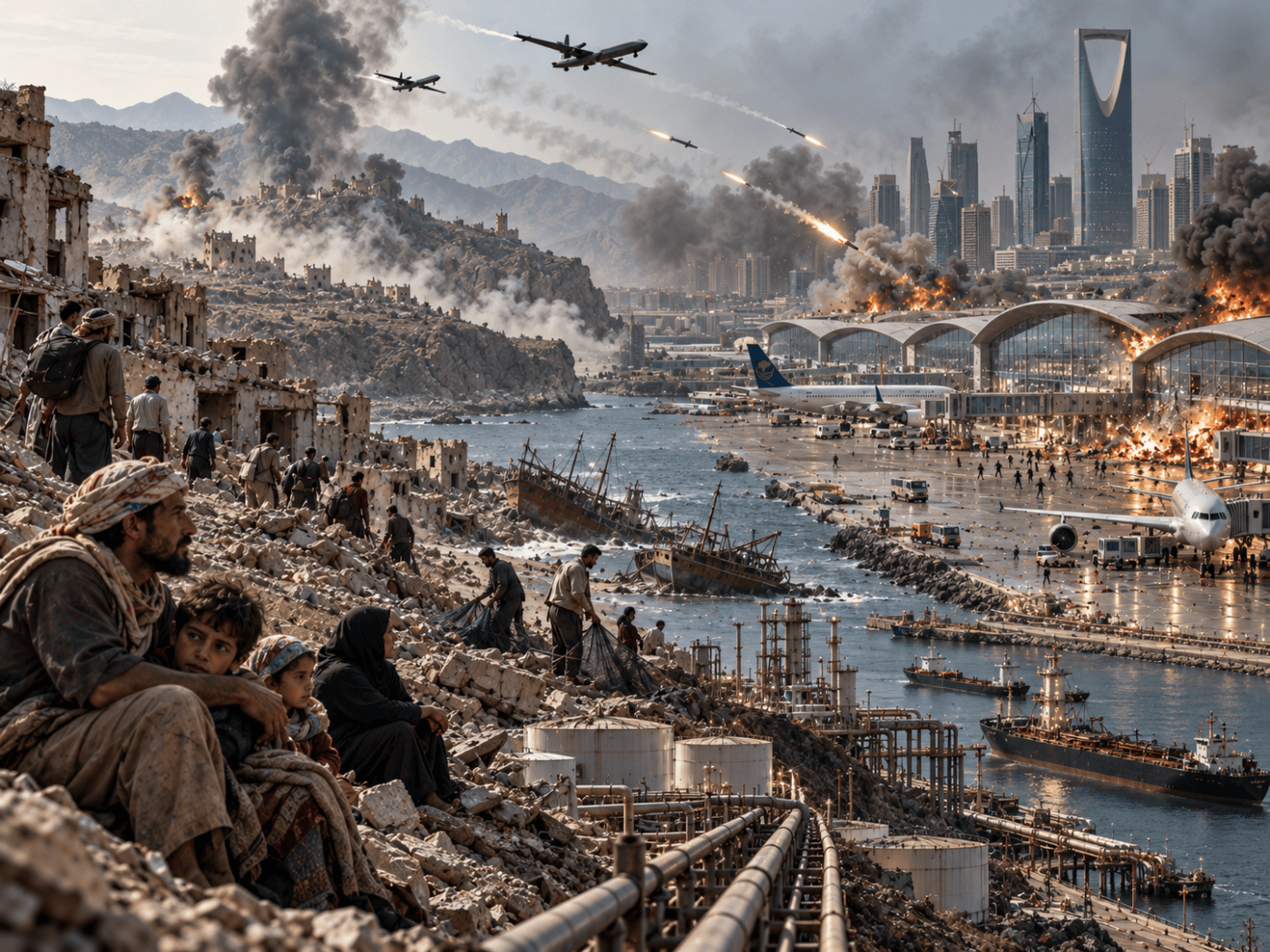
The New York Times turns Saudi Arabia’s long war against Yemen into a crisis of frightened investors, endangered airports, and a crown prince struggling to protect his ambitions. Beneath that royal predicament lies a century of struggles over Yemeni land, labor, economic independence, and the foreign powers determined to dominate them. The monarchy poured petroleum wealth into a glittering commercial future while helping sustain a war whose consequences now threaten the very infrastructure that future depends upon. Behind the bombs stand arms corporations, government contracts, and imperial military support, while Yemen’s workers and communities continue fighting for the means to rebuild their country and determine its future.
Prince Kapone | Weaponized Information | October 12, 2026
I. The Kingdom at the Center of the Story
Vivian Nereim opens her October 11 report with a shattered passenger terminal in Riyadh: at least twelve dead, hundreds wounded, travelers caught in a war they didn’t choose. Within two sentences, however, the crown prince has pushed his way to the front. Mohammed bin Salman has “few options” against an enemy his own war failed to defeat. People are dead, families are shattered, but the story settles around the troubles of the man on the throne. The question becomes how to get his kingdom out of the mess its war helped create.
Nereim calls this Saudi Arabia’s “faraway war in Yemen,” now brought home. Faraway for whom? Certainly not the Yemenis living beneath Saudi bombs. Saudi aircraft crossed that border for years, bringing death into homes, schools, and the places where people worked. Nereim records the catastrophe, the hundreds of thousands dead from the war and its consequences, and the school bus Saudi aircraft bombed in 2018. But look at what she does with that history. Yemen’s destruction explains why the kingdom cannot easily crush its enemy. Riyadh’s suffering becomes the problem that needs solving. The country under the bombs supplies the background; the kingdom dropping them gets the story.
Then comes the money, and suddenly the danger has a price the powerful understand. Saudi Arabia wants to become a “global hub for business and tourism.” An investment summit is approaching, executives might stay away, and a damaged airport might send their money elsewhere. Nereim quotes F. Gregory Gause explaining the risk. Here is the obscenity, laid out in respectable language: ruined Yemeni livelihoods explain how the Houthis keep fighting, while frightened investors threaten Saudi Arabia’s future. Yemenis have already lost their homes, their wages, their children. Those losses belong to the scenery. The possibility that a wealthy executive might cancel his flight becomes an emergency.
The proposed solutions follow the same royal logic. Yasmine Farouk explains that Riyadh wants to weaken Ansar Allah before negotiating. Gause suggests Washington secure promises from Iran to stop Houthi attacks. Yemen’s future is passed between foreign capitals as though the people who live there require somebody else’s permission to decide it. Abdulghani al-Iryani of the Sana’a Center cuts into the monarchy’s boasts of invulnerability, but even that sharp criticism leaves the article circling the palace. When it comes time to discuss peace, Riyadh, Washington, and Tehran hold the tools. Yemeni demands become obstacles those powers must manage.
Nereim says the militia has “little to lose.” Years of destruction are turned into a reason why further punishment might not work. But Yemen is full of people who still have everything to fight for: a harvest, a paycheck, a school their children can reach alive, a home they can rebuild, a country they can govern themselves. Saudi bombing did not erase those needs or the people carrying them. The article leaves us worrying about the kingdom’s airport and investment plans when the question underneath is much larger: who gets to decide how Yemenis live, work, and rule their country? The monarchy’s war tried to impose an answer. Its failure is what haunts this story.
II. The Country They Tried to Break
Saudi interference in Yemen didn’t begin when the warplanes arrived in 2015. Long before that, rulers fought over the frontier while families fought to hold on to their land, wells, grazing grounds, and roads to market. The 1934 Treaty of Taif formalized Saudi claims to Asir, Jizan, and Najran, drawing a border through communities whose lives reached across it. People continued crossing under customary arrangements. Isa Blumi follows this history in Destroying Yemen (pp. 48–50). The 2000 Treaty of Jeddah fixed the boundary more firmly and tightened the rules for crossing, while preserving grazing and water rights within a twenty-kilometer strip along part of it. Later Saudi border barriers brought fresh disputes. Officials could admire a settled line on a map. A family trying to reach its water or pasture had to live with what that line meant.
Yemeni workers also built a measure of independence with the wages they earned abroad. During the 1970s, they traveled to Saudi Arabia and other Gulf countries and sent money home. Under Ibrahim al-Hamdi, Local Development Associations pooled those earnings with local contributions and communal funds to build roads, schools, and water systems. Blumi describes communities putting their money to work without waiting for foreign creditors or officials in the capital to tell them what they needed (pp. 122–128). Local big men still carried weight, and Sheila Carapico’s research shows that merchants profited from imports while much of the money went toward consumption. But workers and villagers had shown they could build something with their own earnings and judgment. International development agencies pushed finance and plans controlled from above. At stake was a plain question: would Yemeni wages build what Yemeni communities needed, or what somebody else’s development office prescribed?
Unification in 1990 brought together two countries with different histories and different rules over who owned what. Under Ali Abdullah Saleh, business privilege, military command, and favors from the president became tangled together. The 2011 popular uprising challenged that order. The Gulf-backed transition answered by installing Saleh’s deputy, Abd Rabbuh Mansur Hadi, through an election with one candidate and granting Saleh immunity. Such was the democracy offered to people who had risen against the old government: its deputy in office and its president protected from prosecution. Promised elections never arrived. A proposed six-region federation deepened fights over land and resources, while fuel-price increases piled more hardship onto ordinary people. Ansar Allah, forged through successive wars in Sa’dah, entered Sana’a in September 2014 alongside military forces tied to Saleh. Helen Lackner traces its rise through these Yemeni struggles, shifting alliances, and later Iranian assistance. Tehran didn’t manufacture the grievances that brought people into the fight.
In March 2015, Mohammed bin Salman, then Saudi defense minister, launched the coalition war to restore Hadi, sustained by American and British military assistance. The bombs struck the things people needed to stay alive. Drawing on Yemeni agricultural records, Martha Mundy documented roughly 180 attacks on farms and cultivated land in the first eighteen months. Fisheries records counted 220 fishing boats destroyed by the end of 2017. Roads, markets, food stores, and water systems were hit too. A ruined farm meant an empty table and lost earnings; a wrecked fishing boat took away both a family’s food and its livelihood. Then, after the central bank was moved to Aden in 2016, teachers, medical workers, and other public employees across the north lost their salary payments. People were battered by bombs and deprived of the money they needed to survive the wreckage.
Restoring Hadi hardly exhausted the monarchies’ ambitions. Susanne Dahlgren documents Saudi and Emirati struggles over southern Yemen’s armed allies, ports, and oil. The Emirati-backed Southern Transitional Council pushed into oil-rich Hadhramaut in December 2025 before Saudi-backed forces drove those gains back. Discussions resumed in 2026 over a proposed Saudi pipeline through Hadhramaut and al-Mahra to the Arabian Sea, potentially giving Saudi oil a route beyond Hormuz and Bab al-Mandab. The proposal remains a proposal; the record establishes neither a completed pipeline nor a direct link to October’s offensive. But it shows what else the rulers see when they look at Yemen: territory through which oil might flow and ports through which wealth might pass. Southern people have their own history of demanding self-determination, and their future cannot be reduced to the competing appetites of two monarchies.
Meanwhile, Yemeni labor keeps crossing the frontier. September research estimates that Saudi Arabia accounts for 61 percent of Yemen’s formally recorded incoming remittances. Roughly three-quarters of that income now pays for food, rent, and healthcare. Money that might once have helped build a road or open a business goes toward getting a family through another month. Rival central banks, different exchange rates, and banking restrictions tied to sanctions make even those transfers uncertain. A Yemeni worker can spend his days raising buildings in Saudi Arabia while his family struggles to receive the wages he earned with his own hands.
The airport confrontation grew out of another round of attacks. On July 13, Yemeni government forces backed by the Saudi coalition struck Sana’a’s runway, reportedly to stop an Iranian aircraft from landing. Ansar Allah retaliated against Abha airport and announced restrictions on Saudi shipping. Fighting intensified along the Red Sea coast, and Yemenis faced another squeeze on the cost of living. The September freight estimate put the price of shipping a forty-foot container from China to Aden at about $9,000, compared with $3,650 a year earlier. Ships still passed through Bab al-Mandab, but higher insurance and shipping costs drove prices upward. Families already struggling to buy necessities faced the bill.
On October 5, the internationally recognized government launched Operation Dawn of Yemen with renewed Saudi air support. Five days later, a strike on Riyadh’s King Khalid International Airport killed twelve people and wounded 309, according to initial Saudi figures. An Indian passenger later died of his injuries, bringing the reported toll to thirteen. Civilians from several countries were among the dead. Riyadh Air had begun flights in June, tying a new Saudi business venture to the airport now under attack. The monarchy was selling a future of easy travel and expanding profits while Yemenis struggled to recover the farms, wages, schools, and homes the war had taken from them. Now the violence had reached the runway from which that glittering future was supposed to depart.
III. The War Comes Home to Its Financiers
At Riyadh’s airport, the war reached machinery the Saudi monarchy expected to keep earning money while Yemen burned. For years, Saudi aircraft crossed the border to wreck the roads, farms, markets, and buildings Yemenis depended on. Across that same border, petroleum wealth paid for airports, airlines, commercial corridors, and gleaming promises of prosperity. Yemen got the demolition crew; Saudi Arabia advertised the grand opening. The destruction fell overwhelmingly on Yemen, but military superiority never delivered the obedient neighbor the monarchy wanted. Now the kingdom’s commercial plans stand within reach of the war it helped sustain. The missiles exposed the unpaid bill behind the investment brochure.
That bill began accumulating long before the latest offensive. Drawing a border means deciding who can reach a well, graze livestock, carry goods to market, or visit the place where their family has worked for generations. A treaty can preserve a customary right on paper while handing the state the gate and the key. The same struggle runs through the roads, banks, and public treasury. Whoever controls them can put a hand around the throat of everyday life. A farmer needs water and a road to market. A worker needs wages he can receive and spend. Foreign domination gets its grip through those needs, often before the first warplane leaves the ground.
Yemeni workers once loosened that grip with money earned by the sweat of their own backs. The Gulf oil boom drew them into Saudi Arabia, where their labor helped build wealth they did not own. But some of their wages traveled home and became village roads, schools, wells, and projects people organized themselves. The worker helped build the kingdom, then sent part of his pay home to build something the kingdom did not command. Foreign development institutions preferred money passing through centralized banks and plans drawn up elsewhere. Rural communities kept substantial funds in their own hands. Local notables still wielded power, but the villagers had demonstrated an inconvenient capacity: they could identify a missing road without a foreign consultant being flown in to discover it for them.
War has eaten into that room to build. The money that once helped dig a well now buys water. Savings that might have opened a workshop pay for medicine or keep the landlord waiting another month. Unpaid salaries, rival banking authorities, restrictions on transfers, and different exchange rates put more obstacles between a worker’s earnings and his family’s needs. People burn through the money required to rebuild simply to stay alive. Here the relationship with Saudi Arabia takes its cruelest shape. Yemeni workers help raise wealth across the border while the wreckage at home makes their families more dependent on those wages. One end of the paycheck feeds accumulation; the other holds a household above the grave.
The intervention drove itself into a country already divided by unequal ownership, presidential favors, and struggles over who would govern. The Gulf-backed transition kept much of the old ruling order standing while anger grew over representation, prices, and control of territory. Then the bombing tore into the foundations on which people lived and worked. Aircraft could smash a market; they could not bomb popular consent into existence. They could sink a fishing boat; they could not make a restored government welcome on shore. Ansar Allah survived, strengthened its governing institutions, consolidated military power, and learned to fight an enemy with far greater resources. Yemeni alliances and Iranian assistance helped it do so. Years of war also hardened the movement the monarchy had set out to destroy.
The story of Iranian puppetry asks us to throw that history away. Ansar Allah has its own leadership, institutions, supporters, and aims. Iranian assistance changes what it can do; it does not explain every decision it makes. Saudi Arabia also pursues its own objectives within its relations with Washington and London. American and British assistance supplies military capabilities, while the monarchy brings enormous financial resources and ambitions of its own. The Saudi-Emirati struggle in southern Yemen shows how quickly coalition solidarity thins when oilfields, ports, and territory enter the room. Under the same banner, allied governments backed rival Yemeni forces. Their speeches promised security; their competition concerned who would hold the ground and pocket its proceeds.
The proposed pipeline to the Arabian Sea makes those stakes easier to see. Saudi planners imagine petroleum crossing Yemen to reach an export route beyond vulnerable maritime passages. On their drawing boards, Yemeni land becomes a passage for Saudi oil. On the ground, that passage runs through questions no engineer can answer with a pipe wrench: who controls the territory, who commands the infrastructure, and who receives the money? Southern communities have their own claims to their future. Foreign patrons cannot settle those claims by dividing the map among themselves. The pipeline remains a proposal, but the proposal tells us something about the place Yemen occupies in its neighbors’ calculations.
The monarchy’s grand diversification program rests on labor just as surely as a building rests on its foundations. Petroleum revenues supply the money. Workers turn it into terminals, aircraft services, buildings, and transport networks. Contractors expect payment, investors expect profits, and businesses need customers who can reach them. An airport earns nothing from a passenger too frightened to board. Here Mohammed bin Salman runs into a limit his wealth cannot abolish: he can announce another magnificent project, but he cannot issue a royal decree ordering confidence to report for duty. The intervention sought a political order favorable to Saudi power. Its failure now threatens the reliable movement of people and goods on which Saudi business depends. The monarchy helped keep the region at war and expected commerce to enjoy the peace.
Yemen’s own rulers must also answer to the people whose sacrifices sustain the country. Ansar Allah’s armed forces, governing institutions, and control of public revenues help it resist foreign command. They also place power in the hands of leaders whose interests can differ from those of a farmer, an unpaid teacher, or a household scraping together rent. Southern movements carry their own history of national struggle, while rival elites fight over resources and office. Those struggles reach into the meaning of independence. A flag over the government building does not decide who gets paid, who owns the land, or who can reach into the treasury. Sovereignty acquires substance when working people can shape what happens to the wealth they produce.
The suffering travels downward through the same class divisions. Higher freight charges reach a Yemeni household as dearer food and fewer necessities. A strike on an airport reaches a passenger or worker as injury, death, or a journey home that never arrives. Saudi intervention and the destruction of Yemeni infrastructure came before the present retaliation; that history cannot be scrubbed away to give the monarchy a clean beginning. But the people paying for the confrontation rarely occupy the offices where its course is decided. The wealthy have reserves, investments, and access to power. A working family may have one wage, one food shipment, or one ticket home. Losing any of them can tear the household apart.
Each round of war can prepare the ground for the next. Bombing feeds demands for retaliation. Retaliation threatens trade and investment. Those threats enter the calculations behind another offensive, and the wheel turns over the people beneath it. Yet governments and armed movements make these choices; no ancient hatred winds the mechanism for them. Saudi Arabia retains wealth and room to reach an accommodation. Ansar Allah has endured militarily while governing people whose livelihoods have been devastated. Negotiation and further warfare remain possibilities because the forces involved face pressures they cannot simply wish away.
Nereim’s account of Saudi vulnerability works because that vulnerability is real. The deception lies in seating the monarchy at the center of the disaster it helped create and inviting the reader to worry over its options. Riyadh’s runway has exposed a flaw in the sales pitch: petroleum wealth can buy aircraft, terminals, and polished promises, but it cannot permanently insulate them from a war across the border. Yemen’s future still turns on who controls its land, its labor, its wealth, and its government. Meanwhile, foreign military support, contracts, and profits keep the machinery of destruction supplied. The families burying their dead pay the price, while the business of providing the means continues.
IV. Where the War Gets Its Fuel
The machinery of war doesn’t run on royal speeches. Someone manufactures the bombs, maintains the aircraft, authorizes the exports, and collects the profits. Governments supply the political permission while arms companies turn public money into private fortunes. The devastation of Yemen has been enormously profitable for businesses far removed from the families buried beneath the rubble. Those profits, contracts, and government decisions expose the material foundations of foreign military intervention, and they can be challenged.
In Britain, the Campaign Against Arms Trade is demanding an end to renewed military assistance and a full Saudi arms embargo. Its research estimates that BAE Systems received approximately £20 billion from the Saudi military between 2015 and 2022. Aircraft maintenance and technical support have continued through opaque export licences that conceal much of the trade from public scrutiny. British workers and campaigners have concrete institutions to confront: licensing authorities, military contracts, and the corporations profiting from them. CAAT’s organized, nonviolent campaign provides a means to challenge those arrangements and demand their termination.
In Washington, Senate Joint Resolution 216, introduced in September 2026, seeks to prohibit a proposed shipment of American bombs, guidance kits, and associated military services to Saudi Arabia. It remains before Congress, where senators can be pressed to support disapproval and publicly account for their positions. CODEPINK’s earlier Yemen campaign helped organize opposition to American weapons transfers, while its continuing antiwar work provides a broader organizing network. The Friends Committee on National Legislation has demonstrated how congressional war-powers campaigns can force recorded votes and raise the political cost of military involvement. These are distinct legal mechanisms, but both bring the machinery of American war-making before institutions that can be pressured.
The bill for destruction should also reach those who profited from it. CAAT and the Transition Security Project have proposed a windfall tax on British arms-industry profits, potentially raising £3.9 billion toward reparations, with matching public funds proposed. Meanwhile, the Yemen Relief and Reconstruction Foundation supports food, clean water, healthcare, schools, and income-generating projects. These efforts address the productive capacities that bombing, financial restrictions, and years of war have torn apart. Relief keeps people alive; reconstruction helps restore their ability to sustain themselves.
Yemen needs its wells repaired, its workers paid, its fields productive, and its public wealth returned to the service of its people. Foreign governments and weapons corporations must be confronted where they authorize, finance, and profit from continued warfare. The struggle to stop that machinery belongs alongside the struggle to rebuild what it destroyed. Political independence will have substance when Yemenis themselves can decide who controls their land, labor, revenues, and future.


Leave a Reply