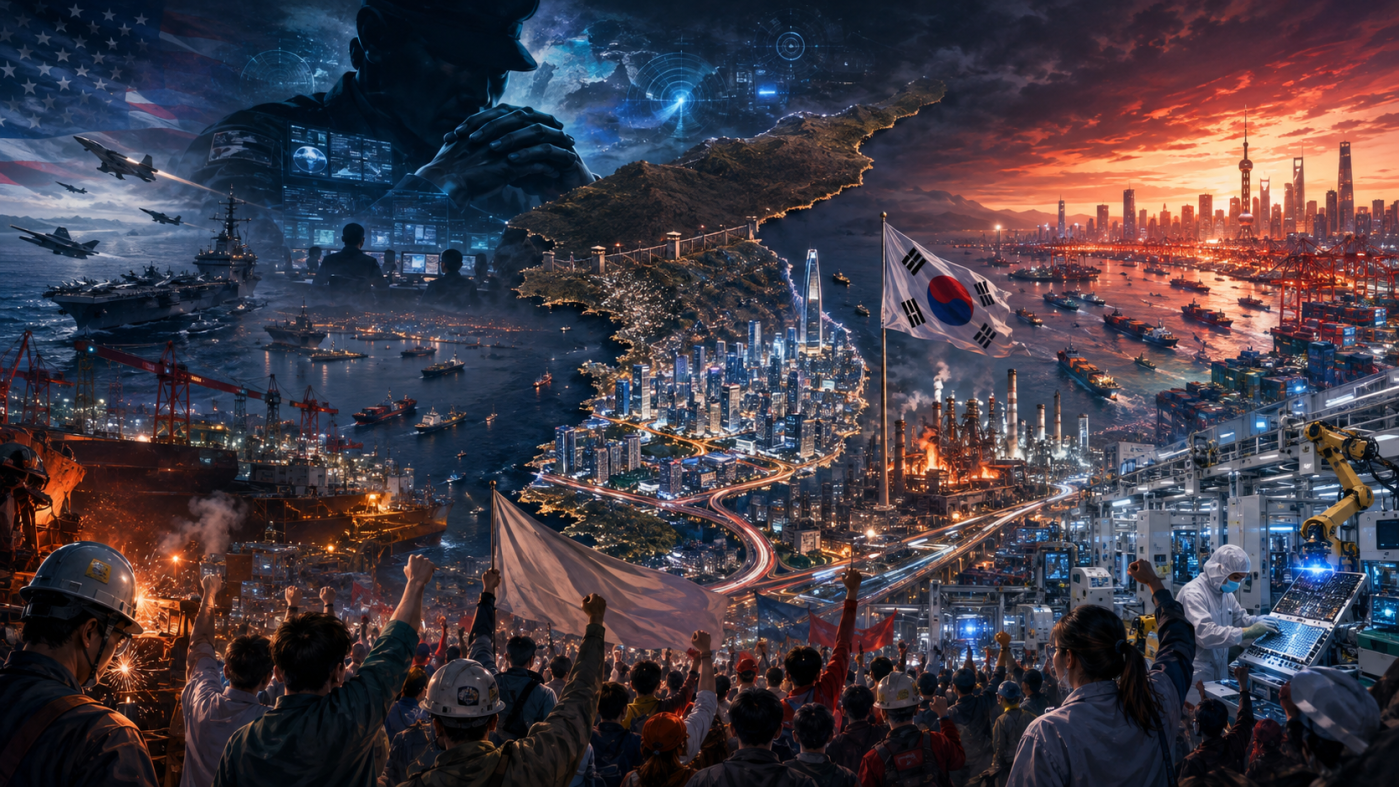
South Korea emerged from liberation not into sovereign national reconstruction but through division, U.S. military occupation, counterrevolution and a war whose unfinished settlement converted emergency command into a permanent architecture of strategic subordination. The Korean War simultaneously devastated the peninsula and revived occupied Japan as the industrial rear of the American war machine, laying the regional foundations for a U.S.-directed capitalist order in which the former colonizer and formerly colonized would later be compelled to normalize their relationship under Washington’s anti-communist command. Inside that hierarchy, American aid, Japanese capital and technology, Korean state planning, labor repression and an emerging international division of production built the capitalist “miracle” into an industrial power whose corporations, workers and productive capacities eventually exceeded the subordinate function for which the showcase had been cultivated. Today, as China-centered production collides with a U.S.-centered military system, Washington confronts the contradiction buried inside its own success: it needs South Korea richer, more technologically powerful and more militarily capable than ever while demanding that those growing capacities continue taking orders from an imperial strategy increasingly at odds with the economic geography and popular forces that South Korean development itself produced.
Prince Kapone | Weaponized Information | August 18, 2026
The Strong State Inside the Unfinished War
South Korea is supposed to be one of the great success stories of the postwar order. The country that crawled out of colonialism, division and war now builds some of the most advanced semiconductors on earth, launches warships from some of the most productive shipyards in the world, manufactures automobiles and batteries across continents, exports weapons, develops nuclear technology and sends its monopoly corporations deep into global production. Its people have also repeatedly demonstrated that they are nobody’s passive subjects. When President Yoon Suk Yeol tried to impose martial law in December 2024, the totalitarian rupture didn’t conjure a docile population waiting for respectable institutions to save it. Workers, political organizations and masses of ordinary people poured into the struggle, and the attempted seizure of power was broken. President Lee Jae Myung could therefore stand before the country on the eighty-first anniversary of liberation and speak, however imperfectly, of a South Korea that had moved from colonial dispossession through industrialization and dictatorship into what he called a government of popular sovereignty, while proposing that the peninsula move from its unstable armistice toward peaceful coexistence and eventually a peace regime.
And yet this tremendously capable state remains lodged inside a military architecture whose foundations were laid when Korea itself had barely emerged from colonial rule. South Korea still does not exercise independent wartime operational control through a nationally autonomous command structure. More than seven decades after the Korean War stopped without actually ending, the transfer of wartime operational control remains something Seoul must negotiate with Washington. As recently as August 11, 2026, more than 160 South Korean civic organizations were still demanding its immediate and unconditional return, arguing that the ability to decide questions of war and peace is not some technical privilege to be awarded after an ally passes enough examinations but a basic element of sovereignty. The absurdity almost writes its own satire: South Korea can build weapons sophisticated enough to sell across the world, but the question of who ultimately commands its armed forces in wartime remains embedded in an alliance structure in which the United States retains decisive institutional power.
The contradiction is becoming sharper because Washington is no longer asking South Korea merely to defend South Korea. Under what both governments call “alliance modernization,” the military function of the peninsula is being widened beyond the old justification of deterring the DPRK. Korea Peace Action warned immediately before the August 2026 Ulchi Freedom Shield exercises that U.S. military planning now openly incorporates the peninsula into operations extending through the First Island Chain and into the broader confrontation with China, including plans for rapidly projecting forces through the region. Its August 15 statement argued that the exercises themselves reveal the expanding connection between the U.S.-ROK alliance and Washington’s Indo-Pacific strategy against China. This is not an academic dispute about diplomatic vocabulary. If Korean territory, ports, airfields, intelligence systems and armed forces become usable components of a regional war architecture, then the question of Korean sovereignty suddenly becomes inseparable from the question of who gets to decide what Korea is being armed for.
At the same time, the economic relationship is beginning to expose another inversion. The United States that once stood at the industrial center of the alliance now increasingly needs capacities accumulated by the ally it subordinated strategically. Washington’s own November 2025 agreement with Seoul records $350 billion in planned Korean strategic investment in the United States, including $150 billion directed toward shipbuilding, alongside commitments to expand American shipyard capacity and accelerate the production and readiness of U.S. vessels. The same document records Seoul’s plan to push military spending toward 3.5 percent of GDP, purchase $25 billion in American military equipment by 2030 and provide tens of billions more in support connected to U.S. Forces Korea. Read as a Washington press release, this is partnership. Read materially, something more interesting is happening: the hegemon is increasingly mobilizing Korean capital, Korean industrial knowledge, Korean shipbuilding and Korean military expenditure to reproduce American power itself.
This would already complicate the old picture of dependency. But South Korea’s position is more contradictory still because its military alignment and its economic reproduction increasingly point in different directions. Tricontinental’s study of East Asia’s “double bind” locates South Korea inside a regional economy increasingly integrated with China while its security architecture remains organized through the United States and increasingly directed against China. Korean capital cannot simply pack up decades of accumulated production networks, markets and supply chains because strategists in Washington have drawn another colored line across a map of the Pacific. Geography has an irritating habit of refusing orders from the Pentagon.
So the problem before us is not whether South Korea is “really sovereign,” as if sovereignty were a bucket that could be measured at sixty or eighty percent full. Nor is the answer uncovered by reversing the liberal mythology and declaring Seoul a puppet whose strings explain every motion. Puppets do not build globally dominant monopoly corporations, negotiate against their patrons, generate independent accumulation strategies or produce working classes capable of overturning totalitarian political projects. Something historically stranger happened on the Korean Peninsula. A state whose postcolonial foundations were constructed under American military occupation and whose strategic order was hardened through division and war developed tremendous economic, political and social power of its own. Some dimensions of Korean sovereignty expanded enormously. Others remained structurally constrained. Still others became weapons in struggles between Korean classes themselves.
That is the contradiction hiding inside the celebrated South Korean miracle. The very order that once required a strong anti-communist capitalist state on the eastern edge of Eurasia helped create a country powerful enough that Washington now needs its capital, technology and industrial capacity to reinforce American power. Korean development did not abolish the structure of subordination. It changed the material balance inside it. And before we can understand why that old structure is becoming harder to reproduce in 2026, we have to go back to the moment when the contradiction was first made—not to the Korean War, not to the founding of the Republic of Korea, but to 1945, when Japanese colonial rule collapsed, Koreans began constructing political power for themselves, and liberation arrived carrying a question that has never completely gone away: who would possess the authority to decide what Korea became?
Liberation Was Not Allowed to Become Sovereignty
The contradiction visible in South Korea today did not begin with a treaty, an American military base or even the Korean War. It began at the moment Japanese colonial rule collapsed and Koreans confronted the elementary question that follows every genuine liberation struggle: who now possesses the authority to rule? In August 1945, Korea was not an empty administrative space waiting for Allied officers to teach it politics. Across the peninsula, Koreans moved rapidly to constitute power from below. People’s Committees emerged throughout the country, taking responsibility for public security, food distribution, local administration, Japanese property and other basic functions of government. The Committee for the Preparation of Korean Independence and the Korean People’s Republic attempted to give this local movement a national political form. Liberation had already begun turning into sovereignty.
That process was subverted before Koreans even had the chance to determine its outcome. The 38th parallel was not the product of some ancient Korean antagonism, nor did Koreans gather together and decide to divide their country into northern and southern security zones. The line was proposed by the United States in August 1945 as the boundary for accepting the Japanese surrender, shaped by the emerging strategic contest with the Soviet Union and by Washington’s determination to secure Seoul and southern Korea within its occupation zone. Moscow accepted. Koreans were presented with the result. A temporary military convenience imposed from outside the peninsula thus entered history as a territorial fact before any Korean national government had been permitted to consolidate itself.
When American troops arrived in September, they did not encounter a politically inert population. They encountered competing Korean institutions already claiming authority. The decisive question was therefore whether the occupation would recognize those indigenous organs and facilitate a transfer of power, or replace them with another state-building process. The U.S. military government chose the latter. USAMGIK declared itself the governing authority in the southern zone and refused to recognize the Korean People’s Republic as the government of Korea. Even the returning leaders of the Korean Provisional Government, men whose anti-colonial credentials long preceded the arrival of American soldiers, were permitted to return only as private individuals rather than as representatives of a sovereign Korean government.
This was the original rupture in postcolonial sovereignty. Japanese rule had ended, but the power to decide what would replace it did not pass directly into Korean hands. Washington did not simply stand outside an already formed South Korean state and pressure it. The military occupation intervened in the very process through which the political order of the South was being constituted. That distinction matters because it changes the chronology. American power was not an external limitation added to South Korean sovereignty after the fact. It was present at the moment the institutional form of that sovereignty was being fought over.
The state apparatus built under occupation reflected that intervention materially. The collapse of Japanese rule did not produce a clean institutional break with the colonial state. Substantial portions of the colonial administrative and police machinery were retained, reconstructed or repurposed under USAMGIK, including Korean personnel who had served within the Japanese system. The political function of those institutions changed, but their coercive usefulness did not disappear. Police power was redirected against communist organizations, militant workers, local People’s Committees and other forces challenging the occupation’s authority and the emerging conservative political order.
The continuity here should not be flattened into a childish formula in which Japanese colonial rule simply changed uniforms and became American colonial rule. The social relations were changing too rapidly for that. Colonial property was being dismantled and redistributed. Political organizations were multiplying. Workers and peasants were demanding transformations the Japanese state would never have tolerated. New Korean elites were competing for power. What survived was not an unchanged colonial regime but crucial pieces of an administrative and coercive apparatus that could be reorganized for a new historical purpose: containing the revolutionary and popular possibilities released by liberation while constructing a southern state tied to the emerging U.S. Cold War order.
That struggle immediately assumed a class form. Economic crisis, food shortages, inflation, labor militancy and agrarian grievances fed into a wider confrontation over who would control postcolonial society. The 1946 general strike and the uprisings that followed brought organized workers and popular forces into direct confrontation with the expanding police apparatus and military government. These were not disturbances happening alongside state formation. They were part of state formation. Every strike broken, every local committee displaced and every political organization criminalized altered the balance between competing forms of authority.
Jeju exposed that contradiction with particular brutality. The crisis on the island grew out of repression following the March 1 demonstrations of 1947, mounting hostility toward police and collaborators, deep social grievances and resistance to separate southern elections that threatened to institutionalize division. The suppression of the Jeju 4·3 struggle ultimately killed an estimated 25,000 to 30,000 people. Its chronology is decisive: the conflict began under U.S. military government before the Republic of Korea even existed. The state violence that followed cannot therefore be narrated simply as a sovereign South Korean government defending itself against insurgency. The machinery of counterinsurgency and the political terrain on which it operated had already been assembled under occupation.
The political content of Jeju also reveals why national division and class struggle cannot be separated. Resistance to the May 1948 separate elections was intertwined with anti-collaborationist politics, agrarian demands, opposition to police repression and organized left activity. For many Koreans, the issue was not simply whether one preferred communism or capitalism. It was whether liberation would end with one Korean political settlement or whether occupation lines would be converted into rival state forms backed by opposing international powers.
The Republic of Korea that emerged in August 1948 was nevertheless not fictitious. It possessed a constitution, a Korean government, political institutions and a social base of its own. Korean elites were not simply clerks taking dictation from an American commander. They were constructing a state through which their own class and political interests could be pursued. The contradictions inside that new order appeared even in its founding constitutional framework. The original constitution contained strong commitments to social justice, balanced economic development, agrarian reform and public regulation of key economic resources. These provisions reflected the enormous pressure generated by workers, peasants, the popularity of redistributive demands and the transformation occurring north of the 38th parallel.
Land reform demonstrates the point particularly well. The South Korean order was created against revolutionary forces, yet it could not survive by simply restoring the old landlord structure. Agrarian reform substantially weakened the landlord class and redistributed land to cultivators, while the redistribution of former Japanese property helped restructure ownership after colonial rule. The anti-communist state therefore had to concede part of the social terrain on which communists and peasant movements had built their strength. Counterrevolution could not merely preserve the old order. It had to transform that order enough to deprive revolution of some of its material base.
This is precisely why the history cannot be reduced to a puppet-state thesis. The southern ruling bloc possessed agency because it was constructing something real: a Korean capitalist state with its own institutions, social base and developmental possibilities. But that state was born through a constituent process in which competing Korean claims to sovereignty had been forcibly narrowed under military occupation and national division. Its sovereignty was therefore real from the beginning, but real in a particular form. It was increasingly capable of commanding Korean territory, regulating property, policing political life and restructuring society, while the larger strategic conditions under which that state existed had been determined through a geopolitical settlement Koreans themselves did not control.
The National Security Law made the emerging political logic explicit. Passed after the Yeosu-Suncheon rebellion, the law became a central instrument for suppressing left-wing organization and political opposition, carrying forward elements of the logic through which colonial authorities had criminalized threats to the existing order. South Korean sovereignty thus grew stronger precisely in the realm of internal discipline. The new state could define enemies, imprison opponents, destroy organizations and claim exclusive political authority over the South even while the nation itself remained divided and the strategic framework governing that division remained beyond its independent control.
This was the structure already taking shape before the Korean War began: a sovereign Korean state had emerged in the South, but it had emerged through a process of interrupted decolonization in which foreign occupation, domestic counterrevolution, popular struggle, agrarian transformation and national division had become inseparable. The Republic of Korea was neither an illusion nor the uncomplicated fulfillment of liberation. It was one historical outcome of a defeated struggle over what liberation might have become.
And that outcome did not settle the question of Korea. Two states now claimed authority on a peninsula whose division had hardened faster than any peace capable of legitimating it. The political conflicts suppressed in the South, the competing state projects north and south, the unresolved national question and the surrounding great-power confrontation were not disappearing. They were being concentrated. When war came, it would transform the provisional structures born from occupation into something far more durable: an armistice order in which emergency itself became institution.
When the War Stopped, the Emergency Stayed
The Republic of Korea entered the Korean War as a newly constituted state still carrying the unresolved contradictions of liberation, division and counterrevolution. The war did not create those contradictions. It detonated them. Two rival Korean states now occupied a peninsula whose division had been imposed before either government existed, each claiming a different political future for a still-unfinished national liberation. When the DPRK moved south in June 1950, it did so through a Korean revolutionary strategy that Kim Il Sung had repeatedly pressed upon Moscow rather than through an invasion plan simply handed down from Stalin. The surviving Soviet correspondence shows Kim pushing for military reunification while Stalin initially hesitated over the danger of U.S. intervention. The war was immediately Korean, civil, national and revolutionary; the intervention of surrounding powers would turn it into something larger without making Koreans disappear from their own history.
The correspondence among Kim, Stalin and Mao Zedong matters because it shatters the Cold War puppet theater through which the conflict is still commonly narrated. Materially, the relationship was enormously unequal: the DPRK needed Soviet weapons and industrial assistance, revolutionary China was only beginning reconstruction after decades of war, and the Soviet Union possessed capabilities neither could match. Politically, however, that asymmetry did not amount to Moscow commanding two Asian satellites. When Kim and Pak Hon-yong brought the Korean plan to Beijing in May 1950, Mao sought direct clarification from Stalin rather than merely accepting a Soviet decision. Stalin replied that Moscow supported the Korean proposal but treated Chinese agreement as necessary and indicated that Chinese opposition would require the matter to be reconsidered. Consultation, dependency and unequal power existed together. They were not the same thing as colonial command.
The distinction became even clearer once the U.S.-led counteroffensive crossed the 38th parallel and drove toward the Chinese frontier. Stalin urged Chinese intervention. Mao did not obey. He warned that open war with the United States could impose catastrophic burdens upon the newly founded People’s Republic, noted disagreement within the Chinese leadership and stated that the Chinese Communist Party had not yet reached a final decision. China entered only after its own leadership concluded that the destruction of the DPRK and the arrival of U.S.-led forces at the Yalu threatened both the Korean Revolution and the security of revolutionary China. The Soviet Union supplied crucial matériel and air assistance while attempting to avoid a direct Soviet-American general war. Korean, Chinese and Soviet interests were not identical, but neither were they antagonistic by definition. The survival of one revolutionary state had become materially bound to the survival of the others.
The wartime record contains disagreement precisely because these were distinct governments rather than appendages of a single command. Chinese and Korean leaders argued over offensive timing, army organization and armistice strategy. In January 1951, when Peng Dehuai proposed reorganizing several Korean corps, the Korean leadership rejected the proposal and Peng declined to impose it once Kim and his comrades refused. By 1952, Kim, Pak Hon-yong, Zhou Enlai, Peng and Stalin were negotiating military supplies, aircraft, food, troop requirements and peace terms directly; differences over tactics and the urgency of an armistice were discussed inside a common war effort rather than concealed beneath a Soviet chain of command. Earlier Weaponized Information work reconstructed this documentary record in Red Autumn. Its importance here is not to romanticize any of the three leaderships. It is to establish the actual form of the relationship before turning to the very different institutional consequences the war produced in the South.
There, the decisive change came through war itself. In July 1950, as the South Korean state faced military collapse, Syngman Rhee transferred operational control of the Republic of Korea’s armed forces to the commander of the U.S.-led United Nations Command. In the immediate emergency, the transfer answered the military conditions confronting the ROK. What matters historically is what happened afterward. The emergency did not disappear when the front stabilized. The command relationship survived, and with it survived a peculiar condition in which South Korea could possess a national army without exercising fully autonomous strategic command over that army in wartime. The durability of the arrangement became unmistakable in 1961, when the U.S. commander objected that South Korean military units involved in Park Chung-hee’s coup had been moved without authorization from the command structure under which those forces formally operated. More than a decade after the original transfer, wartime necessity had already become peacetime institution.
The armistice hardened the contradiction further. The fighting stopped in July 1953, but peace did not arrive. The Republic of Korea itself was not a signatory to the Korean Armistice Agreement. Rhee opposed a settlement that accepted continued division and refused to place his government’s signature beneath it. The ceasefire was instead concluded between the U.S.-led United Nations Command, the Korean People’s Army and the Chinese People’s Volunteers. The South Korean state therefore entered the postwar era in the strange position of exercising government over the South while the legal instrument suspending the war had been concluded through a military command in which Washington held the decisive position.
The armistice did not resolve the political question that had produced the war. It froze it. No peace treaty replaced military confrontation with a new political order. No common Korean settlement reconciled the rival states. No regional security structure displaced the wartime command system. The line separating North and South became a permanent military frontier backed by opposing states and surrounding powers. Emergency ceased to be an interruption of political life and became one of the institutions through which political life itself was organized.
The U.S.-ROK Mutual Defense Treaty gave that emergency a durable bilateral foundation. American forces remained on Korean territory, while subsequent agreements, including the arrangements that developed into the 1966 SOFA, regulated the facilities, jurisdiction and legal status of U.S. forces stationed in South Korea. Direct American military government was over. The strategic architecture produced through occupation and war was not. It had changed institutional form.
This is where South Korean sovereignty became particularly uneven. By the 1950s the ROK was not administered by an American governor. Korean officials collected taxes, enacted laws, ran ministries, commanded police and fought over the direction of the state. But the same war that institutionalized strategic dependence also dramatically enlarged the coercive power of that state over Korean society. Mass killings of suspected leftists, prisoners and members of the Bodo League became part of a wider machinery of political cleansing and counterinsurgency; later South Korean historical investigations established that state violence against civilians grew out of conflicts already underway before June 1950 and intensified catastrophically during the war. The ROK could conscript workers and peasants, imprison opponents, police political thought and mobilize society with tremendous force while decisive wartime authority remained lodged inside a U.S.-led command structure. It was not powerless. Its power was distributed asymmetrically.
Anti-communism tied the two sides of that arrangement together. A rival socialist Korean state now stood across a militarized frontier, backed by revolutionary China and supported by the Soviet Union. The enemy invoked by the southern security state was therefore not imaginary. But the existence of a real enemy made the ideological work of the security order more effective, not less. Domestic opposition could be folded into national defense; military dependence could be presented as the unavoidable price of survival; and political repression, the alliance, the police apparatus and permanent mobilization could reproduce one another under the sign of an unfinished war.
This is what earlier Weaponized Information work has called the armistice order: not simply the document signed in 1953, but the political structure through which unresolved war, militarization, anti-communism, repression and military dependency became mutually reinforcing. Its durability did not depend upon Washington issuing daily instructions to Seoul. Korean military institutions developed inside it. Conservative political forces derived legitimacy from it. The security bureaucracy reproduced itself through it. Korean ruling classes increasingly understood the alliance as part of the geopolitical framework within which their own power could be secured and expanded. Imperial hierarchy became more durable because it acquired an internal social base.
That is also why occupation, taken by itself, becomes too crude a category for what followed. Direct military government gave way to a sovereign Korean state embedded inside treaties, commands, bases and legal arrangements that preserved decisive elements of the earlier strategic hierarchy. Wartime necessity had been converted into durable architecture. The emergency had acquired offices, budgets, jurisdictions and routines.
But the contradiction did not freeze with the armistice. Washington had little use for a permanently devastated capitalist frontier facing the DPRK and revolutionary China. South Korea had to survive, consolidate and become materially convincing as an anti-communist state. Its ruling classes wanted development for reasons of their own, but the policy space, aid, security subsidy and external support made available to them were themselves part of a Cold War strategy in which capitalist success carried ideological and geopolitical value. The order that constrained South Korean strategic sovereignty would therefore become the framework within which extraordinary productive capacity was deliberately cultivated. The next contradiction would emerge not because the subordinate state remained weak, but because the capitalist strength built inside that hierarchy would eventually become too substantial to remain politically uncomplicated.
Development Makes Its Own Contradictions
South Korea did not escape the contradictions of the armistice order by remaining weak. It changed them by becoming strong. But the strength that emerged after the Korean War cannot be understood as a purely Korean developmental project unfolding beneath an American security umbrella. The war had already reorganized Northeast Asia into a regional division of labor. Korea had been devastated and militarized while occupied Japan became the industrial and logistical rear of the U.S.-led intervention, its factories, ports and repair facilities pulled into the reproduction of American military power. Washington emerged from the war with two very differently positioned capitalist states under its strategic command: reconstructed Japan as the advanced industrial pillar of its Asian order, and South Korea as the more deeply dependent military-developmental frontier that now had to be made economically viable.
John Foster Dulles explained the logic to Syngman Rhee with remarkable candor only days after the armistice. Rhee complained that American money intended for Korean reconstruction was purchasing Japanese goods and employing Japanese technicians while Korea remained ruined. He feared that Washington was rebuilding the productive supremacy of Korea’s former colonizer while leaving Koreans dependent upon it. Dulles did not really dispute the regional hierarchy Rhee described. He answered from the standpoint of what he called the broader anti-communist front: the United States had to sustain both Japan and Korea according to the requirements of the entire Asian position rather than organize American resources solely around Korean national development. Development itself had become part of imperial strategy. Washington was deciding not merely where troops should stand, but where factories should accumulate, where procurement dollars should flow and which economies would perform which functions inside the regional order.
South Korean development would therefore proceed through a hierarchy already shaped before Park Chung-hee came to power. The agrarian restructuring after liberation had broken much of the old landlord class and expanded smallholder agriculture, while revolutionary land reform in the North and peasant demands in the South made preservation of the colonial landed order politically impossible. American support for reform was itself bound up with the need to deprive communism of one of its strongest social bases among the peasantry. The anti-communist state survived partly because revolution had forced concessions from it.
The same principle operated at the level of industrial development. Washington did not apply to South Korea the kind of laissez-faire discipline later imposed on much of the Global South. A frontline capitalist state facing the DPRK and revolutionary China could be permitted extensive planning, protection, directed credit and state intervention because its successful development served the larger struggle against socialism. American aid, markets, military underwriting and access to technology created extraordinary developmental space. But that space was regional as well as bilateral. Japan, whose industrial recovery had been accelerated by Korean War procurement, was increasingly positioned to provide machinery, technology, intermediate goods and finance to the southern Korean economy.
The 1965 normalization between Japan and the Republic of Korea gave that relationship an institutional form. It should not be remembered principally as two sovereign neighbors finally putting history behind them. Washington had spent years pressing its two Northeast Asian allies toward settlement because the unresolved colonial contradiction between Korea and Japan obstructed the economic and strategic integration of the anti-communist bloc. Korean scholarship reconstructing the negotiations describes U.S. pressure for normalization as part of a regional strategy in which Japan would assume a larger economic role in sustaining South Korea while both states were consolidated inside the American security system. Two differently subordinated states were being compelled to reconcile the unresolved relationship between former colonizer and colonized because U.S. imperial strategy required them to function together.
The settlement materially accelerated South Korean accumulation. Japan provided $300 million in grants, $200 million in government loans and another $300 million in commercial credit, while Japanese machinery, technical knowledge and industrial inputs flowed into Korean development. Part of the public package helped finance Pohang Steelworks, with Japanese steel firms providing technical cooperation. Japanese capital and technology entered automobiles, electronics and machinery as well. The former colonial metropole no longer governed Korea politically, but portions of the unequal productive geography created under Japanese empire were being recomposed inside a different hierarchy headed by Washington.
None of this reduced the Park regime to an administrator of American or Japanese instructions. Park’s state seized these externally supplied resources and reorganized them through a fiercely national capitalist project. It controlled credit, directed investment and pushed capital toward selected industries, combining protection and selective import substitution with aggressive export promotion. Banks, foreign exchange and state patronage became instruments for forcing firms to meet developmental priorities. Later heavy and chemical industrialization demonstrated how aggressively the state could redirect capital into strategic manufacturing. Korean developmental agency was real. But it operated through resources and policy space made available inside a regional order Korea itself had not designed.
The chaebol grew out of that contradiction. Hyundai could acquire foreign machinery and Japanese technological cooperation while the Korean state concentrated credit behind it. POSCO could begin through an externally financed and technically dependent relationship and nevertheless become a Korean-controlled industrial giant. Samsung could learn through relationships with more advanced Japanese firms and later become their competitor. Dependence therefore did not remain frozen. Korean planners, engineers, workers and capitalists appropriated knowledge accumulated elsewhere, reproduced it locally and gradually built capabilities that reduced portions of the hierarchy through which they had initially risen.
That development also reveals why neither “dependency” nor “autonomous development” is sufficient by itself. South Korean capitalism was neither an externally operated branch economy nor a nationally sovereign capitalism unfolding outside imperial constraints. It accumulated through a nested structure: strategically beneath U.S. hegemony, technologically and industrially beneath a reconstructed Japan in important sectors, while increasingly developing nationally rooted state and monopoly-capital capacities of its own. Subordination generated resources that Korean ruling classes could use to modify the terms of subordination without abolishing the larger system.
By the late 1960s and 1970s, another relation was developing inside that process. South Korea was becoming not only a national industrial project but a site within an emerging international fragmentation of production. Export growth leaned heavily upon labor-intensive manufacturing, while technologically sophisticated machinery and intermediate goods were often imported. Free-export zones drew foreign firms into electronics assembly and other labor-intensive stages of production performed by comparatively low-wage Korean workers. Long before neoliberal globalization universalized the model, one of its governing principles was already taking shape: strategically and technologically commanding functions could remain elsewhere while labor-intensive production was relocated to a disciplined workforce where accumulation was cheaper.
That made labor discipline more than a domestic requirement of Park’s developmental dictatorship. It became part of South Korea’s position inside an international division of labor. The state supplied infrastructure, credit and industrial policy upward while restricting independent worker organization downward. This was also occurring inside a wider Cold War effort to separate organized labor from revolutionary politics. The Korean federation that became the FKTU traces its participation in the Western-aligned international “free trade union” movement to the founding of the ICFTU in 1949, while Park’s coup later dissolved existing labor organizations and reconstructed permissible unionism beneath extensive state supervision. The postwar capitalist order did not require workers to remain completely unorganized. It required them to be organized in forms that would not challenge capitalist ownership, anti-communist state power or the geopolitical system surrounding both.
The result was a peculiar capitalist freedom. Korean capital was encouraged to accumulate. Foreign capital was encouraged to invest. Production was encouraged to cross borders. Workers were encouraged to work harder. But the freedom of Korean workers to determine what development was for remained another matter. The state-chaebol order concentrated command over accumulation while excluding organized labor from meaningful control over the wealth it produced. National productive capacity expanded dramatically without becoming popular productive sovereignty.
Park’s own search for greater military self-reliance exposed the same unevenness at the level of the state. As uncertainty grew over American commitments, Seoul pursued stronger indigenous defense capabilities and even an aborted nuclear-weapons project. The effort demonstrated a desire for greater strategic room inside the alliance, not an attempt to leave the capitalist order that had enabled Korean development. Korean ruling classes could resent subordination, bargain against particular constraints and seek greater autonomy while continuing to benefit from the hierarchy itself. Agency inside subordination did not abolish subordination.
But capitalist development has a habit of creating social forces its architects would prefer to keep as economic inputs. The same factories that turned foreign machinery, Japanese technology and state-directed capital into Korean industrial power also brought workers together by the millions. Shipyards, automobile plants, steel mills and electronics factories concentrated people who shared conditions, grievances and an increasingly obvious dependence of the entire developmental project upon their labor. The regime had built a sophisticated machinery for disciplining workers because workers were becoming powerful enough to require one.
The contradiction therefore developed upward and downward at the same time. South Korea climbed through an imperial regional hierarchy and accumulated productive capabilities that increasingly allowed Korean capital and the Korean state to bargain with the powers above them. Inside Korea, the accumulation process strengthened monopoly capital while simultaneously producing a concentrated proletariat whose growing collective power challenged the dictatorship below. The capitalist showcase Washington needed against socialism was no longer merely demonstrating growth. It was producing Korean industrial power, Korean monopoly capital and a Korean working class whose political consequences could not be contained indefinitely.
The next rupture would therefore come not because developmental capitalism had failed to transform the country, but because it had transformed it too thoroughly. By the 1980s, the authoritarian state faced an urbanized society, militant industrial workers, organized students, democratic opposition and memories of repression that could no longer be sealed inside the language of national development. The factories had done more than manufacture exports. They had concentrated a class. And when that class entered the wider democratic struggle, the state would discover that South Korean capitalism had generated a form of power neither Washington, the chaebol nor the developmental dictatorship had intended to place in workers’ hands.
Democracy Outran De-Subordination
The class concentrated by developmental capitalism now entered politics on its own terms. Gwangju had already exposed the violence beneath the dictatorship’s claim to embody the nation, but 1987 tore open the political order itself. The June Democratic Struggle forced constitutional concessions from above; workers then carried the rupture into the factories where the “miracle” had actually been made. Between July and September, the Great Workers’ Struggle unleashed thousands of workplace conflicts and rapidly expanded union organization, providing the social foundation from which the democratic labor movement would grow and, eventually, the Korean Confederation of Trade Unions would emerge. KCTU’s own history records more than 3,300 labor disputes during the upheaval and traces its 1995 formation directly to the power workers accumulated through that struggle. Development had produced a working class the developmental state could no longer keep politically contained.
That was the deeper rupture. Workers did not merely win permission to join a democracy already waiting for them. They broke through the institutional form that had organized labor as a disciplined input into accumulation. Independent unions, strikes and shop-floor power expanded beyond the narrow channels through which authoritarian capitalism had tried to render organized workers politically harmless. The dictatorship had wanted labor collective enough to run giant factories but never collective enough to ask who commanded the factories, who received the surplus or why national development required endless sacrifice from below. Once workers forced those questions into public life, South Korean democracy ceased to be simply a constitutional rearrangement among elites. Popular sovereignty had acquired an organized class force capable of imposing limits upon the state and capital themselves.
Yet democratization immediately revealed how unevenly sovereignty had developed. South Korea recovered peacetime operational control of its armed forces on December 1, 1994, ending one layer of the command relationship inherited from the Korean War. Wartime operational control remained inside the combined U.S.-ROK structure, and subsequent efforts to recover it were repeatedly postponed or made conditional upon criteria negotiated with Washington. South Korea had democratized faster than it had de-subordinated. Koreans had won far greater authority over who governed them in peacetime while the state still entered the supreme political question of war through a military architecture whose commanding structure remained deeply integrated with the United States.
The economic relation was moving differently again. By the democratic period, Korean monopoly capital had partially overcome the technological and industrial subordination to Japan through which much of its earlier ascent had occurred. The dependence did not vanish, but its form changed. Korean firms increasingly competed with Japanese capital, expanded production abroad and entered relationships that were less simply vertical than those of the 1960s and 1970s. Research on Korea-Japan economic relations describes the movement from pronounced Korean dependence upon Japanese imports and technology toward a more interdependent relationship as Korean corporations developed global production capacities of their own. Korean dependence on Japanese imports fell substantially as Korean firms expanded internationally and the two economies became more competitively intertwined. Capitalist autonomy had grown. Popular ownership had not.
That distinction became harder to miss after the 1997 Asian Financial Crisis. The IMF program accelerated financial liberalization, labor-market restructuring, corporate reorganization and greater penetration by international capital. Korean workers met the crisis not as an abstract correction of bad balance sheets but as a direct assault on employment security and the social gains wrested from the dictatorship. KCTU was already organizing around the employment crisis produced by the IMF intervention in December 1997. The developmental state had demanded generations of sacrifice so the country could accumulate; when that accumulation regime entered crisis, the people who had built it were once again expected to absorb the cost.
But the neoliberal turn cannot be reduced to foreigners imposing an alien program upon one unified Korean nation. Powerful Korean capital had interests of its own in breaking from portions of the old developmental compact. A major Korean political-economic analysis of the post-1987 transformation argues that the chaebol were among the most active domestic forces embracing neoliberal restructuring, particularly as democratization strengthened labor and loosened the state’s older disciplinary control over monopoly capital. The IMF supplied coercive acceleration from outside, but the restructuring also answered an internal class problem: Korean capital wanted greater freedom from the developmental state and new mechanisms for disciplining workers whose political power had increased after 1987.
The result was not the disappearance of the state but a change in the way accumulation was organized. Earlier internationalization had operated through protected markets, directed credit, state-selected industries and carefully managed access to foreign technology. After 1997, Korean monopoly capital moved more aggressively through financial liberalization, foreign investment, mobile production and international labor competition. The same corporations that had once depended upon the state to climb the regional industrial hierarchy now possessed greater capacity to move production, reorganize suppliers and play workers in different labor markets against one another. Korean capital had gained room to maneuver abroad at precisely the moment Korean workers had gained room to organize at home. The achievement of greater capitalist autonomy therefore contained its own class counteroffensive.
The military order changed more slowly. Roh Moo-hyun’s government pursued greater Korean authority over wartime command while accepting a simultaneous transformation of the alliance’s regional function. The debate over “strategic flexibility” made the problem explicit. KCTU warned in 2006 that the reorganization of U.S. forces around Pyeongtaek and other bases was turning forces originally justified through the defense of the peninsula into a more mobile regional apparatus whose operations could extend across the Asia-Pacific. The contradiction was concrete: the democratized Korean state possessed enough sovereign authority to negotiate, police and reorganize Korean territory, yet that authority could still be exercised to reproduce a military infrastructure whose strategic horizon extended beyond decisions made by Koreans themselves.
Moon Jae-in’s peace initiative exposed the other side of the same relation. Seoul could initiate inter-Korean negotiations, lower military tensions and assert that Koreans themselves should play the leading role in constructing peace. But the deeper security structure could not be rearranged by Seoul alone. Sanctions, U.S.-DPRK relations, combined exercises and wartime command remained embedded in the alliance. Even Moon’s promise to recover wartime operational control became trapped within a conditions-based process. People’s Solidarity for Participatory Democracy argued that preserving the Combined Forces Command after transfer risked changing the nationality at the top while leaving Korean military planning structurally tied to U.S. Indo-Pacific strategy. Formal authority could move without fully changing what the institution was organized to do.
South Korea had therefore not traveled along some straight road from dependency to autonomy. Different powers had developed unevenly inside the same society. Workers had forced open democratic space and established an organized capacity capable of checking both governments and capital. Korean monopoly firms had accumulated enough productive and technological power to reduce important forms of their earlier dependence and operate transnationally. The state possessed vastly greater administrative, diplomatic and economic capabilities than the battered republic that emerged from the Korean War. Yet capitalist power remained privately concentrated, and strategic-military sovereignty remained lodged inside institutions whose center of gravity was still outside Korea. More power had accumulated in South Korea without becoming one common national power.
Meanwhile, the regional economy through which Korean capitalism reproduced itself was changing underneath the old security structure. The industrial hierarchy through which South Korea had once climbed had been centered heavily on reconstructed Japan beneath U.S. hegemony. By the end of the twentieth century that relation had become more competitive and interdependent, while Korean trade and intermediate-goods flows were increasingly shifting toward China as China’s industrial weight transformed East Asian production. The military architecture, however, remained anchored in Washington. One historical movement was reorganizing where Korean capital accumulated. Another continued organizing where Korean strategic power belonged.
For a time those movements could remain parallel. Korean capital could deepen its place inside an increasingly China-centered regional economy while the South Korean state remained militarily embedded in the U.S.-led order. That arrangement had become possible because democracy, capitalist internationalization and military de-subordination had proceeded at different speeds. By the new century, however, the distance between them was becoming harder to sustain. The productive geography through which Korean capitalism reproduced itself and the strategic geography through which the Korean state remained organized were approaching a collision.
The Map of Production No Longer Matches the Map of War
By the twenty-first century, the contradiction had escaped the boundaries of the peninsula. South Korea’s industrial rise, the transnationalization of Korean monopoly capital and China’s growing centrality to East Asian production were reorganizing the material geography through which Korean capitalism reproduced itself. The military geography moved on a different clock. Bases, combined commands, alliance structures and war planning remained rooted in the U.S.-organized order built out of occupation, division and the unfinished Korean War. For decades Seoul could trade increasingly through one regional system while preparing for war through another. The New Cold War is the attempt to force those two maps back into alignment.
They had once corresponded much more closely because Washington had helped organize them to correspond. The Dulles-Rhee exchange examined earlier established the principle: economic development was not treated as a collection of unrelated national projects but as part of the political economy of containment. Japan’s industrial reconstruction, South Korea’s development and the allocation of American resources were fitted into differentiated positions inside a regional anti-communist system. The point here is no longer the meeting itself. It is what that meeting reveals about the original architecture. Production and military strategy reinforced one another because development itself had been organized to help reproduce the strategic order.
That was the material reality lurking beneath what Washington called the domino theory. The “dominoes” were never merely governments frightened that communist ideas might drift across borders like a contagious fever. They were industrial centers, ports, markets, labor forces, military positions and political regimes whose relation to one another determined whether the larger U.S.-centered order could hold. Containment therefore operated through political economy as surely as through bases and weapons. Industrial strength was useful when it accumulated inside a strategic arrangement Washington could command. The later crisis begins precisely because the productive forces cultivated inside that arrangement eventually developed beyond its original geography.
By 1971 the problem had already changed enough that Zhou Enlai and Henry Kissinger could discuss a different method of maintaining the same regional balance. Zhou reconstructed the Dulles-era effort to isolate socialist states while consolidating the “intermediate” countries around them. Kissinger disputed parts of Zhou’s interpretation of American intent but conceded enough of the underlying structure to make the transition visible. Under the Nixon Doctrine, regional allies would be expected to assume a larger share of the military and economic burden while Washington retained responsibility for the balance above them. The July 1971 Zhou-Kissinger conversation records this movement away from carrying every burden directly toward making allied states stronger and more responsible for sustaining the regional system. The empire was already learning that command could be centralized even while costs and capacities were distributed outward.
The same principle was developing inside production. U.S. strategic command did not require every factory, shipyard or assembly line to remain on American soil. The postwar order had already demonstrated that productive capacity located in allied territory could serve a system whose strategic center remained elsewhere. As manufacturing became more fragmented across borders, that arrangement widened beyond wartime procurement. Labor-intensive stages could be placed where wages were lower, advanced components produced elsewhere, finance organized through another center and final markets scattered across continents. By 1973, internal World Bank discussions under Robert McNamara were explicitly considering the gradual transfer of labor-intensive industries from developed to developing countries. Cold War developmental internationalization was becoming one foundation for a far more generalized international division of production.
Neoliberal globalization pushed that separation much further. Capital increasingly organized production through wage differentials, supplier networks, financial mobility and the ability to divide a single commodity chain across multiple countries. States did not disappear from this process. They built infrastructure, protected property, disciplined labor, negotiated trade access and defended the international conditions under which accumulation occurred. But the geography of production became less identical to the geography of political command. American, Japanese and increasingly Korean capital could reproduce itself through production scattered across Asia while U.S. military power continued to organize a very different regional map.
China’s industrial ascent transformed that contradiction from a manageable tension into a strategic problem. China did not simply wander into a system built elsewhere and offer cheaper labor. Decades of socialist construction had created a sovereign state with an industrial base, infrastructure, educated labor force and planning capacity that could absorb, discipline and eventually move beyond portions of foreign-dependent production. As China’s productive capabilities expanded, East Asia’s center of economic gravity shifted with them. Tricontinental documents the resulting “double bind”: China has become central to the trade and industrial reproduction of countries including South Korea and Japan even as those same states remain incorporated into a U.S.-led military architecture increasingly directed against China. The productive geography that had once developed largely beneath American strategic supremacy was no longer contained within it.
South Korea now sits directly across that fault line. Korean capital does not encounter China merely as one customer among many. Regional manufacturing, intermediate goods, markets and investment have become deeply interwoven with China’s industrial economy. Yet the South Korean state remains bound militarily to Washington. What Section V reached as an emerging divergence therefore becomes something sharper here: the geography through which Korean capital accumulates increasingly conflicts with the geography through which Korean military power is organized.
Washington’s answer has been to make strategic geography discipline productive geography. “Economic security” is the respectable phrase for a project in which supply chains, investment, technology and industrial location are increasingly judged according to their usefulness in the geopolitical struggle with China. Semiconductor policy makes the relation unusually clear. In August 2025 the U.S. Commerce Department ended license-free access to U.S.-origin semiconductor manufacturing equipment and technology for selected foreign-owned fabs operating in China and barred the licensing system from being used to expand or upgrade those facilities. Korean and other allied firms were being told, in material rather than rhetorical terms, that the location and development of productive capacity could no longer be decided solely by accumulation. National-security strategy was reaching directly into the factory network.
The military side of the same project is what appears as “alliance modernization.” Section I already established the widening function of the U.S.-ROK alliance; here its significance changes. First Island Chain planning, greater interoperability with Japan and the expanding regional use of forces stationed on the peninsula are the coercive counterpart to supply-chain restructuring. Korean peace organizations have warned that Ulchi Freedom Shield and the broader restructuring of the alliance are tying South Korea more tightly to U.S. operations extending through Japan and the Philippines and into confrontation with China. The economic map is being sorted according to strategic reliability while the military map is being widened to police the resulting alignment.
Japan makes the historical continuity impossible to miss. Washington spent the postwar era subordinating the unresolved colonial contradiction between Japan and Korea to the requirements of regional anti-communism. In 1965 that meant forcing economic normalization so Japanese capital and technology could be reintegrated with South Korean development. Today it means pressing the two countries toward ever tighter military integration against China. The form has changed, but the underlying requirement remains familiar: historical relations among Asian peoples are repeatedly reorganized around the strategic priorities of a power outside the region. The colonial question Washington treats as an irritating obstacle to trilateral efficiency persists because imperial management never resolved it. It merely demanded that Koreans operate around it.
The contemporary U.S.-ROK economic relationship reveals a second historical inversion. The investment package introduced at the beginning of this essay now looks different after the development that produced it has been reconstructed. The United States once supplied extraordinary resources, markets and military underwriting because its Asian strategy required South Korea to become an industrially successful capitalist state. Washington now openly seeks Korean investment across shipbuilding, semiconductors, energy, critical minerals and other industries defined simultaneously as economic and national-security priorities. Productive capacity once cultivated outward is increasingly being called back toward the reconstruction of the imperial center.
The hierarchy has not reversed merely because the United States needs what South Korea can produce. Washington retains overwhelming military advantages, leverage through finance and market access, extensive technological controls and the command architecture of the alliance itself. What has changed is the material burden of reproducing that hierarchy. American primacy increasingly requires industrial capacities accumulated elsewhere. Korean shipbuilding, electronics, batteries, capital and military expenditure become more important precisely because the United States cannot reproduce every strategic capacity cheaply within its own borders. “Burden sharing” is therefore larger than an argument over base expenses. It is the redistribution of the industrial, fiscal and military costs of maintaining U.S. predominance.
Dependence consequently becomes more reciprocal without becoming equal. Washington depends more heavily upon Korean productive capacity, and that gives Seoul and Korean monopoly capital greater bargaining room. Yet bargaining power inside a hierarchy is not command over the hierarchy. South Korea can negotiate over investment, weapons, technology and alliance costs while remaining embedded in a strategic system whose regional purpose is still disproportionately determined in Washington. The subordinate state has become more indispensable. Indispensability makes obedience more negotiable; it does not magically abolish the structure in which the negotiation occurs.
The Yoon and Lee governments expose two political responses to that contradiction. Yoon Suk Yeol pushed South Korea more aggressively into U.S.-Japan strategic integration, but his martial-law rupture collided with a society transformed by the very democratic and working-class struggles reconstructed in the previous section. The attempt failed because the security state no longer confronted the social terrain Park Chung-hee or Chun Doo-hwan once ruled. Lee Jae Myung inherits the same alliance architecture while attempting to reopen room for Korean initiative. His August 2026 liberation address called for peaceful coexistence, inter-Korean dialogue and movement from armistice toward a peace regime. The difference between the governments matters, but neither governs from outside the accumulated contradictions of the postwar order. One leaned hard into the regional security system; the other seeks greater maneuver within it.
Pyongyang has also changed the terms on which that order can be reproduced. Kim Jong Un’s 2024 policy turn defined relations with the ROK not through an unfinished project of one-state reunification but as relations between separate and hostile states, a position subsequently written into the DPRK’s constitutional and territorial framework. Kim’s January 2024 policy speech explicitly described the ROK as a foreign and hostile state, while Pyongyang’s later constitutional changes hardened that separation. The DPRK’s strategic position has simultaneously been strengthened by its formalized relationship with Russia, including the Comprehensive Strategic Partnership treaty ratified in 2024. These developments did not create an equivalent opposing alliance system out of thin air. They arose within and against a much older U.S.-organized military architecture that had already bound Japan and South Korea into Washington’s regional order. The armistice system is therefore no longer merely reproducing division on the peninsula; it is being absorbed into a broader Northeast Asian confrontation.
That is the historical inversion the New Cold War exposes. The U.S.-organized postwar order helped reconstruct Japanese capitalist power, strategically cultivated South Korean development and encouraged an international division of production that allowed capital to scatter manufacturing across borders without surrendering the commanding advantages of finance, technology and military power. Globalization intensified the arrangement until an increasingly integrated Asian productive economy emerged whose center of gravity was no longer Washington or even Tokyo, but China. The capitalist logic of internationalized production had begun colliding with the imperial logic of strategic control.
Imperialist recalibration is Washington’s attempt to manage the collision: restrict China’s access to strategic technologies, redirect critical investment toward the United States and politically reliable allies, deepen Japanese and South Korean military responsibilities, and reorganize supply chains around geopolitical loyalty. But the cure reproduces the disease. The United States needs South Korea more technologically advanced, more industrially capable and more heavily armed precisely because maintaining American primacy has become more materially demanding. Those same capacities enlarge the resources through which Korean capital, the Korean state and Korean popular forces can pursue interests that do not line up neatly with Washington’s.
The miracle was supposed to take orders. That was easier when South Korea occupied a far weaker position inside the regional hierarchy. It is harder when Washington itself needs Korean industrial capacity to sustain American power and when the economic geography reproduced by Korean capitalism no longer maps cleanly onto the military geography Washington inherited from the Cold War. The contradiction is no longer that a weak dependent state wants greater sovereignty. It is that U.S. primacy increasingly requires a South Korea powerful enough to help reproduce the imperial order while the accumulation of that very power makes the old terms of subordination progressively harder to reproduce.
Sovereignty for Whom?
By this point, the wrong question is whether South Korea is sovereign. Of course it is. The harder question is what kind of sovereignty exists, who exercises it, and what social purpose that power serves. South Korea possesses a formidable state, globally significant corporations, advanced industry, a powerful military, democratic institutions and a working class that has repeatedly forced its way into history. None of those facts cancel the strategic hierarchy inherited from the postwar order. Neither do they add up automatically to national liberation. Sovereignty is not a single possession stored inside the state. It is a relation of power distributed unevenly among classes, institutions and competing centers of command.
The history reconstructed here makes that distinction unavoidable. South Korea’s ruling class gained enormous room to accumulate and bargain while the state remained deeply integrated into a U.S.-centered military system. Korean monopoly capital escaped much of its earlier technological dependence on Japan and became capable of disciplining workers and suppliers across borders. Korean people broke military dictatorship and expanded democratic power from below. Yet those victories did not place the chaebol under popular ownership, dissolve the armistice order or give Korean society collective command over the strategic uses of the productive power it had built.
That is why the language of “Korean national interest” can become ideological so quickly. Which Korea? Which class? Hyundai may have an interest in access to American markets, Chinese production networks and cheap labor abroad. A Korean shipyard worker may have an entirely different interest in wages, peace, union power and whether the ship being built will carry commerce or missiles. The state may seek greater bargaining power against Washington while repressing workers at home. A government can speak the language of sovereignty while using that sovereignty to protect monopoly ownership and deepen military integration. The nation is real. So are the class divisions running through it.
This is also where the older language of puppet states and simple dependency reaches its limit. Washington did not spend seven decades issuing orders to passive Korean administrators. It did something more durable. It helped construct a system in which powerful Korean institutions, capitalists, military bureaucracies and political forces developed material interests in reproducing the alliance themselves. Imperial hierarchy survives most effectively when it does not have to be enforced from outside every morning. It survives when domestic ruling classes can derive wealth, security and geopolitical advantage from maintaining it.
That does not make the hierarchy voluntary in any meaningful historical sense. The institutions themselves were born through occupation, division, war, command transfer and a regional order Korea did not design. But history does not freeze at the moment of origin. Korean ruling classes learned to maneuver inside the structure, exploit its openings and accumulate power through it. Some now possess enough power to negotiate with Washington rather than simply receive instructions. The contradiction is therefore not between total domination and complete independence. It is between a strategic order whose commanding center remains external and domestic classes strong enough to reproduce, bargain within and occasionally resist parts of that order for reasons of their own.
Popular sovereignty stands somewhere else entirely. Korean workers did not build democratic power because monopoly capital gradually became enlightened. They built it through strikes, uprisings, sacrifice, organization and resistance to states that repeatedly invoked national survival while denying workers control over their own lives. That distinction matters now because the same industrial capacity celebrated as Korean national strength can be mobilized for radically different ends. It can reproduce chaebol profit, finance another round of military buildup and service American regional strategy. Or it can become part of a social project organized around secure livelihoods, democratic planning, peace and the needs of the people who actually created the wealth.
National autonomy can therefore improve the terrain of struggle without solving the class question. A South Korean government with greater freedom from Washington would possess more room to pursue peace with the North, resist regional militarization or choose different economic relations. That would matter. But a more autonomous capitalist state could also use the same freedom to strengthen Korean monopoly capital, exploit workers abroad and project power in ways that reproduce inequality on a different scale. Multipolarity and national development open possibilities; they do not determine their class content.
The same principle applies to the Korean national question. The division imposed after liberation has hardened over generations into two states, two political economies, two military systems and two different historical experiences. Pyongyang’s two-state turn acknowledges a reality that cannot be wished away by repeating the language of inevitable reunification. But accepting the existence of two sovereign Korean states does not require accepting permanent hostility between them. The political question is whether sovereignty will remain organized through military confrontation and bloc discipline or whether Koreans can build forms of coexistence capable of reducing the permanent emergency that has governed the peninsula since 1953.
That possibility immediately collides with the wider regional order. Washington is not merely asking South Korea to defend itself against the DPRK. It increasingly asks Korean territory, capital, technology and military power to serve a confrontation with China whose stakes extend far beyond the peninsula. Japanese remilitarization is being folded into the same structure despite the unresolved history of Japanese colonial rule. The productive forces of East Asia have become more interconnected while the political order is being pushed toward harder blocs. The contradiction is no longer simply whether Korea can become sovereign from America. It is whether the peoples of the region can prevent their accumulated productive power from being reorganized around another cycle of imperial confrontation.
There is no automatic answer coming from history. The rise of China does not guarantee socialism. The weakening of U.S. primacy does not guarantee peace. Korean capital becoming stronger does not make Korean workers stronger in equal measure. Even the defeat of authoritarian ruptures does not permanently disarm the security state that produced them. Every gain creates new terrain upon which different classes struggle over what comes next.
What the history does establish is that the old postwar order is no longer reproducing itself as effortlessly as it once did. The state Washington helped construct is more capable. The capital it helped cultivate is more powerful. The workers whose labor made the developmental project possible have accumulated their own traditions of organization and resistance. The regional economy has outgrown the industrial hierarchy within which the original alliance system was built. The institutions created to discipline Korea therefore confront forces that did not exist when those institutions were first assembled.
That is the real contradiction behind the celebrated South Korean miracle. Capitalist development gave the state more power without giving the people equal command over that power. Imperial integration built industrial capacity while limiting strategic sovereignty. Democratic struggle expanded popular power without socializing the productive wealth workers created. The old order succeeded spectacularly at producing a strong South Korea and now discovers that strength itself has become politically dangerous because it raises a question the entire postwar arrangement was designed to avoid.
Who gets to decide what Korean power is for?


Leave a comment