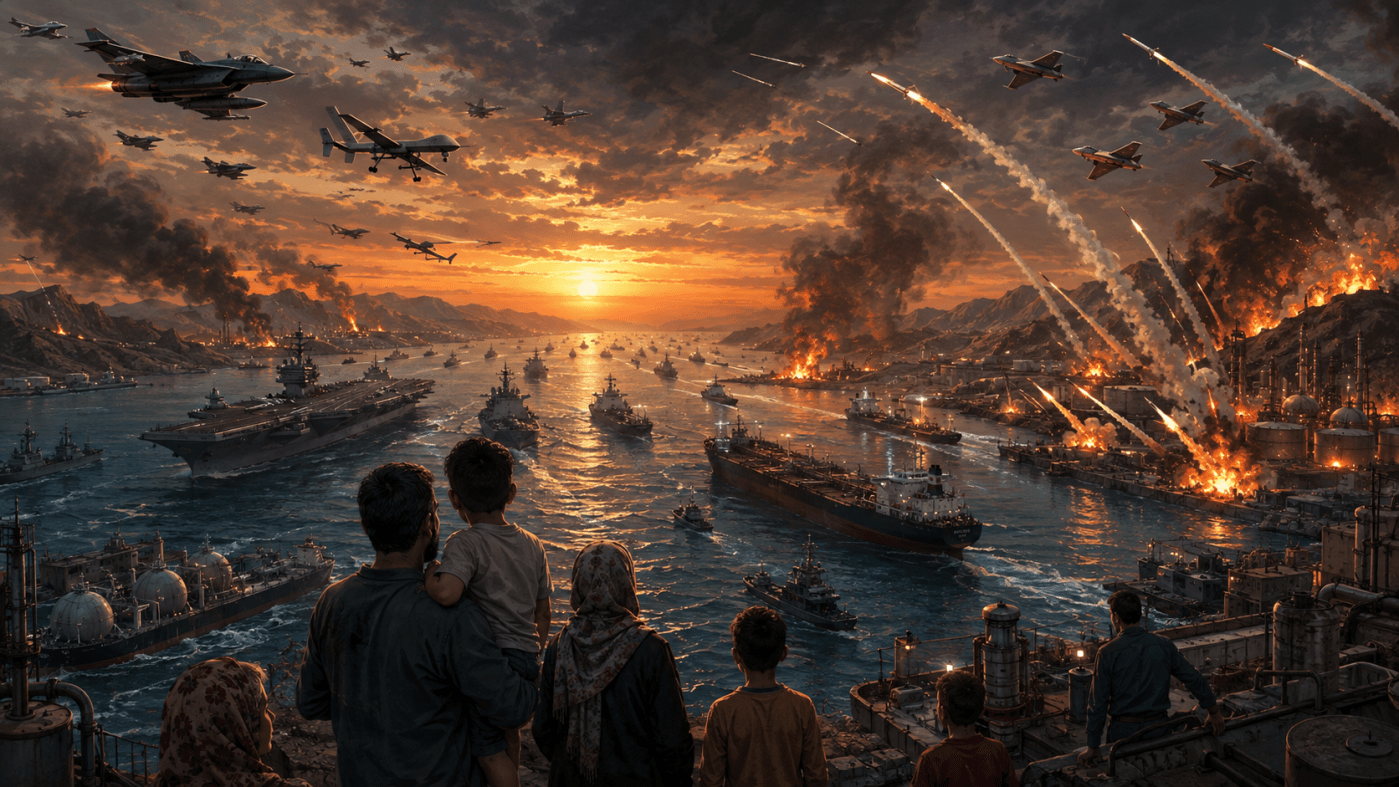
CNN admits that Washington started the war, then quietly moves that fact into the scenery so Iran’s response can reappear as the new source of danger. The chronology tells another story: Iran’s offensive doctrine preceded the August reshuffle and was hardened through war, blockade, a failed reciprocal settlement, and renewed coercion around the Strait of Hormuz. Beneath the spectacle lies the central contradiction—the more U.S.-Israeli military and economic power tries to convert superiority into Iranian submission, the more Iran develops the capacity to make domination expensive through missiles, asymmetric warfare, and leverage over the circulation of global energy. For working people from Tehran to the wider Global South, breaking that cycle means opposing the institutions that authorize, finance, normalize, and sustain a war whose costs keep traveling downward while its architects remain insulated above.
Prince Kapone | Weaponized Information | August 20, 2026
The War He Started, the Threat They Became
CNN gives away the contradiction almost immediately. In “Iran’s latest warning to the US signals the hardliners are just getting started,” Tim Lister opens by acknowledging that Donald Trump is struggling to extract the United States from “a war that he started almost six months ago.” It is a remarkable admission because the article then spends the rest of its energy making that initiating act strangely passive. Washington started the war; Iran supplies the verbs. Tehran is “devising,” “promoting,” “mobilizing,” “targeting,” “pressing” and potentially “escalating.” The United States, having started the war, becomes the environment in which Iranian aggression supposedly develops.
The chronology is built to perform the same trick. CNN declares that the “starting gun” for Tehran’s new posture came with August decrees reorganizing Iran’s security leadership. From there, the reader moves through Mohsen Rezaie, Ahmad Vahidi, IRGC declarations about “strong offensive operations,” preparations to act on “enemy soil,” missile adaptation and discussion of attacks on regional infrastructure. The article contains earlier history—the American initiation of the war, the subsequent memorandum, continuing sanctions and the naval blockade—but those facts never organize its explanatory structure. They are conditions surrounding the action. The action belongs to the Iranian “hardliners.”
The headline does additional ideological labor before the first paragraph is even read. “Hardliners” collapses institutions, commanders, strategic debates and military doctrine into a political personality type. By the time Western-based analysts are brought in to explain what Tehran “believes,” “seeks” and “may conclude,” Iran has already been rendered psychologically legible: a leadership emboldened by survival and hungry to convert it into advantage. Iranian officials appear primarily through statements demonstrating menace; outside analysts receive the authority to interpret what those statements mean.
The same compression governs CNN’s treatment of the region. Armed movements and organizations in Yemen and Iraq enter as Iranian “proxies,” allowing a complicated field of relationships to be narrated as an extension of Tehran’s agency without the article having to distinguish influence, alliance, support, coordination or command. Even CNN’s own acknowledgment that Iran may be shifting greater weight toward its direct missile and drone capabilities does not unsettle the vocabulary.
The result is more sophisticated than simply pretending Washington never attacked Iran. CNN admits the initiating aggression and then demotes it. Cause becomes backdrop. Response becomes initiative. By the end, the political question placed before the reader is no longer why a war initiated by the United States has produced this increasingly dangerous confrontation, but what must be done about an Iran whose “hardliners,” apparently, are only getting started.
The Clock Started Before August
The first correction is chronological. Iran’s turn toward a more offensive military doctrine did not begin with the August command reshuffle. On February 2, 2026, then-Chief of Staff Abdolrahim Mousavi said Iran had already revised its defense doctrine after the 2025 war, emphasizing faster responses and asymmetric operations. After the February 28 U.S.-Israeli attack, senior commander Ali Abdollahi publicly reiterated in March that the doctrine had shifted from defensive to offensive. The August appointments therefore occurred after the doctrinal change was already publicly underway.
The reshuffle itself was substantial. Mohsen Rezaei, the longtime former commander of the Islamic Revolutionary Guard Corps, became secretary of Iran’s Supreme National Security Council, while several senior military posts were filled by experienced wartime figures. Iranian analysts examining Rezaei’s appointment described both a strengthening of the security establishment and the possibility that his revolutionary credentials could give the leadership greater latitude in managing either confrontation or negotiation. The institutional consolidation is clear. Its eventual political use remains unsettled.
The immediate setting for that consolidation is a war begun months earlier. China’s government identified the February 28 U.S.-Israeli military attack on Iran as the root cause of the subsequent Hormuz crisis, while also opposing Iranian attacks on Gulf states and calling for normal navigation through the strait. The present Iranian posture developed after that attack, not before it.
The Strait of Hormuz then became one of the central instruments through which the military confrontation was carried into negotiations. Iran restricted passage through the strait while the United States imposed and enforced a naval blockade. By mid-June, those measures had become formal subjects of negotiation. The Islamabad memorandum provided for an end to military operations, lifting of the U.S. blockade, commercial passage through Hormuz, and negotiations over sanctions relief, frozen Iranian assets and reconstruction. The present argument over reopening the strait is therefore inseparable from the disputed implementation of those reciprocal provisions.
The agreement did not hold. Commercial vessels were attacked in Hormuz on July 6 and 7. Washington attributed the attacks to Iran, treated them as violations of the memorandum and subsequently resumed major military operations and withdrew economic relief. The White House explicitly cited the shipping attacks as justification for renewed U.S. force. What remains established for the present WPE is a breakdown in the agreement followed by renewed U.S. military pressure and continuing conflict over the blockade and passage through Hormuz; the available record does not justify turning the disputed sequence into an uncontested single-actor breach narrative.
Iran’s ability to sustain this confrontation also rests on material capacities developed inside the country. Its military leadership has tied the revised doctrine to expanded missile capabilities, asymmetric warfare and adaptation after the 2025 conflict, while IRGC officials were publicly emphasizing continued ballistic-missile development and deterrent capacity before the present war began. That domestic productive and technical base helps explain how doctrinal revision could become operational rather than remain rhetorical.
Hormuz matters because it connects those military capacities to the circulation of energy and commodities. The strait is one of the principal routes linking Gulf oil and gas production to Asia and the wider world economy. Tricontinental traces how disruption there moves outward through oil prices, freight, insurance, fertilizer and food costs, with poorer energy-importing countries possessing far less room to absorb the shock. A naval confrontation in the Gulf therefore reaches well beyond the states directly fighting it.
Inside Iran, CNN’s reference to “deepening economic problems” also describes concrete deterioration in everyday life. United Nations reporting found food prices 133.9 percent higher year-on-year by June, while the minimum food basket had risen more than 35 percent since February, placing the heaviest burden on lower-income households. War, sanctions, blockade and inflation were therefore being transmitted directly into the conditions under which Iranian families reproduced daily life.
CNN’s repeated use of “proxies” also compresses relationships that require more precise institutional distinctions. The article groups forces in Yemen and Iraq into a single Iranian regional network without demonstrating the same degree of operational control in each case. In Iraq, for example, the Popular Mobilization Forces have had formal legal status within the Iraqi state’s security structure since 2016. Iranian influence, arms, training or political alignment cannot simply be treated as synonyms for direct command unless that command is separately established.
By August, then, the relevant sequence was already several stages deep: doctrinal revision after the 2025 war, another U.S.-Israeli attack, the militarization of Hormuz, an attempted reciprocal settlement, its breakdown, renewed pressure and the reorganization of Iran’s wartime command. The August appointments belong at the end of that established chronology, not at its beginning.
The Empire Taught Deterrence to Strike First
The decisive contradiction is not that two states want different things. It is that one side possesses overwhelming military, financial and naval power and is trying to convert that superiority into political obedience, while the other is reorganizing its military capacity and geographic position to make obedience prohibitively expensive. The United States and Israel can destroy far more than Iran can. But destruction becomes political command only when the target concludes that resistance costs more than submission. Iran’s evolving doctrine is an attempt to reverse that calculation. Its missiles, drones, asymmetric operations and capacity to threaten the routes and infrastructure through which war is sustained are not substitutes for American-scale power. They are instruments for preventing American-scale power from remaining cheap to use.
That is why offensive capability has become part of Iranian deterrence. A purely retaliatory doctrine leaves the stronger power greater freedom to choose when the confrontation begins, where force is concentrated and how long pressure can be maintained before consequences return home. Iran’s answer has been to increase its ability to interfere with that freedom. The objective is not military equality. It is to force the dominant power to calculate the possibility that attack will immediately widen the geography of risk, expose assets previously treated as protected and disrupt systems whose uninterrupted operation gives superior force much of its political value.
The historical sequence established in Section II shows how that doctrine developed. Military attack did not extinguish Iranian capacity; it pushed the state to revise how that capacity was organized. Blockade did not reduce the strategic importance of geography; it increased the value of controlling access to Hormuz. Negotiation did not suspend these underlying relations; it temporarily gave them an institutional form. The mid-June agreement joined military de-escalation, maritime passage, blockade relief and sanctions questions because none of those issues could actually be separated. Each concerned the same unresolved struggle over whether Washington could restore a position from which pressure could be imposed without Iran possessing sufficient means to impose counter-costs.
Hormuz is where this military contradiction enters political economy. Iran cannot control the world financial system, dominate global shipping or match American naval power. It does not need to do any of those things to create leverage. Its position beside one of the central arteries of Gulf energy circulation allows military conflict to move through tankers, freight rates, insurance, fertilizer, food and fuel. Force applied at one point becomes pressure across an entire chain of accumulation. A narrow strait becomes a mediation between sovereignty and the world market.
That mediation also reveals who pays for strategic confrontation. The costs do not distribute themselves according to responsibility. Wealthier states possess greater fiscal, logistical and financial capacity to absorb disruption. Poorer energy-importing countries possess less. Workers possess less still. Inside Iran, war, sanctions, blockade and inflation appear not as abstractions of national endurance but as shrinking household purchasing power and rising costs of basic reproduction. Outside Iran, disruptions moving through energy and shipping markets are transmitted into the same sphere of everyday life. The geopolitical struggle is therefore materialized through the unequal capacity of classes and countries to survive the shocks it generates.
This does not flatten the forces producing those shocks into equivalents. The relation remains historically asymmetric. The stronger military bloc initiated the present war and possesses the greater capacity to impose violence, blockade and economic coercion. Iran’s response has developed inside that pressure and cannot be detached from it without falsifying the sequence. But once resistance acquires the ability to disrupt circulation, its consequences are no longer confined to the institutions applying the pressure. They spill outward through a capitalist world economy that protects power upward and distributes vulnerability downward. That is not a moral footnote to the conflict. It is part of how the contradiction operates.
The same process helps explain the growing political weight of Iran’s security institutions. A state repeatedly compelled to organize itself around military survival will concentrate resources, authority and strategic initiative in the institutions responsible for that survival. External coercion and internal militarization are therefore not separate stories. The first creates conditions in which the second can deepen. That relation does not make domestic coercion an invention of foreign pressure, nor does it diminish the historical responsibility of the forces imposing siege and attack. It shows how imperial pressure can strengthen precisely the institutions through which a besieged society is internally disciplined.
What CNN presents as a sudden turn toward aggression is therefore the ideological appearance produced when this historical relation is broken into pieces. Attack is treated as background. Blockade becomes a condition. Sanctions become economic weather. Iranian military adaptation then appears to arrive from nowhere, carried into history by the temperament of “hardliners.” Once cause is separated from development, consequence can be made to look like origin.
The deeper movement runs in the opposite direction. Repeated coercion has generated stronger incentives for Iran to develop the means to resist coercion before it becomes decisive. The more Washington relies on military and economic pressure to restore political command, the more valuable Iran’s offensive deterrent, indigenous military capacity and control over strategic circulation become. Each attempt to make domination easier helps reproduce the capacities that make domination harder.
For the global working class and oppressed nations, that is the real danger in the present conjuncture. An imperial strategy still organized around the assumption that superior force can ultimately compel submission is colliding with a state increasingly organized around denying that assumption materially. The contradiction is no longer confined to missiles and warships. It moves through food, fuel, shipping, household budgets and the political institutions hardened by prolonged conflict. The question is not whether Iran has suddenly become more dangerous. It is whether a system of coercion that keeps producing stronger forms of resistance can continue reproducing itself without spreading the cost of that struggle across the people least responsible for creating it.
Make the War Harder to Wage
If the machinery sustaining this war runs through appropriations, sanctions, executive war-making authority and the political legitimacy required to keep all three intact, then opposition has to strike those mechanisms directly. The first leverage point is Congress. Anti-war organizations and constituent formations can force representatives to choose publicly between restraining an expanding war and financing it. That means district-office pressure, coordinated call-ins, public testimony, demonstrations and campaigns around War Powers restrictions and appropriations. The aim is not symbolic disapproval. It is to make continued authorization, funding and political cover for the war more difficult to sustain.
The ANSWER Coalition’s campaign against the Iran war already provides one organized vehicle for that work, combining demonstrations with political education against bombing, sanctions and blockade. Those demands have to remain linked. Treating sanctions as a humane alternative to war merely leaves the coercive structure intact between bombing campaigns. Anti-war organizing should therefore expose the blockade and sanctions regime as material instruments of the same confrontation and pressure elected officials to oppose their continuation alongside military escalation.
The Black Alliance for Peace offers another necessary front: connecting opposition to the Iran war to the broader struggle against U.S. militarism and imperial policy rather than reducing the question to whether a particular intervention was strategically wise. Its political education and organizing can help break the ideological isolation that allows foreign war to be presented as unrelated to the conditions facing working people at home. Teach-ins, community forums, media interventions and coalition work can make the connection concrete: resources mobilized for coercion abroad are defended politically through the same institutions that demand austerity, discipline and sacrifice from workers domestically.
Veterans possess a different kind of leverage. Veterans For Peace can contest the claim that continued escalation represents the interests of U.S. service members themselves. Veteran testimony, public education and organized pressure can fracture the moral authority routinely used to insulate war policy from criticism and expose the distance between those who order wars and those expected to fight them.
None of this requires laundering Tehran’s policies into revolutionary virtue. The task is more concrete: weaken the domestic political capacity of the United States to bomb, blockade and sanction another country into submission. Oppose attacks on civilians wherever they come from. Defend the Iranian people’s right to live free of foreign coercion. And build enough organized pressure that Washington can no longer treat war as something it conducts abroad while ordinary people everywhere else are left to absorb the bill.


Leave a comment