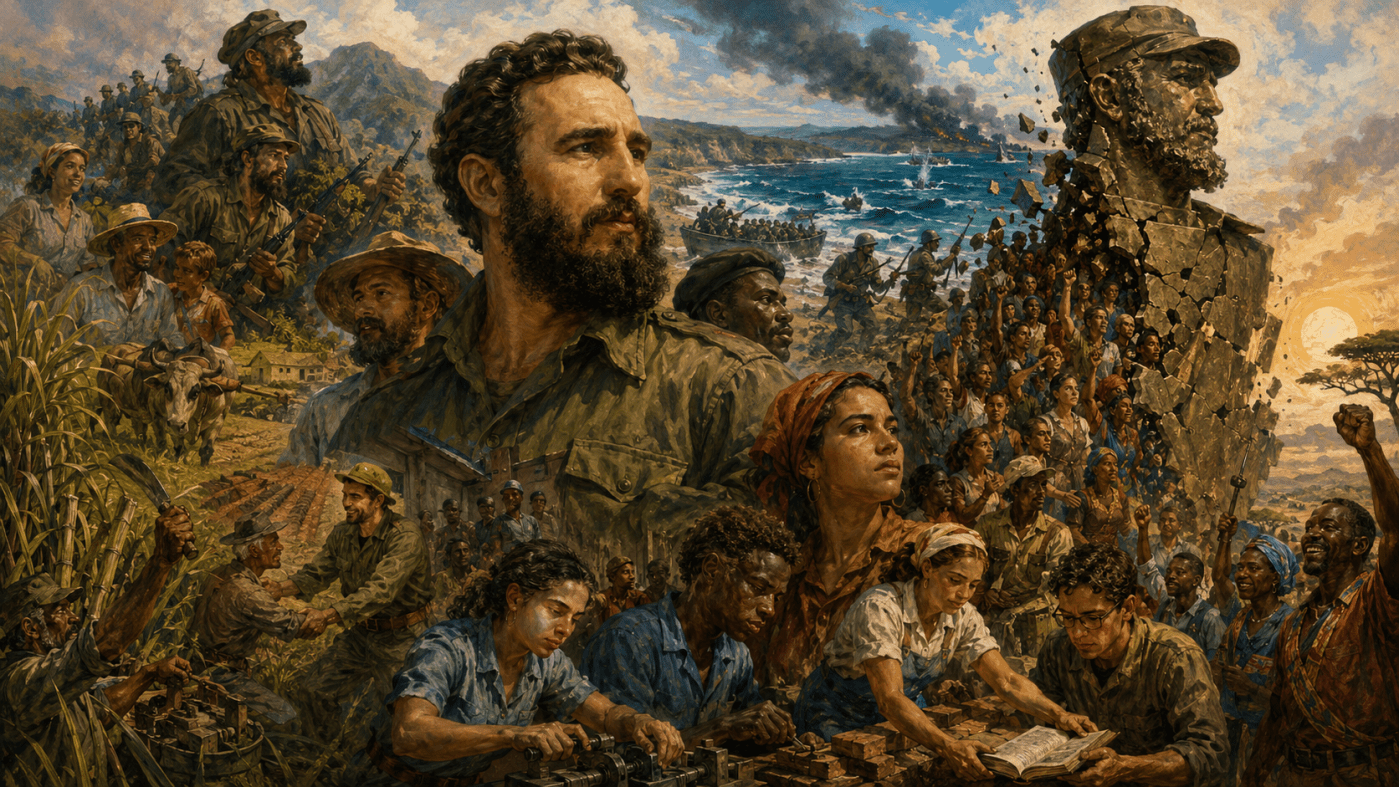
A hundred years after Fidel Castro’s birth, My Life is most useful not as scripture or monument, but as the record of a revolutionary intelligence learning how people shaped by history can organize themselves to change it. Fidel traces how rebellion became consciousness, consciousness became organization, and organized people turned national liberation into a struggle over land, property, sovereignty and imperial power. But victory did not abolish contradiction: the Revolution carried inherited racism, machismo and homophobia into the new society, confronted the coercive problems of defending socialist power, and discovered that legal equality could coexist with material inequality reproduced across generations. Fidel’s deepest warning therefore comes at the end—when he admits that the United States may fail to destroy the Cuban Revolution while Cubans themselves could destroy it if they lose the capacity to recognize errors, correct institutions and keep producing people capable of remaking the Revolution.
Prince Kapone | Weaponized Information | Weaponized Intellects Book Review | August 13, 2026
A Man Is Not Born a Revolutionary
There is a cheap way to remember a revolutionary after a hundred years: cast him in bronze and be done with it. Scrub away the hesitation, the mistakes, the bad bets, the contradictions, the long years of learning, until the finished leader appears to have been hiding inside the child from birth. Bourgeois biography performs the same trick from the opposite direction. It rummages through the boy looking for the future tyrant, as if the beard, the rifles and the Revolution were already tucked beneath his school uniform. Fidel Castro has little use for either fairy tale. One of the strongest things about My Life is that he refuses to pretend history works that way.
And we have to remember who is doing the remembering. Ignacio Ramonet conducted these conversations after the Soviet Union had disappeared, after Cuba had staggered through the Special Period and survived the funeral that Washington had been preparing for it since 1959. Fidel was an old revolutionary looking backward over a road whose bends he already knew. Ramonet calls the book his “political testament.” That gives the testimony both its power and its limit. This is not the young Fidel speaking from inside uncertainty, wondering what comes next. It is Fidel after Moncada, after the Sierra, after Girón, after Angola, after the Soviet collapse, gathering the pieces of his own life and trying to tell us what they meant. He knows how the story turned out. That gives him perspective. It also means the story comes to us through the eyes of one of the men who helped make it.
His starting point could hardly be clearer: “A man is not born a revolutionary.” Then he adds the line that keeps the first sentence from becoming an excuse for fatalism: “I made myself into a revolutionary.” There is the contradiction in miniature. Fidel is not saying he climbed out of his own skull through sheer willpower and invented himself. His account immediately fills that “self” with circumstances, books, arguments, poverty, privilege, struggle, comrades and enemies. People are made by history, yes. But history does not finish the job. Human beings can come to understand the conditions that shaped them and then begin pushing back against them.
Fidel’s own class position makes that point harder to dodge. His father owned land. He did not crawl out of the cane fields as the poorest child in Cuba, hand already clenched into a revolutionary fist. But the rural world that gave him relative privilege also showed him the misery surrounding it. He remembers workers and campesinos living on one side of a social divide while landowners stood on the other. Looking back, he tells Ramonet, “I have an indelible memory of what capitalism was in the country.” That memory did not arrive already labeled “capitalism.” First came the people, the poverty, the land, the distance between those who owned and those who worked. The explanation came later.
That matters because rebellion by itself is cheap. Plenty of people hate injustice. Plenty of people curse the boss, the landlord, the cop, the politician, and then get up the next morning and go right back into the same machinery. Anger is not yet revolutionary consciousness. If poverty looks like one family having bad luck, corruption looks like one politician being a thief, and domination looks like one official being an asshole, then the system gets away clean. The pieces have to be connected before the structure comes into view.
For Fidel, study becomes part of that connection. Martí, Marx and Lenin do not march into the book like three saints carried through a procession. Fidel says that “if we hadn’t been inspired by Marti, Marx and Lenin, we couldn’t possibly have conceived the idea of a revolution in Cuba.” Martí gives him the unfinished struggle for Cuban sovereignty and the warning that the United States had its own designs on the island. Marxism gives him a way to see poverty and exploitation as products of ownership and social relations rather than bad manners among the rich. Lenin sharpens the problem of imperialism and political power. None of them replaces Cuba. They help Fidel see Cuba more clearly.
That is why his own testimony blows a hole through the old Cold War story that the Cuban Revolution began as a nice democratic uprising and somehow caught communism after 1959. Marxism was already part of Fidel’s political formation long before victory. But he does not commit the opposite fraud either. He does not pretend Moncada was secretly carrying a completed socialist constitution in its pocket. He calls the struggle at that stage “a revolution that was not yet Socialist but was the prelude to a Socialist revolution.” That distinction is important because history moves. The movement was already confronting dictatorship, land concentration, dependence and mass misery. But it had not yet fought through every contradiction those struggles contained. Some lessons could not be learned in advance. History would collect its tuition.
Fidel’s method becomes sharpest when he says that “capitalism’s influences, invisible to the majority of people, act on the individual without the individual’s awareness.” At that point his story stops being merely about how one man became radical. It becomes an argument about how a system hides itself. If Cuba suffered because the politicians were crooks, then perhaps the cure was honest politicians. Elect a cleaner bastard, sweep the office, and call it progress. Fidel arrives at a harsher conclusion. Poverty, unemployment, landlessness and dependence survive the replacement of individual administrators because the relations producing them remain standing. You can throw the thief out of the building and leave the safe exactly where it was.
That is where experience and theory begin doing something to each other. Experience without explanation leaves people with a pile of grievances. Theory without concrete life becomes a professor arguing with dust. Fidel’s political formation happens in the collision between the two. Rural inequality becomes intelligible through political economy. Martí’s unfinished independence collides with Marxist analysis. Student militancy is forced toward organization. Failure stops being tragedy and becomes instruction. Even Moncada loses some of its later mythology when viewed this way. It becomes proof that being ready to die for a revolution and being capable of making one are two very different things.
This is the real force of Fidel’s claim that revolutionaries are made. People inherit a world they did not choose, but that world does not explain itself to them. Somebody has to learn why the same misery keeps returning under different presidents and different slogans. Somebody has to connect hunger to land, dependence to empire, corruption to the structure that survives the corrupt official, anger to strategy, and strategy to organization. But that only gets us to the edge of the next problem. One person can understand the machinery and still be one person. The best analysis in the world cannot feed a fighter, shelter a clandestine organizer, move a worker or break an army. Fidel has shown us how revolutionary consciousness begins to form. Now the question becomes material: how does that consciousness leave the individual, enter organization, and become power in the hands of the people?
The Rifle Only Moves Because the People Move
A revolutionary idea can live inside a person for twenty years and never trouble the ruling class beyond giving them something to laugh about at dinner. Batista did not give a damn how many people privately hated him. Marx sitting unopened on a shelf was no threat to the army. Courage locked inside one brave man was still only one brave man. After Moncada, Fidel had to deal with the uglier and more practical question: how do you turn conviction into food, shelter, weapons, intelligence, discipline and enough organized human force to break a state that has soldiers, prisons, money and Washington behind it? In the Sierra Maestra, revolutionary consciousness had to acquire a body.
The wreck of the Granma is a good place to begin because it ruins the romance. The landing was a disaster. Men scattered. Weapons vanished. The expedition that was supposed to begin a revolutionary war nearly ended in the swamp before the war properly started. Fidel remembers that, “aided by the campesinos… we managed to put together an arsenal of seventeen guns.” Seventeen guns. Not exactly the machinery one expects to bring down a dictatorship. But Fidel’s sentence tells us something more important than the number. The rifles survived because people helped the men carrying them survive.
The campesinos knew the mountains. They supplied food, shelter, information, guides and connections. They lived on the ground the rebels were trying to turn into revolutionary terrain. The guerrillas could arrive with courage and political purpose, but they could not eat courage. They could not navigate a mountain with a quotation from Lenin. Without relations with the rural people around them, seventeen rifles would have become seventeen trophies collected from seventeen dead revolutionaries.
This is where the comic-book version of foco theory falls apart against Fidel’s own testimony. A small armed group can begin something. It cannot manufacture the people who must carry it forward. Rural Cuba was not an empty countryside waiting for educated militants to arrive and switch history on. The campesinos already carried their own experiences of poverty, insecure land, landlord power, police violence and abandonment by the state. The guerrillas entered those conditions. Their task was not to invent grievance but to become politically connected to people already living inside it.
Fidel calls the rebel force “the embryo of a small army” that could grow until, “with the total support of the people, right up to a general revolutionary strike, [it] would defeat the enemy army.” Embryo is doing serious work there. The guerrilla nucleus matters enormously, but it is not yet the thing it is trying to become. It concentrates commitment, training, leadership and experience. Its real power develops only as struggle spreads beyond the original fighters and draws larger layers of the population into action.
That knocks down two bad theories at once. The first says misery eventually gets so miserable that revolution simply happens. History has buried enough starving people to dispose of that nonsense. Exploitation can last centuries if the exploited remain divided, disorganized or convinced that resistance is impossible. The second bad theory tries to correct the first by replacing the missing people with a heroic minority. If the masses are not moving, perhaps twelve exceptionally determined revolutionaries can move history for them. That road usually ends with twelve exceptionally determined corpses.
Fidel’s account gives us something harder. Material conditions create grievances, openings and limits. Organization works inside them. Neither does the job alone.
He makes the point almost perfectly when he says that “guerrilla warfare was the detonator of another process… a revolutionary general strike and a general uprising of the populace.” A detonator is important precisely because the detonator is not the explosion. The guerrilla war concentrates pressure and helps release forces much larger than itself. The Sierra matters because its struggle begins changing conditions elsewhere: confidence rises, clandestine networks expand, enemy morale weakens, recruitment becomes possible, workers and urban militants confront a dictatorship whose invincibility has started looking considerably less divine.
The rifle matters because people give it political meaning. Remove those relations and the rifle goes back to being a piece of metal.
That is also why Fidel refuses to treat revolutionary discipline as nothing more than soldiers obeying orders. He says, “you have to have a policy towards the populace and a policy towards your adversary… There’s no other way to justify the use of violence.” Violence here is subordinate to politics. How guerrillas get food matters. How they behave toward campesinos matters. How they treat prisoners matters. How they punish abuses inside their own ranks matters. An army claiming to fight for the people cannot behave toward those people as one more armed gang demanding obedience.
The treatment of captured soldiers makes the point concrete. A prisoner can be beaten or shot, or he can be treated in a way that changes what the next soldier thinks surrender means. A campesino can be bullied into giving food, or relations can be built in which supporting the rebels becomes connected to the campesino’s own interests. These are not sentimental questions added after the military work is done. They affect intelligence, desertion, recruitment, trust and whether ordinary people are willing to risk their lives around the revolutionary force. Political conduct becomes part of military capacity.
None of this means Fidel imagines the people spontaneously organizing themselves while leadership politely watches from the bushes. The Sierra required decisions. Fight here. Retreat there. Preserve these forces. Punish that abuse. Take this risk. Refuse that one. Organization matters because a revolutionary crisis does not arrive with an instruction manual stapled to it. But Fidel’s own evidence places a limit on what leadership can do. The revolutionary nucleus becomes powerful by expanding the people’s capacity to act, not by appointing itself their historical replacement.
This is what sits behind Fidel’s later statement that “in the case of our country, subjective conditions played a considerable role.” Taken alone, “subjective conditions” can sound like revolutionary optimism with a nicer vocabulary. In the history he actually recounts, it means cadres surviving defeat, militants learning, campesinos building relations with the rebels, underground networks functioning, fighters developing discipline, mistakes being corrected and armed struggle becoming connected to a wider political movement. The subjective factor is not wishing harder. It is human beings becoming organized enough to alter the situation confronting them.
Seventeen rifles are weak. Seventeen rifles sustained by campesino networks are harder to kill. Survival allows recruitment. Recruitment changes military strength. Victories change what the population thinks is possible. A dictatorship that yesterday looked permanent begins today to look vulnerable. Nothing mystical has happened. People acting through organization have altered the conditions that were supposed to dictate what they could do.
Fidel never turns this into a recipe for revolution by photocopier. His insistence on concrete conditions forbids it. You cannot manufacture a revolutionary people by putting on olive-green fatigues and finding yourself a mountain. Organization can concentrate anger, develop confidence and open possibilities, but it cannot summon a social foundation from thin air. The lesson of the Sierra is not that every country needs its Sierra Maestra. It is that revolutionary organization becomes a material force when it connects disciplined political purpose to grievances, capacities and struggles already alive among the people.
And once that happens, the problem changes. Batista’s defeat would give the Revolution something far more dangerous than rifles: state power. Now it could make laws, redistribute land, dispossess old interests and reach directly into the structure of Cuban society. The question was no longer how an organized people could break the machinery protecting the old order. The question was what would happen when the Revolution put its hands on the property that machinery had been built to defend.
Independence Runs Into Property
Throwing Batista out answered one question: who was going to run the government. It did not answer the harder one: who was going to run Cuba. That difference is where revolutions either deepen or become ceremonies. A new flag over the palace means very little if the land, the wealth and the commanding heights of economic life remain in the same hands as before. Fidel does not begin this argument with some abstract proclamation about socialism. He begins with the countryside: “hundreds of thousands of people in rural areas with no land” and “tens of thousands of campesinos who paid rent.” There it was, plain as dirt under the fingernails. Political liberation had run straight into property.
Land is not just acreage. Land is power. Somebody owns it; somebody else works it; somebody collects the rent; somebody can be thrown off it. A government may declare the nation free while leaving those relations untouched, and history has seen plenty of that kind of independence: the colonizer lowers one flag, the local elite raises another, and the poor are invited to applaud while returning to the same fields. Fidel’s account insists that Cuba could not stop there. Once the Revolution began redistributing land and breaking concentrated ownership, national independence stopped being a matter of symbols and became a fight over who would control the material life of the country.
And the minute you touch property, the enemy becomes easier to identify.
Batista running away did not make the social forces behind the old Cuba disappear. Landowners still had land to lose. Wealthy families still had privilege to defend. Foreign capital still had investments and influence tied to the old arrangement. Fidel drives this home when he looks at Playa Girón and remembers that among the invaders were sons of large landowners and wealthy families: “There you clearly see the class nature of the invasion.” He is not saying merely that rich Cubans were angry. He is saying that people whose material power had been hit by the Revolution now had a direct interest in reversing it, and that interest found a powerful friend ninety miles away.
That is why Girón cannot be reduced to some geopolitical shouting match between two governments. In Fidel’s account, domestic counterrevolution and U.S. power meet on the same beach. The invasion carried more than weapons. It carried a social project: restore what the Revolution had begun taking apart. The international conflict makes sense because the Revolution had already begun changing property relations inside Cuba. Imperial hostility was not floating above Cuban society like bad weather. It was tied to what the Revolution was doing to land, ownership and power.
This also gives sharper meaning to Fidel’s later description of Cuba as the target of “the most prolonged economic war in history.” He is talking about something more serious than hurt feelings in Washington. Economic relations can be used as weapons. A small country that depends on external fuel, machinery, shipping, credit, trade and finance does not have to be invaded every morning to be coerced. Choke the channels through which daily life reproduces itself and you can wage war without firing a shot.
And on Fidel’s hundredth birthday, that argument is not sitting peacefully in a museum. Washington is once again squeezing Cuba through fuel access, third-country suppliers, financial institutions and the external networks Cuban state enterprises need to function. That does not prove every claim Havana has ever made. It does not absolve Cuban socialism of its own mistakes, inequalities or failures. But it does prove something important: the material relation Fidel describes did not disappear when the Cold War ended. The Cold War was supposed to be the explanation. The coercion stayed after the explanation died.
What matters, then, is what that pressure did to the Revolution itself. Fidel puts it simply: “Giron accelerated the revolutionary process.” He is not claiming that Washington invaded Cuba and accidentally invented socialism for it. The Revolution was already moving against large property. Agrarian reform was already changing the balance of social power. But the invasion hardened the lines. Those who had lost power at home found backing abroad, and suddenly the question of land reform was no longer a domestic policy dispute. It had become bound up with armed restoration.
Girón therefore clarified something the old language of national independence could no longer hide. Defending the country now meant defending the changes being made inside the country. You could not defend Cuban sovereignty while treating the redistribution of land as some separate economic matter. To defend agrarian reform was to defend the transfer of power buried inside it. To defeat restoration was not simply to save a government. It was to defend a social transformation that had begun pushing beyond the old republic.
But we should not make the reverse mistake either. Once imperialism enters the explanation, there is always a temptation to make it explain everything. It cannot. The existence of a real enemy does not turn every response into a correct response. Washington’s hostility does not prove the wisdom of every policy adopted in Havana. The stronger argument is narrower: Cuban socialism developed inside a material struggle where changing land, ownership and state power produced both domestic class resistance and imperial intervention. Cuba did not build socialism in one room and later discover a foreign-policy problem waiting in another. The internal transformation changed Cuba’s position in the world.
The Missile Crisis raises that problem from restoration to survival. Fidel insists that “the American plan for invading Cuba after Giron was already drawn up.” His chronology matters. In his reconstruction, Soviet missiles did not create the basic threat to Cuban sovereignty. They entered a country that had already survived one invasion and believed another was being prepared. That does not settle every dispute about October 1962. It does, however, stop the convenient habit of beginning the story when Soviet missiles appear and turning Cuba into a patch of tropical real estate over which two great powers happened to quarrel.
Cuba was not empty geography. It had something concrete to defend. Land had been redistributed. Old property relations were being broken. A new state was trying to reorganize social life. The threat to Cuba was therefore also a threat to what Cubans had begun building. But defending that transformation brought a new dependency into view. A small revolutionary country could declare its political independence from Washington; it could not manufacture oil, military protection, industrial technology and external markets out of revolutionary enthusiasm. The world remained unequal whether Cuba liked it or not.
That is the contradiction sitting at the edge of the Missile Crisis. The Soviet Union could provide resources and protection Cuba badly needed. But once a larger socialist state became materially necessary to a smaller one, another question appeared. Washington had already shown what it meant for a powerful country to treat Cuban sovereignty as conditional. Socialist solidarity would have to prove it could behave differently. The Revolution had run into property and found imperial power standing behind it. Now Cuba had to find out whether an ally could help defend its independence without eventually claiming the right to speak in its name.
Internationalism Without a Master
A revolution that survives long enough to look beyond its own borders runs into a new danger. Solidarity can become instruction. Alliance can become obedience. A powerful socialist country can begin talking to a smaller one in the same tone every empire eventually discovers: we know what is best for you. Fidel wants no part of that. Cuba needed allies, badly. It supported liberation struggles thousands of miles from Havana. Its economy and defense became deeply tied to the Soviet Union. But throughout these chapters of My Life, Fidel keeps returning to one stubborn principle: nobody can make another people’s revolution for them.
He says it plainly: “revolution can’t be exported, because no one can ‘export’ the objective conditions that make revolution possible.” There goes the fantasy that Cuba discovered some universal revolutionary recipe in the Sierra and could simply mail copies abroad with the rifles. You can send weapons. You can send doctors. You can send teachers, technicians, political solidarity, even fighters. What you cannot ship across an ocean is another country’s class structure, its history of land dispossession, its exhausted ruling bloc, its political traditions, its popular anger or the particular crisis that makes millions of people willing to stop living the old way.
This matters because Cuba itself became a costume almost immediately after the Revolution. Mountains. Olive-green fatigues. Beards. A few rifles. Add enough courage and apparently history is supposed to surrender. Fidel’s own account makes a mockery of that imitation. The Sierra mattered because those fighters entered a specific Cuban society and managed to connect themselves to forces already moving within it. Copy the appearance while ignoring the social relations underneath and you have not reproduced the Cuban Revolution. You have reproduced its photograph.
But Fidel refuses the opposite stupidity too. Objective conditions are not some machine that eventually spits out a revolution when misery reaches the proper temperature. He insists that “there are factors of a subjective nature that can change history.” The two statements have to stay together. Nobody can export the conditions of revolution, but conditions do not act by themselves. People organize. They learn. They make mistakes. They build movements. They seize openings that another generation might have wasted. Internationalism, then, is not arriving in somebody else’s country with the answer already written. It is helping people who are already fighting enlarge their own capacity to act.
That is how Fidel wants Cuba’s role in Africa understood. He speaks of “Cuba’s heroic solidarity with our sister nations in Africa” and insists that later generations remember it. There is no diplomatic modesty in the language because Fidel is not pretending Cuba went to Africa as some neutral humanitarian NGO. He understood colonialism, apartheid and national liberation as fronts in the same wider struggle that had shaped Cuba itself. A people who had fought to break foreign domination at home were not supposed to become suddenly blind when Africans confronted Portuguese colonialism or apartheid rule.
That is Fidel’s argument, and it should be taken seriously before anybody starts correcting it. In his telling, Cuban internationalism was neither charity handed down from Havana nor ordinary state ambition wearing a red shirt. Cuba entered struggles whose revolutionary subject remained the people actually fighting them. The Cubans could strengthen that struggle. They could not own it. Our approved record is not enough to settle every dispute over who initiated what in Angola, how much came from Havana, how much from Moscow, or how every African actor understood the relationship. Those questions require more evidence than Fidel’s testimony alone can provide. What My Life establishes clearly is the principle Fidel believed Cuba was defending.
Operation Carlota makes the Soviet question unavoidable. Fidel stresses that “at no time did we count on any sort of eventual Soviet ‘protection’.” He is not claiming Cuba somehow operated without Soviet material support. That would be absurd, and Fidel does not need the absurdity to make his case. The Soviet relationship mattered enormously to Cuban trade, defense and economic survival. His point is that dependence in one sphere did not, in his telling, hand Moscow ownership of Cuban political judgment. An ally could be stronger without becoming the boss.
And Fidel is perfectly capable of criticizing the socialist camp when that line is crossed. Looking back at the Soviet Union, he speaks of “a tendency towards the abuse of power” and “the habit of imposing one country’s, one hegemonic party’s, authority.” That is an important admission because now the contradiction is no longer socialism versus imperialism. It is a contradiction inside socialist relations themselves. A large socialist state may possess the oil, weapons, industrial capacity and diplomatic weight that a smaller revolutionary country desperately needs. But the moment greater capacity is converted into the right to command, solidarity begins rotting into hierarchy.
That does not make the Soviet Union identical to the imperial powers Fidel spent his life fighting, and nothing in this record justifies pretending otherwise. The material relation is different. Soviet assistance could enlarge Cuba’s capacity to survive, develop and act internationally. But Fidel’s criticism reminds us that good intentions and socialist banners do not magically abolish unequal power between states. If one party begins deciding that its strength gives it the right to speak for everybody else, internationalism has already started losing its revolutionary content.
This is the international version of a lesson Fidel keeps discovering at different levels. Concentrated power can be necessary. It can organize resources that scattered forces could never mobilize alone. But concentrated power does not acquire some divine right to substitute itself for the people whose capacity it was supposed to strengthen. The revolutionary organization cannot become the people. The larger socialist state cannot become every revolution. Otherwise solidarity becomes the polite name for somebody else doing your thinking.
The Soviet collapse put Fidel’s claim through a merciless historical test. Cuba had become deeply entangled with the socialist bloc, and when that world disappeared the island lost far more than a friendly diplomatic partner. Yet the Cuban Revolution did not disappear with Moscow. Fidel reads that survival as proof that Cuba’s socialist foundations were rooted inside Cuban society rather than imported from abroad. That is a serious argument, though survival alone cannot tell us exactly how broad, deep or politically uniform popular support remained. What it does show is that the material world around the Revolution changed catastrophically while the Cuban state and socialist order endured.
Fidel carries the same suspicion of easy formulas into his reflections on Latin America. “No one can guarantee that revolutionary changes are going to occur… But no one can guarantee that they’re not, either.” There is more revolutionary intelligence in that sentence than in a thousand predictions announcing history’s inevitable destination. Crisis does not automatically become revolution. Elections do not automatically disarm oligarchies. A nationalist government waving its fist at Washington does not thereby become socialist. But failure is not guaranteed either. Political arrangements that look permanent can become surprisingly fragile once organized people begin acting upon the contradictions holding them together.
For Fidel, then, internationalism is neither passive respect for whatever happens inside another country nor revolutionary ventriloquism from abroad. Struggles are connected because colonialism, capitalism and imperial power cross borders without asking permission. Solidarity must cross borders too. But solidarity becomes revolutionary only when it enlarges another people’s capacity to fight on their own historical ground. The ally provides strength; the people provide the revolution.
By this point in My Life, the revolutionary agency that began with one young Cuban trying to understand his country has traveled a long distance. It became organization, state power and international solidarity. At every stage the same danger reappears in a different uniform: concentrated power can help people act, and concentrated power can begin acting in their place. Fidel rejects the right of a stronger socialist ally to command Cuba in the name of solidarity. The harder test now comes home. If revolutionary power must refuse masters abroad, then how does it prevent the institutions of the Revolution itself—its courts, laws, security organs and machinery of state—from becoming power exercised over the people rather than power exercised through them?
The Revolution Enters Its Own Contradictions
A guerrilla army can win a battle and walk off the field. A revolutionary state does not have that luxury. Once the old order has been broken, somebody has to defend what replaced it. Courts still exist. Prisons still exist. Laws have to be written. Armed power does not evaporate because the right people finally seized it. The Revolution that once looked at the state from the wrong end of a rifle now finds the rifle in its own hands. That changes everything. The question is no longer whether revolutionary power is necessary. It is whether that power can defend liberation without slowly forgetting what the hell it was supposed to be defending.
Fidel is more useful here when he refuses to pretend revolutionary power walks through history wearing spotless gloves. Looking back at the public trials after Batista’s fall, he admits that their form “was in conflict with our own ideas of justice.” That is not the same as saying Batista’s torturers and murderers should have been sent home with a pension and a polite reminder to behave. Fidel does not surrender the right of the Revolution to judge crimes committed against the people. He admits something harder: a revolutionary state can pursue a just end through practices that violate standards the Revolution itself claims to uphold.
That is where power has to be judged by more than its intentions. Before victory, revolutionaries have no trouble exposing the old state by what it actually does. After victory, they cannot suddenly lower the standard and say that good intentions settle the matter. A prison does not become innocent because a revolutionary government owns the key. A mistake does not stop being a mistake because the person making it once fought in the Sierra. Fidel’s admission keeps open the one door every revolution eventually needs: the possibility that revolutionary institutions themselves may require revolutionary criticism.
His discussion of homosexuals makes the point impossible to keep abstract. Fidel says, “the part of the responsibility that I bear, I accept,” and acknowledges that homosexuals suffered discrimination. What matters here is bigger than personal guilt. The old Cuba did not vanish from people’s heads on January 1, 1959. Catholic morality, machismo, fear of homosexuality, habits learned under the old social order—these things could walk right through the front door of the new institutions wearing revolutionary uniforms.
And that leaves us with two equally useless explanations. One says this happened because Fidel was personally bad, which turns a social problem into a personality test. The other says the prejudice came from the old society, therefore the Revolution bears no responsibility for it. Fidel’s own admission blows up both excuses. Once an inherited prejudice enters a revolutionary institution, it is no longer merely a leftover from yesterday. It becomes something the Revolution is now reproducing and therefore something the Revolution has to fight inside itself.
The terrain shifts again when Fidel turns to organized opposition. Defending the arrests of 2003, he argues that “no argument would have prevailed over sheer necessity” because “you can’t allow a fifth column to be organized against you.” There is a real material argument here, and pretending otherwise only makes liberalism look more foolish than usual. Political organizations do not float above money, state power and international strategy. If an opposition current is financed, coordinated or politically integrated into a foreign project aimed at reversing the social order, then calling it simply “dissent” tells us almost nothing about what it is actually doing.
But necessity cannot become a rubber stamp. Somebody still has to decide what counts as foreign-directed restoration and what counts as disagreement inside the Revolution. Somebody has to decide what evidence is sufficient and what punishment is proportionate. The existence of a hostile empire establishes a real danger. It does not automatically prove every action taken in the name of security. Otherwise the enemy becomes wonderfully useful: every error can be blamed on him before anyone has even examined what happened.
Fidel’s treatment of capital punishment leaves that contradiction open. “We Cuban revolutionaries also abhor it,” he says, even while defending its retention under circumstances he considered exceptional. There is no clean little bow to tie around that. The state says necessity may force it to use a punishment its own revolutionary ethics reject. Fine. Then the tension remains a tension. Calling something necessary does not magically turn it into a virtue.
The point is sharper because Fidel had already insisted that revolutionary violence must answer to politics. That principle does not become less important once the rebels have won; it becomes more important because the scale of power has grown. A guerrilla column can punish a prisoner. A state can build an entire machinery of punishment. Courts, police and prisons can defend a revolution, but they can also acquire routines of their own. The Revolution therefore has to keep asking where defense ends and habit begins, where punishment stops being justice and starts becoming vengeance dressed in official paperwork.
My Life shows that Fidel understood this danger. It does not give us enough independent evidence to tell us how consistently Cuban institutions solved it. That gap has to remain a gap. We do not need to fill it with liberal mythology about dictatorship, and we do not need to fill it with revolutionary wishful thinking either.
The press question brings the same struggle onto ideological ground. Fidel tells Ramonet, “If what you call freedom of the press is the right to mount a counterrevolution… we are not in favour of that ‘freedom’.” His argument slices through the respectable nonsense that privately owned media somehow belongs equally to everybody. A printing press costs money. A television network costs money. A professional newsroom costs money. The class that owns the infrastructure does not suddenly become politically invisible because somebody calls the result “free speech.” A billionaire buying a newspaper has considerably more freedom of the press than the worker buying the newspaper on his lunch break.
But material analysis cannot stop once private ownership has been criticized. Public ownership changes the relation; it does not solve every problem of ideological power by decree. Socialist media still has to tell the truth when the truth is inconvenient. Workers and communities still need ways to challenge official explanations. Bad information still has to travel upward instead of being buried because somebody is afraid to embarrass the Revolution. A public institution that cannot hear criticism eventually begins hearing only itself.
Fidel gives us a serious argument for why Cuba rejected the capitalist media model. What the approved record does not give us is enough evidence to judge every mechanism through which Cuban public institutions received criticism, corrected errors or allowed competing interpretations to fight their way into political life. That is where the evidence stops, and we should stop with it.
Still, one thing follows from Fidel’s own testimony. If revolutionary institutions are supposed to be durable forms of popular power, then criticism of those institutions cannot automatically be treated as criticism of the Revolution itself. Sometimes criticism may be hostile. Sometimes it may be financed from abroad. Sometimes it may be wrong. And sometimes the institution may simply be fucking up. A revolutionary state that cannot distinguish among those possibilities leaves itself only two settings: obedience and betrayal. That is not enough to govern a living society.
Fidel’s admission about homosexual discrimination makes the point especially difficult to escape. The Revolution could honestly seek human emancipation and still reproduce an inherited injustice through its own institutions. External aggression could tighten the pressures around Cuba, but Washington did not invent every prejudice, every mistake or every contradiction inside Cuban society. The Revolution therefore had to fight in two directions at once: against forces trying to restore the old social order, and against pieces of that old order that had survived inside people, institutions and everyday practice.
And even that is only the part of the contradiction that wears a uniform. Courts, prisons and censorship announce themselves openly. Other inequalities travel quietly through the home, the school, the neighborhood and the family. They hide in who had better housing to begin with, whose parents had more education, who carried the burden of domestic labor, who had access to outside resources. A law can abolish discrimination overnight. History is a more stubborn bastard. Fidel’s next problem is therefore not simply how revolutionary power uses force. It is how a society committed to equality deals with inequalities that continue reproducing themselves after formal equality has already been declared.
Equality Is Not a Decree
A revolution can tear a racist law out of the statute book in an afternoon, with white supremacy still in tact the next morning. You can open the schools, outlaw discrimination, put women into universities and workplaces, and still wake up the next morning inside a society where families carry very different inheritances from the world that came before. Better housing here. More education there. Relatives abroad. Connections. Domestic burdens. Generations of accumulated advantage on one side and accumulated deprivation on the other. Fidel is at his strongest when he stops treating equality like something the Revolution announced and therefore completed, and starts asking the much nastier question: what keeps reproducing inequality after the law says everybody is equal?
His discussion of race cuts deepest. Fidel calls what remains “objective discrimination, a phenomenon associated with poverty and a historical monopoly on knowledge.” That phrase matters because it gets us past the childish idea that racism exists only when some individual openly hates Black people. A society does not need a segregation sign on every door to keep reproducing racial inequality. If different sections of the population arrive at legal equality standing on completely different material ground, then the starting gun may be the same while half the runners are still carrying bricks chained to their ankles.
Fidel is unusually blunt about this. The Revolution, he says, “has not had the same success in its fight to eradicate the differences in social and financial status for the black population of the country.” He points toward housing, work, income, education and access to resources. That does not mean the Revolution accomplished nothing. It means the Revolution accomplished something real and then discovered that reality was more stubborn than the decree. Formal racial barriers could be broken. The social consequences accumulated across generations did not politely disappear because the new state had declared them unjust.
This is a much more serious way to talk about racism under socialism than the usual stupid argument over whether racism either “exists” or “doesn’t.” Fidel is asking how it reproduces itself. Suppose one family enters the revolutionary period with better housing, more educated parents, stronger social connections and greater familiarity with professional institutions. Suppose another enters carrying the accumulated damage of centuries of racialized poverty. Give both families equal legal rights and you have changed something enormous. But you have not made their material starting points identical. History survives through what people inherit, what they know, where they live and what they can pass to their children.
Education shows exactly how this works. Fidel admits that “the parents’ educational level, even after we’ve made the Revolution, continues to have a tremendous influence on the children’s later outcome.” That is the old society sneaking into the new one through the family kitchen. Universal education can put both children in the classroom. It cannot instantly give both homes the same books, the same educational confidence, the same knowledge of how institutions work or the same expectations about what a child might become.
So when Fidel calls higher education “a formidable instrument for social levelling,” the word instrument is everything. Education is not proof that equality has arrived. It is one weapon used to produce more equality. Its revolutionary value lies in whether it actually breaks the old monopoly on knowledge, widens access to professional and technical life, and allows people whose families were locked out for generations to move into social positions that once belonged to a much narrower layer.
That is what gives Fidel’s racial analysis some real bite. The Revolution can transform the position of Black Cubans without eliminating every difference between Black and white Cubans. Those are not contradictory statements. They describe a process. The first struggle breaks the legal and institutional walls. The next struggle begins over all the unequal conditions that remained standing behind them. And that second struggle is harder because there is no single racist statute left to repeal. You are fighting history after history has learned how to hide inside ordinary life.
Fidel runs into the same stubborn bastard in relations between men and women. He remembers that “Fighting discrimination against women was tough; we even had to pass a law… stipulating a man’s obligation to share household chores, cooking, childcare, with his wife.” There is a whole revolution packed into that sentence. Women can enter the university. Women can enter the workplace. Women can enter politics. But if they come home and are still expected to cook, clean, raise the children and carry the household on their backs, then equality at work can sit comfortably beside inequality at home.
The law matters because the Revolution refuses to treat the household as some sacred private kingdom where social relations stop being political. Cooking, childcare and housework are labor. Somebody has to do them. If the burden falls overwhelmingly on women, then the old division of labor survives even while the public language changes. But a law can only go so far. The state can tell a man to share the work. It cannot crawl into his head and rip out generations of machismo by the roots. Habits learned over centuries do not surrender because the National Assembly passed a bill.
That is the larger lesson. Some things can be changed quickly because their power sits openly in institutions. A property title can be canceled. A discriminatory law can be abolished. A school can be opened. Other relations live inside families, expectations, habits and inherited social positions. They have to be fought differently, sometimes for generations. Revolution does not end history. It changes the ground on which history keeps moving.
The Special Period makes this even more complicated because new inequalities can enter from outside the Revolution and then take material form inside Cuban society. Fidel points to the Cuban Adjustment Act, which he says “acts as the fundamental stimulus for all the emigrants who illegally leave Cuba.” He is challenging the lazy propaganda line that every Cuban who leaves the island has cast some pure ideological vote against socialism. People migrate inside a brutally unequal Caribbean and North American economy, and U.S. policy deliberately shapes the material incentives surrounding that movement.
But once migration happens, the consequences do not remain safely outside Cuba. Families with relatives abroad may gain access to dollars, goods and opportunities that other families do not have. Remittances enter a socialist society unevenly because kinship networks are uneven. Foreign currency does not care that everybody has equal legal citizenship. It lands in particular households. Suddenly an international inequality between Cuba and the United States starts producing new differences between Cubans themselves.
That is why neither easy explanation works. You cannot blame every Cuban inequality on Washington and call the analysis finished. Nor can you take inequalities intensified by blockade, migration and unequal access to foreign currency and pretend they were produced inside some sealed laboratory called socialism. External pressure enters Cuban society through real people, real households and real institutions. Once it enters, the Revolution still has to deal with what it becomes.
Crisis makes all of this sharper because scarcity never lands on socially equal ground. One family has relatives abroad. Another does not. One household has more education or better housing. Another begins with less. Some people find ways around shortages that others cannot. But the evidence in My Life does not give us permission to jump from that differentiation to grand declarations about a new exploiting class or completed capitalist restoration. That would be theory swaggering past the evidence with its chest out. Fidel gives us something more concrete: socialism continues operating inside uneven social conditions, and those uneven conditions can reproduce themselves unless they are consciously fought.
So the useful conclusion is neither that the Revolution solved equality nor that surviving inequality proves the Revolution was fake. Both positions are lazy. Fidel’s own testimony points toward something more demanding: equality has to be produced again and again because every generation inherits the results of the one before it. The Revolution can radically change the starting conditions. But those new conditions immediately become somebody else’s inheritance, with their own advantages, gaps and contradictions.
And now the problem gets dangerous. If socialist institutions can transform law, property, education and social provision yet still confront old inequalities and new forms of differentiation, then revolutionary continuity cannot mean putting those institutions in a glass case and guarding them like holy relics. The final question is whether the institutions built by the Revolution can recognize what Cuban society is producing now, after the old order has already been defeated—and whether the people acting through those institutions still possess enough power to correct what the Revolution itself has not yet overcome.
The Revolution Can Destroy Itself
Every revolution eventually reaches the point where it has to answer a question no founding generation can settle for the next one: what happens when the people who carried the Revolution on their backs begin to leave the stage? Fidel arrives at the end of My Life staring directly at that problem. By then the issue is not whether Fidel Castro can keep going. No human being gets a permanent exemption from death. The issue is whether a Revolution so closely identified with a handful of historic figures can reproduce the kind of people, institutions and political consciousness that made those figures possible in the first place.
Fidel’s first answer is to deny that the whole thing rests on his shoulders. “My functions as leader exist within a collective,” he says. He has to make that argument, because if the Revolution ultimately depends on Fidel being Fidel, then succession is already defeat with a calendar attached. A revolution built around one irreplaceable man has not solved the problem of power. It has merely postponed the funeral. Fidel therefore pushes the question away from personality and toward institutions capable of carrying revolutionary power after the founders are gone.
He gets more concrete when he discusses elections. “The Party doesn’t nominate candidates — candidates are nominated by the people,” he says, describing neighborhood assemblies where residents put names forward themselves. That matters because Fidel’s defense of Cuba is not that democracy becomes unnecessary once socialists take power. His argument is that democracy does not begin and end with several parties competing in elections financed through wildly unequal concentrations of money.
That argument deserves better than the usual counting exercise. One party, two parties, five parties—fine. Then ask the next question. Who nominates? Who pays? Who owns the media? Who gets organized access to political institutions? Who can actually make somebody in power listen? Fidel offers neighborhood nomination as evidence that political unity and popular participation are not automatically enemies. Whatever one thinks of Cuba’s system, reducing the whole thing to the number of party logos on the ballot does about as much political analysis as counting the colors on a flag.
But Fidel’s testimony can only take us so far. My Life tells us how these institutions are supposed to work and how Fidel understands their purpose. It tells us much less about what happens when a neighborhood wants one thing and the national leadership wants another, how criticism travels upward when somebody in authority is wrong, or how ordinary people force correction when an institution has become deaf. That does not prove the mechanisms are fake. It means Fidel’s autobiography cannot independently prove how well they worked. There is a difference, and we should keep it.
His defense of socialism’s constitutional durability raises the stakes. “In order to revoke the Socialist nature there has to be a revolution — or rather a counter-revolution.” Fidel is saying that socialism is not a brand of government that can be swapped out like a cabinet minister. It rests on changed property relations and a different organization of social power. Restoring capitalism would therefore mean more than winning an election. It would mean reorganizing ownership and the power that grows out of ownership.
The liberal fairy tale likes to pretend capitalist property sits outside politics, innocent as rain. It does not. Property is defended by law, courts, contracts, police power and an entire state machinery built around its legitimacy. Fidel refuses the strange demand that socialist property alone should stand naked and defenseless while forces committed to restoring capitalism organize against it.
But a constitution can defend socialism on paper and still fail to keep a Revolution alive. You can write “irrevocable” in the biggest letters available and still have corruption. You can protect public ownership and still produce inequality. You can preserve institutions until everybody who remembers why they were built is dead. Legal continuity is not the same thing as revolutionary continuity. A Revolution cannot answer the question of what it is becoming forever by pointing to what it was when it began.
And this is where Fidel says something far more dangerous than any slogan about defeating Washington: “This Revolution can destroy itself. We, we can destroy it, and we would be to blame.” That sentence should stop anybody trying to explain Cuba with one hand tied behind their back. The United States remains an enemy in Fidel’s account. Imperial pressure remains real. But here Fidel refuses to make the empire responsible for everything. Cuba can survive Washington and still lose something essential inside itself.
He tells us how: by becoming incapable of correcting its own mistakes. Around this warning he talks about theft, diversion of resources, inequality and people enriching themselves under the pressures opened by the Special Period. Now survival means more than not being overthrown. A Revolution can withstand invasion, blockade, isolation and the collapse of its strongest ally and still rot from inside if contradictions accumulate faster than the people and institutions can deal with them.
That is a hard lesson because siege can become a comfortable explanation even when the siege is real. If the enemy is responsible for every shortage, every mistake, every abuse, every inequality and every institutional failure, then the Revolution never has to examine itself. Fidel refuses that escape in his strongest moments. The enemy can tighten the noose. The Revolution still has to decide what it becomes while breathing inside it.
His reflections on socialist construction push the point further. Fidel rejects the idea that anybody inherited a finished blueprint for socialism, while warning that “There were those who thought that capitalist methods would allow them to construct Socialism. That is one of the great errors in history.” Those two thoughts belong together. There is no sacred manual telling revolutionaries exactly what to do next. But that does not mean every method is harmless. Markets, incentives, private accumulation, administrative shortcuts—whatever tools are used—carry social consequences. The Revolution has to experiment without becoming stupid enough to believe the tool has no politics buried inside it.
So institutional survival is not enough. The Revolution has to learn. It has to recognize when new conditions are producing new inequalities, new habits, new interests and new forms of power. It has to correct course without mistaking surrender for flexibility. Unity cannot mean everybody shutting up. Continuity cannot mean embalming institutions because they were revolutionary fifty years ago. And self-criticism cannot become one of those pleasant rituals where everybody admits mistakes and nobody changes a damn thing.
Fidel does not hand us a finished theory for all of this, and we should not pretend he does. The fuller formulation belongs to what we can build from the relations running through his testimony. But he gives us the pieces. Revolutionaries are made, not born. Organized consciousness can change conditions. Socialist institutions can make mistakes. Nobody possesses a completed formula for socialism. And a Revolution can destroy itself if it becomes unable to correct what it is producing.
Put those pieces together and the centenary question changes completely. We do not need another Fidel manufactured in somebody’s imagination. History is not a factory stamping out replacement commanders. The deeper question is whether revolutionary institutions remain places where ordinary people can still become political actors—people capable not only of defending what earlier generations won, but of recognizing when those gains are being hollowed out, when new contradictions are emerging, and when institutions themselves have to change.
Revolutionary institutions may indeed be accumulated popular power. But their origin does not grant them eternal revolutionary innocence. The real test is what happens when the people need to correct them. Can criticism move? Can mistakes be exposed? Can power be forced to listen? Can a new generation look at what the founders built and say, without surrendering the Revolution, that this part has to change?
A hundred years after Fidel’s birth, that is the question worth carrying forward. Not who can stand where Fidel stood. Not who can imitate the voice, the uniform or the speeches. The real question is whether the Revolution can keep producing people with enough consciousness, organization and power to do what Fidel once said he had done for himself: become revolutionaries—and then become revolutionary enough to remake the Revolution.


Leave a comment