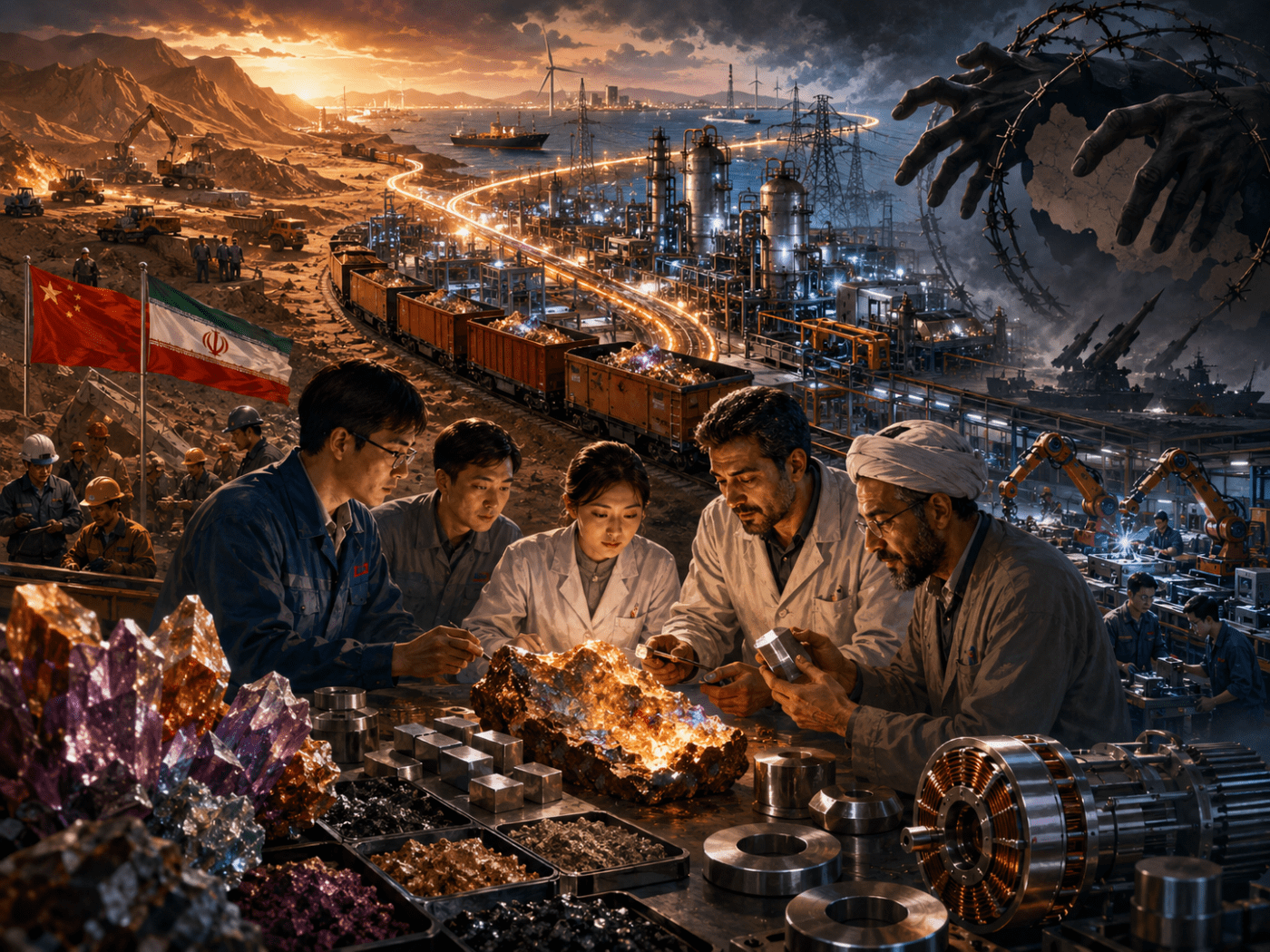
A small China-Iran scientific workshop is inflated into a geopolitical provocation because the article measures their cooperation through Washington’s strategic anxiety rather than through the relationship itself. Beneath that framing lies the real material struggle: rare-earth power rests not in the dirt but in the labor, processing knowledge, industrial machinery, and manufacturing depth that turn minerals into productive force. U.S. sanctions against Iran and technological pressure against China are meant to preserve strategic command, yet those same pressures create stronger incentives for the targeted states to build scientific and industrial routes around that command. For workers and oppressed nations, the question is not which flag dominates the supply chain, but whether these new relations actually spread productive capacity, weaken dependency, and break the chain that turns strategic minerals into another justification for war.
Prince Kapone | Weaponized Information | August 14, 2026
The Empire at the Center of Somebody Else’s Workshop
The ideological work begins before Park Yoon-sun has even bothered to give us the facts. In “As If to Provoke U.S., China Deepens Rare-Earth Ties With Iran Ahead of Summit,” a scientific workshop between China and Iran arrives already wearing an American costume. Beijing and Tehran are discussing rare-earth exploration and processing, but somehow Washington is the protagonist. China is not simply cooperating with Iran; it is acting “as if to provoke” the United States. Before a single Iranian scientist has spoken, before anybody has established what technology will actually move, the reader has been handed the proper emotional instruction: watch what China is doing to America.
The rest of the article obediently marches behind that premise. Iran is reduced to geology—a country sitting on useful dirt but supposedly lacking the means to do much with it. China becomes the keeper of forbidden knowledge, guarding the mysteries of rare-earth processing and now perhaps cracking the door open for Tehran. And the United States, naturally, becomes the wounded center of gravity, the power whose “sensitivity” gives everybody else’s relationship its meaning. The article even calls the workshop a possible “show of strength ahead of the Trump-Xi summit.” That is a heavy political conclusion to pile onto a scientific program, particularly when the article produces no evidence that the workshop was designed as summit leverage, timed around Xi’s visit, or announced by Beijing as a warning to Washington. Apparently the calendar has now been promoted to the rank of diplomat: two events occurring near one another are enough to establish political intent.
The article actually contains the evidence that should make us suspicious of its own dramatic framing. It acknowledges that the two science foundations have cooperated since 2017. It tells us that Chinese and Iranian researchers have already worked across biology, medicine, and artificial intelligence, and that the bilateral workshop mechanism itself dates to 2024. In other words, there is an existing institutional relationship into which rare-earth research has now entered. But that history is treated like furniture in the room. The spotlight swings instead toward the coming Trump-Xi summit, as though China and Iran had spent the better part of a decade building scientific ties merely to one day irritate Donald Trump in September 2026.
The hierarchy of voices completes the operation. The article leans on the South China Morning Post, unnamed “analysts,” Reuters reporting about American mineral investment and missile replenishment, and U.S. officials debating stalled trade and investment panels. Iran itself mostly enters as a mineral deposit with a flag planted on top. No Iranian scientist is asked what processing capacity would mean for Iran’s own development. No Iranian institution is allowed to explain why this field was selected. No Chinese researcher tells us what the workshop is actually supposed to accomplish. China and Iran possess agency only insofar as their actions can be translated into consequences for Washington.
That is the ideological labor of the piece. It does not have to scream that China is evil or Iran is dangerous. That would almost be too obvious. The smoother method is to establish American strategic advantage as the natural baseline of world affairs and then measure everyone else according to how much they disturb it. Washington’s dependence becomes “sensitivity.” Its military shortages become “supply difficulties.” Its anxiety becomes context. But when China and Iran cooperate outside the arrangements most comfortable to the United States, suddenly we have provocation. Empire, as usual, is granted the privilege of being scenery. Everybody reacting to it gets accused of making a scene.
The Power Is Not in the Dirt
First, strip away the drama and put the event back on the ground where it belongs. The National Natural Science Foundation of China’s August 10 announcement is not the unveiling of some giant Chinese-Iranian mining complex rising out of the desert. It is a bilateral workshop program with the Iran National Science Foundation: roughly seven projects, 30,000 yuan in Chinese support for each, each workshop lasting one week during 2027. The South China Morning Post reported that rare-earth exploration and processing is one of the selected subjects. That matters. But a workshop is still a workshop. There is no evidence in the present record of Beijing agreeing to build Iran a refinery, hand over a processing line, or ship across controlled industrial technology in a diplomatic gift basket.
What makes the workshop worth watching is not its size but the particular part of the chain it touches. Rare earths do not become power by lying patiently beneath the soil. Dirt does not build a missile, an electric motor, a radar system, or a factory. Ore has to be dug up, crushed, concentrated, chemically treated, separated, purified, converted into metals and alloys, and then manufactured into magnets and other components. That whole chain requires machinery, laboratories, engineers, workers, power, transport, industrial memory, and years of accumulated know-how. The International Energy Agency estimates that China accounts for roughly 60 percent of global mining of the main magnet rare earths, but more than 90 percent of refining and nearly 95 percent of permanent-magnet production. There is the real source of Chinese leverage. Not some mystical blessing buried in Chinese soil, but productive capacity built through labor, planning, infrastructure, technical knowledge, and industrial depth.
Beijing knows the difference, which is why it protects the knowledge farther down the chain. China tightened controls on several medium and heavy rare-earth-related items in April 2025. Then, in October, the Ministry of Commerce placed rare-earth mining, smelting and separation, metal refining, magnet manufacturing, and related production-line technologies under export control. That is why the word processing deserves more attention than all the breathless talk about “provocation.” The workshop reaches into a field China treats as strategically sensitive. But reaching into a field and transferring restricted technology are two different things. The evidence gives us the first. Anybody claiming the second is outrunning the facts.
Iran’s side of the story needs the same kind of cleanup. “Large deposits, little technology” is neat enough for a headline, but geology is rarely that polite. Peer-reviewed research on the Jajarm bauxite deposit in northeastern Iran has documented enrichment in both light and heavy rare-earth elements and identified the area as promising for further exploration. That tells us Iran has real mineral potential. It does not tell us how much of that material can be commercially recovered, at what cost, on what scale, or under what ownership. A geological occurrence is not a proven reserve. A proven reserve is not a functioning mine. A functioning mine is not an industrial supply chain. Capital loves to collapse those stages into one whenever a map with colored deposits can be made to look like tomorrow’s fortune.
Iran is also not standing there helplessly with a shovel waiting for the Chinese professor to arrive. Iranian reporting says the country opened its first monazite processing facility in 2025 as part of an effort to build domestic rare-earth separation capacity. The scale and performance of that effort still need to be treated carefully. Nothing in the record suggests Iran has anything remotely comparable to China’s industrial system. But that is not the same as having nothing. The real question is therefore not whether China is about to introduce Iran to the strange new concept of processing minerals. It is whether cooperation with Chinese researchers can deepen an Iranian capability that has already begun to take shape.
The institutional road connecting the two countries is older than the Trump-Xi summit too. Chinese and Iranian science foundations have worked together across several fields for years, while the political relationship sits inside a broader strategic framework. The China-Iran comprehensive cooperation plan was signed in 2021, and scientific collaboration subsequently spread through medicine, energy, and other areas. Rare earths are a new branch growing from an older tree. They were not planted in August because somebody in Beijing suddenly looked at the September calendar and wondered how best to spoil Donald Trump’s morning.
Washington’s anxiety, however, is not imaginary. Rare earths and other critical minerals run through advanced electronics, guidance systems, aircraft, and missile production. The recent war with Iran exposed how quickly a modern military can chew through the industrial base underneath its arsenal. On August 7, the Trump administration announced a $3 billion critical-minerals and battery investment program explicitly tied to domestic production, national security, and defense supply chains. Reuters separately reported that the U.S. Army burned through much of its global inventory of long-range precision missiles during the Iran conflict. Missiles do not replenish themselves through patriotic speeches. Somebody has to mine the material, process it, machine it, assemble it, move it, and do it again.
So yes, rare earths really are sitting inside the current U.S.-China bargaining table. In late July, American officials raised rare-earth commitments directly with Chinese Vice Premier He Lifeng while discussing trade and investment arrangements ahead of the expected September summit. And yes, Iran is simultaneously living under an extensive U.S. sanctions regime that restricts finance, shipping, energy, trade, and commercial networks, including dealings involving Chinese entities. That is the actual terrain beneath the workshop: China dominates the downstream industrial chain; Iran is trying to build more capacity of its own; Washington wants to reduce its dependence on Chinese production while continuing to squeeze the economic room available to both countries in different ways.
Once the facts are laid out that way, the spectacle becomes less mysterious. The issue is not that China and Iran have discovered some secret mineral conspiracy. The issue is that whoever controls the processing controls far more than whoever owns the hole in the ground. And that is exactly why every empire eventually becomes a little nervous when the people sitting on the raw materials start learning how to do something with them.
When the Chokepoint Begins Teaching Around Itself
The rare-earth question only starts making sense once we stop treating minerals like some enchanted powder buried in the earth waiting to become power. A deposit by itself does nothing. It does not build a factory, guide a missile, turn a turbine, run a communications grid, or manufacture a magnet. Human labor has to drag it out of the ground, separate it, refine it, transform it, engineer it, transport it, and put it to work. The real struggle is therefore not simply over who owns the rock. It is over who commands the workers, machinery, laboratories, knowledge, infrastructure, and industrial system that can turn the rock into productive force.
That is the material relation underneath this little China-Iran workshop. China’s leverage does not come from sitting on a lucky patch of dirt. It comes from having built up a huge share of the processing and manufacturing chain inside its own economy. Other countries, including the United States, organized themselves around access to capacities they no longer fully reproduce at home. And there is the contradiction. Washington was perfectly happy with interdependence when American power sat comfortably above it. But once Chinese productive capacity began giving Beijing the ability to set terms of its own, suddenly the sacred free market discovered customs officers, export licenses, blacklists, sanctions, and national-security lawyers. Capital loves an open door right up until somebody else starts holding the key.
Iran enters this contradiction from another road. Its access to finance, shipping, investment, technology, and trade has been squeezed by sanctions imposed from outside its own borders. Those measures do not merely inconvenience a few ministers. They narrow the developmental space available to an entire society. They make some banks unreachable, some technologies harder to acquire, some trade routes more dangerous, some investments more costly. Under those conditions, cooperation with countries capable of moving outside Washington’s preferred channels becomes more valuable whether anybody waves an anti-imperialist banner or not. Close enough doors and people begin paying very serious attention to the windows.
That is where the contradiction starts moving. The more Washington turns finance, technology, trade, and access into instruments of discipline, the more incentive targeted countries have to build circuits that do not depend on Washington’s permission. China, itself confronting restrictions on its technological development, has its own reason to strengthen those circuits. Iran, facing sanctions while trying to deepen its own limited processing capacity, has every material reason to seek scientific cooperation that might help it do more with resources under its own soil. No secret conspiracy is required. No dramatic declaration of defiance is necessary. The pressure itself manufactures the incentive.
And that is exactly what the propaganda frame turns upside down. The machinery of coercion becomes scenery. Sanctions are simply there, like winter. Technology controls become prudent administration. Military demand for strategic minerals becomes common sense. But when countries living inside those pressures begin finding ways around them, suddenly there is movement, danger, aggression, provocation. History conveniently begins with the reaction. It has to, because beginning with the action would raise the uncomfortable question of what these countries are reacting to.
Still, none of this means we should clap every time Beijing and Tehran sign something. The real question is harder and much more important: does this cooperation change Iran’s place inside the productive chain? A country can own mountains of valuable minerals and remain dependent if the difficult parts of the process—refining, machinery, advanced manufacture, intellectual property, financing, markets—remain somewhere else. It can dig wealth out of its own ground, ship it abroad, and then buy back the finished value at ten times the price. Colonialism wore that suit for centuries. Neocolonialism simply had it tailored.
If cooperation with China only creates another pipeline for Iranian minerals to leave the country while the higher-value stages remain concentrated elsewhere, then the map changes more than the underlying relation. Iran may gain customers, revenue, and room to maneuver, but that is not the same thing as gaining command over development. If, on the other hand, cooperation expands domestic processing knowledge, engineering capacity, machinery, skilled labor, and downstream production, then the relation begins to shift in a more substantial way. The test is not whether China is benevolent. The test is whether productive capacity actually spreads.
That question cuts directly into China’s own position. Beijing gains leverage because rare-earth processing is concentrated. Yet China also benefits when countries pressured by Washington become less dependent on Western-controlled channels. So the same productive capacity contains two tendencies at once. It can remain a chokepoint that strengthens Chinese bargaining power, and it can be selectively shared in ways that help other countries build greater autonomy. Those tendencies do not automatically move in the same direction. A tiny workshop proves neither one victorious. But the contradiction is already sitting there in plain sight.
Washington faces the problem from the other side. Its effort to preserve strategic command pushes it toward tighter technology controls, mineral subsidies, military stockpiles, and pressure on rival supply chains. But every restriction also teaches the targeted state a lesson: dependence is dangerous. Every sanction that closes a channel raises the value of another. Every attempt to monopolize access demonstrates that access itself is political. The system keeps producing the incentive for alternatives out of the very methods it uses to prevent them.
For workers and oppressed nations, this is where the whole discussion has to be pulled down from the clouds of diplomatic chess and put back on the shop floor. Minerals do not refine themselves. Workers mine them, haul them, crush them, separate them, smelt them, machine them, assemble them, and move them across continents. Yet the power to decide where the value accumulates usually sits far away from the hands doing the work. Resource-rich countries are told that possessing the raw material is already a blessing, while the high-value stages—processing, technology, finance, advanced production—remain concentrated elsewhere. The pattern is old enough to be boring: the wealth leaves heavy and comes back expensive.
So the real question raised by China-Iran rare-earth cooperation is not whether Washington feels provoked. The real question is whether one of the international division of labor’s most strategic bottlenecks is beginning, however slightly, to loosen. That cannot be answered by a workshop announcement. It cannot be answered by waving the flag of multipolarity either. It will be answered materially: who learns, who builds, who processes, who owns, who works, who controls the machinery, and where the value stays.
The workshop, then, is neither the birth certificate of a new industrial order nor some meaningless academic get-together. It is a small opening onto a much larger historical movement. One center of power tries to preserve command over strategic technology and supply. States constrained by that command search for routes around it. Those routes can reproduce dependency in new clothing, or they can widen the space for genuine productive sovereignty. Nothing in the present evidence settles that outcome in advance. But the contradiction is already doing its work: the more the old order turns access to development into a weapon, the more reason the excluded have to learn how to live, build, and produce beyond its reach.
Break the War Chain Before It Hardens
The first battlefield is not Beijing and it is not Tehran. It is here, inside the institutions that take every mineral shortage, every Chinese refinery, every Iranian research agreement, and every nervous Pentagon spreadsheet and turn them into another argument for sanctions, military spending, and permanent confrontation. That is how a Cold War is built before anybody formally declares one. First the public is taught that dependence is danger. Then competition becomes threat. Then threat becomes security policy. By the time the missiles arrive, the political work has already been done.
CODEPINK’s China Is Not Our Enemy campaign gives organizers one concrete place to interrupt that process. The work belongs in union halls, classrooms, community meetings, churches, political-education circles, and anywhere else working people are being fed the lazy line that “China controls what America needs.” Fine. Then ask the next question. Why does every supply-chain problem have to become a military problem? Why are sanctions treated as if they fell from the sky instead of being deliberate instruments of state power? Why should scientific cooperation between China and Iran require the blessing of officials in Washington? Once those questions enter the room, the whole national-security performance starts looking a little less majestic and a lot more like what it is: an argument for preserving command.
The same struggle runs through Iran. CODEPINK’s Iran organizing and anti-sanctions work provides a direct channel for opposing the machinery that restricts Iran’s access to trade, finance, technology, and development and then complains when Tehran looks elsewhere. Congressional pressure against new sanctions, public education on how economic warfare actually works, and organized opposition to further military escalation all hit the contradiction where it lives. Washington cannot keep narrowing a country’s economic options and then act scandalized when that country builds relationships outside Washington’s reach. Even an empire should not be allowed to set the fire and then lecture the neighborhood about smoke.
Veterans For Peace’s China Working Group can strike at another point in the chain: the attempt to turn mineral insecurity into military necessity. Veterans can speak with particular force against the absurd idea that economic security should be measured by how quickly the United States can refill missile inventories for the next war. Their organizing can make the material chain visible: the mine becomes the magnet, the magnet becomes the guidance system, the guidance system becomes the missile, and the missile exists because somebody in power decided that another confrontation was necessary. Put that chain in front of people clearly enough and “critical minerals” stops sounding like neutral technocratic language.
That work has to become organized practice: resolutions in unions and community organizations, teach-ins, public forums, congressional pressure, independent media, and worker education in logistics, manufacturing, transportation, and defense-linked industries. Not vague appeals for everybody to be nicer to one another. The point is to weaken the political machinery that turns industrial dependence into sanctions, sanctions into militarization, and militarization into common sense. If workers are expected to mine the minerals, move the cargo, machine the components, and build the weapons, then workers have every right to ask who decided the weapons were necessary in the first place.
And there is another guardrail we cannot abandon. Opposing U.S. imperial pressure does not mean cheering for any new mineral order simply because Washington dislikes it. Iran has every right to develop the resources beneath its own soil without being strangled for doing so. But genuine sovereignty means more than changing the destination printed on the shipping manifest. Mineral wealth should build domestic knowledge, processing capacity, skilled labor, infrastructure, and social development. Otherwise the ore leaves under one flag and the value still accumulates somewhere else. The fight is not over which great power gets to sit at the top of the supply chain. It is over whether the people who dig, refine, machine, assemble, transport, and transform the world’s materials gain greater control over the wealth their labor creates.


Leave a comment