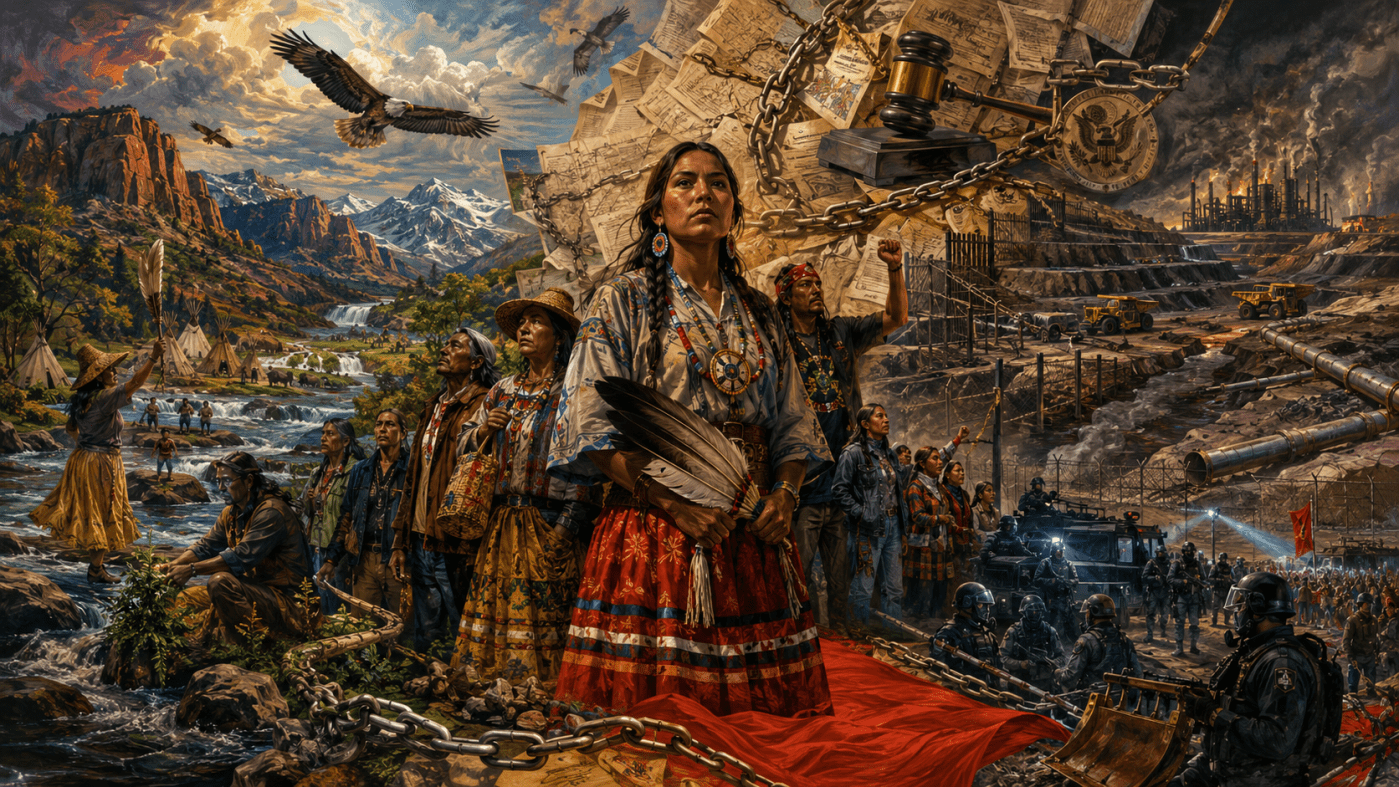
Ward Churchill’s Perversions of Justice tears open the legal machinery through which the conquest of Indigenous nations was transformed from naked seizure into title, trusteeship, compensation, racial classification, resource extraction and administered “self-government.” Following that machinery from the Marshall Doctrine through Hawai‘i, uranium colonization and the counterinsurgency against AIM, the book shows that Indigenous sovereignty was never simply abolished but selectively recognized whenever settler power needed treaties, leases, consent or legitimacy—and restricted whenever sovereignty threatened land, profit or political command. Churchill’s final wager is even more dangerous: that the contradictions inside the colonizer’s own law can be seized as political weapons, used to fracture legitimacy, withdraw consent and pry open the structure of state power itself. Read from the technofascist consolidation of 2026, the question is no longer whether Churchill proved the conquest unlawful, but whether exposing the law’s contradictions can help build the organized counter-power capable of undoing what centuries of legality have made material.
Prince Kapone | Weaponized Information | Weaponized Intellects Book Review | August 16, 2026
The Law Needs the Nation It Is Trying to Bury
I first read Perversions of Justice in prison in 2010. What blew me away was not simply where Churchill landed, but how he got there. He did not ask you to believe that the United States was built through conquest because he said so, then sprinkle a few radical adjectives on top and call it analysis. He went digging through the treaties, court decisions, congressional acts, doctrines and legal inventions of the settler state itself, and he came back carrying receipts. I was sitting in a cell reading a book about how raw power cleans itself up, puts on a robe, learns the right vocabulary and starts calling itself law. That stayed with me. Prison did not make Churchill correct, and sixteen years later I owe a book that shaped me harder scrutiny, not worship. But I understood something reading him in there that I have never forgotten: the violence that builds an order and the law that manages it afterward are not two different histories just because one carries a rifle and the other carries a briefcase.
Sharon Helen Venne opens the book by refusing the tense America needs in order to sleep at night. “This continent has not entered a ‘postcolonial era,’” she writes. That one sentence blows a hole through the whole respectable story. Put colonialism safely in the past and federal Indian law becomes a technical field dealing with minorities inside an already legitimate United States. Treaties become museum pieces. Reservations become administrative districts. Sovereignty becomes a question for specialists. Conquest gets buried in the nation’s childhood alongside wooden teeth and powdered wigs: regrettable, yes, perhaps even tragic, but finished. Everybody can mourn what happened once nobody is expected to give anything back.
Venne will not let the burial happen. She points instead to “the corpus of European and Euroamerican law by which the colonizers have sought to rationalize, disguise, or deny the character of their relationship to indigenous America.” Rationalize is doing serious work there. Once the cavalry wins, colonial power does not suddenly stop needing an explanation for itself. It still has to tell us why the nations whose territories it occupies have some sovereign powers but not others. It has to explain why treaties supposedly bind Native nations permanently while Washington can reinterpret its own obligations whenever convenient. It has to explain why a government calling itself a trustee exercises command over the people it claims to protect. It has to explain how a nation can remain a nation while some other nation decides what its sovereignty means. The gun can take the land. Somebody still has to write the paperwork that makes the taking look like ordinary government.
Churchill enters Angloamerican law right there. Reconstructing the early federal treatment of Indigenous title, he describes the need for the “construction of a legal theory—a subterfuge, as it were—by which the more inconvenient implications of international law might be nullified.” That is much sharper than saying American judges were racists. Of course they were operating inside a deeply racist settler society. But racism alone does not tell us why one doctrine develops instead of another, or why certain legal categories suddenly become useful at a particular historical moment. Churchill puts the pressure where it belongs. Indigenous nations had already been treated as political entities. Treaties had been signed. Territorial rights had been acknowledged. The United States could not simply wake up one morning and announce that none of this had ever happened without screwing up the legal story behind its own title. Expansion needed a doctrine capable of swallowing the contradiction.
That saves Churchill’s argument from becoming another morality tale about bad judges with ugly ideas. If the problem were only prejudice, then maybe better judges could clean it up. If the problem were only hypocrisy, then exposing hypocrisy ought to fix it. Churchill finds something harder underneath. Legal categories are being pushed and bent by a struggle over land and jurisdiction. The United States has negotiated with Indigenous nations, obtained cessions from them and then relied upon those cessions as proof that the land now belongs to the United States. That means the settler state needs Indigenous nations to possess enough political authority to transfer territory. But once those same nations claim enough sovereignty to block U.S. jurisdiction, refuse extraction or challenge the transfer itself, suddenly sovereignty needs qualifications.
John Marshall gives the state exactly what it needs. Indigenous nations remain nations, only now they become “domestic dependent” nations living beneath a superior sovereign authority. Churchill calls the arrangement “little more than a judicial description of the classic relationship between colonizer and colonized, but worded so as to seem at first glance to be the opposite.” That is the trick. The state does not simply erase Native sovereignty. Erasing it outright would create too many problems for the treaties, cessions and agreements the United States uses to justify its own possession. So sovereignty is recognized and then hollowed out. You remain sovereign, brother, except some other sovereign gets to decide what your sovereignty allows you to do. A generous arrangement indeed.
This is the contradiction sitting at the center of Churchill’s case. Settler law needs the nation it is trying to bury. It needs somebody capable of signing the treaty, ceding the territory, approving the agreement and supplying the appearance of consent. But that same nation cannot be allowed to exercise sovereignty where sovereignty would threaten the result. Recognition gives the settler order legitimacy. Restriction protects the land once the signature is dry. These are not opposite policies. They work together.
Even the ordinary words start carrying the conquest. Dependent makes domination sound like some unfortunate condition the court discovered in the wild, rather than something produced through warfare, dispossession and imposed jurisdiction. Domestic quietly moves Indigenous nations inside the United States before anybody has established by what legitimate process they got placed there. A contested relationship between nations becomes an administrative category. The battlefield disappears into vocabulary. What people fought over with armies, treaties and resistance starts reappearing several generations later as if it were simply how federal law has always worked.
None of this means a handful of legal phrases conquered a continent. Churchill’s evidence will not let us get away with anything that soft. The doctrine becomes necessary because settlers want land, the government wants jurisdiction and older legal principles get in the way. Law matters because it helps mediate that fight. The state has to reconcile three facts that do not sit comfortably together: Indigenous nations were already here; the United States wanted their territory; and the United States wanted to acquire that territory without admitting that the civilization forever lecturing the world about law was building itself through conquest.
The strange afterlife of the whole thing became almost too perfect in 2023, when the Vatican formally repudiated the legal and political concepts associated with the Doctrine of Discovery and acknowledged their role in the dispossession of Indigenous peoples. Good. A doctrine used to sanctify conquest deserves to be dragged into daylight and condemned. But nobody woke up the next morning to find North America politically rearranged. Property lines did not vanish. Federal jurisdiction did not evaporate. Indigenous lands did not march themselves home. The old ideological blessing could be withdrawn because the social order it helped bless had already been poured into concrete.
That makes Churchill more useful, not less. Ideas matter, but once an idea has helped become a deed, a jurisdiction, an agency, a boundary, a court precedent and several centuries of inherited property, denouncing the idea does not automatically undo the world built around it. Colonial ideology does not float above material life forever. It sinks into institutions. It becomes procedure. It becomes common sense. Eventually people stop asking why the arrangement exists at all because the arrangement has acquired the majesty of paperwork.
And that is why Perversions of Justice is far more dangerous than another book accusing America of failing to live up to its principles. Churchill asks what those principles had to be twisted into so the country could live with what it had done. Before anybody asks whether the United States has governed Indigenous peoples fairly, he drags a more basic question back onto the table: by what legitimate authority did the United States acquire the right to govern them in the first place?
Once that question is opened, the law books cannot contain it. If dependent sovereignty was built because possession needed a political form that could survive after the shooting stopped, then we have to follow the doctrine back outside the courtroom. Somebody got the land. Somebody kept the land. And once the stolen land became lawful property, the thief no longer had to call himself a thief.
The Theft Becomes a Deed
Once Churchill tears apart the legal foundation of discovery, the settler order has another card to play: conquest. Maybe the land was not discovered in any meaningful legal sense. Fine. It was conquered. History is full of conquest, we are told, and eventually the winner gets to stop explaining himself. Churchill spends “Rights of Conquest” ruining that convenience too. After working through the older laws of war, the conditions historically attached to conquest and the actual conduct of the United States toward Indigenous nations, he comes to a blunt conclusion: “No such right is now recognized, nor was it ever.” Military power can seize territory. That does not magically convert seizure into lawful ownership just because the side holding the gun survived long enough to write the history books.
This is where the treaties become dangerous. The United States has always depended upon them as evidence that Native land passed legitimately into American possession. But a treaty only works if there is somebody on the other side with the political authority to make one. You cannot claim that Indigenous nations were too primitive, dependent or legally deficient to possess real sovereignty and then turn around and treat their signatures as perfectly valid whenever those signatures transfer millions of acres. The colonized somehow become sovereign at exactly the moment the colonizer needs them capable of surrendering something.
Churchill keeps pressing the contradiction until the respectable story starts falling apart. If the treaties were entered into through fraud, coercion, manipulation or systematic violation of obligations, then the piece of paper does not cleanse the transaction. If the agreement recognized continuing Indigenous rights, Washington cannot simply behave generations later as though those terms evaporated when they became inconvenient. And if conquest itself does not provide the right everybody assumes it does, then the legal foundation beneath enormous portions of American property begins looking less like granite and more like paperwork stacked over a battlefield.
That is where the problem stops being merely legal. There is a whole social order sitting on the other side of those documents. Farms, railroads, military installations, mines, hotels, suburbs, resorts and banks did not materialize out of constitutional theory. People took possession, built institutions around possession and then turned yesterday’s conquest into today’s property. Once that happens, the state develops a strong preference for historical remedies that acknowledge wrongdoing without disturbing the thing everybody got from it.
Hawai‘i gives Churchill one of the cleanest examples in the book. After the overthrow of Queen Liliʻuokalani in 1893, President Grover Cleveland investigated what had happened and described it for what it was: an “unprovoked act of war.” There is no shortage of presidential conscience here. Cleveland recognized that representatives of the United States had helped destroy a government with which the United States was at peace. But when the deposed queen asked for restoration, the conscience suddenly encountered property, class power and political facts already created on the ground. The wrong could be condemned. The result remained.
Churchill refuses to let this become another story about America tragically betraying its ideals. He brings the plantation bourgeoisie into the room. Liliʻuokalani had moved against a political order increasingly dominated by planter interests, sought greater control over government and advanced a constitution Churchill describes as “nothing less than a blunt repudiation of the plantation bourgeoisie and the institutions it had established.” Now the overthrow starts making considerably more sense. This was not simply a clash between monarchy and republican modernity, nor some spontaneous uprising of democracy against despotism. A class rooted in plantation wealth had accumulated economic power inside Hawai‘i and wanted political institutions suited to protecting it. Indigenous sovereignty threatened that arrangement.
The U.S. minister understood the equation well enough. The white settler population was too small to guarantee control of Hawaiian politics on its own, so American force became the great democratic equalizer. Marines landed, the monarchy fell, and the property regime survived the constitutional crisis. Later generations could debate whether every procedural step had been legitimate. The sugar still moved. The land still changed hands. The political victory had already established the conditions under which legality would catch up.
Churchill follows the story forward because stolen land does not remain a historical artifact. It enters circulation. By the twentieth century, Hawai‘i had been remade into what he describes as a meeting place and playground for the world’s corporate elite, with major financial interests embedded in tourism and development. Yesterday’s conquest becomes today’s portfolio. The stolen kingdom gets a resort brochure. Capital is wonderfully innocent that way: it rarely remembers the bayonet once the property has appreciated enough.
The Indian Claims Commission performs the same conversion through federal bureaucracy rather than an overthrow. Created in 1946, the Commission was advertised as proof of American fair play. Congressmen presented it as evidence that the United States was willing to examine historical grievances and compensate Native peoples for wrongful takings. Harry Truman could even boast that the government had purchased most of its public domain rather than simply confiscating it. Churchill looks past the language of national generosity and asks the obvious question: what was the Commission actually allowed to do?
The answer is devastating. Indigenous claimants could prove that land had been wrongfully taken. They could establish that treaties had been violated. They could demonstrate fraud or unconscionable dealings. They could receive monetary compensation. But Churchill notes one iron rule governing the whole procedure: “under no circumstances were Indians permitted to recover their property.”
There it is. The state will hear your case. It will examine the evidence. It may even agree that you were robbed. What it will not do is return what was stolen. The theft is open to litigation; possession is not.
This was not some technical flaw buried in an otherwise restorative process. Churchill places the Commission inside a larger federal drive toward what supporters called a “permanent solution to the Indian problem.” Resolve the outstanding claims, calculate a cash value, close the historical account and then move toward termination, assimilation and the disappearance of Indigenous political status as an unresolved problem for the United States. A national-territorial struggle gets reduced to damages. Land becomes money. Sovereignty becomes a claim number. Once the check is cut, Washington can declare the past settled while keeping the settlement.
The irony is that the Claims Commission’s own research kept uncovering evidence more explosive than the institution was built to handle. Investigators digging through treaties, surveys and title histories found enormous areas for which the United States had never secured valid proprietary rights. Churchill cites estimates reaching roughly 750 million acres. By 1970, even the Interior Department was acknowledging the implication: around one-third of the United States could still be understood as land that legally belonged to Native peoples.
The machine built to close the books had accidentally started auditing the owner.
That is the real importance of these chapters. Churchill does not simply prove that American property has a violent past. Almost every ruling class on earth can survive admitting that its ancestors were bastards. The more dangerous point is that the past remains embedded in the present property relation. Hawai‘i can receive an official acknowledgment that its government was illegally overthrown without restoration of the government. Native nations can prove unlawful taking before a federal commission whose founding rules forbid restitution. The state can admit the crime so long as the remedy never reaches the property produced by the crime.
Once we see that, “historical injustice” starts sounding suspiciously convenient. History becomes the place where the robbery is stored after the stolen goods have entered the economy. The violence belongs to yesterday; the title belongs to today. One is regrettable. The other is sacred.
Churchill’s achievement here is to reconnect them. He forces the deed to remember the theft. But the deed does not just sit in a courthouse archive. Property can be leased, financed, drilled, mined and militarized. Once stolen territory becomes an asset, sovereignty acquires an even more concrete meaning. The question is no longer only who owns the land on paper. It is who gets to decide what comes out of it, who profits when it does, and whether the people beneath whose feet the wealth lies possess enough sovereignty to say no.
Sovereign Enough for the Mine
Churchill’s argument gets harder to hide from once it reaches the mine shaft. In “A Breach of Trust,” sovereignty stops sounding like a constitutional abstraction and starts showing up in uranium, coal, oil, gas, corporate leases, poisoned water and royalty checks. Churchill puts the contradiction in one brutal sentence: Native nations are treated as “sovereign enough to legitimate Euroamerican mineral exploitation on their reservations, never sovereign enough to prevent it.” There is the arrangement stripped of ceremony. Sovereignty is real when somebody needs a signature. It becomes strangely theoretical when the people whose land is being carved up decide they would rather say no.
Churchill backs that formulation with the geology of colonial power. He notes that reservation lands contain enormous concentrations of strategic resources: major uranium deposits, low-sulfur coal, oil, natural gas and a long list of minerals essential to industry and war. By the early twentieth century, he argues, federal planners had begun recognizing that there was no need to liquidate every reservation if the remaining territories could instead be held inside a trust system through which Washington retained decisive control over access. The reservation did not have to disappear. It could be made useful.
That is an important turn in the history Churchill reconstructs. Colonial domination does not always advance by abolishing whatever came before it. Sometimes it works better by preserving a weakened form and managing it. Keep the reservation. Recognize the tribe. Establish a council. Call it self-government. Then reserve the right to determine how much government the self is actually permitted.
The legal architecture arrives wrapped in paternal affection. Churchill opens the essay with the Supreme Court’s construction of Native peoples as permanent federal “wards,” the United States as their “trustee,” and congressional authority as “plenary.” It is an astonishing little arrangement once the language is stripped of its benevolence. The government declares a people incapable of managing their own affairs, appoints itself guardian, and then cites the guardianship it imposed as the legal basis for continuing to rule them. Colonialism, apparently, becomes legitimate once the conqueror remembers to call himself a caretaker.
Churchill is interested in what that trusteeship does, not simply what it calls itself. Federal economic planners, he shows, came to understand that Indian lands could remain formally protected while their resources were opened to favored corporations through leases administered within the federal system. The Indian Reorganization Act and the tribal governments structured under it became part of that arrangement. These governments could exercise real authority, but within a political field whose outer boundaries Washington retained the power to set. Mineral leases could therefore carry Native signatures while the deeper relation determining access remained colonial.
That is what makes Churchill’s “sovereign enough” formulation so precise. Indigenous sovereignty does not simply vanish. It gets calibrated according to what the settler state needs from it. A tribal government can possess enough authority to enter a lease, making the transaction appear consensual and legitimate. But if that same government tries to exercise sovereignty in ways that threaten strategic access, corporate profit or federal jurisdiction, the limits suddenly become easier to find.
The money tells the rest of the story. Churchill documents Bureau of Indian Affairs leases that returned Native nations a fraction of prevailing market royalty rates while major corporations acquired access to valuable resources on extraordinarily favorable terms. He describes the result as “super-profit,” especially where contracts lacked meaningful protections for workers, environmental rehabilitation or the long-term health of surrounding communities. No conspiracy board covered in red string is necessary. The class relation is sitting right there in the contract. Colonial jurisdiction structures access to the resource; corporate capital walks through the door and leaves with the minerals.
This is why neither racism nor capitalism alone can explain what Churchill has put on the table. Say it is only racism and we lose the economic beneficiaries, the resource flows and the corporate interests that make the arrangement profitable. Say it is only capitalism and we lose the prior colonial relation deciding who possesses authority over the land in the first place. The two relations meet materially. Indigenous territory is subordinated through colonial power; that subordination then creates profitable conditions for capital and strategic advantages for the state.
Uranium makes the relation impossible to pretty up. Churchill recounts federal discussions of parts of the Four Corners and northern Plains as “national sacrifice areas in the interests of energy development.” Bureaucracy has always had a special genius for this kind of language. A homeland becomes an “area.” People become an external cost. Destruction becomes development. And once the word national is placed in front of sacrifice, nobody is supposed to ask which nation gets the benefit and which one gets the cancer.
Churchill does ask. On Navajo land, radioactive waste from uranium mining remained in communities while the extracted material entered the American nuclear economy. Tailings contaminated land and water. Abandoned waste became part of everyday life. Churchill writes that “both the land and the people have already been sacrificed on the altar of U.S. armaments development.” Trusteeship reaches its logical conclusion here. The government claiming a legal duty to protect Native peoples oversees the removal of strategic minerals from their land for a military system built in the name of national security, while much of the environmental and bodily cost remains behind with the people being “protected.”
The geography of the arrangement is as revealing as the law. Uranium moves outward. Profit moves outward. Military capacity accumulates elsewhere. The tailings stay. The damaged water stays. The disease stays. Churchill does not need an abstract formula for unequal exchange; he gives us the road the uranium travels down.
And the word sacrifice itself exposes the political relation. Sacrifice sounds collective, as though everybody tightened a belt and bore the same burden for some common good. But sacrifice areas are selected. Somebody possesses the power to determine that one territory can be contaminated so another political center can accumulate energy and military strength. Once that decision-making power is made visible, “national interest” stops appearing universal. The nation extracting the resource and the nation carrying the poison are not occupying the same side of the transaction.
That is why the contemporary fight over Bears Ears is such a useful stress test for Churchill’s argument. In July 2026, the Trump administration drastically reduced Bears Ears National Monument while openly invoking energy independence, critical minerals and national security. The proclamation itself acknowledges the area’s deep significance to Native peoples, then turns almost immediately toward uranium, copper, vanadium, zinc and other strategic resources beneath and around the land.
Bears Ears is not simply the twentieth-century reservation mineral regime repeating itself with a new date stamped on the document. The legal form is different. Monument designation, federal land management and contemporary critical-mineral policy are not the BIA lease system Churchill analyzed. The continuity lies somewhere more exact. Once again Indigenous ancestral territory, federal control, valuable minerals and the language of national necessity converge in the same struggle. Churchill gives us the question we have to ask without pretending history repeats word for word: who actually possesses the power to decide what this land is for?
That question cuts through a lot of ceremonial talk about sovereignty. A sovereignty that cannot meaningfully control land, minerals, water or the conditions under which extraction occurs has been emptied of much of its material content. Churchill’s achievement here is to drag sovereignty down from the constitutional clouds and force it underground with the miners. Who negotiates the lease? Who sets the royalty? Who writes the environmental terms? Who carries the contamination? Who gets the resource? Who gets to refuse?
And once those questions are answered, another follows. Colonial power cannot indefinitely govern territory without also reaching into the life of the nation that inhabits it. Land can be leased and minerals extracted, but a people who continue reproducing themselves as a people can keep contesting the arrangement. Sooner or later the administrator confronts a more intimate problem: who belongs to the nation, who gets to decide that, and what happens when the colonizer starts writing the answer?
Who Gets to Decide Who the People Are?
Churchill opens “The Crucible of American Indian Identity” with a question that liberal politics has spent decades trying to shrink into a matter of personal identity: who gets to decide who belongs to a people? For Churchill, this is not primarily about what box somebody checks, how they describe themselves, or whether outsiders think they look “authentic.” He calls a people’s power to determine its own membership “the very bedrock expression of self-determination by any nation or people.” Start there and the whole discussion changes. Indigenous identity is not first a cultural label. It is a political relation. The question is not simply Who are you? It is Who has the authority to decide who “we” are?
That is what makes blood quantum much more than some archaic racial oddity hanging around in federal paperwork. On the surface it looks administrative, even scientific: a fraction goes on a document, the fraction determines eligibility, the file gets processed. Churchill tears the neutrality off the procedure. A people whose membership had been determined through its own political institutions, kinship systems, adoption practices and collective life is translated into hereditary arithmetic maintained under colonial authority. Nationhood becomes genealogy. Political belonging becomes blood percentage. The sovereign becomes a file clerk’s calculation.
Once that happens, the state can present itself as merely recording who is Native rather than exercising power over what Native nationhood is allowed to mean. That distinction is everything. Liberal multiculturalism loves recognition because recognition makes the state look generous. Here are your identities. Here are your heritage months. Here is your official designation. But recognition always leaves one inconvenient question sitting in the corner: by what authority does the United States get to certify the political existence of nations that existed before the United States?
Churchill sees the trap clearly. He writes that colonial rule increasingly depends upon “the kinds of subterfuge designed to create false appearances,” because confusion can accomplish “much more cheaply, quietly and efficiently what raw force was once required to achieve.” That does not mean the violence has vanished. It means domination becomes cheaper when the dominated are forced to move through political categories the colonizer has made appear natural. A rifle can impose a boundary. An administrative system can teach everybody to forget the boundary was imposed.
Blood quantum is brutally efficient in that sense. The government does not have to announce that it intends to make Native nations disappear. It can simply establish a formula under which recognized membership diminishes as people marry outside the federally defined bloodline. Generation after generation, the number gets smaller. One-half becomes one-quarter. One-quarter becomes one-eighth. Eventually the people subjected to centuries of warfare, dispossession, removal and forced assimilation are confronted with the bureaucratic discovery that there are apparently fewer of them left. The state manufactures the conditions of disappearance and then records the result as demography.
Churchill does not treat this as an isolated paperwork problem because the assault on national membership was tied to a much wider attack on the reproduction of Indigenous peoples as peoples. The boarding schools make that impossible to miss. Children were taken from their families and communities, stripped of language and social relations, disciplined into Euroamerican norms and trained for subordinate places in the colonial economy. Churchill invokes Richard Henry Pratt’s infamous program of “killing the Indian” in the child, but he also reminds us that what passed for industrial education regularly involved “uncompensated manual labor.” The school was not merely teaching children a different culture. It was reorganizing them for somebody else’s society.
That is what assimilation actually means when stripped of the liberal language of integration. A nation does not reproduce itself by DNA alone. It reproduces itself because children inherit language, memory, political obligations, ways of relating to land, collective institutions and the knowledge that they belong to a people with a history larger than the individual. Break those chains of transmission and conquest moves inside everyday life. The frontier fort becomes a classroom. The campaign against the nation becomes a curriculum.
Federal administration then performs another trick: institutions created within this colonial framework begin appearing as proof that colonialism has ended. Churchill is merciless about tribal councils structured under federal authority that can end up defending what he calls the “negation of indigenous sovereignty in the name of maintaining it.” He calls it a “perfect shell game.” The point is not that every Native official working inside a federally recognized government is some colonial stooge. That would be politically childish and historically false. Indigenous people act, struggle, compromise, resist and govern under conditions they did not choose.
The harder question is institutional. A government can be genuinely Native in its constituency and leadership while still operating inside a jurisdiction whose outer boundaries are determined elsewhere. Elections can be real. Councils can make meaningful decisions. Programs can improve people’s lives. None of that answers who possesses final authority when Indigenous political power collides with federal command. Colonial relations do not disappear just because their administration acquires Indigenous personnel.
That distinction matters enormously for any serious critique of identity politics. Indigenous nationhood cannot be reduced to having Indigenous faces inside institutions. Representation may matter, but representation is not sovereignty. A Native administrator can administer an imposed structure. A culturally sensitive policy can remain a colonial policy. A government can recognize Native identity all day long while withholding the political power through which a nation defines its own membership, controls its own institutions and determines its own future.
Churchill’s chapter on Canada, “Forbidding the ‘G-Word,’” pushes the same struggle into the power of naming. Here the issue becomes not who the people are, but what they are permitted to call what has been done to them. Churchill examines a case in which a Canadian judge set aside the legal definitions of genocide presented before the court and relied instead upon the “plain and ordinary meaning” of the word. On paper, the move looks modest, almost common-sensical. In practice, whoever controls the definition controls what forms of destruction can be recognized.
If genocide is imagined only as immediate mass killing, then a whole colonial arsenal becomes easier to place outside the category: removal of children, destruction of institutions, attacks upon cultural reproduction, imposed living conditions and policies designed to dissolve a people as a people. The dead do not become less dead because a judge changes vocabulary. The destroyed institutions do not rebuild themselves because the court prefers a narrower definition. But the political order does gain the power to decide which histories count as crimes of a particular magnitude and which are demoted into unfortunate policy mistakes.
Churchill writes about victims insisting upon “calling things by their right names.” There is something deeper in that phrase than an argument over terminology. Colonial power has always fought over names because names organize political reality. The state names the territory. It names the people. It names the legal status of the people. It names which government counts as legitimate. Eventually it claims the authority to name what happened to them too.
Churchill sometimes pushes the comparative genocide argument farther than he needs to. Once the debate becomes a contest over which atrocity resembles which other atrocity closely enough, there is a danger that the concrete colonial process disappears behind the terminology. His strongest argument does not need that detour. It rests on something much firmer: states possess institutional power over classification, and classification becomes material whenever rights, jurisdiction, membership, compensation and historical responsibility depend upon the category.
That is what makes these chapters so politically useful. They rip Indigenous identity out of the little box liberal society has prepared for it. This is not mainly about recognition, representation or whether everybody learns to use the respectful terminology. Churchill puts the question back where colonial history put it: in the struggle over whether a people retains the power to reproduce itself politically.
Who belongs to the nation? Who raises the children through whom the nation continues? Who determines membership? Who names the violence done to the people? Who possesses the authority to answer any of these questions?
A colonial state can tolerate a great deal of identity so long as identity remains something it can administer. The trouble begins when the people stop asking to be properly classified and start asserting themselves as a political force. Then the problem is no longer what box they fit into. The problem is that they have begun challenging the hand holding the clipboard.
When Administration Runs Out of Quiet
Churchill begins “The Bloody Wake of Alcatraz” with the political shift that made AIM dangerous. The movement had risen through struggles against police brutality, poverty and discrimination, but it did not stay inside those limits. AIM came to understand the condition confronting Native peoples “not so much [as] socioeconomic discrimination against Indians as … their internal colonization by the United States.” That distinction changes everything. Discrimination says the system is treating people unequally. Colonization asks who built the system, whose sovereignty it rests on and by what right it governs the people demanding relief. One problem can be answered with reform. The other opens the question of power.
AIM opened it. Treaties were not dead documents to be brought out for ceremonial occasions. Land was not an unfortunate historical dispute everybody had inherited from less enlightened ancestors. Indigenous sovereignty was not a cultural metaphor. AIM treated these as living political questions and increasingly spoke in the language of national liberation. At that point the soft vocabulary of trusteeship and administration began falling away. Churchill describes the federal response as part of the “continuing Indian Wars” and, more importantly, documents the FBI’s movement toward what he calls “outright counterinsurgency warfare.” The word matters because it tells us what kind of enemy the state believed it was confronting.
Ordinary policing claims to pursue an offender for an offense. Counterinsurgency goes after an organized political force. It maps leadership, support networks, finances, communications, territory and the social base from which resistance can reproduce itself. Its objective is not simply to prove that somebody broke a law. It is to weaken the movement’s ability to continue functioning. Churchill’s account of AIM becomes strongest when read on those terms. Arrests, prosecutions, intelligence gathering and armed force stop looking like a pile of unrelated excesses and begin to reveal an institutional logic.
Wounded Knee made that logic difficult to disguise. In 1973, AIM members and Oglala traditionalists occupied the village against the background of bitter Pine Ridge political conflict and unresolved treaty claims. Federal power answered with a level of force wildly out of proportion to the language of ordinary law enforcement. Churchill records that more than 500,000 rounds of military ammunition were fired into AIM positions during the seventy-one-day siege. Frank Clearwater and Buddy Lamont were killed. Others were wounded. The state could call the confrontation whatever it liked—occupation, disorder, insurrection—but half a million rounds have a way of cutting through euphemism.
The political struggle did not end when the shooting stopped. The settlement was supposed to include discussions over federal compliance with the 1868 Treaty of Fort Laramie. Churchill recounts how government representatives met with Lakota elders and then failed to sustain the promised process. Meanwhile the machinery aimed at AIM worked without any comparable loss of enthusiasm. Hundreds were arrested in connection with Wounded Knee. Federal investigators generated an enormous body of intelligence files. Scores of indictments followed.
That disparity gets us closer to Churchill’s point than the spectacle of the siege alone. The state did not need to imprison every AIM activist in order to damage AIM. Leaders dragged through court cannot spend the same time organizing. Bail costs money. Lawyers cost money. Defense committees consume people and resources. Meetings become harder. Travel becomes dangerous. Informants and surveillance create mistrust. A movement can be bled through procedure even when the government cannot win every case.
Churchill’s evidence makes that distinction especially important. Most of the prosecutions generated by the Wounded Knee campaign did not produce the crushing courtroom victories one might expect from the scale of federal activity. Yet that does not mean the repression failed. If the political objective was to disrupt AIM’s leadership, exhaust its resources and narrow its room to operate, then the courtroom was only one front. A case could fail legally and still succeed politically.
That is the uglier meaning hiding inside the phrase law enforcement. Law can enforce more than statutes. Under counterinsurgency conditions it can help enforce a political order. The indictment looks individualized—this defendant, this charge, this proceeding—while the accumulated burden falls upon an organization. Churchill does not need to invent a theory from outside the evidence. The distinction is visible in what happened to AIM.
Pine Ridge deepens the picture because the violence extended far beyond federal prosecutions. Churchill documents a period in which AIM supporters and traditionalists were subjected to killings, shootings and assaults on a staggering scale. During the years following Wounded Knee, dozens of movement supporters died violently and hundreds suffered serious attacks. By 1976 even the U.S. Commission on Civil Rights was describing conditions on Pine Ridge as a “reign of terror.”
The federal response to that terror was not symmetrical. Churchill contrasts the enormous investigative capacity deployed against AIM with the failure to produce anything comparable when violence struck people associated with the movement. That contrast is more revealing than any speech about neutrality. The state could find extraordinary resources when confronting the political organization challenging the existing order. When that organization’s supporters were being beaten and killed, urgency became harder to locate.
The local political structure matters here too. Much of Churchill’s account turns on the Guardians of the Oglala Nation and the administration surrounding tribal chairman Dick Wilson. It would be easy—and lazy—to reduce this to a story in which Native collaborators simply carried out Washington’s commands. Churchill’s material is stronger than that caricature. Native political actors had their own agency, interests and conflicts. The important question is what political structure they operated inside and what relation that structure bore to federal power.
A federally recognized tribal government could possess real local authority while remaining enclosed within a larger system in which Washington retained ultimate jurisdiction. When armed forces connected to that local order attacked AIM supporters while federal institutions concentrated their coercive attention on AIM itself, the contradiction became brutally concrete. Colonial administration did not require every act of repression to be performed by a white federal agent. Power could operate through layers.
This is also where Churchill’s occasional comparisons to collaborationist regimes elsewhere can do less work than his own evidence. Pine Ridge does not need to become occupied France or some imported Third World analogy in order to be understood. The concrete relation is enough. AIM was challenging a political system of federally bounded Indigenous governance and reopening the question of treaty sovereignty. Federal agencies responded with surveillance, prosecution and overwhelming force, while local armed opponents of AIM operated inside the same political terrain. The history is already sharp. It does not need borrowed drama.
Leonard Peltier became the longest human shadow cast by that period. Nearly half a century after his imprisonment, President Joe Biden commuted Peltier’s two life sentences in January 2025 to home confinement. That mattered. Leaving a federal prison after decades behind bars is not symbolic. But neither does commutation erase the political history Churchill reconstructs around AIM, Pine Ridge and the federal counterinsurgency campaign from which Peltier’s case emerged. A state can eventually loosen its grip on a man without undoing the machinery that put an entire movement under assault.
Churchill’s case does not require us to settle every disputed fact surrounding every prosecution from the period. Its larger structure is harder to evade. AIM moved beyond demands for fairer treatment and began articulating Indigenous liberation as a political struggle against internal colonization. The government accumulated intelligence, tied leadership up in court, deployed military-scale force at Wounded Knee and operated amid a climate in which movement supporters were subjected to sustained violence. The response corresponded not simply to crimes allegedly committed by individuals, but to the political danger represented by the organization.
That is where the earlier promise of administrative self-government reaches its limit. Indigenous political activity can be tolerated so long as it stays within the sovereignty the settler state has made available. AIM refused that bargain. It reached backward to treaty relations, outward toward international anti-colonial struggle and forward toward a politics in which Native nations would determine their own future rather than negotiate endlessly over the terms of dependency.
When that happened, the quieter forms of rule did not disappear. The councils remained. The courts remained. The files remained. The administrative language remained. But behind them stood another capacity that had been there all along. Administration had not replaced coercion. It had made coercion more selective.
Churchill now carries that discovery beyond Native North America. If a state built through continental conquest learned to move between legal recognition, administration and force whenever subordinated sovereignty exceeded its permitted boundaries, what happened when that same state acquired global power? And there Churchill makes the book’s final wager: perhaps the law used to legitimate domination also contains contradictions that can be turned against the power that wrote it.
Can the Master’s Law Help Break the Master’s State?
Churchill ends Perversions of Justice by taking the argument somewhere considerably more dangerous than a complaint about inconsistent jurisprudence. “The expansion of the United States from a strip of territory … first to continental scale, then to a position of global ascendancy,” he writes, “is a history replete with the use of military force.” He is trying to follow the political habits formed during the conquest of Native North America outward into the world. The state that fought its way across the continent did not reach the Pacific, shake the blood off its boots and enter international politics as an innocent beginner. It became an empire.
Churchill follows the United States through later wars while insisting upon a distinction empire would rather erase: power is not the same thing as right. “No country possesses a right—as distinct from the power—to exempt itself” from standards it demands others obey. That distinction cuts through a lot of civilized bullshit. When a weaker country violates international law, Washington suddenly develops an almost theological devotion to universal principles. When Washington does it, principles acquire footnotes, exceptions and classified memoranda.
Churchill pushes the contradiction until he reaches one of the book’s most provocative formulations. Under the conditions of overwhelming U.S. military supremacy, he writes, “the entire planet can be viewed as ‘Indian Country’ by U.S. elites.” There is real insight here, but also danger. He is identifying a sovereign mentality in which superior force gives Washington the practical power to decide whose sovereignty matters, whose law can be ignored and which populations may be subjected to violence in the name of order. But the metaphor can swallow the history if we let it. Vietnam was not Pine Ridge. Iraq was not the Cherokee Nation. A settler colony, a military occupation, a neocolonial state and an interstate war are not interchangeable simply because the same empire can brutalize people in all of them.
The stronger question is whether the continental conquest helped form capacities and assumptions later carried into American imperial power: unilateral judgments about legitimate sovereignty, racialized enemy construction, doctrines of exceptional jurisdiction, technological overkill and the recurring habit of treating law as binding upon the subordinated while reserving discretion for the power enforcing it. Churchill gives us enough to take that genealogy seriously. He does not give us permission to skip the genealogy. History does not become materialist simply because we call two things colonial.
Then Churchill turns the whole problem around. Hundreds of pages have shown law being stretched, invented and selectively enforced to make conquest governable. What happens if the contradictions inside that law are seized from below?
His answer sounds almost scandalously moderate at first: “recourse to law represents the best available avenue along which to pursue a transformative agenda.” After all this conquest, uranium, counterinsurgency and judicial fraud, we are going to call a lawyer? But Churchill is not waiting for a benevolent court to rescue anybody. His point is strategic. Revolutionary politics begins from where people actually stand, not from where militants wish their consciousness had already arrived. Americans have been taught from childhood that theirs is a government of laws rather than arbitrary power. Churchill says: good. Make the ruling order answer to the story it has spent centuries telling about itself.
He is equally clear that nobody “out there” is coming to enforce those standards for us. “There is no entity ‘out there’ to which an appeal can be made for the enforcement of international law.” Nuremberg followed military defeat. International jurisdiction only matters where material power allows jurisdiction to be exercised. Churchill therefore places enforcement back inside political struggle. The question becomes how to develop a sufficient “critical mass” capable of compelling the state to move.
That kills the weakest criticism of his position. Churchill does not believe proving illegality makes domination disappear. He wants to use the contradiction between professed law and actual state conduct to crack the ideology holding the political order together. He argues that exposing that contradiction can produce “cognitive dissonance,” then “a conscious withdrawal of consent from the functioning of power,” and eventually demands for “some tangible rearrangement of power relations.” The law is not the destination. It is a crowbar.
Churchill also understands that reform cuts both ways. Ruling classes concede things precisely because concessions can contain opposition. But a reform that genuinely reduces the state’s room to maneuver can also create another opening. Restrictions on coercive institutions, international jurisdiction, restored Indigenous territorial authority—each victory can become “a diminishment in the centralized authority/autonomy of the State.” Push the process far enough, he argues, and the United States “in the sense that it has been previously constructed” could cease to exist, replaced by interacting autonomous political forms. This is not a program for putting more progressive judges on the bench.
Churchill states the objective even more plainly elsewhere: “Dismantlement of the statist structures which are foundational to projections of both military and corporate power is key.” That sentence brings his legal strategy back onto material ground. He does not ultimately want a more honest state. He wants to weaken and dismantle the institutions through which military and corporate power reproduce themselves. The question is whether his route from exposed contradiction to withdrawal of consent provides enough of the bridge to get there.
This is where Churchill deserves to be fought at full strength. His sequence is real: legal exposure produces ideological rupture; rupture weakens consent; weakened consent can produce mass pressure; mass pressure wins concessions; concessions may reduce centralized power and create conditions for further struggle. The problem is not that he lacks a theory of enforcement. The problem is what determines whether the chain keeps moving in the revolutionary direction.
A concession can widen struggle. It can also convince people the system works. A scandal can shatter legitimacy. It can also disappear under next week’s scandal. Millions can stop believing a government is just while the government continues collecting taxes, commanding armies, enforcing property and filling prisons. Consciousness matters. But consciousness does not automatically become organization, and disbelief does not automatically become power.
The problem is sharper still because people are bound to the existing order through more than ideological loyalty. A worker can stop believing in the justice of the state and still need a wage. A tenant can see through every official lie and still owe rent. A migrant can reject the legitimacy of the government deciding whether they may remain in the country while still having no power to escape that decision. A prisoner does not have to consent to the prison. A family can despise the bureaucracy controlling benefits while still needing those benefits to survive. A population can withdraw moral allegiance from an order and remain materially trapped inside the relations that reproduce it.
That is where the present conjuncture of technofascist consolidation sharpens Churchill’s unfinished problem. The emerging order does not depend upon everybody believing in it. Capital and the state can secure compliance through wages, debt, housing, migration status, policing, incarceration and conditional access to the institutions people need to live. Some populations are incorporated, some disciplined, some rendered deportable, some confined and some simply abandoned while remaining thoroughly governable. Ideological consent still matters, but material dependence can hold people inside a system long after faith in the system has died.
Technology enters that relation as a force multiplier, not as some mystical new source of power floating above society. Digital identification, commercial data, algorithmic systems and corporate software allow classifications produced in one institution to become actionable across others. Palantir matters in this sense not because software has replaced politics, but because Big Tech increasingly supplies connective tissue between border enforcement, policing, intelligence, military operations and administrative government. The machine does not create the relation. It gives the relation new capacities.
Churchill did not predict Palantir, and John Marshall did not have a laptop hidden under the bench. There is no serious basis for pretending nineteenth-century Indian jurisprudence marched in a straight line into twenty-first-century data infrastructure. The connection is more precise. Churchill shows how ruling power creates legal categories through which subordinated peoples become legible to the institutions governing them. The contemporary apparatus can connect such classifications across databases, agencies and private platforms with a speed and reach earlier bureaucracies did not possess. Coercion therefore does not always have to arrive as soldiers at the door. It can arrive as a deportation flag, a denied application, a terminated benefit, an employment classification, an automated risk score or an administrative decision whose political author disappears behind the system processing it.
That makes the missing mediation in Churchill’s strategy more decisive. The question is no longer simply how exposed illegality becomes withdrawal of consent. It is how withdrawal of consent becomes material independence from the institutions through which capital and the state organize everyday life. Counter-power has to mean collective capacities through which people can secure resources, reproduce social life, defend victories, withstand coercion and progressively remove parts of human existence from institutions whose legitimacy they no longer recognize. Otherwise the ruling order may survive disbelief quite comfortably.
And this is where Churchill’s argument turns back upon itself in the best way. The law he spent the book exposing as a weapon of conquest contains standards he believes can be seized against the conqueror. The sovereignty settler law tried to shrink into an administrable category remains the sovereignty Indigenous peoples can insist upon. The contradiction inside the ruling order becomes terrain for struggle. Churchill is right about that. Revolutionary politics has to begin from contradictions people already recognize. But terrain is not victory. A map can show where the enemy stands. It cannot march for you.
That is why Perversions of Justice remains such a formidable book. Churchill forces the colonizer’s law to testify until the property, coercion and colonial relations hidden inside it become visible, and then he asks what can be turned against the order that built them. He is right that people must begin where they actually stand. The harder question in our own moment is what people standing there must build so that withdrawal from the legitimacy of the existing order becomes withdrawal from its material command. That is the distance between exposing power and replacing it, between seeing the ground clearly and becoming organized strongly enough to move it.


Leave a comment