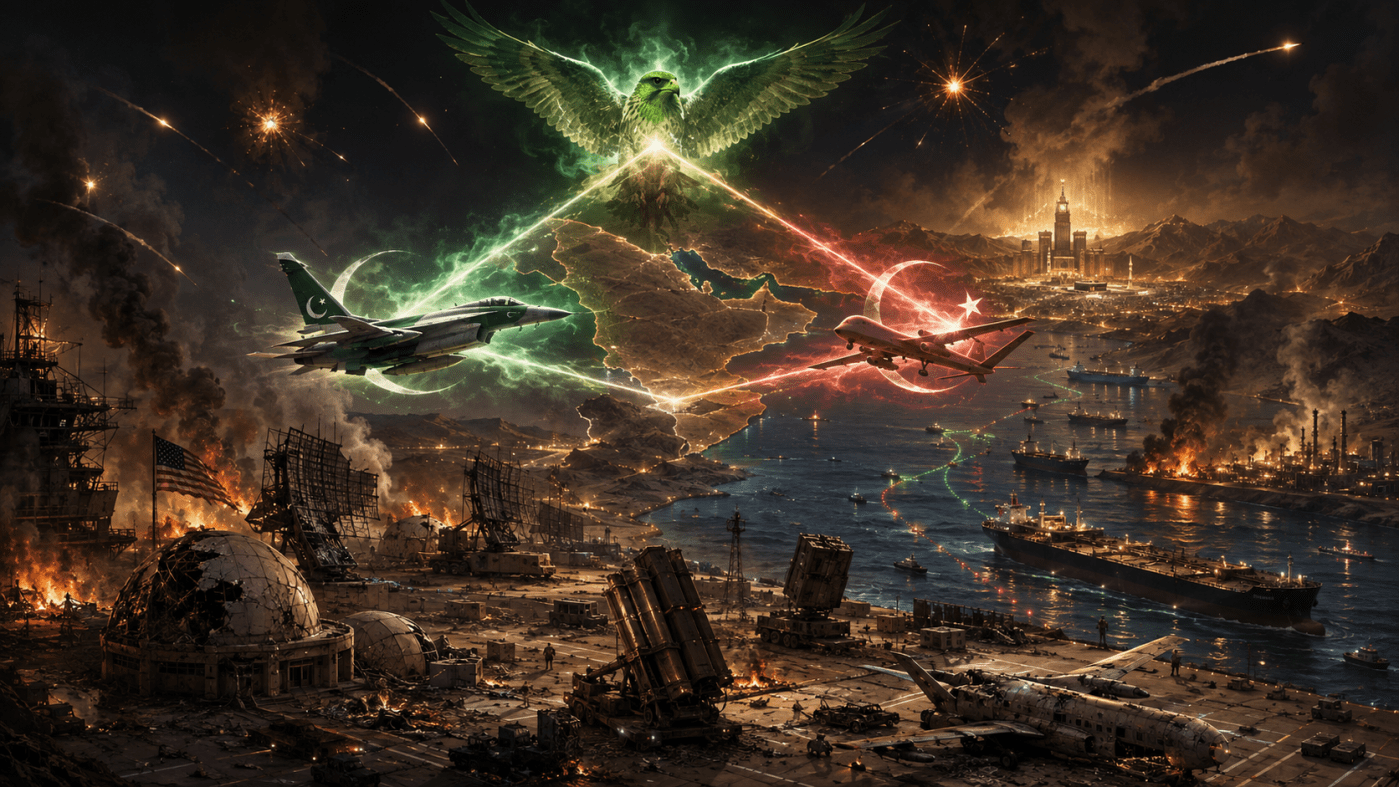
The Times of India packages Saudi money, Turkish military power and Pakistan’s nuclear arsenal into the spectacle of an emerging “Islamic NATO,” while burying the war and contradictions that made the agreement intelligible. Beneath the headline lies an older architecture of military cooperation, energy dependence and regional hedging accelerated by a U.S.-Israeli war that devastated Iran but also battered American bases, disabled critical command infrastructure and exposed the vulnerability of Washington’s security system across West Asia. The contradiction is larger than who destroyed more targets: the United States demonstrated that it can still inflict extraordinary destruction, but failed to convert that destruction into uncontested command, accelerating a multipolar process in which even governments still tied to Washington construct additional escape routes from exclusive dependence upon it. For workers and oppressed peoples, those cracks in imperial monopoly are possibilities rather than liberation itself, and the task is to widen them through organized anti-war struggle without mistaking the maneuvering of capitalist states for the emancipation of the people beneath them.
By Prince Kapone | Weaponized Information | August 8, 2026
The Pact Behind the Spectacle
On August 7, The Times of India announced the signing of the Makkah Joint Defence Agreement between Saudi Arabia, Pakistan and Türkiye with a headline carefully constructed to tell the Indian reader what to notice first: three Muslim-majority powers have entered a mutual-defense pact, Pakistan possesses nuclear weapons, and India is watching. The underlying event is unquestionably significant. The agreement declares that an armed attack against one of the three states will be regarded as an attack against them all. But the article does more than report that fact. It arranges the facts so that a particular interpretation begins forming before the reader has been given enough information to judge what kind of alliance has actually been created.
The first maneuver is buried in the grammar. The agreement, we are initially told, arrives as the “conflict involving Iran” generates instability across West Asia. War appears here almost like weather rolling in from the Persian Gulf: unpleasant, dangerous, but without an identifiable author. Only later does the same report acknowledge that the present escalation followed attacks launched against Iran by the United States and Israel on February 28. The chronology exists inside the article, yet its opening formulation dissolves that chronology into the neutral fog of a “conflict involving Iran.” Aggression acquires no subject; instability simply happens.
The second maneuver is accumulation. Türkiye is introduced as possessing NATO’s second-largest military. Saudi Arabia arrives as one of the world’s great oil exporters. Pakistan enters as the only Muslim-majority state possessing nuclear weapons. Placed immediately beside the declaration that an attack against one is an attack against all, these attributes begin doing ideological work of their own. Three separate national capabilities are mentally converted into one enormous military fist. The article even directs readers toward an embedded video asking whether an “Islamic NATO” has emerged. But the article never establishes a NATO-style integrated command, automatic force commitments, common operational planning, or a Pakistani nuclear guarantee to the other signatories. The image runs ahead of the evidence.
Then comes India. The headline announces that “India reacts,” although the reaction quoted in the article is strikingly restrained: New Delhi says only that it is “closely following” the development. Yet positioning India beside Pakistan’s nuclear arsenal changes the emotional temperature of the story. The reader is nudged toward an Indo-Pakistani threat narrative without being given the historical terrain necessary to understand why relations between those two states remain militarized in the first place. The unresolved contradiction is removed; the weapon produced by that contradiction is placed under a spotlight.
Finally, the article privileges the familiar priesthood of security journalism: ministries, presidents, strategic analysts, military capabilities, oil reserves, investment and deterrence. Ordinary people appear mainly as inhabitants of something called “regional instability.” The result is not crude fabrication. It is more effective than that. The decisive facts are largely present, but their hierarchy is arranged so that the reader sees an alarming new bloc before asking what material pressures produced it. The spectacle is “Islamic NATO.” The buried question is why three states already tied deeply into existing security structures now believe they require another one.
The Architecture Beneath the Clause
The Makkah Joint Defence Agreement did not suddenly manufacture a new military pole out of three flags and a photograph overlooking the holy city. Its public language is substantial: Saudi Arabia, Pakistan and Türkiye agreed that an armed attack against one would be regarded as an attack against all three, while committing themselves to expand defense cooperation. Yet the publicly released material does not establish a NATO-style integrated command, standing combined force, automatic troop-deployment mechanism or nuclear-sharing arrangement. Türkiye presented the agreement as an exercise of collective self-defense consistent with Article 51 of the UN Charter rather than as the creation of a formally integrated military command. The question buried beneath the “Islamic NATO” spectacle is therefore not whether the three governments possess armies, weapons and money. It is why states already entangled in older military systems are constructing another layer of collective security now.
The answer began forming before the present war. On January 29, before the February 28 attack on Iran, Turkish Foreign Minister Hakan Fidan was already discussing Türkiye’s possible participation in the Saudi-Pakistani defense arrangement and arguing that regional states needed greater “regional ownership” over security rather than continuing to outsource it to outside powers. Fidan explicitly rejected the idea of constructing another closed Arab, Turkish or Persian camp and instead proposed beginning with cooperation among a small number of states that could later broaden into a regional platform. The February war therefore did not invent the underlying project. It accelerated a discussion already concerned with reducing exclusive dependence upon externally supplied security.
Then the abstraction became battlefield experience. The United States informed the UN Security Council that it commenced combat operations against Iran on February 28 in cooperation with Israel. Washington publicly defined the campaign around destroying Iran’s offensive missile capacity, missile-production infrastructure, naval capabilities and other military assets. By April 8, the Pentagon was declaring the objectives of Operation Epic Fury accomplished, claiming Iran’s missile program had been functionally destroyed, its navy eliminated as an effective force, its air defenses devastated and its military-industrial capacity crippled for years.
But the military chronology did not end with the declaration. By July, CENTCOM was again conducting sustained strikes against Iranian missile facilities, drone infrastructure, coastal surveillance systems, communications nodes and air defenses over successive nights. The same U.S. military account reported that more than 50,000 American personnel remained deployed across the region. Whatever destruction the February-April campaign inflicted inside Iran, the capacities Washington had publicly pronounced destroyed continued to require military suppression months later.
The war also reached directly into the American forward infrastructure built to organize military power across West Asia. Only weeks before the fighting began, CENTCOM opened a multinational air-and-missile-defense operations cell at Al Udeid Air Base in Qatar. The new cell was embedded inside the Combined Air Operations Center and designed to coordinate air defense, contingency planning, threat warnings and information-sharing among the United States and regional partners. CENTCOM described the existing Combined Air Operations Center as incorporating military representatives from seventeen countries.
Iranian retaliation subsequently penetrated that infrastructure. Multiple Iranian missiles struck the Combined Air Operations Center at Al Udeid and rendered the facility inoperable. The United States had anticipated the command center’s vulnerability and shifted command functions for the air campaign to Shaw Air Force Base in South Carolina before the attack. The significance was not that Al Udeid itself ceased to exist, but that a command complex central to decades of U.S. air operations across Afghanistan, Iraq, Syria and the wider region could no longer safely perform its wartime function from the territory it was built to command.
The damage extended beyond a single command center. Satellite-imagery analysis identified Iranian damage or destruction to at least 228 structures or pieces of equipment across fifteen U.S. military sites. The affected infrastructure included hangars, aircraft, radar and communications equipment, fuel-related infrastructure and air-defense systems. Independent satellite analysis also documented significant physical damage at Al Udeid. The American basing network remained operational, but the war demonstrated that the radars, command nodes, aircraft, missile-defense batteries and logistics facilities through which Washington projects power were themselves vulnerable to sustained regional retaliation.
The defensive burden was costly as well as physical. Analyses of postwar U.S. munitions inventories found that replenishing key Patriot, THAAD and Tomahawk inventories consumed during the Iran war could take years. Those are not regionally disposable stocks: they belong to the same global U.S. arsenal required for military planning in Europe and the Pacific. Iran therefore imposed costs not only upon American installations in West Asia but upon globally scarce components of the wider U.S. military system.
Regional governments were confronting the economic consequences of the same war. A May study by the Al Jazeera Centre for Studies traced the acceleration of Saudi, Turkish, Pakistani and Egyptian security coordination to the exposure of Gulf vulnerabilities during the U.S.-Israeli campaign and Iranian retaliation. The study places those developments within a longer deterioration of confidence in externally provided security, including the 2019 attacks on Saudi oil infrastructure, while identifying the 2026 war as a major accelerator. By June, Türkiye, Pakistan, Saudi Arabia and Egypt were jointly warning that continuation of the war endangered regional security, energy markets, maritime routes, global supply chains and international trade.
The maritime danger was measurable. The International Maritime Organization documented repeated attacks against international shipping in and around the Strait of Hormuz during the conflict, while a subsequent emergency mechanism was established to evacuate stranded crews. Roughly 11,000 seafarers were identified for evacuation through the arrangement. The Strait was therefore not simply a military theater. Disruption there threatened the physical circulation of petroleum, commodities and shipping upon which regional economies depend.
For Pakistan those vulnerabilities reach directly into the balance of payments. Pakistan’s Economic Survey identifies petroleum as one of the country’s largest import burdens, accounting for roughly 22 percent of imports during July-March FY2026 and approximately $11.2 billion in petroleum imports. The same report records Brent crude rising from an average of $62.70 per barrel in December 2025 to $103.70 in March 2026 and attributes additional pressure on Pakistan’s external account to higher oil, freight and transportation costs produced by the Middle East conflict.
Saudi Arabia sits directly inside that vulnerability. The Saudi Fund for Development reports approximately $6.7 billion in petroleum financing for Pakistan since 2019, including a $1.2 billion oil-derivatives financing agreement signed in 2025. In April 2026, Saudi Arabia committed another $3 billion in deposits while extending an existing $5 billion deposit arrangement, support Pakistan’s government explicitly connected to strengthening foreign-exchange reserves and meeting external-financing requirements. Riyadh is therefore not simply a military partner for Islamabad. It functions simultaneously as an energy supplier, petroleum financier and financial backstop.
The relationship reaches even further into the reproduction of Pakistani working-class households. Of the 762,499 Pakistanis registered for overseas employment in 2025, 530,256 went to Saudi Arabia—nearly 70 percent of the total. Pakistan’s Economic Survey identifies workers’ remittances as one of the country’s most reliable sources of external financing, while the State Bank recorded approximately $1.025 billion in remittances from Saudi Arabia in May 2026 alone. Saudi-Pakistani security cooperation therefore rests atop petroleum dependence, reserve support, migration and a remittance system connecting Saudi accumulation directly to millions of Pakistani livelihoods.
The military relationship was already becoming operational before the Makkah agreement. Pakistani fighter and support aircraft deployed to King Abdulaziz Air Base in April under the 2025 Saudi-Pakistan Strategic Mutual Defense Agreement to strengthen joint coordination and operational readiness. Pakistan and Türkiye had meanwhile developed institutional defense cooperation through their High-Level Strategic Cooperation Council and were expanding joint exercises, training, interoperability, aerospace cooperation and work involving unmanned systems. Saudi-Turkish defense cooperation likewise moved beyond simple procurement: agreements surrounding Turkish unmanned systems included localization in Saudi Arabia of electronics, mechanical components, airframes, testing, training, munitions and optical systems.
TOI’s list of three supposedly separate “strategic strengths”—Saudi wealth, Pakistani military and nuclear capability, and Turkish armed force and defense industry—therefore conceals an important material fact: those capabilities were already becoming interconnected through finance, deployment, industrial production, training and technology transfer before the collective-defense clause formally placed all three governments inside one agreement.
But military cooperation does not automatically produce common war policy. Pakistan’s history with Saudi Arabia demonstrates the distinction. When Riyadh sought Pakistani participation in the Saudi-led intervention in Yemen in 2015, Pakistan’s parliament unanimously called for neutrality in the Yemen conflict while separately pledging to defend Saudi territorial integrity and the holy sites against a direct threat. The difference between defending Saudi Arabia and participating in Saudi Arabia’s wars was therefore embedded in Pakistani policy long before Makkah.
That distinction remained unresolved under the newer bilateral Saudi-Pakistani defense agreement. When Pakistan’s Foreign Ministry was asked in July 2026 whether attacks on Saudi Arabia would automatically trigger Pakistani military involvement, it declined to define an automatic trigger, describing the determination of what constitutes an attack and what operational response follows as matters to be assessed under the agreement. The wording of a collective-defense pact may be sweeping; the actual response remains mediated through national interests and political decisions.
The historical record offers an older warning against assuming otherwise. Pakistan and Türkiye previously participated in CENTO, the successor to the Baghdad Pact. Pakistan entered Western Cold War security arrangements while primarily concerned with military vulnerability relative to India, whereas Washington conceived the system around containment of the Soviet Union. Declassified U.S. records show that Pakistan later argued that CENTO had failed as a military alliance because it provided no effective collective assistance during Pakistan’s wars with India. By 1979, the U.S. Embassy in Islamabad itself judged CENTO “virtually useless” in Pakistan’s confrontations with India and attributed the weakness of joint military planning to incompatible threat perceptions among its members.
The comparison has limits. The original Baghdad Pact did not contain an identical “attack on one is attack on all” provision, and CENTO operated in a different historical system. But its experience establishes something directly relevant to TOI’s “Islamic NATO” framing: military institutions, exercises and defense agreements cannot by themselves manufacture a common enemy where participating states possess different strategic interests.
That problem is especially important because TOI places India beside Pakistan’s nuclear arsenal. The India-Pakistan antagonism predates nuclear weapons. It emerged from the unfinished political settlement of the 1947 partition and the conflict over Jammu and Kashmir. The 1972 Simla Agreement transformed the previous ceasefire line into the Line of Control while leaving the final political settlement of Jammu and Kashmir unresolved. Türkiye has also maintained an established political relationship with Pakistan on Kashmir. That history explains why New Delhi watches any expansion of Pakistan’s military relationships closely, but it does not establish that a future India-Pakistan confrontation would automatically become a Saudi-Turkish war.
The same complexity applies to Iran. Iranian President Masoud Pezeshkian himself called in June for a regional security framework constructed through cooperation among regional states and praised Pakistan’s mediation while identifying Saudi Arabia, Türkiye, Egypt and Qatar among governments contributing to regional convergence. China’s Foreign Ministry subsequently described Pakistan as having played an “indispensable coordinating and mediating role” between Iran and the United States. Saudi Arabia, Pakistan, Türkiye and Egypt simultaneously condemned Iranian attacks while supporting negotiations with Tehran and arguing that ending the war was necessary to protect regional economies and trade.
The Makkah pact therefore cannot be reduced empirically to an anti-Iran alliance merely because its signatories are Sunni-majority states. Pakistan is simultaneously a Saudi security partner and a mediator with Iran; Türkiye remains a NATO state while calling for regional ownership of security; Saudi Arabia remains integrated into U.S. military structures while seeking additional regional guarantees. Their relationships overlap precisely where the rigid bloc model expects them to separate.
Nor has the American-centered security architecture vanished. SIPRI reports that 77 percent of Saudi Arabia’s major imported weapons during 2021-2025 came from the United States. Pakistan occupied an almost inverse military-industrial position, with 80 percent of its major arms imports coming from China and another 7 percent from Türkiye. Türkiye remains inside NATO while developing an increasingly autonomous defense industry. The three signatories therefore enter the Makkah pact from different military-industrial systems rather than from an already unified geopolitical camp.
The larger regional structure remains similarly contradictory. Tricontinental has documented how dependence upon Western arms embeds West Asian states within long-term relationships of foreign training, maintenance, spare parts, logistical support and military interoperability. SIPRI’s newer figures show that the United States alone supplied 54 percent of Middle Eastern major-arms imports during 2021-2025. Washington’s own Treasury Department simultaneously describes its campaign against Iran in openly coercive economic terms, boasting that U.S. measures are designed to impose a “financial stranglehold,” block Iranian revenues and punish third-country firms and financial institutions participating in Iranian trade.
The Makkah agreement is therefore being assembled neither after American power disappeared nor outside the structures that reproduce it. It is being built while tens of thousands of U.S. troops remain deployed, while Saudi Arabia remains heavily dependent upon American weapons, while Türkiye remains inside NATO, and while Washington continues combining military force with sanctions and financial coercion. What changed during the Iran war was that this architecture was no longer experienced merely as protection. The bases, command centers, radars and air-defense systems at the center of the American security system became targets themselves, while the war endangered the energy routes, foreign-exchange flows and commercial circulation upon which Washington’s own regional partners depend.
That is the material terrain beneath the Makkah clause: an older system of military dependence still firmly embedded across West Asia; regional states already constructing supplementary relationships before February; a war that exposed the vulnerability of the imperial security infrastructure itself; and three governments now binding together military capacity, capital, industrial production and strategic geography without yet dissolving the contradictory relationships each maintains with Washington, Beijing, Tehran and one another.
When Destruction Stops Producing Obedience
The Times of India wants the reader to stare at the ingredients: Saudi money, Turkish military power, Pakistani nuclear weapons. Arrange them closely enough on the page and an “Islamic NATO” appears by optical illusion. But alliances are not assembled from adjectives. They emerge from material problems. And the material problem underneath the Makkah pact is that the security order Washington spent decades constructing across West Asia has demonstrated an increasingly dangerous contradiction: the United States retains an extraordinary capacity to destroy, yet that destructive capacity no longer guarantees its ability to organize the region around unquestioned obedience.
The Iran war exposed that distinction with unusual clarity. The United States and Israel inflicted enormous damage upon Iran. Air defenses were struck, missile infrastructure attacked, naval and military facilities destroyed. None of that should be minimized. Historical materialism has no use for fairy tales in which resistance magically abolishes the material superiority of imperial power. But war is politics prosecuted through organized violence, and the strategic question is therefore not how many buildings one side destroyed. It is whether destruction produced the political order for which the destruction was undertaken.
By Washington’s own measure, it did not. The Pentagon declared Iran’s relevant military capabilities functionally destroyed and the objectives of the war accomplished, only to return months later to bombing missile sites, drones, surveillance systems and air defenses that were apparently still capable of requiring sustained attack. Iran had been wounded terribly, but it had not been rendered strategically inert. The empire possessed the hammer. What it increasingly lacked was the old certainty that enough hammering would make history hold still.
Worse for Washington, the architecture designed to contain Iran became part of the battlefield itself. Al Udeid was not merely another American base. It was one of the command centers through which U.S. air power coordinated regional war. Iran demonstrated that this infrastructure could be penetrated badly enough that its central operations facility became unusable and command had to be shifted outside the region. Across the wider network, bases, radar, communications systems, aircraft, fuel infrastructure and missile defenses became targets rather than invisible foundations of imperial supremacy. The fortress still had guns. The problem was that everybody could now see where the walls were thin.
This is where “strategic defeat” has to be understood precisely. It does not mean the United States ceased to be the strongest military power in West Asia. It did not. It does not mean Iran emerged physically unscathed or militarily dominant. It did not. Strategic defeat means that Washington expended enormous force without securing the political relationship that force was supposed to reproduce. Instead of demonstrating that American protection insulated its partners from regional war, the conflict demonstrated that hosting the machinery of American power could itself place their territory inside the target set.
That contradiction cuts directly through the old bargain between imperial center and subordinate ally. The client accepts bases, weapons dependence, intelligence integration and political discipline because the hegemon promises security. But what happens when the security guarantee becomes inseparable from the danger? What happens when the umbrella attracts lightning? At that point dependency does not disappear. It begins producing hedging.
The Makkah pact grows out of that contradiction. Saudi Arabia has not broken with Washington; its military remains deeply integrated with American weapons and training. Türkiye has not abandoned NATO. Pakistan has not abandoned its Chinese military relationship or its connections to the Gulf and Iran. None of these states has marched out of one geopolitical camp and saluted another. They are doing something more typical of periods when hierarchy begins to loosen: multiplying relationships so that no single external power possesses an absolute monopoly over their security.
Hedging, however, does not remain a diplomatic gesture forever. Bilateral defense agreements produce troop deployments. Procurement becomes joint production. Training becomes interoperability. Financial dependency becomes political leverage. Separate arrangements begin overlapping until what began as insurance starts acquiring institutional weight. That is how a tactic of maneuver can begin becoming an architecture even when none of the participants set out with a manifesto announcing a new world order.
Pakistan illustrates the contradiction particularly well. Its value comes precisely from standing at several intersections at once. It can cooperate militarily with Saudi Arabia, deepen defense ties with Türkiye, maintain a major strategic relationship with China, mediate with Iran and preserve channels to Washington. A rigid bloc would reduce that value by forcing a choice. Multipolarity, in its actual bourgeois form, often works differently. It rewards the state capable of moving between centers, extracting resources from several directions and refusing exclusive dependence on any one patron.
This is also why the phrase “Sunni NATO” obscures more than it reveals. A military bloc requires more than religious identity and armies. It requires some agreement about the enemy. Yet the interests of the three states do not line up neatly. Pakistan’s historical refusal to join Saudi Arabia’s Yemen war already demonstrated the difference between defending Saudi territory and inheriting every Saudi conflict. CENTO demonstrated the same contradiction on a larger scale: common institutions did not produce common war policy when Pakistan considered India the principal threat while the alliance’s imperial architects were organizing against the Soviet Union. A treaty can manufacture obligations on paper. It cannot abolish the material interests that determine how governments interpret them.
The Iran relationship makes the contradiction sharper still. The same governments alarmed by Iranian retaliation were simultaneously involved in attempts to end the war and restore regional stability. There is nothing mysterious about this. These ruling classes require deterrence because missiles can destroy their infrastructure; they require diplomacy because war can destroy the circuits through which they accumulate. Oil routes, remittances, shipping, investment, foreign exchange and industrial development do not prosper indefinitely under missile alerts. Deterrence and negotiation are therefore not opposites. They are different instruments for protecting the same material interests.
There is no socialism hiding inside this process. Saudi capital remains capital. Turkish defense production remains capitalist accumulation. Pakistan’s military establishment remains a state power standing above its own working people. A bourgeois government can seek greater sovereignty from Washington abroad while preserving exploitation and hierarchy at home. Multipolarity does not abolish class struggle merely because several flags now crowd the negotiating table.
But neither should the global working class be indifferent to the objective weakening of imperial monopoly. A hegemon capable of dictating the security architecture of an entire region possesses greater capacity to blockade, sanction, invade and discipline peoples than one forced to bargain through increasingly autonomous centers of power. The erosion of monopoly creates openings. It does not decide who will fill them.
That is the deeper significance of Makkah. The pact is not proof that a new anti-imperialist pole has arrived, and it is not evidence that American power has disappeared. It is evidence that American power can remain immense while becoming less exclusive; that imperial armies can devastate a country while failing to restore political command; that allies can remain inside an imperial system while quietly constructing escape routes from dependence upon it.
The United States still possesses the machinery to wreck societies. What the Iran war called into question was whether wreckage still automatically produces submission. The Makkah pact is one answer emerging from the rubble: not liberation, not yet a new order, but another sign that the empire increasingly has to share a chessboard it once believed belonged to it.
Turn the Cracks Into Organization
The task for working people in the United States is not to choose which military bloc should manage West Asia. It is to weaken our own ruling class’s capacity to keep setting the region on fire. That means opposing the expansion of the U.S.-Israeli war, the economic strangulation of Iran, and the occupation and dispossession of Palestine while refusing the equally useless fantasy that every government seeking distance from Washington thereby becomes a vehicle of liberation. Solidarity belongs with the peoples forced to live beneath missiles, sanctions, occupation and austerity—not automatically with the ruling classes maneuvering above them.
There are already organizations trying to move this opposition from moral outrage into working-class action. The United Electrical, Radio and Machine Workers has pushed anti-war politics directly through its union structures. UE’s Eastern Region adopted a resolution connecting billions spent on war to workers struggling with food, housing and healthcare, while calling on locals and members to join demonstrations, build anti-war coalitions with other unions and pressure elected officials to end the war. This is not foundation-funded activism descending upon workers from above. UE is financed by membership dues and explicitly identifies that financial independence as the basis of accountability to its members rather than outside funders.
The Democratic Socialists of America has likewise built an organized response to the Iran war, mobilizing chapters into the streets, generating more than 30,000 letters demanding congressional action through the War Powers Resolution and convening mass political-education calls around the war and the tasks confronting organizers. Its usefulness here is not simply numerical. DSA describes itself as entirely member-funded, principally through dues rather than large outside donors, giving militants another arena in which anti-war sentiment can be organized into durable political work.
That work has to go deeper than another Saturday march followed by collective amnesia on Monday morning. Union locals can debate and pass anti-war resolutions, organize political education inside workplaces, affiliate with independent anti-war coalitions and force the connection between imperial expenditure and domestic austerity into everyday working-class politics. Socialist organizations can combine street mobilization with pressure for War Powers restrictions while training members to explain how sanctions, military deployments and occupation function as parts of the same machinery of domination. The point is not to collect signatures as political souvenirs. It is to build people capable of acting together again when the next bomb falls.
And there will always be another bomb so long as opposition remains weaker than the institutions dropping them. The fractures appearing inside imperial command create possibilities, not guarantees. Our responsibility is to organize inside those openings—to turn declining imperial control not into applause for another set of rulers, but into greater power for workers, colonized peoples and movements fighting to determine their own futures. Cracks in the fortress matter. But somebody still has to widen them.


Leave a comment