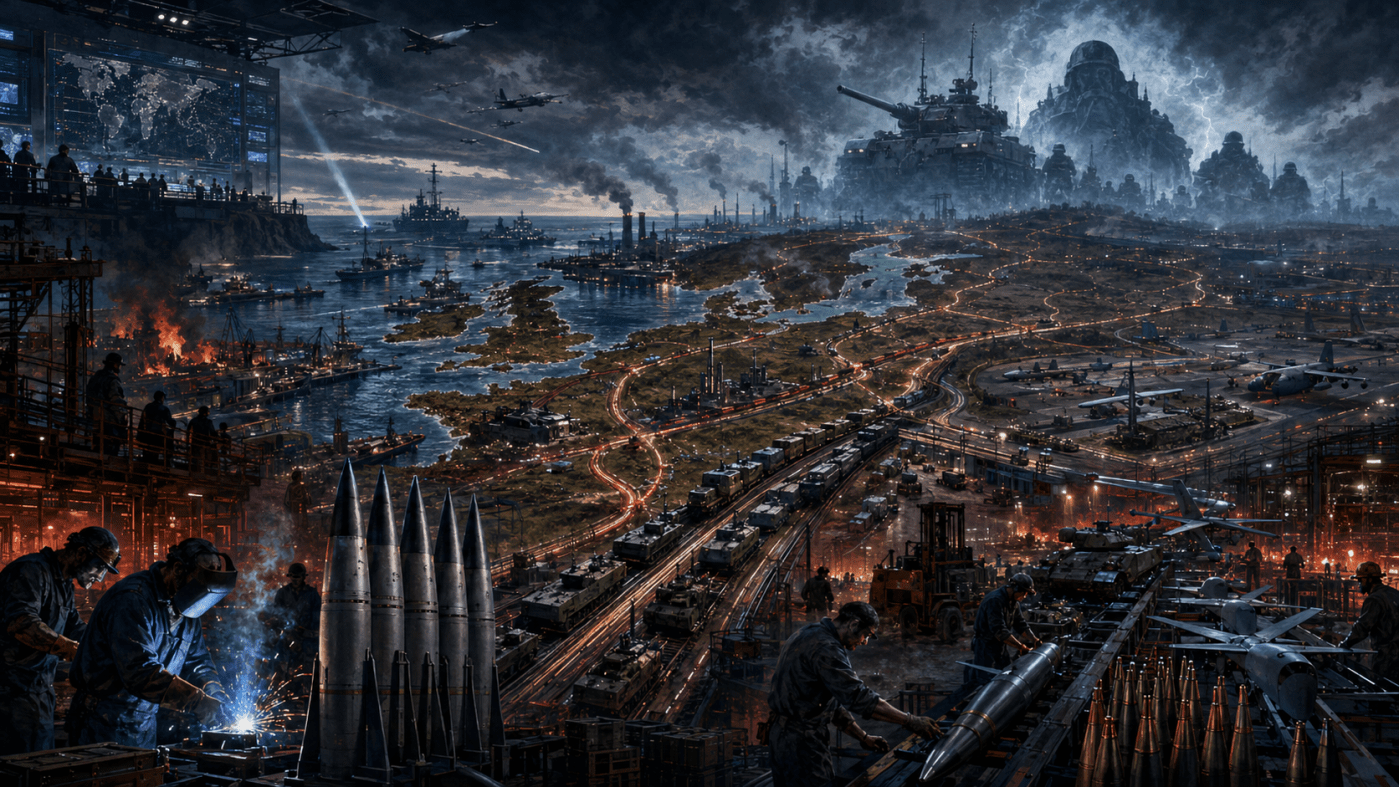
CNN turns a chain of anonymous possibilities—what Russia could do, where it might strike, and when it may test NATO—into the atmosphere of an approaching war, with depleted missiles and expanding weapons factories waiting conveniently at the end of the story. Beneath that prophecy lies a harder material terrain: NATO’s eastward military geography, genuine but unevenly interpreted Russian confrontations with NATO states, European rearmament, the conversion of civilian infrastructure for military mobility, and a U.S. arsenal strained across several theaters. The deeper contradiction is an American-centered imperial bloc confronting the rising cost of reproducing its global military reach and reorganizing Western Europe as a more heavily armed, industrialized, and logistically hardened Western Rear, where what Russia could do tomorrow becomes justification for what Europe must finance and manufacture today. Against that war machine, the task is not to exchange NATO mythology for Moscow mythology, but to build independent working-class and anti-war power where militarism becomes material—in budgets, factories, ports, railways, weapons production, and the labor without which no empire can move.
Prince Kapone | Weaponized Information | August 8, 2026
From “Could” to Crisis in Four Minutes
There is a peculiar magic trick performed every day in the imperial press: take a possibility, pass it through the mouth of an anonymous intelligence official, surround it with enough military hardware, and watch it emerge dressed as a fact. CNN’s August 7 report, “US intel assesses Putin could launch attack aimed at testing NATO unity”, is a remarkably clean specimen. Three unnamed sources familiar with intelligence reports tell CNN that Vladimir Putin could attempt to test NATO sometime between now and the next several years. He might use a cyberattack. He might use a small territorial incursion. He might target Poland or the Baltic states. He might escalate if he cannot obtain an acceptable settlement in Ukraine. How and when remain “an open question.” What begins as a tree of hypothetical branches somehow arrives at the headline already bearing fruit.
The first device is authority without evidence. “US intel assesses” does enormous ideological labor. CNN does not show its readers the assessment, its evidentiary basis, its confidence levels, the collection behind it, or a single named intelligence official willing to defend the proposition publicly. The institutional prestige of the intelligence apparatus substitutes for what cannot be inspected. The anonymous source becomes a secular oracle: invisible, credentialed, and therefore conveniently difficult to interrogate.
Then comes strategic vagueness. The scenario can occur across several years, through several methods, against several possible targets, under an uncertain future condition. Such elasticity is politically useful because it is nearly impossible to falsify in the present. CNN then stacks actual security incidents beside the hypothetical forecast: Russian drones entering NATO airspace, an explosive-equipped drone discovered at Leipzig/Halle Airport, rising casualties from Russian long-range attacks in Ukraine. Each episode carries its own evidentiary status, but assembled in sequence they produce an emotional continuity the article never actually proves. Possibility acquires atmosphere; atmosphere begins impersonating probability.
The omission is equally important. CNN repeatedly tells the reader what Russia may do while giving almost no space to competing assessments about whether Moscow actually intends to attack NATO. Russia itself appears principally as an object of Western intelligence analysis; CNN notes that it requested Kremlin comment, but no Russian response appears in the piece. The hierarchy of voices has already decided who interprets reality and who is interpreted by it.
And then, almost casually, the article arrives at the material destination of all this speculation: depleted American munitions. CNN moves from Putin’s hypothetical future action to shortages of THAAD and Patriot interceptors, military planning for possible conflict with Russia or China, Trump’s complaints about dwindling stockpiles, and his celebration of expanding weapons factories. The speculative threat and the industrial remedy enter the reader’s mind together. No one has to shout, “Build the arsenal.” The article has already arranged the furniture so that the conclusion appears to have walked into the room by itself.
The Military Geography Behind the Scenario
The intelligence assessment at the center of CNN’s story is not a disclosed finding that Moscow has decided to attack NATO. The underlying U.S. intelligence reports examine several possible scenarios, ranging from cyber operations and other forms of disruption to a limited territorial incursion, across a horizon stretching toward the end of the decade. The same reporting places those scenarios beside an immediate material problem facing Washington: weapons transferred to Ukraine and munitions expended in the war with Iran have reduced stocks military planners also regard as necessary for possible future conflicts involving Russia or China.
There are real military incidents underneath the atmosphere of escalation. On May 29, a Russian-made Geran-2 attack drone entered Romanian airspace and crashed into a residential building in Galați while Russian forces were attacking targets across the border in Ukraine; Romania scrambled F-16 fighters and authorized engagement. Poland’s parliament subsequently classified the September 2025 series of drone incursions into Polish airspace as deliberate violations carried out by Russian unmanned aircraft. These incidents demonstrate how a war fought along NATO’s frontier can cross territorial boundaries and bring Russian and NATO forces into dangerous proximity.
The Leipzig/Halle incident adds another serious but less settled case. An explosive-equipped drone was discovered at an airport that serves as a major logistical node for NATO’s Strategic Airlift International Solution, while German federal prosecutors opened a counterterrorism investigation and German authorities had not publicly established the drone’s origin. CNN nevertheless cites an anonymous U.S. assessment attributing it to Russian intelligence before that public German investigation had reached such a conclusion.
Inside NATO’s own eastern frontier, intelligence assessments have been considerably less categorical about a coming Russian attack. Former senior Estonian intelligence official Rainer Saks described claims of an impending direct Russian assault as “exaggerated speculation” and said no significant indication had been presented that Russia was actually preparing such an operation. Months earlier, Estonian Foreign Intelligence Service director Kaupo Rosin wrote that Russia had no intention of militarily attacking Estonia or another NATO member during the coming year and warned against treating every act of Russian sabotage or influence as evidence of a single overarching plan. These assessments do not predict what Moscow will do years from now. They establish that security officials positioned directly along NATO’s Russian frontier distinguish between hostile activity, border incidents and evidence of preparation for a wider attack.
Article 5 itself is also more conditional than the familiar shorthand suggests. NATO’s own explanation states that although an armed attack against one member is treated as an attack against all, each government determines the action it considers necessary, and that assistance may or may not involve armed force. Moscow continues to deny plans to attack NATO while describing European rearmament and NATO military expansion as threats requiring Russian countermeasures; Russian officials have also discussed non-aggression guarantees within broader security arrangements while warning that Europe’s current military buildup is becoming increasingly difficult to reverse.
The confrontation has a longer geographical history. Since the dissolution of the Soviet Union, NATO has expanded through Central and Eastern Europe, incorporating Poland, the Czech Republic and Hungary in 1999; the Baltic states, Romania and several other countries in 2004; and eventually Finland and Sweden. The diplomatic prehistory remains disputed, but declassified Western and Soviet records document repeated political assurances during the negotiations over German reunification concerning the eastward movement of NATO military jurisdiction. Those assurances never became a general treaty prohibiting later enlargement, but they became part of the unresolved security dispute that followed the Cold War.
That enlargement has developed into physical military infrastructure. NATO now maintains nine multinational Forward Land Forces battlegroups stretching from Finland and the Baltic states through Poland to Romania and Bulgaria, supported by reinforcement plans, prepositioned equipment and formations designed to expand toward brigade strength. European governments are simultaneously reorganizing budgets and production around larger military commitments. NATO’s 2025 Hague agreement established a 5 percent of GDP defense-investment target by 2035, combining core military expenditure with spending on infrastructure and other defense-related requirements. The European Union’s SAFE instrument makes up to €150 billion in loans available for joint military procurement, including ammunition, missiles, air-defense systems and other strategic capabilities.
Military preparation is also being built into the continent’s transportation systems. The EU’s Readiness Roadmap 2030 calls for a continent-wide military-mobility network connecting land corridors, airports and seaports in close coordination with NATO. European governments have also advanced measures for faster cross-border movement of troops and heavy equipment and for expanding dual-use transport infrastructure capable of supporting both civilian and military traffic.
Washington confronts a production problem of its own. The wars in Ukraine and Iran have placed heavy demands on Patriot, THAAD and other precision-munition inventories, while military planning involving Russia and China draws upon overlapping industrial capacity. The United States is consequently spending billions to expand Patriot interceptor production and replenish stocks reduced by current wars. Europe is increasing military expenditure and procurement, NATO is expanding forward infrastructure, civilian transport networks are being adapted for military mobility, and U.S. planners are confronting simultaneous demands upon weapons stocks and production capacity across several theaters.
The Threat That Rearms the Rear
The first task is to turn the picture right-side up. CNN asks us to begin with a future Russian attack that has not happened and has not been shown to have been decided upon, and then to read Europe’s militarization backward as a prudent response. But history does not move backward simply because a headline asks it to. The barracks are already being reinforced. The military budgets are already swelling. European industry is already being summoned toward weapons production. Roads, railways, ports and airports are already being prepared to carry troops and matériel. American missile stocks are already being pulled thin across several theaters. Then, into this landscape already being reorganized for war, comes the prophecy: Russia may someday test NATO. A possible war in the future is recruited to explain a military transformation already underway in the present.
None of this requires us to pretend that the confrontation itself is fiction. Russian military actions have crossed NATO borders. States along Russia’s western frontier have every reason to take escalation seriously. Europe has become crowded with weapons, troops, surveillance, contingency plans and suspicion. Historical materialism does not require lullabies about any state. It requires precision. A hostile act is not the same thing as evidence of a planned invasion. Military capacity is not intention. Possibility is not probability. Collapse those distinctions and intelligence ceases to investigate the future; it begins manufacturing political permission in the present. Every Russian action can then be made to testify about the next Russian action before it has occurred.
And preparation is never passive. A missile battery changes the terrain around it. A battlegroup occupies real land. A military corridor takes over the use of roads, bridges, ports and railways built by workers for the circulation of ordinary life. A spending target is not a percentage floating harmlessly in an accountant’s ledger; it is a claim upon social wealth. A procurement order sends labor, steel, electronics, factories and public money in one direction rather than another. What is called “readiness” by generals becomes a reorganization of society long before a shot is fired.
This is why the confrontation cannot be understood as two equal military machines wandering toward each other across vacant ground. The ground has a history. NATO expanded eastward across the political terrain opened by the collapse of the Soviet Union, and that expansion was steadily given military form along Russia’s western frontier. Russian countermeasures developed inside that changing environment and, in turn, intensified the danger around it. Those countermeasures then return to Western populations as evidence that still more troops, still more weapons and still more infrastructure are required. The cycle is real, but it is not historically weightless. One cannot explain a fire by beginning with the latest spark and declaring the accumulated timber irrelevant.
Nor does that history require us to adopt Moscow’s mythology in place of NATO’s. Russia pursues state interests, security interests and national interests of its own. Its actions can deepen the very military pressures it says it seeks to contain. But this is where materialist analysis separates itself from the moral theater of the corporate press. The question is not simply who acted badly yesterday. The question is what historical structure organized the field upon which these actions occur, how that structure has changed, and who possesses the greatest capacity to arrange the military geography within which others must calculate their survival. History did not begin when the latest drone crossed the latest border.
Western Europe sits inside this contradiction in a position that is neither servile nor sovereign in the full strategic sense. Its governments are not marionettes hanging from Washington’s fingers. European ruling classes have their own industries, interests, ambitions and calculations. They choose budgets. They manufacture weapons. They mobilize public opinion. They can fear Russia without waiting for an American intelligence officer to whisper the appropriate nightmare into their ear. But their expanding military capacity is not being built outside the Atlantic system. It is being built through common spending commitments, interoperable forces, integrated procurement, eastern deployments and transport networks increasingly organized for military movement. Europe acts, but it acts inside an architecture whose steel beams are becoming thicker.
This is the material meaning of the Western Rear. Western Europe is not being weakened so that America may dominate it more easily. It is being strengthened so that it can perform more work for the bloc. A rear that cannot manufacture ammunition, move troops, replenish weapons, repair infrastructure and sustain the front is no rear at all. The demand is therefore for a Europe capable of carrying a larger portion of the European military burden while remaining woven into the strategic architecture that gives that burden its direction. Strength and subordination can grow together. Indeed, under conditions of imperial strain, they may have to.
The depleted American arsenal is where the abstractions come down to earth. Strategy maps the world in theaters; factories confront it in shifts, machines, supply chains and hours. Ukraine requires continued military supply. War with Iran consumes high-end interceptors. The confrontation with Russia creates new demands for European stockpiles and production. China remains the larger horizon against which military planners must preserve still more capacity. But the same missile cannot be fired in four places. The same production line cannot manufacture four arsenals at once. The war room can multiply arrows across a map with the movement of a marker. The worker on the factory floor still has only two hands.
This is what relative imperial decline looks like when stripped of diplomatic euphemism. It does not necessarily arrive with the lowering of flags and the closing of bases. Empire can decline while becoming more violent, more demanding and more expensive. What disappears first is not necessarily command itself, but cheap command. More money must be spent to produce the same obedience. Allies must contribute more. Production must be forced upward. Infrastructure must be reorganized. Larger portions of social life must be made available to military calculation. The machinery remains formidable, but it requires more fuel to move the same distance.
The American Pole is taking shape inside that contradiction. It is not a cartoon empire in which Washington speaks and thirty silent capitals salute. Its durability comes precisely from its capacity to organize states that retain their own bourgeoisies, institutions and interests into a wider structure of collective power. Under pressure, such a bloc does not necessarily fracture. The opposite can occur. Costs are shifted. Responsibilities are redistributed. The center demands that the periphery and rear areas of the bloc become more capable precisely because the center can no longer reproduce every function at the old price.
Now CNN’s strange migration from a hypothetical Russian incursion to THAAD shortages, Patriot stocks, Iran and China ceases to look strange at all. Russia supplies the immediate European theater of confrontation. Iran consumes part of the arsenal required to sustain American military power elsewhere. China remains the larger strategic horizon against which Washington measures the future. Western Europe is pushed toward greater military production and readiness so that more of the European burden can be reproduced there. These struggles are not identical, and there is no need to flatten them into a single conspiracy. Their unity is material: one U.S.-centered military system is being asked to prepare for, arm, supply or sustain confrontation across all of them.
From there, the political machinery begins feeding itself. Military commitments consume the arsenal. The depleted arsenal is declared a vulnerability. Vulnerability gives greater political force to the worst possible scenario. The worst possible scenario justifies new factories, larger budgets, deeper stockpiles and more militarized infrastructure. The resulting buildup generates new friction, new countermeasures and new claims that yesterday’s buildup was inadequate. The war machine does not require universal war every morning. It requires society to live permanently beneath the expectation of war.
And it is here that the question becomes a working-class question rather than a discussion among generals. “Defense spending” means labor time. “Industrial mobilization” means factories, wages and production targets. “Military mobility” means roads, ports and railways built and maintained by workers. “Readiness” means public wealth that cannot be spent twice. The people who are told that geopolitics is too sophisticated for them are nevertheless expected to weld its vehicles, load its ships, manufacture its missiles, surrender their taxes to it and send their children into its armies. The ruling class reserves for itself the right to define security while presenting the working class with the invoice.
That is why the future Russian tank is so politically useful before it ever arrives. It travels first as an image, a forecast, an intelligence possibility. It enters the public imagination before entering any hypothetical town. And there it begins doing work. It makes the reordering of budgets appear unavoidable. It makes weapons production appear synonymous with industrial policy. It turns civilian infrastructure into prospective military infrastructure. It teaches populations to experience preparations made by their own rulers as simple reactions to decisions supposedly being made somewhere else.
The real story beneath CNN’s anonymous intelligence forecast is therefore not that Putin has been shown to possess a secret timetable for attacking NATO. He has not. Nor is the lesson that Russia can do no harm, that every Russian action is defensive, or that working people should sleep peacefully beside an armed frontier. The real story is that a U.S.-centered imperial formation is confronting the rising material cost of reproducing military power across several fronts and is reorganizing its European rear to carry more of that burden. Inside that process, uncertainty becomes a weapon of political economy. What Russia could do tomorrow becomes the argument for what Europe must finance, manufacture and militarize today.
Break the War Machine Where It Is Built
The answer to war propaganda is not a competing mythology in which every Russian action becomes innocent and every danger disappears when the television is switched off. Working people need something more useful than that: political independence from the military blocs, ruling classes, and weapons industries whose solutions to insecurity continually manufacture the conditions for greater insecurity. The immediate demand is de-escalation and a negotiated European security settlement that recognizes the peoples of the region as human beings rather than pieces on somebody else’s strategic map. Veterans For Peace has advanced precisely this orientation: negotiated settlement, reduced U.S. and NATO military posture in Europe, renewed arms-control agreements, and the redirection of military expenditure toward human needs.
That work matters because veterans can puncture one of militarism’s favorite disguises: the idea that opposition to war comes from people who do not understand its dangers. Veterans For Peace organizes from the accumulated experience of people who have been sent to execute U.S. foreign policy and now work to expose the causes and costs of war, restrain intervention, reduce the arms race, and abolish war as an instrument of national policy. This is not an organization floating on the payroll of the security state it criticizes: VFP publicly releases its IRS filings and financial reviews, while its membership structure is sustained through dues and its bylaws require regular independent financial review.
But the harder struggle lies where the missiles, rail corridors, factories, ports, budgets and labor power meet. The anti-war movement cannot remain a moral protest assembled outside the gates while capital reorganizes production inside them. The United Electrical, Radio and Machine Workers of America has adopted a rank-and-file foreign-policy program that calls upon labor to organize against militarism, coordinate unions around demilitarizing the economy, reduce military spending, redirect resources toward housing, healthcare, education, transportation and renewable infrastructure, and protect workers displaced by conversion from war production. UE’s independence is rooted materially in a member-financed structure: dues finance the union while elected trustees audit its books and members are given direct oversight of how their money is spent.
That points toward the tactical terrain opened by this excavation. Workers in aerospace, ammunition, rail, ports, logistics, shipbuilding and military-adjacent industries should organize inside their unions for political education on what they are being asked to build, where it is going, and whose security it actually serves. Opposition to rearmament cannot mean telling workers whose livelihoods depend upon those industries to simply accept unemployment for the sake of somebody else’s pacifism. The demand must be conversion with guarantees: protect wages, pensions, training and employment while transferring productive capacity from permanent war preparation toward the enormous backlog of socially necessary work waiting everywhere around us.
And every union hall, veterans’ meeting, classroom and community political-education project can teach one elementary discipline that the intelligence spectacle depends upon us forgetting: capability is not intention, possibility is not probability, and contingency planning is not prophecy. The ruling class can build weapons much faster when working people surrender those distinctions. Our task is to recover them, connect them to the factories and budgets behind the headline, and organize where the war machine is actually reproduced. The point is not to become better spectators of imperial strategy. It is to make the people whose labor gives that strategy material form conscious of their power to refuse its terms.


Leave a comment