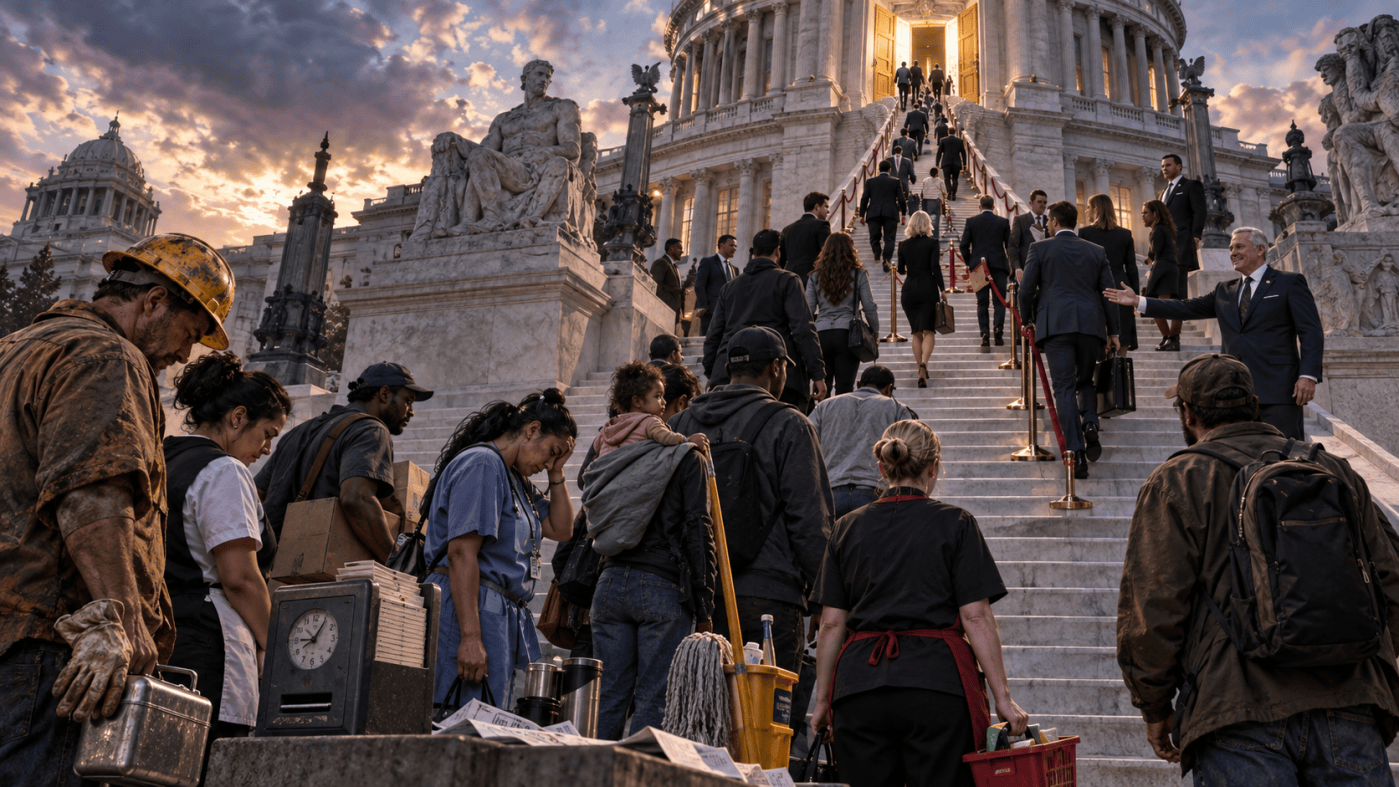
Bloomberg finds the missing worker before election day, but turns a class relation into a problem of individual candidates who somehow lack the time, money, and flexibility professional politics demands. Follow the worker farther and the disappearance happens rung by rung—through primaries, party placement, promotion, and a political career system that steadily thins working people from the field. Beneath the formally equal right to run sits a social order that distributes political time, money, networks, and credentials unequally, then baptizes the winners of that sorting process as the most qualified people to govern. The answer isn’t to wait for exhausted workers to volunteer for a second unpaid job, but to build organizations that recruit, train, sustain, and develop working-class leadership before the professional political class closes the gate.
Prince Kapone | Weaponized Information | September 21, 2026
The Worker Disappears Before the Voter Arrives
Bloomberg Businessweek opens Nicholas Carnes and Noam Lupu’s September 21, 2026 essay with a number that lands like a wrench dropped on the shop floor: of 919 Democratic and Republican candidates running for Congress this November, only seven came directly from working-class jobs when they entered politics. The authors widen the lens from there. Across the democracies they study, working-class occupations make up roughly 70 percent of the labor force while former workers hold about 2 percent of legislative seats. Their forthcoming book, Keeping Workers Off the Ballot, builds its argument around that chasm.
To their credit, Carnes and Lupu knock down several comfortable excuses. Workers aren’t simply less qualified, less interested in political life, or automatically rejected by voters. Countries with stronger unions or public campaign financing don’t erase the gap either. So the article pushes backward from election day and finds the worker disappearing before most voters ever get a choice. Running for office takes time, unpaid labor, financial cushion, privacy, and the freedom to spend night after night in meetings. A carpenter who has to be on the job at seven in the morning can’t float through that schedule like a lawyer, consultant, or professional political operative.
Then comes the quiet turn. Once Bloomberg reaches this point, a social relation starts shrinking into a candidate problem. Workers “face barriers.” Party recruiters recognize those barriers and choose professionals who can endure the campaign grind. The language is accurate as far as it goes, but notice where agency settles: the worker carries the burden, the recruiter reacts to it, and the organization of working life itself fades into the wallpaper. The boss who controls the schedule disappears. The wage that has to keep coming disappears. Politics somehow arrives afterward, as though the factory whistle, restaurant shift, warehouse clock, and childcare bill belong to another universe.
That framing also determines the horizon of reform. Candidate schools, political scholarships, party recruitment targets: each answers the worker who reaches the political doorway short on time and money. What Bloomberg doesn’t yet ask is why exercising an allegedly equal political right requires resources ordinary working life distributes so unequally in the first place. The article finds the missing worker, follows his footprints almost to the factory gate, and then stops just before asking who built the road.
Every Rung Gets Narrower
Once the search moves beyond Bloomberg’s claim that workers simply don’t run, the disappearance starts looking less like one locked door and more like a staircase that narrows at every landing. The Global Legislators Database tracks 19,704 lawmakers across 97 electoral democracies and records the paid occupations they held before entering elected politics. The gap survives different electoral systems, party structures, and national histories. Earlier OECD research found the same basic pattern across wealthy democracies: workers formed majorities of the labor force while occupying only a sliver of legislative seats.
The first easy explanation is ambition. Maybe professionals want political office and workers don’t. Carnes and Lupu tested that with 10 surveys covering 13,535 people across the Americas and found little evidence of a meaningful class gap in standard measures of nascent political ambition. Workers weren’t uniquely uninterested in public life. The shortage appears somewhere between wanting political influence and acquiring the institutional means to exercise it.
Voters don’t provide a clean explanation either. Carnes and Lupu’s candidate experiments in the United States, Britain, and Argentina found little evidence that voters automatically punished hypothetical candidates merely for coming from working-class occupations. Real primaries are rougher terrain. Sarah Treul and Eric Hansen found that working-class U.S. House candidates from 2008 through 2016 received an average 24 percentage points less of the primary vote and were 31 points less likely to win in the raw data. Controls reduced the disparity, leaving possible roles for fundraising, prior officeholding, and the unequal circumstances under which candidates enter the race. The ballot may be formally open, but candidates don’t arrive there carrying equal political equipment.
Sweden makes the attrition impossible to hide behind American campaign-finance folklore. A fifty-year study of nearly 80,000 political careers found workers making up about half the voting-age population, but only 34 percent of local nominees, 28 percent of councilors, 17 percent of local party leaders, and 13 percent of parliamentarians. Workers didn’t vanish in one spectacular act of exclusion. Their numbers were shaved down at each promotion. The same study found far greater schedule inflexibility among workers, and those job conditions explained part of the political gap. The hours commanded at work don’t suddenly become free when politics begins.
Germany reveals another stage in the sorting process. Working-class candidates were less likely to receive electorally secure placements, particularly in center-right parties, while professional political careers brought nomination advantages in parts of the left. Parties don’t merely discover candidates lying around in civil society like loose change. They rank them, place them, promote them, and decide which résumés look like governing material.
Money matters, but the evidence refuses to let it carry the whole explanation. The OECD comparison found that generous public campaign financing was associated with somewhat higher working-class representation, but even the most favorable modeled conditions left workers nowhere near their share of society. Stronger unions also correlated with more worker officeholding without erasing the gap. Removing one toll booth doesn’t flatten the road.
Mexico shows that the candidate pool itself can change when the selection machinery changes. MORENA used lotteries for some proportional-representation nominations, creating a natural experiment in who entered politics. Researchers found that areas represented by lottery-selected deputies who were socially similar to constituents and rooted in local organizations later showed higher political participation. The finding is narrower than a claim that lotteries solve class representation. It does show that changing how candidates are selected can change who reaches office and how communities relate to those officials.
Nor does the old excuse that legislatures simply require a superior professional caste survive much contact with the evidence. Research covering more than 14,000 U.S. state lawmakers found no meaningful effectiveness gap between working-class and white-collar legislators after controls. In Argentina, legislators with labor-union backgrounds introduced roughly twice as much workers’ rights legislation as colleagues without those ties. Workers who survive the climb don’t suddenly reveal themselves incapable of governing. Some carry different social relationships into the chamber with them.
So the factual terrain is harsher than the phrase “workers rarely run” suggests. Workers are thinned out before candidacy, inside primaries, through party placement, and during promotion. Public financing can soften part of the burden. Unions can change part of the equation. Different selection systems can alter who gets through. But by the time voters meet the polished candidates standing beneath the campaign lights, much of the class sorting has already happened. The ballot is real. So is everything that happened before the ballot was printed.
Democracy After the Punch Clock
The democratic promise is clean enough to print on a schoolhouse wall: every citizen has a vote, every eligible citizen may seek office, and the people choose. On paper, the warehouse worker and the attorney arrive as equals. But politics doesn’t begin on paper. Before anybody files paperwork, buys a yard sign, or shakes a hand at a fundraiser, society has already divided people by who controls the working day, who can miss a paycheck without missing rent, who can spend three nights a week in meetings, who knows donors by first name, and who already speaks the polished dialect of professional politics. The law opens the door equally. The social order decides who can afford to walk through it.
That’s the contradiction Bloomberg can see without quite naming. Its worker enters politics carrying what looks like a personal shortage: not enough time, not enough money, not enough flexibility, not enough connections. The professional arrives with those same advantages disguised as ordinary qualifications. One rearranges a calendar. The other asks permission. One calls a donor. The other calls the supervisor. One turns years inside political institutions into evidence of readiness. The other is expected to turn years of hard labor into an inspiring biography and still make the fundraiser by seven. Democracy, apparently, welcomes everybody—provided everybody arrives with the life of somebody who doesn’t punch a clock.
The working day follows the worker into politics. Time sold at work is time unavailable elsewhere. Lost wages follow. Childcare follows. Job security follows. The boss’s authority over schedules follows. What liberal common sense calls a candidate’s “barrier” is therefore no private misfortune floating outside the social order. The worker reaches the political arena carrying the relations of the workplace on his back.
Then the party performs another sorting. It receives people already divided by unequal time, unequal income, unequal networks, and unequal proximity to political institutions. From there come the respectable questions. Who looks viable? Who has experience? Who can devote the hours? Who knows the right people? Who has already demonstrated that they can live inside politics? Each question sounds innocent by itself. Together they can operate like a conveyor belt. No guard needs to hang WORKERS KEEP OUT on the headquarters door. Class rule has always preferred better manners when they’ll do the job.
Yesterday’s advantage then becomes tomorrow’s credential. Those who enter politics more easily accumulate the experience later demanded for advancement. Those excluded from the first opportunities appear less qualified for the next ones. The result of the sorting process becomes its justification. The machine manufactures the credential, stamps it with the seal of merit, and then bows before its own product as proof that the selection was natural.
This is where collective organization changes the equation. An isolated worker must somehow manufacture political capacity after the shift ends: learn the rules, build networks, find money, master public communication, and acquire leadership experience while protecting the paycheck that keeps the household alive. Collective organization can pool some of those burdens. It can turn individual experience into common knowledge, scattered relationships into organized force, and private weakness into capacities no single worker could purchase alone.
That doesn’t turn every worker who enters politics into a tribune of the class. Biography isn’t destiny. An official can drift from the life that produced him, and an organization can reproduce hierarchy inside its own walls. But those limits don’t rescue the fantasy that political institutions somehow select from society on neutral ground. When workers confront the process individually while professionals arrive with occupations and networks already adjacent to power, neutrality becomes the polite name given to an unequal starting line.
Workers therefore don’t disappear because one villain slams one gate. Their numbers are thinned through repeated conversions of social inequality into political inequality. Less control over working time becomes less space for political labor. Less political labor becomes less experience. Less experience becomes weaker standing. Weaker standing produces fewer opportunities to advance. One round of selection prepares the conditions for the next.
The fact that this process varies also matters. Political representation isn’t governed by some biological law assigning legislation to lawyers and labor to everybody else. Institutions can widen or narrow the road. Organization can alter who acquires political experience. Selection can be arranged differently. The legislature is not the natural habitat of a superior species that evolved opposable thumbs specifically for committee hearings.
But more workers in office would still not abolish class power. A different occupational composition can change what struggles enter the chamber, whose experience is present when laws are written, and which interests find people able to speak from lived familiarity. It doesn’t by itself dissolve employer power, concentrated wealth, party discipline, or the institutions surrounding the legislature. Representation is terrain. It is not the whole battlefield.
That distinction brings Bloomberg’s problem into sharper focus. The central question isn’t why more workers fail to volunteer for a second unpaid job called politics. It is why representation has been organized so that exercising an equal political right depends so heavily on resources ordinary working life distributes unequally. Once that becomes visible, the missing worker no longer looks like an applicant who couldn’t clear a neutral hurdle. The hurdle itself finally stands in the light.
Where the Pipeline Can Be Changed
If workers are filtered out before election day, then the fight starts upstream of the ballot. One choke point is the private cost of becoming a candidate. The New Jersey State AFL-CIO’s Labor Candidates Program recruits, trains, and mentors union members seeking office. Its candidate school covers election law, fundraising, communications, voter contact, campaign planning, and volunteer organization. The federation reports 1,354 victories and a 78 percent success rate, figures that remain its own accounting. The material point is simpler: skills that an isolated worker would otherwise have to purchase or stumble into are pooled through an organized labor institution.
Another choke point is recruitment itself. Rhode Island labor organizations didn’t wait politely for candidates to appear. They mapped districts and recruited candidates where union membership and electoral openings gave them leverage. That changes the question from “Which politician should labor endorse?” to “Which workers and labor allies should be developed before the ballot is set?” Candidate supply stops looking like weather and starts looking like something organization can shape.
Leadership can also be built before anybody runs for public office. Labor Notes workshops train rank-and-file members to map workplaces, build teams, listen to coworkers, and run for local union office. That matters because political experience doesn’t have to begin in a consultant’s cubicle or a campaign staff job. Workers can acquire it through collective struggle where they already stand.
Parties can make the same choice consciously. The Working Families Party’s Southern Made campaign set a goal of recruiting and training 1,000 working-class candidates across Southern states by 2030. The significance here is institutional, not devotional. A party can treat the social composition of its candidates as an organizational responsibility instead of waiting for professional political careers to reproduce themselves.
None of these programs turns electoral representation into working-class power by magic. They intervene at specific points where workers are otherwise left alone with unequal time, money, training, and networks. That is the orientation worth carrying forward: build leadership before endorsement, recruit before the professional class monopolizes the field, and socialize political knowledge rather than forcing every worker to buy it privately. Bloomberg’s carpenter doesn’t lack civic virtue. The fight begins where one future representative enters politics with flexible hours and institutional backing while another still has to ask the boss for Tuesday night off.


Leave a comment