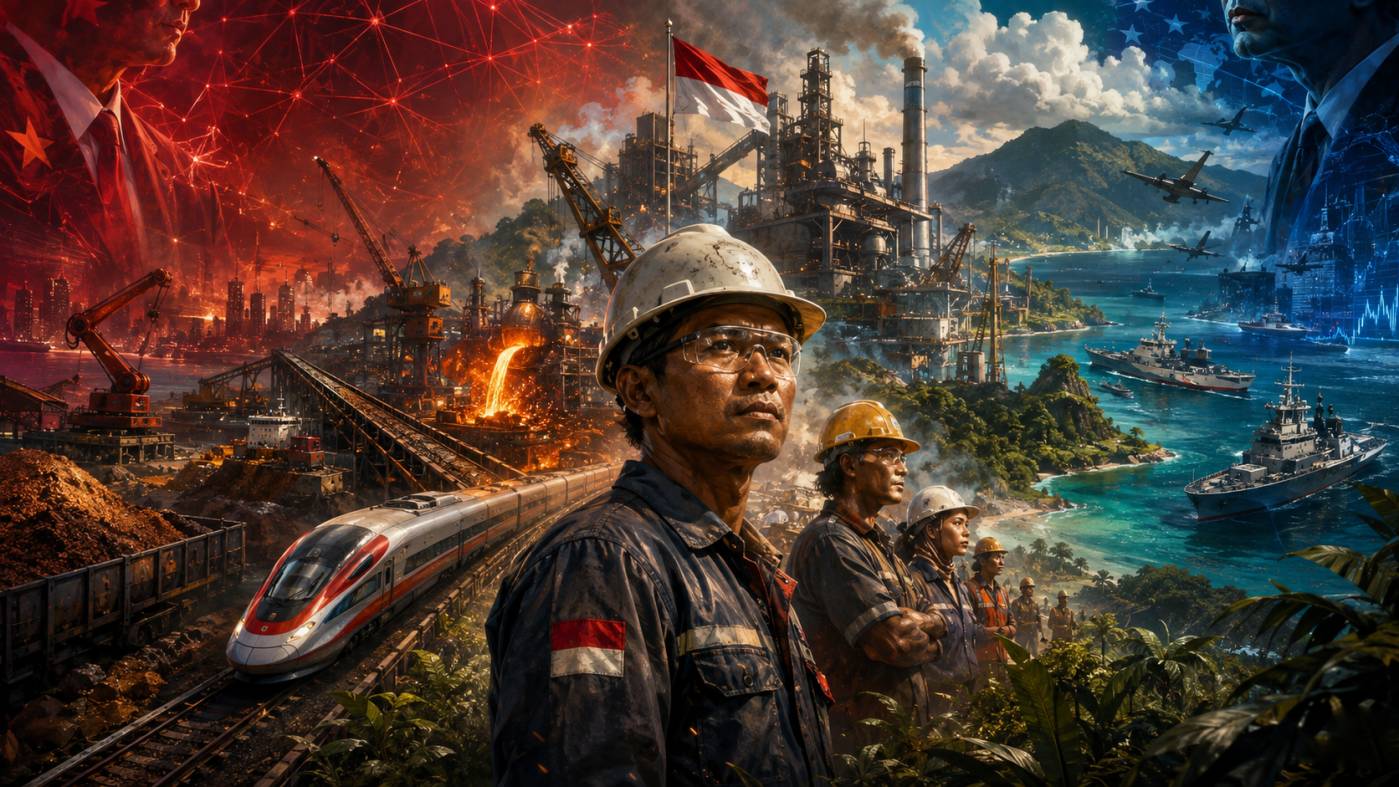
Indonesia is using Chinese capital, technology and markets to break out of the old raw-material trap, even as those same relationships create new concentrations of ownership, debt and corporate power inside the industries meant to deliver greater autonomy. Washington approaches from another direction, wielding tariff pressure, military ties and an emerging economic-security architecture designed to narrow Jakarta’s room to maneuver. Beneath the diplomatic talk of “balance,” the real struggle runs through nickel quotas, smelters, rail finance, maritime claims, technology transfer and the workers and communities carrying the costs of industrialization. The question isn’t whether Indonesia stands closer to Beijing or Washington, but whether the productive power being built on Indonesian soil can be wrested from foreign and domestic capital and turned into power for the people who make it run.
Prince Kapone | Weaponized Information | August 27, 2026
The Balance That Never Existed
On August 25, 2026, Asia Times published an opinion piece by Muhammad Zulfikar Rakhmat and Yeta Purnama arguing that Indonesia’s deepening relationship with China is beginning to compromise Jakarta’s “free and active” foreign policy. The evidence they assemble isn’t trivial. Wang Yi had just completed a three-day visit that tightened political, economic and defense cooperation. Chinese companies had protested Indonesian regulations. Indonesia and China were discussing domestic production of ammunition, missiles and rockets. An Indonesian frigate had exercised with a Chinese warship east of Taiwan. The Natuna dispute remained unresolved. Debt problems still hung over the Jakarta-Bandung high-speed railway. None of that needs to be waved away.
The ideological work begins with how those facts are arranged. The article starts its meaningful clock in August 2026, jumps back to Chinese investor complaints in May, then reaches October 2024 only when a Chinese coast-guard confrontation near Natuna becomes useful to the story. The compressed timeline makes expanding cooperation with Beijing look like a directional slide. Indonesia’s longer foreign-policy history enters only as a phrase—“free and active”—rather than something whose meaning might require explanation.
That compression is reinforced by a peculiar distribution of agency. China acts. Wang “urged,” Chinese firms “warned,” Chinese vessels operated, Beijing requested. Indonesia increasingly appears as the object being moved: Jakarta is “leaning,” perhaps “bowing,” perhaps trading away concessions behind closed doors. Even when Indonesian officials deny that J-10 purchases or U.S. overflight access were discussed, the denial remains suspended under suspicion. It’s “worth watching rather than simply accepting.” Suspicion becomes an evidentiary method.
The United States receives softer treatment. The article acknowledges a U.S. trade agreement that could constrain Indonesian dealings with China and mentions Washington’s request for military overflight access. Neither becomes the organizing measure of Indonesian sovereignty. They sit in the background while Chinese economic and military ties supply the foreground danger.
The sharpest move comes at the end. Jakarta’s doctrine is recast as an “even balance,” and every unequal relationship can then become evidence that the balance is failing. Indonesia’s entry into a China-initiated AI organization becomes an “alignment already made.” The naval exercise east of Taiwan joins the same accumulating case. Real contradictions are threaded together until proximity itself starts doing the work of proof.
That’s what makes the article effective. It doesn’t need to invent Chinese power. It takes genuine pressure points and asks the wrong material question of them. Instead of showing where Indonesian sovereignty is actually being surrendered, accumulated or contested, it measures sovereignty by political distance from Beijing. Once that ruler is accepted, the conclusion is already waiting at the end of the page.
Mines, Missiles, Debt and the Price of Autonomy
Indonesia’s bebas aktif doctrine was never a promise to stand exactly halfway between Washington and Beijing. Foreign Minister Sugiono described it in 2026 as maintaining an independent position, avoiding exclusive blocs and widening Indonesia’s strategic room through institutions ranging from ASEAN and the G20 to BRICS and the OECD process. Different levels of cooperation with different powers therefore don’t, by themselves, establish that Jakarta has abandoned the doctrine.
The same language has also carried radically different economic relationships. After the destruction of Indonesia’s old political order in 1965–67, Suharto’s New Order remained formally non-aligned while reopening the economy to Western capital. Contemporary U.S. diplomatic records welcomed liberal foreign-investment rules, debt restructuring and the return of foreign-owned enterprises. Political independence and economic dependence were already capable of occupying the same sentence long before Wang Yi arrived in Jakarta.
China’s contemporary weight is nevertheless enormous. Indonesian statistics place China as the country’s dominant source of imports and its largest market for non-oil-and-gas exports, with machinery, electrical equipment and other industrial inputs moving into Indonesia while processed minerals and manufactured products move the other way. BPS trade data show an economy whose productive circuits are deeply connected to Chinese industry.
That relationship has a property structure. At the Indonesia Morowali Industrial Park, Shanghai Decent Investment Group holds the largest shareholder position alongside Indonesian partners. At Weda Bay Nickel, the ownership structure gives Tsingshan indirect majority control of the mining venture while Indonesian state miner Antam holds a minority share. These aren’t abstract measures of “influence.” They are concrete positions inside mines, smelters and the machinery built around them.
Jakarta has also shown that those investors don’t simply dictate policy. Indonesia entered 2026 tightening nickel production after years of rapid expansion. The Energy Ministry tied the quota restrictions to supply, prices, smelter demand and conservation of national reserves. By August, industry estimates put approved 2026 production around 260–270 million tonnes, well below roughly 379 million tonnes actually produced in 2025.
Chinese companies pushed back hard. Their chamber of commerce complained to President Prabowo about quotas, royalties, export-earnings rules, taxation, enforcement and alleged corruption and extortion. The corruption claims remain allegations, and the chamber’s assertion that some firms suffered quota reductions above 70 percent hasn’t been independently established as a national figure. The corporate pressure itself is documented. Indonesia’s finance minister answered by defending national control of its minerals, while the government continued restricting extraction and tightening commodity policy.
The industrial boom has a shop floor and a landscape around it. Unions inside Morowali bargain over collective agreements, safety, dismissals and employment conditions; in 2026, SPN workers at IMIP moved from deadlocked bargaining toward organized strike action. Mining and smelter expansion has also produced concrete struggles over land and resource control in communities around the industrial zones, where research has documented community resistance to expanding corporate power. “Indonesia” isn’t one undifferentiated beneficiary of downstreaming.
China-Indonesia cooperation doesn’t erase their maritime conflict. Indonesia’s formal UN position rejects Chinese historic-rights claims inside Indonesia’s exclusive economic zone or continental shelf beyond what UNCLOS permits. Indonesian authorities have repeatedly confronted Chinese coast-guard vessels, including during seismic operations near Natuna. Beijing continues to speak of “overlapping claims” in the area. The contradiction is real.
So was the August 12 naval event. China’s Defense Ministry says the frigates conducted communications, formation and replenishment exercises east of Taiwan. Indonesia called it a routine PASSEX, but its geography was genuinely unprecedented for a publicly acknowledged Chinese exercise with a foreign navy. Yet the same Indonesian frigate had just exercised with Russia, while Jakarta was simultaneously expanding defense cooperation with Washington and implementing new defense ties with Japan. China is becoming a more important military partner, but the wider pattern remains plural.
Washington is bargaining over Indonesian policy space too. The February U.S.–Indonesia Reciprocal Trade Agreement followed intense tariff negotiations and contains provisions on third-country restrictions, sanctions cooperation, investment screening and sensitive-technology controls. The signed agreement is significant, but the latest USTR status report still lists it as pending entry into force. Washington has separately sought military overflight access, while Indonesian officials say no standing clearance has been granted.
The unresolved projects with China sharpen the stakes from another direction. Whoosh is real infrastructure, but its China Development Bank-backed financing remains under restructuring and Indonesian public institutions are increasingly involved in managing the domestic side of the risk. The proposed ammunition, missile and rocket project promises technology transfer through Indonesian state firms, while the Chinese partner, equity structure, intellectual property and actual local technological control remain undisclosed.
Indonesia has more processing capacity on its soil, more external partners and more tools for regulating strategic resources than a raw-commodity exporter possesses. But the capital, machines, markets, credit and technology making that advance possible carry claims of their own. That contradiction sits inside the factories and contracts long before it reaches the diplomatic podium.
Sovereignty Built With Borrowed Tools
The real problem begins where the language of “balance” ends. Indonesia’s independence can’t be measured by drawing a line between Washington and Beijing and checking whether Jakarta stands precisely in the middle. Sovereignty becomes material when the question turns to command: who controls the ore beneath the ground, the smelter processing it, the machines running the plant, the bank carrying the debt, the market buying the output and the labor producing the value. A state can trade heavily with one power, exercise with another and bargain with a third. The harder question is what it can actually make, regulate, finance and defend on its own terms.
Indonesia’s modern history already shows why diplomatic language alone tells us so little. The post-1965 political order reopened the economy to Western capital while formally preserving non-alignment. Today’s downstreaming drive represents a different attempt to alter Indonesia’s place in the international division of labor. Instead of leaving minerals at the raw-export stage, the state is forcing more processing and industry onto Indonesian soil. That is a real development of productive capacity. The factories exist. The smelters operate. The state has more tools with which to bargain than a government exporting unprocessed ore would possess.
But location and command are different things. A plant can stand in Indonesia while major ownership stakes, machinery and technological knowledge remain concentrated in foreign hands. A railway can expand national infrastructure while its financing leaves Indonesian public institutions managing the risk. A weapons project can promise technology transfer while the decisive question remains whether Indonesia gains actual command over the knowledge and productive process. Indonesia is building greater capacity through a mixture of domestic state power, domestic capital and foreign-controlled or foreign-dependent inputs. The sovereignty gained through that process arrives already carrying limits.
Those limits don’t simply cancel the development. They drive it forward. Indonesia needs outside capital and technology because it doesn’t yet possess everything required to industrialize at the speed its government wants. Foreign investment expands domestic capacity. That new capacity gives Jakarta greater leverage over extraction, processing and the terms under which investors operate. The state then tightens quotas, regulates commodity earnings and forces capital to bargain inside a terrain that industrialization itself has changed. Dependency produces development; development produces new forms of dependency; the state tries to discipline the capital it needed to get there.
China sits deep inside that contradiction. Chinese firms hold powerful positions in major industrial nodes and benefit from the machinery, markets and supply chains binding Indonesian production to China. That gives them real capitalist leverage. Jakarta’s response has been neither submission nor rupture. It welcomes investment, demands continued production, regulates extraction and resists corporate pressure when those interests collide. The interstate relationship carries another contradiction at Natuna, where economic cooperation coexists with a direct conflict over maritime rights. Chinese productive integration widens Indonesia’s available economic relationships while also creating new struggles over ownership, regulation and command.
Washington operates through a different historical and institutional route. U.S. leverage appears through market access, tariff pressure, defense ties and efforts to bind economic relations more closely to American security priorities. China’s leverage is embedded more heavily inside production itself: ownership, industrial inputs, machinery, markets and credit. Calling both “influence” would erase what actually gives each relationship force. Their histories differ, their mechanisms differ, and reciprocal pressure doesn’t make them equivalent.
Now split open the word “Indonesia.” The state can capture more mineral rent while industrial workers remain under corporate discipline. Domestic conglomerates can accumulate alongside Chinese investors. State firms can gain strategic assets while public institutions carry financial risk when projects run into trouble. Workers can stand inside a nationally celebrated industrial project and still have to fight over safety, dismissals and bargaining rights. Communities can watch smelters expand while corporate power presses against their control of land and resources. National development therefore has a class content. More power for the Indonesian state can coexist with concentrated power over Indonesian workers and communities.
That is why the Asia Times framing can feel convincing. Its evidence points toward real Chinese structural power, real commercial pressure and real interstate friction. But it mistakes those effects for the whole process. Indonesia isn’t confronting a choice between pristine independence and sudden dependence on Beijing. It is trying to enlarge its room to maneuver through an industrial transformation whose capital, technology and markets remain partly beyond national command. The same process that gives Jakarta more leverage also creates new interests capable of pushing back against it.
The apparent inconsistencies follow from that material relation. Cooperation with Chinese capital and regulation of Chinese firms belong to the same development strategy. Military engagement with China doesn’t dissolve Natuna. Bargaining with Washington doesn’t require surrendering Indonesian airspace. Non-alignment becomes the effort to keep several channels open while preventing any one of them from becoming a command post over the whole economy or state.
That struggle moves through levels. Raw materials processed at home increase national productive capacity. Control over technology, finance and industrial chains pushes further toward productive sovereignty. But even nationally commanded industry can remain concentrated above the people who work the factories and live beside the mines. The unresolved question is therefore no longer how far Jakarta stands from Washington or Beijing. It is whether the power Indonesia is building travels downward with the machinery—or stops where ownership and class rule tell it to stop.
Sovereignty Has to Reach the Shop Floor
If Indonesia’s industrial ascent leaves workers powerless inside the factories producing it, sovereignty has stopped halfway. Morowali concentrates thousands of workers inside the same industrial system where foreign and domestic capital depend on uninterrupted production. That concentration is leverage. SPN Morowali is already using it through collective bargaining, demonstrations and organized strike action over safety, dismissals, workplace agreements and union rights. Strengthening those struggles forces downstreaming’s gains out of investment statistics and into enforceable improvements in working life. A nickel industry celebrated as national development should have to answer to the workers whose labor makes the damn thing run.
The struggle also runs through the land and water feeding that industrial machine. Mining expansion gives companies enormous material stakes in permits, environmental enforcement and access to community territory. JATAM’s Weda Bay work, the Save Sagea struggle and AMAN-linked advocates are already fighting on that terrain through community documentation, public campaigning, legal defense and pressure on authorities to enforce mining, environmental and Indigenous rights. Those fights push resource sovereignty beyond the state’s ability to collect rents toward the people’s power to defend the conditions of their own lives.
Another leverage point sits in the rules governing development itself. Jakarta can’t discipline strategic-resource capital if trade agreements or investor pressure quietly narrow the policies available to it. JATAM has already opened a political fight around the U.S.–Indonesia Reciprocal Trade Agreement, demanding public and legislative scrutiny of provisions it argues threaten Indonesian policy space. The principle cuts wider than Washington: no foreign government, creditor or corporation gets a free pass to turn markets, investment or technology into a veto over Indonesia’s ability to regulate its own resources.
For an international anti-imperialist left, solidarity means standing with the struggles already underway rather than choosing an external patron for Indonesia. Amplify workers fighting China-linked industrial capital. Defend communities and Indigenous organizers protecting land, water and legal space. Oppose U.S. economic coercion without pretending every contradiction attached to Chinese capital disappears in the name of multipolarity. The organized forces confronting those pressures from below are where sovereignty stops being a diplomatic slogan and starts becoming power.
The orientation is concrete: strengthen the unions that can halt production, defend the communities that can contest extraction, and expose the agreements that can narrow Indonesia’s room to act. National development becomes popular power only when the people producing and defending it can force their way into command.


Leave a Reply