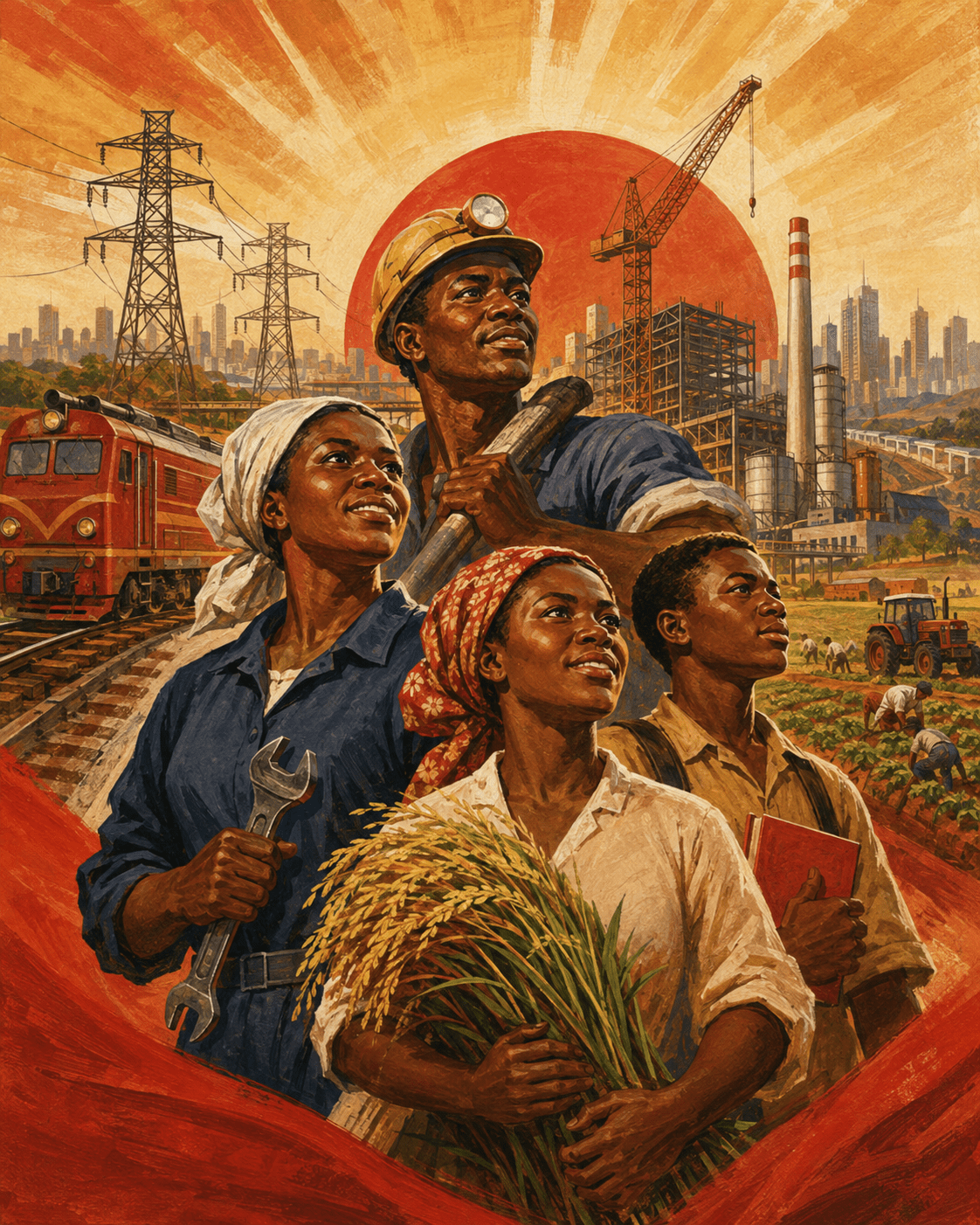
The Financial Times turns the old Malthusian panic on its head, suggesting that Africa’s historical problem may have been too few people rather than too many, but leaves population itself sitting in the defendant’s chair. Africa’s demographic history tells a harder story, where slavery tore human labor from the continent, colonial infrastructure carried wealth outward, and today’s swelling cities reveal that density alone cannot manufacture development. The real contradiction is that Africa is acquiring the workers, cities, markets, and human scale capable of historic productive transformation while debt, commodity dependence, weak industrial absorption, and inherited infrastructure restrict the means to realize it. The question is therefore not whether Africa has enough people, but whether those people will command the factories, credit, technology, infrastructure, and continental markets needed to turn human abundance into African productive power.
Prince Kapone | Weaponized Information | August 12, 2026
From Too Many Africans to Too Few
David Pilling begins “Does Africa have too few people?” by turning one of the oldest commonplaces about Africa on its head. The continent is racing toward 2.5 billion people, its median age is nineteen, and many young people are already scrambling for scraps in the informal economy. Surely, Pilling writes, the problem must be too many people. Then comes the reversal: perhaps Africa has historically suffered from too few. It is a clever opening because it breaks with the stale Malthusian habit of treating African fertility itself as a pathology. But the article does not escape demographic reduction so much as flip its sign. The quantity and concentration of African people remain the organizing explanation.
The authority for that reversal is overwhelmingly Joe Studwell. His recent book, How Africa Works, supplies the article’s governing proposition: low population density has been the “most important reason” for Africa’s relative poverty, and present population growth amounts to an “extremely belated process of demographic normalisation.” From there, Pilling arranges the evidence around that thesis. Africa has the population of India spread across nine times the landmass. Disease and poor soil historically restrained population growth. Sleeping sickness weakened animal agriculture. The slave trade removed millions of young Africans. Cities remained small. Joseph Ki-Zerbo is then recruited to reinforce the importance of reaching a threshold of demographic concentration. Each element points the reader back toward the same causal center: too few people, too widely dispersed.
The chronology is revealing. Pilling moves from ecological constraint and slave extraction to twentieth-century medical advances, declining mortality and population growth. A vast historical middle effectively disappears. The article does not ask what happened to African land, labor, production or infrastructure during that missing interval because its story does not require those relations to explain the outcome. Once population begins “normalising,” roads, electricity, schools, hospitals, markets and cities appear principally as things that density makes cheaper and easier to build. The historical problem has quietly become one of insufficient concentration.
The same narrowing occurs at the contemporary end. When Pilling finally qualifies Studwell’s optimism, agency shifts almost entirely inside Africa: “poor leadership,” “bad infrastructure,” corruption and social upheaval may squander the demographic opportunity. Even the threat that artificial intelligence could close the manufacturing route appears as an external technological fact arriving upon the continent rather than part of any larger historical relation. The result is subtler than the familiar sermon that Africans are poor because they reproduce too much. Pilling deserves credit for breaking that particular piece of imperial common sense. But his inversion leaves the reader inside another demographic common sense: Africa’s tragedy becomes that there were historically too few Africans in the right places, and its promise becomes that there may finally be enough.
The History Inside the Numbers
The demographic shift Pilling describes is real and enormous. Africa’s population passed 1.5 billion in 2024 and is projected to reach roughly 2.5 billion by 2050. Over the same period, the continent’s working-age population is expected to rise from about 883 million to 1.6 billion. But the UN Economic Commission for Africa does not describe those numbers as a development program in themselves. Whether this expanding population becomes a demographic dividend depends on whether people are healthy, educated and able to enter productive employment. Population growth creates potential labor power and markets. It does not create the institutions or productive structure capable of using them.
Nor is Pilling wrong that density can matter. Research from UNECA identifies genuine agglomeration advantages: concentrated populations can reduce transaction costs, make infrastructure and public services cheaper per person, enlarge markets and increase the possibilities for specialization and productivity. That gives substance to Studwell’s argument that very sparse settlement can impose real economic costs. The problem begins when this material condition is elevated above the history that produced it, or when greater density is treated as though it naturally carries societies toward industrial takeoff.
The demographic history itself cannot be separated from forced human extraction. Pilling acknowledges the slave trade, but the scale of what happened cannot be reduced to a subtraction from an otherwise self-contained African population curve. Historical work collected by UNESCO documents severe population losses across regions subjected to the slave trades, including the removal of millions of people in their most productive years and the wider mortality and social devastation surrounding capture, warfare and forced transportation. Africa did not simply begin modern history with an unfortunate shortage of people. Entire regions had their demographic development violently interrupted through systems that removed human beings from African societies and transferred their labor elsewhere.
The next historical interval is equally important because it is largely absent from Pilling’s chronology. Colonial infrastructure was not simply too sparse because Africans were too dispersed. The African Union’s Programme for Infrastructure Development in Africa describes the inherited transport geography of the continent as a product of colonial economies in which roads, railways and ports were constructed primarily to move resources outward and maintain political control rather than integrate African economies with one another. This matters directly to Pilling’s claim that low density made infrastructure prohibitively expensive. Infrastructure scarcity and fragmentation cannot be explained only by the number of people available to use it when much of the infrastructure that was built followed an entirely different economic geography.
The same problem appears in the relationship between cities and industrialization. Africa has been urbanizing rapidly, but UNECA’s work on urbanization and industrialization finds that the connection between the two has often been weak. Population concentration therefore already exists in major parts of the continent without automatically reproducing the industrial trajectory that Pilling’s discussion of agglomeration invites the reader to imagine. The employment figures make that gap harder to ignore. UNECA reports that around 83 percent of African employment remains informal, while manufacturing accounts for less than 10 percent of GDP in many African economies and Africa contributes only a small share of global manufacturing value added. More people are gathering in cities; productive employment has not expanded at the same pace.
Continental averages also conceal where population pressure actually falls. FAO’s mapping of African farming systems shows enormous differences between agroecological regions: some highland systems support very dense rural populations, while other farming zones experience acute pressure on limited productive land despite comparatively modest average population density. The comparison between Africa’s landmass and India’s therefore establishes scale, but not how much land is equally usable, where people are concentrated, or what productive systems sustain them. A continent is not one giant vacant field waiting for demographic filling.
The historical evidence also counsels against turning density into a universal deep determinant. In a recent long-run study of African fiscal development, Morten Jerven finds little support for the proposition that population density around 1900 produced the persistent effect on fiscal capacity predicted by theories that treat early density as a lasting institutional cause. That finding does not establish that population density was irrelevant. It does establish that its effects cannot simply be projected across the twentieth century while the historical transformations in between are treated as secondary noise.
The present constraints are equally concrete. African governments must finance the schools, hospitals, electricity systems, transport networks and productive infrastructure through which population concentration could become economically useful while carrying roughly $1.2 trillion in external debt. In many countries, debt service is consuming more than a quarter of public revenue, directly competing with spending on infrastructure, employment and social services. At the same time, the African Union’s strategy for the African Continental Free Trade Area is explicitly aimed at overcoming reliance on primary commodities by developing regional value chains, industrial capacity, infrastructure and value-added production across a continental market.
Pilling’s final warning about artificial intelligence therefore lands inside an already unfinished industrial transition. UNIDO identifies real dangers: AI capacity is highly concentrated, adoption requires capital, energy, digital infrastructure and skills, and technological dependence could deepen existing industrial inequalities. But that is not the same as establishing that Africa has permanently missed the manufacturing route. The material question remains open because the continent is simultaneously becoming more populated, more urban and pursuing greater continental economic integration while still struggling to build the productive capacity capable of employing that human scale.
When People Become a Productive Force
People do not become an economy just because somebody squeezes them closer together on a map. A million workers without land, tools, electricity, transport, schools, hospitals, factories, credit, and political power are not a “demographic dividend.” They are a million human beings trying to live. Population becomes productive power only when society has built the means through which people can work, learn, move, heal, produce, and reproduce life. Studwell is right about one thing: density matters. When people live closer together, roads can serve more people, markets can thicken, workers can specialize, and schools and clinics can reach more families. But density is an opening, not a destiny. History still gets a vote.
And Africa’s history refuses to sit quietly inside a population chart. Disease and ecology constrained population growth, certainly. But millions of Africans were also ripped bodily out of African societies. The slave trades did not simply make the continent “less dense,” as though somebody misplaced a few census forms. They tore workers, farmers, artisans, mothers, fathers, and children out of communities and sent their labor across oceans to enrich other societies. The people missing from African production did not disappear into thin air. Their labor showed up somewhere else as wealth. Africa’s demographic weakness and the enrichment of the Atlantic world were bound together by chains, ships, guns, and markets.
Colonialism took up the work in another form. It built railways, yes. The question is where those railways went. A track running from a mine to a port is not the same thing as a network tying farms to factories, factories to cities, and cities to one another. One system drains wealth outward. The other can circulate production inward. Colonial infrastructure was built largely to move what empire wanted from the interior to the coast and from the coast to somebody else’s market. So counting kilometers of rail and calling that “development” is like measuring a prison by the quality of its hallways. The direction matters.
That history now crashes into Africa’s demographic present. Cities are swelling. Markets are thickening. Workers are being concentrated in numbers large enough to sustain specialization, industry, transport, services, and continental trade on a scale previous generations could scarcely imagine. But a packed city does not become an industrial center because the buses are full. When factories, infrastructure, and productive investment fail to keep pace, the city concentrates misery alongside possibility. Informal work grows beside new markets. Unemployment grows beside new skills. The same density that can reduce the cost of schools, clinics, housing, transport, and electricity also makes their absence more brutal. Productive possibility and social pressure rise together.
There is the contradiction in plain clothes. Africa is gaining the people, cities, labor pools, and market scale capable of carrying a historic productive transformation, while debt, commodity dependence, weak industrial absorption, and inherited infrastructure choke the means of carrying it through. A larger working population can produce more, but somebody has to build the productive capacity first. A continental market can sustain industry, but only if African workers increasingly produce what that market consumes. Greater density can make public infrastructure cheaper per person, but governments still need money to pour the concrete, string the wires, build the schools, run the clinics, and keep the trains moving.
Debt brings the whole matter down from the clouds. The young African worker who appears in some development economist’s spreadsheet as tomorrow’s “demographic advantage” has to eat today. That worker has to be educated today, transported today, housed today, kept healthy today, connected to electricity today, and given useful work today. None of that is free. The dividend must be produced before it can be harvested. Yet when public revenue is swallowed by debt service, the worker is praised as the continent’s future while the social conditions required to create that future are starved in the present. Capital has always had a marvelous talent for celebrating tomorrow while collecting today.
The continental market carries the same contradiction. Two billion consumers may look magnificent on an investor presentation, but a market does not tell us who makes what sits on the shelves. If African economies continue shipping raw materials outward and buying higher-value goods back, a larger population can simply mean a larger market for somebody else’s production. More trade, more consumption, more containers moving through the ports—and the same old structure underneath. Regional value chains, African industrial production, and infrastructure connecting African economies to one another point somewhere else. They turn density from a head count into a material base for production. The real question is brutally simple: will Africa merely become a bigger market, or will it become a bigger producer?
Artificial intelligence sharpens the problem. New technology can raise productivity, reorganize work, and expand what a society is capable of producing. But AI does not float down from heaven like technological rain. It runs on electricity, capital, skills, data systems, computing infrastructure, and institutions capable of using it. In economies already struggling to create secure employment for growing labor forces, automation can make that struggle harder. But technology can also deepen productive capacity when people possess the means to command it. The fight is not between Africa and machines. It is over who owns the machines, who develops them, who has access to them, whose labor they displace, and whose life their productivity is made to serve.
This is where Pilling’s inversion breaks out of one cage and walks straight into another. The old Malthusian looks at African poverty, counts Africans, and concludes there are too many. The demographic optimist looks at African underdevelopment, counts Africans again, and concludes there were too few. The arithmetic changes. The habit does not. Africans remain the variable under inspection while the machinery organizing their labor, land, infrastructure, finance, and production slips into the background. Density matters. Numbers matter. But no population was ever industrialized by a calculator.
Look instead from the street. The worker hustling for survival in an informal economy is not an excess mouth, and neither is that worker proof that Africa has finally crossed some magical demographic threshold. That person is labor power already alive in the world, carrying knowledge, skill, creativity, needs, and possibilities that the existing productive system has not fully absorbed. Multiply that across hundreds of millions of people and the meaning of Africa’s population surge comes into focus. What the bourgeois economist calls a demographic dividend is, in lived terms, an enormous human capacity pressing against an economic structure too narrow to employ, sustain, and develop it.
Africa has not arrived late to somebody else’s starting line. It is standing inside its own historical contradiction. One road leads toward industrial capacity, integrated markets, public infrastructure, and production increasingly organized around African needs. The other produces a continent with more workers than secure jobs, more consumers than locally produced goods, more cities than functioning public systems, and more human potential than the existing economy knows what to do with. Population density changes the battlefield. It does not choose the winner. That will depend on who gets to build the factories, command the credit, lay the rail, control the technology, organize the labor, and decide where the wealth goes.
Turn the Demographic Dividend Into Working-Class Power
If Africa’s expanding population is to become more than a vast pool of precarious labor, the struggle has to reach the institutions that determine where investment goes, what gets produced, who gets employed, and whether public revenue builds productive capacity or disappears into debt service. That begins with organized labor. The Organisation of African Trade Union Unity, which represents dozens of affiliated national labor centers across the continent, already possesses the kind of continental worker infrastructure capable of contesting development policy from the shop floor upward. Trade unions can turn the language of the “demographic dividend” into concrete demands for job-rich industrialization, local processing, apprenticeship and skills programs, stronger labor protections, and public investment tied to actual employment creation rather than abstract growth figures.
Debt is another material choke point. African governments cannot build the transport systems, schools, hospitals, power grids and industrial infrastructure required by a rapidly growing population while large portions of public revenue are committed to creditors. ITUC-Africa and allied African trade unions have already linked debt cancellation to employment, wages, social protection and structural transformation. That campaign provides a concrete bridge between workplace organization and fiscal sovereignty. Debt cancellation should be fought for not as an accounting adjustment but as the release of resources for public investment, productive employment and the social infrastructure that reproduces the working class itself.
The same pressure has to be brought to bear on continental integration. The promise of the African Continental Free Trade Area cannot be reduced to lowering tariffs and expanding commerce between markets that still export raw materials and import finished goods. Workers and unions have a direct interest in forcing integration toward regional value chains, African processing, industrial production and infrastructure that connects productive centers to one another. Political education inside unions, worker organizations and community formations can make that distinction clear: a bigger continental market means little if African labor produces little of what fills it.
And none of this requires turning African women into machinery for producing tomorrow’s workforce. UNFPA’s reproductive-agency framework rejects fertility targets imposed from above and centers people’s ability to decide whether, when and how many children they have. That principle matters here. The answer to racist population-control politics is not state-sponsored pronatalism. Africans are neither excess mouths to be suppressed nor missing workers to be manufactured.
The immediate task is sharper: organize the workers who already exist, fight to free public resources from debt, force industrial policy toward employment and value creation, and make continental integration serve African production. A demographic dividend worth anything will not arrive because the population crossed the right statistical threshold. It will have to be organized into existence.


Leave a comment