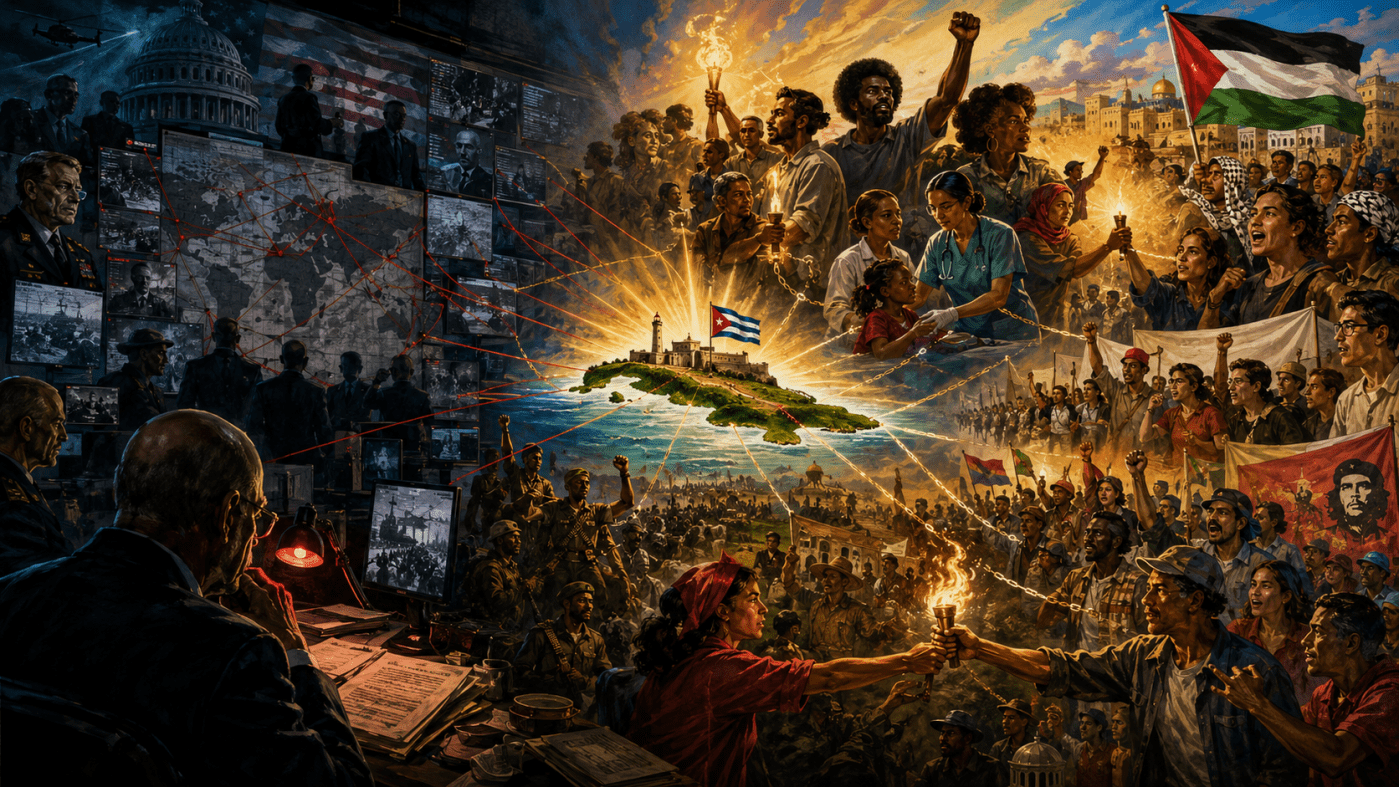
The State Department begins with documented espionage cases and stretches them into an indictment of students, Black revolutionaries, socialists, antiwar organizers and entire liberation movements. Its conspiracy theory erases colonialism, dictatorship, racial capitalism, invasion, sabotage and blockade so that resistance appears to originate not in material oppression, but in secret instructions from Havana. Yet Cuba did not manufacture the struggles of Harlem, Nicaragua, Puerto Rico, Colombia, Angola or Palestine—it joined peoples already fighting an internationally organized system of domination. Washington fears Cuban influence because the Revolution proved that oppressed nations could defy empire, recognize one another across borders and organize resistance without imperial permission.
By Prince Kapone | Weaponized Information | July 21, 2026
When the Oppressed Speak to One Another, Washington Hears a Conspiracy
The United States Department of State has discovered a conspiracy. It stretches from Havana to Harlem, from socialist organizations and labor campaigns to antifascist networks and university encampments, from the memory of Black liberation to the living struggle for Palestine. Its agents are apparently everywhere. Some secretly carried classified documents. Others carried banners. Some operated under diplomatic cover. Others attended public conferences, joined humanitarian delegations, opposed the blockade or committed the suspicious act of believing that a small Caribbean nation has the right to resist the empire trying to suffocate it. Washington has gathered these radically different people, actions and histories beneath one roof and stamped the file Cuba: The Capital of 21st Century Communism.
The report’s conclusion states the method with unusual honesty. Cuba allegedly fought the United States through “spies and soldiers,” but also through “students and intellectuals”; through “terrorist cells,” but also through “solidarity committees and nonprofit networks” (p. 98). The arrangement on the page performs the work that evidence was supposed to perform. A clandestine agent appears beside a student. An armed cell appears beside a nonprofit. Espionage, education, political advocacy, public diplomacy and revolutionary solidarity are placed within one enemy field, then made to inherit one another’s guilt.
By the final page of the prosecution, the circle has widened enough to swallow contemporary American dissent. The report links the George Floyd protests, the rise of antifascist organizing and campus mobilization for Palestine to Cuban influence “in some way, shape, or form” (p. 98). That phrase deserves to be placed beneath a bright lamp. An intelligence analysis should establish what occurred, who directed it, through which mechanism, toward what operational objective and on the basis of what evidence. In some way, shape, or form is not an evidentiary standard. It is what remains when the accusation has outlived the proof.
This looseness is not an accidental defect in an otherwise careful document. It is the political function of the document. The State Department knows that a spy is not a student, that an intelligence operation is not an academic exchange, that military tasking is not ideological agreement and that a public coalition is not automatically a command structure. Its own report formally distinguishes among clandestine agents, hybrid influence actors and public political contacts. Yet its concluding narrative reunites them inside one revolutionary apparatus. The categories remain separate when Washington needs the authority of a documented espionage case. They blur when that authority is carried outward toward activists, intellectuals, lawyers, unions, socialists and movements against war.
That is why the report reaches far beyond the government of Cuba. Its American targets include journalists, labor organizers, elected officials, socialist organizations and prominent activists whose cited offenses often consist of visiting Cuba, denouncing sanctions, participating in solidarity work or expressing political conclusions favorable to the Revolution. The report does not need to prove that Havana appoints their leaders, controls their finances, writes their resolutions or possesses the authority to command their members. Political alignment itself becomes evidence that Cuban power has entered the American bloodstream. When direction cannot be demonstrated, influence is made to stand trial. When influence is too ordinary to appear criminal, conviction becomes the crime.
Defending Rights & Dissent has correctly identified the report as a McCarthyite exercise in guilt by association, one capable of preparing the political ground for heightened surveillance and repression against domestic movements. The warning does not require speculation about some distant authoritarian future. The report is already teaching its readers how to recognize the internal enemy. A socialist education program becomes cultivation. International solidarity becomes alignment with a hostile power. Opposition to military action becomes obstruction. Black revolutionary memory becomes foreign ideological penetration. A protest against American policy becomes suspicious precisely when it develops an international understanding of the system producing that policy.
The document therefore depends upon an old imperial superstition: rebellion among the oppressed must have arrived from somewhere else. Black revolt cannot emerge from slavery’s afterlife, police terror, segregated poverty and organized state violence. Puerto Rican resistance cannot arise from conquest and colonial rule. Nicaraguan revolution cannot grow from occupation, landlord power and dictatorship. Students cannot look upon Gaza and recognize the machinery of colonial extermination with their own eyes. Workers and oppressed peoples may suffer under the American order, but they are not permitted to reach a revolutionary judgment of it without foreign assistance. Socialism must have been planted. Anti-imperialism must have been cultivated. Solidarity must have been directed. Cuba becomes the hidden author because Washington cannot admit that its own system keeps producing the evidence against itself.
The report has mistaken communication for command because it fears what communication makes possible. Oppressed peoples possess memories, and those memories cross borders. They compare the armies used against them, the prisons built for them, the land taken from them and the lies told about them. They study victories because isolation serves the jailer. Cuba influenced revolutionaries because the Cuban Revolution entered this international conversation and refused to leave the colonized fighting alone. The State Department calls that subversion. What it has actually discovered is that the oppressed speak to one another—and sometimes, to the horror of the empire, they understand what they hear.
When Conviction Becomes Evidence
The State Department begins with a real category of state conduct and steadily enlarges it until political consciousness itself enters the file. Cuba, the report declares, developed a “long war of attrition, organized around espionage, infiltration, sabotage, proxy networks, and a revolutionary infrastructure designed to turn America against itself” (p. 5). Espionage is clandestine work performed for a state. Sabotage is a material act. Infiltration requires entry into an organization under concealed purpose. Yet “revolutionary infrastructure” can include almost anything: a conference, a reading group, an exchange program, a solidarity committee, an antiwar coalition, a lawyer defending a political prisoner. The sentence begins with conduct and ends with a political ecosystem. By the time the report reaches its conclusion, everyone inside that ecosystem has been made to stand in the shadow of the spy.
Precision matters here because the report does not entirely abolish distinctions. It names them. Cuban intelligence supposedly classifies people as a “useful link” who may possess no secret information, a hybrid political-intelligence actor who knowingly cooperates with Cuban officials, or a full clandestine agent operating through communications, training, discipline and access (p. 32). These are not identical relationships. A person who passes classified material under secret instruction is not the same as a public advocate who shares Cuba’s opposition to the blockade. A political organization coordinating an announced delegation is not a covert cell. A scholar who reaches conclusions favorable to the Revolution is not thereby serving an intelligence service.
The problem is not that the report lacks nouns. The problem is that it lacks a stable evidentiary bridge between them. What conduct transforms a public contact into a “useful link”? What proof distinguishes ideological agreement from knowing service? What mechanism turns cooperation into subordination? Who possesses authority to issue orders, and what happens when the alleged subordinate refuses? The report supplies detailed conduct when discussing actual spies. Elsewhere, contact, travel, access, praise, common membership and shared political analysis begin doing the work of command. The labels change, but the atmosphere of suspicion remains.
This architecture is most visible in the report’s section on “True Believers” (p. 31). Proven Cuban agents such as Ana Belén Montes were motivated primarily by political conviction rather than money. That fact has obvious counterintelligence significance: an ideologically committed agent may leave no unexplained deposits, sudden wealth or ordinary financial trail. But the report carries this operational observation toward a much larger political population. Universities become “premier targets” and “fertile ground” where politically engaged students can be identified before entering institutions of influence (p. 31). Academic exchange, political sympathy and future public service are arranged into the opening stages of a possible recruitment story.
The implication is constructed carefully enough to evade direct statement. The report does not formally announce that every socialist student is an intelligence prospect or that unpaid conviction proves agency. It does something more durable. It teaches the reader to regard ideological commitment as an intelligence vulnerability, education as a development environment and the absence of financial evidence as perfectly compatible with danger. A genuine espionage case supplies the model. The model then reorganizes the meaning of ordinary political life around it.
There is no need to deny that intelligence services recruit through political affinity. The question is whether the existence of such recruitment permits the state to classify the surrounding ideology as presumptively foreign. Montes was an agent because she accepted clandestine direction and transmitted protected information. Her opposition to American policy may explain her motive; it does not define the offense. Once motive is detached from conduct and made available as a general security category, every sincere anti-imperialist begins to resemble an agent who has not yet been caught.
This method is older than the Cuban Revolution. In Black Scare / Red Scare, Charisse Burden-Stelly reconstructs the conjoined development of anti-Black repression and anticommunist governance. The Black radical who challenged racial capitalism was cast as alien to the nation because the nation had already been defined through capitalist property, white supremacy and imperial power. Demands against exploitation became evidence of Red instigation. International solidarity became proof of foreign contamination. The ruling order first declared itself synonymous with America and then prosecuted its opponents for being un-American.
Gerald Horne’s historical work demonstrates how white supremacy and anticommunism operated together as governing forces during the Cold War. Black organizers internationalized the struggle against Jim Crow because the federal government preferred to advertise freedom overseas while protecting segregation at home. That international appeal increased their power. It also made them vulnerable to the accusation that they were serving an external enemy. William L. Patterson used international communist networks to expose racial terror and advance Black freedom; Washington answered not by eliminating the terror but by branding the internationalism suspect. W.E.B. Du Bois developed a revolutionary politics through relationships spanning Africa, Asia and the socialist world; the guardians of American respectability translated world consciousness into disloyalty.
The state did not merely theorize this danger. It built institutions to suppress it. The FBI created COINTELPRO in 1956 to disrupt the Communist Party and expanded its counterintelligence methods across Black liberation, antiwar and other domestic movements. The Church Committee later described COINTELPRO as covert action designed to disrupt and discredit groups and individuals deemed threats to the social order. The phrase is revealing. Not threats to a particular person. Not proven conspiracies to commit a defined offense. Threats to the social order. Intelligence language supplied the instrument through which political opposition could be investigated as internal war.
The State Department report inherits this countersubversive tradition and updates its filing system. It does not need to call every activist a spy. It only needs to place the activist inside an integrated field where espionage, propaganda, education and public influence are treated as coordinated dimensions of the same enemy project. The documented agent gives the network theory its seriousness. The network theory then carries suspicion far beyond anything demonstrated by the agent’s case.
This is why the decisive question is not whether Cuba has ever cultivated an American asset. It plainly has. The question is whether those cases establish Cuban authority over the much larger world of people who oppose Washington for reasons found in Washington’s own conduct. They do not. A state may influence political thought without commanding it. A revolution may inspire people it has never recruited. Ideas may cross a border without becoming foreign orders. Political actors may cooperate openly while retaining independent organization, judgment and purpose.
The report’s deeper achievement is therefore administrative rather than evidentiary. It produces a map of unacceptable consciousness. The socialist, the Black internationalist, the antiwar organizer and the student who returns from Cuba unconvinced by Washington’s story are not all charged with espionage. They are placed along a continuum whose respectable end is permitted dissent and whose dangerous end is foreign agency. The government reserves the right to move them along that continuum whenever political necessity demands it. The file begins with what a person did. It ends with what kind of person the state believes them to be.
The Rockets Came Before the Vow
The State Department opens its history of Cuban hostility with a sentence torn from June 1958. Fidel Castro watches an attack in the Sierra Maestra and vows that the Americans will “pay dearly,” promising that after the war against Batista he will begin a “much wider and bigger war” against the United States (p. 8). Presented alone, the words become evidence of an original obsession: before the Revolution has even taken power, Fidel has supposedly selected America as his permanent enemy. The conflict begins inside the revolutionary’s mind. Washington merely arrives later, unfortunate enough to become the object of an irrational hatred already waiting for it.
But the United States did not arrive in Cuba in 1958. It had been organizing the limits of Cuban sovereignty for more than half a century. After intervening in Cuba’s war of independence from Spain, Washington occupied the island and made formal independence conditional upon the Platt Amendment, which reserved an American right to intervene in Cuban affairs. Cuban independence was admitted into the room only after the empire had inspected its papers, restricted its treaties and debts, and secured a permanent military foothold at Guantánamo. The intervention clause was formally removed in 1934, but the economic and military structure it protected did not evaporate with the ink. Cuba remained tied to the American market, American capital and the political requirements of the American state.
By the 1950s, the republic created beneath this arrangement had reached its historical limit. Cuba possessed modern cities, profitable industries and islands of considerable wealth, but its economy remained distorted by sugar monoculture, seasonal unemployment, unequal land ownership, commercial dependence upon the United States and foreign control over strategic sectors. The wealth of the island did not abolish underdevelopment because underdevelopment was not the absence of economic activity. It was the organization of that activity around the needs of foreign capital and the Cuban classes attached to it. Sugar left the ports. Profits crossed the water. Rural laborers waited through the dead season with empty pockets in a country whose soil had enriched owners at home and abroad.
Fulgencio Batista supplied this order with a barracks. He seized power in 1952, suspended constitutional government and ruled through censorship, torture, police terror and military force. Washington’s own diplomatic records acknowledged the political damage produced by its arms sales to Batista and its support for elections organized beneath the dictatorship. The United States eventually suspended shipments of combat arms in March 1958, when the regime’s brutality had become a public embarrassment and its survival increasingly doubtful. But Batista’s armed forces had already been equipped and trained through years of American military cooperation, and U.S. officials remained preoccupied with criticism that Washington was sustaining him. The empire did not create every bullet fired by the dictatorship. It created the structure through which Batista could present himself as the reliable custodian of American interests.
The revolutionary program did not emerge from a civilizational hatred of the United States. It emerged from Cuban conditions. In History Will Absolve Me, Fidel had already laid out the social content of the rebellion five years before the letter cited by the State Department: land for those who worked it, profit-sharing for labor, protection for small producers, housing reform, industrial development, education and the restoration of constitutional sovereignty. These demands were not imported from Moscow. They were addressed to the concrete misery of a country where cultivable land remained idle while peasants lacked plots, where children went without schools and where public authority had become the private weapon of a dictator.
The sentence quoted by the State Department was written after Batista’s aircraft attacked the home of a peasant named Mario in the Sierra Maestra. Fidel’s complete letter begins: “Upon seeing the rockets they fired at Mario’s house, I swore to myself that the Americans are going to pay dearly for what they are doing”. The rockets bore the markings of the United States. Washington had supplied the military system from which they were fired. The vow did not descend from the clouds as a prophecy of anti-American war. It rose from the wreckage produced by American weapons in the hands of an American-supported dictatorship.
The report preserves the anger and removes the rockets.
That removal is essential to its story because the actual sequence reverses the prosecution. The Revolution entered Havana in January 1959 and began acting upon the social program for which Cubans had fought. Rents and utility rates were reduced. Batista’s military institutions were dismantled. Barracks were converted into schools. The Agrarian Reform Law limited large estates, distributed land and reorganized property around the needs of rural labor and national development. The reforms struck the old Cuban landed class, but they also struck foreign ownership. The sovereignty promised in speeches became materially real only when the government began deciding how Cuban land, labor and resources would be used.
This is where Washington’s quarrel with the Revolution became irreconcilable. An independent flag was tolerable. Independent control over property was not. When U.S.-owned refineries refused to process Soviet crude purchased by Cuba, the revolutionary government intervened in the facilities. Washington then reduced the Cuban sugar quota—the “ultimate weapon” in a relationship where the United States purchased roughly half of Cuban production. Cuba nationalized major American-owned enterprises; Washington imposed an export embargo; Cuba answered by taking control of additional foreign property. Even the State Department’s internal chronology records the sequence: oil-company seizures were followed by the reduction of the sugar quota, nationalizations, the U.S. embargo and further Cuban expropriations. The conflict did not deepen because Havana suddenly discovered communism in a library. It deepened because social reform crossed the property line of empire.
Economic pressure was rapidly joined by organized counterrevolution. In March 1960, the CIA began planning what became the Bay of Pigs operation: recruiting, training, arming and infiltrating a paramilitary force to overthrow the Cuban government. In April 1961, approximately 1,400 members of the CIA-organized Brigade 2506 landed at Playa Girón after aircraft carrying false Cuban markings attacked the island’s airfields. The invasion was defeated within three days, not by a Soviet army occupying Cuba, but by Cuban armed forces and popular militias defending a revolution barely two years old. Fidel described the operation plainly: the personnel were Cuban exiles, but the camps, equipment, naval protection, aircraft and organization belonged to the United States.
Defeat did not end the operation against Cuba. It enlarged it. Within months, the Kennedy administration created Operation Mongoose, placing sabotage, psychological warfare, infiltration, economic disruption and preparations for revolt beneath a centralized interagency command. The surviving documents are not ambiguous. American planners sought targets whose destruction would produce the “maximum economic impact,” including refineries, industrial plants, ports, shipping, communications and public works. Plans contemplated mining harbors, attacking Cuban vessels, burning facilities, sabotaging production and constructing clandestine networks inside the country. One raid against the Matahambre copper mine proceeded even while the missile crisis was placing humanity within reach of nuclear war.
The same state now describing Cuba as uniquely consumed by subversion maintained sabotage schools, exile armies, propaganda stations, infiltration teams and assassination programs directed against the island. The Senate investigation into intelligence abuses found repeated CIA involvement in plots to kill Fidel Castro, including cooperation with organized-crime figures, poison devices and covert teams operating across several administrations. The schemes occasionally became absurd in design, but there was nothing comic about their political purpose. Washington was attempting to remove the leadership of another country because that leadership had survived an invasion, reorganized property and refused to return the island to its former station.
Cuba built its security institutions inside this siege. Revolutionary vigilance, mass militias and counterintelligence were not invented in a peaceful laboratory by leaders searching for enemies. They developed while bombs exploded, armed infiltrators entered the country, industrial targets were selected for destruction and the most powerful state in the hemisphere publicly and secretly pursued regime change. When Fidel called for collective vigilance and organized defense in September 1960, he spoke while counterrevolutionary explosives were detonating among the crowd and invasion planning was already underway. The Revolution’s defensive institutions would develop contradictions, abuses and bureaucratic powers of their own. But history does not become more honest by severing those institutions from the aggression that shaped them.
The State Department’s origin story begins with Cuban hostility because beginning with American domination would overturn the entire indictment. Cuba did not awaken one morning and select the United States as an enemy from among the innocent nations of the world. It inherited occupation, the Platt system, dependent development, foreign property, Batista’s dictatorship and American weapons. It then encountered economic punishment, invasion, sabotage and assassination when it attempted to break that inheritance. The rockets came before the vow. The empire arrived before the resistance. Washington was not attacked because Cuba hated American freedom. Washington became the enemy because Cuban freedom required an end to American command.
The Hunger Was Not an Accident
The State Department turns Cuba’s present hardship into the closing exhibit against the Revolution. The shortages, blackouts, exhausted hospitals, damaged infrastructure and daily struggle for food appear as the natural harvest of socialism. On its final page, the report describes Cubans as living “in hunger and darkness” beneath a government holding them “hostage” (p. 99). Washington disappears from the scene. The power that has spent more than six decades restricting Cuba’s access to markets, credit, fuel, technology, shipping and international finance presents itself as a concerned spectator standing outside the crime scene, apparently unaware that its fingerprints cover the machinery.
The blockade is not a magic word that explains every bad harvest, administrative failure, pricing error or misguided investment. No foreign sanction forced Cuban institutions to delay necessary reforms, tolerate inefficient production or mishandle every contradiction that accumulated inside the economy. But those contradictions have never developed inside a sovereign economic laboratory. They have been managed under a system designed to restrict the resources, markets, currencies, technologies and commercial relationships through which mistakes might be corrected. The blockade does not replace internal causes. It sets the coercive structure within which every internal weakness becomes more expensive, every shortage becomes harder to resolve and every external shock strikes with greater force.
Washington stated the purpose with a clarity its later propaganda has never improved. In April 1960, Deputy Assistant Secretary of State Lester Mallory acknowledged that Fidel Castro retained broad popular support and that no effective political opposition existed on the island. Economic suffering would therefore have to manufacture the disaffection that Cuban politics had failed to produce. The proposed policy sought to deny “money and supplies to Cuba,” reduce wages and bring about “hunger, desperation and overthrow of government”. The human consequences were not an unfortunate side effect buried inside a policy memorandum. They were the mechanism.
There is a vulgar honesty in that document. The problem was not that the Revolution lacked legitimacy. The problem was that it possessed too much. Washington could not defeat it politically on Cuban soil, so deprivation would become the opposition party. Scarcity would campaign door to door. Hunger would organize dissatisfaction. Desperation would enter the polling station carrying the empire’s preferred ballot. The people were to be punished until their suffering produced the political outcome that invasion, dictatorship and the old Cuban ruling class could no longer secure.
What began as economic strangulation accumulated into a dense legal machinery. The Cuban Assets Control Regulations froze Cuban property, prohibited broad classes of financial and commercial transactions and placed legal permission between Cuba and ordinary international exchange. The Cuban Democracy Act and the Helms-Burton Act extended the pressure beyond American territory, targeting foreign subsidiaries, investors, executives and commercial relationships. Goods produced in third countries can become restricted because they contain American technology or components. Ships entering Cuban ports may face barriers to entering ports in the United States. Transactions between non-American parties can encounter U.S. jurisdiction because the payment touches the dollar system. The blockade reaches through foreign banks, insurers, suppliers, transportation companies and international payment channels until formally independent corporations begin calculating whether Cuba is worth the risk.
This is why the word embargo is inadequate. An embargo suggests that one country has chosen not to trade with another. The Cuban system punishes and intimidates actors in third countries for conducting business Washington dislikes. It turns American control over finance, patents, technology, shipping access and market entry into instruments of extraterritorial discipline. The United States does not merely withdraw its own commerce. It works to determine the terms on which the rest of the world may trade with Cuba.
The enforcement record gives the threat material weight. In 2024, the Swiss banking group EFG International agreed to pay $3.7 million for processing transactions that included apparent violations of the Cuban Assets Control Regulations. Larger international banks have paid penalties running into hundreds of millions or billions of dollars. Every such settlement circulates through compliance departments across the world. The lesson is understood without another instruction from Washington: a Cuban transaction may be legal in the country where it begins and still become a costly problem if it enters the reach of American power.
The blockade therefore reproduces itself through overcompliance. A bank does not need to be ordered to reject a payment when fear has already completed the transaction. A supplier may refuse an otherwise permitted sale because the Cuban market is too small to justify lawyers, licensing delays and possible exclusion from the United States. An insurer may decline a shipment. A manufacturer may discover that one component contains enough American technology to trigger another review. Each corporation becomes a junior customs office of the empire, guarding Cuba from credit, machinery, raw materials and replacement parts.
Washington answers that food and medicine are exempt or licensable. The regulations do permit specified agricultural, medical and humanitarian transactions. But a humanitarian exemption is not a supply chain. A medicine requires financing, insurance, shipping, refrigeration, reagents, software, patents, maintenance contracts and a bank prepared to process the payment. A medical machine is not repaired by pointing to a paragraph in the Federal Register. Exports and re-exports remain subject to overlapping Treasury and Commerce Department rules, while licensing and component restrictions follow the product through its production and delivery.
The distance between legal theory and material life is measured in broken equipment and untreated patients. The United Nations investigation conducted in Cuba in 2025 found that medical exemptions had little practical effectiveness because payments, transportation, insurance, spare parts, raw materials and goods containing American technology remained obstructed. Replacement components may require months of licensing or purchases through expensive intermediaries. Hospitals may be forced to replace an entire machine because one unavailable part cannot be obtained. The bureaucrat displays the exemption. The patient waits beside the equipment.
The same structure restricts development financing. Cuba cannot ordinarily enter the international financial institutions and capital markets available to other states. Commercial flows remain volatile, foreign investment is discouraged by political risk and banks withdraw even from transactions that may be legally permissible. An Economic Commission for Latin America and the Caribbean assessment found Cuba’s access to development finance unstable, poorly diversified and highly vulnerable to external shocks, especially changes in U.S. policy. Bank financing and foreign direct investment remain weak, while remittances and fiscal deficits cannot provide a sustainable foundation for long-term accumulation.
This does not absolve Cuban policy. It clarifies the terrain upon which policy operates. Exchange-rate distortions, weak productivity, insufficient exports, inefficient administration and delayed economic adjustments have deepened the crisis. Cuban institutions bear responsibility for decisions within their control. But responsibility cannot be honestly measured by pretending that an economy denied normal credit, investment, shipping, fuel security and technological access faces the same range of choices as an economy welcomed into the circuits of international capital. The blockade narrows the field of possible correction, raises the cost of every reform and then cites the resulting hardship as proof that no socialist alternative was possible.
Cuba’s revolutionary achievements make this method especially visible. The Revolution inherited mass rural illiteracy and organized hundreds of thousands of students, workers and teachers into the 1961 literacy campaign. Some 850,000 people emerged newly literate, followed by a national system of continuing education. It built universal, free and accessible health care organized around primary and preventive medicine. It developed scientific and biotechnological capacity in fields that dependent economies are usually instructed to import from their former masters. These gains did not abolish scarcity, bureaucracy or uneven development. They revealed that a poor country could direct limited resources toward social need rather than private accumulation.
That record is why the blockade must create more than deprivation. It must create an interpretation of deprivation. Every blackout must testify against planning. Every empty pharmacy must testify against public ownership. Every Cuban who leaves the island must become a vote against the Revolution. The sanctions disappear from the explanation at the precise moment their effects become politically useful. Washington damages Cuba’s access to fuel, credit, machinery and medicine, then points toward the resulting hardship and demands that socialism answer for the entire scene alone.
The world has rejected this arrangement year after year. In October 2025, 165 governments voted in the United Nations General Assembly for an end to the economic, commercial and financial blockade. The vote did not emerge from mass conversion to Cuban socialism. It reflected a more elementary judgment: no state possesses the right to punish an entire population in order to dictate its political system. Sovereignty becomes meaningless when the most powerful country in the international order may organize hunger against a smaller one and call the operation democracy promotion.
The State Department wants Cuba’s hardship admitted into evidence. It should be. But the entire historical record must enter with it. Enter the Mallory memorandum. Enter the frozen accounts, blocked payments, penalized banks, diverted ships, unavailable components and abandoned purchases. Enter the licensing maze through which medicine must travel. Enter the revolutionary institutions that protected health and education while revenue, fuel and technology were restricted. Enter the internal mistakes as well, without allowing them to serve as an alibi for economic war.
Then the verdict changes. Cuba’s suffering does not prove that Washington was absent. It proves how much force Washington has invested in being present. The hunger was not invented by a single memorandum, and no blockade explains every contradiction on the island. But the policy was designed to turn contradiction into pain and pain into regime change. The empire wrote that purpose down. It has been implementing it ever since.
The Fire Was Already Burning
The State Department begins each revolution at the moment Cuba enters the frame. A shipment arrives. A cadre trains abroad. A delegation visits Havana. A radio transmitter switches on. Everything that came before—the occupation, the plantation, the prison, the stolen land, the murdered organizers and the political doors nailed shut by the ruling class—is pushed outside the photograph. The resulting image is clean enough for imperial use: Havana appears as the author, local revolutionaries as instruments and the people themselves as scenery.
This method allows the report to concede the existence of national grievances while denying those grievances independent political force. Cuba may not have created poverty, colonialism or dictatorship, but it allegedly transformed scattered discontent into a coordinated revolutionary offensive. Assistance becomes authorship. International solidarity becomes external command. A movement is permitted local suffering but denied the capacity to understand that suffering, organize against it and choose its own allies.
The 1966 Tricontinental Conference receives this treatment on a global scale. Hundreds of delegates from Africa, Asia, Latin America and the Arab world appear in the report as components of a revolutionary structure centered in Havana. Yet the organizations gathered there represented struggles already underway against Portuguese colonialism, apartheid, foreign occupation, landlord power and neocolonial dependency. Amílcar Cabral did not arrive from Guinea-Bissau waiting for Cuba to inform him that Portuguese rule was oppressive. The Palestinians did not learn dispossession in a Havana seminar. The African National Congress did not discover white supremacy after receiving a Cuban invitation. The conference did not manufacture their conflicts. It created a space in which movements facing an internationally organized enemy could coordinate an international response.
The larger affirmative meaning of the Tricontinental belongs later in this essay. What matters here is chronological discipline. The State Department’s own catalogue of participating organizations demonstrates that Havana did not assemble politically empty bodies and distribute grievances among them. It convened movements carrying histories, programs, leaderships and constituencies of their own. Cuba possessed influence because it had broken the imperial enclosure around itself and declared that other peoples fighting comparable systems would not be left alone. Influence was real. Command must still be proved.
Nicaragua exposes the missing history immediately. The report calls Cuba “the patron of the insurgency,” describes Havana as the Sandinistas’ “operational node” and presents the 1979 victory as proof of Cuba’s continental revolutionary machinery (pp. 20–22). Cuban arms, training, communications and political support mattered. Nobody needs to pretend otherwise. But the name Sandinista itself points backward toward a revolution Cuba could not have invented.
Augusto César Sandino led a peasant-based guerrilla war against the United States Marine occupation from 1927 until the withdrawal of American forces in 1933. He fought for actual national sovereignty against a foreign power that supervised elections, intervened in political settlements and maintained military control over Nicaraguan territory. Washington called him a bandit because empire has always considered national independence a form of criminal trespass when practiced against itself.
Sandino was murdered in 1934 after entering Managua for negotiations. The National Guard created and trained beneath the American occupation became the armed foundation of the Somoza dynasty. Anastasio Somoza García consolidated personal rule through the force that Washington had constructed to preserve order after the Marines departed. Even a 1951 State Department assessment acknowledged that Somoza had rendered meaningful opposition ineffective, ruled authoritatively and treated the national domain as though it were his private estate. The same assessment praised his reliable cooperation with the United States. Dictatorship and friendship occupied the same memorandum without producing any crisis of conscience.
The FSLN emerged from this Nicaraguan history. Carlos Fonseca recovered Sandino’s suppressed legacy, joined national liberation to Marxist analysis and helped construct Sandinismo as a distinctly Nicaraguan revolutionary tradition. The movement developed through debates over rural guerrilla war, proletarian organization, mass political work and insurrection. Its factions disagreed because they were not puppets receiving a finished strategy from abroad. They were revolutionaries testing different roads through their own society.
The Cuban Revolution gave this process confidence, experience and material support. It demonstrated that a dictatorship tied to the United States could be defeated. Havana trained cadres, supplied arms and helped connect the FSLN to wider revolutionary networks. Those contributions increased Sandinista capacity. They did not create Somocismo, organize its National Guard, monopolize land, loot the treasury or close the peaceful avenues through which Nicaraguans might have transformed their country. Cuba entered a conflict Washington had already internationalized by building and sustaining the dynasty.
The Sandinistas developed clandestine organizations, military fronts, student networks, neighborhood structures and relationships among workers, peasants, clergy and sections of the national opposition. They reconciled internal tendencies, made strategic decisions and mobilized a population whose hatred of the dictatorship was not imported in a weapons crate. The dead were Nicaraguan. The prisons were Nicaraguan. The insurrection that spread through the cities was Nicaraguan. Cuba strengthened the revolution because the revolution existed.
Calling the FSLN a proxy removes the people from their own victory. Nicaragua becomes an empty chessboard upon which Washington and Havana move colored pieces. This is useful because it conceals what each external power supported. The United States sustained a family dictatorship rooted in the National Guard, private accumulation and oligarchic rule. Cuba assisted the movement attempting to overthrow it. Once the Nicaraguan masses return to the story, the two relationships no longer appear equivalent.
Puerto Rico receives the same historical amputation. The report claims that “large shares” of the Puerto Rican independence movement were “effectively built by Cuban intelligence services” (p. 22). It moves from documented Cuban relationships with particular militants toward a genealogy in which Havana becomes the builder of Puerto Rican revolution. But Puerto Rico had been under American rule for more than sixty years before the Cuban Revolution entered Havana.
U.S. colonial rule reorganized Puerto Rico’s economy around American capital, concentrated sugar production, transformed labor relations and subordinated the island’s political development to federal authority. Citizenship did not dissolve colonial power. Puerto Ricans could be drafted into American wars while remaining without voting representation in the Congress that governed them. Formal local institutions operated beneath a sovereignty whose final authority remained in Washington.
The independence movement developed inside that contradiction. The records of the Puerto Rican Nationalist Party document an organized anticolonial current decades before the Cuban Revolution. Pedro Albizu Campos, Juan Antonio Corretjer, Blanca Canales and generations of nationalists did not require Havana to explain that their country had been conquered. The Ponce Massacre occurred in 1937. Albizu was imprisoned under the colonial state. The Jayuya uprising erupted in 1950. Puerto Rican nationalists attacked Blair House that same year and the U.S. House of Representatives in 1954. Whatever judgment one reaches about their tactics, the chronology is fatal to the State Department’s causal theory.
Cuban support later gave Puerto Rican militants refuge, training, arms and international visibility. Specific operational relationships must be examined on their evidence. A person recruited into Cuban intelligence is an agent. A group receiving weapons may become materially dependent upon its supplier. Neither fact permits the retroactive conversion of Puerto Rican nationalism into a Cuban creation. A liberation movement can contain infiltrators, agents, allies, adventurists and genuine representatives of a colonized people at the same time. History does not become intelligible by collapsing them into a single category.
Colombia reveals the same trick under different conditions. The report lists Cuban training and assistance to the ELN, M-19 and other armed organizations, then treats these relationships as fingerprints left by Havana upon Latin American violence. But Colombia’s guerrillas emerged from unresolved agrarian conflict, a long tradition of violently suppressing social demands and severe restrictions upon political participation. Cuba did not invent the concentration of land, the assassination of popular leaders, La Violencia or the armed defense organizations that arose in abandoned rural territories.
The Colombian ruling order had been constructing its internal enemy before Cuban revolutionaries possessed a government from which to assist anyone. Renán Vega Cantor traces a native counterinsurgency tradition to the 1920s, when workers, peasants, Indigenous communities, unions and social organizations were grouped beneath the elastic label of communism and treated as threats to property, religion and national order. Anticommunism preceded a significant communist movement. Counterinsurgency preceded the modern guerrillas. The ruling class prepared the explanation before its victims had organized the alleged conspiracy.
American intervention hardened this structure. A 1962 U.S. military mission proposed selecting civilian and military personnel for clandestine resistance training and supporting “paramilitary, sabotage and/or terrorist activities” against known communist supporters. Washington did not merely observe Colombia’s conflict from outside. It helped build doctrines, institutions and armed capacities through which agrarian struggle and popular opposition were converted into military targets. Cuba later assisted organizations formed within this social war. Again, the report begins where Havana enters and calls everything before it background noise.
Colombia’s Truth Commission located the land question near the origin of the armed conflict. Peasant colonization, unequal ownership, displacement, frontier expansion and the absence of effective state protection created territories where political conflict was inseparable from survival. The guerrillas did not descend upon a peaceful countryside and corrupt it with Cuban doctrine. They emerged through a history in which social demands were repeatedly met with exclusion, armed force and private violence.
None of this transforms every armed action into liberation or absolves revolutionary organizations of abuses, strategic failures or crimes against civilians. Independent agency includes responsibility. The point is not that local movements were pure because they were local. It is that they were local enough to possess contradictions, factions, constituencies, errors and decisions that cannot be explained through Cuban control. A puppet does not argue with its strings. These movements split, revised strategy, negotiated, rejected advice and sometimes acted against the preferences of their international allies.
A movement does not become a proxy because it receives assistance. International support may be decisive and still not constitute command. The relevant questions are material: Who determines the political program? Where does the movement obtain its social base? Who selects its leadership? Who decides when to fight, negotiate or disarm? Can the external supporter compel obedience? Does the movement survive changes in that relationship because its roots remain planted in domestic conditions?
The State Department mostly avoids these questions because the local histories supply inconvenient answers. The Sandinistas inherited Sandino and Somoza, not merely Havana. Puerto Rican nationalists inherited conquest and colonial rule. Colombian insurgencies inherited land conflict, political violence and counterinsurgency. Cuba did not export the grievance. It joined movements already produced by the world empire had made. Washington calls that authorship because admitting solidarity would require admitting the existence of something more dangerous than Cuban command: peoples capable of recognizing their own oppression and choosing their own side.
They Crossed an Ocean and Left No Colony Behind
The State Department counts Cuban soldiers in Africa as though the number itself settles the political character of their presence. It describes Havana’s cooperation with African liberation movements as an infrastructure that “metastasized into a continent-wide revolutionary supply chain” and cites hundreds of thousands of Cuban internationalists as evidence of a global apparatus spreading violence and subversion (p. 26). The report counts the Cubans but not the colonial armies they confronted. It records the weapons but not the people those weapons defended. Portuguese rule, apartheid aggression, South African occupation and Western-backed counterrevolution fade into the scenery, leaving Cuba alone beneath the interrogation lamp.
Southern Africa was not a peaceful collection of sovereign states disrupted by Caribbean communists. Portugal had waged colonial wars to retain Angola, Mozambique and Guinea-Bissau. Apartheid South Africa illegally occupied Namibia, raided neighboring countries and treated the entire region as a defensive perimeter for white-minority rule. Liberation movements were banned, bombed, imprisoned and driven across borders. The mining wealth of the region remained tied to racial domination, cheap Black labor and Western capital. Cuba entered a war already being fought over whether African independence would become materially real or remain trapped inside an imperial order wearing new flags.
When Portuguese colonial rule collapsed in 1975, Washington did not stand aside while Angolans determined their future. The United States supplied aid and training to the FNLA and UNITA, Zairian troops entered in support of the FNLA, and UNITA sought military reinforcement from apartheid South Africa. South African forces invaded from the south in October and advanced toward Luanda, seeking to destroy the MPLA before Angolan independence could be consolidated. The same American historical record acknowledges that Washington encouraged the South African intervention while attempting to conceal its association with the apartheid regime. American assistance to armed clients remained policy. Cuban assistance to the movement holding the capital and preparing to declare independence became foreign aggression.
Agostinho Neto and the MPLA requested Cuban assistance before independence. Cuba initially sent a limited force of military instructors. As South African armored columns advanced from the south and Zairian-backed forces pressed from the north, Havana and Luanda expanded the mission. Operation Carlota was launched in consultation with Neto after Cuban instructors and Angolan troops encountered the invading forces and suffered casualties. Cuba did not invade a settled country and provoke an African response. It responded to an invasion intended to decide Angola’s political future before the Angolan people could secure independence.
Cuban and Angolan forces stopped the advance. South Africa withdrew in the spring of 1976, and the MPLA remained the government of Angola. But Pretoria did not abandon the regional war. It continued occupying Namibia, supporting UNITA, attacking Angolan territory and targeting the bases of the South West Africa People’s Organisation and the African National Congress. Angola had become more than a newly independent state defending its borders. It was a rear base for movements fighting the racial order that Pretoria was determined to preserve throughout southern Africa.
This is the political reality erased by the language of proxies. Apartheid South Africa was not merely another state selecting a Cold War ally. It was a racial-capitalist regime occupying Namibia and waging war to prevent independent African governments from assisting Black liberation. The ANC and SWAPO were not foreign contaminants inserted into the region by Havana. They were movements created by the dispossession, labor exploitation, political exclusion and national oppression of their own peoples. Cuba’s relationship with them did not supply the cause of struggle. It supplied material force to people whose enemies already possessed armies, capital and powerful international partners.
The regional balance shifted decisively in 1987 and 1988. South African forces again entered Angola in support of UNITA and pressed the campaign around Cuito Cuanavale. Cuba reinforced the Angolan defense while building a powerful force farther west that threatened South Africa’s position along the Namibian border. The military outcome forced Pretoria to confront a reality it had spent years denying: its army could not dictate the future of Angola without risking a wider defeat. The ANC remembers Cuito Cuanavale as the battle that forced the apartheid forces to retreat, guaranteed Angolan sovereignty and opened the road toward the liberation of Namibia.
The December 1988 settlement joined the regional questions that imperial narration tries to separate. The agreements signed by Angola, Cuba and South Africa provided for the implementation of Namibian independence and the phased withdrawal of Cuban forces from Angola. Cuba did not demand permanent bases, mineral concessions, political trusteeship or control over the Angolan state as the price of withdrawal. The troops left as the conditions for which they had fought were secured: Angola survived, Pretoria withdrew, and Namibia moved toward independence under SWAPO.
Nelson Mandela understood the historical meaning because his movement had lived the war that Washington reduces to communist expansion. In Havana in 1991, he declared that the Cuban internationalists had made a contribution to African independence, freedom and justice “unparalleled for its principled and selfless character”. He called Cuba’s reinforcement at Cuito Cuanavale historically decisive. The defeat of the apartheid army strengthened Angolan sovereignty, made Namibian independence possible, shattered the myth of white military invincibility and inspired the struggle inside South Africa. The State Department calls Cuba’s presence a revolutionary supply chain. Mandela called it a victory for the whole of Africa.
This judgment cannot be dismissed as ceremonial gratitude. The liberation movement was identifying the material consequence of the intervention. Angola remained sovereign. Namibia became independent. The apartheid military lost its freedom to invade neighboring countries without encountering an equal force. The ANC and other liberation organizations gained political and strategic momentum. The archival record reconstructed by Piero Gleijeses places Cuba’s independent decisions, Pretoria’s regional ambitions and Washington’s support for anti-MPLA forces at the center of this transformation. Cuba was not simply executing Soviet orders. At decisive moments, Havana acted according to its own revolutionary assessment of African liberation and the international balance of power.
Cuba possessed strategic interests. A revolutionary state under blockade had every reason to prevent imperialism from isolating and destroying independent governments one at a time. But national interest does not erase class content. It reveals it. Cuba strengthened its own security by helping an African government survive invasion, weakening apartheid power and widening the space in which liberation movements could operate. Washington pursued its interests by arming clients, coordinating with Zaire, encouraging South African intervention and treating white-minority rule as an acceptable barrier against revolution.
The difference is visible in what remained after the fighting. Cuba acquired no colony. It seized no Angolan mine, imposed no privatization program and converted no African country into a dependent market. It sent soldiers, instructors, doctors and teachers, and it buried more than two thousand of its own people in the struggle. Cuba’s account records 2,016 compatriots killed in Angola and hundreds of thousands who served there in military and civilian missions. Amílcar Cabral had described the relationship years earlier with devastating simplicity: the Cubans were prepared to give their lives for African liberation, and all they carried home were their fallen comrades.
Empire travels abroad to command labor, territory, markets and governments. Cuban internationalism crossed an ocean to prevent an apartheid army from commanding Africa. One project defended racial rule and dependent accumulation. The other placed the sovereignty of a small socialist country beside the freedom of peoples it did not seek to own. Washington cannot recognize this distinction because domination is the only international language it speaks fluently. Cuba’s presence in Africa was not empire painted red. It was what empire fears most: organized solidarity with enough material force to change history.
Harlem Did Not Need Havana to Explain the Fire
The State Department’s racial argument is not hidden in a footnote. It announces itself with the confidence of a police report written before the witnesses have been interviewed. Robert F. Williams’s ideas, it claims, “did not originate on American soil” but were “projected into the country from Cuba” (pp. 17–18). Havana supposedly sought to aggravate “the racial problem in the United States” (p. 18), later played a “foundational role in the formation of Black Power ideology” and cultivated a “fifth column of American black extremists” (p. 53), then “helped create the ideological infrastructure” through which Black people understood themselves as part of the colonized world (p. 56). By page 59, “black radicalism was absorbed into the Cuban regime’s larger project”. The Black freedom struggle enters the report possessing pain but no theory, anger but no memory, bodies but no minds. Cuba supplies the consciousness.
The argument is insulting before it is inaccurate. It requires Black people to become strangers to the conditions of their own lives. Slavery does not produce rebellion. Jim Crow does not produce rebellion. Lynching, convict leasing, stolen labor, segregated housing, police violence, medical abandonment, political exclusion and imperial war do not produce rebellion. Cuba produces it. Black people may endure the American order for centuries, but apparently they need a Caribbean government to explain that something is wrong.
This is the old doctrine of the outside agitator wearing the badge of foreign-influence analysis. Charisse Burden-Stelly’s reconstruction of the intertwined Black Scare and Red Scare shows how anticommunism and the suppression of Black radicalism became mutually reinforcing instruments of capitalist rule. Black demands became foreign when they threatened domestic property. Black internationalism became subversion when it carried the crimes of the United States before the world. The state declared racial capitalism authentically American and then treated those opposing it as alien intruders into national life.
The accusation solved an old ideological problem. If Black revolt came from Black experience, the social order itself stood accused. If it came from communists, abolitionists, Cubans or some other convenient outsider, the order could remain innocent while repression presented itself as national defense. The slaveholder blamed the abolitionist for teaching the enslaved to desire freedom. The segregationist blamed the communist for teaching Black people to reject segregation. The State Department now blames Havana for teaching the descendants of the enslaved to recognize colonialism, policing and exploitation as parts of one system.
Gerald Horne distinguishes armed self-defense, armed propaganda and armed struggle while locating each inside the Cold War, African liberation and the domestic Black freedom movement. That distinction disappears when every refusal of defenselessness is renamed Cuban militancy. Black people did not approach violence as an exotic doctrine imported from abroad. They confronted violence as an existing institution: the sheriff, the mob, the plantation guard, the prison, the police patrol and the federal government that repeatedly protected racial order more reliably than Black life.
Cuba influenced Black revolutionaries. It should have. The Cuban Revolution overthrew a dictatorship tied to Washington, challenged foreign ownership and declared that the struggle against colonialism did not stop at national borders. Black radicals recognized in Cuba not the author of their oppression but a small nation that had broken with the state enforcing it. The relationship mattered because the struggles saw one another. Political recognition is not recruitment. International exchange is not foreign command. Influence does not erase the history that made influence intelligible.
Robert F. Williams demolishes the State Department’s chronology. Williams did not become a militant after arriving in Havana. He became one in Monroe, North Carolina, where white supremacy possessed police protection, economic power and armed civilian organization. As president of the local NAACP branch, he recruited working-class members, confronted segregation and helped organize armed community defense against Ku Klux Klan attacks. North Carolina’s own historical record places Williams’s advocacy of armed self-defense before his Cuban exile and identifies his writings as an influence upon Huey P. Newton. Even the state that drove him out can keep the sequence straighter than the State Department.
Williams’s Negroes with Guns did not preach indiscriminate warfare against white civilians. It argued that organized Black communities possessed a right to defend themselves when courts and police refused to restrain racist attackers. The violence already existed. Williams disputed white supremacy’s monopoly over its use. Klansmen could arrive in armed motorcades and still be described as citizens; Black residents guarding their homes became dangerous radicals. The aggressor inherited the presumption of order. The intended victim acquired the criminal file.
Repression drove Robert and Mabel Williams into exile. Cuba gave them refuge and a communications platform. From Havana they produced Radio Free Dixie, combining news, music, political analysis and criticism of American racism and imperialism for listeners across the United States. Mabel Williams’s testimony, together with preserved speeches, interviews and broadcasts, traces their path from NAACP leadership and armed defense in Monroe to exile and internationalist work in Cuba. The broadcast widened their audience. It did not write their history.
The report reverses this sequence. Williams becomes important because Cuba projected him into America, while Monroe is reduced to the place from which a useful exile happened to depart. But the Klan supplied the confrontation. The courts supplied the lesson. Black workers and families supplied the organization. Washington supplied the repression. Cuba supplied a transmitter. North Carolina gave Williams the politics.
The meeting between Malcolm X and Fidel Castro is subjected to the same insinuation. In September 1960, the Cuban delegation arrived in New York for the United Nations General Assembly and encountered humiliation from the city’s respectable institutions. Harlem received the visitors whom downtown Manhattan treated as contamination. Malcolm met Fidel at the Black-owned Hotel Theresa in full public view, amid journalists, Cuban officials, Harlem organizers and crowds gathered outside. The history of the encounter reconstructed through Black political memory places Harlem itself—not a Cuban intelligence service—at the center of the meeting.
This was not a handler meeting a recruit. It was an act of Black international diplomacy. A revolutionary government rejected the racial etiquette imposed upon it and entered a political community accustomed to receiving people the American ruling class considered dangerous. Malcolm did not emerge from the room carrying ideas he lacked upon entering. He had already condemned colonialism, identified the condition of Black people as national oppression and challenged the moral authority of the United States. Cuba gave those conclusions an international counterpart with state power behind it.
Malcolm’s later internationalism developed openly through Africa, the Middle East and the Black struggle itself. The Organization of Afro-American Unity’s program joined Black self-determination inside the United States to renewed political communication with Africa and the wider African world. Its objectives did not ask Havana to determine the fate of Harlem. They called upon Black people to construct organizations, schools, economic institutions, political power and international relationships of their own. Malcolm’s internationalism was dangerous to Washington precisely because it escaped Washington’s jurisdiction. It proposed taking the case against American racism before newly independent nations that already understood the language of colonial rule.
The Black Panther Party likewise did not descend from a Cuban blueprint. Robert Williams mattered. Malcolm mattered. Fanon, Mao, Cabral, the Vietnamese Revolution, anticolonial Africa and Cuba mattered. But the Panthers built their program by examining Oakland. Huey Newton and Bobby Seale canvassed the community and transformed its demands into the Ten-Point Program: employment, housing, education, an end to police brutality, freedom for the incarcerated and power over Black community life. The international sources helped them interpret local conditions. They did not manufacture unemployment, slum housing, predatory policing or political exclusion.
The State Department cannot accept this multidirectional process. It sees that Newton studied Williams, that Williams broadcast from Cuba and that the Panthers admired international revolutions. The lines are then rearranged into a chain of command. But ideas do not move like military orders. Williams’s influence reached the Panthers through his book and through the Black freedom struggle’s internal debate over self-defense. The Panthers then transformed inherited ideas through their own practice, community programs, political education and confrontation with the Oakland police. They were influenced because they were thinking, not because they had surrendered the capacity to think.
Stokely Carmichael’s appearance in Havana becomes further proof of absorption. Yet Carmichael arrived after years of organizing through the Student Nonviolent Coordinating Committee, confronting racist registrars, police violence, jail cells, plantation counties and the federal government’s unwillingness to protect Black voting rights. Cuba did not teach SNCC workers that Mississippi functioned like an occupied territory. Mississippi supplied the demonstration. Havana provided a place where Carmichael could connect that experience with African, Asian and Latin American struggles confronting related structures of rule.
International consciousness did not make Black Power less Black or less American in origin. It enabled Black radicals to escape the ideological prison in which American citizenship was offered as the outer boundary of political imagination. The Vietnamese peasant, the Algerian fighter, the Cuban revolutionary and the Black organizer in Lowndes County did not inhabit identical conditions. They recognized a common system in which land, labor, race and military force were organized across borders. Washington calls that recognition foreign penetration because the oppressed are easiest to govern when each is persuaded to suffer alone.
Assata Shakur enters the report as the final proof that Cuba transformed Black militancy into a durable propaganda weapon. She was convicted in 1977 for her alleged role in the death of New Jersey State Trooper Werner Foerster, escaped prison in 1979 and later received asylum in Cuba. She maintained that she did not shoot anyone and described herself as a political prisoner targeted through the state’s war against Black revolutionary organizations. Her case cannot be treated honestly by repeating either the prosecution or the movement’s defense as though no evidentiary dispute existed. The National Conference of Black Lawyers, which helped assemble her defense and supported her for decades, emphasized her previous acquittals and dismissed cases, challenged the fairness of the New Jersey proceedings and cited medical evidence concerning her wounded arms. Assata: An Autobiography supplies the political and personal account that the State Department’s prosecutorial narration removes.
Cuba’s asylum decision was a political judgment shaped by the history of COINTELPRO, contested political trials and the persecution of Black liberation organizations. That decision may be debated. It does not prove that Havana authored Assata’s revolutionary consciousness, controlled the Black Liberation Army or created the movements that later treated her as a symbol. Asylum preserved her voice. The United States produced the conditions to which that voice spoke.
The report eventually carries this genealogy into 2020. Its conclusion claims that the George Floyd protests can be linked “in some way, shape, or form, to Cuban influence” (p. 98). The phrase completes the disappearance of Black agency. A Minneapolis police officer pressed his knee into Floyd’s neck while other officers watched. The killing circulated across a country already marked by the deaths of Breonna Taylor, Eric Garner, Michael Brown, Freddie Gray and generations whose names never entered national memory. The pandemic had exposed the lethal distribution of work, illness, unemployment and housing insecurity. Millions entered the streets because the event was horrifying and familiar.
Keeanga-Yamahtta Taylor situated the uprising within the accumulated history of police abuse, failed reform, racial inequality, poverty and repeated official refusal to protect Black life. The protests spread through Black communities, white towns, suburbs, workplaces and cities with no organizational relationship to Cuba. People recognized George Floyd’s death because it condensed a social reality they already knew. Some participants carried socialist ideas. Some invoked Assata, Malcolm, the Panthers or international liberation struggles. Political memory gave the uprising language. It did not place the officer’s knee on Floyd’s neck.
The State Department mistakes memory for command because revolutionary memory is itself intolerable to the counterinsurgent state. It would prefer each generation to encounter police violence as an isolated malfunction, mourn politely and return home before drawing a conclusion about the system. Black radical traditions connect the event to a history. Cuba helped preserve and circulate parts of that tradition when the United States was imprisoning, surveilling, exiling and killing its carriers. That is influence. It is also solidarity. Neither is evidence that Havana directed the people who filled the streets in 2020.
Cuba did not turn Black people against the United States. The United States produced a Black radical tradition through the violence required to preserve slavery’s inheritance, racial hierarchy and capitalist property. Cuba refused to pretend otherwise. It offered refuge when Washington offered prison, a microphone when Washington demanded silence and international recognition when American power insisted that Black struggle remain a domestic inconvenience. Harlem did not need Havana to explain the fire. Harlem recognized Havana because both had seen who was carrying the matches.
A Spy Is Not a Metaphor
The State Department reaches its strongest ground when it leaves ideological cartography behind and describes actual clandestine conduct. Cuba has recruited agents inside the United States government. Some operated for decades. They concealed relationships with Cuban intelligence, received instructions through secret channels, lied during security investigations and transmitted protected information. These are not imaginary offenses invented to criminalize solidarity. They are specific acts that can be charged, investigated and proved.
That distinction must be defended precisely because the report spends the authority earned by these cases far beyond their evidentiary boundaries. Its section on “True Believers” presents ideological commitment as a distinctive advantage of Cuban intelligence (p. 31). A committed recruit may require little payment, remain loyal for decades and leave no suspicious trail of sudden wealth. The report then identifies universities as “premier targets” and “fertile ground” for locating politically sympathetic students before they enter positions of influence (p. 31). The documented spy and the socialist student are not declared identical. They are placed along the same developmental road.
Ana Belén Montes was not prosecuted because she opposed American policy in Central America. Her political convictions explain why Cuban officials considered her recruitable and why she agreed to serve them. They do not constitute the espionage. Montes joined the Defense Intelligence Agency after agreeing to assist Cuba, memorized classified information at work, reproduced it at home, encrypted it onto disks and received coded instructions through shortwave radio. She acknowledged disclosing the identities of four undercover American intelligence officers, pleaded guilty in 2002 and received a twenty-five-year sentence.
The evidence establishes a concealed relationship, a method of communication, access to classified material and deliberate transmission. Her opposition to Washington’s wars was motive. The clandestine handling of state secrets was conduct. Without the second, the first was political belief. With it, she became an agent.
This elementary distinction is obscured when the report treats the Montes case as proof of a general recruitment model operating through left-wing consciousness. Thousands of students opposed American intervention in Central America. They did not therefore enter Cuban service. Millions of people hold political commitments that a foreign government may find attractive. A potential motive shared by a political population does not establish an operational relationship within that population. Otherwise every conservative favorable to Israel, every exile hostile to Iran and every business executive enthusiastic about China becomes a presumptive foreign asset awaiting confirmation.
Victor Manuel Rocha presents a different but equally concrete case. Rocha occupied senior posts in the State Department, served on the National Security Council and became ambassador to Bolivia. He admitted that from 1973 until his arrest he secretly supported Cuba’s intelligence mission, concealed his status, supplied false information to the United States and traveled abroad to meet Cuban intelligence personnel. During meetings with an undercover FBI officer whom he believed to represent Cuban intelligence, Rocha referred to the United States as “the enemy,” spoke of Cuba and himself as “we” and celebrated his contribution to the Revolution.
Rocha pleaded guilty to conspiring to act as an agent of a foreign government, conspiring to defraud the United States and acting as an undeclared foreign agent. He received the statutory maximum sentence of fifteen years. His convictions were not identical to Montes’s espionage offense. The publicly established case did not require proof that he transmitted a particular classified document. It established covert agency through his admissions, concealment, clandestine relationships and conduct performed on Cuba’s behalf.
That difference matters. The legal and evidentiary category is broader than espionage, but it is still not a metaphor. Rocha did not become an agent merely because he praised Fidel Castro, opposed American policy or privately considered Cuba part of a common revolutionary “we.” Those statements became incriminating because they occurred inside an undercover encounter in which he accepted what he believed was renewed contact with the intelligence service he admitted serving. Political language did not prove the relationship by itself. It corroborated a clandestine relationship already confessed.
Walter and Gwendolyn Myers provide another case grounded in conduct rather than atmosphere. The couple pleaded guilty after admitting that Cuban intelligence recruited them in 1979, directed Walter Myers to pursue access inside the State Department and communicated with them through encrypted shortwave messages, overseas meetings, dead drops and hand-to-hand exchanges. Investigators recovered the radio, verified relevant travel, identified coded transmissions and documented access to classified reports. Walter Myers received life imprisonment; Gwendolyn received eighty-one months.
Here again, sympathy opened the door. It did not complete the crime. Myers admired the Cuban Revolution before his recruitment. Millions admired it without receiving code names, clandestine instructions or assignments to obtain classified information. The difference between the admirer and the agent was not intensity of conviction. It was an organized relationship of secret service.
The report’s treatment of these cases therefore produces two different arguments, only one of which the evidence sustains. The first is that Cuban intelligence has successfully recruited ideologically motivated Americans, including officials with extraordinary access. That is established. The second is that universities, exchanges, solidarity organizations and the broader anti-imperialist left should be understood as a developmental environment surrounding this clandestine apparatus. That conclusion requires evidence the individual prosecutions do not provide.
The report attempts to cross this distance through biography. Montes attended Johns Hopkins. Rocha studied at Yale, Harvard and Georgetown. Myers taught at Johns Hopkins. Their educational histories are arranged beside Cuban academic exchanges and left-wing campus politics until the university itself begins to resemble a preliminary intelligence station. But a campus is where people acquire languages, credentials, political commitments and professional relationships. It is also where the CIA, State Department, Pentagon, corporations, foundations and every other institution searching for future personnel recruit openly. The fact that an intelligence service once approached a student does not transform the surrounding student body into its auxiliary.
Nor does the existence of academic contact prove institutional penetration. A university agreement with a Cuban institution may create opportunities for travel and political relationship. It may also create opportunities for intelligence collection, just as diplomatic, commercial and cultural exchange creates such opportunities for every state. Possibility is not proof. To establish recruitment, the evidence must move beyond proximity: assessment, approach, agreement, tasking, concealment, communication and service. The report documents these stages in actual cases. It cannot discard them when discussing everybody else.
The concept of the “true believer” becomes politically dangerous at exactly this point. Inside a proven espionage case, ideological motivation helps explain why a person accepted clandestine service without substantial payment. Outside such a case, the same concept can turn sincere political conviction into the very reason evidence is supposedly difficult to find. No mysterious deposits appear because the believer needs no money. No public order appears because the relationship is cultivated patiently. No obvious intelligence activity appears because the subject has not yet reached a useful position. Suspicion becomes self-sealing: the missing evidence is reclassified as evidence of professional concealment.
Counterintelligence cannot operate by pretending that ideological recruitment never happens. Political analysis cannot operate by treating every ideology from which an agent has been recruited as an intelligence network. The existence of communist spies did not make communism espionage. The existence of Zionists who secretly served Israel does not make Zionism an Israeli command structure. The existence of Cuban agents who opposed American imperialism does not turn anti-imperialism into a Cuban operation.
This is the evidentiary wall the report repeatedly climbs and then removes behind itself. Montes, Rocha and the Myerses demonstrate that Cuba recruited particular people into concealed relationships for particular purposes. They do not demonstrate that Cuba commands American socialists, writes the politics of Black liberation, directs campus movements or controls the organizations opposing the blockade. Those propositions require their own evidence. They cannot inherit proof from an unrelated prosecution simply because the defendants and the activists sometimes speak a common political language.
A spy is a person who enters a demonstrable relationship of clandestine service. A spy is not everyone who shares the agent’s motive. A spy is not the professor who teaches the history that shaped that motive, the student who reaches a similar conclusion or the organization that publicly advocates the policy the agent privately favored. Once the word becomes a metaphor for ideological influence, the state has stopped investigating conduct and begun policing consciousness.
A Coalition Is Not a Command Chain
The State Department’s network theory works by accumulation. One organization supports Cuba. It cooperates with another organization. The second belongs to a coalition. The coalition enters an antiwar campaign, an immigrant-defense struggle, an antifascist mobilization or a movement for Palestine. The report draws a line through every point and announces that Havana has constructed a single apparatus. No Cuban order needs to be found. No financial control needs to be demonstrated. No organizational decision needs to be traced to an external authority. Association supplies the links, and the word network supplies the illusion of command.
The Cuban Institute of Friendship with the Peoples is not an apolitical social club that accidentally developed opinions about the Cuban Revolution. ICAP is a Cuban public institution created to organize international friendship, political exchange and solidarity with Cuba. It hosts delegations, maintains relationships with foreign organizations and promotes the revolutionary government’s understanding of the blockade, national sovereignty and international struggle. Its work openly includes people-to-people diplomacy and coordination with friendship associations abroad. The serious question is not whether ICAP advances Cuban positions. It plainly does. The question is whether every organization that meets, travels or cooperates with it therefore becomes an instrument of Cuban intelligence.
The State Department never supplies that bridge. It calls ICAP the central node of a civil-society structure whose “seemingly decentralized network can be mobilized in service of the Cuban revolutionary state” (p. 69). The phrase performs impressive labor. The network is called seemingly decentralized because its visible decentralization contradicts the command theory. The report cannot locate the headquarters controlling every participant, so the absence of one becomes evidence of sophistication. Independence is reclassified as camouflage.
The National Network on Cuba is one of the report’s principal American suspects. NNOC is an umbrella coalition of more than sixty organizations that opposes the blockade, coordinates public campaigns, promotes travel and educational exchange, supports legislation changing American policy and works with Cuban institutions. Its published goals explicitly include ending economic and military hostility, returning Guantánamo Bay, opposing intervention and coordinating international solidarity. None of this is secret. A foreign-intelligence service did not leave the documents carelessly beneath a park bench. The coalition placed them on its website.
Its internal structure is equally public. NNOC’s national meeting is its highest decision-making body; each full member organization has one vote; policy decisions, endorsements and national activities are adopted by member delegates through consensus or majority vote. Coordinators carry out decisions made by those meetings. Member organizations nominate representatives, submit proposals, vote and amend the bylaws. A public constitution does not make clandestine influence metaphysically impossible. It does establish where formal authority resides. To prove that Cuba secretly overrides this structure, the report would need evidence that Havana appoints leaders, controls the treasury, issues binding instructions, vetoes strategy or punishes organizations that refuse its requests. It offers public cooperation instead.
The distinction between coordination and command is elementary everywhere except inside a counterinsurgency diagram. Coordination means organizations with shared objectives plan activities together. Command means one possesses authority over another. Allies exchange information. Subordinates obey. Coalition partners retain the right to disagree, withdraw or pursue another course. An operational front does not become independent whenever it pleases. The report repeatedly documents the first relationship and asks the reader to imagine the second.
The Democratic Socialists of America case reduces the theory to comedy because the report eventually concedes almost everything required to disprove it. DSA, it admits, “was not founded as a Cuban intelligence or influence front” and does not support Cuba because it is controlled by Cuban agents “per se” (pp. 84–85). Its commitments are described as “native and organic,” adopted “of its own accord” (p. 85). Having admitted independent origin, independent ideology and voluntary adoption, the report declares the result an “ideological victory” for Cuba.
This is foreign-influence theory after the foreign direction has been removed. DSA’s membership debated and adopted its Cuba policy through an American socialist organization’s own convention process. Its 2019 convention formally declared solidarity with the Cuban socialist struggle, condemned the blockade and the American military occupation of Guantánamo Bay, and mandated participation in NNOC. The organization’s National Political Committee then approved a public statement grounding that position in opposition to imperialism, sanctions and attacks upon Cuban self-determination. The State Department has uncovered a socialist organization reaching socialist conclusions through socialist politics. Sherlock Holmes may now retire.
DSA’s position serves Cuban interests because ending the blockade serves the country being blockaded. That tells us the political effect of the position, not who commanded it. A labor union demanding higher wages serves the material interests of its members. An anti-apartheid organization served the interests of those fighting Pretoria. An abolitionist organization served the interests of the enslaved. Political action generally benefits the people or forces whose cause it advances. Benefit is not evidence of agency unless every act of solidarity is defined in advance as foreign service.
The same method absorbs the National Lawyers Guild. The Guild publicly maintains a Cuba Subcommittee that challenges the blockade, defends travelers, organizes delegations and supports solidarity campaigns. Its lawyers also provide legal observers and representation to movements facing arrest and state repression. The report places these activities beside the Guild’s relationships with antifascist organizers and creates another chain: NLG supports Cuba; NLG defends antifascists; therefore Cuba stands somewhere behind antifascism.
A lawyer defending a movement does not command the movement. Legal support does not establish political tasking, much less Cuban tasking. The Guild’s radical lawyers support antifascists because the organization’s political tradition places it against racist violence, police repression and the criminalization of dissent. Antifascist groups arise because fascists, white supremacists and armed reactionaries organize—not because Cuban officials require additional entries on an American coalition chart. Shared enemies generate overlapping alliances. They do not automatically generate a common headquarters.
CODEPINK enters the same machine through its opposition to sanctions and war. Its Cuba campaigns are not disguised. The organization publicly joined a multinational convoy carrying humanitarian aid and describing its mission as peace, sovereignty and cooperation across borders. The effort unquestionably strengthens Cuba’s ability to resist economic pressure. That is the declared purpose. The report treats this transparency as further evidence of the network’s reach, because once solidarity has been defined as influence, openness can no longer acquit anyone.
The accusation becomes most revealing when the report reaches NNOC’s rapid-response plan. It describes the coalition as prepared to use American civil society as a “fifth column for the Cuban regime” and cites a plan for demonstrations at federal buildings, military facilities and immigration-enforcement offices following a U.S. attack or imminent threat against Cuba (p. 70). The initiating act is American military aggression. The political response is reorganized as Cuban subversion.
The plan was not recovered from an encrypted server. NNOC publicly advertised coordinated nationwide action within twenty-four hours of a U.S. military attack. Its campaign page lists rallies, teach-ins, vigils, banner drops, forums, aid drives, call-in days, cultural events and other forms of public organizing. The stated objective is to stop war, end the blockade and defend Cuban sovereignty. The government describes this advance preparation as sinister because the only respectable antiwar movement is apparently one that waits until the bombing begins, reacts without coordination and goes home before inconveniencing anyone responsible.
Every serious movement prepares. A union builds a strike committee before the contract expires. An immigrant-defense network prepares before a raid. Lawyers train observers before police arrive. Antiwar organizers identify decision-makers, military infrastructure and public pressure points before missiles are airborne. Preparation is not evidence of foreign control. It is evidence that organizers have studied how power operates.
The plan’s connection between Cuba solidarity and anti-ICE work is presented as further proof of hidden coordination. The relationship is perfectly visible. The same activists understand sanctions, invasion, deportation and border enforcement as instruments through which the imperial state disciplines workers and displaced peoples across different territories. Migration is produced by war, unequal development, political destabilization and economic coercion. ICE administers consequences inside the United States that American policy helps produce abroad. One may debate every tactic proposed. The political connection does not require a Cuban handler to invent it.
By its conclusion, the report extends this association machine into Palestine solidarity. Cuba supports Palestinian national liberation. DSA, CODEPINK, the National Lawyers Guild and sections of the Black and socialist left support Palestine. Their campaigns overlap. The report then links what it calls “pro-terrorist activism on American college campuses” to Cuban influence “in some way, shape, or form” (p. 98). Palestine itself vanishes. Only the network remains.
Palestine solidarity does not require mysterious manufacture. It has a material object. The Nakba displaced and dispossessed the Palestinian people in 1948. Israel’s prolonged occupation, annexation practices and settlements violate the Palestinian right to self-determination and cannot create Israeli sovereignty over occupied territory. Gaza has lived under blockade since 2007 and has endured mass death, destruction and repeated displacement since October 2023. This system is sustained by a ten-year American commitment providing Israel with $38 billion in military assistance. Students do not need Havana to explain the rubble visible on their screens.
Cuban solidarity can strengthen an internationalist understanding of Palestine. Black radicalism, anticolonial history, socialist analysis and direct Palestinian testimony can do the same. Ideas have lineages because people study previous struggles. Movements have allies because no oppressed people defeats a global system alone. Coalitions overlap because the institutions producing war, racial domination, displacement and economic punishment also overlap. None of this establishes a handler.
The report’s deeper target is the social infrastructure through which political memory becomes organization. An isolated opinion may be tolerated. A network can preserve experience, coordinate action, train new organizers and respond before the state has completed its attack. That is indeed a force multiplier. Ruling classes understand the principle perfectly; they possess armies, banks, corporations, intelligence services, foundations and media systems for precisely that reason. The State Department objects when ordinary people develop institutions of their own.
Strip away the intelligence vocabulary and the conspiracy becomes less impressive: Cuba maintains a public solidarity institution; American organizations publicly oppose the blockade; coalitions share members and campaigns; socialists adopt socialist positions; radical lawyers defend movements; antiwar organizers prepare to interfere with war; people confronting different forms of imperial violence recognize common structures. The association is real. The solidarity is intentional. The command chain is missing.
The International of the Unredeemed
The State Department treats the Tricontinental Conference as the moment Havana assembled the machinery of global subversion. More than five hundred delegates from eighty-two countries gathered in Cuba in January 1966, creating what the report calls “a foundational event in the inauguration of Third Worldism as a global revolutionary project” (p. 9). Africa, Asia, Latin America and the Arab world supposedly entered Havana as separate grievances and departed as components of a Cuban design. A new identity had been manufactured, a new enemy assigned and a new revolutionary center installed.
The report has mistaken a meeting place for a command post. Cuba did not summon politically vacant delegations to the island and distribute oppression among them. The participants arrived carrying nations under occupation, workers beneath foreign capital, peasants driven from land, political prisoners, guerrilla armies, banned parties and the fresh memory of colonial massacre. They did not need Havana to tell them that imperialism existed. Imperialism had introduced itself through the mine, the plantation, the military base, the concession, the settler colony and the prison camp.
The State Department’s own catalogue exposes the absurdity. The conference included representatives of the African National Congress, the MPLA, FRELIMO, the Palestine Liberation Organization, the Vietnamese liberation movement, Puerto Rican independence forces and organizations from across the colonized world (pp. 10–11). These were not Cuban departments with foreign names. They were products of South African apartheid, Portuguese colonialism, Zionist dispossession, American war, Caribbean colonial rule and the political economies imposed upon Africa, Asia and Latin America.
The Tricontinental did not appear from nowhere. It extended a political geography already taking shape through the anticolonial revolutions and the 1955 Asian-African Conference at Bandung. The Bandung communiqué defended national self-determination, racial equality, non-interference, economic cooperation and the right of colonized peoples to independence. The states gathered there differed in class structure, ideology and foreign policy. Their unity did not abolish contradiction. It arose from a common confrontation with colonial domination and the international hierarchy colonialism had built.
Bandung had brought Africa and Asia together while much of Latin America remained trapped beneath dictatorships, landed oligarchies and the disciplined supervision of the United States. The Cuban Revolution changed that political map. For the first time, a socialist revolution in the Western Hemisphere had defeated an American-backed order, survived invasion and declared itself part of the wider struggle of the colonized world. Havana became the location where Afro-Asian solidarity could join the revolutionary movements of Latin America and the Caribbean. Cuba did not invent the Tricontinental world. It opened a door through the American enclosure surrounding it.
The conference’s unity rested upon material relationships, not civilizational resentment. European colonialism had seized land and reorganized production around metropolitan accumulation. Neocolonialism preserved the transfer after the flag changed, binding formally independent states through debt, foreign ownership, military dependence, unequal exchange and political intervention. Kwame Nkrumah described neocolonialism as a condition in which a state appears sovereign while its economy and policy remain directed from outside. The peoples gathered in Havana inhabited different regions of that same international structure.
The report must replace this political economy with a Cuban ideology of grievance. It claims the Tricontinental displaced class struggle with racial, cultural and civilizational hostility toward the West. But anticolonial Marxism did not abandon class. It examined the classes produced by colonialism: settlers, comprador merchants, plantation owners, foreign corporations, colonial administrators, landless peasants, mine workers, urban laborers and the national bourgeoisies attempting to inherit the colonial state. Race and nation did not replace political economy. They described how political economy had been historically organized.
Amílcar Cabral’s address to the conference destroys the report’s caricature. In “The Weapon of Theory,” Cabral grounded national liberation in the concrete development of productive forces, class structure and the social relations created by imperial domination. Liberation could not be manufactured through slogans, romantic will or foreign instruction. Each movement had to understand its own society, identify the classes capable of carrying the struggle and prevent independence from becoming the mere transfer of administrative authority to a new elite.
That is not the theory of puppets awaiting orders from Havana. It is the theory of movements responsible for studying and transforming their own conditions. Cabral welcomed international solidarity while insisting upon national agency. Imperialism was international, but revolution could not be mechanically exported because every people confronted imperial power through a particular history. The Tricontinental joined these particular struggles without pretending they were interchangeable.
Cuba’s authority within this gathering was political, not administrative. The island had earned prestige by defeating Batista, expropriating imperial property, surviving the Bay of Pigs and refusing to surrender under economic war. It had converted barracks into schools, organized mass literacy and declared solidarity with peoples beyond its language, region and immediate national interest. Cuba became influential because its Revolution made a promise credible: imperial power could be confronted and defeated.
That influence was reinforced through material action. Cuba trained doctors, teachers, engineers, soldiers and organizers. It offered refuge to exiles, education to students and assistance to liberation movements whose enemies received weapons, intelligence and finance from the imperial powers. The relationship was not free of disagreement. Havana, Moscow, African movements, Latin American guerrillas and Asian revolutionaries often differed over strategy, timing, alliances and the conditions for armed struggle. Those disagreements are evidence of a political international, not a Cuban chain of command.
Fidel Castro’s closing address did not present Cuba as the general staff of world revolution. It placed the island inside a collective struggle against imperial power. He defended revolutionary movements against the demand that they wait peacefully while colonial armies, dictatorships and American intervention destroyed their peoples. Cuba’s position was partisan because neutrality between the colonizer and the colonized is merely colonialism expressed in diplomatic language.
The Tricontinental recognized that the international system was already organized against the peoples represented in Havana. NATO coordinated the principal imperial states. Western banks disciplined economies. Intelligence agencies crossed borders freely. Colonial governments shared weapons, training and surveillance. Foreign corporations transferred capital and technology through networks spanning continents. The oppressor had constructed an international long before the oppressed assembled one of their own.
Che Guevara’s call for “two, three, many Vietnams” emerged from this imbalance. The phrase was not a Cuban order assigning wars to obedient clients. It was a strategic appeal to prevent the Vietnamese people from confronting the concentrated violence of the United States alone. American power depended upon isolating each struggle, crushing it locally and moving to the next. Internationalism sought to break that sequence by multiplying resistance and raising the political, military and economic cost of imperial intervention.
The cost was not abstract. Vietnam was being bombed by a power from across the Pacific. Portuguese armies fought simultaneously in Angola, Mozambique and Guinea-Bissau. Apartheid South Africa occupied Namibia and attacked neighboring states. Israel displaced Palestinians with Western sponsorship. Washington armed dictatorships throughout Latin America while announcing that revolutionary assistance from Cuba violated regional sovereignty. Empire reserved the right to internationalize repression while demanding that liberation remain national, isolated and poorly supplied.
The Tricontinental answered that double standard by creating institutions of memory and communication. OSPAAAL publications carried speeches, analysis, artwork and political information across borders. Its posters placed Vietnamese resistance, African liberation, Palestinian struggle, Black revolt and Latin American revolution inside a common visual world. The State Department describes this circulation as propaganda because imperial ideology becomes visible only when somebody else produces it. Washington’s newspapers, films, universities, foundations and broadcasting systems apparently represent information. A poster from Havana represents manipulation.
Yet communication did not dissolve political independence. An ANC cadre could admire Cuba without becoming Cuban. A Palestinian revolutionary could learn from Vietnam without becoming Vietnamese. A Black organizer in the United States could recognize a common enemy with Angola without receiving instructions from Luanda. Internationalism created relationships among struggles, not ownership over them. Its purpose was to overcome the loneliness imposed by empire.
This was the international of the unredeemed: peoples formally excluded from the humanity proclaimed by the colonial powers, nations granted flags but denied economic sovereignty, workers told that exploitation was development and movements informed that resistance disqualified them from civilization. They met in Havana because the world order had already placed them on the same side of the barricade.
The State Department calls this a Cuban network because the alternative is more dangerous. A Cuban network can be decapitated, sanctioned, infiltrated or blamed upon a hostile foreign state. An international convergence produced by common material conditions cannot be removed by closing an embassy. It will reappear wherever land is seized, labor exploited, nations occupied and people denied the right to determine their future.
Cuba did not command the Tricontinental. It helped give it a home. Havana’s influence came from what the Revolution had done, what it had survived and the side it chose when neutrality would have meant obedience. Washington sees subversion because the conference violated an imperial rule more fundamental than any law: the oppressed were supposed to face the system separately. In Havana, they compared notes.
One Network Defends Empire, the Other Helps Peoples Break It
The State Department’s case depends upon stripping political relationships of their class content. Cuba supports a liberation movement. Washington supports a counterrevolutionary organization. Cuba hosts students, publishes revolutionary ideas and assists foreign allies. Washington finances media, trains political actors and constructs international networks. Once every relationship has been reduced to the bloodless category of influence, the two projects can be placed before the reader as rival versions of the same misconduct. Cuba is then condemned not because of what its solidarity serves, but because it dared to exercise political influence inside a world Washington considers its private estate.
The relevant question is not whether influence occurred. It did. Cuba influenced movements against colonialism, apartheid, dictatorship and imperial war. The relevant questions are: Which classes organized the relationship? What property system did it defend? Whose sovereignty did it strengthen or subordinate? What material order was the relationship built to preserve? Internationalism and imperialism may both cross borders, transfer resources and cultivate allies. A surgeon and an interrogator both use sharp instruments. Only a fool—or a State Department lawyer—would conclude that they are performing the same operation.
Imperialism is not merely a powerful country behaving arrogantly abroad. It is a stage and structure of capitalist development in which monopoly, finance capital, the export of capital and the division of the world bind weaker societies to the accumulation needs of stronger ones. Lenin located the export of capital at the center of an international system through which concentrated wealth sought higher profits abroad. Colonial government, military force and political intervention protected the resulting ownership relations. Formal independence did not end the transfer. It changed the administrative method.
Kwame Nkrumah described neocolonialism as a condition in which a state possesses the outward symbols of sovereignty while its economic system and political policy remain directed from outside. The flag rises, the anthem plays and the ministries acquire local names, but foreign capital controls strategic sectors, external creditors discipline public policy and military dependency narrows the range of permissible politics. Sovereignty survives as ceremony while command remains elsewhere.
Walter Rodney demonstrated that underdevelopment was not an original condition patiently awaiting European correction. It was a relationship produced through enslavement, colonial extraction, distorted production and the systematic transfer of wealth. Europe developed through the underdevelopment of others. The mine, plantation and export enclave did not fail to modernize the colonized economy. They modernized extraction.
Washington’s political networks operate within this material structure. They do not merely circulate abstract democratic values among equal sovereign states. They cultivate forces capable of reorganizing governments, laws, property relations and foreign alignments in ways compatible with American power. The governing objective is written into U.S. law. The Helms-Burton Act declares that American assistance should facilitate “a peaceful transition to representative democracy and a market economy in Cuba”. A government acceptable to Washington must move toward a market-oriented system based upon private property. Democracy arrives carrying the title deeds.
This is the class content concealed beneath the language of transition. The United States does not condition the end of economic warfare merely upon elections. It prescribes the economic direction of the government that may follow: market reorganization, restored property claims and renewed access for capital. Cuba is free to choose its future provided it chooses the social order Washington has already selected for it. Imperial democracy permits the people to vote after the decisive questions of ownership have been removed from the ballot.
The National Endowment for Democracy functions inside this regime-change architecture. It is formally a nonprofit foundation but receives congressional funding to finance political organizations, media platforms and civil-society projects abroad. Its own history of Cuban programming describes a long-term effort to develop “independent social actors” whose gradual growth would lead to the “breakdown” of the existing political order and produce political change. In 2026, NED allocated $6 million through more than forty organizations to media, religious initiatives, political coordination, documentation projects and connections between Cuban activists and regional advocacy groups.
The people receiving this money are not thereby stripped of all agency. Some possess authentic grievances, independent objectives and political commitments older than the grant agreement. Foreign funding does not magically transform every recipient into a puppet any more than Cuban assistance transformed every liberation movement into a Cuban battalion. But the existence of local agency does not erase the programmatic purpose of the funding institution. Washington selects which tendencies to strengthen, which political capacities to develop and which conception of Cuba’s future deserves material support. It subsidizes an opposition ecosystem while the blockade depletes the resources available to the state that opposition is organized to replace.
USAID has performed the same work more directly. Its Cuban Civil Society Support Program was established under laws directing the United States toward political transition on the island. A USAID inspector-general review describes programs supplying training, technology, humanitarian assistance and organizational support to Cuban civil-society actors operating toward a democratic transition. Washington calls this capacity-building. When Cuba develops political relationships with people resisting American policy, the same government calls it cultivation.
The media front is equally open. The federally operated Office of Cuba Broadcasting directs Radio and Television Martí, Martí Noticias and associated digital platforms from Miami. Its broadcasts enter Cuba through radio, satellite, digital and social-media channels, while its declared governmental mission is to promote “freedom and democracy” among the Cuban people. This is a state broadcasting system explicitly created to shape political consciousness inside another country. Its existence is not revealed in a breathless report about American ideological penetration. It is listed on an official government website beneath an American flag.
The method long predates Radio Martí. During the Cold War, the CIA secretly financed the Congress for Cultural Freedom, constructing an international network of magazines, conferences, intellectuals and cultural institutions intended to isolate Marxism and shape the boundaries of respectable left thought. The CIA’s own institutional history recognizes the Congress as a major Cold War cultural operation. The state did not merely answer communist ideas with better arguments. It covertly subsidized an intellectual field while many of its participants and audiences believed they were encountering autonomous cultural production.
This is more than hypocrisy, though hypocrisy is certainly plentiful. The decisive distinction lies in the social order each network advances. American political funding is attached to an economic blockade, global financial power, military encirclement and laws prescribing Cuba’s transition toward a market economy. The grant does not stand alone. Behind it stand the bank sanction, the denied shipment, the military base, the expropriated-property claim and the largest capitalist market on earth. Civil society enters after economic warfare has narrowed the country’s options and then offers political reorganization as the escape route.
Cuban internationalism operated from the opposite position in the world system. Cuba did not possess international banks capable of excluding countries from settlement networks. It could not threaten foreign corporations with loss of access to a continental market. It held no African colonies, imposed no structural-adjustment programs and demanded no privatization schedules from the movements it assisted. It offered what a besieged revolutionary state possessed: political education, medical personnel, military training, schools, refuge, communications and the accumulated experience of its own struggle.
The relationship was not free of national interest. Cuba’s leaders understood that a revolution isolated inside an imperial hemisphere would remain in mortal danger. Every anti-colonial victory widened Cuba’s strategic room to breathe. But its security was pursued by strengthening the sovereignty of other subordinated peoples rather than reducing them to clients of Cuban capital. Angola survived invasion. Namibia reached independence. Anticolonial movements gained trained personnel and material support. Doctors remained where soldiers had withdrawn. No Cuban corporation arrived afterward to invoice Africa for the blood.
Imperialism and revolutionary internationalism therefore cannot be distinguished by pretending one exercises influence and the other does not. They are distinguished by the direction of power. Imperialism moves from concentrated capital and dominant states toward the control of weaker societies. Revolutionary internationalism moves among peoples attempting to break that control. Imperialism organizes dependence. Internationalism organizes the capacity to resist it. One protects the right of capital to cross every border. The other protects the right of peoples to determine what capital may own.
Apply this standard to Cuba and the comparison becomes clear. Washington’s institutions openly seek political change on the island, finance selected domestic actors, broadcast into Cuban society and legally condition relief upon the construction of a market order. Cuba supported movements struggling against apartheid, colonialism, dictatorship and American war. The forms occasionally overlap: money, training, media, travel, conferences and organizational relationships. The class purpose does not.
The State Department reduces both projects to foreign influence because the category is empty enough to hide ownership, coercion and history. Once those return, equivalence collapses. Washington builds networks so capital may retain or recover command. Cuba built solidarity so subjected peoples might acquire the power to remove it. One organized domination. The other organized resistance.
The Failed State That Apparently Commands the World
The State Department requires Cuba to occupy two incompatible realities at once. In the first, it is an exhausted relic: economically ruined, technologically deprived, politically illegitimate and incapable of supplying the basic needs of its people. In the second, the same island has penetrated the highest levels of the American government, cultivated generations of political leaders, constructed hundreds of organizations across continents and attached itself to nearly every movement Washington fears. Cuba cannot reliably import fuel, yet it apparently operates the most durable revolutionary command center in modern history.
The contradiction appears on the report’s opening page. “In contrast to every other aspect of Cuba’s failed state,” it declares, the island’s alleged system of espionage, infiltration and ideological subversion “has yielded remarkable success” (p. 5). Every other institution has supposedly failed. The economy fails. The political system fails. Public administration fails. Socialist development fails. Only the machinery aimed at destroying the United States functions with historic brilliance.
By the conclusion, the contradiction has become almost supernatural. Cuba’s economy “teeters on the brink of collapse” while its agents allegedly maintain footholds in hundreds of organizations constituting one of the largest and most sophisticated foreign-influence systems in American history (p. 98). A state unable to obtain replacement components for electrical infrastructure can apparently manage countless movements across borders, languages, political traditions and organizational structures. Havana may struggle to keep a turbine operating, but no campus encampment escapes its strategic supervision.
This is not carelessness. Cuban weakness and Cuban strength perform different political tasks. Weakness proves socialism has failed. Strength proves communism remains dangerous. Shortage justifies regime change. Influence justifies surveillance. Isolation demonstrates that the Revolution lacks legitimacy. Foreign partnerships demonstrate that Havana commands an international conspiracy. Cuba changes shape according to the imperial measure awaiting justification.
The report presses the economic crisis into service without examining the power organized around it. Cubans are described as living “in hunger and darkness,” trapped in “something akin to modern slavery” and held hostage by their own state (p. 99). The blockade disappears. Financial restrictions disappear. Fuel constraints, shipping barriers, denied credit, unavailable components and fear-driven banking overcompliance disappear. Washington arrives at the blackout after disconnecting itself from the power line.
The deprivation is real. So are Cuba’s internal failures. Low productivity, distorted prices, inadequate investment, bureaucratic inertia and delayed reforms have deepened the crisis. But these contradictions operate within an economy subjected to systematic external restriction. The United Nations investigation into unilateral coercive measures documented how financial restrictions and corporate overcompliance obstruct fuel, medicine, transportation, insurance, spare parts and ordinary international payments. A country denied normal access to credit and commercial infrastructure is then judged as though it were participating freely in the international economy and simply losing through incompetence.
The report will not permit sanctions to explain suffering because suffering must remain the Revolution’s confession. But neither can it permit suffering to diminish the Cuban threat. A country depicted as too impoverished to govern itself might invite an awkward question: why does the wealthiest and most heavily armed power on earth still treat it as an emergency? The answer is to detach Cuban power from material capacity. Havana may be poor, the report insists, but its ideas are everywhere.
It therefore declares that Cuba has been “less a nation-state than an all-encompassing intelligence and subversion operation” since 1959 (p. 99). The sentence abolishes Cuba as a country. Its schools, clinics, farms, workplaces, families, scientific institutions and political organizations are swallowed inside one gigantic security plot. Eleven million people cease to inhabit a nation struggling through underdevelopment, blockade and socialist construction. They become the human camouflage surrounding an intelligence service.
This denial of ordinary statehood performs important ideological work. A nation possesses sovereignty. An “all-encompassing intelligence and subversion operation” possesses no rights that Washington must respect. Its economy may be strangled, its government overthrown and its territory penetrated without aggression ever entering the story. The United States is not attacking another country. It is dismantling a hostile operation inconveniently shaped like one.
Yet the report cannot explain why Cuban political influence has outlived the material conditions through which Washington measures power. Cuba does not command international finance, global communications infrastructure or fleets of overseas military bases. It cannot remove foreign governments from banking networks or threaten corporations with exclusion from the largest consumer market on earth. Its resources for international activity are limited, particularly amid the present crisis.
Cuba’s actual influence is less mysterious. It survived. It defeated an invasion, endured assassination campaigns and resisted the economic punishment designed to make sovereignty impossible. It trained doctors and teachers, joined liberation movements and placed its limited resources beside peoples confronting colonialism, apartheid and dictatorship. That history gives Cuba authority among those who recognize their own struggles within it. Example travels where capital cannot.
The distinction between influence and command resolves the report’s apparent paradox. A materially constrained country can retain considerable political influence because people are not empty containers filled in proportion to foreign spending. Cuba does not need to finance or direct every organization that studies its history, opposes the blockade or learns from its survival. Political example can shape consciousness without possessing administrative authority over those it inspires.
The report cannot admit this without conceding that Cuba’s endurance represents something more than socialist failure. It must therefore convert respect into manipulation. The Revolution does not persuade; it infiltrates. Solidarity does not grow from history; it is deployed through an apparatus. Movements do not recognize common enemies; Havana manufactures their conclusions. Every voluntary relationship becomes proof of secret capacity because the alternative is to acknowledge that people may examine Cuba, examine Washington and independently choose a side.
The report closes by warning that “to mistake Cuba’s poverty for harmlessness is to misunderstand the threat entirely” (p. 99). But the real misunderstanding belongs to Washington. Poverty does not prevent a people from possessing history. Economic weakness does not extinguish revolutionary example. Sanctions may restrict what Cuba can purchase without determining what its survival means to others.
The report is not accidentally inconsistent. It requires no truthful Cuba, only a useful one: a failed state when socialism must be condemned, an omnipotent state when dissent must be investigated and a humanitarian disaster when the consequences of American policy must be blamed upon Havana. Cuba cannot keep the lights on, we are told, but it can apparently switch on every revolutionary consciousness in the world.
The Foreign Enemy Was the American Dissenter
The State Department draws its strongest authority from bounded cases of clandestine conduct, then spends that authority upon an entire political population. By the conclusion, Cuba has supposedly fought the United States “with spies and soldiers, but also with students and intellectuals; with terrorist cells, but also with solidarity committees and nonprofit networks” (p. 98). The spy enters carrying classified material. The student enters carrying a book. The armed cell enters with explosives. The nonprofit enters with a petition. Once they have been seated beside one another, the report invites each to testify against the rest.
The document’s real destination becomes unmistakable on its final page. Cuba is accused not merely of opposing particular American policies, but of launching a “revolution against Western civilization itself,” persuading “the children of the West to turn against their own inheritance” and turning Americans into “instruments of their own nation’s undoing” (p. 99). Here the foreign-policy report reveals its domestic political object. The enemy is no longer the Cuban intelligence officer stealing secrets. It is the American who studies the history of empire and withdraws consent from it.
This is why the report ends with George Floyd, antifascism, socialism and Palestine. Cuba supplies the external enemy through which internal dissent can be reorganized as foreign penetration. The government does not need to charge every organizer with espionage. It needs only to place them inside a security narrative whose most dangerous figure is the person who has turned against the national inheritance. The inheritance itself—settler conquest, slavery, capitalist property and imperial war—is removed from examination. Those who reject it become evidence that somebody abroad has tampered with their minds.
This is counterinsurgency before it becomes a raid. It maps the social terrain, identifies the political ideas capable of linking separate grievances and constructs an infrastructure of suspicion around the organizations that preserve those ideas. The revolutionary is not approached only as a person who may commit an illegal act. The revolutionary is approached as a carrier of consciousness. The reading group, student exchange, legal collective, antiwar coalition and Black political organization become spaces in which the infection may circulate.
Charisse Burden-Stelly names the historical structure joining the Black Scare to the Red Scare. Antiradical repression and anti-Black domination did not develop along separate tracks and accidentally meet during moments of panic. They protected a common order. Black movements became especially threatening when they connected racial oppression to capitalist exploitation, colonialism and imperial war. Anticommunism gave the state a language through which demands produced by American conditions could be recoded as foreign subversion.
The ruling class first declares its own institutions to be the nation, then prosecutes opposition to those institutions as hostility toward the nation. Capitalism becomes Americanism. Empire becomes national security. White supremacy becomes social stability. The communist, Black internationalist and anticolonial organizer may have been born in the United States, shaped by American violence and organizing among American workers, but politically they are placed outside the country. The state converts domestic contradiction into alien invasion because an invasion can be defeated without changing the social order that produced the contradiction.
The historical archive is crowded with these alleged foreigners born at home. In 1951, the Civil Rights Congress presented We Charge Genocide, documenting lynching, police killings, economic deprivation and the systematic destruction of Black life for presentation before the United Nations. The petition internationalized the Black freedom struggle because the American government had demonstrated little interest in prosecuting itself. Washington answered this appeal to world opinion by treating the organization and its communist leadership as subversive. The crime was not fabricating racial terror. The crime was refusing to keep it within the family.
Paul Robeson experienced the same national-security discipline. The State Department revoked his passport in 1950 as his international advocacy against colonialism, racism and war made him a principal target of anticommunist repression. Robeson had used his fame to connect Black oppression inside the United States with struggles abroad. The government answered by attempting to confine both the man and the argument. America would export armies, capital and propaganda across the world. Robeson was not permitted to export an indictment.
This logic became an administrative program through COINTELPRO. The FBI launched the Counterintelligence Program in 1956 to disrupt the Communist Party and extended its machinery into Black liberation, Puerto Rican independence, antiwar organizing and other domestic movements. Surveillance was only the beginning. Informants were inserted, conflicts aggravated, reputations destroyed, employment disrupted, families pressured and organizations fractured. Intelligence was gathered not merely to understand political activity but to prevent it from becoming effective.
The state’s own investigation later stripped away the respectable vocabulary. The Church Committee documented domestic intelligence operations that infringed constitutional rights while targeting groups and individuals treated as threats to the existing social and political order. That formulation reaches the heart of the matter. The target was not confined to violence or espionage. The target was effective opposition to the established arrangement of power.
Martin Luther King Jr. did not need to become a communist or Cuban agent to enter this category. The FBI subjected King to an intensive campaign intended to neutralize him as an effective civil-rights leader. His movement challenged segregation, but his danger expanded as he moved toward opposition to the Vietnam War, economic exploitation and the organization of poor people across racial lines. The state had long insisted that respectable civil rights remained separate from communism, class struggle and foreign policy. When King crossed those imposed boundaries, the treatment reserved for the subversive moved toward him.
The State Department report updates this machinery for the age of nonprofit coalitions, social media, university encampments and decentralized protest. It does not reproduce COINTELPRO instruction by instruction. It supplies the ideological preparation through which similar measures can be made reasonable. First, documented agents establish the existence of a genuine Cuban intelligence threat. Second, political allies and public contacts are placed inside an integrated influence environment. Third, ideological commitment becomes a vulnerability. Fourth, organizations sharing that commitment become nodes. Finally, the American dissenter appears not as a political actor responding to material conditions, but as the domestic effect of an enemy campaign.
This sequence does not require a prosecutor to prove that Havana ordered a particular demonstration. The report has already lowered the burden to influence “in some way, shape, or form” (p. 98). The vagueness is politically productive. Every contact may become relevant. Every shared slogan may become lineage. Every lineage may become cultivation. Every cultivation may justify investigation. A theory too imprecise to sustain a criminal conviction may remain perfectly adequate for congressional hearings, employment blacklists, university discipline, donor intimidation, surveillance and public vilification.
The targets named at the end of the report are not united by Cuban command. They are united by their capacity to connect American violence abroad with American violence at home. Black radicals connect policing to racial capitalism and empire. Socialists connect sanctions and war to class power. Palestine organizers connect American weapons to colonial destruction. Antifascists connect organized reaction to the institutions and social relations nourishing it. The report calls these connections foreign influence because the connections themselves threaten the ideological partitions upon which imperial innocence depends.
The state prefers each grievance sealed inside its own administrative department. Police violence belongs to municipal reform. Poverty belongs to social policy. Palestine belongs to foreign affairs. Cuba belongs to national security. Capitalism belongs nowhere because it is the room in which the departments are housed. Revolutionary analysis breaks through those walls and identifies a system. Counterinsurgency begins by treating the act of connection as conspiracy.
The State Department therefore does not merely accuse Cuba of commanding American movements. It warns American movements against becoming capable of commanding themselves. A people that studies history, builds durable organizations, crosses racial and national boundaries and develops an analysis independent of the ruling class becomes difficult to govern through spectacle and fear. Cuba is dangerous within this story not because Havana must issue the orders, but because its survival demonstrates that imperial command is neither natural nor eternal.
The report draws upon real spies to construct an imaginary political colony. It begins with people who secretly served a foreign government and ends with people who openly oppose their own government’s crimes. Between them it builds a bridge of influence, association and belief. That bridge does not lead primarily to Havana. It leads inward—to the surveillance of students, the disciplining of intellectuals, the isolation of socialists, the criminalization of Black internationalism and the suppression of movements capable of recognizing themselves as part of a common struggle.
The real target is the revolutionary possibility inside the United States: the possibility that workers and oppressed peoples may understand their conditions without permission, communicate across borders without shame and organize against the empire from within its own territory. Washington calls this foreign subversion because it cannot admit the more frightening truth. No foreign power has to turn the oppressed against the system. The system has been doing that work itself.
Cuba’s Crime Was to Prove That Empire Could Be Defied
The State Department set out to expose a Cuban conspiracy and instead exposed the political method through which empire explains resistance to itself. Its strongest evidence concerns particular people who entered clandestine relationships with Cuban intelligence, concealed those relationships and performed identifiable acts on behalf of a foreign state. Those cases establish that Cuba recruited agents. They do not establish that Havana commanded Black liberation, authored Puerto Rican independence, created the Sandinista Revolution, directed American socialism or organized every movement that later recognized Cuba as an ally.
The distance between those propositions is the distance between evidence and ideology. A spy can be identified through conduct: secret communication, tasking, concealment, access and service. A movement cannot be reduced to foreign command because some of its members traveled, exchanged ideas or received assistance abroad. The report formally distinguishes a “useful link,” a hybrid influence actor and a full clandestine agent (p. 32), yet repeatedly narrates them as parts of one integrated revolutionary machinery. The categories remain separate when their differences preserve credibility. They collapse when Washington needs the guilt of the agent to migrate toward the activist.
That migration carries the report from specific espionage into an indictment of political consciousness. By its conclusion, Cuba allegedly fights through “spies and soldiers,” but also through “students and intellectuals”; through “terrorist cells,” but also through “solidarity committees and nonprofit networks” (p. 98). The documented operative lends danger to the student. The armed organization lends danger to the nonprofit. Political agreement begins to resemble cultivation; cultivation begins to resemble recruitment; recruitment is then permitted to hover over every organization whose conclusions Washington dislikes.
Yet the report repeatedly encounters the independence it is built to deny. It admits that the Democratic Socialists of America “was not founded as a Cuban intelligence or influence front” and is not controlled by Cuban agents “per se”. It further admits that DSA’s commitments are “native and organic” and were adopted “of its own accord” (pp. 84–85). Having conceded origin, autonomy and voluntary political judgment, the report calls the result an “ideological victory” for Cuba. The confession is complete: independent socialist conviction becomes evidence of Cuban success even when Cuban control has been explicitly removed.
The same erasure governs its treatment of liberation movements. Nicaragua possessed Sandino, Somocismo, occupation and a National Guard fashioned beneath American tutelage before Havana assisted the FSLN. Puerto Rico possessed conquest, colonial administration, Albizu Campos, the Ponce Massacre and decades of organized independence struggle before the Cuban Revolution existed. Colombia possessed concentrated land, political exclusion, paramilitary violence and a native counterinsurgency tradition before Cuban-trained guerrillas entered the file. Black America possessed slavery, Jim Crow, lynching, police terror, labor exploitation and armed self-defense before Robert Williams transmitted a single word from Havana. Cuba joined revolutions already produced by material conditions. It did not manufacture the conditions or deprive the people confronting them of minds.
The report’s racial theory is therefore more than bad chronology. It reproduces the old accusation that Black rebellion must have been imported because admitting its domestic origin would place the American order in the dock. Robert Williams’s politics arose in Monroe before exile. Malcolm X’s internationalism grew from the Black condition and the anticolonial world before he entered a room with Fidel Castro. The Panthers examined Oakland, not an instruction manual issued by Cuban intelligence. The George Floyd uprising followed the public killing of a Black man beneath the knee of the state, not a command transmitted from Havana. Cuba amplified Black revolutionary voices when Washington sought to silence them. Amplification is not authorship.
Nor can Cuba’s history be judged after removing the war waged against it. The Revolution inherited foreign domination, dependent development and a dictatorship armed by the United States. When it redistributed land and nationalized property, Washington answered with economic punishment, invasion, sabotage and assassination. The policy’s purpose was written plainly: deny Cuba money and supplies, reduce wages and produce “hunger, desperation and overthrow of government”. The hardship later displayed as socialism’s confession was not created by sanctions alone, but sanctions were designed to deepen every contradiction until suffering could be recruited into counterrevolution.
The blockade and the report perform complementary work. One restricts Cuba’s access to fuel, credit, machinery, technology and medicine. The other removes those restrictions from the explanation and presents the resulting scarcity as the natural condition of socialism. Then, when Cuban poverty might seem to reduce the danger, the report resurrects an omnipotent Havana capable of supervising political life across continents. Cuba is a failed state when socialism must be condemned and an all-encompassing power when repression requires an enemy.
The contradiction dissolves once influence is distinguished from command. Cuba possesses less material power than Washington but greater moral and political authority among many peoples Washington has invaded, sanctioned or subordinated. That authority was earned through survival and through internationalism. Cuba crossed the Atlantic to assist Angola against invasion and apartheid power, then withdrew without establishing colonies or claiming mineral wealth. Nelson Mandela called the Cuban contribution to African liberation “unparalleled for its principled and selfless character”. Washington calls the same history subversion because revolutionary solidarity violates the imperial monopoly over legitimate international action.
This is why there can be no equivalence between the networks Washington builds and those Cuba helped sustain. American influence operates with blockades, banks, military bases, covert programs and laws prescribing a market transition for the countries it targets. It protects foreign ownership and the international hierarchy through which wealth flows toward the imperial center. Cuban internationalism assisted peoples attempting to recover land, sovereignty and political power from that hierarchy. Both crossed borders. One organized domination. The other organized resistance.
The State Department’s final accusation makes its domestic purpose explicit. Cuba is said to have launched a “revolution against Western civilization itself,” persuading “the children of the West to turn against their own inheritance” and converting Americans into “instruments of their own nation’s undoing” (p. 99). The hostile agent has become the American who rejects the inheritance. The report is no longer primarily describing Cuban espionage. It is identifying the consciousness that must be isolated inside the United States.
That consciousness does not require foreign manufacture. Workers and oppressed peoples can study the world that exploits them. They can compare the police force with the occupying army, the sanction with the siege, the plantation with the export zone and the prison with the colonial camp. They can recognize that struggles separated by geography may still confront one system. They can choose international solidarity because ruling classes have already internationalized exploitation.
Cuba’s crime was not controlling every movement that admired it. Cuba’s crime was proving that control could be broken. It showed that a nation treated as American property could seize its land, reorganize its economy, defeat an invasion and survive the punishment that followed. It showed that a small country could place doctors, teachers, soldiers and political solidarity beside peoples fighting forces far richer than itself. It showed that imperial power was immense without being eternal.
Washington can prosecute spies. It can sanction institutions, investigate coalitions and draw arrows between every revolutionary who ever passed through Havana. What it cannot comfortably admit is that the arrows may point in both directions because political exchange is not ownership. Cuba influenced the oppressed because its history spoke to conditions they already understood. The empire fears that influence not because Havana controls them, but because it does not have to.


Leave a Reply