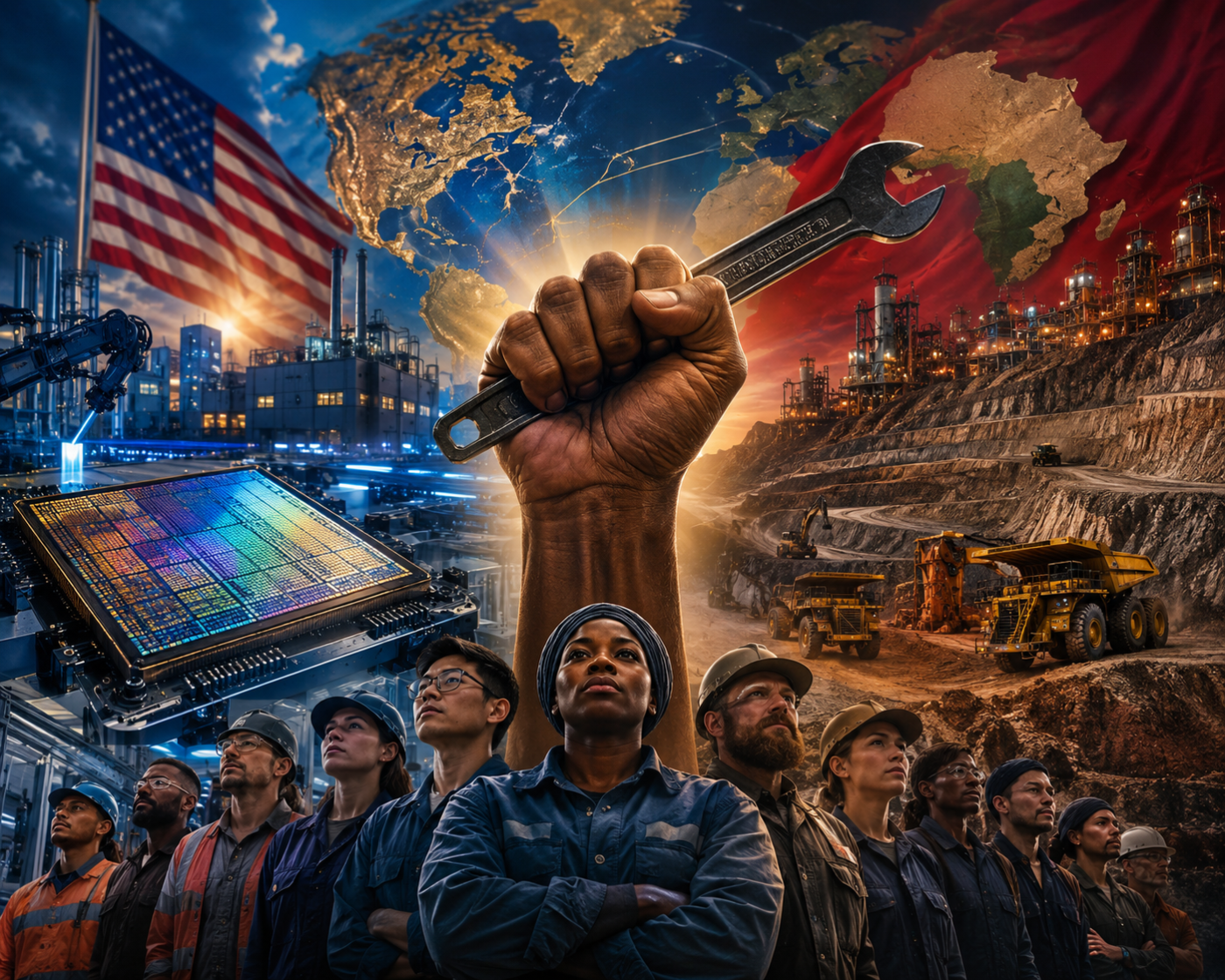
Washington’s new equity stakes in Intel, MP Materials and other strategic corporations are not socialism, but an admission that private capital can no longer reproduce the industrial system on which American power depends. The state is assuming greater responsibility for financing factories, securing minerals and directing investment while workers and communities remain excluded from control. Behind the language of national security lies a wider imperial reconstruction joining semiconductor plants, military procurement and Global South extraction within a fortified American industrial bloc. The task is not to restore the mythology of the free market, but to turn public investment into working-class power, community authority and democratic command over production.
By Prince Kapone | Weaponized Information | July 20, 2026
The Government Owns the Risk, Capital Keeps the Company
CNBC’s July 20 article, “Voters wary of government ownership in companies as Trump administration takes equity stakes,” announces its conclusion before the reader has been allowed to understand the question. Nearly half of registered voters, CNBC reports, consider federal ownership stakes in American companies inappropriate. Only 19 percent approve, while almost one-third remain undecided. The numbers appear decisive until one notices that “government ownership” has never been defined.
A noncontrolling share acquired through a subsidy agreement is treated as though it were equivalent to nationalization. A temporary rescue investment is placed beside permanent public ownership. Presidential patronage, military-industrial planning, sovereign investment funds and worker-controlled social property are compressed into a single category, then presented to voters as one undifferentiated political choice. The poll does not measure a clear public judgment. It produces one by eliminating the distinctions required to make such a judgment.
That category collapse performs necessary ideological work. CNBC continues to describe Intel, MP Materials and similar firms as private companies even after the federal government has supplied grants, loans, contracts, strategic protection and direct equity. The legal ownership structure remains private while the public absorbs costs that the corporations are unwilling or unable to carry alone. Shareholders preserve their claims over the company, while taxpayers are summoned whenever the productive system becomes too important to fail.
The contradiction is then concealed beneath the language of national security. Semiconductors, rare earths, artificial intelligence and steel are presented as exceptional sectors in which the state must reluctantly interfere because China possesses a “chokehold” or military preparedness requires intervention. Once the discussion is organized around strategic rivalry, the class content of the policy disappears. Who controls the shares? Who appoints management? Who guarantees employment? Who receives the dividends? Who determines whether production serves civilian needs or military supremacy?
CNBC does not pursue these questions because the article treats state intervention as a technical adjustment within capitalism rather than evidence of capitalism’s inability to organize the productive system on which it depends. The corporation is still presented as the natural center of economic authority, even when the public finances its expansion, protects its markets and underwrites its survival.
The Vulcan Elements controversy is narrowed in the same manner. The issue becomes whether Donald Trump Jr. improperly benefited from a Pentagon-backed loan. Personal corruption is easier to isolate than the ordinary structure beneath it. Public institutions absorb much of the investment risk, military agencies guarantee demand, politically connected financiers gain early access and private owners retain command over the wealth that follows. The scandal is treated as an exception because the normal arrangement cannot be permitted to appear scandalous.
The ideological function of the article is therefore not to restore a pure laissez-faire order. That mythology is already collapsing under the weight of subsidies, procurement, tariffs, investment controls and direct state ownership. CNBC instead restricts the permitted alternatives to two forms of capitalist rule: private monopoly with less visible state support, or executive-directed monopoly with the government holding shares.
The excluded possibility is that public investment should create public power. Workers and communities might acquire enforceable authority over the enterprises their labor, land, infrastructure and taxes sustain. Employment guarantees, worker representation, public control over dividends and democratic direction of production could become conditions of state support. None of these possibilities enters the poll.
CNBC asks whether the government should own part of the corporation. It never asks why the corporation should remain beyond the people’s control.
The Public Machinery Behind the Private Corporation
The federal government did not nationalize Intel. It did not abolish the company’s shareholders, place its factories under public administration or transfer governing authority to the workers who fabricate its chips. Under the August 2025 agreement between Intel and the Department of Commerce, Washington acquired a substantial minority financial position in a corporation that remained privately managed and operated. The government purchased approximately 433.3 million shares at $20.47 per share, equal to roughly 9.9 percent of Intel, together with a conditional warrant connected to the future ownership of the company’s foundry business.
The terms made the limits of that ownership unusually clear. The government’s position was designated passive, carried no board representation and provided no additional governance or information rights. Washington also agreed, with limited exceptions, to vote its shares in accordance with Intel’s board recommendations. The public acquired exposure to Intel’s financial future without acquiring institutional command over the company.
Even the language of a government “purchase” obscures how the transaction arose. Washington was not entering an independent private enterprise as an ordinary investor. The equity arrangement converted billions of dollars in previously authorized public assistance into shares. It drew upon the CHIPS framework and the Secure Enclave program, which connected advanced domestic fabrication to trusted production for the Department of Defense. The amended federal funding agreement changed the legal form of assistance already committed to Intel. Public financing, military procurement and strategic planning preceded the government’s appearance on the shareholder register.
The intervention into MP Materials followed the same broader logic. In July 2025, the Department of Defense agreed to purchase $400 million in convertible preferred stock and receive a warrant to acquire additional common shares. The wider agreement also included financing, long-term purchasing commitments and support for expanded rare-earth separation and magnet manufacturing. The objective was not simply to hold an appreciating security. It was to construct an integrated domestic chain extending from mined material through processing and finished magnets.
Private capital had not built that chain on terms considered adequate by the military establishment. The state therefore supplied investment, credit support and guaranteed demand. Mining, separation, refining and magnet production were treated as parts of a single strategic system rather than isolated commercial ventures. The intervention joined public finance to the physical reorganization of production.
These transactions sit within an expanding executive investment structure. Trump’s February 2025 order instructed the Treasury and Commerce departments to prepare a plan for a United States sovereign wealth fund, including possible financing mechanisms, investment strategies, governance arrangements and legal authority. The order established a planning process; it did not by itself create an operating fund.
The administration subsequently created a United States Investment Accelerator to coordinate large investments and remove regulatory obstacles. Its America First Investment Policy paired the encouragement of selected capital inflows with tighter restrictions on investment and technology relationships involving China. Public equity, federal loans, military contracts, tariffs, investment screening and export controls were becoming parts of the same industrial apparatus.
CNBC isolates the government’s stockholdings as though they were an eccentric departure from normal capitalism. In practice, the shares are one visible instrument inside a wider system of publicly supported production. The state is directing capital toward selected industries, protecting markets, securing inputs and guaranteeing customers while leaving the firms themselves under corporate management.
The American state has never stood outside the semiconductor industry. Military demand, publicly funded research, federal laboratories, universities, infrastructure, patent enforcement and government purchasing were central to its formation. Cold War procurement created markets capable of absorbing the high cost of early components. Public institutions trained engineers and sustained scientific work later enclosed within corporate property.
The state did not enter semiconductor capitalism in 2025. What changed was the form and visibility of its intervention. Federal policy moved beyond research support, grants and procurement toward a direct financial claim because the cost, scale and strategic importance of advanced fabrication had exceeded what private firms were willing to carry without protection.
The underlying problem extends beyond semiconductors. Monopoly corporations have organized global supply chains around lower costs, rapid turnover and the elimination of capacity that does not immediately produce revenue. Strategic resilience requires duplicated facilities, reserve inventories, geographically dispersed production and long-term commitments to projects whose returns may remain uncertain. Those requirements conflict with the cost-cutting imperatives through which monopoly capital constructed contemporary supply chains.
When corporations decline to finance redundancy, uncertain mineral projects or expensive domestic processing, the state supplies grants, subsidized credit, guaranteed prices and assured demand. Public institutions make investments that individual firms consider too costly or too slow, particularly where military planners regard the resulting capacity as indispensable.
That intervention does not automatically enlarge public authority over the enterprise. Executives may retain control over investment, automation, hiring, plant allocation and the use of the surplus. A minority public stake does not tell us whether workers hold board seats, whether communities can prevent a closure or whether dividends will be directed toward public services. Those questions depend upon enforceable rights attached to the investment, not the government’s mere presence among the shareholders.
Intel’s workforce illustrates the distinction. In July 2025, the company reported that its restructuring program was expected to reduce Intel’s core workforce by approximately 15 percent by the end of the fiscal year. These reductions were part of a corporate restructuring program rather than a direct consequence of the later equity agreement. But expanding federal support did not itself create employment guarantees or give workers authority over the decisions shaping their livelihoods.
The productive capacity could be treated as strategically necessary while the workforce remained subject to ordinary corporate discipline. Government equity might protect the state’s financial position or preserve an industry considered vital. It did not determine who managed production, what employment obligations the company carried or how any eventual gains would be distributed.
The return of American industrial policy becomes still more revealing when placed beside the economic doctrines Washington imposed upon the Global South. For decades, the United States, the International Monetary Fund and allied institutions pressured indebted countries to privatize public enterprises, remove industrial protections, reduce subsidies and open domestic markets to international capital. Tariffs, public credit and state ownership were described as obstacles to development.
Structural-adjustment programs imposed privatization, trade liberalization, public-spending cuts and debt-service priorities across much of the Global South. Public enterprises were sold, domestic industries were exposed to foreign competition before they could mature and state budgets were redirected away from infrastructure and long-term productive investment. Countries rich in labor and resources remained dependent upon imported machinery, external finance and volatile commodity markets.
The United States now uses instruments it instructed weaker nations to abandon. Tariffs protect selected industries. Subsidies reduce corporate costs. Export controls preserve technological advantages. Public equity secures production regarded as strategically important. The difference lies between the policies Washington considers necessary for its own industrial position and those it prescribed to states whose independent development might weaken imperial control.
The rare-earth dispute reveals the same structure. China’s position was not produced by geology alone. Its leverage rests heavily in separation, refining and processing—the stages Western corporations neglected while seeking lower costs elsewhere. China became especially important in the processing stages required to convert mined rare earths into usable industrial inputs. Western firms profited from that arrangement for years. Dependence became a strategic emergency only after China acquired the capacity to exercise greater control over the chain.
China built its industrial position through infrastructure, technical education, engineering knowledge, coordinated investment and the sustained accumulation of productive capacity. U.S. semiconductor restrictions sought to block Chinese access to advanced chips, manufacturing equipment and technological bottlenecks, while Washington pressed allied states to restrict the transfer of critical machinery and knowledge.
Those restrictions did not restore the earlier hierarchy. They intensified China’s efforts to replace imported technologies and reduce reliance upon systems controlled by the United States and its allies. Across the preceding decades, China built a substantial domestic semiconductor production base while remaining dependent in several advanced segments. Export controls transformed those remaining dependencies into urgent targets of industrial policy.
Industrial development cannot be reduced to the movement of private finance. It requires reliable electricity, transport, machine tools, research institutions, trained workers, coordinated credit and investment sustained beyond the timetable of immediate shareholder return. Chinese development analysis emphasizes state capacity, technological learning and coordinated productive investment as means of overcoming industrial dependence. Financial markets did not assemble China’s industrial system on their own.
This does not place every Chinese enterprise beyond class criticism. Chinese firms operate within a world economy structured by profit, competition and unequal exchange. Their labor practices and overseas investments must be judged concretely. But the rare-earth chain cannot be understood through a morality tale in which Western corporations represent voluntary exchange and Chinese firms alone represent state coercion.
The cobalt economy of the Democratic Republic of the Congo joins Western corporations, Chinese companies, traders, financiers and state institutions within a transnational system of extraction and accumulation. Firms compete for mines, processing facilities and contracts while also supplying one another across the chain. The nationality of an investor does not determine whether workers and communities exercise control over the wealth produced from their land.
Mining alone does not determine where that wealth goes. A country may export enormous quantities of cobalt, copper, lithium or rare earths while remaining dependent because extraction is only one stage of production. Processing technology, industrial machinery, finance, patents and final manufacturing are concentrated elsewhere. The mineral leaves, while dangerous labor, environmental damage and exhausted land remain. The largest returns are captured farther along the chain.
Mineral competition across Africa unfolds within economies shaped by colonial extraction, structural adjustment and sovereign debt. Governments negotiating under fiscal pressure confront foreign corporations and creditor states with greater financial and technical resources. A different investor may provide infrastructure or diplomatic room, but it does not automatically transfer control over processing, technology or the use of national resources.
For mineral-producing nations, moving beyond raw-material dependence requires domestic processing, infrastructure, scientific institutions, trained workers and public investment. Industrial sovereignty depends upon controlling larger portions of the productive chain rather than remaining a permanent exporter of unprocessed resources. Without those capacities, the growing demand for critical minerals can reproduce the colonial division of labor beneath the language of green transition and national security.
The United States’ effort to reduce dependence upon Chinese processing therefore extends beyond domestic factories. Semiconductor plants, magnet producers and weapons contractors require access to mines, refineries, ports and transport corridors abroad. What Washington calls supply-chain security can impose new pressure upon resource-rich countries to reorganize land, infrastructure and investment around American military and industrial requirements.
The domestic factory and the foreign mine are materially joined. Public money finances advanced production inside the United States. Corporate management retains authority over labor. Military demand determines which capacities receive protection. Mineral-producing nations and communities are pressed to supply the inputs. This is the machinery concealed by CNBC’s narrow debate over whether the government should hold corporate shares.
The State Plans, Capital Commands
The Intel transaction does not mark a passage from capitalism into socialism. It marks the point at which American capitalism can no longer reproduce certain strategic industries through private initiative alone. The state must finance, coordinate and protect capacities that monopoly capital neglected, relocated or refused to build without guarantees. State intervention has become more direct. The class power governing the enterprise has not changed.
CNBC’s category of “government ownership” conceals this distinction. Legal title does not determine the social character of property. A state can hold shares, rescue creditors, stabilize a military supplier or own an enterprise outright while excluding workers from meaningful authority. Public ownership becomes social ownership only when the people who produce and sustain the economy gain institutional power over investment, production and the surplus.
The central question is not whether Washington owns part of Intel. It is which class controls the state, whose interests shape the investment and what purpose governs the productive system. Under the arrangement now taking form, public institutions assume more of the expense and uncertainty while corporate management retains command over the workplace. The state enters the ownership structure. The worker does not.
Semiconductor production is already social in its material foundations. It rests upon accumulated scientific knowledge, public infrastructure, technical education, coordinated supply chains and decades of state procurement. No isolated capitalist created that system. Yet the authority to direct it remains concentrated within the corporation.
As production becomes more complex, individual firms prove incapable of organizing the system as a whole. They eliminate spare capacity, abandon uncertain projects and move capital toward the highest available return. The state then finances redundancy, guarantees demand and protects investments whose strategic importance exceeds their immediate profitability. It reconciles the short-term calculations of competing capitals with the long-term needs of the capitalist order.
This intervention does not resolve the contradiction between social production and private appropriation. It exposes it. The more openly public institutions finance and coordinate industry, the less credible the claim that private owners alone create wealth or allocate resources efficiently. The government’s equity stake is an admission that strategic production rests upon collective foundations.
The ruling class intends to draw the narrowest possible lesson from that admission. Society must provide patient capital, secure mineral supplies and absorb the cost of industrial reconstruction, while workers and communities remain outside the decisions. Public responsibility expands. Democratic authority does not.
This is capitalist state ownership, not socialist transformation. Planning is not inherently socialist. Corporations plan. Militaries plan. Banks plan. Capitalism concentrates extensive planning inside institutions controlled from above while leaving society as a whole subject to crisis, duplication and waste. The issue has never been planning against the market. It is who plans, for whose benefit and toward what end.
Trump’s industrial policy answers those questions plainly. Production is being reorganized around military readiness, technological rivalry and the preservation of American power. Semiconductors, rare earths and advanced manufacturing receive protection because they occupy critical positions inside weapons systems, surveillance infrastructure and strategic competition. Social needs appear only where they overlap with accumulation and war.
The immediate form is militarized industrial policy: public equity, defense procurement, tariffs, subsidies, export restrictions and investment controls directed toward selected sectors. The class relation beneath it is state capitalism: government coordinates and protects monopoly firms without transferring command to labor. The historical movement driving both is imperialist recalibration: the effort of a declining hegemonic power to preserve its position through more expensive and coercive forms of organization. The territorial project produced by that effort is the American Pole, a fortified bloc centered on North American production, allied industrial capacity, controlled technologies and secured access to resources.
These levels must remain distinct. A federal stake in Intel is not itself the American Pole. It is one part of a wider reconstruction visible in tariffs, mineral agreements, export controls and strategic investment policy. Each measure responds to the weakening of older forms of imperial command.
For decades, American corporations organized production across borders in pursuit of lower wages, cheaper inputs and higher returns. The United States tolerated the erosion of domestic capacity so long as its financial, political and military power guaranteed access to what was produced elsewhere. China’s rise broke that assumption. Productive power accumulated within a state Washington could pressure but could not command.
The conflict is therefore not between an American market economy and Chinese state interference. Washington is expanding state direction of its own. The conflict concerns who will control industrial development, strategic technologies and the terms of international exchange. China’s ascent placed substantial productive capacity outside the authority of the imperial center. The New Cold War is Washington’s attempt to contain or reverse that shift.
The language of a Chinese “chokehold” hides the history that produced the dependence. Western capital relocated production and relied upon Chinese processing because doing so lowered costs. Once China gained leverage from capacities built within its territory, dependence was recast as aggression. Development is treated as legitimate only while it remains subordinate.
Export controls, investment restrictions and supply-chain reconstruction are parts of the same campaign. Washington seeks to preserve technological bottlenecks, rebuild selected industries inside a protected bloc and prevent China from converting manufacturing scale into wider sovereign power. Economic policy becomes an instrument of containment.
Neoliberalism reaches its limit here. It never removed the state from economic life. It redirected state power toward disciplining labor, protecting property, enforcing debt, opening foreign markets and rescuing finance. Corporate decisions were presented as natural market outcomes even when law, police power and public money sustained them.
The present industrial turn does not abolish that order. It reveals where it failed. When unrestricted capital movement weakened American industry and strengthened a rival productive center, Washington recovered tariffs, subsidies and ownership instruments with remarkable speed. The principles imposed upon weaker nations became negotiable once they threatened the state that had imposed them.
The contradiction is international as well as domestic. At home, public money protects advanced production while workers remain under corporate command. Abroad, the same strategy requires minerals, processing capacity, transport routes and political access. The semiconductor plant and the foreign mine belong to one chain.
For workers in the United States, this policy is sold as national renewal. For mineral-producing nations, it appears as another demand for secure access to land and resources. The American worker is promised employment without authority. The producing nation is promised investment without control over the larger chain.
The global working class cannot choose between private corporate rule and imperial state management. Nor can dependent nations overcome their position merely by changing the foreign purchaser of their minerals. The common question is control over production, technology, investment, land and the wealth created through collective labor.
This does not erase the differences between the United States and China. China’s state-led development followed a materially different path from Trump’s corporate nationalism. It used coordinated credit, infrastructure and long-term productive investment to build a manufacturing system on a scale neoliberal doctrine warned developing nations not to attempt. Trump’s program intervenes primarily to preserve private monopoly and military primacy after decades of productive decline.
Recognizing that difference does not require romanticizing every Chinese enterprise or abandoning class analysis. It requires refusing the imperial habit of treating all state intervention as identical while ignoring the historical position and social purpose of the state involved. A formerly colonized nation expanding productive sovereignty is not engaged in the same historical act as an imperial power rebuilding the machinery of domination.
The deeper continuity lies in the separation between collective production and concentrated command. Workers produce socially while owners appropriate privately. Colonized and dependent nations supply labor and resources while technological and financial power remains concentrated elsewhere. Neoliberalism did not create this structure. It reorganized it through debt, privatization and the authority of global finance.
The current industrial turn reorganizes it again under pressure. Washington is socializing more of the investment required to sustain imperial power without socializing control. It plans where the market has failed while preserving the hierarchy that made the failure profitable.
This is the confession buried beneath CNBC’s poll. Strategic production cannot be left to private capital. Society already finances it, sustains it and protects it. The unresolved question is whether that collective power will remain an instrument of monopoly and empire or become the basis of democratic control by workers and oppressed peoples. The government’s shares do not answer that question. They make it impossible to avoid.
Turn Public Investment into Working-Class Power
The contradictions exposed in this excavation are already producing resistance wherever the new industrial policy touches the ground: inside semiconductor plants, at zoning hearings, across technology workplaces and in mining communities supplying the materials on which advanced production depends. These struggles remain fragmented, but they point toward a common demand. Public investment must produce worker power, enforceable community obligations and democratic control—not another protected field for private accumulation.
Inside the semiconductor industry, United Chips Against Global Exploitation has emerged as a worker, student and community network connecting semiconductor labor, political education and opposition to militarization. Its importance lies in the terrain it has opened. Semiconductor workers occupy strategic positions inside an industry sustained by public subsidies, military contracts and international mineral chains. Grievances over layoffs, working conditions and corporate secrecy can become the basis for a wider struggle over what is produced, how public money is used and who holds authority inside the enterprise.
The first task is organization at the point of production. Workers can form confidential committees across departments, classifications and subcontracting lines. Engineers, technicians, maintenance workers, construction crews, logistics workers and production staff are separated by title and employer even when their labor sustains the same facility. Cross-department committees can document layoffs, safety conditions, automation, public subsidies and military contracts, then turn isolated complaints into a shared account of how the plant is governed.
Workers seeking durable union structures already have established institutions available. The Communications Workers of America participated in launching CHIPS Communities United around labor standards, environmental protection and community accountability in publicly subsidized semiconductor projects. CWA offers a formal union route through which workers can pursue neutrality agreements, protection against retaliation, bargaining rights and enforceable recognition procedures. No corporation receiving billions in public assistance should be permitted to use that support against worker organization.
The United Electrical, Radio and Machine Workers of America offers another useful model. Its rank-and-file structure and anti-militarist tradition demonstrate that workers can contest not only wages and conditions but the direction of industrial production. Semiconductor workers should be able to demand job security and workplace safety while also challenging the organization of publicly financed capacity around permanent war.
The struggle cannot stop at the factory gate. CHIPS Communities United brings labor, environmental-justice and community organizations together to demand binding obligations from semiconductor firms receiving public subsidies. Every fabrication or packaging facility depends upon local land, water, roads, energy systems, schools and public services. Communities therefore possess leverage through permits, infrastructure agreements and environmental review.
That leverage must be organized before corporate plans become irreversible. Residents can demand publication of water-use projections, wastewater plans, chemical inventories, traffic studies and infrastructure subsidies. They can organize attendance at zoning boards, water authorities and planning commissions, submit coordinated public comments, use public-records laws and require independent testing for PFAS and other industrial contaminants. A hearing with a few isolated objections remains administrative procedure. A hearing filled with organized workers, parents and neighborhood associations becomes a political obstacle.
The strongest local instrument is an enforceable community-benefits agreement. Corporate announcements are not contracts. Promised jobs can be reduced, outsourced or automated. Environmental protections can disappear after permits are granted. A binding agreement can establish wage floors, local hiring requirements, apprenticeships, childcare support, environmental monitoring, public reporting and penalties for noncompliance. Public land, water and infrastructure must carry enforceable public conditions.
The same principle applies to federal ownership and financing. The public cannot exercise power over agreements kept secret. A national campaign should demand a public registry of every federal corporate stake, warrant, loan, procurement guarantee and strategic subsidy. Each entry should disclose the purchase price, valuation, voting rights, board rights, labor conditions, military contracts, dividend flows, executive compensation and the terms governing any later sale.
Transparency is only the beginning. No corporation receiving public equity or strategic financing should be permitted to conduct mass layoffs, close facilities, relocate production, buy back stock or suppress union activity without worker and public review. If a company is important enough to rescue in the name of national necessity, then its employment practices, investment decisions and use of public funds cannot remain private affairs.
Workers must also confront the military direction of technology. No Tech for Apartheid is a worker-led campaign opposing Google and Amazon’s Project Nimbus contract with the Israeli government and military. Through petitions, public actions and workplace resistance, the campaign has shown that workers can investigate the destination of their labor, expose secretive state-corporate agreements and organize around the social use of technology rather than accepting management’s claim that technical work is politically neutral.
Semiconductor workers can apply the same method by tracing military contracts, identifying the weapons and surveillance systems into which their components flow, circulating internal petitions, organizing public disclosures and building relationships with anti-war movements outside the company. Such work must be collective. An isolated whistleblower can be removed. An organized workforce with outside support can turn disclosure into a sustained confrontation.
The mineral end of the chain provides another arena of struggle. Mining Affected Communities United in Action organizes mining-affected communities in South Africa against extractive projects imposed without meaningful community power. One of its most useful methods is the community social audit. Residents obtain corporate Social and Labour Plans, compare promised spending and development against actual conditions, collect testimony and construct their own public record of jobs, pollution, infrastructure and unmet obligations.
This method can be used throughout critical-mineral supply chains. Communities can compare promised employment with jobs actually created, track local procurement, document water damage, record displacement and examine whether processing or technical development remains in the country. The people living with the consequences should assemble the evidence, not consultants hired by the corporation under examination.
Workers in semiconductor and technology firms can build direct solidarity with mining communities by demanding traceable mineral supply chains, publication of suppliers, community consent, environmental restoration and protections for workers and artisanal miners. Unions and local coalitions can establish relationships with organizations in mining regions, coordinate public statements and expose the connection between subsidized industrial growth in the United States and intensified extraction abroad.
This solidarity must remain independent of Washington’s anti-China campaign. Exploitation by a Chinese firm is not excused because the United States is imperialist. Exploitation by a Western firm does not become progressive because it is described as supply-chain diversification. Every company must be judged by its treatment of workers, communities and national sovereignty. But genuine abuses must not be converted into propaganda for sanctions, military pressure or a renewed imperial seizure of mineral chains.
The immediate work begins at connected points of the same system. Workers organize inside the plant. Communities impose conditions upon land, water and infrastructure. Unions demand rights wherever public money enters. Anti-war workers expose the military use of technology. Mining communities audit corporate promises and defend control over resources. Researchers and journalists publish the agreements corporations and agencies prefer to keep buried.
Each struggle confronts a different site of concentrated command. The factory worker faces corporate authority over production. The neighborhood faces corporate authority over water and land. The mining community faces corporate authority over resources. The public finances the chain while remaining largely excluded from its decisions.
The immediate demand should be simple enough to repeat and strong enough to organize around: no public money without worker rights, community guarantees, full disclosure and enforceable public control.
The machinery of planning already exists. The task is to place it under the power of the people whose labor, land and resources make production possible.


Leave a Reply