Editorial Correction: Weaponized Information Misread Ortega’s Speech
Weaponized Information is issuing a formal correction to our original interpretation of Daniel Ortega’s July 19, 2026 speech.
The first published version of this Weaponized Propaganda Excavation incorrectly concluded that Ortega had announced the end of elections in Nicaragua and treated his remarks as opening the question of what participatory mechanisms might replace them. That interpretation was wrong.
Ortega did not announce the abolition of national or municipal elections. He declared that Nicaragua would never again permit elections to serve as the vehicle through which imperial powers, foreign-financed political organizations and forces associated with the 2018 coup attempt could return to power. His target was not elections themselves, but elections subordinated to foreign money, political direction and economic coercion.
By reading Ortega’s remarks through the frame established by The Guardian, I unintentionally reproduced the very distortion this publication exists to expose. The error was not simply one of context, but of accepting the article’s central premise instead of testing it against the full record.
I thank comrades from the Nicaragua Solidarity Coalition for challenging that interpretation and directing me back to Ortega’s complete remarks. Their intervention led me to review Gustavo Porras’s clarification, reexamine the constitutional record and substantially reconstruct this excavation.
The revised article demonstrates that Nicaragua’s national and municipal elections remain in place, that the National Assembly and Supreme Electoral Council are preparing reforms governing electoral sovereignty and foreign political interference, and that the stated objective is to prevent imperial powers from using Nicaragua’s electoral system as an instrument of political restoration.
The historical analysis of U.S. intervention, the Contra war, electoral coercion, foreign political financing, the 2018 coup attempt, sanctions and hybrid warfare remains essential. But it now serves the correct conclusion: Nicaragua is not abolishing elections. It is attempting to prevent foreign powers from controlling the conditions under which they are held.
Weaponized Information has an obligation not only to expose imperial propaganda, but to correct our own work when we reproduce it. Revolutionary journalism demands transparency, accountability and fidelity to the strongest available evidence.
The original version of this article has therefore been substantially revised. Readers who encountered the earlier publication should disregard its interpretation of Ortega’s speech and refer to the corrected version presented here.
—Prince Kapone
Founder and Editor-in-Chief
Weaponized Information
The Guardian amputated imperialism from Daniel Ortega’s statement, then converted Nicaragua’s rejection of foreign-controlled elections into the abolition of elections themselves. The history buried beneath its headline reveals a century-long chain running from Marine-supervised ballots and Contra warfare to NED political financing, the 2018 coup attempt, sanctions and tariffs. Once elections are restored to the material relations of power surrounding them, the real contradiction appears not as democracy against dictatorship but as national sovereignty against imperial access to the ballot. Defending Nicaragua therefore requires both organized resistance to foreign intervention and deeper popular control over the laws and institutions built to prevent it.
Prince Kapone | Weaponized Information | July 21, 2026
The Guardian Erased the Object: How “No Imperial Elections” Became “No Elections”
The Guardian announced that Daniel Ortega had abolished elections in Nicaragua. The article itself never established that claim. Its headline transformed a declaration against elections serving imperialism into a declaration against elections as such, then spent the remainder of the report accumulating enough accusation around Ortega and the Sandinista government to make the distortion feel true.
The operation begins by removing the object of Ortega’s statement. He did not simply declare that there would be “no more elections.” He denounced elections through which imperial powers and their domestic agents could return to government. Once the reference to imperialism is stripped away, a statement about foreign political command becomes a prohibition against voting. Nicaragua’s attempt to distinguish national political struggle from imperial intervention is rewritten as one ruler’s fear of the ballot box.
The article then quietly retreats from the certainty of its own headline. Nicaragua’s elections are abolished at the door and restored several paragraphs later as an unresolved question about what the government intends to change. No law eliminating national or municipal elections is produced. No reform text abolishing the electoral system is cited. The headline declares a completed political fact that the body of the article cannot demonstrate.
This is assertion disguised as reporting. The conclusion arrives first; the evidence is summoned afterward. Ortega’s words are not examined as a political argument with a defined object. They are cut down to the fragment required by the narrative, while every surrounding allegation is arranged to make the fragment appear self-explanatory.
The article’s source hierarchy completes the operation. Nicaraguan officials provide the words to be prosecuted, but Western analysts and institutions are granted the authority to explain what those words supposedly mean. Tiziano Breda and the wider diplomatic and human-rights apparatus interpret Nicaragua for the reader before Nicaragua’s own political argument can be heard on its own terms. The imperial courtroom has already decided which witnesses possess reason and which merely produce evidence against themselves.
Card stacking supplies the atmosphere. The report moves through imprisoned opponents, closed organizations, citizenship measures, universities, exile and the events of 2018. Each allegation may concern a distinct law, institution, conflict or historical sequence, but they are piled together without reconstruction of their causes. Their function is cumulative rather than explanatory. By the time the article returns to elections, the reader has been trained to receive abolition as the natural act of a government already presented as criminal in every other field.
The article also relies upon a familiar liberal renaming process. Foreign-funded political structures become civil society. Forces involved in an attempted seizure of power become democratic opposition. Measures taken against imperial penetration become repression. The political content of the conflict disappears beneath institutional labels chosen precisely because they conceal who funds whom, who appeals to which foreign power and whose program is strengthened by sanctions against the country.
The Guardian occupies the respectable liberal wing of the imperial information system. Its institutional independence from direct government ownership does not remove the political assumptions organizing its foreign coverage. Nicaragua is placed before a tribunal whose accepted categories were produced by the same Western order contesting the Sandinista Revolution. Washington’s forms of intervention appear as democracy promotion, while Nicaragua’s resistance to them appears as an attack on democracy itself.
This repeats the method exposed in Weaponized Information’s excavation of the campaign surrounding Nicaragua’s disbarred lawyers: a definitive headline, uncertainty buried beneath it, foreign-backed political infrastructure erased from view and state defense detached from the history of intervention that made it necessary. The names and institutions change. The machinery remains.
The ideological function is precise. The article converts a struggle over who controls Nicaragua’s political institutions into a morality tale about one man abolishing democracy. Imperialism vanishes from Ortega’s sentence. Its domestic instruments are purified into ordinary opposition. The revolutionary state is condemned for responding to a force the article refuses to acknowledge. The Guardian did not report that Nicaragua had abolished elections. It abolished the distinction between sovereign elections and elections organized for imperial return.
The Facts Buried Beneath the Headline
Daniel Ortega’s July 19 speech denounced political parties and candidates serving foreign powers and called for reforms preventing imperialist forces and participants in the 2018 coup attempt from using Nicaragua’s electoral institutions to recover political control. Even the Guardian article acknowledged that Ortega directed the National Assembly and electoral authorities to develop a new legal framework. It produced no enacted law abolishing elections, cited no constitutional amendment eliminating the vote and identified no official declaration cancelling the next national or municipal contests.
Two days after Ortega’s speech, National Assembly president Gustavo Porras removed the ambiguity upon which the Guardian headline depended. Nicaragua would continue holding national and municipal elections. The rejected model was not the election itself but the election subordinated to imperial financing, foreign direction and forces attempting to return Washington’s clients to government. Porras stated that the National Assembly and Supreme Electoral Council would jointly prepare the reforms, consult organized sectors of Nicaraguan society and submit the constitutional measures through the required legislative process.
Nicaragua’s constitutional order continued to provide for elections to the co-presidency, National Assembly, Central American Parliament, municipal governments and the autonomous councils of the Caribbean Coast. The Supreme Electoral Council remained responsible for organizing and supervising elections, plebiscites and referendums. Those electoral offices and institutions remained embedded in the Constitution while the reform process was being prepared. The Guardian converted a proposed defense of the electoral field into the disappearance of the electoral system.
Nicaragua’s refusal to treat foreign-directed elections as neutral procedure arises from a history the article erased. The United States occupied the country, fought the resistance led by Augusto C. Sandino and supervised elections while Marines remained on Nicaraguan soil. U.S. military personnel administered the 1928 election as Washington imposed the political order from which the National Guard and the Somoza dynasty emerged. Electoral procedure did not terminate the occupation. It helped stabilize the system produced by it.
After the Sandinista Revolution overthrew Somoza, Washington armed, trained, supplied and directed the Contra forces, mined Nicaragua’s harbors and imposed an economic embargo. The International Court of Justice found the United States responsible for unlawful military and paramilitary intervention and ordered it to cease its attacks and pay reparations. Washington rejected the judgment and continued the war.
The 1990 election occurred after a decade in which U.S.-backed forces had killed thousands, destroyed productive infrastructure and subjected the country to economic siege. Washington tied peace and the lifting of the embargo to the removal of the Sandinistas. Nicaraguans entered the voting booth knowing that the foreign power directing the war possessed the ability to continue it. Formal electoral competition existed, but one side commanded resources, armed force and economic pressure far beyond Nicaragua’s borders.
By 2018, direct warfare had given way to a long campaign of political preparation conducted through opposition media, nongovernmental organizations, leadership programs, electoral projects and youth networks. The National Endowment for Democracy’s own records document funding for Nicaraguan media, polling, election observation, social-media monitoring, youth organizing and political training. Its supporters later celebrated how years of U.S. financing had helped lay the groundwork for the 2018 insurrection.
The resulting operation was a violent attempted coup. Armed opposition groups constructed roadblocks that divided the national territory, strangled transport and commerce, attacked police stations, burned public buildings and homes, kidnapped and tortured Sandinistas, and murdered police officers, government supporters and civilians. Opposition paramilitary forces exercised violence and intimidation across numerous municipalities while their political representatives demanded the removal of the elected government outside the constitutional timetable.
The foreign-backed infrastructure that helped drive the confrontation also supplied the international account of what occurred. Opposition-linked human-rights organizations removed the political identity of coup violence, attributed deaths caused by opposition forces to the government and presented armed territorial control as peaceful protest. Casualty lists used to prosecute Nicaragua internationally included duplication, unrelated deaths and victims falsely assigned to state forces. Western media then treated organizations embedded in the opposition campaign as neutral authorities over the conflict they had helped shape.
After the coup failed, Washington intensified the economic pressure. The NICA Act restricted Nicaragua’s access to international financing while U.S. agencies continued supporting anti-government media and political organizations. Sanctions targeted officials, public institutions and strategic industries. Treasury openly declared its purpose of cutting the Nicaraguan government off from gold revenues. The United States later added phased tariff pressure, with rates scheduled to rise during the approaching electoral period.
The present reforms therefore emerge from a continuous struggle over whether Nicaragua’s political institutions will be governed from within the country or penetrated by the power that has repeatedly occupied, attacked and economically punished it. The methods have changed with the balance of forces. Marines supervising elections gave way to Contra armies, electoral coercion, political grants, media networks, sanctions and tariffs. The objective has remained the restoration of a Nicaraguan government acceptable to Washington.
The reforms had not yet been published in final statutory form. Their definitions, evidentiary requirements and legal procedures would therefore have to be judged from the actual text rather than invented in advance. What was already established was narrower and decisive: national and municipal elections remained in place; the constitutional reform process was proceeding through Nicaragua’s institutions; and the declared target was foreign command over the electoral arena. The Guardian erased that record because acknowledging it would have forced the article to confront the history behind Ortega’s words.
The Ballot Behind the Gun
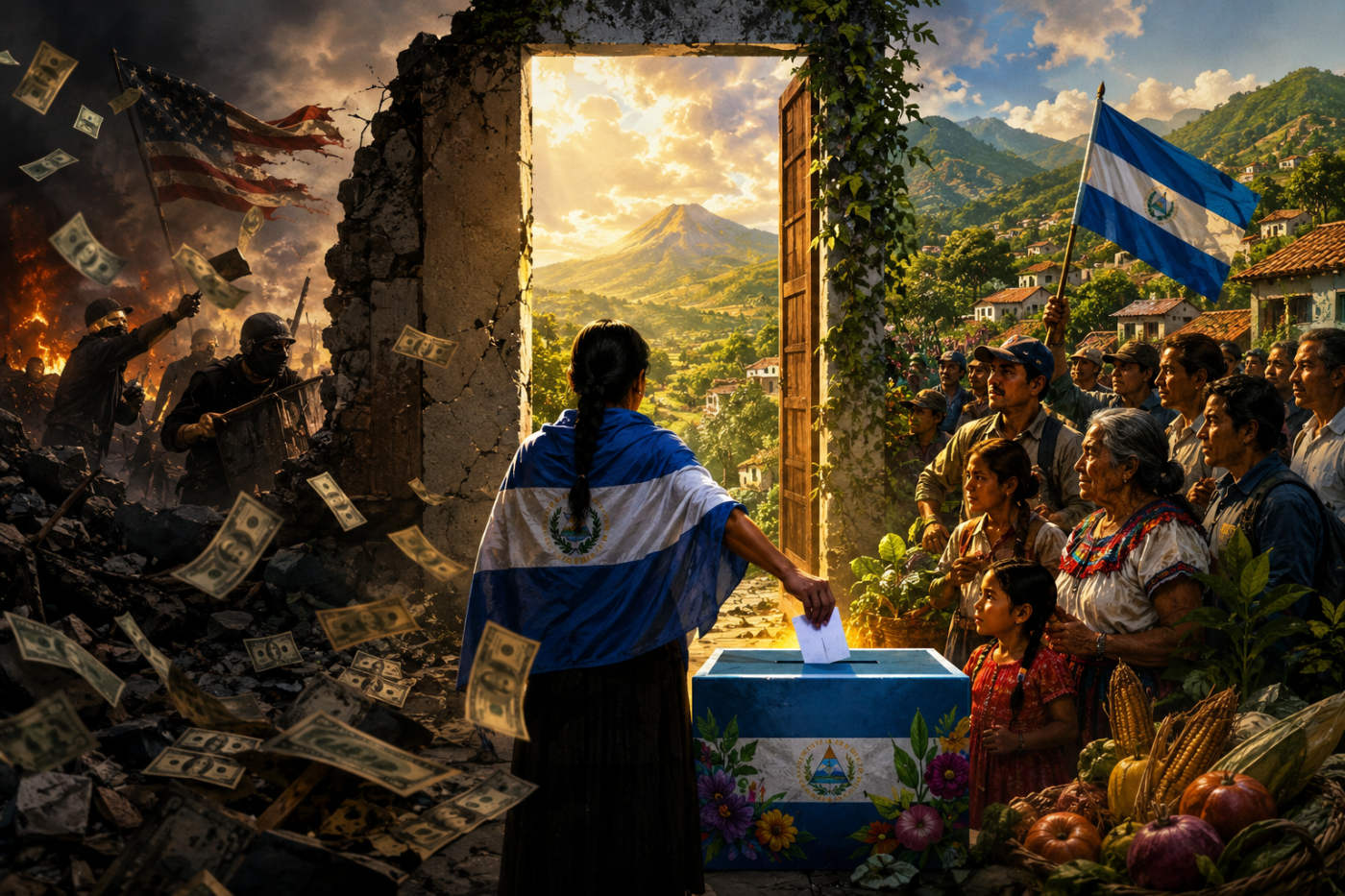
An election does not float above history. It takes place inside a definite arrangement of power: who controls wealth, who commands the means of communication, who can finance political forces, who can punish the population and who possesses the ability to make one electoral result materially survivable while making another unbearable. The ballot records a choice, but it does not create the conditions under which that choice is made.
This is the contradiction erased by the Guardian’s account. The article treats elections as democratic by definition and every restriction upon foreign political intervention as an assault upon democracy. It asks only whether parties may compete, never whether an external power may organize the field upon which they compete. Money becomes speech. Sanctions become diplomacy. Foreign political training becomes civil society. Media systems cultivated by outside agencies become independent journalism. Imperial power enters the election stripped of its name and emerges disguised as pluralism.
Nicaragua’s position begins from the opposite premise: a people cannot exercise sovereignty through institutions that another state is permitted to finance, penetrate and weaponize against them. The formal existence of a vote cannot by itself make the political process free. An election conducted beneath the threat of continued punishment is not rendered sovereign because the coercion remains outside the polling station. A ballot placed in a box while an empire holds the country’s economy, peace and international access hostage carries the pressure of that power within it.
The liberal conception isolates the moment of voting from everything surrounding it. History stops at the curtain of the booth. The war that preceded the election, the money entering the political system, the institutions manufacturing consent, the violence assigned to domestic proxies and the punishment promised after an unacceptable result are treated as external matters. Once removed from the frame, the surviving procedure can be presented as pure. Empire may shape every road leading to the ballot and still claim innocence at the final count.
The issue is therefore not elections against no elections. It is whether elections will express the organized will of the Nicaraguan people or preserve an avenue through which the United States may convert superior financial, institutional and coercive power into domestic political command. The Guardian’s headline depends upon collapsing these two forms into one. It must make opposition to imperial elections appear as opposition to elections altogether because its political vocabulary contains no category for a sovereign electoral order defended against foreign capture.
That collapse also converts the agents of imperial access into democracy’s natural representatives. Their foreign relationships disappear, while the state’s response becomes the only visible exercise of power. Those attempting to open the country to outside command are granted the innocence of opposition. Those attempting to close that route are burdened with the entire appearance of coercion. Imperialism becomes invisible precisely because its local instruments remain visible.
Sovereignty, however, cannot mean the passive ownership of a flag, a constitution or a seat at the United Nations. It must exist materially in the capacity of a people to determine their political direction without another state financing the forces that would reverse it, destroying the conditions necessary to sustain it or reserving the right to punish them for choosing it. The defense of electoral sovereignty is therefore not separate from democracy. It is the struggle over whether democracy belongs to the population exercising it.
Nor can that defense rest upon the authority of the state alone. A sovereign political order requires an organized people capable of debating reforms, governing institutions, holding officials accountable and preventing the language of national defense from becoming a substitute for popular participation. The contradiction cannot be resolved by choosing between an undefended electoral field and administrative command from above. It must be resolved by expanding the organized power of the workers, peasants, communities and autonomous peoples whose sovereignty is invoked.
The Guardian reduces this conflict to the personality of Daniel Ortega because personality is easier to condemn than structure is to explain. Once the matter becomes one ruler’s hostility toward elections, the reader need not examine the power standing behind Nicaragua’s opposition forces or the political order those forces would restore. The empire disappears. History disappears. Class power disappears. What remains is a villain, a ballot and a morality play written in London for a country Washington has never stopped trying to govern.
The real contradiction is not democracy versus dictatorship. It is the right of a people to construct their political institutions against the claimed right of empire to enter those institutions, organize their enemies and call the resulting penetration freedom. The gun does not cease to govern the ballot merely because it has been moved beyond the camera frame.
No Imperial Ballot, No Power Beyond Recall
Washington has no right to turn Ortega’s declaration into another sanctions campaign. The same power that occupied Nicaragua, armed the Contras, rejected the International Court of Justice and financed political infrastructure inside the country cannot appoint itself guardian of Nicaraguan democracy. Any new effort to isolate Nicaragua, restrict investment, intensify tariffs, finance opposition formations or punish its people for defending their political institutions must be confronted before the propaganda headline hardens into policy.
That confrontation begins where imperial policy is made materially possible. Trade unions should pass resolutions opposing sanctions, tariffs and foreign financing of regime-change operations against Nicaragua. Those resolutions should demand an end to the NICA Act, the restoration of Nicaragua’s access to international credit and the cessation of U.S. funding for political organizations seeking the removal of the Sandinista government. They should be carried into labor councils, union conventions and international committees so that solidarity becomes an organized position of the working class rather than an occasional statement issued after the attack has begun.
The Nicaragua Solidarity Campaign Action Group provides an existing structure for that work. Its base in individual membership and trade-union affiliation makes it a concrete vehicle through which workers can obtain briefings, organize delegations, strengthen relations with Nicaraguan unions and circulate material capable of breaking the Western media blockade. Union branches can affiliate, invite campaign representatives to speak and use NSCAG resources to conduct political education on sanctions, the Contra war, the 2018 coup attempt and the struggle over electoral sovereignty.
In the United States, the Black Alliance for Peace’s Zone of Peace campaign places Nicaragua within the larger struggle to drive imperial power out of the Americas. Its framework connects unilateral coercive measures, military domination, foreign political intervention and information warfare rather than treating each attack as an isolated dispute. Organizers should carry its demand for an Americas free from imperial aggression into anti-war coalitions, Black political formations, community organizations, classrooms and public forums.
The media front must be contested with the same discipline. Ortega’s complete statement, Gustavo Porras’s clarification and the eventual reform text should be circulated directly rather than filtered through hostile headlines. Every claim that Nicaragua has abolished elections should be answered with the evidence that national and municipal elections remain, that reforms are being drafted through the National Assembly and Supreme Electoral Council, and that the declared target is foreign command over the electoral process. The lie survives because repetition outruns correction. Our task is to reverse that balance.
Political education cannot stop with proving that the Guardian distorted one speech. Workers must be shown how electoral intervention operates: through grants, media systems, leadership programs, sanctions, diplomatic recognition and the constant threat that a population will be punished until it votes correctly. Nicaragua belongs in study sessions on the Contra war, the 1990 election, the 2018 coup attempt and the conversion of open warfare into hybrid war. Without that history, every act of national defense can be repackaged as authoritarianism and every imperial instrument can return wearing the name of civil society.
Solidarity must also recognize the Nicaraguan people as political subjects rather than scenery behind the government. Trade unions, cooperatives, campesino organizations, women’s organizations, youth formations and the autonomous peoples of the Caribbean Coast must participate in debating the laws that define foreign political subordination and govern the electoral field. The legal text should be published before passage, explained publicly and subjected to organized consultation. Defense against imperial penetration cannot become power beyond popular recall. The answer to foreign command is not the withdrawal of the people from politics, but their deeper organization within it.
That principle draws the line between revolutionary sovereignty and mere state authority. Nicaragua has the right to prevent an empire from purchasing its political future. Its workers and peasants have the right to determine how that defense is constructed, how its laws are applied and how those entrusted with power are held accountable. Both rights must be defended together. One without the other leaves the country exposed either to imperial capture from outside or administrative separation from below.
The immediate tasks are therefore plain: oppose every new sanction and tariff; demand an end to U.S. political financing; affiliate unions with verified solidarity structures; organize public briefings; circulate the primary documents; expose media falsifications; and build direct relations with Nicaragua’s organized people. The empire has spent more than a century teaching Nicaragua that the ballot can arrive behind a gun. Solidarity means helping ensure that neither the gun nor the money behind it determines the country’s future.


Leave a Reply