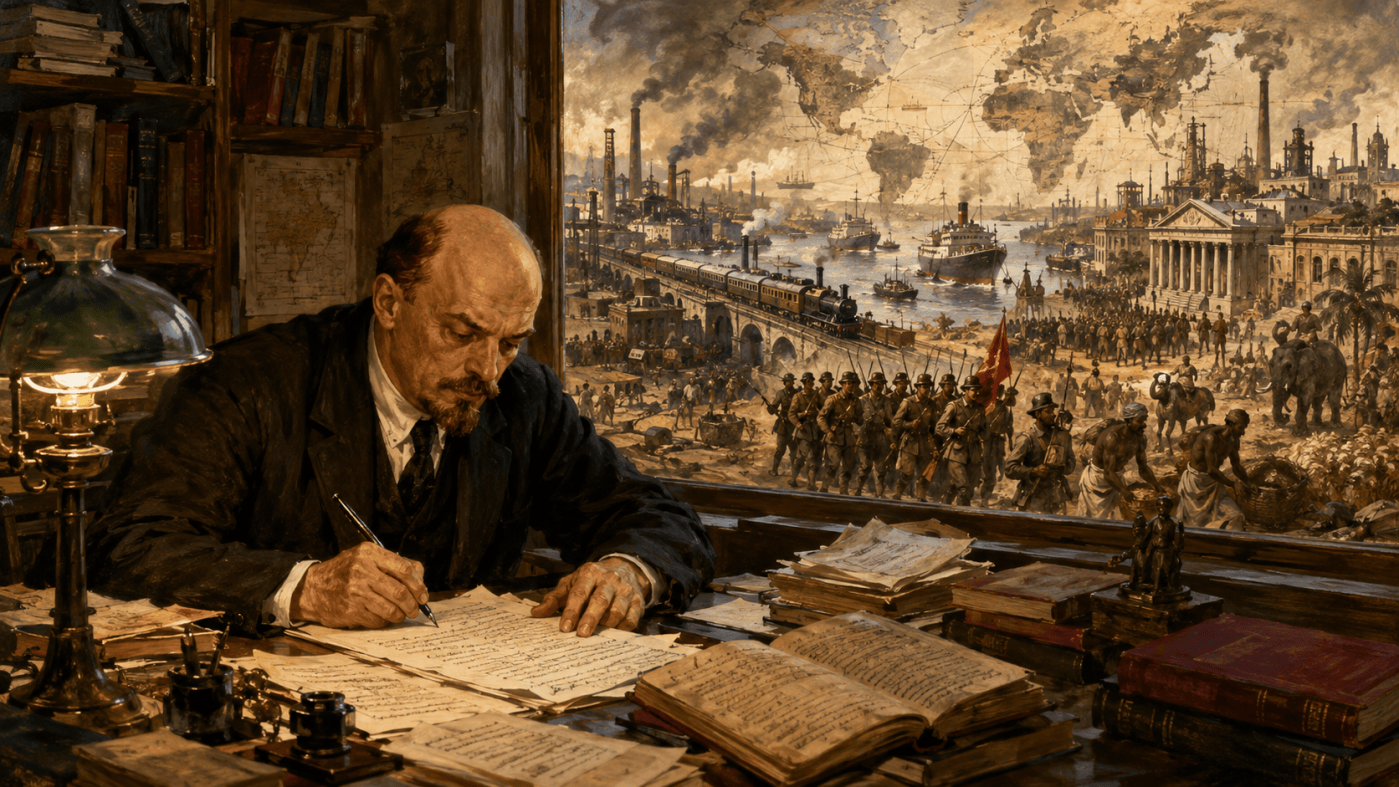
Lenin begins with the slaughter of imperial war and forces us beneath the flags, treaties and diplomatic theater to the capitalist relations that made the battlefield possible. From competition producing monopoly to finance capital crossing borders, Imperialism follows a system that increasingly organizes production across society and the planet while keeping ownership, surplus and command concentrated in private hands. That contradiction does not disappear when colonies gain flags, capitals cooperate inside U.S.-led institutions, or imperial privilege fractures the working class; it changes form through dependency, uneven development, hierarchy, rivalry and opportunism. A century later, Lenin’s real weapon is therefore not a five-point checklist frozen in 1916, but a method for distinguishing what capitalism has transformed from what it still cannot overcome: humanity produces the world collectively while capital continues to divide, command and appropriate it privately.
Prince Kapone | Weaponized Information | Weaponized Intellects Book Review| | August 23, 2026
The War Was Already in the Balance Sheet
Lenin begins Imperialism, the Highest Stage of Capitalism with a warning that is easy to read past and disastrous to ignore. “This pamphlet was written with an eye to the tsarist censorship,” he tells us. The sentence explains more than an inconvenience of publication. It tells us that the apparent shape of the book is not identical to the full shape of its politics. Lenin had been forced to confine himself largely to a “specifically economic analysis of facts,” smuggling political conclusions through hints and what he bitterly calls an “accursed Aesopian language.” The imperialism on the page therefore arrives wearing a muzzle. Behind the statistics stand questions censorship made dangerous to state plainly: socialist revolution, social chauvinism, annexation, and the collapse of internationalism inside the workers’ movement. The economics are not a retreat from politics. They are Lenin’s route underneath it.
That distinction matters because Imperialism is often read backward. People remember the colonies, great powers, warships and famous five characteristics, then begin as though Lenin had written a theory of aggressive states. Lenin gives the opposite instruction. The “fundamental economic question,” he writes, is “the economic essence of imperialism,” because without grasping it “it will be impossible to understand and appraise modern war and modern politics.” He does not reduce politics to economics. He is saying that political forms become unintelligible when detached from the social relations that produce their interests, capacities and limits. The cannon announces the conflict after the relation that made the cannon necessary has already been built.
His later preface states the object even more clearly: the pamphlet is meant to provide “a composite picture of the world capitalist system in its international relationships.” There is the book in one phrase. Not Germany by itself. Not Britain by itself. Not Russia by itself. Not colonialism severed from banking, industry and accumulation. Lenin is trying to catch capitalism in motion as a world system, where ruling classes confront one another from positions produced through relations extending beyond the national border. The state matters enormously in that system, but its actions cannot be explained by treating it as a timeless creature pursuing an abstract national interest. Its power, interests and strategic possibilities have been historically produced.
This also explains Lenin’s obsession with facts that can look painfully mundane beside the spectacle of war. Railway mileage, foreign investment, bank deposits, industrial concentration and colonial territory become evidence because each records something about the material distribution of capitalist power. A railway can appear as nothing more than transport, commerce and development. Lenin asks who financed it, what productive regions it connects, whose commodities and capital it carries, and what relations of property surround it. The point is not that every railway is secretly imperialism. The point is that an apparently neutral institution acquires a different historical meaning once placed inside the relations through which capital owns, finances and commands it. Appearance does not disappear; it has to be explained.
Lenin makes the same methodological break when he turns directly to the war. Its “true social, or rather, the true class character,” he insists, is found “not in the diplomatic history of the war,” but in the “objective position of the ruling classes” of the belligerent countries. This is the knife that cuts through the patriotic fog. Diplomatic history can tell us who issued which ultimatum, which government mobilized first, which treaty obligated whom and which minister wrapped slaughter in the prettier flag. All of that happened. None of it, by itself, tells us what kind of war it was. Lenin requires another movement: from the sequence of state decisions into the material relations that positioned those states and their ruling classes before the first shot was fired.
That is a harder standard than simply calling the war capitalist. Lenin does not replace the bourgeois sentence “Germany attacked” with the supposedly radical sentence “capitalism caused the war” and declare the investigation complete. A class explanation has to be reconstructed rather than announced. Isolated facts, he warns, can be assembled to prove almost anything. His answer is to build the pattern across production, banking, foreign investment, colonial possession and international division. The tables are not filler between revolutionary conclusions. They are how Lenin earns the right to make them. His method refuses diplomatic superficiality on one side and Marxist incantation on the other.
The world emerging from that investigation is not the liberal world of formally equal nations meeting one another in an innocent marketplace. Lenin calls it a “world system of colonial oppression” and “financial strangulation” imposed upon the overwhelming majority by a handful of advanced capitalist countries. The violence of the language follows the relation rather than substituting for it. Colonial domination is not explained by wicked national character, and finance is not condemned because bankers lack manners. Lenin is asking how capitalist development has produced concentrations of capital whose reproduction reaches outward through markets, investment, territory and subordinated peoples. Once that relation comes into view, the respectable vocabulary of trade, civilization and national interest has to answer for what it materially organizes.
Neither does this method make every act of state coercion identical. A war, annexation or colonial seizure still has to be located historically. The relevant question is not whether capitalists somewhere benefited—somebody usually does—but whether the political act can be connected through demonstrated mediations to the structure of accumulation Lenin is reconstructing. Class analysis does not abolish diplomatic history; it changes what diplomatic history must answer. The names of treaties and ministers tell us who acted. The economic anatomy tells us what historical relations made those actions part of imperialism rather than simply another entry in the endless chronicle of states using force.
Kautsky appears here only as the warning sign at the edge of that method. By separating imperialism’s politics from its economics, he makes annexation appear as one policy available to finance capital rather than a political form arising from the contradictions of monopoly capitalism. Lenin’s objection is methodological before it becomes polemical: detach policy from the relations producing it and imperialism can be reduced to bad conduct by an otherwise reformable system. The full reckoning belongs later, after Lenin has reconstructed monopoly, finance capital and the division of the world. For now the point is narrower. A politics cut loose from its economic foundation can be condemned morally without ever being explained materially.
So the First World War is where the book begins politically, but it cannot be where the explanation begins materially. Lenin’s wager is that the battlefield had an economic prehistory. Before the mobilization orders and patriotic speeches, capitalism itself had changed. The war was not sitting outside that transformation waiting to interrupt it; it emerged from a world whose productive, financial and colonial relations had already been reorganized.
To see what changed, we have to leave the diplomats behind. The next evidence is waiting in the factory.
Competition Builds the Monopoly
Lenin leaves the diplomats behind and walks into the factory. What he finds there is the first crack in capitalism’s story about itself. “At a certain stage of its development,” he writes, “concentration itself, as it were, leads straight to monopoly.” The qualification matters. Monopoly has not descended upon competitive capitalism from outside. It has grown inside it. Capitalists compete by enlarging production, introducing new machinery, expanding markets, surviving crises and accumulating faster than weaker rivals. Lenin’s American figures already showed the direction of travel: by 1909, barely one percent of industrial enterprises produced almost half of total industrial output. Competition had not failed to operate. It had operated so successfully that the winners were changing the conditions under which competition itself could continue.
Lenin therefore insists that “free competition gives rise to the concentration of production, which, in turn, at a certain stage of development, leads to monopoly.” There is no conspiracy theory here and no moral fable about unusually greedy businessmen. The mechanism is accumulation. Larger firms command greater productive capacity, technical resources, credit and market reach; crisis accelerates the sorting. Lenin follows economists who observed that the crash of 1900 devastated many older “pure” enterprises while huge combined firms survived through their reserves, technical integration and access to finance. The market performs its famous discipline, but the lesson is awkward for the worshippers of competition: the strong become strong enough to alter the field on which everyone else must compete.
That is why “competition becomes monopoly” must be read dialectically rather than sequentially. Cartels, syndicates and trusts can regulate output, divide markets, control raw materials and coordinate prices, yet competition does not disappear. It is reorganized around larger concentrations of power. The smaller capitalist no longer confronts another isolated capitalist across some ideal marketplace. He may confront an industrial combination commanding mines, transport, laboratories, credit and access to essential inputs. The market remains formally open in roughly the same sense that a boxing ring remains open after one fighter has bought the referee, the gloves and the building. Monopoly is competition’s historical product, and it carries competition into a new scale rather than abolishing it.
Lenin’s deeper breakthrough comes when he stops asking how large the enterprises have become and asks what concentration is doing to production itself. Under monopoly, he writes, “the result is immense progress in the socialisation of production.” Technical research is organized. Engineers are gathered into coordinated productive systems. Raw-material sources are surveyed in advance. Markets are studied. Transport and production become integrated across enormous complexes. Capital, which spends so much time preaching the sacred genius of private initiative, has built productive forces that depend upon collective labor, accumulated social knowledge and coordination extending far beyond any individual owner.
Then Lenin cuts to the contradiction: “Production becomes social, but appropriation remains private.” This is not a complaint that corporations have become too large. It identifies what concentration has transformed and what it has preserved. Thousands labor collectively. Scientific knowledge accumulates socially. Mines, mills, railways, ports and power systems become interdependent. Yet the product, surplus and power to decide what gets produced remain under private command. Capital has socialized the material organization of production without socializing ownership. The contradiction is therefore not big business versus some lost paradise of small proprietors. Returning to small property would not reverse the productive forces capitalism has already created. The problem lies in a socialized productive capacity still governed by private accumulation.
The bank enters because production on this scale cannot reproduce itself out of the proprietor’s cashbox. Lenin begins Chapter II with the modest description of banks as “middlemen in the making of payments.” Concentration changes that function. Deposits accumulate in fewer institutions. Credit relationships give banks intimate knowledge of industrial firms: who is solvent, who is expanding, who is overextended, who needs money immediately. As banking concentrates, Lenin says, banks grow “from modest middlemen into powerful monopolies,” controlling enormous masses of money capital and reaching ever deeper into industrial production.
The bank’s power therefore comes from a material dependency, not from bankers becoming uniquely sinister. Industrial reproduction increasingly passes through organized credit. Lenin’s phrase is sharp: “Scattered capitalists are transformed into a single collective capitalist.” When a small number of banks carry the accounts, debts and investment operations of large portions of industry, they can restrict or expand credit, accelerate combinations and materially influence which capitals survive. A technical intermediary becomes an institution of command because access to the reproduction of production has been concentrated through it. No smoke-filled conspiracy is required. Credit itself supplies the leverage.
This relation develops into finance capital. Lenin takes Hilferding’s account of the fusion of bank and industrial capital but insists that monopoly cannot be left outside the definition. The historical movement is “the concentration of production; the monopolies arising therefrom; the merging or coalescence of the banks with industry.” Finance capital is therefore not simply money lending to factories. It is concentrated financial and industrial power produced through the same accumulation that transformed competition into monopoly.
Lenin’s discussion of shareholding then exposes another appearance. Bourgeois reformers could celebrate wider ownership of shares as the “democratisation” of capital. Lenin asks who actually controls the enterprise. Holding companies and layered subsidiaries allow comparatively small controlling stakes to command much larger bodies of capital, while scattered shareholders possess legal fragments without exercising strategic power. Thus the “‘democratisation’ of the ownership of shares,” he writes, becomes “one of the ways of increasing the power of the financial oligarchy.” Ownership can look broader on paper while command becomes narrower in practice. The share certificate says dispersion; the decision structure says concentration.
This is the relation behind Lenin’s claim that finance capital “levies tribute upon the whole of society for the benefit of monopolists.” Industry depends on credit; smaller firms depend on larger financial networks; holding structures magnify controlling stakes; monopoly associations command vital inputs. What appears as a collection of private contracts increasingly functions as a system through which concentrated owners exercise power over productive resources created and operated socially. The contradiction discovered in the factory has widened. The productive apparatus becomes more collective, more planned and more interdependent while the circle directing its surplus contracts.
A century later, the specific machinery has changed. The decisive sectors are no longer only coal syndicates, steel trusts and Berlin banks. But the contemporary investment structure does not suggest that concentration has somehow dissolved into a frictionless sea of equal firms. UNCTAD reported that the twenty largest host economies received more than 80 percent of global foreign direct investment in 2025, while strategic sectors including AI infrastructure, semiconductors, critical minerals and energy technologies accounted for 44 percent of global greenfield project value; the top three investor economies accounted for 72 percent of announced value in those strategic sectors. That does not make a semiconductor foundry identical to a German steel cartel. It shows that strategic productive capacity and investment remain heavily concentrated, which is the relation this section is testing.
The historical form therefore matters as much as the continuity. A cloud platform, chip foundry and early twentieth-century trust do not exercise command through identical property forms, technical systems or markets. Lenin gives us no permission to collapse them into one timeless monopoly. What survives the stress test is narrower: accumulation still concentrates productive and financial capacity, and concentration still changes the conditions under which other capitals operate. The category remains useful only if we follow the mechanism instead of searching for a cartel wearing the same clothes it wore in 1910.
By the end of these chapters, the capital confronting us has changed scale and social character. Production has become more coordinated and collective. Banking has concentrated the money flows on which industry depends. Industrial and financial capital have fused into commanding concentrations while appropriation remains private. Lenin has reached monopoly without needing an imperial army to explain it.
But this concentrated capital cannot reproduce itself simply by sitting still. It must accumulate again. Once that accumulation searches beyond the profitable field immediately before it, the contradiction Lenin has uncovered begins to cross the border.
Capital Crosses the Border, Command Follows
Lenin opens Chapter IV with the distinction that usually gets flattened into a checklist: “Typical of the old capitalism, when free competition held undivided sway, was the export of goods. Typical of the latest stage of capitalism, when monopolies rule, is the export of capital.” The important word is not export but capital. What crosses the border is the concentrated capital reconstructed in the preceding chapters, accumulated on a scale that makes the search for profitable investment international. Imperialism therefore does not begin with an inexplicable national appetite for foreign adventure. Capital moves outward because capital must continue accumulating.
Lenin makes the class content of that movement explicit when he asks why accumulated capital is not simply used to transform life at home. Why not raise wages, improve agriculture, relieve poverty, shorten work? Because doing so at the expense of profitability would require capital to stop behaving like capital. “Surplus capital will be utilised not for the purpose of raising the standard of living of the masses,” he writes, “but for the purpose of increasing profits by exporting capital abroad.” The attraction of the destination lies precisely in unequal conditions: capital is scarcer, land and raw materials cheaper, wages lower. Abundance at one pole encounters poverty at another not as a humanitarian emergency but as an investment opportunity. Misery enters the prospectus under the heading comparative advantage.
Then Lenin complicates the argument himself. “The export of capital influences and greatly accelerates the development of capitalism in those countries to which it is exported.” That sentence rules out any theory in which imperial domination must preserve its victims in permanent economic stagnation. Railways can be built. Mines, ports, factories, banks and commercial agriculture can expand. Wage labour can spread and productive capacity increase. None of that tells us by itself who directs accumulation, who owns the strategic nodes, where surplus flows, or which external relations condition the development. Imperialism can develop capitalism precisely by drawing new territories more deeply into capitalist production.
The contradiction is therefore not development versus no development. It is development under whose command. A country can produce more without gaining equivalent power over the direction of its production. Industrialization can proceed while critical decisions over finance, technology, markets or investment remain externally conditioned. This is also the strongest point in WI’s analysis of dependency and sovereign development: expanded production does not settle the question of economic sovereignty unless we ask who commands accumulation and toward whose social priorities it is organized. Lenin has already made stagnation an inadequate test. The harder question is control.
He moves toward that question when capital export becomes something more than money invested abroad. “The capital-exporting countries have divided the world among themselves in the figurative sense of the term,” he writes. “But finance capital has led to the actual division of the world.” Investment creates interests that demand security. Loans become entangled with concessions. Firms seek protected access to transport, resources, land and markets. Finance wants the conditions under which profits are expected today guaranteed tomorrow. Capital crosses a border, and the political organization of the territory suddenly matters to those holding the claims.
Lenin’s colonial argument is strongest when read through that material relation. Finance capital, he writes, strives to seize “the largest possible amount of land of all kinds in all places, and by every means,” because monopoly calculates future resources as well as present ones. Territory offers more than acreage. Colonial possession can exclude competitors, secure raw materials and place political force behind privileged access. The connection between capital export and colonial conquest therefore runs through concrete interests. The flag follows the ledger because property wants an insurance policy with an army behind it.
But Lenin does not make direct colonial rule the only possible form of domination. Chapter VI contains the passage that matters most once the colonial flag begins coming down: finance capital “is capable of subjecting, and actually does subject, to itself even states enjoying the fullest political independence.” Political independence, he adds, can coexist with different degrees and forms of financial dependence. That qualification tears a hole in any theory that identifies imperialism exclusively by the presence of a foreign governor. A state may possess juridical sovereignty while its room to direct accumulation remains materially constrained.
This gives later theories of neocolonialism an opening in Lenin without pretending Lenin had already written them. Formal decolonization changes the juridical form of domination. It does not answer in advance whether the underlying economic relation has also been broken. Credit, foreign exchange, commodity dependence, strategic technology and external investment can become mechanisms through which formally sovereign states face pressures that colonial administrators once enforced more directly. But those mechanisms have to be demonstrated. Inequality alone is not proof of imperial command.
Debt shows why the mediation matters. UNCTAD reported developing-country external debt of $11.7 trillion in 2024, with roughly $1.6 trillion due in servicing; low-income countries devoted 18.1 percent of government revenue to servicing public and publicly guaranteed external debt. That establishes a large external claim upon social resources. It does not establish imperialism by arithmetic. We still have to ask who lends, in what currency, on what terms, what happens when payment becomes difficult, what concessions creditors can extract, and whether servicing the obligation blocks a different development strategy. A debt burden is evidence of constraint. Imperial domination requires the relation producing and enforcing that constraint to be shown.
Without that distinction, historical materialism degenerates into radical labeling. Domestic ruling classes can borrow recklessly, transfer wealth abroad and impose the cost on their own people. Creditors can be private, multilateral or state actors operating under different conditions. Lenin gives us the category of political independence alongside financial subjection; he does not give us permission to declare every debtor country a colony. The mediation is the argument.
Modern production creates another problem for a mechanical reading of capital export. Foreign command no longer always requires a lead firm to own every factory it controls. WI’s examination of Apple’s production network shows how design, branding, supplier dependence, logistics and control over the most profitable stages can remain concentrated in the lead firm while manufacturing is dispersed through formally separate producers. The factory gate can carry somebody else’s name while strategic command over the chain remains elsewhere.
This does not overturn Lenin’s theory of capital export. It forces us to distinguish the relation from one historical mechanism through which it operated. Capital still moves through investment, equipment, finance and production. But ownership and command can be partially separated through contracts, intellectual property, supply-chain dependence and control over market access. The contemporary question is therefore not whether every foreign factory is directly owned by an imperial monopoly. It is whether the organization of production gives concentrated capital durable power over the terms on which other producers and societies reproduce themselves.
That is the material force behind Lenin’s deliberately brutal sentence: “Finance capital does not want liberty, it wants domination.” Finance possesses no personality that wakes every morning craving conquest. The preceding argument tells us what the phrase means. Capital seeks conditions that secure accumulation; creditors seek repayment; monopolies seek protection against competitors; holders of strategic assets seek to preserve control over the advantages attached to them. When those interests acquire the power to discipline another society’s economic choices, the freedom promised by formally equal exchange begins to look very unequal indeed.
Lenin has therefore brought us beyond the old map of empire without allowing us to throw the map away. Capital export can accelerate development while deepening dependence. Political independence can be real while material sovereignty remains constrained. Direct ownership can loosen while strategic command stays concentrated. Each historical form has to be investigated on its own terms; none can be declared imperial merely because the word fits our politics.
And capital does not enter an empty world. Other concentrations of capital have crossed borders too. They bargain, cooperate, divide markets and struggle over their shares. The next contradiction is no longer whether capitalism has become international. It has. The question is how an integrated world economy is organized when the powers dividing it possess neither equal capital nor equal strength.
The World Market Is Unified by Being Divided
By Chapter V, Lenin has capital moving across borders, securing investments, resources and fields of accumulation. The next step is not automatically war. “As the export of capital increased,” he writes, and as the foreign connections and “spheres of influence” of the great monopolist associations expanded, the process moved toward “an international agreement among these associations, and towards the formation of international cartels.” Monopoly capital does not internationalize only by colliding with rivals. It also negotiates with them. Giant firms divide markets, allocate production and establish rules among themselves. The world market has become concentrated enough that sections of it can be consciously organized.
Lenin’s examples leave little room for caricature. Railway producers divided foreign markets among British, German, Belgian and later French groups. Zinc producers apportioned output. German, French and American explosives firms concluded agreements over markets. These were not failed wars disguised as contracts. They were real forms of capitalist cooperation. The important question is who does the coordinating and according to what principle. Production is becoming international enough to be planned across borders, but the planning belongs to monopolies dividing profit, not to the peoples whose labor makes the system run.
Lenin says this without moral mythology. “The capitalists divide the world,” he writes, “not out of any particular malice,” but because concentration has driven them toward agreements that secure monopoly profit. Their shares are determined “in proportion to capital,” “in proportion to strength.” The agreement therefore contains inequality inside it. Cooperation does not suspend power; it gives power an organized form. A cartel can replace open struggle over a market with negotiated percentages, but the percentages still express the accumulated capacities that each participant brings to the table.
The distinction matters because peaceful cooperation is often treated as evidence that capitalist rivalry has been superseded. Lenin refuses the shortcut. The division of the world between monopolies, he writes, “does not preclude redivision if the relation of forces changes.” Nothing requires an agreement to be fraudulent for it to become unstable. One capital expands faster. One industry gains a technological advantage. One financial center weakens while another rises. Accumulation changes the distribution of strength on which the settlement rested. Yesterday’s agreement can therefore become tomorrow’s constraint. The contradiction lies not between sincerity and deceit but between a fixed distribution and an accumulation process that keeps altering the forces being distributed.
Only after reconstructing that movement does Lenin arrive at the definition that is too often substituted for the movement itself: “imperialism is the monopoly stage of capitalism.” He immediately warns that any brief definition is inadequate because it cannot contain “all the concatenations of a phenomenon in its full development.” Then come the famous five characteristics: concentration producing monopoly; the fusion of bank and industrial capital into finance capital and financial oligarchy; the exceptional importance of capital export; international monopolist associations dividing the world; and the completed territorial division of the globe among the greatest capitalist powers.
Read as five boxes, the definition becomes a way to stop thinking. Lenin has spent six chapters showing why those features belong together. Monopoly emerges through concentration. Finance capital develops through the fusion of already concentrated banking and industry. Capital export grows from accumulated capital seeking profitable fields abroad. International monopolies divide those fields, while states become implicated in securing the conditions under which the division operates. The five characteristics are therefore not five independent badges an analyst pins onto a country. They condense a historical relation whose parts have been produced through one another. The definition is the receipt, not the meal.
Now Kautsky’s retreat becomes concrete. If international monopolies can make agreements, why could those agreements not become permanent? Why could the great finance capitals not peacefully divide the world and jointly exploit the rest of humanity without repeatedly breaking into destructive rivalry? Lenin does not evade the possibility by pretending capitalists cannot cooperate. In Chapter IX he asks us to suppose precisely such an arrangement: “internationally united finance capital” dividing dependent countries among itself. His objection is that capitalist cooperation does not abolish the uneven accumulation on which the distribution rests.
That is why Lenin’s line that “Peaceful alliances prepare the ground for wars, and in their turn grow out of wars” should not be read as a prophecy that every treaty carries a hidden countdown to artillery. Peace and conflict are forms through which changing relations of strength can be organized. A settlement can last years or decades. The analytical question is whether the underlying property relations have eliminated uneven development among the capitals participating in it. If they have not, then the possibility of redivision remains even when cooperation is genuine.
A century later, that proposition has to survive a world Lenin did not live to see. The old image of several European empires facing one another as relatively distinct blocs no longer describes the imperial core adequately. Samir Amin argued that the postwar order had reorganized the older plurality of imperialisms into a form of collective imperialism centered on the United States, Western Europe and Japan. The historical change is substantial. Military institutions, finance, technology, investment and political strategy became far more integrated across the dominant capitalist states than in Lenin’s immediate conjuncture.
Tricontinental’s formulation of “hyper-imperialism” pushes the argument further, emphasizing the extraordinary military and coercive integration of a U.S.-led Global North even as that bloc loses relative productive weight in the world economy. This creates a serious problem for any Leninism content to reenact 1914 with updated country names. If the contemporary imperial core is organized through dense common institutions under U.S. leadership, then rivalry cannot simply be assumed to take the same form it did before the First World War.
But the opposite conclusion outruns the evidence just as quickly. Institutional integration does not prove that the distinct capitals inside the bloc have disappeared, that uneven development among them has ceased, or that every allied ruling class has become economically indistinguishable from Washington. WI has described this contradiction as a divided empire: U.S.-centered military, financial and technological structures can organize and discipline allied states while national capitals and their unequal development continue to generate interests and frictions inside that hierarchy. The stronger formulation is therefore not rivalry instead of integration, or integration instead of rivalry. It is rivalry reorganized within an unequal structure of collective command.
That formulation has to remain bounded. U.S. leadership is not the same thing as the complete absorption of European or Japanese capital into a single American capitalist. To establish that stronger claim would require a much fuller demonstration of ownership, profit flows, industrial command, political autonomy and the capacity of subordinate capitals to resist or redirect bloc priorities. The evidence used here supports hierarchy and deep integration. It does not justify declaring every contradiction inside the imperial core extinguished.
Multipolarity confronts the same discipline from the opposite direction. Lenin’s account of uneven development gives us every reason to expect inherited concentrations of world power to face pressure as new productive centers develop. What it does not give us is a socialist classification of those centers in advance. A shift away from unilateral domination can enlarge the room available for states to pursue sovereign development; it does not settle who owns production within those states, who commands accumulation or which classes benefit from the expanded room. A new pole is not socialism by geometry.
This is why Lenin’s five characteristics remain useful only when kept inside the historical movement that produced them. The task is not to hunt the contemporary world for exact replicas of 1916. It is to determine who owns, who finances, who controls strategic production, how markets and resources are apportioned, and what happens when the distribution of productive strength changes. Cartels can become multinational networks; colonial blocs can give way to integrated alliance systems; rivalry can operate through institutions that also organize cooperation. What has to be demonstrated in each case is the relation beneath the form.
The world market Lenin has reconstructed is therefore unified precisely through a division it cannot resolve. Capital can coordinate internationally, bargain peacefully and build common institutions while the gains from that coordination remain unequally appropriated. Integration makes the struggle over distribution more organized; it does not make the distribution common. And once the unequal gains of that world system begin feeding back into the societies at its dominant poles, the contradiction moves again—this time into the workers’ movement itself.
The Spoils Enter the Workers’ Movement
Lenin does not leave imperialism safely overseas. By Chapter VIII, the monopoly profits and foreign income accumulated through the world system have begun to alter the social structure of the countries sitting at its dominant poles. He makes the political turn with carefully chosen words: “high monopoly profits for a handful of very rich countries” make it “economically possible to bribe the upper strata of the proletariat.” The qualification matters. Lenin does not claim that imperial wealth automatically purchases an entire national working class. He identifies a material possibility: extraordinary profits can support privileges for particular strata, and those differentiated positions can “foster, give shape to, and strengthen opportunism.” Imperialism therefore enters the workers’ movement not only through patriotic ideology but through contradictions within the proletariat itself.
That changes the political problem. If imperial profits accumulated only in the mansions of financiers, class lines would remain comparatively clean. Lenin argues that monopoly capitalism can distribute some advantages unevenly downward. Particular workers, labor leaders or organized strata may acquire material interests more compatible with bargaining for a place inside the existing order than with overthrowing it. Proletarian internationalism therefore confronts more than ruling-class propaganda. It confronts the possibility that sections of the class experience the imperial order differently from the workers whose intensified exploitation helps reproduce it.
Lenin is careful enough that later Leninists ought to be careful too. “Imperialism has the tendency to create privileged sections also among the workers,” he writes, “and to detach them from the broad masses of the proletariat.” Tendency. Sections. Elsewhere he speaks of “certain sections” and “a fairly considerable minority.” These are analytical limits, not embarrassed qualifications added by later readers. The argument concerns differentiation within labor. It does not transform everyone holding the right passport into a junior shareholder of empire.
The companion writings sharpen the political mediation. In The Collapse of the Second International, Lenin defines opportunism as sacrificing the long-term interests of the mass of workers to the temporary interests of a minority, and more sharply as “an alliance between a section of the workers and the bourgeoisie, directed against the mass of the proletariat.” Political betrayal is therefore not left floating in the realm of bad ideas. Lenin searches for the social position that can make class collaboration durable. A privileged layer can receive what he calls “crumbs from the table of their national capitalists,” develop institutions and expectations around that position, and become more receptive to identifying its fortunes with national capitalism. When war arrives, social chauvinism does not have to be invented overnight. An existing relation of accommodation can acquire a flag.
Chapter IX helps prevent the argument from becoming sociology without politics. Lenin insists that criticism of imperialism itself must be judged through the class forces behind it. Opposition to annexation or war can arise from radically different social positions and point toward radically different destinations. A bourgeois critic can deplore imperial excess while preserving monopoly capitalism; a proletarian critique has to confront the social relations that continually reproduce imperialism. The same distinction applies inside the labor movement. Anti-imperialist language does not settle the question if the organizations speaking it remain materially and politically tied to arrangements that preserve collaboration with their own bourgeoisie.
The primary text also complicates any image of a uniformly privileged metropolitan proletariat. Lenin notes migrant workers entering Germany from Austria, Italy and Russia, Polish, Italian and Spanish workers in French mines, and immigrants from Eastern and Southern Europe concentrated in “the most poorly paid jobs” in the United States while American workers appeared more heavily among overseers and better-paid positions. The international hierarchy therefore runs through the labor market inside the imperial country itself. Capital can draw vulnerable workers across borders under unequal conditions while simultaneously differentiating workers already living on the same territory.
A century of globalized production makes that problem more, not less, complicated. John Smith’s analysis of global labor arbitrage links the mobility of capital toward lower-wage labor with the restrictions imposed on workers attempting to move in the opposite direction. Capital can send production toward cheaper workers, or incorporate migrant workers into richer economies while maintaining legal and social conditions that preserve their vulnerability. The international working class is integrated through production without being equalized by it.
The same relation appears in different institutional forms when migrant agricultural labor inside the United States is compared with outsourced electronics production across global supply chains. One workforce can be disciplined through immigration status, deportability and restricted mobility; another through subcontracting, supplier competition and corporate command exercised across distance. These are not interchangeable labor regimes. What connects them is capital’s capacity to organize vulnerability and exploit differences in the conditions under which workers are compelled to sell their labor.
Yet globalization has also battered sections of the older industrial working class inside the imperial core. Production could be relocated precisely because stronger wage and organizational positions represented costs capital wanted to escape. Deindustrialization, weakened unions and increasingly precarious employment therefore sit beside enormous international wage differentials. This is where a mechanical labor-aristocracy theory breaks down. A worker may possess advantages of citizenship, mobility or labor rights relative to workers elsewhere while losing wages, security and bargaining power at home. Migrants may perform some of the worst-paid labor inside the imperial center itself. Union leaderships may remain institutionally incorporated while their members become poorer. There is no single national ladder on which every worker occupies the same rung.
For that reason, higher wages in an imperial country cannot simply be entered as proof that imperial superprofits have been transferred to those workers. Lenin’s proposed mechanism has to be demonstrated. One must show how extraordinary profits are produced, through what institutions some portion reaches particular strata, which workers receive the benefit, and how that position contributes to political alignment with the bourgeois order. Productivity, union organization, labor scarcity, citizenship restrictions, monopoly rents and past class struggle can all shape wage differentials. Without tracing the mediation, “labor aristocracy” becomes a political accusation pretending to be a material analysis.
Lenin’s own formulation remains narrower and stronger. Monopoly profits can make it possible to win “certain sections of the workers” toward the bourgeoisie; imperialism therefore develops a material “bond” with opportunism. But a tendency is not destiny. Nationalism, bureaucracy and institutional privilege can strengthen that bond, while class struggle and revolutionary organization can work against it. The category identifies a contradiction to investigate, not a population to condemn.
This is what gives Lenin’s attack on opportunism its force. “The fight against imperialism is a sham and humbug,” he writes, unless it is inseparably connected to the fight against opportunism. By the time he makes that declaration, opportunism is no longer simply cowardice or ideological confusion. It has a possible material basis in the unequal social relations imperialism reproduces. Anti-imperialism therefore cannot mean condemning what capital does abroad while protecting the forms of class collaboration through which imperial society secures consent at home. A movement that rails against war and colonial domination while bargaining to preserve its own privileged corner of the existing order has not escaped imperialism. It has negotiated better seating.
But Lenin has now created another problem. The capitalism capable of producing these differentiations is not a system lying economically motionless. It can expand production, reorganize labor internationally, generate enormous monopoly profits and build institutions capable of incorporating opposition. Yet Lenin will call this capitalism parasitic, decaying and “moribund.” If decay means that capitalism has exhausted its capacity to grow, the history after Lenin poses an obvious objection. If it means something else, then the final chapter has to show us what can be decaying inside a system still very much in motion.
Moribund Does Not Mean Motionless
Lenin reaches the end of Imperialism carrying a word that has caused a century of confusion: decay. Read lazily, it sounds like a prediction that capitalism was about to exhaust itself, stop developing the productive forces and politely expire. Lenin blocks that reading himself. “It would be a mistake to believe that this tendency to decay precludes the rapid growth of capitalism,” he writes. “It does not.” He goes further: “On the whole, capitalism is growing far more rapidly than before.” Decay therefore cannot mean economic immobility. Lenin places rapid development and decomposition inside the same historical stage. Capitalism can remain technologically restless and enormously productive while the social relations governing that productive capacity become more contradictory.
The cheap refutation begins by ignoring that passage. Capitalism survived 1916, built automobiles and aircraft, electronics and computers, satellites and global logistics, semiconductors and artificial intelligence; therefore “moribund capitalism” must have been a failed prophecy. But Lenin never says accumulation has stopped. The question is what has begun to decay within accumulation itself. His answer lies in the transformation reconstructed throughout the book: capitalism develops institutions capable of organizing production on an increasingly social scale while keeping the results, command and purposes of that organization enclosed within private property.
Chapter VII already names the movement. At the monopoly stage, Lenin writes, fundamental characteristics of capitalism begin “to change into their opposites.” The transformation is not magical. The processes generated by capitalist development push against the form in which they began. Competition produces concentrations powerful enough to regulate markets. Private enterprises construct systems of coordination extending far beyond any individual proprietor. Finance links institutions whose reproduction increasingly depends upon one another. Capital internationalizes production while preserving rival claims over the wealth that international production creates. Capitalism does not abolish its contradictions by developing. It develops them into larger forms.
This is why Lenin returns in the final chapter to the bourgeois language of “interlocking.” Banks, industrial firms, holding companies and financial groups become woven through one another until the institutional diagram looks enormously complicated. Lenin asks what this description actually explains. “Underlying this interlocking, its very base,” he writes, “are the changing social relations of production.” Cataloguing connections is not yet explaining them. The question is what property relation produced the network, who commands it and what social power that command concentrates.
Lenin then imagines production organized across immense distances: raw materials calculated in advance, transported systematically, processed through coordinated stages and distributed through an enormous productive apparatus. What bourgeois observers describe as corporate combination has already become, materially, the “socialisation of production.” Capital has developed the technical capacity to organize labor consciously across scales no individual proprietor could ever command alone. The contradiction lies not in a lack of organization but in who owns that organization and toward what purpose it is directed.
That is why one sentence from the beginning of the book has to return here: “Production becomes social, but appropriation remains private.” Earlier, the contradiction appeared inside the concentrated enterprise. By the end of Lenin’s argument, its scale has widened. Production stretches across firms, industries, financial institutions and national borders, while the surplus and strategic decisions produced through that cooperation remain concentrated under private command. The productive apparatus becomes increasingly collective in operation without becoming collective property. Capital has solved enormous problems of coordination while preserving the class relation that decides who benefits from the solution.
This makes Lenin’s description of imperialism as transitional more precise than the familiar caricature. Monopoly is not socialism with ugly management. The socialization Lenin identifies is organizational, not political. Capital can plan when planning protects profit. It can coordinate industries, mobilize science and direct investment when doing so strengthens accumulation. What it cannot do within its own property relations is subordinate accumulation itself to social need. Apparently planning becomes an assault on freedom only at the moment the people doing the producing might decide what the plan is for.
Lenin’s “close network of dependence relationships” has to be read with equal care. His argument does not require the childish picture of capitalist rule in which a banker whispers orders into every minister’s ear. Ownership, credit, investment, corporate control and state dependence can create powerful mediations between concentrated capital and political institutions. But the pamphlet does not give us a developed theory of state autonomy, and we should not manufacture one for it. What Lenin establishes is narrower: political power operates within a society where control over crucial means of economic reproduction has become heavily concentrated.
Here the distinction between historical form and underlying relation becomes decisive. Some later developments are less corrections of Lenin than historical concretizations of openings already present in his argument. Political independence alongside financial subjection does not have to be imported from elsewhere; Lenin already sees the possibility. Development through dependent relations is not a later refutation; he explicitly says capital export can accelerate capitalist development abroad. Cooperation among great capitals does not falsify rivalry; international cartel agreements belong inside his theory. Rapid growth does not overthrow his category of decay; he warns against that conclusion in advance.
Other developments require genuine extension because Lenin could not analyze institutions that did not yet exist in mature form. Global production can now be commanded through supply chains, intellectual property and contractual dependence without direct ownership of every productive unit. Formal decolonization has produced new mechanisms through which financial and technological dependence can operate without colonial administration. Monetary infrastructures, digital platforms and strategic technologies can concentrate forms of command for which the early twentieth-century cartel is an inadequate institutional model. Carrying Lenin forward therefore requires distinguishing what history has merely clothed differently from what history has actually added.
The same discipline applies to imperial decline. Lenin gives us no reason to assume that relative decline weakens every instrument of power at the same pace. Productive weight can shift while financial, military, technological or institutional capacities remain concentrated. A ruling class losing advantages in one field may lean harder on advantages retained elsewhere. That possibility is compatible with the contradiction between growth and decay. It does not establish an iron law that every declining imperial power must become steadily more coercive, nor does decline guarantee liberation. The mediation still has to be demonstrated.
That restraint is politically necessary because capitalist contradiction is not socialist agency. Crisis can deepen exploitation as easily as revolutionary consciousness. New productive centers can weaken an old monopoly of world power without abolishing class exploitation. National sovereignty can widen the terrain on which social transformation becomes possible without determining who will control that terrain. Contradictions generate possibilities, pressures and countertendencies. They do not organize themselves in the interests of the working class.
The Lenin worth carrying forward is therefore neither the museum Lenin of five boxes nor the prophet whose every institutional description must remain unchanged. What survives most powerfully is the demand to reconstruct the relation beneath the appearance: concentration beneath competition, command beneath dispersed ownership, class power beneath apparently neutral institutions, unequal appropriation beneath international coordination. Where those relations survive, Lenin does not need rescuing. Where new mechanisms carry them, the analysis has to be extended. Where the evidence does not establish the mediation, the revolutionary answer is not to shout the category louder.
That is also what “highest stage” is worth after a century of history. Not a final landing from which capitalism was expected to topple on schedule, but a stage in which capitalist development had produced forms of social organization increasingly at war with the private property governing them. Lenin understood that this shell could remain in decay “for a fairly long period.” History proved just how long “fairly long” could become. What history did not abolish was the contradiction itself.
A world capable of coordinating the labor of millions, moving raw materials across continents, mobilizing science at planetary scale and organizing production through intricate international systems still reserves the decisive questions—what gets produced, for whom, under whose command—for owners and the institutions built around their accumulation. The absurdity is not that capitalism lacks planning. It is that humanity has built extraordinary powers of collective production and left their command in private hands.
That is Lenin’s surviving weapon. Follow the new institutions until they reveal the property relations underneath them. Separate changing form from durable relation. Refuse both the liberal who sees policy without class and the dogmatist who sees Lenin’s vocabulary without Lenin’s method. Then the task becomes harder than repeating Imperialism and more revolutionary than updating its checklist: determine concretely how capitalist command has been rebuilt in our own time, where its contradictions now run, and what social force can seize productive capacities already made collective and make their ownership collective too.


Leave a comment