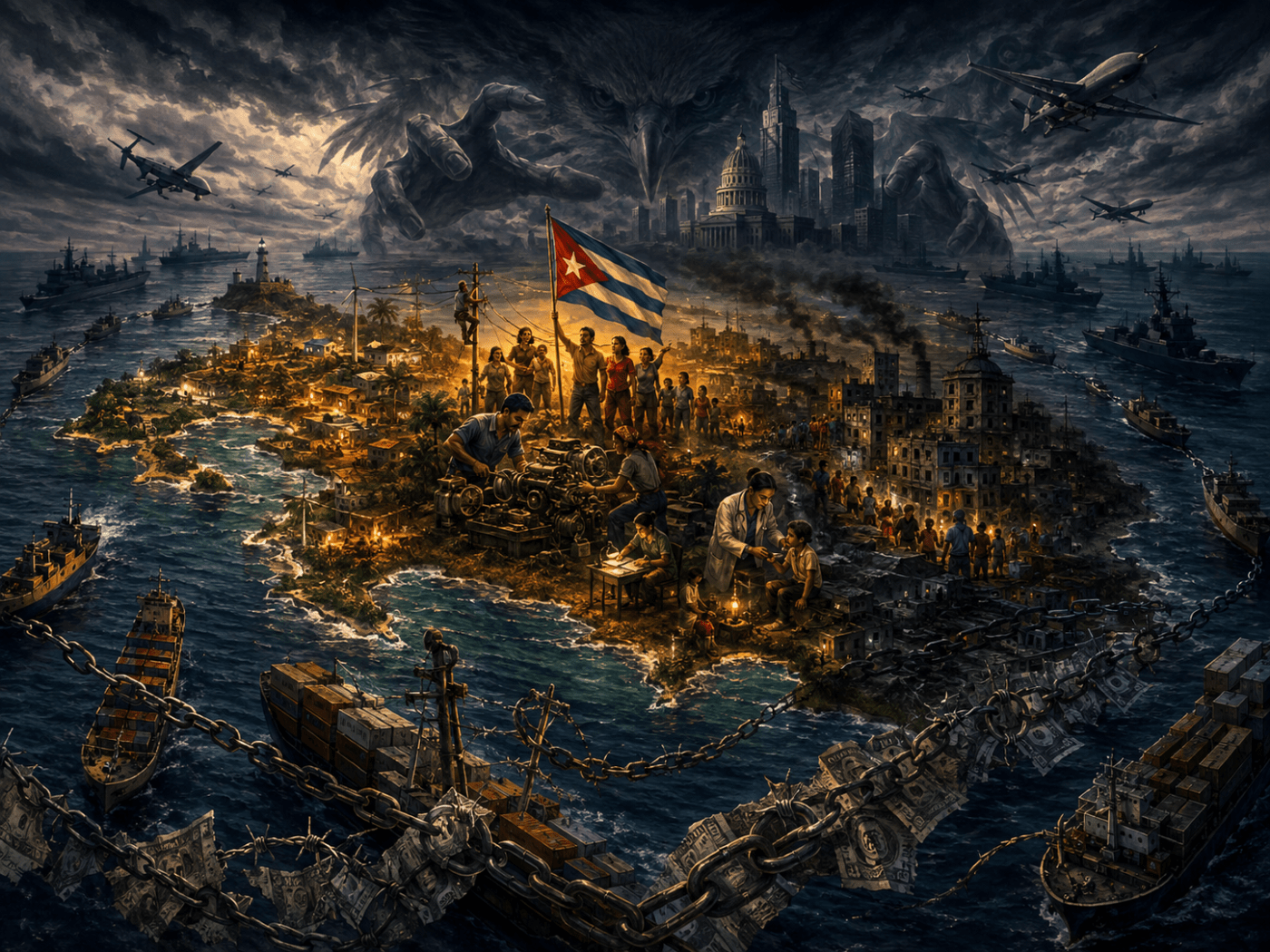
The Hill reports Washington’s blockade, covert operations, financial threats, military sanctions, and leadership-change ambitions in fragments, allowing the empire’s coordinated offensive to disappear behind the manufactured image of Cuban aggression. The factual record shows that Rubio is targeting the procurement, repair, banking, energy, and international relationships through which Cuba keeps its institutions functioning and its defenses intact under a blockade historically designed to manufacture desperation and overthrow. The sanctions expose Washington’s unresolved contradiction: it can intensify suffering, but it cannot guarantee that the Cuban people will interpret that suffering as a reason to surrender their Revolution, so it must attack the very means by which siege is converted into survival. Breaking this offensive requires organized political education, material solidarity, institutional struggle, and a movement capable of confronting the imperial machinery rather than merely managing the emergencies it creates.
Prince Kapone | Weaponized Information | August 6, 2026
The Operation Is Reported in Pieces
In “Rubio targets Cuban military procurement with new sanctions,” Ashleigh Fields reports that Marco Rubio has sanctioned five Cuban state entities and eight individuals connected to military procurement. The article also tells us that Washington is tightening an oil blockade, threatening foreign banks and companies, recruiting CIA personnel for cyber and covert-influence operations, discussing leadership change, and warning that Cuba could face treatment resembling the recent operation against Venezuela. Very little is completely hidden. The ideological work is performed by breaking the operation into separate pieces so that the reader never has to confront their combined meaning.
The article opens inside Rubio’s vocabulary. Cuba is a “rogue state,” Marxism is “poisonous,” left-wing radicals are violent instruments of Havana, and the island serves Russia, China, Iran, and terrorist organizations from ninety miles away. These accusations establish the emotional atmosphere before the article examines what the sanctioned institutions allegedly did. Military procurement, foreign relations, intelligence activity, political ideology, and terrorism are compressed into one cloud of menace. Once Cuba has been placed inside that cloud, nearly any act associated with its government can be made to appear threatening without being demonstrated as an attack upon the United States.
Washington’s conduct receives gentler language. The administration hopes economic pressure will produce “leadership change.” Its objective is described as “rearranging” Cuba’s communist government system. The word performs remarkable labor. A foreign government seeking to alter another country’s political order becomes a decorator dissatisfied with the furniture. An oil blockade becomes pressure. Covert-influence operations become another instrument in the policy toolkit. The language empties each measure of force and returns it to the reader as routine statecraft.
The article’s central technique is strategic fragmentation. The sanctions against military enterprises appear first. The oil blockade enters as background. The desire for political transformation arrives in another paragraph. CIA cyber and influence operations appear later as a separate development. The comparison with Venezuela is reported as a warning. The Bay of Pigs is placed near the end as historical precedent. Each fact is disclosed, but each is enclosed within its own compartment. The article never stops to ask what kind of policy emerges when economic coercion, international financial threats, covert operations, military pressure, and an explicitly stated desire for leadership change are operating at the same time.
This fragmentation also contains the history. The Bay of Pigs appears as a failed operation belonging to Eisenhower, Kennedy, Cuban exiles, and the distant Cold War. Its inclusion gives the article the appearance of historical depth, but the past is not allowed to illuminate the present. It is displayed, acknowledged, and safely returned to the museum. The reader is invited to notice that Washington once attempted to overthrow the Cuban government, but not to ask why the article’s contemporary actors are again discussing covert influence, economic strangulation, military pressure, and leadership change.
The source hierarchy reinforces this framing. Rubio defines the threat. The Trump administration defines the desired transformation. U.S. intelligence reporting defines the covert terrain. A U.S. presidential library defines the historical episode. Cuban officials are quoted, but primarily as defendants responding to a case already constructed around them. Their claims of sovereignty, collective punishment, and legitimate self-defense enter only after Washington’s accusations have established the article’s terms.
The result is an aggressor-target inversion produced less by silence than by arrangement. Cuba’s procurement institutions, foreign relationships, and preparations for possible attack occupy the foreground as the danger. Washington’s blockade, threats against third parties, covert preparations, and stated desire to replace Cuba’s leadership remain dispersed across the background as separate policy developments. The article reports the operation in fragments, then asks the reader to fear the country trapped inside it.
What Rubio Is Actually Trying to Cut Off
The August 6 package is not simply a blacklist of Cuban officials. OFAC added six individuals and five state enterprises, while placing two previously sanctioned military leaders under an additional authority. The administration advertises eight affected officials, but the number is less important than the material functions of the enterprises selected. Washington is targeting the institutions through which Cuba imports equipment, maintains what it already possesses, develops domestic repair capacity, and keeps essential systems functioning under blockade.
Tecnoimport and Duna connect Cuba to foreign procurement and wholesale supply. Tecnotex participates in technical and security projects. The Military Industries Union produces, repairs, and modernizes equipment inside the country. The Yuri Gagarin Military Industrial Enterprise maintains Russian-origin aircraft and helicopters. By the State Department’s own description of the targets, the sanctions strike every stage of the chain: purchasing equipment abroad, moving it into Cuba, repairing existing machinery, manufacturing what can be produced domestically, and preserving systems that ordinary commercial channels no longer reliably service.
This is what Rubio’s warning to foreign banks and companies is meant to accomplish. Executive Order 14404 reaches across Cuba’s defense, energy, mining, financial, and security sectors, including state institutions, majority-owned entities, officials, and anyone providing them with money, technology, goods, or services. A foreign bank that processes a significant transaction can lose access to U.S. correspondent accounts or have property under U.S. jurisdiction blocked. Washington is therefore not merely prohibiting American companies from dealing with five Cuban enterprises. It is using control over the U.S. market and financial system to order banks, shippers, insurers, suppliers, repair firms, and technology companies across the world to isolate them.
That is how a U.S. designation becomes an international blockade. The Treasury Department writes the name; corporate compliance departments enforce the punishment far beyond U.S. borders. A supplier does not need to be formally sanctioned to withdraw. It needs only to fear losing access to dollar clearing, American customers, insurance, financing, or correspondent banking. Washington converts its national jurisdiction into a claim of command over the commercial relations of other countries, then describes the resulting isolation as though Cuba had simply failed to find willing trading partners.
The procurement offensive is inseparable from the oil blockade imposed on January 29, 2026—roughly six months before The Hill published its article, not eight. The order threatens tariffs against countries supplying petroleum to Cuba directly or through intermediaries. It also permits relief when Cuba or the affected state takes steps that “align sufficiently” with U.S. foreign-policy and security demands. Fuel is therefore being used as an instrument of political discipline: trade may resume when the target or its partners begin behaving as Washington requires.
The relationship between the two measures is concrete. The oil blockade restricts the energy required to operate Cuban society. The procurement sanctions attack the payments, suppliers, maintenance facilities, replacement parts, and technical relationships through which Cuba might preserve its institutions and defenses under that pressure. One measure drains the fuel tank; the other attacks the workshop, the bank account, and the supply line needed to keep the remaining machinery running.
Cuba has been forced to reserve scarce fuel for hospitals, water systems, food production, electricity generation, transportation, defense, and activities capable of earning foreign exchange. These are not separate inconveniences. Fuel shortages prevent workers and goods from moving. They weaken water pumping, food and medicine refrigeration, emergency transport, industrial repair, and electrical stability. UN experts have documented damage to healthcare, food, education, water, sanitation, electricity, transportation, and national development. Rubio’s procurement sanctions now strike the institutions responsible for maintaining equipment and securing supplies while those civilian systems are already operating under energy deprivation.
The point is not that every Cuban shortage originates in Washington. Cuba has internal problems, administrative weaknesses, aging infrastructure, limited resources, and necessary economic reforms of its own. The point is that the blockade deliberately worsens those contradictions while obstructing the means available to overcome them. It restricts fuel, financing, machinery, replacement parts, technology, and external trade, then invites the world to judge Cuban institutions as though they operated under ordinary conditions of sovereignty.
This combination of deprivation, weakened state capacity, covert pressure, and leadership-change policy is not an accidental convergence. Its design was recorded in April 1960, when State Department official Lester Mallory acknowledged broad support for the Revolution and the absence of an effective political opposition. Because Washington could not find the internal social force required to reverse the Revolution, Mallory proposed creating one through economic suffering: deny Cuba money and supplies, reduce real wages, and produce “hunger, desperation and overthrow of government.”
The relevance to Rubio’s package is direct. Economic injury was selected as a means of manufacturing political disaffection. The Cuban population would be made to experience deteriorating material conditions; the state would be deprived of the means to relieve them; and the resulting desperation would be redirected against the Revolution. Human suffering was not an unfortunate by-product of the policy. It was the mechanism through which Washington expected the policy to work.
Operation Mongoose joined economic warfare to psychological operations, clandestine organization, sabotage, and preparations for armed revolt. The plan was to prevent the Cuban government from meeting popular needs, direct the resulting resentment against it, weaken its capacity to respond, and convert crisis into political overthrow. The Hill now reports the same strategic components in updated form: an oil blockade intensifying deprivation, sanctions against institutions preserving Cuban capacity, CIA recruitment for cyber and covert-influence operations, and an openly declared desire for leadership change.
The instruments have changed with the development of imperial power. Sabotage can now be performed through compliance departments as well as explosives. A bank transfer can be stopped in New York, an insurer frightened in London, a supplier pressured in Asia, and an oil shipment deterred before it reaches the Caribbean. But the political sequence remains recognizable: weaken the economy, make the government appear incapable of meeting popular needs, cultivate discontent, organize that discontent politically, and prepare to intervene when the resulting crisis becomes sufficiently severe.
The strategy did not disappear when Operation Mongoose ended. It was embedded in the Cuban Assets Control Regulations, which established extensive restrictions on trade, banking, financing, property, and financial transactions, and later codified in the Helms-Burton Act. That statute conditions the suspension and termination of the blockade upon political arrangements Washington defines as a Cuban “transition” followed by a “democratically elected government.” The objective acknowledged in The Hill is therefore not a recent obsession invented by Rubio or Trump. Regime change is written into the legal structure of the blockade itself.
This history also explains why military procurement is being targeted alongside fuel and finance. A state subjected to economic warfare, covert destabilization, and an externally prescribed transition is more difficult to overthrow when it retains the capacity to maintain its institutions and defend its territory. Washington is not only attempting to generate crisis. It is trying to weaken Cuba’s ability to govern through that crisis, resist external intervention, and prevent economic pain from being converted into political collapse.
Russia and China matter to the August 6 sanctions because they provide some of the external channels Washington is trying to close. Russia has formalized military cooperation with Cuba, while both countries maintain relations involving fuel, equipment, technical capacity, infrastructure, and development. Cuba and China likewise cooperate in technology, energy, planning, and other priority sectors. These relationships do not erase Cuba’s shortages, internal contradictions, or development problems. They do, however, give the island access to supplies, technical support, and diplomatic relations beyond institutions dominated by the power blockading it.
That limited room for maneuver is precisely what Washington seeks to eliminate. A blockade can produce maximum political leverage only when the target has no alternative market, lender, supplier, source of fuel, technical partner, or defensive relationship. Every external channel available to Cuba weakens the capacity of economic suffering to force political surrender. What Rubio calls hostile foreign cooperation is, from Cuba’s standpoint, part of the material infrastructure of sovereign survival.
The procurement sanctions therefore belong to Washington’s larger hemispheric strategy. The 2025 National Security Strategy calls for stronger U.S.-centered supply chains, control over strategic locations and resources, deeper commercial and security dependence, and the exclusion of “non-Hemispheric competitors” from Latin America and the Caribbean. The issue is not merely what Cuba buys or which aircraft it repairs. The issue is whether a Caribbean state may maintain economic, technological, and military relations outside Washington’s command.
The sanctions reported by The Hill put that doctrine into operation against Cuba. Restrict the island’s fuel. Threaten the banks processing its transactions. Frighten away its suppliers. Attack the enterprises maintaining its equipment. Punish the foreign relationships that reduce its isolation. Then call the entire structure a response to Cuban aggression. What Washington is actually trying to cut off is not simply military procurement. It is Cuba’s remaining capacity to survive the blockade without surrendering the Revolution.
The Siege Must Destroy the Means of Surviving It
The Rubio sanctions descend upon a contradiction Washington has spent more than six decades trying—and failing—to master. The United States can make Cuba suffer. It can empty the fuel tank, frighten the bank, immobilize the machine, and make every ordinary transaction pass through a gauntlet constructed by imperial decree. What it cannot mechanically command is the political meaning the Cuban people will draw from that suffering. Hunger does not arrive carrying a counterrevolutionary ballot. A blackout does not automatically teach surrender. Scarcity may sharpen anger, but Washington cannot guarantee where that anger will be directed. Between the misery the empire manufactures and the capitulation it expects stand the organized capacities of Cuban society: its state institutions, collective systems, defensive preparations, revolutionary memory, and international relations. Rubio’s sanctions are aimed precisely at those forces standing between deprivation and defeat.
This is the actual significance of the procurement agencies, industrial enterprises, repair facilities, banks, suppliers, and technical partners placed in Washington’s crosshairs. They are not merely departments in some gray military bureaucracy. Under blockade, they are pieces of the material bridge by which Cuba crosses from siege toward survival. They keep old equipment operating when replacement is forbidden. They repair machines abandoned by frightened suppliers. They preserve institutional continuity when the normal arteries of international commerce have been pinched shut by the United States. They connect a small island to resources, skills, and relationships beyond imperial supervision. Rubio is not simply attacking the purchase of weapons. He is attacking the practical machinery through which Cuba prevents economic warfare from finishing the political job assigned to it.
The blockade can accomplish its purpose only if this relationship remains hidden. Washington first shrinks the material world within which Cuba must govern. It obstructs fuel, credit, technology, trade, transportation, spare parts, and international payments. It then summons the Revolution before the court of imperial opinion and judges its performance as though Cuba were a laboratory sealed from history, power, and coercion. Scarcity manufactured through blockade is entered into evidence against socialism. Emergency allocation becomes proof of administrative incompetence. The difficulty of maintaining public systems under siege becomes proof that public systems cannot work. The strangler disappears from the photograph, and the bruises are presented as a medical mystery.
The empire is therefore producing more than deprivation. It is trying to produce a particular consciousness of deprivation. It wants the Cuban worker to see the stopped bus but not the severed fuel route; the mother to see the medicine shortage but not the bank terrorized into refusing payment; the technician to see the idle machine but not the supplier ordered to abandon the replacement part. Imperial ideology reaches its highest refinement when the injured are made to experience the wound as self-inflicted. Having poisoned the well, Washington arrives in a clean suit to lecture the village about socialist water management.
But Cuban society has repeatedly spoiled this little performance. Its institutions allocate scarcity rather than surrendering every necessity to the wallet of the highest bidder. Its public systems, however strained, preserve collective capacities that the market would gladly auction off to those capable of paying. Its international relationships create openings around total isolation. Its defensive preparations make direct intervention more expensive. Its revolutionary memory allows present suffering to be understood within a longer history of colonial domination, national liberation, and imperial revenge. The blockade intensifies Cuba’s contradictions, but it cannot dictate how those contradictions will be interpreted. Washington may control the pressure applied from outside; it does not fully control the consciousness formed beneath that pressure.
This is why every possible exit from the emergency must be declared illicit. Washington blocks ordinary trade and then punishes alternative trade. It restricts petroleum and threatens those who might replace it. It obstructs new machinery and sanctions the institutions repairing old machinery. It weaponizes the banking system and then denounces Cuba for searching for routes beyond it. It threatens the Revolution with overthrow and then gasps theatrically when Cuba prepares to defend itself. Apparently, the empire’s ideal victim is permitted every freedom except the freedom to survive.
The demand imposed upon Cuba is impossible by design. The island may escape the crisis only through channels controlled by the power producing the crisis. It may obtain relief only by accepting the political conditions attached to that relief. It may trade only with Washington’s preferred partners, finance itself through Washington’s preferred institutions, defend itself with Washington’s permission, and govern only so long as its political system meets Washington’s definition of democracy. In other words, Cuba is offered sovereignty on the modest condition that it surrender sovereignty.
The contradiction between aggression and self-defense therefore reaches far beyond any single aircraft, contract, supplier, or military agreement. Washington claims the authority to determine Cuba’s trading partners, regulate its external finance, punish third countries for conducting legal commerce, decide which sectors of the Cuban economy may function, and maintain collective pressure until Havana produces a government acceptable to the United States. Cuba is then informed that any effort to preserve the material capacity to resist this project constitutes aggression. Empire monopolizes every weapon and grants the besieged only the right to lie still.
China and Russia become intolerable within this architecture because they interfere with Washington’s attempt to make Cuban dependency total. Their significance does not reside in childish fantasies that multipolarity automatically resolves scarcity, bureaucracy, underdevelopment, or every contradiction within Cuban socialism. History does not distribute liberation through diplomatic communiqués. Their importance is more concrete. They weaken Washington’s monopoly over Cuba’s access to fuel, technology, infrastructure, equipment, financing, and diplomacy. They enlarge—however unevenly—the space in which Cuba can make decisions without first submitting an application to the government committed to overthrowing it.
For an empire demanding absolute leverage, even partial autonomy becomes a felony. A shipment beyond U.S. control becomes “malign influence.” An alternative lender becomes “strategic penetration.” A technical partnership becomes a security threat. A country conducting normal relations beyond Washington’s jurisdiction is accused of importing foreign domination by the very power that maintains a military enclave on Cuban soil and claims the authority to police the entire hemisphere. Imperial hypocrisy is rarely subtle, but subtlety has never been necessary when the loudest cannon also owns the printing press.
The sanctions therefore reveal their place inside the construction of Fortress America. Washington does not merely seek diplomatic sympathy from nearby governments. It seeks a hemisphere disciplined around U.S. capital, secured by U.S. military power, wired through U.S.-controlled finance and technology, and closed against partnerships capable of widening the sovereignty of Latin America and the Caribbean. Its preferred region is one in which resources flow north, profits return north, strategic decisions are approved in the north, and every government understands that independence is a privilege revocable by executive order.
Cuba remains a breach in this imperial wall. Its existence denies the ancient colonial superstition that geography confers ownership—that because an island lies ninety miles from Florida, Washington possesses a natural title to its government, economy, and future. Cuba’s relations beyond U.S. command demonstrate that proximity to an empire does not annul the right of a people to choose their own social system or international partners. For this offense, the island has endured punishment without expiration date.
The New Cold War makes the closure of that breach more urgent. As Washington’s capacity to command the entire world grows less secure, it seeks to fortify the zone where its military, financial, and geographic advantages remain most concentrated. The hemisphere is to become the empire’s protected rear: a reservoir of resources, labor, supply chains, ports, markets, and compliant states, strategically sealed against China, Russia, and any other power capable of weakening U.S. monopoly. The campaign against Cuba’s foreign relations is therefore not an isolated dispute over procurement. It is part of the effort to prevent multipolarity from acquiring roads, contracts, fuel tanks, cables, workshops, and political allies inside the American Pole.
Rubio’s denunciation of Marxist ideology exposes the ideological nerve beneath all this machinery. Washington fears more than Cuban equipment. It fears the political significance of Cuban endurance. The island testifies that capitalism and colonial obedience are not laws of nature, that an empire may punish a people without winning their consent, and that organized human beings can survive long enough to embarrass the prophets who have announced their imminent collapse every year since Eisenhower.
That example must therefore be explained away as foreign manipulation. Revolutionary influence must be renamed command. Internationalism must become conspiracy. Marxism must be treated as an imported poison rather than a conclusion repeatedly drawn by people confronting exploitation, racism, colonialism, and war. Otherwise, Washington would have to admit a deeply inconvenient possibility: that oppressed people possess minds of their own, recognize common enemies through historical experience, and sometimes discover socialism without being smuggled instructions inside a Cuban cigar.
The true story hidden beneath The Hill’s account is not that Rubio has uncovered a dangerous procurement conspiracy. Washington is attacking the material, defensive, diplomatic, and ideological capacities standing between imposed suffering and the surrender that suffering was designed to produce. The sanctions seek to make the blockade politically decisive by destroying the institutions through which Cuba has repeatedly prevented deprivation from ripening into recolonization.
The United States can manufacture hardship. It can export its laws through banks and corporate offices. It can terrify suppliers, punish trading partners, narrow Cuba’s choices, and sharpen every internal contradiction. What it has never been able to guarantee is that Cubans will interpret their suffering according to the script written for them in Washington. The empire has produced the wound but not the desired consciousness of the wound. Rubio’s task is to close that gap: to sever survival from sovereignty, isolate resistance from material support, and make surrender appear as the only remaining road toward relief.
That is what lies beneath the respectable language of military procurement. The siege has failed to make the Cuban people kneel, so the siege must now destroy the means by which they remain standing.
 Weaponized Information
Leave a comment