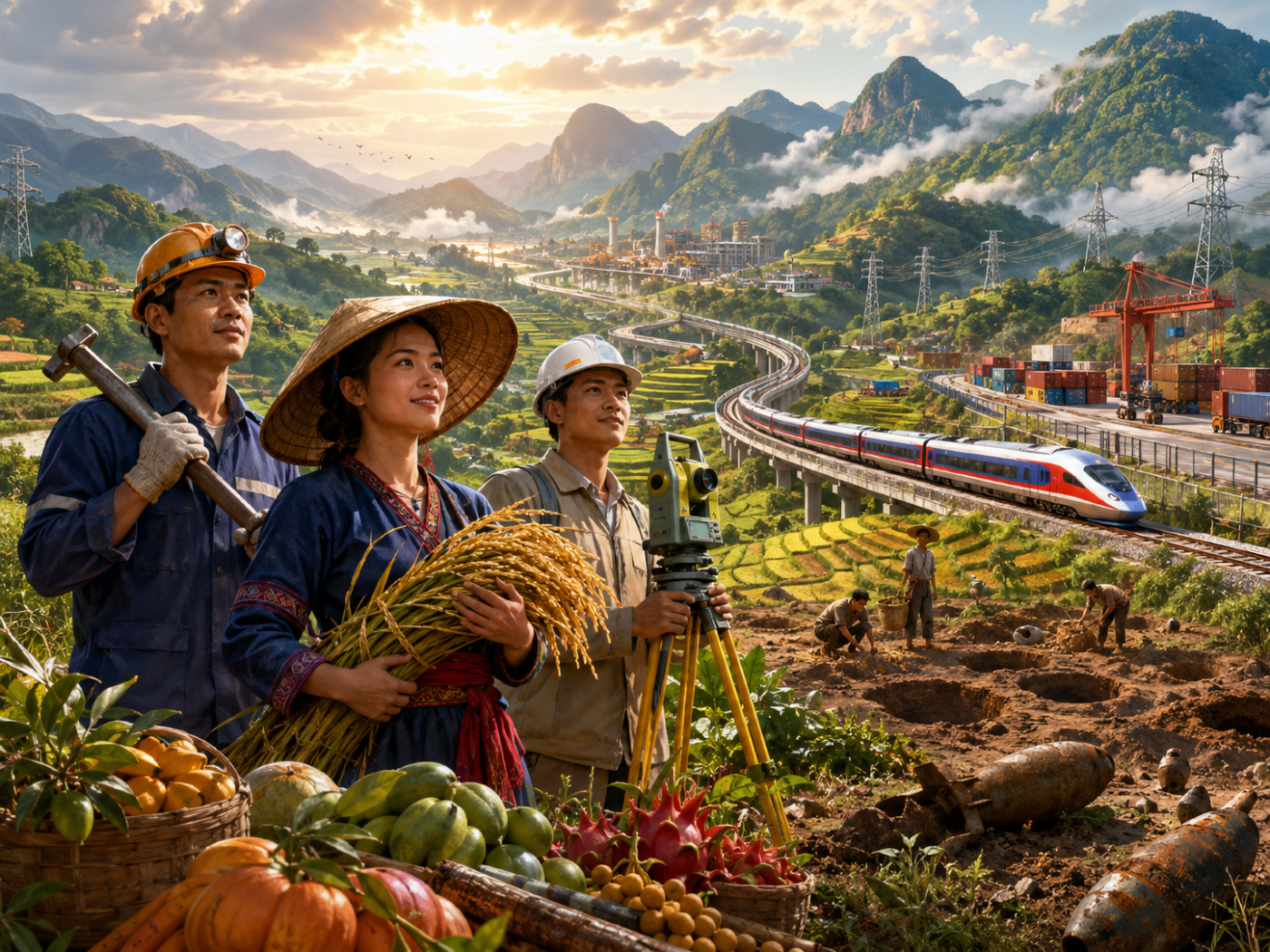
The June 2026 Laos-China state visit was more than a diplomatic ceremony between unequal neighbors. It brought together two socialist national projects, each with its own Party, planning system, development strategy, and historical responsibilities. Their cooperation is neither a frictionless ideal nor the “debt trap” caricature imposed by the imperial press, but a politically organized attempt to turn unequal interdependence into productive capacity, technical sovereignty, regional policy space, and social development. The decisive question is whether Laos can govern that cooperation through its own socialist institutions so that infrastructure serves production, markets answer to public power, and development reaches the workers, farmers, and multi-ethnic people in whose name it is carried out.
By Prince Kapone | Weaponized Information | June 12, 2026
The Agreement Package the Imperial News Cycle Could Not Read
Imperial journalism has no trouble finding the Global South when something is on fire. Let a bomb fall, a government collapse, a protest turn violent, or Washington announce another round of sanctions, and the whole factory of explanation roars into motion. Maps appear. Retired officers are dragged from the Pentagon’s storage room. Think-tank professionals who could not find Laos without a briefing folder suddenly become authorities on its history, politics, and national interests. Every missile receives a genealogy. Every market tremor becomes a strategic crisis. Every sentence issued by the White House is treated as though it came down from the mountain carved into stone. But when two socialist countries sit down to coordinate planning, production, finance, technology, agriculture, education, and long-term development, this same all-seeing press develops a mysterious case of blindness. The empire can spot a Chinese ship from three oceans away, but thirty-two signed agreements sitting on a table in Beijing somehow disappear from view.
From June 2 to June 6, 2026, Thongloun Sisoulith—General Secretary of the Lao People’s Revolutionary Party and President of the Lao People’s Democratic Republic—made a state visit to China. The visit took place during the sixty-fifth anniversary of diplomatic relations between Laos and China and the officially designated Year of China–Laos Friendship. It also came as both countries entered new planning periods: China beginning its Fifteenth Five-Year Plan and Laos its Tenth National Socio-Economic Development Plan. This was not just another ceremony beneath red flags, with leaders shaking hands while photographers crowded the room. It was a meeting between two socialist states preparing to coordinate the next stage of their political and economic development.
On June 5, Thongloun met Xi Jinping at the Great Hall of the People. The two leaders reviewed bilateral relations, discussed regional and international developments, reaffirmed their strategic partnership, and advanced what both governments call an all-weather China–Laos community with a shared future. After the talks, they witnessed the signing of thirty-two cooperation agreements and documents covering Party relations, trade, investment, finance, energy, agriculture, culture, human-resource development, security, connectivity, artificial intelligence, and Chinese assistance. The full text of every agreement has not been released, and there is no need to imitate the Western think-tank habit of inventing certainty where the public record remains incomplete. What is already known is enough to establish the scale of the event. This was not one loan, one mine, one railway contract, or one ceremonial memorandum destined for a filing cabinet. It was a broad attempt to bring the institutions, plans, productive capacities, and technical resources of two socialist countries into closer coordination.
Lao, Chinese, and regional Asian media reported the meeting. The Vientiane Times account circulated through the Asia News Network, while Malaysia’s The Star carried the regional report. Across the Western governmental and corporate-media apparatus, however, there was silence. A comprehensive search found no mention of either the meeting or the thirty-two-agreement package among the principal Western governments, wire services, broadcasters, and newspapers examined. Reuters had considered a February exchange of anniversary messages important enough to report under the headline “China open to more practical cooperation, strategic coordination with Laos”. But when that cooperation became concrete—when the leaders met and thirty-two agreements were signed—the wire went quiet. So did the rest of the imperial press.
This was not a story that received too little attention. It received none. It was not pushed below the fold, shortened into a brief, or buried beneath a larger crisis. It was simply excluded. The meeting happened. The agreements were signed. Lao, Chinese, and regional media documented them. Yet the main institutions through which Western workers are told what matters in the world behaved as though nothing had occurred. Silence on this scale is not an empty space where propaganda failed to appear. The silence is the propaganda. It decides which events become history, which countries are allowed to act, and which possibilities are kept outside the public imagination.
The story could not be used because it violated the script written for Cold War 2.0. Western audiences are trained to encounter China through aircraft carriers, spy balloons, sanctions, trade wars, Taiwan war games, and lectures about the so-called international order. Chinese credit is called a debt trap before anyone reads the terms. Chinese infrastructure is called strategic penetration before anyone asks who owns it, who operates it, what it connects, or what it produces. Trade becomes dependency before the partner country’s own plans and institutions are permitted to enter the discussion. Every new relationship between China and the Global South must be turned into evidence of Chinese aggression, because the alternative conclusion is too dangerous: China’s rise may be giving formerly colonized nations more room to develop outside Western command.
Laos fares even worse inside this imperial narrative. China is allowed to have a strategy; Laos is allowed to have a location. China acts; Laos receives. China plans; Laos is planned for. One country appears as an active subject, the other as a patch of land on somebody else’s geopolitical map—small, landlocked, poor, indebted, vulnerable, and waiting to be used. Lao agency is recognized only when it can be translated into fear of China, resistance to China, or regret over dealing with China. When Lao leaders speak about socialist construction, national planning, public institutions, technical training, productive development, and sovereign diplomacy, their words are treated as official wallpaper. Then a banker in London, an intelligence veteran in Washington, or a think-tank clerk with a fellowship and a necktie is brought forward to explain what the Lao people supposedly do not understand about their own country. The pith helmet is gone. The colonial ventriloquism remains.
The June meeting disturbed this arrangement because Laos did not appear as a victim waiting for Western rescue. China did not appear as an invader circling another prize. No Western government stood in the middle, granting approval, imposing conditions, or collecting tribute. Development appeared as a political process: planned, negotiated, institutionalized, and tied to the national projects of the two countries involved. Laos entered the relationship through the Lao People’s Revolutionary Party, the people’s democratic state, its own development plans, and a revolutionary history forged in struggle against colonialism and imperial war. China entered through capacities built by its socialist revolution: public control over strategic sectors, national planning, state-directed infrastructure, control over finance, technological development, and the productive strength to sustain cooperation beyond the reach of Western banks and governments.
China and Laos are not equal in size or productive capacity. China possesses vastly greater industrial, financial, scientific, and administrative resources. That unevenness is real, and it creates contradictions that both countries must manage. But inequality by itself is not imperialism. Imperialism is not the simple fact that one country is larger, possesses more technology, extends credit, or has interests of its own. Imperialism is the organized use of superior power to subordinate another country, break its political independence, reorganize its economy around external accumulation, weaken its public institutions, and force its alignment with the dominant power. That is what the Western powers did across Asia, Africa, Latin America, and the Caribbean. That is what France and the United States did to Laos.
The China–Laos relationship moves in another direction. It is organized through recognition of Lao sovereignty, coordination with Lao development plans, Party-to-Party and state-to-state institutions, productive infrastructure, technical training, preferential access to markets, development assistance, and opposition to hegemonic politics. China is not demanding that Laos privatize its public institutions, dismantle the LPRP, surrender its foreign policy, join a Chinese military bloc, or open the country to the unrestricted rule of Chinese capital. Chinese capacity is being connected to a national project defined by the Lao state itself.
This is why the agreement package matters beyond the normal business of diplomacy. It represents a developing form of socialist cooperation between two countries that stand at very different levels of development. Laos is attempting to overcome burdens that did not fall from the sky by accident: colonial fragmentation, imperial war, geographic isolation, limited industrial capacity, technological dependence, and a narrow fiscal base. China possesses productive, financial, scientific, and institutional resources that can help Laos reconstruct its territory, expand domestic production, train its people, connect its regions, and widen its room to maneuver. This is not charity descending from a generous benefactor to a grateful beggar. It is cooperation between two sovereign socialist projects whose capacities differ greatly but whose strategic direction converges.
The June meeting was therefore part of something larger now taking shape across the Global South. Countries long trapped inside Western-controlled systems of finance, trade, technology, military pressure, and diplomatic blackmail are building new relations outside the exclusive command of the old imperial centers. They are trading in new markets, borrowing through new institutions, constructing infrastructure with new partners, and refusing the old fiction that development must arrive with a Western banker in one hand and an austerity program in the other. Multipolarity does not abolish capitalism. It does not settle the class struggle, wave a red flag over every government, or guarantee justice by itself. What it does is weaken the monopoly of the powers that have spent centuries deciding which countries may industrialize, which governments may survive, and which peoples must remain poor for the comfort of the rich.
That change matters to workers everywhere. The ruling class that encircles China abroad is the same ruling class that closes factories, cuts public services, militarizes the police, expands surveillance, attacks unions, and tells workers in the United States that their enemy is a Chinese worker they have never met. The same banks that impose discipline on the Global South impose debt and austerity at home. The same monopolies that demand access to Lao resources squeeze wages, raise prices, and loot public wealth across the imperial core. Every breach in imperial monopoly weakens the power of that class. Every successful form of South–South cooperation gives oppressed nations greater room to breathe and gives revolutionary movements material experience from which to learn.
The lesson is not that every country should copy China or Laos line by line. Revolutions are not franchise restaurants. Each people must work through its own history, class structure, culture, geography, and balance of forces. But the principles matter: political independence, national planning, public direction of strategic development, cooperation among formerly colonized nations, technological sovereignty, infrastructure built for production rather than plunder, and international relations not organized around threats, sanctions, and military occupation. These are not abstract hopes. They are being tested in the real world.
This is why imperial journalism had so little use for the story. Before sanctions come the stories that make sanctions seem reasonable. Before military bases come threat assessments explaining why the bases are necessary. Before war comes the steady poisoning of public consciousness. Western workers must be trained to see Chinese development as aggression, multipolarity as disorder, and every Global South government that escapes Western control as corrupt, coerced, or confused. The media does not simply lie about the world after history happens. It patrols the borders of what people are allowed to believe history can become.
Weaponized Information stands on the other side of that class line. We do not treat China–Laos cooperation as a mystery suspended between an imperial accusation and an anti-imperialist hope. Its historical direction is already visible. It is an actually existing process of socialist cooperation and sovereign development, advancing through Party leadership, national planning, public institutions, productive construction, technical formation, and multipolar diplomacy. Its contradictions must be struggled through by strengthening Lao productive capacity, public authority, technological command, ecological protection, and the organized power of workers and peasants. Those contradictions are part of building socialism inside a capitalist world system. They are not evidence that Washington’s theory of Chinese imperialism was right all along.
The Western press ignored the June meeting because an honest report would have required three admissions that empire cannot make comfortably: Laos is not an empty map, China is not a new colonial master, and the Global South is not waiting for Washington to write its future. It would have shown two socialist states coordinating their national projects outside Western command and constructing, through unequal but sovereign cooperation, part of the material foundation of a new international order. That is dangerous because it tells the oppressed something they are never supposed to hear: another world is not only possible. It is already being planned, financed, built, argued over, corrected, and defended.
To understand what the imperial news cycle refused to show, we must begin before the railway, the loan, the development zone, or the latest summit. We must begin with Laos itself: with the colonial geography imposed upon it, the American war still buried in its soil, the revolutionary state born through national liberation, and the long struggle to turn damaged territory into sovereign and socialist development.
The Ground Still Carries the War
To understand development in Laos, begin with the ground. Not with a growth forecast, an investment prospectus, or one of those polished reports where history appears as a footnote beneath a graph. Begin with the field a farmer cannot safely plow, the road crew forced to stop while explosives are searched for, the schoolyard where children are warned not to touch the small metal object half-hidden in the soil. The ground beneath Lao development is not empty. It has been administered from abroad, bombed from above, and left carrying weapons that still wait for labor to disturb them. Before Laos can fully build upon its territory, it must repeatedly recover that territory from empire.
French colonialism did not discover an “undeveloped” Laos and merely fail to modernize it. It reorganized Lao territory around an imperial geography whose political and economic center lay elsewhere. Within French Indochina, Laos was treated not as a national economy to be developed around the needs of its own people, but as a western hinterland of France’s more heavily developed possessions in Vietnam, incorporated into commercial circuits linking Tonkin and Cochinchina. Luang Prabang remained under a nominal protectorate, while the rest of Laos was divided into directly administered provinces. Their taxation, labor obligations, public works, and bureaucracy answered upward to the French colonial apparatus rather than inward to Lao society, repeatedly provoking resistance to colonial taxes and compulsory labor.
The colonial administration sought to govern Laos cheaply by forcing the colonized population to bear much of the cost of its own subordination. Taxes financed the colonial apparatus and restructured relations among Lao communities, local elites, and the foreign state, while poll taxes and corvée obligations supplied coerced labor for roads and other public works. These projects are often entered into the colonial ledger as evidence that France brought infrastructure. But under colonialism, infrastructure is meant to serve very strict political and class functions that have very little to do with public utility. French road-building, for example, was explicitly designed to penetrate and administer Lao territory, bind it more tightly to French Indochina, and redirect trade and communication toward colonial centers in Vietnam. Route 9, linking Savannakhet on the Mekong to Vietnam, embodied these administrative, commercial, and military priorities. A road built through coerced labor to move officials, troops, taxes, and commodities across conquered territory was first an instrument of command; its later public use does not erase who planned it, whose labor constructed it, or whose interests it originally served.
French rule left behind neither a nationally integrated productive system nor a state apparatus adequately prepared to direct independent development. Investment remained thin, transport routes unreliable or seasonal, and administrative and commercial lines continued to point outward toward the larger Indochinese structure. Colonialism did not leave Laos outside history. It inserted Laos into a distorted history whose priorities were decided elsewhere. The colony received what foreign rule required and inherited what foreign rule refused to build: weak internal integration, limited productive capacity, a narrow fiscal base, and institutions shaped more effectively for extraction and obedience than for national reconstruction.
That colonial order was later buried beneath another imperial project. From 1964 to 1973, the United States waged a sustained and deliberately obscured war in Laos as part of its wider counterrevolutionary assault on the liberation struggles of Indochina. Declassified U.S. records referred to “unpublicized” American military actions—a phrase of bureaucratic delicacy for a war conducted from the sky over villages whose inhabitants were never consulted about Washington’s requirements. Laos was not merely struck by accidental spillover from Vietnam. Its territory was turned into strategic battlespace in an attempt to destroy revolutionary forces, sever supply lines, and prevent Southeast Asia from reorganizing itself beyond imperial control.
During those nine years, American forces dropped more than two million tons of ordnance on Laos, including more than 270 million cluster submunitions. The numbers are almost too large to absorb, which is exactly why they must not be left as spectacle. Their meaning lies in what they created. Vast quantities of submunitions failed to explode on impact, turning fields, forests, riverbanks, village paths, and future construction sites into reservoirs of delayed violence. The aircraft departed. The weapons remained. The war did not end; it changed its timetable.
A buried bomb does not require a pilot, an operations room, or another speech from the White House. It waits for a shovel, a plow, a cooking fire, a road crew, a child’s curiosity, or the first cut made for a foundation. Fifteen of Laos’s eighteen provinces remain known to be contaminated by cluster-munition remnants, and the people most exposed are those whose lives bring them closest to the land: farmers, rural workers, children, and ethnic communities in heavily bombed and remote areas. They do not enter contaminated fields because they are ignorant of the danger. They enter because they need food, wood, water, land, roads, and work. The class geography of unexploded ordnance follows the geography of necessity.
This is why UXO cannot be pushed into a humanitarian side column, safely separated from the development question. Unexploded ordnance removes agricultural land from safe use, delays roads, irrigation, schools, clinics, homes, and transmission lines, raises construction costs, consumes scarce technical labor and public funds, destroys bodies, and reduces the productive capacity of households. A single explosion can remove a worker from production, strip a family of income, impose lifelong medical costs, and deepen rural poverty. UXO functions as imperial fixed capital in reverse: instead of expanding the forces of production, it blocks them, destroys labor power, and forces the present to pay continuously for destruction imposed by the past.
The Lao state understands this relation clearly. Its national UXO strategy, Safe Path Forward III, identifies contamination as a major obstacle to socioeconomic development because it restricts infrastructure construction and access to agricultural land. The strategy joins survey, clearance, risk education, survivor assistance, technical training, land release, environmental safeguards, and national and provincial planning within one process. Its stated vision is that by 2030 the Lao people should live in “a safer environment from UXO” so that socioeconomic development can be accelerated. The language is administrative. The political meaning is not. The recovery of land from imperial war is one of the material conditions of Laos’s productive future.
Clearance is therefore not simply the removal of metal from soil. It is the recovery of national territory for agriculture, housing, transport, public services, settlement, and collective life. Survivor assistance is not an act of charity added after the important economic work is done. It is part of restoring people to their families, communities, labor, and social world. The strategy accordingly calls for priority land to be cleared and returned to productive use, UXO action to be incorporated into sectoral and local plans, and high-risk communities to be protected through coordination stretching from national institutions through provinces, districts, and villages.
The work already carried out is substantial. Laos’s Tenth National Socio-Economic Development Plan reports that during the preceding five-year period clearance operations covered 17,317 hectares of productive land, community zones, and business locations. Technical surveys identified tens of thousands of additional contaminated hectares, while risk-reduction programs reached more than 1.6 million people through villages and schools. These figures represent actual labor: survey teams crossing difficult terrain, technicians identifying explosives, clearance workers removing them, administrators coordinating operations, and communities waiting to reclaim land upon which their lives depend.
Yet the same plan records that the area cleared amounted to only 34.63 percent of the national five-year target. Deaths and injuries continued, survivor assistance reached only a portion of those intended, and funding remained below operational requirements. Education can reduce danger, but it cannot educate a bomb out of the soil. People must still farm, gather wood, construct homes, repair roads, and dig foundations. Less than a decade of bombing created a burden that more than three decades of organized clearance have not exhausted.
The financing of that reconstruction contains one of imperial history’s more obscene reversals. International assistance saves lives and restores land, and U.S. funding contributes significantly to mine-action work in Laos. But the state that saturated Lao territory with cluster munitions has transformed historical responsibility into discretionary aid, renewed through annual budgets and presented as generosity. Laos must survey the fields, train the technicians, treat the survivors, raise the funds, and prove measurable progress toward removing weapons it did not place there. The destruction was centralized. The obligation has been broken into grants, contractors, agencies, and project cycles. The bomber returns as donor and expects gratitude for helping to remove a fraction of the bombs.
Laos has nevertheless refused to leave UXO trapped inside the language of emergency relief. In 2016, it established the nationally specific Sustainable Development Goal 18, “Lives Safe from UXO”, alongside the seventeen global Sustainable Development Goals. This was not the passive adoption of international development language. It was a Lao intervention into that language: an insistence that no framework addressing poverty, health, agriculture, education, infrastructure, or inequality can describe the country honestly while its soil remains armed by a foreign war.
SDG 18 converts the afterlife of war into a national planning question. Laos must calculate the contaminated land, train the workers, assist survivors, clear priority areas, and integrate the recovered territory into development. Imperial destruction reappears in the present as targets, indicators, funding gaps, and administrative burdens. But the plan also records Lao agency. The state has named the violence, placed it inside the national project, and declared that recovering land and restoring people are not optional humanitarian exercises. They are part of rebuilding the country.
This is the history concealed by the innocent language of “underdevelopment.” Laos did not emerge poor because too little happened to it. It emerged poor because colonialism and war happened to it in concentrated form. French rule organized territory, labor, taxation, and transport according to foreign command. The United States then transformed that territory into a battlefield and left millions of weapons embedded in the conditions of production. What later appears in the respectable vocabulary of economics as low agricultural productivity, high infrastructure costs, rural poverty, weak internal connectivity, or uneven regional growth cannot be separated from the political history that produced those conditions.
Underdevelopment is often described as an original emptiness: not enough roads, capital, education, technology, or administration. In Laos, the apparent absence is full of history. Colonialism failed to organize the country around Lao requirements because it organized Laos around imperial requirements instead. War did not merely interrupt some natural path of modernization. It killed labor, displaced communities, contaminated land, and imposed future costs upon every public project that later attempted to reconstruct the country.
Laos is therefore not beginning from zero. It is beginning from damage. Its farmers, workers, technicians, planners, and communities are not simply trying to catch up with countries that started farther ahead along the same road. They are clearing the road before they can build it, surveying the field before they can cultivate it, and spending present labor to remove the material remains of an imperial war waged generations earlier. Every hectare returned safely to production is both an economic gain and an act of national recovery.
But damaged ground does not decide what will replace the ruins. A cleared field may become a village farm, a school, an irrigation system, a mine, a plantation, or another concession organized around priorities established elsewhere. Territorial recovery therefore requires political power. It requires a state capable of deciding what cleared land is for, whose needs receive priority, how scarce resources are organized, and what social purpose guides reconstruction after foreign powers spent generations organizing Laos for purposes not its own.
The ground establishes the burden. It also establishes the standard. Development in Laos cannot be judged as though the country entered the modern world from a neutral starting point. Every railway, clinic, school, industrial zone, irrigation system, and technical program forms part of a longer struggle to recover territory, labor, and national capacity from colonial command and imperial war. The next question is therefore not simply what Laos must build. It is who will direct the building: what kind of state, carrying what revolutionary inheritance, and acting toward what class purpose can turn clearance into reconstruction and reconstruction into sovereign socialist development?
Laos Is Not an Empty Map
The ground remembers, but it does not decide what will be built upon it. A field cleared of unexploded ordnance may become a village farm, a school, an irrigation system, a mine, a plantation, or another concession organized around priorities set elsewhere. Someone must decide whose needs come first, where scarce resources will go, and what kind of society all this labor is meant to produce. The wounded territory established in the previous section therefore leads directly to political power: who is organizing Lao reconstruction, through what institutions, and toward what historical end?
This is where the imperial map becomes deceptive. Laos appears as a small landlocked space between larger powers, a corridor waiting to be opened, financed, advised, influenced, or absorbed. Its mountains are visible. Its rivers are visible. Its location between China, Vietnam, Thailand, Cambodia, and Myanmar is visible. Its political subjectivity is not. The Lao People’s Revolutionary Party, the state it leads, the revolutionary inheritance it carries, and the plans through which it directs national development are pushed into the background, as though geography acts while the Lao people merely endure the consequences.
That erasure is not an innocent simplification. It reproduces the old colonial belief that small and underdeveloped nations possess problems but not projects, territory but not history, needs but not strategy. Larger powers are allowed intention. Laos is reduced to location. Once the country has been stripped of its own political line, every relationship it enters can be explained entirely through the ambitions of somebody else.
The Lao People’s Revolutionary Party describes itself as the political vanguard of the working class and patriotic laboring people and the core force of the people’s democratic political system. That claim places the Party inside a continuity extending from anti-colonial struggle and national liberation to the construction and defense of the Lao People’s Democratic Republic. It does not understand itself as a temporary administration managing the country until history arrives from abroad. It claims responsibility for carrying the revolution from the conquest of political independence into the harder work of transforming the productive, social, and institutional conditions inherited from colonialism and war.
The Party identifies Marxism-Leninism and Kaysone Phomvihane Thought as its ideological foundation. Kaysone Phomvihane Thought is not a Lao name placed decoratively beside a foreign doctrine. It represents an effort to apply Marxism-Leninism to the concrete conditions of a small, multi-ethnic, heavily rural country in which national liberation and social transformation could never be separated. Its political logic joins workers, peasants, patriotic forces, and ethnic communities under Party leadership around national unity, people’s democracy, independence, and the gradual construction of socialism under conditions the revolution did not choose.
Revolutionary legitimacy, however, cannot be stored like a medal in a glass case. It must be reproduced through the ability to govern, defend sovereignty, improve social life, and carry the national project forward. The Party that organized resistance against foreign domination must now organize ministries, budgets, schools, provinces, public enterprises, production, law, and long-term development. The battlefield changes. The obligation does not. A revolutionary state survives politically by translating the legitimacy of liberation into the material power to reconstruct the society that liberation made possible.
The Twelfth National Congress of the LPRP, held in January 2026, condensed the contemporary line into four connected tasks: strengthen Party leadership, build an independent and self-reliant economy, consolidate the people’s democratic regime, and advance toward socialism. The sequence matters. Party leadership supplies political direction. Self-reliance supplies the material foundation of sovereignty. The people’s democratic regime supplies the state form through which national power is organized. Socialism supplies the direction of movement.
The Congress joined ideology, organization, and planning within one governing architecture. It adopted the Third Political Programme, the political report of the Central Committee, the Tenth National Socio-Economic Development Plan, and revised Party statutes. The Programme is presented as the theoretical foundation for strengthening the people’s democratic regime and gradually advancing toward socialism. Its concerns include national sovereignty, productive self-reliance, industrial and technical development, environmental protection, trained personnel, law-governed administration, national unity, and the continued strengthening of the Party itself.
This political line is broader than economic growth. An economy may grow while sovereignty weakens. Investment may rise while public authority fragments. Production may expand while the power of workers and peasants declines and the commanding decisions of society migrate toward private wealth. The Lao line therefore does not treat growth as a number that justifies itself. Development is a struggle over who directs national time, who commands strategic resources, how territory is organized, and what social purpose the expansion of productive forces is made to serve.
That struggle is organized through nested horizons. The Tenth National Socio-Economic Development Plan covers 2026–2030, but it stands inside the Ten-Year Socio-Economic Development Strategy for 2026–2035 and the longer national Vision 2055. It is also the final five-year phase in realizing Vision 2030 and the principal instrument for carrying out the resolution of the Twelfth Party Congress. Five-year execution, ten-year strategy, and long-range vision are nested rather than improvised one after another.
“The 10th Plan serves as a strategic roadmap,” the document states. A roadmap cannot guarantee arrival, but it establishes a destination and a basis for determining whether the country is advancing, stalling, or being pushed away from its chosen path. Planning is political power exercised over national time. It is the refusal to allow immediate crisis, market pressure, foreign demand, or bureaucratic habit to become the sole authors of the future.
The Plan defines self-reliance through connected capacities: an economy better able to meet national needs through its own productive potential; educated workers, technicians, scientists, teachers, planners, and administrators; a narrower division between town and countryside; stronger protection of land, water, forests, and other natural resources; reduced poverty; and public institutions capable of turning political decisions into material results. Self-reliance, in this sense, is not retreat from the world. It is the internal power required to decide how the world enters.
A small country may trade widely, receive investment, borrow capital, import machinery, and cooperate with larger states while still pursuing sovereign development. The decisive question is whether these external relations are inserted into a national strategy or whether the national strategy is quietly rewritten around external demands. Laos does not define independence as economic solitude. It defines it as the capacity to establish priorities, preserve room for maneuver, and keep necessary cooperation from hardening into foreign command.
The Three Build Directive gives this political relationship between center and locality a territorial form: provinces are to serve as strategic units, districts as coordinating units, and villages as development units. The formula reflects a country whose population is dispersed across mountains, river valleys, towns, borderlands, and rural communities. A plan issued in Vientiane does not become development merely because the ink has dried. It must acquire material life through provincial strategy, district coordination, village institutions, Party organizations, cooperatives, mass organizations, and the labor of the people who must carry it out.
Central direction without local capacity becomes decree without implementation. Local initiative without national coordination becomes fragmentation. The task of socialist planning is to connect national purpose to different territorial conditions without allowing regional inequality, private influence, or administrative isolation to break the political unity of the whole. The people cannot remain passive recipients at the end of this chain. Workers, peasants, women, youth, ethnic communities, and village organizations are the social forces through which plans become production, public service, supervision, and correction—or remain paper instructions circulating among offices.
The economy governed by this state is not built from one uniform property form. The Lao Constitution places it inside a people’s democratic state in which power belongs to the people and is exercised in the interests of the multi-ethnic population, with workers, farmers, and intellectuals identified as its political core. It describes a multi-sectoral economy intended to expand production and circulation, transform subsistence into commodity production, develop the national economic base, and improve living conditions. State enterprises, collective forms, household production, domestic private firms, and foreign investment coexist because the productive forces inherited by the revolution remain uneven, dispersed, and insufficient.
The presence of markets does not cancel this political structure. Nor are markets harmless little shopkeepers who politely stop at the frontier of state power. Once generalized, market relations reward those who already possess money, land, information, and command over circulation. They press enterprises toward profit, workers toward discipline, and public institutions toward measuring social need by purchasing power. The issue is therefore not whether Laos contains prices, commodities, private firms, or trade. The issue is whether those mechanisms remain subordinate to political institutions organized around national development and socialist transition, or whether accumulated wealth acquires the power to command those institutions in return.
The Constitution states that economic management proceeds through “the mechanism of the market with adjustment by the state”. The market circulates commodities, connects producers and consumers, transmits prices, and helps distribute some resources. The people’s democratic state is charged with setting the direction: deciding which sectors must remain strategic, where public investment goes, which regions receive infrastructure, how national resources are used, and what forms of accumulation may not be permitted to override social need. The market is given work to perform. It is not granted the throne.
The Twelfth Party Congress accordingly placed public enterprise at the center of the transition, calling for state-owned enterprises to serve as the backbone of the national economy while coordinating multiple forms of economic activity. Laos’s development plan identifies 171 state-owned enterprises, including 93 administered centrally and 78 managed locally. These firms operate unevenly and require reform, stronger supervision, technical improvement, and financial discipline. But their strategic purpose is clear. Energy, finance, communications, transport, logistics, and other commanding sectors cannot be abandoned to the unrestricted authority of private accumulation without surrendering part of the material basis of national sovereignty.
Public ownership matters because it gives the state instruments with which to retain revenue, carry out long-term investment, provide socially necessary services, and defend strategic systems from external capture. Yet a public seal does not absolve an enterprise from class struggle. State property can be weakened by debt, poor management, corruption, bureaucratic privilege, or the quiet transfer of profitable functions to private hands. The answer is not to conclude that ownership does not matter. It is to deepen political supervision, public accountability, worker participation, technical competence, and the social use of the surplus public ownership makes possible.
Collective forms occupy another important part of this terrain. The NSEDP records 36 production cooperatives and 4,193 community-based production groups. For an economy still built substantially from scattered rural households, cooperatives can become the bridge from isolated petty production toward greater collective power. They can pool machinery, organize storage, secure credit, process crops, meet quality standards, and negotiate with purchasers who would otherwise confront each family separately. But collective production cannot live on patriotic language alone. It requires public finance, technical assistance, transport, democratic participation, procurement, and protection against capture by wealthier members, merchants, or officials.
Domestic private firms and foreign capital also occupy the mixed economy, but they do not enter an empty political field. Private initiative may fill productive gaps, mobilize resources, and develop enterprises the state cannot immediately construct on its own. Foreign investment may provide machinery, finance, technology, and access to markets that Laos does not yet possess. Their function within the transition depends upon the terms established by public power: taxation, credit, procurement, labor law, land regulation, technology transfer, domestic sourcing, environmental protection, and the state’s ability to redirect or refuse projects that undermine national priorities.
The Party names the strategic objective as the construction of “a self-sufficient economy in the new era” and a “structured and systematic socialist market economy”. This is not a confession that socialism has been abandoned in favor of commerce. It identifies the terrain upon which socialist direction must be reproduced. Laos remains constrained by weak domestic production, dependence upon imports, limited processing, fragmented supply chains, and an economy that too often consumes value produced elsewhere while exporting raw materials, low-value goods, and labor power.
The call to transform Laos from a consumption-oriented into a production-oriented society therefore carries a precise political meaning. It means expanding the country’s ability to grow, manufacture, process, repair, transport, and eventually design more of what it needs. It means moving farther along the value chain rather than remaining trapped at its lowest and least profitable stages. It means using state enterprise, public procurement, credit, infrastructure, agricultural modernization, technical education, cooperatives, and domestic markets to build a productive system able to reproduce itself.
Self-reliance does not mean closing the border and pretending a small country can immediately manufacture every machine, medicine, component, and technology. It means strengthening the productive base from which international exchange takes place. Machinery and technology that expand Lao production can contribute to self-strengthening. Finished imports that overwhelm every emerging domestic producer deepen dependence. Foreign investment that trains Lao workers, builds domestic suppliers, and leaves knowledge behind strengthens sovereignty. Capital that controls the technology, management, market, and surplus while purchasing little from Lao society merely occupies Lao territory.
This is the class struggle inside the mixed economy. Who receives credit? Who wins public contracts? Which sectors remain under public command? Where does the surplus go? Do workers gain wages, security, organization, and technical authority, or only more disciplined labor beneath modern machinery? Do peasants gain processing capacity and bargaining power, or become scattered suppliers to larger buyers? Does foreign cooperation build Lao institutions capable of reproducing what has been introduced, or leave the country waiting for the next external project?
These are not neutral questions posed to an ungoverned market. They are contradictions confronted within a revolutionary state whose declared line, constitutional structure, planning system, public sector, and mass institutions are directed toward national self-reliance and socialist construction. That direction is unfinished and contested because socialist transition occurs inside a capitalist world economy and through productive conditions inherited from colonialism. But the existence of struggle does not make the political character of the process unknowable. Laos is not standing halfway between two roads, waiting for an outside analyst to decide which one it has chosen. It is advancing along a socialist path while fighting over the economic forms, institutions, and class forces through which that path can be made material.
The question carried into the next stage is therefore not whether Laos possesses a sovereign line of its own. It plainly does. The question is how that line meets the productive, financial, technological, and institutional capacities of China. Laos enters that relationship neither as blank geography nor as an open market awaiting occupation, but as a revolutionary state seeking to place external cooperation inside its own national plan and socialist transition.
Where Two Socialist National Projects Converge
Laos does not approach the world as an empty market, and China does not approach Laos as empty territory. The previous section established the political ground from which the Lao state enters international cooperation: a revolutionary Party, a people’s democratic system, a national planning architecture, public command over strategic sectors, and a mixed economy whose declared direction is socialist construction. China enters from a different scale and historical condition, but from a related political field. The meeting between the two countries is therefore not simply a transaction between a large economy and a small one. It is a convergence between two sovereign socialist national projects attempting to place markets, technology, finance, and international exchange under political direction.
China’s capacity to cooperate with Laos did not appear from nowhere. It was built through the 1949 Revolution, the recovery of national sovereignty, public ownership of strategic sectors, state control over the commanding institutions of finance, decades of Five-Year planning, industrialization, infrastructure construction, scientific development, and the deliberate cultivation of technological capacity. Whatever contradictions emerged through reform and the expansion of market relations, the Chinese state did not surrender the decisive levers of national development to a private bourgeoisie or foreign capital. The Communist Party retained command over political direction, strategic investment, finance, major infrastructure, industrial policy, and the long horizon within which the productive forces were expanded.
This matters because China’s international development capacity is itself a product of socialist construction. A neoliberal state ruled by private finance could not have coordinated railways, power systems, public banks, industrial enterprises, universities, provincial governments, and diplomatic institutions around long-term cooperation of this scale. Private capital can build whatever promises an adequate return. It does not ordinarily train another country’s cadres, align projects with a partner’s national plan, construct social infrastructure, accept politically directed assignments, or sustain investments whose strategic purpose exceeds the next quarterly report. China can mobilize these capacities because the state retains the authority to direct resources beyond the immediate logic of private profit.
China’s general foreign policy rests upon principles formally extended across different social systems: sovereign equality, non-interference, peaceful coexistence, mutual benefit, and respect for every nation’s right to choose its own path. The Chinese foreign ministry describes the Five Principles of Peaceful Coexistence as opposing hegemonism, power politics, interference in internal affairs, and the attempt by stronger states to impose their political systems upon weaker ones. China’s development-cooperation framework likewise emphasizes national ownership, responsiveness to partner-country priorities, the absence of political conditions, and mutual benefit.
These principles are not minor improvements in diplomatic manners. They reject the doctrine upon which Western imperial relations have long been built: that wealthier states possess the right to reorganize weaker societies. Western credit arrives with orders concerning what must be privatized, which public expenditures must be cut, whose corporations must be admitted, which resources must be opened, and which geopolitical line the borrower must follow. Political coercion is renamed reform. The loss of sovereign choice is sold as good governance. A country is pronounced free only after its government has been stripped of the freedom to direct its own economy.
China’s refusal to demand ideological conversion, structural adjustment, regime change, or entry into a Chinese military bloc does not make every Chinese project socialist by magic. China cooperates with capitalist monarchies, liberal republics, military governments, and socialist states alike. A railway or credit line acquires its social character from the political structure into which it enters, the ownership relations surrounding it, and the national strategy it is made to serve. Chinese cooperation can strengthen a socialist transition, support a sovereign capitalist development project, or be partially captured by local elites. Non-interference protects national choice; it cannot make that choice on behalf of another people.
The relationship with Laos carries an additional political content because cooperation occurs not only between governments and enterprises, but between two ruling communist parties and two states committed to socialist development. State-to-state diplomacy is joined by Party-to-Party coordination. Trade and infrastructure are joined by discussions of planning, governance, cadre formation, public institutions, social development, and the long-term continuity of Party-led rule. The 2024–2028 Action Plan for Building a China–Laos Community with a Shared Future was constructed through the leadership of the Communist Party of China and the Lao People’s Revolutionary Party, while official statements describe the relationship through strategic trust, Party relations, governance exchange, and long-term development cooperation.
This does not fuse the two countries into one political administration. China has its plan; Laos has its own. Each Party answers to a distinct revolutionary history, national condition, territory, population, and set of responsibilities. Socialist internationalism does not abolish the nation or demand that the smaller country disappear inside the larger one. It creates a political framework through which two sovereign national projects can coordinate their capacities without surrendering their separate authority.
The synchronization of their new planning periods gives that cooperation unusual depth. China is beginning its Fifteenth Five-Year Plan while Laos begins its Tenth National Socio-Economic Development Plan. Chinese reporting has connected the current stage of relations to implementation of the decisions of the two ruling parties and coordination between their respective development strategies. This is not one plan swallowing the other. It is strategic synchronization: Laos identifies the priorities established through its own national process, while China identifies where its productive, financial, scientific, and technical capacities can support them.
Laos enters this convergence with needs produced through its own history. It requires infrastructure capable of connecting fragmented territory, investment that can move the economy beyond raw exports and import dependence, technology that can be absorbed rather than permanently rented, energy systems that support agriculture and industry, access to larger markets, stronger public institutions, and room to maneuver through a difficult macroeconomic transition. These needs were not invented in Beijing. They arise from the Lao struggle to transform the political sovereignty won through revolution into the material sovereignty required to preserve it.
China also enters with national interests. It seeks stability along its southwestern frontier, deeper continental links into Southeast Asia, development opportunities for adjoining regions such as Yunnan, supportive relations within ASEAN and the Global South, transport routes less exposed to maritime containment, and the security of a neighboring socialist state. Official accounts identify cooperation through agriculture, electricity, artificial intelligence, the digital economy, education, health, talent development, livelihood improvement, and Global South coordination. China does not cease possessing interests because it is socialist. The question is how those interests are pursued and whether their advancement strengthens or diminishes the sovereignty of the partner country.
That distinction is where the imperial argument collapses. Imperialism is not another word for national interest, influence, trade, or unequal size. Every state possesses interests; every relationship produces influence; every exchange alters the position of the parties involved. Imperialism begins when superior economic, political, and military power is organized to subordinate another nation, reconfigure its economy around foreign accumulation, destroy or hollow out its independent institutions, and compel its strategic alignment. China’s interests in Laos are being pursued through the construction of Lao infrastructure, the expansion of Lao market access, coordination with Lao plans, support for Lao institutions, technical formation, and the strengthening of a friendly socialist state. Chinese national interest and Lao sovereign development are not identical, but on this terrain they materially overlap.
The relationship is unequal, and no serious socialist analysis should hide the fact. China possesses far greater industrial capacity, finance, technology, administrative depth, and international power. Laos faces a narrower productive base, landlocked geography, postwar reconstruction burdens, foreign-exchange pressure, and institutions operating under severe constraints. But unequal capacity does not establish an antagonistic relationship. It creates a contradiction within cooperation: how to use China’s greater capacity without allowing inequality to harden into permanent dependence.
The political architecture of the relationship is designed precisely to govern that contradiction. Separate national plans preserve Lao political direction. Party-to-Party relations provide strategic continuity beyond individual contracts. State committees, central banks, ministries, provinces, universities, and technical bodies translate broad commitments into specific work. Chinese policy banks and state-owned enterprises carry different responsibilities from private Chinese firms seeking commercial return. Provincial institutions operate with interests distinct from central ministries. Universities and research bodies transmit knowledge rather than capital. To speak of “China” as one undifferentiated commercial actor is to erase the political institutions through which competing incentives are coordinated and disciplined.
This distinction also prevents commercial problems from being falsely elevated into proof of Chinese imperialism. A private contractor may cut corners. A state enterprise may pursue revenue too narrowly. A provincial institution may prioritize its own region. A Lao official may fail to enforce the national plan. These are contradictions within a larger cooperative structure, not evidence that the structure is secretly colonial. The purpose of Party leadership, public regulation, bilateral supervision, and national planning is to prevent particular interests—Chinese or Lao, public or private, central or local—from displacing the strategic direction agreed by the two states.
The 2024–2028 Action Plan gives that direction a political language. Its reproduced text organizes cooperation around mutual political trust, mutually beneficial economic cooperation, mutual support in security, understanding among the peoples, and ecological governance. It also opposes hegemonism, power politics, interference in internal affairs, a new Cold War, and exclusive blocs directed against particular states. China–Laos cooperation is therefore not conceived as an isolated commercial corridor or a closed sphere of Chinese dominance. It is placed inside an anti-hegemonic vision of international relations in which sovereign states coordinate development without submitting to a single commanding center.
The primary contradiction surrounding this relationship is not China against Laos. It is the struggle between the sovereign development of socialist states and a capitalist-imperialist world system that produced Lao underdevelopment, monopolizes technology and finance, surrounds China militarily, and punishes nations that attempt to leave its discipline. The secondary contradictions arise within the process of cooperation itself: unequal productive capacity, commercial pressure, debt, institutional weakness, incomplete technology transfer, ecological strain, bureaucratic distortion, and the continuing class struggle inside mixed economies. These contradictions demand political management. They do not place the Western accusation of Chinese imperialism back on equal footing with the material evidence.
The convergence between China and Laos is therefore neither sentimental fraternity nor ordinary market exchange. China brings productive and institutional capacities created through its socialist development. Laos brings a revolutionary state, national plan, public institutions, and an independent strategy of reconstruction. Their cooperation places Chinese finance, technology, infrastructure, and market access inside a Lao-led project whose declared and institutional direction is sovereign socialist development.
That process remains unfinished because history itself remains unfinished. But its political character is not suspended until every contradiction disappears. Two socialist national projects have converged, and that convergence is already reorganizing the material possibilities available to Laos. The next question is no longer whether Chinese capacity can theoretically serve Lao development. It is how Party and state institutions are turning that shared direction into machinery, projects, production, and power.
From Agreement to Productive Power
A document is not development. It does not clear land, train a railway worker, settle a payment, inspect a shipment, coordinate two ministries, or correct a project that has gone off course. A signature records political intention. Institutions give that intention responsibility, sequence, memory, supervision, and the power to become material. The thirty-two agreements signed during Thongloun Sisoulith’s June 2026 state visit therefore matter not as diplomatic arithmetic, but as part of a larger machinery through which two socialist states are attempting to turn political coordination into roads, power, production, trade, technical capacity, and public authority.
The first layer of that machinery lies between the two ruling parties. The 2024–2028 Action Plan was concluded between the Communist Party of China and the Lao People’s Revolutionary Party, not simply between two governments passing temporarily through office. Its scope has been confirmed in official Chinese reporting and by the Lao News Agency. That Party-to-Party form supplies continuity across ministerial reshuffles, administrative cycles, and individual contracts. It places the relationship inside institutions charged with preserving political direction beyond the lifespan of any one project.
The reproduced plan connects central Party departments responsible for research, organization, coordination, and public communication; extends exchanges to local Party bodies and mass organizations; and provides for regular liaison, theoretical exchange, and cadre programs involving neighboring Chinese provinces. The point is not to collect photographs of delegations and call the album socialism. It is to construct a political chain capable of carrying a long-term line downward through institutions that would otherwise see only their own budget, sector, or jurisdiction.
The plan assigns the two international liaison departments responsibility for “communication and coordination, supervision and implementation, summary and evaluation”. These are not interchangeable phrases from the bureaucratic dictionary. Communication connects the bodies involved. Coordination aligns their duties. Supervision determines whether agreed work is being carried out. Evaluation records results and creates the basis for correction. Without such a sequence, every ministry may complete its small piece while the project fails in the spaces between them.
On the state side, the Lao–China Cooperation Committee serves as a central coordinating body. Its March 2025 review brought together ministers, senior officials, and provincial representatives to assess the previous year’s work, identify implementation problems, and establish priorities for the next period. Provincial participation matters because bilateral cooperation does not become real when an agreement lands on a desk in Vientiane. It becomes real when responsibilities enter the territorial structure through which development is administered: provinces as strategic units, districts as coordinating units, and villages as development units.
A single project may require the planning authority to establish priority, the finance ministry to arrange resources, the central bank to authorize settlement, customs to regulate imports, a sectoral ministry to enforce standards, a province to administer land, a public enterprise to operate infrastructure, and local bodies to address the effects on communities. Coordination is necessary because failure often occurs not inside one institution but between several of them. Everyone performs a task; nobody owns the problem.
Financial cooperation shows how political agreement acquires an operating mechanism. In September 2022, the People’s Bank of China and the Bank of the Lao PDR established renminbi-clearing arrangements in Laos. An RMB clearing bank began operating in Vientiane in October 2023, creating a direct settlement channel for institutions and enterprises engaged in bilateral transactions. The Vientiane branch of the Industrial and Commercial Bank of China provides clearing, liquidity, foreign-exchange services, and local-currency settlement under the supervision of the Lao central bank and authorization of the Chinese central bank.
A settlement channel does not decide whether an investment benefits Lao workers or deepens domestic production. It does something more basic but still political: it reduces dependence upon financial routes controlled elsewhere and gives approved China–Laos transactions an institutional path of their own. Administration is not a neutral technical layer laid beneath politics. A customs rule distributes access to markets. A clearing system decides which banks mediate exchange. A provincial office determines whether land and environmental conditions are enforced. A reporting structure decides what the state knows and what remains hidden.
The danger Laos must avoid is the parallel project system, in which external resources are negotiated, managed, measured, and reported through structures detached from the national apparatus. Such a system can produce an impressive object—a road, a terminal, a power station—while leaving the state no more capable of planning, regulating, maintaining, or reproducing it. The project is declared successful. The country remains dependent upon the next contractor, consultant, and externally organized mechanism.
The bilateral machinery is designed to prevent that separation. Party departments, state committees, central banks, ministries, technical programs, provinces, universities, and enterprises connect Chinese resources to the Lao political line, the national development plan, sectoral priorities, national law, and institutions expected to remain after external personnel depart. Its purpose is not merely to move Chinese capital and equipment efficiently into Laos. It is to place those resources within Lao political and administrative command.
The strongest proof of that process is not found in another meeting room. It runs for roughly 1,035 kilometers from Kunming to Vientiane. The China–Laos Railway connects Laos directly to the Chinese rail network and forms the largest material instrument yet placed inside the country’s effort to move from landlocked isolation toward land-linked development. It has shortened distances that colonial geography and weak infrastructure once made punishingly long and has opened Lao territory to continental movement on a scale the country had never possessed.
The railway is not a decorative monument waiting for a ribbon-cutting photograph. During the first quarter of 2026, trade carried through the line increased by 62.7 percent to 6.81 billion yuan. Its international freight network has involved more than 6,000 enterprises and connected markets across nineteen countries and regions. Laos’s national plan records more than 3.269 million passenger trips and 5.53 million tonnes of freight, with rail accounting for 30.14 percent of total cargo transport.
These figures show that the railway has already broken part of Laos’s geographic isolation and reorganized the movement of people and goods. The question is no longer whether the line has material significance. It plainly does. The unfinished task is to deepen the productive structure growing around it so that rising circulation leaves behind more industry, processing, technical knowledge, public revenue, and social power inside Laos.
That task begins from a narrow productive base. Manufacturing contributes only 8 percent of gross domestic product, while modern services such as logistics, banking, and telecommunications account for 5.1 percent. Industrial activity remains dependent upon imported machinery, inputs, and technology, while exports are still weighted toward raw materials and goods with limited processing. The railway cannot transform that structure by steel and motion alone. It becomes a development system when rail connects with roads, dry ports, storage, processing, energy, credit, cooperatives, domestic firms, and public institutions.
This is why the line is being developed alongside a wider logistics network. The Thanaleng Dry Port and Vientiane Logistics Park provide customs processing, bonded storage, warehousing, quarantine, certification, transit facilities, and integrated logistics services. Laos has developed nine dry ports, four of which were operating by 2025. These facilities allow Laos to capture value not only from the movement of goods but from inspection, documentation, storage, brokerage, tracking, consolidation, maintenance, and the transfer between rail and road systems.
Location alone does not produce command. The profitable work of logistics lies in information, regulation, finance, certification, and organization as much as in warehouses and containers. Lao public institutions, workers, and enterprises must increasingly control those functions. This is already becoming possible because the railway is joined to customs systems, national transport planning, dry ports, and financial channels rather than operating as a sealed line crossing politically empty territory.
The corridor must also grow sideways into farms, workshops, towns, and production zones. Feeder roads must connect producers to stations. Storage and cold chains must protect goods before they enter the market. Customs systems must clear legitimate trade without turning each shipment into a pilgrimage through paperwork. Domestic firms and cooperatives require access to transport, credit, certification, and procurement. The World Bank’s limited technical conclusion is useful on this point: the railway’s wider gains depend upon feeder roads, rail-road connections, logistics, customs administration, border management, and complementary domestic policy.
Agriculture supplies the deepest test because so much of the Lao population remains tied to land and village production. The bilateral framework connects agriculture to processing, storage, logistics, quality standards, digital technology, rural commerce, inspection systems, and wider market access. During the preceding planning period, twenty-five additional agricultural products gained market access, while processed agricultural and forestry exports reached approximately US$1.065 billion during 2021–2023.
A larger market can strengthen peasants only when they enter it with more than a sack of produce and a prayer. Farmers require irrigation, veterinary systems, seeds, fertilizer, storage, credit, transport, information, inspection, and bargaining power. Cooperatives and community-production groups can aggregate supply, pool machinery, meet standards, process output, and negotiate with purchasers that would otherwise confront each household separately. The railway carries Lao goods farther and faster; collective organization determines whether the producers travel upward through the value chain with them.
Domestic production is also expanding in sectors that feed the wider economy. Lao animal-feed production covers 61 percent of domestic demand, fertilizer production covers 65 percent, and domestic steel production supplies 71.7 percent. Cement production has reached the level needed to meet domestic demand, with additional capacity in pipes and paint. These are not the commanding heights of a completed industrial economy, but neither are they empty promises. They show a productive base beginning to deepen around infrastructure, construction, agriculture, and domestic demand.
The railway strengthens this process by reducing the cost of machinery and necessary inputs while opening wider markets to Lao producers. Energy cooperation supplies another layer. Power interconnection, clean-energy transmission, electricity for railway operations, and wider regional grid links can support irrigation, cold storage, processing plants, workshops, public services, and rural electrification. Rail, power, roads, water, communications, farms, factories, and public institutions begin to form a system rather than a collection of disconnected projects.
Industrial and economic zones can concentrate machinery, infrastructure, processing, and technical services that scattered production cannot easily assemble. Their value lies not simply in attracting investment but in building domestic linkages: Lao workers moving into skilled and managerial positions, local firms entering supply chains, public institutions collecting revenue, and production purchasing more from the surrounding economy. The danger of enclave development remains real where zones import most inputs, labor, management, and services. But the policy answer is not withdrawal from cooperation. It is stronger Lao procurement, labor regulation, public supervision, training, taxation, and integration with national and provincial plans.
The evidence therefore shows more than a railway passing through Laos. It shows an expanding transport and logistics system increasingly connected to Lao agricultural exports, dry ports, domestic materials production, energy, customs administration, processing, and regional trade. Productive absorption remains uneven because the national industrial base is still weak and the work of technical localization has only begun. But the direction is already visible. Chinese infrastructure is not bypassing the Lao state; it is being inserted into a planning system attempting to turn circulation into domestic capacity.
That is the political meaning of the institutional machinery surrounding the agreement package. Party coordination holds the strategic line. State committees connect ministries and provinces. Financial institutions move approved transactions. Customs bodies regulate exchange. Public agencies, enterprises, cooperatives, and local organizations carry implementation into the territory. The railway then becomes not the whole of development, but the spine along which a broader productive system can grow.
A country becomes more than the road through it when the road begins to change what the country can produce, what its people can operate, what its institutions can govern, and how much of the resulting value remains within national life. That transformation is incomplete in Laos, but it is no longer merely hypothetical. It is already under construction.
Multipolar Integration Without Surrender
A small landlocked country does not defend its sovereignty by pretending it can live outside the world. Laos requires markets, finance, technology, transport routes, development institutions, and diplomatic partners. The question is not whether it will integrate, but on whose terms, through which institutions, and toward what national purpose. Integration can enlarge a country’s choices, or it can turn territory into a platform for somebody else’s trade, capital, and strategy. The difference is political power.
For most of the modern era, the world economy offered countries such as Laos very little choice. Colonial rule reorganized territory around foreign command. After formal independence, Western-controlled banks, aid institutions, trade rules, technological monopolies, and military pressure continued to define what development was supposed to mean. A country could enter the international system, but usually as a borrower obeying conditions, a supplier of raw materials, a market for finished goods, or a strategic position inside somebody else’s security architecture. The flag changed. The division of labor remained.
Laos’s current strategy moves in another direction. Rather than submit its future to one external center, the country operates through overlapping regional and international frameworks: ASEAN, the Regional Comprehensive Economic Partnership, Lancang–Mekong cooperation, the Asian Infrastructure Investment Bank, China’s Global Development Initiative, bilateral relations with socialist neighbors, and wider diplomatic ties under its policy of “More Friends, Fewer Enemies.” The purpose is not to drift between patrons. It is to prevent any one power, market, bank, or transport route from acquiring a monopoly over Lao choices.
ASEAN gives Laos a regional political arena among the states of Southeast Asia. RCEP expands the field of trade and production beyond ASEAN itself. Lancang–Mekong cooperation creates channels for projects tied to water, agriculture, infrastructure, public health, poverty reduction, and human-resource development. The AIIB and Chinese development institutions widen the sources from which infrastructure and public projects may be financed. These bodies do not all possess the same class character or political purpose, but together they create a wider terrain upon which Laos can bargain, compare, combine, and redirect resources.
That wider terrain matters because sovereignty is not exercised in the abstract. A government cannot reject unfavorable terms if there is only one lender, one market, one railway, one port, or one political bloc available. Formal independence becomes thin when every indispensable route leads through an institution controlled elsewhere. Diversification gives the Lao state more room to say yes, more room to negotiate, and—most importantly—more room to say no.
The China–Laos relationship is central to this strategy, but it is not organized as an exclusive sphere separating Laos from the rest of the region. The bilateral Action Plan calls for “open regionalism” and coordination through China–ASEAN relations, ASEAN Plus Three, the East Asia Summit, Lancang–Mekong cooperation, RCEP, and the AIIB. China–Laos cooperation is therefore placed inside a broader regional architecture rather than constructed as a closed bloc requiring Laos to sever ties with other partners.
This is consistent with Lao foreign policy. “More Friends, Fewer Enemies” does not mean political emptiness or neutrality between socialism and imperialism. It means refusing the colonial arrangement in which a small state must choose one master and then call obedience an alliance. Laos maintains historic relations with Vietnam, deepens cooperation with China, trades heavily with Thailand, participates in ASEAN, and engages institutions extending well beyond any single geopolitical pole. Diversification becomes a shield against exclusive dependence.
China’s expansion of zero-tariff treatment to 98 percent of Lao product categories illustrates the material opening such relations can create. Lao producers gain access to a market vastly larger than their own. Agricultural goods, processed products, manufactured inputs, and other exports can enter under more favorable conditions. This is not a minor commercial concession for a country seeking to move beyond a narrow domestic market and the limitations of landlocked geography.
Market access, however, becomes sovereign development only when producers can actually use it. A tariff may disappear at the border while the deeper barriers remain inside the country: limited processing, weak storage, inadequate certification, poor transport links, insufficient credit, and scattered producers confronting large buyers one household at a time. This is why trade access must be tied to cooperatives, public infrastructure, agricultural extension, quality systems, logistics, and national industrial policy. The opening exists; the task is to organize Lao productive forces strongly enough to pass through it.
Regional cooperation also operates beyond trade. Under the 2025 Mekong–Lancang Cooperation Special Fund, Laos and China approved ten projects in human-resource development, agriculture, water management, health, and poverty reduction. Through the Global Development and South–South Cooperation Fund, a school-meal program has reached more than 130,000 children in over 1,400 primary schools across eight provinces. These are not glamorous monuments for diplomats to stand before. They are investments in the social reproduction without which productive transformation cannot last.
A hungry child does not become a technician because a development plan contains a training target. A rural community without clean water, clinics, or reliable transport cannot be ordered into modern production by decree. Human development and productive development are not separate worlds. The health, education, nutrition, and mobility of the population determine what kind of labor force, administrative apparatus, and social capacity the country can build.
This is where the meaning of multipolarity becomes concrete. Multipolarity is often discussed as though it were a diagram of great powers moving pieces around a board. For the countries of the Global South, such as Laos, its deepest significance lies elsewhere. More centers of finance, trade, technology, and diplomatic power reduce the ability of one imperial bloc to dictate the terms of national survival. New institutions do not automatically become socialist. They do, however, weaken the monopoly of the institutions that spent decades attaching austerity, privatization, political interference, and strategic obedience to every offer of assistance.
Laos’s participation in RCEP, ASEAN, Chinese cooperation, and regional development institutions therefore enlarges policy space. Policy space means more markets, more sources of finance, more technical partners, and more political routes through which the state can pursue its plan. Sovereignty goes further. It means possessing the productive, institutional, and political power to use those options without being reorganized by them.
The distinction is important because diversification alone cannot substitute for national capacity. Ten lenders may offer more choice than one, but a weak state may still accept terms it cannot effectively supervise. Several export markets may improve bargaining power, but producers without storage, credit, or processing remain vulnerable before larger buyers. More transport corridors may reduce isolation, but if all of them carry raw materials outward and finished goods inward, the country’s position in the international division of labor remains unchanged.
Laos is therefore using regional integration to widen the field in which its national plan operates, not to replace the plan. External access must serve internal transformation. The north cannot become only an entrance from China. The center cannot become merely a logistics platform around Vientiane. The south cannot remain a passage toward Thailand, Cambodia, and Vietnam or a territory opened mainly for resource extraction. Regional connections strengthen sovereignty when they also deepen the connections among Lao provinces, producers, towns, and public institutions.
The Tenth National Socio-Economic Development Plan accordingly calls for “balanced, strategic regional development” across the northern, central, and southern regions. Each area is expected to develop according to its own productive possibilities while remaining tied to a national system. A border province may gain from proximity to China or Thailand, but its development cannot be left to whatever pattern foreign commerce produces spontaneously. National planning must connect local opportunity to the needs of the entire country.
This principle also applies to cooperation between Lao provinces and stronger Chinese provincial institutions. Yunnan, Guangxi, Hunan, Guangdong, trade fairs, provincial working groups, universities, and local enterprises can give Lao regions practical access to markets, research, logistics, and technical systems. Geography makes these links useful. But a Chinese province may possess more industrial and financial power than whole regions of Laos. Provincial cooperation must therefore remain inside national coordination, or local opportunity can become fragmented bargaining between unequal institutions.
The approach of Laos’s graduation from the United Nations category of least developed countries sharpens these questions. Laos is scheduled to leave the LDC category on November 24, 2026. Graduation carries political importance and reflects real advances, but it does not abolish the country’s structural constraints. Laos will remain landlocked, vulnerable to external shocks, dependent on neighboring transport systems, and burdened by a narrow productive base after the classification changes.
The country’s Smooth Transition Strategy therefore treats graduation not as a ceremonial exit from underdevelopment, but as a struggle to protect productive capacity, employment, social development, institutional resilience, and access to international support. Some trade preferences, concessional finance, and technical measures may change even while the material vulnerabilities that justified them remain. Formal advancement must not be allowed to produce material retreat.
Regional and multipolar diversification becomes more important under these conditions. Laos needs several routes to markets, several sources of development finance, several diplomatic relationships, and several institutions through which support can be maintained after graduation. This is not opportunistic shopping among rival patrons. It is the foreign-policy expression of self-reliance: building enough external options that no single power can turn necessity into obedience.
The evidence shows that Laos is already using this wider regional field to expand its room for maneuver. Chinese tariff access opens markets. RCEP widens the commercial horizon. ASEAN provides political space. Lancang–Mekong and Global Development Initiative projects support social and productive capacity. The AIIB and other institutions diversify finance. China–Laos infrastructure connects the country more deeply to continental trade. None of this replaces the need for internal production, planning, public authority, and popular organization. It gives those forces more space within which to operate.
That is the material promise of multipolarity. It does not deliver socialism from abroad or free a country from class struggle. It weakens the imperial monopoly that has long narrowed the choices available to oppressed nations. It allows states such as Laos to combine partners, resist exclusive dependence, and pursue development through institutions not controlled by the old colonial powers.
Regional integration strengthens Lao sovereignty because it is being organized as diversification under national direction. The process remains uneven, and external access still outruns domestic productive capacity in important areas. But the political movement is already clear: Laos is not surrendering itself to one regional center. It is using a widening multipolar field to protect its independence, expand its choices, and bring more of the world inside a development strategy written in Vientiane rather than Washington.
The next task is to examine the human force capable of carrying that strategy. Railways, markets, finance, and diplomatic space can enlarge what a country may attempt. Only people—workers, technicians, teachers, health personnel, cadres, scientists, and organized communities—can turn those openings into a capacity Laos can reproduce for itself.
Building the People Who Can Build the Country
Material infrastructure can be assembled faster than the social power required to govern it. A railway may cross a country within a planning period. A hospital, laboratory, power station, customs terminal, data center, or satellite facility may be purchased, installed, and opened on schedule. But the workers, technicians, teachers, scientists, health personnel, administrators, translators, and cadres capable of operating, regulating, repairing, teaching, improving, and eventually reproducing those systems cannot be ordered from a catalogue. Concrete hardens in days. Social capability is formed across generations.
This is the human question beneath every development project examined so far. Who runs the railway after the foreign engineers leave? Who inspects agricultural exports, calibrates laboratory equipment, secures public data, interprets a technical contract, maintains an electrical system, or teaches the next cohort to perform the work with greater independence? Infrastructure becomes sovereign only when the knowledge required to govern it is rooted in Lao society and carried by institutions capable of reproducing that knowledge beyond one contract, one project, or one generation.
The process has four connected stages. First comes access: who can enter education, training, and technical formation. Second comes operation: whether Lao workers and public institutions can run the systems being built. Third comes reproduction: whether Lao schools, colleges, hospitals, laboratories, and enterprises can teach, repair, research, adapt, and improve the knowledge independently. Fourth comes retention: whether trained people, technical records, curricula, data, and institutional memory remain available to the national project. Sovereignty weakens wherever that chain breaks.
The Lao political line recognizes the scale of the task. The Twelfth Party Congress connected modernization to talent cultivation, scientific and technological development, digital transformation, a professional workforce, and improved social life. The objective is not a warehouse of certificates. It is the formation of a social force capable of carrying development beyond the limits of imported expertise: workers who can operate complex systems, technicians who can maintain them, teachers who can reproduce the skill, scientists who can adapt the technology, and officials who can regulate the entire process according to national priorities.
The Tenth planning period therefore sets ambitious targets. Laos aims to produce 50,000 vocational graduates and facilitate approximately 411,000 employment placements, while labor authorities have targeted 250,000 people for occupational testing and certification. These figures reveal how large the capability gap remains. They also show that human formation is not being treated as a decorative social program added after the “real” economic work. It is one of the central productive tasks of the plan.
The foundation feeding that effort is under pressure. During the preceding planning period, lower-secondary enrollment fell from 83.3 percent to 72.5 percent, while upper-secondary enrollment declined from 54.6 percent to 38.4 percent. Dropout reached 12.4 percent at lower secondary and 13.5 percent at upper secondary. Financial hardship pushed students from classrooms and teachers from the profession, while shortages of qualified educators remained most severe outside the principal towns.
This is not an education-sector problem sitting politely beside development. It is a limit upon development itself. A country cannot localize railway operations, industrial technology, public health, digital administration, or scientific research while large numbers of young people leave school before acquiring the foundation required for technical formation. Every missing teacher narrows the future workforce. Every household forced to withdraw a child from school converts immediate poverty into future dependence.
Formal access is not material access. A rural family may need a young person’s labor more urgently than a qualification promising uncertain employment years later. A distant school may require transport, food, or lodging the household cannot afford. A village may possess a school building while lacking teachers, electricity, textbooks, digital connectivity, or instruction adapted to the linguistic realities of a multi-ethnic population. The legal door may stand open while geography and poverty still block the entrance.
Laos has nevertheless expanded vocational and higher education. The preceding period included approximately 47,000 vocational students and more than 45,000 graduates. The share of lower-secondary students continuing into technical and vocational education rose from 3.8 percent to 5.7 percent. More than 16,000 students entered science, technology, engineering, and mathematics, Lao institutions carried out more than 500 research projects, and over 14,800 Lao students received support to study in thirty-six countries.
These figures show that an institutional base is being built. They also show how narrow the pipeline remains compared with the transformation demanded of the country. Education has not always aligned closely enough with the needs of production and public administration. A graduate’s field, practical experience, equipment, language skills, or location may not match the institution requiring the knowledge. A country can produce credentials and still import the expertise needed to operate its most complex systems.
China–Laos cooperation is beginning to narrow that gap by connecting training directly to the systems being constructed. Railway formation offers one small but concrete example. By 2025, sixteen Lao students had graduated from Liuzhou Railway Vocational Technical College, with several entering railway employment and one becoming a shunting assistant driver on the Vientiane–Boten section. Sixteen graduates cannot staff a national railway across driving, signaling, dispatch, electrical systems, track engineering, rolling-stock maintenance, safety, logistics, station administration, and management. Their importance lies in the movement they represent: Lao personnel are passing from passengers and auxiliary workers into the technical operation of the system itself.
That movement must spread across the productive economy. Agricultural exports require Lao specialists in veterinary science, sanitary inspection, laboratories, food safety, certification, customs, logistics, translation, and digital tracking. Industrial development requires electricians, welders, machinists, engineers, maintenance workers, accountants, inspectors, procurement officers, and production managers. Without this human infrastructure, factories, stations, laboratories, and processing facilities may stand inside Laos while the advanced decisions governing them remain elsewhere.
Health shows why capability must also spread territorially. A hospital is not a building with expensive equipment waiting to impress a visiting delegation. It is doctors, nurses, laboratory workers, technicians, administrators, referral systems, medicine, and organized public knowledge. A 2025 program provided specialized stroke-care training to health personnel from Luang Prabang and Xayaboury, combining theory with clinical practice. The program was limited in scale, but the principle is national: knowledge concentrated in Vientiane cannot by itself become a national health system.
Vocational formation has also begun moving closer to production. Four Lao technical colleges have worked with more than 150 firms through dual-cooperative training, combining classroom instruction with workplace practice in agriculture, electrical work, automotive trades, hospitality, and other fields. A worker does not become technically independent by meeting actual machinery, schedules, safety standards, and production discipline only after graduation. Knowledge becomes productive power when theory and practice are organized together.
Operation, however, is only the beginning. A country remains dependent if its workers can push the correct buttons but cannot repair the machine, redesign the process, teach the next cohort, or regulate the technology. Reproduction requires Lao institutions to retain curricula, laboratories, manuals, data, research capacity, and instructors. Technical cooperation reaches its highest form not when outside experts perform the work efficiently, but when their presence becomes progressively less necessary.
This is also where translation becomes political. Manuals, standards, software, technical vocabulary, and training materials must become usable inside Lao institutions and across a multi-ethnic society. Knowledge locked inside a foreign language, a private contractor’s server, or one generation of externally trained personnel is not yet national knowledge. Public authorities must retain access to data. Schools must preserve curricula. Successor teachers must be trained. Project teams must transfer records and institutional memory before they dissolve.
The distribution of capability across society is equally decisive. Laos’s Third Voluntary National Review identifies continuing barriers affecting remote rural populations, ethnic communities, women, and learners facing unequal access to teachers, materials, digital infrastructure, and instruction suited to local linguistic conditions. A national knowledge system cannot be built only in the capital, through one language, for families already able to reach it. National unity acquires material content when communities historically separated by poverty, geography, and unequal public provision can enter the institutions through which modern knowledge is produced.
Women’s participation remains uneven. Women accounted for 6,263 of 15,379 participants in formal skills training and 75,468 of 159,837 people trained more broadly. The numbers do not explain themselves, but they expose the organization of opportunity. Care responsibilities, distance, unsafe transport, inadequate dormitories, occupational segregation, and social expectations can all narrow access to technical and managerial work. A socialist development strategy cannot afford to leave half the population crowded into the least secure and least powerful parts of the labor process.
The organized people must also be more than recipients of training designed elsewhere. Trade unions, cooperatives, Party cells, women’s and youth organizations, village institutions, schools, hospitals, and public enterprises are the bodies through which workers and communities can identify needs, shape programs, monitor conditions, and carry knowledge into collective life. Without such organization, technical formation risks becoming an individual escape route from poverty. With it, skill can become social power.
The final stage is retention. During the preceding planning period, 159,837 people received training across agriculture, industry, and services, but only 4,568 were certified against national occupational standards. That gap matters because certification turns private experience into publicly recognized capability. It allows workers to carry proof of skill across employers and gives the state a clearer picture of where the workforce is strong or deficient.
Employment patterns expose a deeper contradiction. Of 464,514 employment placements recorded during the previous period, 342,085 led to work abroad and 122,429 to employment inside Laos. Migration can support families through remittances, relieve unemployment, and expose workers to new skills. But when the country trains labor that neighboring economies are better able to absorb while Lao institutions continue importing technical services, migration becomes part of the unequal regional division of labor.
The reason workers leave is not a failure of patriotism. Wages abroad were reported at nearly three times the Lao minimum wage. A trained worker asked to choose between loyalty to the national project and the survival of a family is not facing a moral examination. Material necessity usually wins debates that official speeches cannot. National loyalty cannot be treated as a discount employers are entitled to deduct from the wage.
Retention therefore requires reasons to stay and institutions capable of using those who return: dignified pay, functioning equipment, professional advancement, housing, social services, stable workplaces, and meaningful authority over the work for which people were trained. A technician cannot practice without tools. A researcher cannot reproduce knowledge without a laboratory. A doctor cannot be retained by patriotic commitment alone if the hospital lacks medicine, staff, and a livable income.
Nor must every student or worker remain permanently inside Laos. People may leave, return, circulate, and build lives across borders. The national question is whether the knowledge and resources created through that movement are absorbed into public institutions, enterprises, cooperatives, and communities. A returning graduate is of little use to the national project if the institution has no place for the skill, no equipment with which to exercise it, and no authority through which it can change practice.
The evidence shows that Laos is not merely importing infrastructure and hoping capability will somehow follow. Vocational expansion, railway training, health programs, workplace education, STEM formation, research, certification, and overseas study are beginning to localize operation and create the foundations for technical reproduction. The process remains too narrow and uneven for the scale of transformation required, but technical sovereignty is already being built.
This is the human content of socialist development. A railway matters because workers can learn to run and improve it. A hospital matters because health personnel can carry knowledge into provinces and villages. A laboratory matters because Lao scientists can test, adapt, and teach. Development becomes sovereign when the people cease to be merely users of systems designed elsewhere and become their operators, regulators, teachers, and creators.
Concrete may carry the weight of a bridge, but people carry the weight of history. The final question is how the Lao state and its partnership with China govern the pressures surrounding this entire process—debt, uneven development, market incentives, ecological strain, and unequal capacity—without allowing them to displace the socialist direction that made the cooperation possible.
Socialist Cooperation in an Unequal World
The China–Laos relationship does not unfold on clean paper. It develops inside a capitalist world economy built through colonial conquest, unequal exchange, financial monopoly, technological enclosure, and military force. Laos enters that system carrying the damage described throughout this essay: a narrow productive base, landlocked geography, unexploded ordnance, limited state revenue, foreign-exchange pressure, uneven institutions, and a workforce whose technical formation remains incomplete. China enters with vastly greater productive, financial, scientific, and administrative power, but also under military encirclement, technological restrictions, sanctions, and a widening campaign by the United States to contain its development. Socialist cooperation does not escape these conditions by declaration. It is one of the ways the two states struggle against them.
The primary contradiction surrounding this relationship is therefore not China against Laos. It is the contradiction between sovereign socialist development and the capitalist-imperialist system that produced Lao underdevelopment, monopolized the commanding channels of international finance and technology, and now seeks to isolate China from the Global South. The secondary contradictions arise inside the cooperative process itself: unequal productive capacity, commercial pressure, debt, institutional weakness, uneven regional development, bureaucratic distortion, incomplete technology transfer, ecological strain, and the continuing class struggle inside mixed economies. These contradictions are real. But they do not return us to the imperial fairy tale in which every railway is a chain and every Chinese loan a gun pointed at the borrower’s head.
The Western “debt-trap” story is especially useful to empire because it begins with the verdict and avoids the investigation. A country borrows from China; therefore China has trapped it. A project encounters financial difficulty; therefore the original purpose was seizure. No inquiry is required into what the money built, how the debt arose, which currencies and external shocks shaped repayment, what restructuring has occurred, how the asset fits into the national economy, or whether Western creditors imposed harsher terms elsewhere. The accusation is less an analysis than a ritual. Say “debt trap” three times before a think-tank mirror and the IMF disappears from the room.
Laos does face serious debt and foreign-exchange pressures. Those pressures cannot be wished away, and socialist solidarity would be worthless if it required pretending otherwise. But debt is not a social relation with one automatic political meaning. Borrowing can finance productive capacity that expands future income, or it can finance consumption and extraction that deepen dependence. Debt can be reduced through growth, restructuring, currency arrangements, public revenue, and greater domestic production, or through austerity imposed upon workers and peasants. The class question is who carries the burden and whether the borrowed resources strengthen the country’s ability to reproduce itself.
The institutional response already under construction shows that these pressures are being governed politically rather than abandoned to the market. China and Laos have created local-currency settlement channels, central-bank cooperation, bilateral review mechanisms, planning coordination, and institutions able to renegotiate implementation as conditions change. Lao authorities are attempting to strengthen state enterprises, stabilize public finance, expand production, improve customs and revenue collection, and reduce dependence upon imports. These measures do not mean the contradiction has disappeared. They mean it has been recognized as a problem of national planning rather than accepted as a private bill to be passed downward to the poor.
The same is true of unequal capacity. China can finance, design, and construct systems that Laos cannot yet reproduce independently. If left untouched, that inequality could become permanent technical dependence. But the relationship is not leaving it untouched. Railway education, vocational cooperation, health training, university partnerships, scientific exchange, agricultural standards, cadre programs, and institutional coordination are designed to move Lao personnel from observation to operation and from operation toward reproduction. The pace remains uneven. The direction is nevertheless clear: Chinese capacity is being used to enlarge Lao capacity, not to eliminate the need for it.
Markets and commercial interests create another field of struggle. Chinese state-owned enterprises, policy institutions, provincial bodies, universities, and private firms do not all act according to one immediate logic. Some carry strategic public assignments. Some must balance political objectives with financial constraints. Some seek commercial returns. Lao ministries, enterprises, provinces, and officials also possess different capacities and interests. A contractor may cut corners. A state enterprise may pursue revenue too narrowly. A local authority may fail to enforce standards. A private firm may seek favorable land, tax, or labor arrangements. None of this is mysterious. Socialism does not abolish contradiction by changing the stationery at the ministry.
What distinguishes the relationship is the political framework through which these interests are governed. Party leadership establishes direction. National plans define priority. State committees coordinate implementation. Central banks organize settlement. Ministries regulate sectors. Provinces and villages carry projects into specific territories. Public enterprises retain strategic functions. Workers, cooperatives, mass organizations, and communities supply the labor, knowledge, supervision, and pressure without which official plans remain paper. The socialist content lies not in the absence of interests, but in the attempt to prevent any particular commercial interest from becoming sovereign over the whole.
This political command must also reach land, labor, ecology, and social distribution. Development that expands national output while dispossessing peasants, degrading water, concentrating benefits in one region, or confining Lao workers to the lowest positions would weaken the socialist project from within. The country’s multi-ethnic population does not experience development from one identical position. Remote villages, women, migrant workers, subsistence farmers, urban wage earners, and communities surrounding industrial or tourism zones carry different burdens and possess unequal power to make themselves heard.
The answer is not to reject development and preserve poverty as though deprivation were environmentally pure. Roads, railways, power systems, industry, irrigation, and modern agriculture inevitably transform land and social relations. The question is who decides, who benefits, who bears the cost, and whether the damage is prevented, repaired, or quietly transferred onto those with the least power. Socialist development must defend the nation from domination abroad and the people from domination within the nation. Otherwise sovereignty becomes a flag flying over the old class relations.
This is why popular organization matters. The people are not raw material to be moved around by enlightened planners. Workers operate the railway, build infrastructure, staff hospitals, teach in schools, and produce the goods moving through the new corridors. Peasants and cooperatives determine whether agricultural market access becomes collective strength or another layer of merchant domination. Women’s organizations, youth formations, Party cells, unions, village bodies, and local institutions carry information upward and political decisions downward. They are also the forces capable of exposing corruption, unsafe conditions, failed implementation, and the distance between the plan and lived reality.
The institutions described in this essay are therefore safeguards only when they possess corrective power. Supervision must identify failure. Evaluation must alter future decisions. Consultation must do more than produce minutes from another meeting. Lao authorities must be able to enforce labor and environmental standards, renegotiate terms, redirect investment, and refuse arrangements that depart from the national plan. Chinese Party and state institutions must be able to discipline enterprises whose immediate interests conflict with the strategic relationship. Socialist cooperation deepens when criticism becomes correction rather than ammunition for imperial sabotage.
There is no contradiction-free road to socialism. Every revolution inherits productive limits, class habits, administrative weaknesses, and an international system organized against it. Markets generate accumulation. Bureaucracies protect themselves. foreign capital seeks advantage. Regions develop unevenly. Technical dependence cannot be abolished by resolution. The question is not whether these pressures exist. The question is whether they command the political system or are themselves made objects of political struggle.
The evidence assembled here shows that Laos and China are not surrendering that command. Laos has retained its Party, people’s democratic state, national plans, public enterprises, diplomatic independence, and authority over the development path it has chosen. China is not demanding their dismantlement. It is coordinating with them. The relationship has expanded Lao connectivity, market access, logistics, agricultural opportunity, financial channels, technical formation, and regional room for maneuver. These gains are incomplete and uneven because the transformation itself is incomplete and uneven. They are gains nonetheless.
This is what the Western news system could not report without breaking its own ideological frame. To acknowledge the June meeting honestly would have required recognizing Laos as a revolutionary historical subject rather than a helpless object of Chinese influence. It would have required admitting that China’s rise is not experienced everywhere as a threat, but by many states as an opening through which productive development and sovereign choice become more possible. It would have required treating socialist planning, South–South cooperation, and multipolar institution-building as world-historical processes rather than propaganda emitted by governments too impolite to submit to Washington.
Imperial journalism understands destruction more easily than reconstruction. A bomb is news. The decades required to clear it are development administration. A coup is history. The patient construction of institutions is bureaucracy. A military alliance is strategy. Two socialist states coordinating agricultural standards, technical colleges, settlement systems, railways, and five-year plans are apparently housekeeping. Destruction is granted drama; reconstruction is denied history.
That denial is political. Empire needs the peoples of the Global South to appear as victims without agency, nations without projects, and territories waiting to be organized by stronger powers. It needs Western workers to believe that every alternative to imperial monopoly is another form of tyranny and every advance by China is a loss inflicted upon them. It needs the world to forget that the ruling class surrounding China abroad is the same class closing factories, cutting public services, attacking unions, expanding police power, and disciplining workers at home.
The China–Laos relationship points toward another understanding of internationalism. It is not the charity of the rich toward the poor, nor the conquest of a weak nation by a stronger one. It is cooperation between two unequal socialist states attempting to combine their different capacities in the struggle for sovereign development. Laos brings its revolutionary state, political line, territory, people, plans, and historical needs. China brings productive, financial, scientific, and institutional capacities created through its own revolution and socialist construction. Their relationship joins these forces without requiring Laos to surrender the authorship of its national project.
For the global working class, oppressed nations, socialist movements, and multipolar forces, the lesson is not to copy Laos or China mechanically. History provides no universal instruction manual, and revolutions do not arrive in standardized packaging. The task is to study the principles at work: national sovereignty, Party and popular organization, public direction of strategic resources, long-term planning, productive infrastructure, technological localization, South–South cooperation, and international relations organized beyond imperial command.
That study must lead to solidarity and political action. Revolutionary forces should defend China–Laos cooperation against imperial distortion and sabotage, support the right of both peoples to develop without sanctions or military pressure, and learn from the institutions through which they coordinate planning and productive capacity. In our own countries, we must fight for public ownership, industrial reconstruction, sovereign finance, technical education, ecological planning, and foreign relations based upon cooperation rather than conquest. The form will differ because national conditions differ. The need will not.
The June agreement package was historically significant because it gathered these processes into one visible political moment. Two socialist states, emerging from different revolutions and standing at different levels of development, coordinated the next stage of their national projects outside Western command. The imperial press looked away because the scene contradicted the future it is paid to defend.
But history does not require permission from an editor in London, a banker in New York, or a strategist in Washington. Across the Global South, the old monopoly is being broken—not all at once, not without setbacks, and not by forces free of contradiction, but materially, institutionally, and before our eyes. Laos is not waiting for history to arrive. Together with China, it is helping to build it.


Leave a Reply