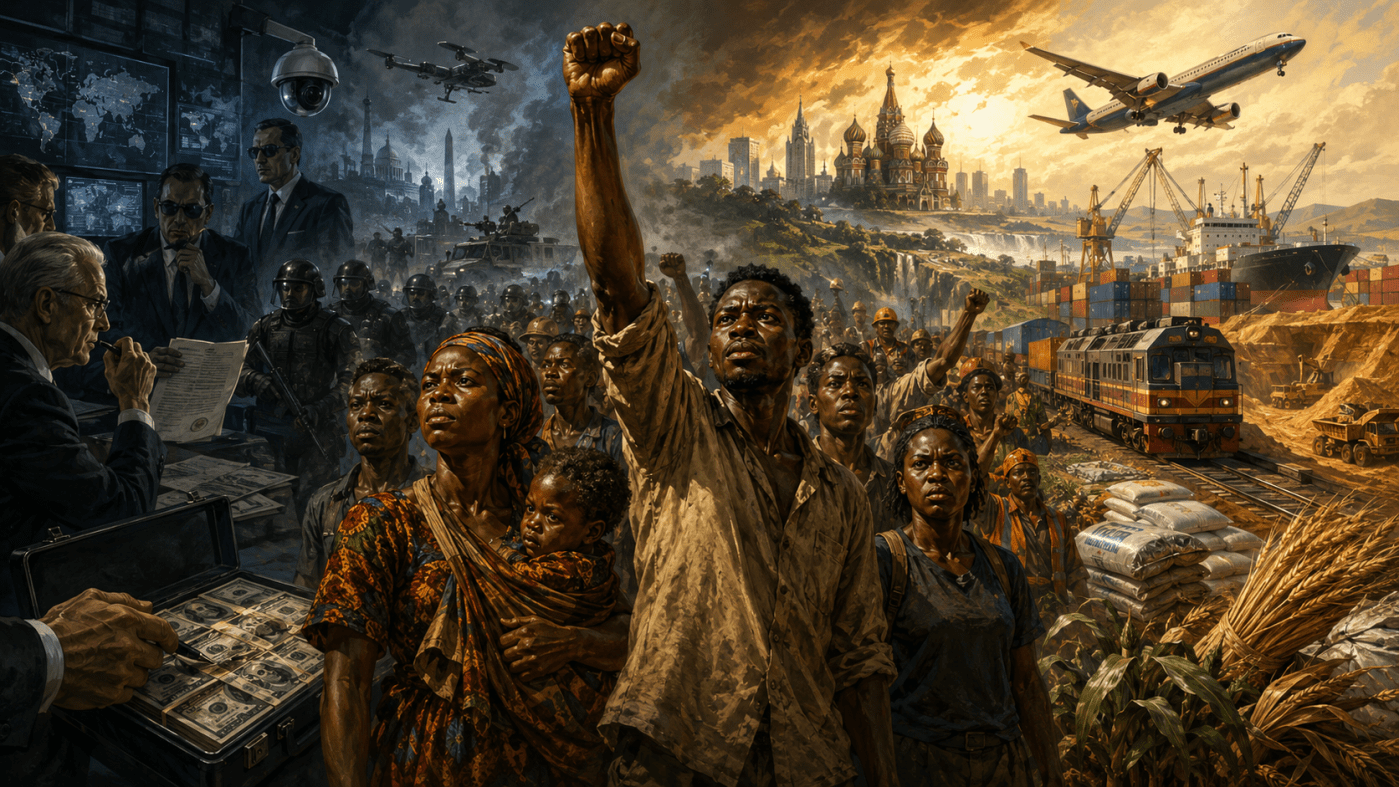
When Tanzania’s president visited Russia, the Western press told a familiar little bedtime story: a disgraced African government runs to Moscow while the noble West worries about democracy. But beneath the wire-service fog sits a harder material reality — wheat, uranium, logistics, local-currency trade, military training, education agreements, and the unfinished struggle over African sovereignty. This essay does not excuse Tanzania’s state repression, nor does it accept Washington and Brussels as guardians of the Tanzanian people. It argues instead that the people of Tanzania must be defended against both state violence and imperial punishment, because sovereignty without popular power is hollow, and human rights in the mouth of empire is usually just a leash.
By Prince Kapone | Weaponized Information | June 10, 2026
The West Is Always the Main Character
The article under excavation is “Tanzania President Visits Russia as Western Ties Fray”, an AFP wire report republished by MSN. In brief, the article reports that Tanzanian President Samia Suluhu Hassan began a three-day visit to Russia, met with Vladimir Putin, described the trip as “historic,” and hoped to expand trade, tourism, and mineral cooperation. It also places this visit against the backdrop of Western criticism over Tanzania’s 2025 election violence, U.S. sanctions against a senior police official, and Hassan’s contested claim to an overwhelming electoral victory. On the surface, it is a short diplomatic news item. Underneath, it is a small but useful specimen of how imperial media teaches the reader to see African diplomacy through Western eyes.
The outlet chain already tells part of the story. MSN is not the original reporting body here. It is the corporate distribution pipe, a Microsoft-owned aggregation platform through which wire copy is circulated to mass audiences in the digital news marketplace. AFP, the original source, is one of the great old European wire services, lodged in the professional culture of bourgeois neutrality, where the sentence is short, the tone is clean, the politics are buried, and the empire speaks most effectively by pretending not to speak at all. This is not crude colonial journalism with a pith helmet and a riding crop. It is something smoother. The lash has been replaced by the hyperlink, the missionary tract by the wire report, the colonial district officer by the “regional analyst.”
The authorial voice is institutional rather than personal. The byline belongs to AFP, not to a named reporter whose method, archive, or political commitments can be examined directly. This matters. The institutional wire voice performs objectivity by arrangement. It stacks the scene, selects the witnesses, compresses the background, and then presents the resulting little package as common sense. Tanzania does not appear first as a country with its own development priorities, diplomatic history, trade needs, or strategic calculations. It appears first as a country whose “reputation in the West” has been “badly damaged.” The West, once again, is not merely a bloc of states. It is the measuring rod of political reality.
The headline is the first act of discipline. “Western ties fray” frames the visit to Russia not primarily as Tanzania pursuing a bilateral relationship, but as Tanzania drifting from the proper diplomatic parent. The reader is invited to ask: why is Tanzania moving away from the West? Not: what does Tanzania need? Not: what is Russia offering? Not: what sectors are being negotiated? Not: what history lies behind this relationship? The headline hands the reader the answer before the investigation begins. Moscow becomes the sign of scandal. The West becomes the implied court of appeal.
The article then practices card stacking with the neatness of a clerk arranging evidence for a pre-decided verdict. Western diplomats, rights groups, U.S. sanctions, an unnamed professor, and Chatham House are all given space to define the meaning of the visit. Tanzanian and Russian officials are quoted, yes, but mostly to decorate the scene already framed by Western disapproval. Hassan says the trip is historic. Putin says trade should increase. Then the article returns to the more familiar furniture: repression, isolation, damaged reputation, Western concern, authoritarian hospitality. The reader is not denied facts. The reader is given a hierarchy of facts.
There is also the old trick of poisoning the well. Before the economic content of the visit can breathe, the article loads the atmosphere with massacre allegations, abductions, murders, sanctions, and a 98-percent election result. These may be serious matters, and no revolutionary has any duty to prettify state repression. But the structure of the article uses them less as a subject to investigate than as a moral fog machine. By the time trade, minerals, tourism, uranium, flights, and business delegations appear, they are already wearing the smell of diplomatic shame. The point is not to understand the relationship. The point is to mark it as suspicious.
The omissions are just as revealing as the claims. The article mentions trade without explaining the material composition of that trade. It mentions minerals without explaining the industrial content. It mentions direct flights without exploring transport, tourism, cargo, or logistical meaning. It mentions Nyerere’s 1969 visit as a historical flourish but does not allow that history to become an interpretive foundation. It mentions Western criticism but not Western leverage. It gestures toward Tanzania’s domestic crisis but refuses to ask why Western states become so morally animated precisely when an African government deepens ties outside their preferred orbit.
What remains is a compact lesson in imperial narrative framing. Africa may trade, but the West must interpret. Africa may travel, but the West must judge the destination. Africa may pursue partners, but if the partner is Moscow, the story must begin with damaged reputation and end with geopolitical suspicion. This is how a short wire report does long imperial work. It does not need to shout. It merely arranges the room so that the reader enters already facing the empire’s mirror.
What the Wire Report Buried Under Two Minutes of Reading
The basic facts of the visit are not mysterious. Tanzanian President Samia Suluhu Hassan traveled to Russia for a June 3–5, 2026 state visit, met Vladimir Putin in Moscow, and participated in the diplomatic and business orbit surrounding the St. Petersburg International Economic Forum. Tanzanian reporting described the trip as historically unusual because it was only the second visit by a Tanzanian head of state to Russia since Julius Nyerere’s October 1969 visit. That historical detail appears in the AFP article as a small decorative bead, but it should have opened the door to a serious reconstruction of what the trip actually meant. Instead, the reader is hurried past the material terrain and escorted into the familiar waiting room of Western concern.
The visit was not only a handshake for the cameras. Tanzanian reporting ahead of the trip stated that Hassan would present Tanzania’s investment opportunities in special economic zones, industrialisation, energy, infrastructure, mining, and tourism. Tanzanian state-linked reporting also identified expected cooperation in trade, investment, education, science and technology, energy, mining, agriculture, infrastructure, tourism, ICT, and higher education. The article under excavation reduces this whole field to a few thin words — trade, tourism, minerals — as though the sectors were a diplomatic shopping list rather than the skeleton of a development agenda.
The trade relationship itself is modest but concrete. Tanzanian reporting placed annual Tanzania–Russia trade at about $321.1 million in 2024/25, with Tanzania exporting only about $5.78 million to Russia while importing far more. That imbalance matters. It tells us that Tanzania is not simply “turning to Moscow” for symbolism. It is trying to widen export access, deepen commercial routes, and change the practical conditions under which Tanzanian goods can enter Russian markets. Russian officials reportedly discussed expanding imports of Tanzanian coffee, tobacco, avocados, nuts, and fruit, while Russia identified possible exports to Tanzania including fertilizers, wheat, sunflower oil, and agricultural goods.
The wheat question is especially important. Tanzania’s annual wheat demand is around one million tonnes, while domestic production is only about 100,000 tonnes. More than 70 percent of Tanzania’s 2024/25 wheat imports reportedly came from Russia. That is not a slogan. That is a food-security fact. A country that imports most of a staple cannot treat grain supply as a side issue. The AFP report mentions trade as a diplomatic category. It does not tell the reader that wheat is one of the material hinges of the relationship.
The logistics question is equally concrete. Air Tanzania announced a direct Dar es Salaam–Moscow–Zanzibar route beginning July 2, 2026. Hassan linked the route to tourism, passenger movement, cargo, trade, and investment. This is why the little phrase “tourism” is insufficient. A flight route is not only a tourist postcard. It is a transport channel. It moves people, goods, delegations, investors, students, and cargo. It lowers the friction of a relationship. In a country trying to expand tourism receipts, export routes, and investment flows, the airplane is not just a machine in the sky. It is infrastructure.
The agreement content was also sharper than the AFP article allowed. Tanzania and Russia signed cooperation documents in higher education, science, scientific-technical activity, innovation, personnel training, and academic mobility, including cooperation involving Tanzania’s education ministry and RUDN University. This matters because development is not only steel, ports, and minerals. It is also trained personnel, scientific exchange, technical capacity, engineers, administrators, agronomists, doctors, and planners. A country cannot build a serious industrial economy with speeches alone. It needs people trained to run the systems that ministers announce from podiums.
The article also fails to explain that Tanzania–Russia relations do not begin with this one controversial visit. Russian diplomatic sources state that relations with Tanganyika began in December 1961, that relations with Zanzibar and Pemba began in January 1964, and that both countries maintain active embassies in Dar es Salaam and Moscow. Russia’s embassy in Tanzania also lists a 2018 agreement on military-technical cooperation as part of the legal basis of the bilateral relationship. Whatever one thinks of the Hassan government, the state-to-state relationship has a documented institutional history. It is not reducible to a panic trip by a besieged president.
The military and security lane is real, but it must be stated precisely. Russia and Tanzania signed a military cooperation agreement and a contract for training Tanzanian servicemen at Russian military academies in September 2016. In 2026, Tanzanian reporting said Russia pledged deeper military cooperation and that more than 300 Tanzanians were receiving military training in Russia. At the same time, the available evidence points to military training, military-technical cooperation, and defense education — not a mutual-defense treaty, not co-belligerency, and not a shared war theater. Precision matters. The relationship should not be inflated into fantasy, but neither should it be erased because it complicates the neat little morality tale.
The minerals question is also more concrete than the wire report’s passing reference suggests. Rosatom-linked Mantra Tanzania commissioned a pilot uranium processing facility at the Mkuju River project in July 2025, with the project tied to Rosatom subsidiary Uranium One Group. The article mentions a planned uranium mine as though it were an old file sitting in a cabinet. But pilot processing infrastructure means the relationship has an industrial and extractive content that cannot be reduced to diplomatic theater. Whether such projects serve national development or deepen extractive dependency is a political question, but the first task is to name the project accurately.
There is also a financial settlement issue. Tanzania and Russia were reportedly finalizing talks on a mechanism for bilateral trade settlement in national currencies. Tanzanian officials connected such mechanisms to the practical facilitation of trade. In plain language, the two sides were exploring how to move commerce without depending entirely on third-country payment channels. The AFP article gives the reader the drama of Western anger, but not the machinery of how states try to trade when payment systems, banking routes, sanctions risks, and currency exposure shape what can actually be bought and sold.
The domestic development context is not hidden because it is obscure. It is hidden because it would make the story less obedient. Tanzania’s official Development Vision 2050 identifies the goal of moving from low-productivity agriculture toward a more industrialized, human-development-centered economy and names pressures around agriculture, mining, industrialisation, land use, and economic transformation. Tanzania’s Third Five-Year Development Plan is organized around “competitiveness and industrialization for human development”, with emphasis on increasing efficiency and productivity in manufacturing using domestic resources. The Russia visit’s sectors — energy, infrastructure, mining, agriculture, education, transport, logistics, and investment — overlap directly with these stated national priorities.
None of this erases the immediate political crisis in Tanzania. A government-appointed commission acknowledged that at least 518 people were killed during the 2025 election violence. The United States then designated Tanzanian police official Faustine Jackson Mafwele under Section 7031(c) for alleged gross violations of human rights, a designation that bars him from entering the United States. U.S. senators also introduced the Reassessing the United States-Tanzania Bilateral Relationship Act, calling for a review of security, economic, and diplomatic engagement with Tanzania while also invoking concern over Chinese influence. European pressure moved on a parallel track, with Tanzanian reporting describing efforts to maintain a freeze on €156 million in EU funding after the election crisis.
This is the surrounding terrain the article compresses into “Western ties fray.” There was domestic violence. There was international criticism. There were U.S. visa restrictions. There was legislative pressure for a broader relationship review. There was European funding leverage. There was also a Tanzanian state pursuing wheat supply, export access, logistics corridors, scientific cooperation, military training, uranium processing, direct flights, local-currency settlement, and industrial-development partnerships. The facts do not fit inside the little box the wire report built for them.
The longer historical baseline matters as well. Tanzania’s official diplomatic history presents the country as the union of Tanganyika, which became independent from Britain in December 1961, and Zanzibar, which became free through revolution in January 1964 before uniting with Tanganyika in April 1964. Tanganyika had earlier been incorporated into German East Africa and then transferred into British mandate and trusteeship structures after Germany’s defeat, a sequence summarized in historical accounts of Tanganyika’s passage from German to British colonial rule before independence. German colonial violence remains a living wound in Tanzanian memory, including the Maji Maji war and the continuing struggle over stolen ancestral remains taken under German colonialism. A country born from anti-colonial rupture does not approach foreign policy as a child waiting for a lecture from Brussels or Washington.
Prior Weaponized Information analysis has already situated Tanzania’s resource policy inside the contradiction between sovereign economic maneuver and extractive dependency, especially in the analysis of Tanzania’s bullion program. WI has also treated African monetary sovereignty, gold, fertilizer, infrastructure, and alternative financial arrangements as fronts in the wider struggle to reduce dependence on Western commodity and financial chokepoints. The Tanzania–Russia visit belongs inside that same factual field. It is not simply an “authoritarian” president visiting an “authoritarian” partner while the noble West frowns into its teacup. It is a state under domestic crisis and external pressure pursuing material channels of food supply, training, transport, minerals, payments, and industrial development in a world where Western approval still comes dressed as morality and armed with leverage.
The Problem Is Not That Tanzania Has Options. The Problem Is That the West No Longer Has a Monopoly.
The real story is not that Tanzania has suddenly “turned to Russia” because the West is displeased. That is the nursery-school version of geopolitics, the version written for people who are expected to mistake the diplomatic mood of Washington and Brussels for the movement of history itself. The real story is that Tanzania is trying to maneuver inside a world system where formal independence never abolished dependency, where the old colonial masters still expect to grade African sovereignty like a school assignment, and where every attempt to widen diplomatic space is treated as a scandal if it does not pass through the proper imperial door.
This is why the article’s phrase “Western ties fray” does so much ideological work. It turns Tanzania’s foreign policy into a problem of Western disappointment. The country is not first presented as a nation with food needs, transport needs, industrial ambitions, educational priorities, military training channels, export problems, and development plans. It is presented as a country whose reputation has been damaged in the eyes of the West. The West becomes the audience. The West becomes the judge. The West becomes the implied owner of Tanzania’s diplomatic respectability. This is not analysis. It is imperial manners masquerading as journalism.
But the facts already reconstructed tell a different story. Under the gossip of diplomatic embarrassment sits the harder material terrain: wheat, fertilizer, sunflower oil, coffee, tobacco, avocados, nuts, fruit, uranium, flights, scientific cooperation, technical education, military training, local-currency settlement, special economic zones, industrialization, logistics, infrastructure, and Tanzania’s own long-term development plans. These are not ornaments. These are the material nerves of sovereignty in a dependent economy. A country cannot eat a Western communiqué. It cannot industrialize on diplomatic compliments. It cannot train engineers with a sermon from a think tank. It cannot move cargo on the wings of human-rights rhetoric. It needs routes, inputs, skills, machinery, markets, energy, and payment systems.
That does not make the Tanzanian government innocent. It does not cleanse the blood from the election crisis. It does not turn state repression into anti-imperialism by the magic trick of a Moscow handshake. There is no revolutionary obligation to cover for a ruling class because it speaks the language of sovereignty abroad while beating its own people at home. The people killed in the election violence do not disappear because a state delegation signs agreements on education or trade. The working class, peasants, youth, students, opposition supporters, and poor communities of Tanzania have their own claims against state power, and no serious anti-imperialist can pretend otherwise.
But this is precisely where revolutionary analysis must refuse the trap. Imperialism always wants us to choose between two lies. Either we accept Western moral supervision as the guardian of democracy, or we excuse domestic repression because the government under pressure is being targeted by the West. Both positions are garbage. Both positions leave the people disarmed. The first hands African sovereignty back to the old colonial and neocolonial managers. The second hands the people over to their own ruling class and tells them to be quiet for the sake of geopolitics.
The truth is sharper. Tanzania is moving through a double contradiction. From below, the masses confront a state that has used violence and coercion to secure political power. From outside, that same state confronts an imperial bloc that seizes on the crisis not because it has suddenly discovered love for African democracy, but because the crisis gives it leverage over Tanzania’s diplomatic and economic orientation. The West does not hate repression. It hates disobedient repression. When repression serves imperial stability, it is called order. When it appears beside Russian wheat, Chinese influence, alternative currency settlement, or non-aligned diplomacy, it becomes a sacred emergency.
This is the old colonial habit in modern dress. The empire disciplines, then lectures. It extracts, then moralizes. It builds the world market through plunder, debt, dependency, sanctions, military pressure, and unequal exchange, then arrives with a clipboard to ask why the former colony is not behaving like Denmark. What a miracle of civilization: first break the legs, then complain about the limp.
Tanzania’s turn toward Russia must therefore be understood as a movement inside the crisis of imperialism, not as a romantic act of liberation already achieved. Russia is not a charity house for the oppressed nations. Russia has its own state interests, commercial interests, strategic calculations, and resource ambitions. No one serious should dress state capitalism in red robes simply because Washington dislikes it. But the existence of alternative partners still matters. It matters because unipolarity was never just a military arrangement. It was a disciplinary system. It told countries where to borrow, where to trade, whose currency to use, whose development models to imitate, whose media judgment to fear, whose sanctions to obey, and whose investors must be kept smiling.
Multipolarity cracks that monopoly. It does not abolish class struggle. It does not abolish extraction. It does not guarantee popular sovereignty. It creates room for maneuver, and room for maneuver is always a battlefield. In the hands of a comprador class, new partnerships become new corridors of accumulation. In the hands of a people organized for power, they can become openings for development, technical capacity, food security, infrastructure, and reduced dependence on imperial chokepoints. The same flight route can carry tourists and cargo, or it can carry the habits of elite circulation. The same uranium project can become a lever of national development, or another hole in African soil through which value leaves the people. The same local-currency settlement can weaken dependence on external payment channels, or simply smooth the accounts of those already sitting at the top of the economy.
This is the question the article cannot ask: who controls the opening? The propaganda frame only wants to know whether Tanzania is moving closer to Russia while Western ties fray. The revolutionary frame asks whether Tanzania’s external diversification will deepen popular sovereignty or merely diversify the ruling class’s bargaining table. It asks whether development will be measured by the ability of the state to sign agreements, or by the ability of the people to command the social product of their labor, land, resources, and institutions.
The historical baseline matters because Tanzania was not born in a vacuum. Its statehood emerged from anti-colonial rupture, from the ending of British rule over Tanganyika, from Zanzibar’s revolutionary break, from the union that formed the country, and from a deeper memory of German colonial violence and British imperial management. That history does not automatically sanctify the present state. It does explain why diplomatic autonomy is not a decorative concern. For a country shaped by colonial domination, sovereignty is not a ceremonial flag. It is the unfinished struggle to decide how food is secured, how minerals are used, how children are educated, how soldiers are trained, how trade is settled, how infrastructure is built, and whether the people or the external masters set the terms of national life.
The AFP article shrinks all this into a morality play. A president under criticism visits Putin. The West frowns. Analysts explain. The reader nods. The curtain falls. But beneath that little stage is a much larger drama: a neocolonial state under domestic crisis seeks wider external options while the imperial bloc tries to discipline the direction of that maneuver. The ruling class wants sovereignty from above. The people need sovereignty from below. The West wants leverage over both.
That is why the revolutionary position must be clear. We do not confuse Western pressure with justice. We do not confuse Russian partnership with liberation. We do not confuse state sovereignty with people’s power. We defend the right of oppressed and formerly colonized nations to break the monopoly of imperial control, and we defend the right of the masses inside those nations to struggle against their own exploiters and repressors. Anything less is either imperial liberalism with better manners or campism with worse eyesight.
The real scandal is not that Tanzania has options. The real scandal, for the imperial mind, is that the old monopoly is cracking. Africa is not supposed to shop around. Africa is supposed to receive instructions. Africa is not supposed to negotiate wheat, minerals, education, payment systems, military training, and logistics with whoever it chooses. It is supposed to remain inside the supervised poverty of the “rules-based order,” where the rules are written in the capitals that once colonized, looted, and lectured the continent.
But history is moving, even when the wire services try to compress it into two minutes of reading. The old imperial order is not dead, but it is anxious. Its anxiety appears in headlines. It appears in sanctions. It appears in aid freezes. It appears in congressional reviews. It appears in the sudden holiness of governments that have never cared for African life unless African life can be used as evidence against an inconvenient state. The mask slips, and behind it we see the same old face: property, power, discipline, and the fear that the colonized world may no longer ask permission before breathing.
Hands Off Tanzania, Justice for the Tanzanian People
Our position must begin where all honest anti-imperialist politics begins: with the people. The Tanzanian people have the right to resist killings, disappearances, political repression, internet shutdowns, the criminalization of protest, and every form of state violence used to silence them. No president, party, police commander, court, or ministry owns the breath of the people. No government earns a revolutionary blank check because it signs agreements in Moscow, speaks the language of sovereignty, or irritates Washington. Sovereignty that sits only in the presidential palace is not yet sovereignty. It is state power wearing the national flag.
But the people of Tanzania also do not belong to the United States, the European Union, or the old colonial club that still imagines Africa as its supervised estate. Tanzania has the right to trade with Russia. Tanzania has the right to negotiate wheat, fertilizer, education, logistics, direct flights, local-currency settlement, military training, and mineral development with whatever partners it chooses. Tanzania has the right to pursue non-aligned diplomacy without begging permission from the same imperial powers that built their wealth on the backs of colonized peoples. A country born from anti-colonial struggle does not need a hall pass from the descendants of empire.
This is why we must reject the dirty little trick at the heart of Western policy. The United States has already turned Tanzania’s crisis into a pressure point through the designation of Tanzanian police official Faustine Jackson Mafwele, while U.S. senators have pushed a broader review of security, economic, and diplomatic engagement with Tanzania. European pressure has moved through the money weapon as well, with Tanzanian reporting describing efforts to maintain a freeze on €156 million in EU funding. This is not solidarity with the Tanzanian people. This is imperial leverage wearing the mask of concern.
We know this mask. We have seen it over Haiti, Libya, Venezuela, Zimbabwe, Cuba, Nicaragua, Syria, Iran, and every other place where the empire discovers human rights at the exact moment a government becomes inconvenient. The empire does not oppose repression as such. It opposes disobedient repression. If a state kills and imprisons while serving imperial interests, it is called a partner. If a state brutalizes its people while also building relations outside the Western orbit, suddenly the microphones turn on, the sanctions lawyers wake up, and the think tanks begin humming like insects over a corpse. The dead become evidence. The suffering becomes a policy instrument. The people become props in somebody else’s geopolitical theater.
That is why our line must be disciplined and impossible to confuse. We stand with the Tanzanian people against state repression. We stand against U.S. and EU punishment of Tanzania for diversifying its relations. We oppose aid blackmail, sanctions escalation, diplomatic threats, and every attempt to turn human-rights language into a leash around African sovereignty. We refuse the false choice between imperial liberalism and state apologetics. The people do not need Washington to discipline their government, and they do not need their government to hide behind Moscow while evading the demands of the street.
Inside Tanzania, the motion of the people has already appeared through youth-led protest currents around Katiba Mpya, political prisoners, anti-repression demands, and post-election justice. These currents do not always arrive as polished organizations with grant reports and executive directors. They arrive as slogans, barricades, grief, courage, and refusal. They arrive as young people who know that a country without the voice of its people is only a flag over a locked room. We must defend their right to struggle without pretending that every force inside that terrain is pure, perfect, or already revolutionary. The first duty is not romanticism. It is solidarity with the democratic and popular space the people need in order to breathe and organize.
For those of us inside the United States, the clearest responsibility is to attack the imperial machinery from where we stand. The Black Alliance for Peace’s U.S. Out of Africa: Shut Down AFRICOM campaign gives this work its strongest anti-imperialist spine. BAP’s 2025 International Month of Action Against AFRICOM named the enemy plainly in its theme, “21st Century Neocolonialism: Capitalism, Compradors, and the Ongoing Scramble for Africa”. That is the frame this moment requires. Tanzania is not an isolated headline. It is one node in the larger struggle over whether Africa will be policed, disciplined, lectured, and managed by the imperial center or whether African peoples will determine their own future.
BAP’s campaign demands include the withdrawal of U.S. forces from Africa, the closure of U.S. bases, and public hearings on AFRICOM with African and U.S. civil-society participation. Its structure is also publicly identified: BAP says it is fiscally sponsored by Community Movement Builders, a 501(c)(3). That matters because movements require more than outrage. They require trusted vehicles, political clarity, infrastructure, and accountability. If we are serious about Tanzania, we must not only share articles and shake our heads at Western hypocrisy. We must organize against the U.S. military and diplomatic apparatus that turns African crises into imperial opportunities.
The resource front must also remain in view. Around the Mkuju River uranium project, earlier community education efforts sought to educate local leaders in Namtumbo District on the effects of uranium mining, and environmental-justice documentation describes surrounding communities as fighting for their rights in relation to uranium extraction. This is where sovereignty becomes concrete. Minerals can either serve the people or pass through them like a curse. Uranium can either be folded into a national development strategy under popular control, or become another hole in African soil through which value escapes while local communities inherit the danger. The question is not only who signs the agreement. The question is who lives with the consequences.
Our readers and supporters should take this article and use it as a weapon of political education. Put the headline in front of people: “Western ties fray.” Then ask what the headline hides. Ask why wheat disappears. Ask why direct flights are treated as tourism instead of logistics. Ask why local-currency settlement is invisible. Ask why military training is mentioned only when it can sound sinister. Ask why uranium appears as a footnote rather than a struggle over land, energy, extraction, and sovereignty. Ask why the West’s anger is treated as moral truth while its own leverage is treated as background weather.
This is the work: expose the propaganda, defend the people, oppose the empire, and refuse the lazy comfort of simple camps. We do not say “hands off Hassan,” because the people are not furniture in the president’s house. We do not say “sanction Tanzania,” because Tanzania is not a plantation whose overseer sits in Washington. We say: hands off Tanzania, justice for the Tanzanian people, no imperial punishment, no state impunity, no AFRICOM discipline, no resource plunder, no aid blackmail, and no confusion between elite maneuver and popular sovereignty.
The people of Tanzania have the right to breathe without police terror and without imperial permission. That is the line. Let the empire choke on it.


Leave a Reply