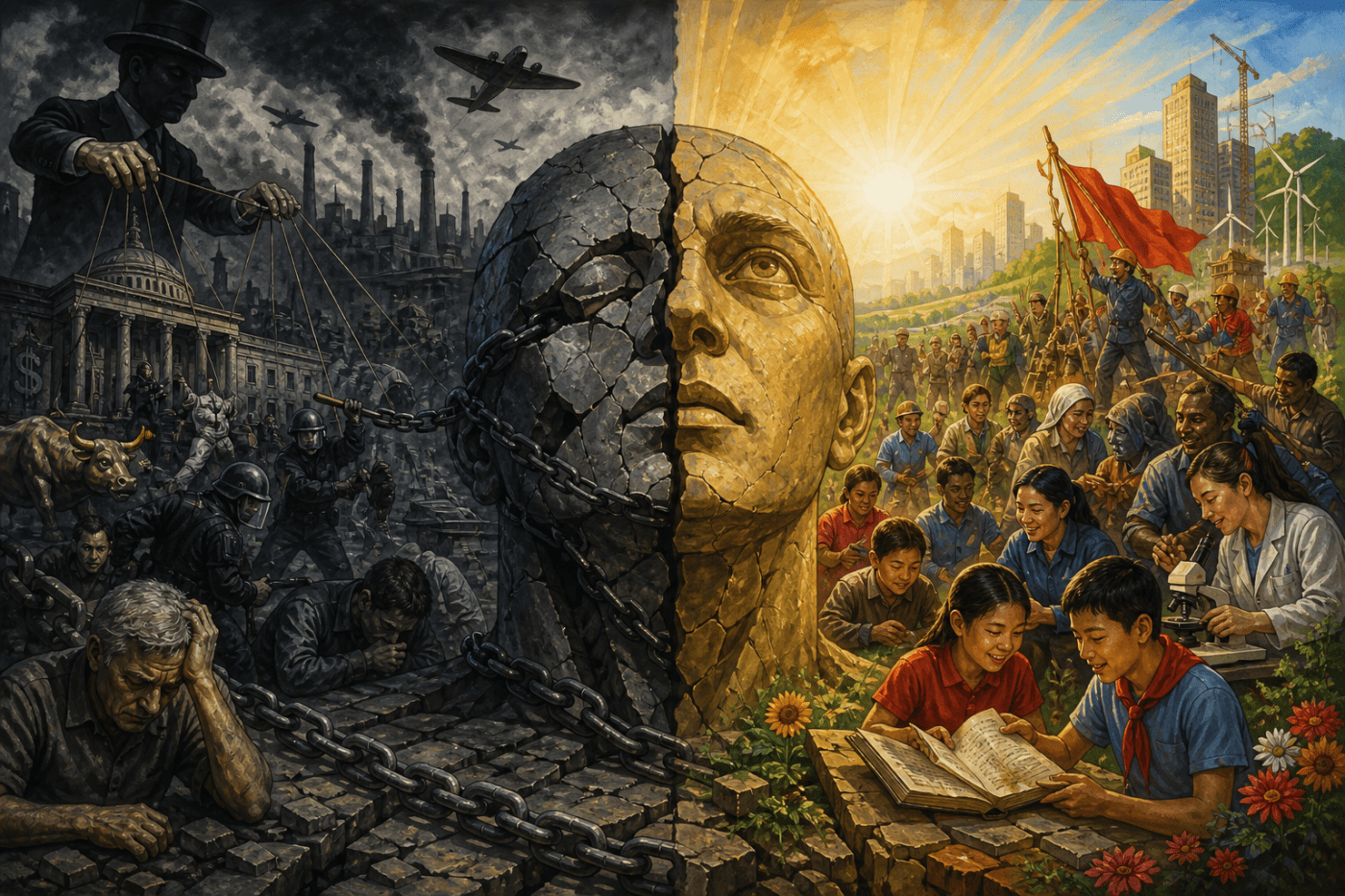
The claim that socialism “failed” collapses the moment we ask who defines success and by what criteria. From the Soviet Union to China, socialist societies transformed conditions of war, poverty, and underdevelopment into measurable gains for the masses. When capitalism is judged by those same standards, it reveals itself as a system that reproduces crisis even at the height of its power. What remains is not a failure of socialism, but a failure of the narrative imposed to discredit it.
By Prince Kapone | Weaponized Information | May 2, 2026
The Sentence That Thinks for You
Everywhere you go, you hear it. In classrooms, on job sites, in barbershops, on podcasts, in comment sections, in the quiet confidence of people who have never been asked to explain it: socialism sounds good on paper, but it has never worked in practice. The sentence travels easily. It requires no evidence, no history, no definition. It arrives fully formed, like a tool handed down, ready to be used without inspection. And because it is repeated so often, it begins to feel like common sense rather than something that must be proven.
But listen closely and the sentence reveals more than it intends. The first half is not an attack—it is an admission. To say socialism sounds good is to acknowledge that the idea of organizing society around human need, cooperation, public welfare, and collective development has an intuitive appeal. It is to recognize, however faintly, that a system built on profit, competition, and private accumulation does not align with what people actually need to live full human lives. The worker who says this is not rejecting socialism as an ideal. He is being told that the ideal cannot exist in reality.
That is where the argument must begin. If socialism is dismissed not because it is undesirable but because it is supposedly impractical, then the question is no longer philosophical. It becomes concrete. What does it mean for a system to work in practice? What standards are being used to make that judgment? Are we speaking about the ability of a society to sustain human life, to organize production, to provide for the population, to develop its capacities, to govern itself? Or are we dealing with a conclusion that has been accepted without ever being defined?
These are not semantic questions. They determine whether we are engaged in serious analysis or repeating inherited assumptions. A claim about practice must be tested against reality. It must be grounded in criteria that can be examined, measured, and compared. Without that, the statement that socialism has never worked does not function as an argument. It functions as a stopping point, a way of ending the conversation before it begins.
The purpose of this essay is to reopen that conversation on disciplined terms. We are not interested in trading slogans. We are not interested in defending abstractions. We are interested in examining how societies have actually functioned, how they have been organized, what they have attempted to do, and how they have been judged. That requires clarity about definitions, attention to historical conditions, and a willingness to evaluate systems by consistent standards.
So we begin with a simple intervention: if the claim is that socialism has failed in practice, then it must be evaluated in practice. That means identifying the criteria by which success and failure are determined and applying them consistently. Only then can the statement be taken seriously. Only then can it be tested. And once it is tested, it must stand or fall like any other claim—on the basis of evidence, reasoning, and the realities of the world we are trying to understand.
From Backwardness to Development: What It Means to Work in Practice
If the claim is that socialism fails in practice, then the only honest way to evaluate that claim is to examine what socialism has done in practice. Not what it promised in theory, not what its critics say about it in abstraction, but what actually happened when societies attempted to reorganize themselves along socialist lines. That requires discipline. It requires criteria. It requires that we look at concrete indicators: whether people could eat, whether they could read, whether they could live longer, whether they could produce, whether they could build, whether they could sustain themselves as a society. Anything less is not analysis. It is storytelling.
Start with the economic question, because without it nothing else stands. Can a system develop the productive forces? Can it transform a society from poverty and backwardness into one capable of sustaining and expanding human life? In the case of the Soviet Union under Stalin, the empirical record is not ambiguous. Economic historian Robert C. Allen demonstrates in Farm to Factory that the Soviet economy grew at roughly 5.3 percent annually between 1928 and 1940, making it one of the fastest-growing economies of the twentieth century. Industrial output expanded at approximately 8.9 percent per year in that same period, compared to just 1.8 percent in the United States, as shown in NBER comparative data. These are not marginal gains. They are the statistical signature of a society undergoing rapid structural transformation.
The material outputs tell the story even more concretely. Steel production increased from 4.3 million tons in 1928 to 17.7 million tons by 1937. Coal output rose from 35.5 million tons to 128 million tons. Electricity generation expanded from 5.0 billion kWh to 36.2 billion kWh. Machine-building capacity exploded, with metal-cutting machines increasing from roughly 2,000 units to over 48,500. These figures, compiled in historical summaries such as industrialization data, demonstrate the rapid expansion of heavy industry under planned development. As Allen further notes in his analysis of Soviet growth, this transformation was driven by capital accumulation, labor mobilization, and productivity gains comparable to the most successful capitalist growth episodes.
These are not abstract achievements. They represent a qualitative leap in the capacity of society to produce, to build, and to sustain itself. A country that had been largely agrarian, underdeveloped, and economically dependent became an industrial power within a generation. And this was not achieved under peaceful conditions. It was achieved under threat of invasion, under economic isolation, and in preparation for a war that would devastate the country. To call this failure is not analysis—it is ideological refusal.
The same structural transformation appears, in different form, in the People’s Republic of China. When the revolution succeeded in 1949, China inherited a society marked by warlord fragmentation, colonial domination, landlord exploitation, famine, and extreme poverty. Life expectancy hovered around 35 to 40 years, as documented in peer-reviewed mortality studies. The task was not refinement. The task was construction. Over the following decades, China transformed itself into one of the most dynamic economies in the world. According to the World Bank, China lifted close to 800 million people out of extreme poverty, accounting for over 70 percent of global poverty reduction during that period.
This transformation was not accidental. It was structured. The Tricontinental Institute documents how poverty eradication in China involved coordinated planning, cadre deployment, rural governance, and long-term socialist construction rooted in land reform and collective organization. Contemporary planning continues this trajectory. China’s 15th Five-Year Plan outlines expansion in infrastructure, energy, transportation, and social provision, demonstrating continuity in planned development. Infrastructure alone illustrates the scale: China has built approximately 45,000 kilometers of high-speed rail, with expansion toward 60,000 kilometers projected, as reported by the Financial Times. This is not the outcome of spontaneous market coordination. It is the result of directed development.
And the pattern extends beyond the major cases. In Vietnam, poverty fell from roughly 45 percent of the population in 1992 to less than 1 percent by 2022, according to the OECD, while the IMF notes that roughly 40 million people were lifted out of poverty in the preceding decades. In Cuba, a system of universal healthcare and education was constructed under blockade, documented in analyses such as Development Education Review. Even in the DPRK, research submitted to the United Nations documents the existence of national systems of healthcare, education, and childcare developed under extreme sanctions.
The economic transformation produces social transformation. In the Soviet Union, literacy rose from roughly 24 percent in 1897 and around 40 percent by 1914 to approximately 75 percent by 1937. The literacy campaigns achieved in roughly two decades what took Western Europe more than a century. Life expectancy rose from 32.3 years in the late Tsarist period to 44.4 years by the late 1920s and reached 68.6 years by the late 1950s, as shown in demographic data. A recent review of Soviet living standards confirms significant improvements in health, education, and biological well-being during the 1930s, even while acknowledging contradictions.
China’s social transformation is equally striking. Life expectancy rose from roughly 35–40 years in 1949 to 65.5 years by 1980. Between 1965 and 1975 alone, life expectancy increased from 49.5 to 63.9 years while child mortality fell dramatically. By 2018, life expectancy had reached 77 years, representing a gain of over 36 years since the early socialist period. These gains were driven by mass health campaigns, rural medical systems, and expanded education—policies rooted in the socialist commitment to social provision.
This is the decisive point. Socialism must be judged by whether it improves the material conditions of human life. On that basis, the historical record is clear. Socialist societies transformed illiterate populations into educated ones, extended life expectancy, reduced mortality, expanded healthcare, and built the infrastructure necessary for modern life. They did this not under ideal conditions, but under conditions of war, blockade, underdevelopment, and global hostility. The contradictions are real, but so are the achievements. And when measured against the conditions they inherited, those achievements are not just significant—they are extraordinary.
So when we return to the original claim—that socialism fails in practice—we are forced to confront its emptiness. If practice means developing productive capacity, raising living standards, expanding education, improving health, and organizing society to meet human needs, then socialism has not failed. It has done precisely what it set out to do. The only way to maintain the claim is to ignore the record entirely. And once we reach that point, we are no longer dealing with argument. We are dealing with ideology.
Democracy Is Not a Ballot—It Is Power Over Life Itself
When the critics of socialism abandon the terrain of material reality, they do not ascend to higher truth—they retreat into abstraction. Now we are told that socialism may build, may feed, may educate, but it does not provide “freedom,” it does not provide “democracy.” The accusation is delivered as if these words float above history, as if they carry meaning independent of power, class, and material life. But once we strip away the ritual language, the question becomes brutally simple: who rules? Not who votes, not who speaks, not who debates—but who actually controls the conditions under which society lives, produces, and reproduces itself.
Marxism does not permit us to hide behind illusions here. As Walter Rodney makes clear in “People’s Power, No Dictator”, the concept of dictatorship must be understood in class terms: a dictatorship is rule exercised on behalf of a class. The question is not whether power is concentrated, but whose interests it serves. A system that claims democracy while leaving the majority economically powerless is not democratic—it is simply a different form of domination. Rodney reminds us that workers and peasants are the overwhelming majority in most societies, and yet historically they have rarely governed. Democracy, in any meaningful sense, must begin with their rule.
This is where capitalist democracy reveals its limits. It offers participation without power, voice without control, representation without transformation. The empirical record leaves little room for doubt. The Gilens and Page study demonstrates that policy outcomes in the United States overwhelmingly reflect the preferences of economic elites, while ordinary citizens have near-zero independent influence. Even when majorities disagree with elites, they lose. This is not a malfunction. It is the system operating as designed. Wealth commands policy because wealth controls the economic base—production, finance, employment, media, and investment. Elections occur within boundaries drawn by capital. The people vote, but capital governs.
And this system, so often celebrated as the pinnacle of democracy, did not emerge as rule by the people. It began as rule by a narrow class. As documented by the Carnegie voting rights timeline, early U.S. political participation was restricted to white male property owners. The historical record shows that only about 6 percent of the population could vote in the early republic. As Colonial Williamsburg explains, expansion of suffrage often came alongside deeper racial exclusion. This is the historical foundation of bourgeois democracy: not universal participation, but structured exclusion tied to property and race.
The anti-imperialist tradition pushes this critique further. Kwame Nkrumah argued that political independence without economic control produces neocolonialism, where formal democracy exists but real power remains external. Nkrumah showed that financial and economic structures continue to shape political outcomes long after formal colonial rule ends. Samir Amin extends this critique by arguing that under monopoly capitalism, electoral democracy becomes an “electoral farce,” masking the concentration of power in economic elites. Domenico Losurdo reinforces this historical reality in Liberalism: A Counter-History, exposing how liberal democracy developed alongside slavery, colonialism, and racial exclusion. What is presented as universal democracy was, in practice, a system of selective inclusion built on global domination.
Against this backdrop, socialist revolutions represent a different political project. They do not begin by asking how to perfect electoral procedures. They begin by asking how to transfer power. V.I. Lenin provides the theoretical clarity in State and Revolution: the state must become the organized power of the working class. This is not metaphor. It is institutional. The 1936 Soviet Constitution defined the USSR as a state of workers and peasants and established universal suffrage, while guaranteeing rights to work, education, healthcare, and social provision. Political participation was tied to material conditions, recognizing that a hungry, uneducated, precarious population cannot meaningfully govern.
More importantly, Soviet democracy did not exist only on paper. It emerged from mass organs of power—soviets, factory committees, workers’ councils. As shown in studies of factory committees, workers exercised direct influence over production, while even the U.S. Marine Corps analysis acknowledged that workers’ councils took control of factories and determined production goals. Later analysis such as EuropeNow shows that grassroots party organizations on the factory floor acted as a real, if contradictory, base of political engagement. This was not liberal pluralism. It was an attempt to embed political power in the process of production itself.
In China, this project took the form of mass mobilization and collective organization. The Constitution of the People’s Republic of China defines the state as a people’s democratic dictatorship led by the working class and based on the worker-peasant alliance. Mao-era people’s communes, described in contemporary sources, organized production and governance collectively. In the present, China’s system of whole-process people’s democracy emphasizes consultation, participation, and grassroots governance. As Rland Boer argues in his analysis, this represents a form of democracy that cannot be reduced to Western electoral models.
Cuba advances this logic further. The 2019 Cuban Constitution defines the National Assembly of People’s Power as the highest organ of state authority, expressing the sovereign will of the people. Governance operates through local assemblies, national structures, and mass organizations. As analysis of People’s Power shows, this system connects local participation to national decision-making. Organizations such as the Federation of Cuban Women integrate social groups into political life, while research on Cuban participation highlights the role of mass consultation. This is not democracy as competition between elites. It is democracy as organized participation.
Vietnam completes the picture. Political success here cannot be separated from national liberation. As Le Duan argues in his analysis of socialist revolution, imperialism and landlordism had to be defeated simultaneously. The Vietnamese revolution created a state rooted in workers and peasants, emerging from decades of anti-colonial struggle. The revolutionary task was to establish a government of workers, peasants, and soldiers. Political success here is not procedural—it is the transformation of a colonized population into a sovereign political subject.
What unites these experiences is not uniformity but principle. Socialist democracy is not defined by multiparty competition within a capitalist framework. It is defined by the attempt to transfer power to the producing classes and to embed that power in institutions of collective life—workplaces, communes, assemblies, and mass organizations. As C.L.R. James argued in “Every Cook Can Govern”, ordinary people are capable of governing society. The question is whether institutions are built to allow them to do so.
This brings us to the decisive contrast. Capitalist democracy separates politics from economics, allowing the people to participate in governance while leaving the material basis of society under private control. Socialist democracy attempts to reunite them, to ensure that those who produce society also direct it. This is not a perfect achievement. It is a process, marked by contradiction and struggle. But it represents a fundamentally different answer to the question of democracy. The issue is not whether socialism conforms to liberal forms. The issue is whether it creates the conditions for the people to actually rule. And when examined on those terms, the claim that socialism lacks democracy collapses into the same category as the claim that it never worked: a statement sustained not by evidence, but by ideology.
The Mountain of Bones Beneath the Market
When the argument retreats to morality, it does so with a certain arrogance—as if capitalism stands before history with clean hands, ready to judge. Socialism is accused of coercion, of violence, of harshness. The tone shifts from analysis to indictment. But morality, if it is to mean anything, cannot be selective. It must examine systems in their totality, in their historical formation, in the lives they have taken and the worlds they have built. And when we apply that standard consistently, the moral hierarchy collapses. Capitalism does not sit in judgment over socialism. It stands in the dock.
This is not rhetoric. It is historical record. Modern capitalism emerged not as a peaceful system of exchange but through conquest, enslavement, and dispossession. Domenico Losurdo shows in Liberalism: A Counter-History that the very tradition that speaks the loudest about freedom developed alongside slavery, colonial domination, and racial hierarchy. Freedom for some required unfreedom for many. The plantation and the colony were not deviations from capitalism—they were its laboratories.
Walter Rodney makes this even more precise. In How Europe Underdeveloped Africa, he demonstrates that Europe’s rise was inseparable from Africa’s devastation. Wealth was not created in isolation; it was extracted, transferred, and accumulated through violence. Africa was not “left behind”—it was pushed back. This is the moral baseline of capitalism: development through underdevelopment, accumulation through destruction.
Nowhere is this clearer than in the system of chattel slavery. The Trans-Atlantic Slave Trade Database records that approximately 12.5 million Africans were forcibly loaded onto ships, with about 10.7 million surviving the Middle Passage into bondage. Over 36,000 voyages carried human beings as cargo across the ocean. This was not peripheral. This was central. The plantation system produced the raw materials—sugar, cotton, tobacco—that fed industrial capitalism. Banks financed it. Insurance companies secured it. States protected it. The market, we are told, is neutral. But here the market is soaked in blood.
The same system required land, and that land had to be taken. Indigenous populations in what became the United States declined from over 10 million to under 300,000 by 1900. A broader estimate suggests that up to 90 percent of Indigenous populations in the Americas perished in the process of colonization. This was not accidental disease alone. It was a structure of elimination—war, displacement, starvation, and cultural destruction. Capitalist property relations in the New World were built on land cleared by genocide. To speak of “free markets” without this history is to speak in abstraction detached from reality.
Colonialism extended this logic globally. Economist Jason Hickel estimates that the Global South lost $62 trillion through unequal exchange between 1960 and 2017, or $152 trillion when accounting for lost growth. The Tricontinental Institute calculates that in 2017 alone, $2.2 trillion was transferred from the Global South to the Global North—enough to end extreme poverty many times over. This is not ancient history. This is the present. Capitalism continues to extract, to drain, to restructure entire regions in the interests of accumulation. The empire has changed its methods, but not its function.
Even the mechanisms that appear peaceful—debt, trade, finance—carry coercive force. Kwame Nkrumah called this neocolonialism: a system in which political independence exists alongside economic domination. Samir Amin described modern capitalism as a global system of unequal exchange that reproduces dependency. These are not moral accusations. They are structural analyses. Capitalism disciplines nations not only through war, but through markets that compel submission or punish resistance.
And when markets fail to enforce order, violence returns in its most direct form. The United States dropped over 635,000 tons of bombs on North Korea, destroying the majority of its cities. In Vietnam, nearly 80 million liters of chemical agents were deployed, poisoning land and people alike. In Iran, a U.S. strike on a primary school in Minab killed at least 175 people, including large numbers of children. Cuba continues to endure a deepening economic blockade that cost over $7.5 billion in a single recent year, condemned repeatedly by the overwhelming majority of the world’s nations. These are not anomalies. They are instruments of a system that enforces its global order through coercion, whether economic or military.
None of this requires pretending that socialist revolutions were gentle affairs. They were not. The Soviet Union carried out executions, mass arrests, deportations, and coercive campaigns, especially during the intense class struggles of the 1930s. Revolutionary China experienced famine, factional struggle, campaigns against counterrevolutionaries, and coercive state measures. No serious Marxist has any need to deny this. The question is whether these events are studied historically or converted into anti-communist mythology. Archival scholarship places Soviet executions in 1937–1938 at roughly 681,692, while broader archival summaries put political executions from 1921 to 1953 at roughly 799,455—brutal figures, but not the “tens of millions executed” fantasy circulated by Cold War propaganda. Likewise, the Great Leap Forward famine was a catastrophe, but the death toll has been the subject of major scholarly dispute, with estimates ranging widely and with radical scholars challenging the inflated figures used to claim that Mao personally “killed” tens of millions of his own people.
The difference matters. To count famine deaths, unborn children, wartime casualties, disease mortality, civil-war losses, and executions under one ideological label—“communism killed”—is not history. It is bookkeeping for empire. Even the Black Book of Communism, famous for its “100 million” figure, was criticized by several of its own contributors for number inflation and political framing. Robert Conquest’s earlier high estimates were also challenged after the Soviet archives opened, while Conquest himself had ties to Britain’s anti-communist Information Research Department. The point is not to sanitize socialist violence. The point is to refuse capitalist mythology disguised as arithmetic.
Once we restore scale, context, and proportion, the moral terrain changes completely. Socialist coercion cannot be abstracted from the conditions that produced it. The Soviet Union did not arise in a seminar hall—it emerged from world war, civil war, economic collapse, and foreign intervention by multiple imperial powers determined to crush it. The People’s Republic of China was forged through invasion, counterrevolution, and prolonged encirclement. Cuba has endured decades of blockade and subversion. Vietnam fought successive wars against colonial and imperial armies. In each case, the question of coercion was inseparable from the question of survival. This was not the violence of expansion into foreign lands for profit. It was the violence of societies attempting to defend their existence, consolidate power, and reorganize life under relentless external pressure.
To acknowledge this is not to excuse everything, nor to flatten contradiction into apology. Socialist societies were marked by struggle—internal conflicts, errors in policy, excesses in repression, and moments where state power overreached. But serious moral analysis does not proceed by isolating these contradictions from their historical environment. It does not inflate numbers, collapse categories, and treat every death as equivalent proof of ideological evil. That method belongs to propaganda, not history. What we are confronted with instead is a consistent pattern: socialist violence is magnified, decontextualized, and moralized, while capitalist violence is normalized, diffused across centuries, and treated as the unfortunate backdrop of progress.
When the comparison is made on equal terms, the asymmetry becomes undeniable. Capitalism’s violence is not episodic—it is constitutive. It creates the land through dispossession, the labor force through enslavement, the global order through conquest, and its ongoing stability through economic coercion and periodic war. Socialist coercion, by contrast, appears within a process of rupture—an attempt, however imperfect, to break from that very system under conditions of siege. One system expands outward, accumulating through domination. The other emerges within hostile terrain, attempting to build while under attack. To treat these as morally equivalent is to erase the difference between a system that requires violence to exist and one that encounters violence in the act of transforming society.
And so the moral indictment collapses under its own weight. Capitalism cannot condemn socialism for coercion without confronting its own foundations. It cannot invoke human life as sacred while presiding over a history defined by mass death, displacement, and extraction. It cannot speak of freedom while maintaining a world order structured by inequality and enforced by power. When it does so, it is not offering a moral argument—it is asserting ideological authority. The task, then, is not to measure socialism against standards set by capitalism, but to interrogate those standards themselves. And once that interrogation begins, the conclusion is unavoidable: a system built on conquest does not possess the moral ground to judge those who resisted it.
The Claim That Repeats Itself: Manufacturing “Failure” Through Ideological Warfare
There is a particular kind of argument that does not argue. It does not define its terms, does not establish criteria, does not examine evidence, and does not engage history. It simply declares: “socialism never worked.” When pressed, it dissolves. When questioned, it retreats. And when challenged, it repeats itself. This is not because it is strong, but because it is familiar. As the research base makes clear, what we are dealing with here is not an analysis but an inheritance—a conclusion produced, circulated, and reinforced by a century of organized ideological warfare.
The Cold War did not only involve armies, missiles, and proxy wars. It involved the systematic construction of an ideological environment. The United States Information Agency, established in 1953, was not an incidental institution. It was a global apparatus designed to shape perception, influence public opinion, and frame socialism as the enemy of human progress. Through libraries, publications, and cultural programming, the USIA promoted American values while undermining communist ideology. This was not background noise. It was policy.
Beneath this official layer operated a more covert system. The Congress for Cultural Freedom, funded by the CIA, worked across dozens of countries, publishing journals, sponsoring intellectuals, organizing conferences, and cultivating a network of anti-communist thought. It did not simply argue against socialism—it shaped the very terms through which socialism would be understood. As John Bellamy Foster’s analysis of the cultural Cold War shows, this effort extended deep into literature, art, and intellectual life. Anti-communism became not just a position, but a cultural atmosphere. And it insiduously encompassed the whole world, especially in the Global South, where the U.S. used “cultural freedom” as part of a broader propaganda offensive to win overseas populations to the Western cause.
The same pattern extended into mass communication. Voice of America and Radio Free Europe/Radio Liberty broadcast directly into socialist countries, presenting themselves as sources of truth while operating as instruments of ideological struggle. These were not neutral broadcasters. They were part of a coordinated effort to shape consciousness across borders, reinforcing a single narrative: capitalism equals freedom, socialism equals failure.
Over time, this narrative moved from the margins into the foundations of everyday knowledge. Education became a central transmission belt. The Victims of Communism Memorial Foundation now produces curricula for schools, framing socialism through a predetermined lens of catastrophe. Its materials, reinforced by policy initiatives such as the Crucial Communism Teaching Act, embed anti-communism into civic education. As PEN America notes and AP reports, contemporary curriculum battles show that this process is ongoing. The Cold War has not ended. It has been domesticated.
Religion, too, was mobilized. As documented in Cold War intelligence studies, U.S. strategists explicitly identified religion as a powerful weapon against communism. Christian institutions often framed socialism not as a political alternative, but as a moral evil. In this way, anti-communism was not only taught—it was sanctified.
Culture completed the circuit. Film, literature, journalism, and popular media reproduced the same themes: socialism as tyranny, capitalism as freedom. Research on Cold War cultural production shows that even artistic spaces were shaped by ideological pressure, with documented instances of intelligence influence in film and media. The result was not a single narrative imposed from above, but a thousand narratives reinforcing the same conclusion. The point is not that every anti-communist film was directly written by the CIA. The point is that cultural production operated inside an ideological climate shaped by state power, studio politics, blacklists, and Cold War narrative discipline.
This system did not disappear with the Soviet Union. It evolved. Institutions like the National Endowment for Democracy continue to fund networks of media, activism, and scholarship aligned with U.S. geopolitical interests, shaping how political systems are understood globally. Even adversarial state responses, such as China’s critique of NED, point to the same reality: the ideological struggle did not end. It was rebranded.
Once this machinery is visible, the persistence of the claim becomes easier to understand. It survives through repetition, not verification. It erases socialist achievements—industrialization, literacy, healthcare, poverty reduction—by simply excluding them from the narrative. It isolates contradictions—shortages, repression, crisis—and presents them as the whole. It removes imperial pressure—sanctions, invasions, coups, blockades—as if socialist societies existed in isolation. It judges socialism by perfection while excusing capitalism’s systemic failures. And it normalizes capitalist violence while framing socialist self-defense as tyranny.
This is why the claim does not require evidence. It has already been pre-validated by the environment in which it circulates. It is taught in schools, repeated in media, reinforced in culture, and embedded in political discourse. By the time it is spoken, it feels self-evident. But self-evidence is not truth. It is familiarity.
And so we arrive at the real conclusion. When someone says “socialism never worked” without criteria, without history, without analysis, they are not making an argument. They are reproducing an ideological product. The statement survives not because it is true, but because it has been repeated so many times that repetition itself has taken the place of evidence.
Changing the Question, Changing the World
By the time the argument reaches its final form—“why does socialism always fail?”—the outcome has already been decided in advance. The question itself is a verdict masquerading as inquiry. It assumes what must be proven. It erases history before it begins. It takes a century of struggle, transformation, contradiction, and achievement, and compresses it into a single word: failure. But a question built on false premises cannot produce truth. It can only reproduce the illusion it was designed to protect.
The first task, then, is not to answer the question. It is to reject it. Because once we accept its framing, we are forced into a defensive posture, explaining away a caricature that bears little resemblance to reality. We are asked to measure socialism against an abstract ideal—perfect abundance, perfect freedom, perfect harmony—while capitalism is judged against its own self-description, insulated from the violence and contradiction that define its existence. One system is measured against perfection. The other is measured against excuses. This is not comparison. It is ideological rigging.
The question must be rebuilt from the ground up. Not “why does socialism fail?” but: under what conditions did socialist societies emerge, and what did they accomplish within those conditions? What did they inherit? In most cases, they inherited devastation—war-torn economies, mass illiteracy, agrarian backwardness, colonial extraction, fragmented infrastructure, and populations excluded from political life. These were not advanced societies experimenting with new ideas in times of peace. They were societies on the edge of collapse, attempting to reorganize themselves in the aftermath of conquest, exploitation, and crisis.
What pressures did they face? Not neutrality, but hostility. Economic blockade, diplomatic isolation, covert subversion, proxy war, direct invasion. The Soviet Union was encircled and attacked. China was invaded and destabilized. Cuba has endured decades of blockade. Vietnam fought for national survival against overwhelming force. These were not controlled environments. They were battlegrounds. Any serious evaluation must account for this, not treat it as background noise.
What gains did they produce? This is where the silence becomes most revealing. Because when we apply material criteria—food, housing, education, healthcare, industrial capacity, life expectancy, literacy, social infrastructure—the record is undeniable. Societies that began in conditions of deep underdevelopment achieved rapid transformation: mass literacy campaigns, universal healthcare systems, industrialization, land reform, expanded life expectancy, and the extension of social and political rights to classes that had been excluded for centuries. These are not abstract claims. They are measurable changes in human life.
What contradictions did they resolve? In each case, socialist revolutions dismantled old systems of exploitation—landlordism, colonial domination, feudal hierarchy, comprador rule—and replaced them with new forms of organization aimed at collective development. They broke the power of entrenched elites and restructured economies toward social need rather than private accumulation. This did not eliminate contradiction. It transformed it.
What contradictions remained? Here, the analysis must remain dialectical. Socialist societies did not transcend history. They struggled with scarcity, bureaucracy, uneven development, internal conflict, and the pressures of operating within a hostile global system. Some contradictions were resolved. Others persisted. Some intensified. The point is not to deny this, but to understand it as part of an ongoing process rather than a final verdict.
And finally, how does this compare to capitalism—under the same standards? This is the question that is almost never asked. Because capitalism is rarely evaluated in the same way. Its starting conditions are ignored. Its global dominance is taken for granted. Its violence is historicized and then forgotten. Yet even under conditions of dominance—without blockade, without encirclement, with access to global resources—capitalism continues to produce poverty, inequality, war, ecological destruction, and social fragmentation on a massive scale. It has not solved these problems. It has reproduced them, again and again, as structural features of its operation.
Once the comparison is made on equal terms, the narrative begins to unravel. Socialism is no longer a failed experiment in ideal conditions. It becomes a series of historical attempts to reorganize society under some of the most difficult conditions imaginable—and to do so with measurable success in improving the lives of the majority. Capitalism, by contrast, is no longer a neutral baseline. It is revealed as a system that, even at the height of its power, cannot resolve the contradictions it generates.
The question, then, is not whether socialism has “worked” in the abstract. It is whether it has improved the material conditions of human life relative to what came before, and relative to the system it seeks to replace. It is whether it has expanded the capacity of societies to meet human needs, to develop productive forces, to extend social rights, and to challenge structures of domination. And when we ask the question this way—grounded in history, in material reality, in comparative analysis—the answer no longer requires repetition. It requires recognition.
Because the real question is not why socialism fails. The real question is why, under siege, it has repeatedly succeeded in transforming societies—while capitalism, in command of the world, continues to fail the majority of humanity.
Socialism Works Because It Solves the Problems Capitalism Creates
We return, finally, to the claim that began this entire exercise: socialism sounds good in theory, but fails in practice. At first glance, it appears reasonable, even cautious—an attempt to separate aspiration from reality. But what we have uncovered is that this distinction itself is false. Socialism “sounds good” not because it is naïve, but because its aims correspond directly to the material needs of human life: food, shelter, healthcare, education, dignity, collective security, and the capacity for human development. These are not abstract ideals. They are the conditions of existence.
The real question, then, was never whether socialism sounds good. The real question was whether it works. And when we define what “working” actually means—when we ground the analysis in material criteria, historical context, and comparative evaluation—the answer becomes clear. Socialist societies, emerging from war, underdevelopment, and colonial domination, repeatedly transformed the conditions they inherited. They built industries where none existed, educated populations long denied access to knowledge, extended healthcare to millions, restructured land relations, and expanded political participation beyond narrow elites. They did not do this in isolation, but under conditions of sustained pressure—blockade, invasion, sabotage, and encirclement.
This does not mean that socialism resolved every contradiction or achieved perfection. No social system has ever done so. But it did demonstrate something decisive: that it is possible to organize society around the needs of the majority rather than the profits of the few, and to do so in ways that materially improve human life on a massive scale. It proved that development can be directed, that social priorities can be restructured, and that the basic conditions of life can be secured as rights rather than commodities.
By contrast, capitalism, even under conditions of global dominance, continues to generate the very problems it claims to solve. Poverty persists alongside immense wealth. War remains a constant feature of international relations. Inequality deepens within and between nations. Social life fragments under the pressure of competition and commodification. The ecological foundations of life itself are degraded in the pursuit of endless accumulation. These are not temporary malfunctions. They are structural outcomes.
And so the narrative must be reversed. Socialism has not failed in practice. What has failed is the ruling-class story about socialism. That story depends on selective memory, ideological repetition, and the systematic erasure of historical reality. It survives not because it is supported by evidence, but because it is embedded in the institutions that shape how people think about the world.
The historical record tells a different story. It shows that even under the most adverse conditions, socialist societies have achieved transformations that capitalism either could not or would not pursue. It shows that when the organization of society is oriented toward human need rather than private profit, different outcomes become possible—materially, socially, and politically.
Socialism works not because it is perfect, but because it addresses the contradictions that capitalism produces. It confronts poverty with planned development, inequality with redistribution, exclusion with participation, and chaos with coordination. It is not the end of history. It is a method of struggle within history—a way of reorganizing society in the interests of those who produce it.
The conclusion, then, is not a slogan, but a recognition grounded in analysis: socialism works because it solves the problems capitalism creates.
 Weaponized Information
Leave a comment