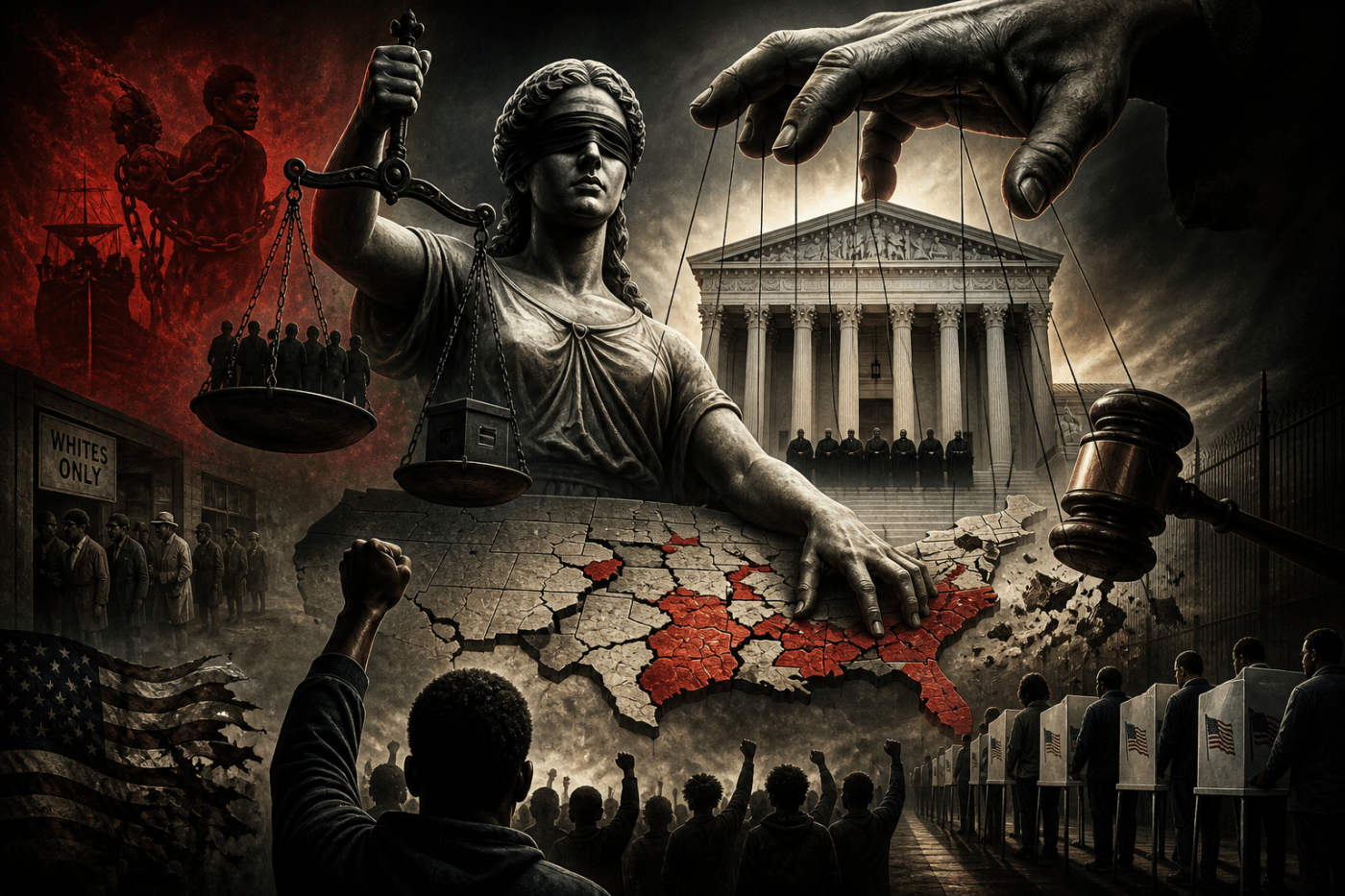
NPR reports a legal ruling, but beneath its procedural tone lies a deeper struggle over who is allowed to wield political power in the United States. The Court’s decision in Louisiana is not an anomaly, but part of a long historical pattern of expanding and then contracting Black political participation through law. What is presented as constitutional neutrality is, in practice, the transformation of racial domination into “colorblind” doctrine. The response cannot remain confined to the courts—it must move toward organized struggle capable of defending gains while building power beyond the limits imposed by the system.
By Prince Kapone | Weaponized Information | May 2, 2026
The Court Speaks in Law, NPR Answers in Procedure, and the System Hides in Plain Sight
In “The U.S. Supreme Court strikes another severe blow to the Voting Rights Act,” published by NPR on April 29, 2026, Miles Parks and Hansi Lo Wang report that the Supreme Court, by a 6–3 ruling along the familiar partisan lines of the present Court, struck down Louisiana’s 2024 congressional map because it created a second majority-Black district. The article explains that the Court called this map an “unconstitutional racial gerrymander,” even though the map had been drawn after years of litigation over whether Louisiana’s prior map diluted Black voting power. NPR presents the decision as another grave wound to the Voting Rights Act, especially Section 2, while noting that the law technically remains standing. The corpse, in other words, is still dressed for the funeral, and the respectable people are instructed to admire the suit.
NPR occupies a particular place in the U.S. media ecosystem. It is not Fox News barking from the plantation porch, nor Breitbart tossing raw meat to the lynch mob imagination. It is public radio liberalism: calm voice, careful sentence, polished concern. Its authority comes from its posture of moderation. It does not usually shout empire’s commands; it explains them in a tone suitable for the morning commute. This gives the article its ideological power. The reporting is not crude reaction. It is liberal institutional grief. It tells the listener that something terrible has happened to voting rights, but it does not fully name the historical structure that made such a ruling not only possible, but predictable.
Parks and Lo Wang write from the professional terrain of election and census reporting. That matters. Their expertise gives the article precision. They know the language of districts, filings, court standards, racial polarization, and statutory interpretation. The piece is useful because it clearly identifies the ruling as destructive. It quotes election-law scholars, civil rights advocates, and legal experts who understand that this decision shifts the burden against those challenging racial vote dilution. But the professional strength of the article is also its political limit. It treats the crisis primarily as a crisis of legal doctrine, institutional protection, and minority representation. It does not ask what kind of state repeatedly grants rights under pressure and then spends generations devising elegant ways to steal them back.
The first major device in the article is appeal to authority. Experts guide the reader through the damage. Rick Hasen calls the decision one of the most pernicious Supreme Court decisions in the last century. Atiba Ellis explains how difficult it is to prove discriminatory intent. Damon Hewitt warns that Black Americans have never been fully represented in the electoral process. These voices are not false. They are necessary. But the structure of the article keeps the struggle inside the courtroom, as though the central drama is what lawyers can prove before judges rather than what Black people have had to force from a hostile state through struggle, blood, organization, and rebellion.
The second device is concision. NPR compresses a vast historical attack into a digestible public-media format. The Voting Rights Act is described as the jewel of the Civil Rights Movement. The Roberts Court is described as having dismembered it since 2013. Louisiana is described as the most directly affected state. All true enough, as far as it goes. But concision has a cost. The article gives us the legal wound without the full anatomy of the body being cut. The reader learns that the Voting Rights Act has been weakened, but not that the vote itself has always been a contested instrument inside a settler republic that never intended the colonized to exercise real sovereign power.
The third device is narrative framing. NPR frames the ruling as democratic erosion. The Court has taken another step against the Voting Rights Act; minority representation may decline; Republican-controlled legislatures may redraw districts. This is a liberal-democratic frame, and it has explanatory value. But it is too small for the crime. The question is not only whether democracy is eroding. The deeper question is whether the United States was ever the democracy it advertised itself to be. A system born in Indigenous genocide, African enslavement, colonial annexation, Jim Crow, prison labor, and police occupation does not suddenly become neutral because it permits limited elections under conditions set by the ruling class.
The fourth device is source hierarchy. The article places judges, professors, lawyers, lawmakers, and legal advocates at the center of interpretation. Again, these are important sources. But the people most materially affected—Black communities in Louisiana and across the South—appear largely as the object of legal consequence rather than as historical subjects of struggle. The Court acts. Experts interpret. Lawmakers maneuver. Plaintiffs litigate. But the Black masses, whose collective political power is being carved up under constitutional language, do not fully appear as a people whose long struggle created the very law now being gutted.
The fifth device is omission. NPR reports the blow but does not excavate the deeper machine. The article does not situate Louisiana redistricting within the long history of Reconstruction and Counter-Reconstruction, when Black political power was first built through mass struggle and then drowned in white terror. It does not connect “colorblind” constitutional doctrine to the old shell games of American racism, where the state first creates racial domination and then criminalizes the remedy as racial favoritism. It does not name the Court’s decision as part of a domestic counterinsurgency against Black political capacity. The result is a good liberal alarm bell attached to a wall with no building around it.
Finally, the article exposes but does not fully dissect the doublespeak of “colorblind society.” Edward Greim, representing the plaintiffs who challenged Louisiana’s map, praises the ruling as a move toward colorblindness. This is the old American magic trick: after centuries of making Black people invisible in power, the ruling class now declares itself morally offended by any attempt to see them clearly. Colorblindness here is not equality. It is erasure with a law degree. It is the plantation ledger rewritten as constitutional principle. It is the state saying: we may count you for population, imprison you for labor, police you for order, and exploit you for spectacle—but the moment you organize collective political power, we suddenly become blind.
NPR gives us the ruling as a severe blow to the Voting Rights Act. That is correct, but insufficient. The article sees the knife. It does not fully name the hand. It hears the Court speak in the language of equal protection, but it does not fully translate that language into the grammar of settler power. This is why the piece must be excavated. Not because it is useless, and not because it is reactionary in the crude sense, but because liberal truth often stops at the threshold of system truth. It can say the Voting Rights Act is being gutted. It struggles to say why: because Black political power, even in its most limited electoral form, remains intolerable to a state built to contain it.
The Law, the Map, and the Long War Over the Black Vote
Strip away the language of constitutional refinement and what emerges is a very concrete sequence of events. On April 29, 2026, the Supreme Court issued its decision in Louisiana v. Callais, ruling 6–3 that Louisiana’s 2024 congressional map—specifically the creation of a second majority-Black district—constituted an unconstitutional racial gerrymander. The majority opinion, authored by Justice Samuel Alito, argued that the state’s use of race in designing the district could not be justified under Section 2 of the Voting Rights Act. In plain terms, a map drawn to remedy racial vote dilution was itself declared legally suspect because it acknowledged race at all. The Court did not abolish Section 2 outright, but it sharply narrowed the conditions under which it can be used.
The map at the center of this case did not emerge in a vacuum. Louisiana’s legislature had enacted a new congressional plan in 2024—known as SB8 / Act 2—after years of litigation challenging the state’s earlier district lines. Those earlier maps had provided Black voters, who make up roughly a third of Louisiana’s population, with only one realistic opportunity district out of six. Civil rights organizations, including the Legal Defense Fund, argued in Robinson v. Landry that this configuration diluted Black voting power in violation of federal law. The state eventually moved to create a second majority-Black district as part of a legal settlement process. That remedial action is precisely what the Supreme Court has now struck down.
Louisiana’s redistricting process itself reveals the material locus of power. As outlined on the state’s official redistricting portal, the legislature controls the drawing of congressional, legislative, judicial, and other electoral districts. These maps are not neutral geographic exercises; they are instruments through which political power is organized, distributed, and restricted. The 2024 congressional plan—documented in full through official shapefiles, precinct reports, and legislative records—represented an attempt, however limited, to adjust that distribution under the pressure of litigation. The Court’s decision reasserts the limits of how far such adjustments can go.
The legal terrain the Court is reshaping has its own history. Congress amended Section 2 of the Voting Rights Act in 1982 to clarify that plaintiffs did not need to prove explicit discriminatory intent, but could challenge voting systems that produced discriminatory effects. As summarized in contemporary legal analysis, this “results test” was central to decades of litigation aimed at addressing structural vote dilution in racially polarized systems. By shifting the emphasis back toward intent—or by making race-conscious remedies themselves constitutionally suspect—the Court is effectively rewriting the conditions under which Section 2 operates.
That rewrite must be placed alongside earlier decisions. In 2013, the Supreme Court’s ruling in Shelby County v. Holder invalidated the coverage formula that determined which jurisdictions were subject to federal preclearance. That decision removed a key enforcement mechanism of the Voting Rights Act, allowing states with histories of racial discrimination to implement new voting laws without prior federal approval. What remains after Shelby County is a more reactive system, dependent on litigation after the fact. The Callais decision narrows even that pathway.
The historical baseline underlying these legal developments is not subtle. Louisiana’s own record includes the 1898 state constitution, which imposed mechanisms explicitly designed to exclude Black men from political participation. Across the South, Jim Crow voting regimes relied on tools such as poll taxes, literacy tests, white primaries, and intimidation to suppress Black suffrage. As documented in historical accounts of literacy testing, local registrars wielded wide discretionary power to accept or reject Black applicants arbitrarily. These were not isolated abuses; they were systemic methods of maintaining political control.
The Voting Rights Act of 1965, as preserved in the National Archives record, emerged directly from mass struggle against this system. It was enforcement legislation for the Fifteenth Amendment, aimed at dismantling the legal infrastructure of racial disenfranchisement. Its passage followed decades of organizing, protest, repression, and federal intervention. It was not an administrative reform; it was a concession extracted under pressure. That context is essential, because it explains why the law has been repeatedly contested, narrowed, and reinterpreted.
The present ruling sits squarely within that longer trajectory. Civil rights organizations, including the Legal Defense Fund, have described the Court’s decision as one that “destroys a key Voting Rights Act provision”, warning that it undermines the principal remaining tool for challenging racial vote dilution nationwide. Reuters reporting notes that the Roberts Court has taken a “wrecking ball” to the Voting Rights Act over multiple decisions, steadily narrowing its scope and effectiveness. The practical implication, also reported by Reuters, is that state legislatures may now redraw districts in ways that reduce minority electoral influence, with fewer viable avenues for legal challenge.
The immediate fallout in Louisiana reflects this instability. Civil rights groups moved quickly to challenge executive actions affecting election timelines, filing emergency litigation documented by the ACLU when the state attempted to suspend an election already underway. The disruption is not incidental. It is a predictable consequence of a system in which the legal standards governing representation are repeatedly altered by the Court, forcing rapid adjustments by states, litigants, and voters alike.
When placed against the broader historical arc, the pattern becomes clearer. The United States has repeatedly moved through cycles in which Black political participation is expanded under pressure and then restricted through new legal, administrative, or constitutional mechanisms. The Voting Rights Act marked one such expansion. Shelby County marked a contraction. Callais represents a further contraction, achieved not through open prohibition but through doctrinal recalibration. The language changes, the mechanisms evolve, but the underlying struggle over who exercises political power—and under what conditions—remains constant.
Colorblind Law and the Recalibration of Colonial Power
What the Court has done in Louisiana is not an aberration, nor a tragic deviation from an otherwise functional democracy. It is the system operating within its own historical logic. When viewed through the long arc of struggle inside the United States, the ruling does not appear as a sudden rupture but as a familiar maneuver: a concession extracted through struggle is reabsorbed, reinterpreted, and neutralized once it begins to threaten the underlying structure of power. The language of the ruling is new. The logic is old. The same state that once used poll taxes and literacy tests now uses constitutional doctrine and “colorblindness.” The tools have changed; the objective has not.
The central contradiction exposed here is not between law and injustice, but between Black collective political power and the settler structure that contains it. The Voting Rights Act was never a gift. It was forced into existence by mass insurgency—by people who made the country ungovernable until the state conceded. But because the Act emerged from pressure rather than from the natural evolution of the system, it has always existed on borrowed time. It functions only so long as it can be contained within limits acceptable to the ruling class. Once those limits are approached—once Black political power begins to translate into structural influence—the system moves to discipline it.
This is why the Court’s turn toward “colorblindness” must be understood for what it is: a legal weapon. It does not erase race in practice; it erases the ability to remedy racial domination. The state first organizes political life through racial hierarchy—through slavery, segregation, redlining, policing, and economic exclusion—and then declares that any conscious effort to counter that hierarchy is itself unconstitutional. In this formulation, inequality is naturalized, while resistance is criminalized. The oppressed are told that they may suffer racial domination, but they may not organize politically in ways that acknowledge it. This is not neutrality. It is the refinement of domination into doctrine.
The ruling reveals something deeper about the nature of U.S. democracy. Liberal narratives insist that the system is eroding—that rights are being chipped away from an otherwise legitimate foundation. But what if the foundation itself is the problem? What if the system was never designed to accommodate the full political power of the colonized? The history suggests precisely this. From Reconstruction to Jim Crow, from the Civil Rights era to the present, every expansion of Black political participation has been followed by a restructuring aimed at containing it. The form of democracy remains; the substance is adjusted. Representation is allowed; transformation is not.
Section 2 of the Voting Rights Act once provided a narrow legal pathway to challenge the dilution of Black voting power. It did not guarantee liberation. It did not overturn the racial and class structure of the United States. But it allowed communities to contest the most blatant forms of exclusion. What the Court has done is not simply weaken that pathway—it has transformed it into a trap. Plaintiffs are now required to meet standards that are structurally misaligned with how modern racial domination operates. The state no longer announces its discrimination openly; it encodes it in policy, geography, economics, and procedure. To demand proof of explicit intent in such a system is to demand proof that has already been engineered out of existence.
This is the essence of modern lawfare. Power is not withdrawn in dramatic gestures; it is reconfigured through technical adjustments that appear neutral on their face. The map is redrawn. The standard is raised. The burden shifts. Each move can be justified within the language of constitutional reasoning. But taken together, they produce a cumulative effect: the contraction of Black political power under the guise of legal consistency. The Court does not need to declare that Black representation is undesirable. It only needs to establish rules that make such representation increasingly difficult to sustain.
The contradiction, then, is not accidental. It is constitutive. The system must present itself as a democracy, because its legitimacy depends on that image. But it must also prevent the full realization of democratic power among those populations whose liberation would disrupt the existing order. This tension produces the recurring cycle: limited inclusion followed by strategic exclusion. The Voting Rights Act was one moment of inclusion. Shelby County marked a step toward exclusion. Callais advances that process further, not by eliminating the law, but by redefining its meaning until it no longer threatens the structure it was meant to challenge.
To see this clearly is to move beyond the language of disappointment and into the language of analysis. The problem is not that the Court has betrayed democracy. The problem is that democracy, as structured within this system, has always been bounded by the requirements of settler rule and capitalist stability. The law can be stretched under pressure, but it will snap back once that pressure recedes or becomes too dangerous. The ruling in Louisiana is one such snap. It tells us, plainly, that even the most limited forms of Black political empowerment remain contingent, conditional, and reversible.
The lesson is not to abandon the terrain of voting rights, but to understand it correctly. The ballot is a site of struggle, not a guarantee of power. Legal victories can open space, but they cannot secure it permanently. The history of the United States shows that every gain must be defended, expanded, and reinforced through organization beyond the courtroom. Without that, the system will do what it has always done: absorb the concession, rewrite the rules, and restore the balance of power in its favor. The Court has spoken in the language of equality. What it has delivered is a recalibration of control.
From the Ballot to Power: Organize Where the System Breaks
The Court has redrawn the limits. The question now is not whether those limits exist, but how people organize against them. What has been exposed in Louisiana is not a temporary legal setback—it is a recurring pattern in which Black political power is permitted to expand only within boundaries that do not threaten the structure of rule. When those boundaries are approached, the system intervenes. That means the response cannot be confined to outrage, nor to litigation alone. It must take the form of organized, sustained, material struggle rooted in the communities most directly affected.
On the immediate terrain of voting rights and redistricting, organizations such as Power Coalition for Equity and Justice are actively engaged in building civic infrastructure in Louisiana and across the South, focusing on voter education, turnout, and redistricting advocacy. Similarly, Black Voters Matter has developed large-scale mobilization campaigns aimed at strengthening Black political participation and local organizing capacity. These formations represent a necessary line of defense. They operate on the understanding that if the terrain of voting is under attack, it must be defended. But defense alone is not strategy—it is the beginning of one.
Beyond this defensive layer, other organizations are working to situate the attack on voting rights within a broader structure of state power and repression. The Black Alliance for Peace frames domestic political struggle as inseparable from U.S. imperialism, linking policing, surveillance, and political exclusion at home to military intervention abroad. This layer of organizing expands the frame: the issue is not simply access to the ballot, but the relationship between state power and the communities it governs. It reminds us that the same state that redraws districts also deploys police, builds prisons, and conducts wars.
There are also formations that approach the problem from a more explicitly revolutionary standpoint. The African People’s Socialist Party, through its broader Uhuru Movement, articulates the struggle of Black people in the United States as one of national self-determination within a system of internal colonial domination. These formations do not treat voting rights as the horizon of struggle. They treat it as one limited arena within a much larger question: who governs, under what conditions, and for whose benefit. Their existence signals that the contradictions revealed by rulings like Callais are not merely legal—they are structural, and they demand structural responses.
Even within the electoral sphere, the narrowing of political representation is producing pressure points. The Green Party of the United States, while operating within the electoral system, has consistently raised issues around ballot access restrictions and structural barriers to alternative political formations. The relevance here is not that electoral alternatives alone can resolve the contradiction, but that even limited challenges to the two-party system encounter institutional constraints. The narrowing of representation does not only affect Black-majority districts; it affects the entire spectrum of political possibility within the system.
Taken together, these organizations represent different responses to the same underlying reality. Some defend the existing terrain. Some expose its limits. Some attempt to move beyond it. The task is not to collapse these approaches into one, but to understand their relationship. Voting rights must be defended, because they represent gains won through struggle. But those gains must be understood as contingent, not permanent. They must be reinforced through independent organization, political education, and community-based structures capable of acting outside the narrow channels defined by the courts.
This means building durable institutions at the local level: political education programs that explain how redistricting works and why it matters; community assemblies that can coordinate responses to legal and administrative changes; tenant and labor organizations that connect political representation to material conditions; and independent media capable of breaking through the narrow framing of mainstream coverage. It also means developing strategies that do not rely solely on favorable court decisions, but can operate under conditions where those decisions are hostile or absent.
The ruling in Louisiana clarifies the stakes. The system will permit participation, but it will regulate power. It will allow representation, but it will constrain transformation. Organizing in this moment requires clarity about that distinction. The ballot remains a site of struggle, but it cannot be mistaken for the source of power itself. Power is built through organization, sustained through collective action, and defended across multiple fronts. What has been exposed is not simply a weakened law, but the limits of a system. The response must be equal to that reality.
 Weaponized Information
Leave a comment