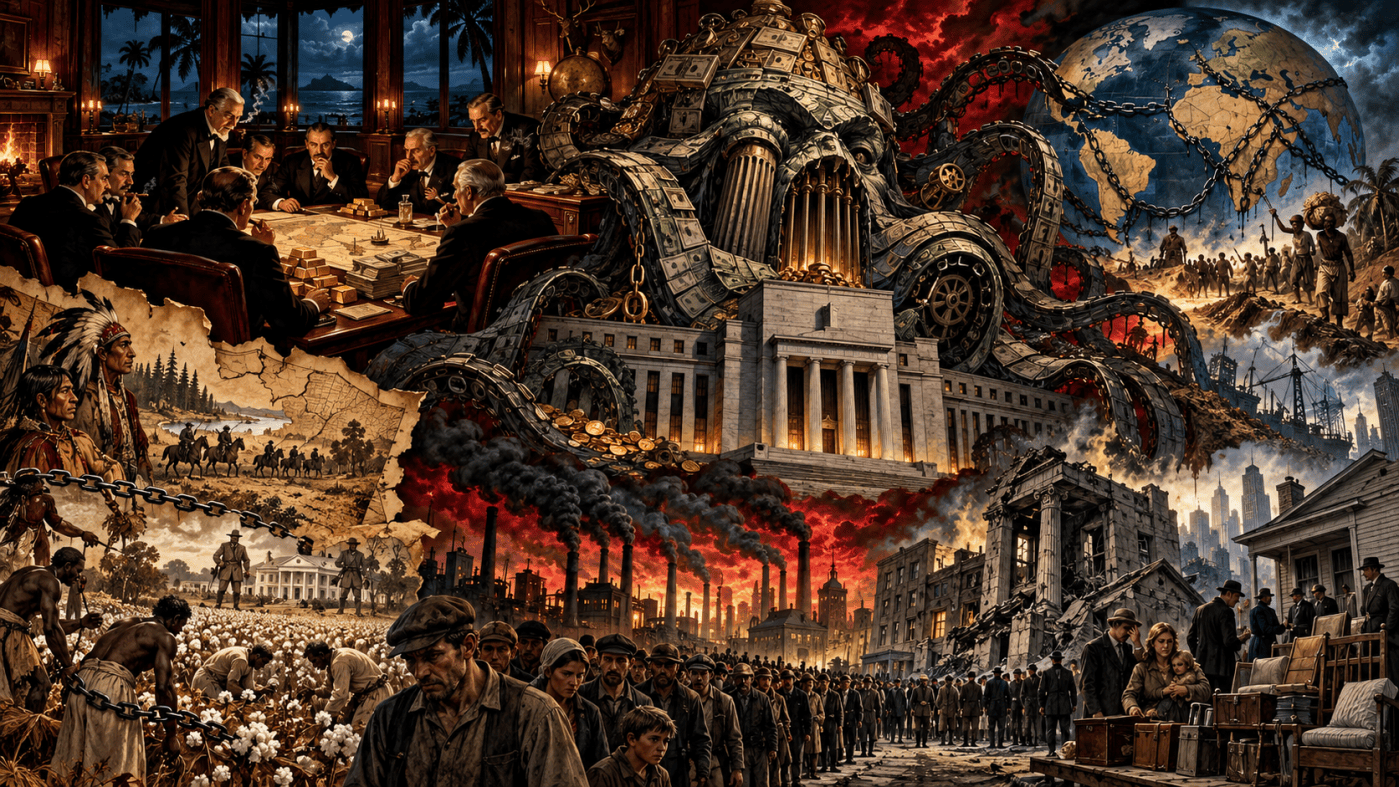
G. Edward Griffin went hunting for the bankers who supposedly betrayed American capitalism and found something far more dangerous than his own conclusions could accommodate. The Creature from Jekyll Island exposes genuine concentrations of financial power, secretive political coordination, public bailouts and the international machinery of debt, only to blame these developments on a conspiracy of collectivists rather than the capitalist system that produced them. From the stolen land and enslaved labor beneath the American republic to the monopolies born of competition and the imperial creditors disciplining entire nations, this review follows Griffin’s evidence beyond the ideological boundaries he refuses to cross. What emerges isn’t a defense of the Federal Reserve, but a Marxist indictment of capitalist property, financial domination and the political mythology that teaches working people to fear socialism while defending the class that exploits them.Prince Kapone | Weaponized Information | Weaponized Intellects Book Review | October 8, 2026
He Really Did Find Something
The easiest way to dismiss G. Edward Griffin is to call him a crank, laugh about secret bankers on Jekyll Island, wave around a textbook definition of the Federal Reserve and assure everybody that the experts have everything under control. It’s also the laziest way to lose the argument. Working people don’t need a lecture from some well-fed economist about why the financial system deserves their confidence. They’ve watched banks gamble away fortunes and come crawling to Washington for rescue. They’ve watched Wall Street executives walk away from catastrophes that would bury an ordinary debtor beneath a mountain of unpaid bills. They’ve seen private losses suddenly become matters of “systemic stability,” while the people whose labor sustains the entire economy are told there isn’t enough money for housing, healthcare or decent wages. Griffin didn’t invent this crooked arrangement. He recognized something rotten in the relationship between banking and government, then built an entire political project around explaining it.
And his opening shot lands because the meeting at Jekyll Island actually happened. In The Creature from Jekyll Island, Griffin writes that “the basic plan for the Federal Reserve System was drafted at a secret meeting” in November 1910 (Chapter 1, pp. 41–42). Strip away the conspiratorial music, the dramatic shadows and the suggestion that civilization was secretly sold over cigars in a Georgia hunting lodge, and the historical fact remains standing. Nelson Aldrich, Paul Warburg, Frank Vanderlip and other men connected to the commanding circles of American finance met behind closed doors to discuss banking reform. Even the Federal Reserve’s own history acknowledges the meeting’s importance. Griffin includes Benjamin Strong among the participants, although his physical attendance hasn’t been established. Fine. Correct the roster. The bankers were still there, the doors were still closed, and men with enormous financial interests were discussing the architecture of the country’s monetary future. Historical relationships don’t disappear because somebody gets a name wrong.
Griffin calls the arrangement a cartel, arguing that powerful bankers wanted to restrain competition, consolidate reserves, protect themselves against bank runs and secure public assistance when private financial arrangements threatened to collapse. He summarizes the alleged scheme as “a cartel agreement with five objectives” (Chapter 1, pp. 41–42). Whether that description explains the eventual Federal Reserve System in its entirety is another matter. But anybody who believes the bourgeoisie abandons its class interests upon entering a government office might as well announce that he’s never studied capitalism. The banker doesn’t become a public servant merely because he starts discussing public policy. And rival financiers can spend Monday trying to cut one another’s throats and Tuesday agreeing that certain rules would make the business more profitable for everybody who matters.
Congress itself had uncovered enough to embarrass the respectable defenders of American finance. The investigation of the Money Trust, conducted before the Federal Reserve Act became law, documented an extraordinary concentration of influence through stock ownership, investment-banking relationships, interlocking directorates and control over access to credit. The Pujo Committee report didn’t establish that a secret fraternity commanded every factory, railroad and bank in the republic. It did expose a financial order in which a comparatively small circle of institutions occupied commanding positions over vast stretches of economic life. The image of America as a nation of independent little businessmen competing on equal terms was already fit for the museum. What the investigation documented, Marxist political economy helps explain as the growing concentration of banking and industrial power. Griffin deserves credit for dragging that concentration into daylight. His difficulty begins when the men occupying those positions become the explanation for the historical development that placed them there.
His treatment of bailouts strikes another genuine nerve. In Chapter 2, Griffin describes creditors using political influence to obtain government guarantees for endangered loans, declaring that “the burden of the loan is removed from the bank’s ledger and transferred to the taxpayer” (Chapter 2, p. 56). The actual distribution of losses can be more complicated. A guarantee isn’t necessarily an immediate expenditure; shareholders may be wiped out, creditors may receive different treatment, and public authorities can recover funds. But these distinctions matter because class analysis isn’t satisfied with shouting that somebody got rescued. It wants the names, the amounts, the property claims and the bill. Which investors escaped losses? Which creditors were protected? Who paid, and who walked out of the wreckage with an even larger share of the economy? The ruling class has developed considerable expertise in distributing the damage without distributing ownership, and working people have every reason to inspect the accounting.
In Chapter 3, Griffin follows Penn Central, Lockheed, New York City, Chrysler and other episodes in which threatened collapse helped justify public intervention. “The game called bailout,” he declares, is real (Chapter 3, p. 76). He’s right about the recurring appeal to public necessity. Watch how quickly the language changes when a major capitalist enterprise gets into trouble. Yesterday its revenues belonged to private owners, its operations were matters of managerial discretion, and anybody questioning its decisions was interfering with the sacred freedom of enterprise. Today its collapse threatens employment, communities, essential services and the national economy. The private claim has wrapped itself in the flag of society, and now everybody is expected to salute. The trick works because the danger isn’t always imaginary. Workers really can lose their livelihoods, suppliers can go under, and whole communities can be gutted by decisions taken in boardrooms they never entered. Capital has organized economic life so that the survival of millions is tied to the fortunes of institutions those millions don’t control.
Then came 2008, when this arrangement became impossible to hide behind speeches about individual responsibility. The American state mobilized enormous fiscal and monetary resources to prevent the collapse of the financial order. Treasury invested public funds in financial institutions through rescue programs documented in its official records. Some funds were repaid and some investments produced positive direct returns. But a profitable line in Treasury’s accounts doesn’t restore a foreclosed house, replace years of lost wages or rebuild a neighborhood stripped of its economic security. Tell a family sleeping in somebody else’s spare bedroom that the government’s investment performance settled the social cost of the crisis. Tell a worker whose job vanished that the relevant achievement was recovering the principal. Public intervention may have prevented something worse, but the necessity of that intervention exposed the extraordinary dependence of private finance upon collective resources. The financiers who lectured society about the virtues of market discipline suddenly discovered that public assistance was indispensable to civilization.
That dependence also changes how risk is calculated. Economists call it moral hazard when the prospect of protection encourages dangerous behavior. Working people know the arrangement by its consequences: the powerful can take chances that ordinary families would never survive. Yet Griffin’s criticism stops before reaching the most uncomfortable problem. Why have particular financial institutions acquired such overwhelming importance that their failure can threaten the entire payments system, the businesses that rely upon credit and the livelihoods of people who never agreed to their speculative decisions? The issue isn’t whether a bankrupt banker deserves sympathy. It’s why society has been placed in a position where saving the banker and preventing a wider calamity can become part of the same political decision.
Chapter 4 reveals the ideological boundary of Griffin’s investigation. Discussing the savings-and-loan debacle, he argues that government guarantees and housing policies moved the industry “out of the free market and into the political arena” (Chapter 4, p. 92). There it is. Beneath the scandals, the collapsing institutions and the fraudulent promises, Griffin imagines a healthy capitalism that government somehow interrupted. Private banking was supposedly going about its honest business until politicians arrived to corrupt its natural discipline. Apparently the same ruling class that spent generations lobbying for charters, guarantees, favorable legislation and public support had nothing to do with the political arrangements it so eagerly exploited. Capitalism becomes the innocent victim of institutions that capitalists themselves helped construct.
And that’s what makes Griffin worth reading critically rather than dismissing. He’s identified real concentrations of financial power, documented conscious cooperation among wealthy interests and exposed the dependence of private banking upon public authority. These aren’t trivial discoveries. They explain why his arguments can resonate among people who know perfectly well that something stinks between Wall Street and Washington. But exposing a rotten arrangement doesn’t settle its causes. Griffin describes banks creating credit, creditors collecting interest and financial institutions acquiring command over enormous sums of money. Behind these transactions stands the society whose labor, resources and production sustain the economy, yet its relationship to the financial system remains largely unexplained. Before we follow his bankers into wars, revolutions and plans for world domination, we need to settle a more basic question: when a bank extends credit and a new deposit appears on its books, what has actually been created?
Money Doesn’t Create Value by Magic
Griffin puts his finger on another genuine scandal and promptly mistakes the discovery for an explanation. Banks don’t simply collect somebody else’s savings in one drawer and hand them to borrowers from another. Modern commercial banks create deposits when they issue loans. That’s not some forbidden secret whispered in the basement of a libertarian bookstore. It’s how contemporary banking works. Griffin understands enough of the process to make his “Mandrake Mechanism” sound like the exposure of a magnificent swindle (Chapter 10, p. 198). A banker approves a loan, figures appear in an account, purchasing power enters circulation, and the borrower spends years working to repay an obligation that originated through an accounting operation. It’s enough to make a wage worker wonder why the fellow behind the desk gets to manufacture purchasing power while everybody else must earn it the hard way. But the crucial distinction is between creating money and producing the wealth that money commands. Griffin sees the banker issuing monetary claims and begins treating him as the creator of the wealth being claimed.
He opens his monetary history by dividing money into four categories: “commodity, receipt, fiat, and fractional.” Gold receives the blessing. Precious metals, Griffin assures us, have proven themselves “the only reliable base for an honest monetary system” (Chapter 7, p. 155). There we have it: an economic classification promoted into a sermon about virtue. Gold is honest, government currency is corruptible, and fractional banking has apparently been caught stealing from the collection plate. But gold didn’t become money because God Almighty buried monetary integrity in the earth. Human beings dug it out, worked it, exchanged it and incorporated it into historically developed systems of production and trade. Its physical qualities helped make it suitable for monetary purposes, but its monetary character arose through social relations. Outside those relations, the noble substance becomes jewelry, industrial material or an expensive lump gathering dust in a vault. Griffin worships the metal while overlooking the society that gives it monetary power. A gold coin doesn’t become an economic constitution merely because somebody stamps an eagle on it.
Chapter 8 carries the moral argument into inflation. Griffin declares that fiat money “is the cause of inflation” and treats declining purchasing power as a concealed tax imposed by government (Chapter 8, p. 163). Inflation can certainly rob workers of the value of their wages. Anybody who has walked into a grocery store with the same paycheck and come out carrying fewer groceries understands that without consulting an economist. But prices don’t rise for one reason alone. Production bottlenecks, shifts in demand, commodity costs, monetary conditions and corporate pricing decisions can all contribute. Even the San Francisco Federal Reserve’s analysis of post-pandemic inflation identified both supply and demand pressures. Griffin crams the whole turbulent process into a box labeled fiat currency and declares the matter settled. The employer resisting wage increases, the corporation controlling essential supplies and the workers absorbing the higher prices scarcely enter the explanation. Apparently the price tag moves by government sorcery alone.
His account of fractional-reserve banking in Chapter 9 begins with the familiar story of goldsmiths issuing more certificates than the gold in their vaults could redeem. The Bank of England becomes part of a historical arrangement joining governments seeking money to financiers charging interest on credit “created out of nothing” (Chapter 9, pp. 179–180). There’s a perfectly intelligible fraud in the warehouse example. If somebody stores one ton of copper and receives a certificate promising its exclusive return, the custodian can’t secretly issue five additional certificates for that same ton without violating the promise. But Griffin takes this example of fraudulent claims against stored property and applies it to a modern credit relationship that works differently. When a bank makes a loan, it ordinarily creates a deposit liability while recording the borrower’s obligation as an asset. It hasn’t simply forged a warehouse receipt for somebody else’s pile of cash.
The Bank of England explains the mechanism plainly: lending creates deposits rather than merely recycling a fixed stock of prior savings. Griffin is right to reject the childish picture of banks as passive custodians transferring money from one customer to another. But correcting that misconception doesn’t transform every loan into a counterfeit claim. The bank assumes obligations, must settle payments and faces constraints involving capital, liquidity, funding and repayment. The loan gives the borrower purchasing power that can command real goods and services. The obligation is enforceable, sometimes brutally so. Try explaining to a family facing foreclosure that its mortgage is imaginary because the bank created a deposit when the contract was signed. The sheriff carrying out the eviction is unlikely to appreciate the finer points of monetary alchemy.
Chapter 10 takes Griffin within striking distance of the actual mechanism before he stretches it into nonsense. “It is true that our money is created out of nothing,” he writes, but “it is more accurate to say that it is based upon debt.” He then claims that if every debt were repaid, “the entire money supply would vanish” (Chapter 10, p. 198). Commercial-bank loan repayments do extinguish corresponding deposit money when payment comes from bank deposits. That’s a genuine feature of credit creation. But commercial banks can also create deposits by purchasing assets from nonbank sellers, and central-bank money includes currency and reserves created through different operations. Not every monetary claim is an outstanding private bank loan. Griffin discovers an important part of the monetary system and announces that he’s discovered the whole damn thing. His formulation makes for a dramatic accusation, but a diagram that leaves out half the equipment won’t explain how the system runs.
The deeper scandal isn’t that the bank collects payment on a nonexistent loan. It’s that institutions exercising private control over credit can allocate purchasing power, charge interest, accumulate financial assets and enforce claims against future income. And here the laboring population finally enters the picture. A banker can approve a mortgage, but he can’t type a house into existence. Bricklayers must raise the walls, electricians must wire them, factory workers must produce the materials, and truck drivers must carry those materials to the site. Credit can mobilize resources and accelerate production, but the accounting entry doesn’t perform the labor or create the finished building. Money commands goods because goods are produced within a real society, not because figures on a screen possess reproductive organs. The banker’s ledger can record claims upon that world. It cannot replace the world itself.
Marx dissected this illusion in his treatment of interest-bearing capital in Capital, Volume III. In finance, money appears to return as more money, M–M′, without production ever entering the picture. The factory vanishes, the workers vanish, the labor process disappears, and what remains is money apparently multiplying through some mysterious internal power. Marx recognized this as one of the most fetishized expressions of capitalist relations. The social process through which surplus value is produced and divided becomes concealed behind the movement of financial claims. Griffin looks upon that same appearance and mistakes it for the underlying reality. He sees the banker collect interest and concludes that the banker must have manufactured the wealth from which the interest is paid. It would be rather like watching a landlord collect rent and announcing that the title deed must be constructing houses in its spare time.
Interest-bearing capital can command portions of profits, wages, tax revenues and other streams of income. Those flows have different immediate sources, and they can’t all be reduced mechanically to a single transaction between a banker and an industrial capitalist. But they depend upon existing wealth, economic activity and claims against future income. Finance can redistribute the social product, subordinate debtors and redirect production toward the demands of creditors. None of that requires bankers to possess supernatural powers of creation. Capitalist property already gives them formidable instruments of domination. There’s no need to invent magical ones.
The same distinction illuminates what Marx called fictitious capital. Bonds, shares and other tradable titles can acquire prices because they represent claims upon anticipated income. These claims can be sold, pledged as collateral and accumulated into fortunes. Yet their market valuation isn’t identical with the productive capital, existing assets or future revenues upon which they ultimately depend. Stock prices can soar while factories produce no corresponding increase in commodities. Governments can issue securities representing claims upon future tax revenues. Mortgages can be bundled, traded and used to support further financial operations while the households carrying the debts continue sending payments every month. Financial markets can accumulate layers of claims whose prices rise far beyond the income streams expected to sustain them. When those expectations collapse, enormous fortunes can evaporate on paper, even though the factories, homes, roads and workers haven’t vanished from the earth. The financial titles were real enough to enrich their owners and discipline their debtors. Their valuation was never identical with the social wealth upon which they depended.
Credit therefore occupies a contradictory place in capitalist development. It can gather scattered resources, finance machinery, expand production and connect industries across continents. It can also inflate speculative assets, deepen debt dependence and carry crises from one institution into the lives of millions. The same system that helps coordinate production can subordinate producers to creditors whose income arrives without their direct participation in the labor process. This is a far more devastating indictment of capitalist finance than the story of dishonest goldsmiths multiplied across the centuries. Griffin has identified the power to create monetary claims but confused it with the power to create wealth. Once that distinction disappears, the banker begins to look like the secret source of society’s fortunes and misfortunes alike. Having mistaken his command over money for command over production, Griffin is ready to promote him into the hidden author of history itself.
When the Banker Becomes the Author of History
Once Griffin has convinced himself that bankers possess the power to manufacture wealth through the movement of money, there’s apparently no limit to what these distinguished gentlemen can accomplish. They don’t merely lend money, speculate on markets, influence governments or profit from the misery of others. They become the secret authors of history itself. Wars are banking operations. Revolutions are investment strategies. Entire peoples become instruments in financial schemes whose architects apparently possess greater command over events than the governments, armies and revolutionary movements actually fighting over them. The problem isn’t that Griffin investigates ruling-class conspiracy. Capitalists conspire, governments conceal their decisions, and financiers use their wealth to influence political power. The problem is that Griffin can no longer distinguish between a capitalist profiting from an event, attempting to influence it and actually causing it. Those are different relationships, and any investigation worth a damn must establish which one the evidence supports. Otherwise the undertaker becomes the secret author of every funeral because business improves whenever somebody dies.
Chapter 11 introduces what Griffin calls the “Rothschild Formula,” identifying “the tendency of those who reap those profits to manipulate governments into military conflicts” (Chapter 11, p. 220). He describes international financiers “profiting from both sides” and warns of an “irresistible temptation to convert debt into perpetual war and war into perpetual debt” (Chapter 11, p. 232). Now, there’s nothing particularly mysterious about capitalists making fortunes from slaughter. Banks lend to governments, arms manufacturers supply armies, shipping companies carry weapons, and corporations position themselves to profit from conquest and reconstruction. Imperialism has never required peace to conduct business. Nor does the bourgeoisie become a collection of self-sacrificing patriots every time somebody raises a flag. Capital crosses borders in pursuit of profit, even while rival capitalist states prepare to shoot one another’s soldiers. But wars also develop through struggles over colonies, territories, markets, resources and international power. Finance capital operates within those antagonisms. Griffin takes its participation in imperialist war and promotes it into an explanation that makes the actual rivalries among imperial powers almost incidental.
World War I gives Griffin plenty of genuine material to work with. In Chapter 12, he follows the vast financial relationship connecting American banks and industry to Britain and France, particularly through J.P. Morgan & Co., which arranged loans and handled purchases of Allied military supplies. Morgan, Griffin observes, was “profiting from both ends of the cash flow,” and as the Allies encountered mounting difficulties, “the Morgan cash flow was threatened” (Chapter 12, p. 253). The firm played a major role in arranging the Anglo-French loan of 1915, while American manufacturers and exporters accumulated substantial interests in supplying the Allied war effort. There’s no reason to conceal any of this behind patriotic fairy tales about defending civilization. American capital had enormous material interests tied to an Allied victory. But Griffin treats those interests as though they can substitute for the history of the war itself. German submarine warfare, the struggle over Atlantic commerce, competing imperial ambitions and Washington’s own strategic calculations become supporting details in the story of a threatened creditor. Morgan didn’t need to personally author American foreign policy for the interests of American finance and industry to weigh heavily upon it. Imperialism already connected them.
The sinking of the Lusitania gives him another opportunity to distinguish historical investigation from conspiracy, and he takes the wrong road. The passenger liner carried ammunition and other war-related cargo, documented in the American government’s Treasury investigation. That matters. The vessel wasn’t detached from the military commerce surrounding the Atlantic war, and the public deserved an accurate account of what it carried. But the presence of military supplies doesn’t establish that British officials or American financiers deliberately arranged its destruction. Nor does the political usefulness of the sinking demonstrate that its beneficiaries engineered it. Exposing one official deception doesn’t automatically prove every alternative conspiracy. The imperial powers had enough blood on their hands without Griffin appointing bankers as the clandestine directors of every tragedy. Historical accusations require evidence connecting particular people to particular decisions. A sinister possibility, however satisfying to the imagination, isn’t a demonstrated event.
Then Griffin arrives at the Russian Revolution, and his theory begins devouring the very history it’s supposed to explain. Chapter 13 declares that the Bolshevik Revolution “was planned, financed, and orchestrated by outsiders.” Although Griffin acknowledges German involvement, he insists that “most of the money and leadership came from financiers in England and the United States” (Chapter 13, pp. 272–273). Read that proposition carefully. British and American financiers supposedly engineered a revolution whose government would repudiate imperial debts, attack capitalist property and nationalize the banks. Apparently the international bourgeoisie became so determined to preserve its fortunes that it organized an uprising against the social relations upon which those fortunes depended. One almost has to admire the contortions required to make capitalists the secret founders of a political movement directed against capitalist rule.
But the most offensive part of this explanation is what it does to the Russian masses. By 1917, Russia had been battered by imperialist war, hunger, industrial hardship, agrarian conflict and the decaying authority of a monarchy that had ruled through repression and privilege. Workers were striking, peasants were demanding land, soldiers were refusing to die for the ambitions of their rulers, and oppressed nationalities were challenging the empire. The February Revolution overthrew the tsar before Lenin had even returned to Russia. Workers and soldiers formed soviets, while the Provisional Government continued the war and failed to resolve the demands shaking society. The Bolsheviks grew influential because their political intervention increasingly addressed those demands for peace, land and power. These developments weren’t manufactured in some London countinghouse or New York investment office. Millions of people were already being driven toward revolution by the conditions of their lives. They didn’t need a banker to explain hunger, a foreign investor to explain landlordism, or an Anglo-American syndicate to tell them that the old order had become intolerable. Griffin takes the political initiative of workers, peasants and soldiers and signs it over to the financial class they were supposedly destined to serve.
Foreign powers certainly intervened in Russia’s revolutionary crisis. Germany wanted Russia removed from World War I and facilitated Lenin’s return through German territory in 1917. German officials had strategic reasons to encourage developments that might weaken the Russian war effort. But assisting a revolutionary’s journey home isn’t the same thing as creating the revolutionary movement to which he returns. Allegations of German financial support require examination of documents, intermediaries and actual political relationships, as Semion Lyandres’s study of the German-gold accusations makes clear. Griffin’s stronger claim concerning Anglo-American bankers faces an additional problem: the revolution’s material consequences. The Bolshevik government repudiated the old regime’s debts, moved against capitalist ownership and nationalized the banks. Foreign investors confronted the loss of property claims they had expected the previous order to protect, while disputes over imperial debts continued long afterward. Griffin’s supposed architects of Bolshevism had somehow arranged a revolutionary victory that tore up their own financial claims.
Nor do later Soviet commercial dealings with foreign capitalists rescue his theory. The revolution emerged from civil war and economic devastation into a world where much of the machinery, technical expertise and international trade it needed remained under capitalist control. Foreign businessmen continued looking for profits, even where governments had overturned capitalist property relations. Lenin openly discussed concessions as a means of obtaining resources and technical assistance while preserving Soviet political authority. There was no mystery requiring the invention of a secret fraternity of revolutionary bankers. The Soviet government sought resources for reconstruction; foreign capitalists pursued profitable opportunities. Their interests could intersect in particular transactions without becoming identical. Griffin discovers that capitalists are willing to do business with political enemies and treats it as evidence that the enemies were secretly created by capitalists. One wonders whether, by this logic, every merchant selling supplies to an opposing army must have personally organized the war.
Chapter 14 reveals the deeper failure. Griffin acknowledges that financiers dealing with the Soviet Union were motivated by “profit and power,” yet interprets their activities as part of a scheme to cultivate opposing political blocs and ultimately establish a world government under financial control (Chapter 14, p. 291). His explanation can now absorb practically any outcome. Capitalists cooperate with Soviet authorities? Proof of the plot. Capitalist states confront them? Another stage of the plot. Financiers profit? Their strategy succeeded. They lose investments? Evidently they were making sacrifices for a greater objective. The conspiracy has become immune to contradiction because Griffin assumes the bankers intended whatever history happened to produce. Real ruling classes aren’t so fortunate. They compete, miscalculate, lose fortunes, provoke resistance and unleash crises they cannot control. Griffin’s financiers, by contrast, possess a kind of historical infallibility that actual capitalists would dearly love to acquire.
None of this requires pretending that powerful men never meet privately, coordinate their interests or commit crimes. Corporations form cartels, bankers pressure governments, employers finance campaigns against unions, and intelligence agencies conduct covert operations against movements threatening established power. But conspiracy is an activity within definite social relations, not a substitute for explaining those relations. The financial magnate possesses extraordinary influence because property, credit and investment confer power in capitalist society. That power gives his intrigues consequence, but it doesn’t transform him into the creator of every contradiction he attempts to exploit. Marxist political economy doesn’t need a secret committee issuing instructions to every capitalist government. It can explain why states repeatedly defend property, creditors and imperial interests through the institutions and antagonisms of capitalist society itself, while still investigating the deliberate actions of particular ruling-class actors.
Griffin reverses the relationship. Instead of explaining the banker through capitalism, he explains capitalism, imperialist war and revolution through the banker! The Russian working class becomes a spectator at its own uprising, while international financiers are promoted into the unlikely founders of Bolshevism. And once every disaster and upheaval can be blamed upon conspirators who corrupted the economic order, Griffin needs somewhere innocent to return. He needs an America before the bankers seized its institutions, before collectivism supposedly poisoned its political life, before monopoly disturbed the natural harmony of competition. His explanation requires an original republic whose capitalism was fundamentally sound. The next question is whether that republic ever existed outside the imagination of the men who owned it.
The Republic That Never Existed
Every good reactionary fable needs a golden age, some glorious yesterday when honest men worked hard, markets behaved themselves, money meant something and government knew its place. Griffin is no exception. If bankers and collectivists corrupted America, then somewhere behind their crimes must stand an America worth recovering: sound currency, independent producers, honest property, free competition and a republic supposedly stolen from its rightful owners. Chapter 15 finally gives this lost country a map. Griffin praises the “collective genius” of the Founders and declares that they “handed us a treasure map” to economic prosperity (Chapter 15, p. 310). Unfortunately, the map seems to have misplaced quite a few people. The Indigenous nations whose lands were conquered, the Africans whose bodies were made into property, and the workers whose labor accumulated the fortunes of the republic are nowhere near the promised treasure. Griffin’s constitutional inheritance is splendid, provided one never asks whose land furnished the estate or whose labor filled the vault.
His own history begins dismantling the fantasy almost immediately. Chapter 16 introduces the Bank of North America, chartered in 1781, as “essentially a private institution” created to lend money to the government, then follows the First Bank of the United States in 1791 (Chapter 16, pp. 322–323). The young republic was already entangled in public borrowing, commercial credit, financial charters, taxation and the conflicting interests of merchants, landowners and creditors. The American state didn’t emerge from the Revolution carrying an immaculate balance sheet and a sacred promise never to interfere with money. It emerged from war with debts to settle, revenues to raise and powerful property interests competing over the institutions of the new political order. Griffin searches for a period when finance and government occupied separate worlds. His own evidence places them at the same table while the republic was being assembled.
His free market has no history. It floats above the actual development of American society like a sacred principle that existed before landownership, courts, sheriffs, banking laws and the creation of enforceable property rights. But property doesn’t descend from heaven with a deed attached. Somebody must determine who owns the land, who can inherit it, whose contracts will be honored and whose claims prevail when ownership is contested. Before a creditor can seize collateral, a legal order must recognize the creditor’s authority. Before a capitalist can command a factory, ownership must be protected against the workers whose labor keeps it operating. Griffin imagines government as an unwelcome intruder upon the natural freedom of private exchange, forgetting that the same government stands behind the property titles, contracts and enforcement mechanisms upon which capitalist exchange depends. His free market requires an entire legal order to function, then complains bitterly that politics has entered the economy.
In the United States, that political order did considerably more than settle commercial disagreements. It conquered territories, expelled Indigenous nations, enforced racial slavery and transformed stolen land into legally protected settler property. The continent wasn’t an enormous vacant parcel waiting for industrious Europeans to introduce the miracle of private ownership. Indigenous peoples already possessed societies, economies, political institutions and relationships to the land. Settler expansion advanced through warfare, dispossession, forced removal and genocide. The historical record of Indigenous removal documents one part of the process through which Native nations were driven from their territories and millions of acres became available to white settlement. The broader colonial conquest included genocidal violence against Indigenous peoples, while American political authority converted dispossession into recognized titles that could be sold, inherited, mortgaged and accumulated. The market didn’t arrive after the violence was finished. The violence helped create the market. Griffin celebrates the sanctity of property while leaving the original owners buried beneath the foundations of his republic.
And the land wasn’t the only thing transformed into capital through the authority of the American state. Africans and their descendants were legally reduced to property, bought and sold, inherited, mortgaged and compelled through terror to produce commodities for world markets. Plantation slavery wasn’t some primitive curiosity surviving outside respectable commercial society. It was integrated into the circuits of Atlantic capitalism. Enslaved workers cultivated cotton, sugar, tobacco and other commodities; merchants handled their sale; shipping interests carried them; insurers, creditors and manufacturers participated in the resulting commercial networks. The history of plantation capitalism and Walter Rodney’s account of slavery and capitalist accumulation illuminate how the wealth extracted through colonial exploitation helped expand European commerce and finance. Nor was the connection between slavery and banking merely indirect. Sharon Ann Murphy’s Banking on Slavery documents how enslaved people were mortgaged as collateral and how financial institutions extended credit against human property. The same republic that Griffin praises for its monetary wisdom permitted bankers to make loans secured by the bodies and forced labor of Black people.
W.E.B. Du Bois drove the knife straight into the respectable historical tradition that concealed these relations. In Black Reconstruction, he restored enslaved Black workers to the center of American political economy, not as passive victims waiting for enlightened statesmen to discover freedom, but as laborers who produced enormous wealth and became active participants in their own liberation. Enslaved people cultivated the plantations, resisted their masters, escaped bondage, undermined the Confederate economy and helped transform the Civil War into a struggle over emancipation. Their unpaid labor wasn’t some unfortunate moral detail hovering above the economy. It was one of the principal labor systems of the American republic. Griffin can recognize a banker’s claim upon property as economically significant, yet becomes remarkably incurious when the property being pledged, traded or inherited is a human being. It’s political economy written from the countinghouse, with the workers who produced the wealth conveniently locked outside the door.
That blindness becomes impossible to overlook when Griffin reaches the Civil War. In Chapter 18, he discusses banking disputes, tariffs, sectional commerce and the interests of foreign powers, all legitimate subjects for historical investigation. Then he declares that “the issue of slavery was but a ploy” (Chapter 18, p. 351). Chapter 19 supplies the supposedly deeper explanation: the war was fought “not over the issue of freedom versus slavery, but because of clashing economic interests” (Chapter 19, pp. 365–366). What an extraordinary achievement in bourgeois historical revisionism. Griffin sets out to rescue the economic explanation of the Civil War from sentimental storytelling and proceeds to remove one of the central economic institutions over which the war was fought. What exactly does he imagine slavery was, if not an economic relation and a foundation of clashing class interests? Enslaved workers didn’t cultivate the cotton fields for amusement. Human beings weren’t auctioned because Southern gentlemen had developed an eccentric hobby. Plantation owners defended a system in which wealth, labor and political power rested upon the ownership of other people. Griffin can’t exclude slavery from political economy without tearing out the very labor relations that political economy is supposed to explain.
The secessionists themselves were considerably less bashful about their material interests. Mississippi’s declaration of secession announced that its position was “thoroughly identified with the institution of slavery” and described slavery as the state’s greatest material interest. These weren’t abolitionists inventing accusations against Southern slaveholders. They were representatives of the slaveholding ruling class explaining why they intended to break the Union. The chronology likewise refuses to cooperate with Griffin’s tariff-centered explanation. The first seven Deep South states had already seceded before the Morrill Tariff became law in March 1861. Tariff disputes and competing regional interests certainly belonged to the economic history of the country, but the slaveholding class itself identified the preservation and expansion of slave property as central to its political struggle. Griffin digs for hidden financial motives while stepping over the economic interests the secessionists put in writing for the entire world to read. The documents aren’t buried in a secret vault. He simply doesn’t like what they say.
Nor does recognizing slavery as central require swallowing the patriotic fairy tale that Northern capitalism marched into war as a unified army of noble abolitionists. Northern industrialists possessed their own interests, many white opponents of slavery’s expansion rejected racial equality, and the federal government didn’t enter the war with an unconditional program of immediate emancipation. The destruction of slavery emerged through military conflict, abolitionist struggle, changing political conditions and the decisive actions of enslaved people who escaped, withheld their labor and joined the fight against the Confederacy. Du Bois understood this because he treated Black workers as historical actors, not background material in a dispute among white politicians. The Civil War can’t be understood by replacing Griffin’s financial conspiracy with an equally dishonest sermon about the moral purity of the Northern bourgeoisie. Its revolutionary significance lay in the destruction of a system of human property, accomplished through struggles that transformed the war itself.
Andrew Jackson offers another revealing example of the freedom Griffin wants restored. In Chapter 17, Griffin describes Nicholas Biddle’s use of credit contraction against Jackson during the struggle over the Second Bank of the United States (Chapter 17, pp. 338–339). The ability to restrict credit and thereby pressure a government is genuine economic power. But Jackson’s campaign against the bank didn’t make him an enemy of class domination. His administration also advanced Indigenous removal and settler expansion, including policies associated with the Trail of Tears. The president could confront one powerful financial institution while overseeing the dispossession of Indigenous nations and protecting other established property interests. A politician doesn’t become a champion of the oppressed merely because he quarrels with a banker. Nor does a state become an instrument of emancipation simply because it disciplines one fraction of the ruling class while helping another accumulate land and wealth.
And here the political stakes of Griffin’s restoration mythology become unmistakable. If the original American order was fundamentally sound, then liberation becomes a return to its institutions: metallic money, limited government, secure private property and supposedly free competition. But what exactly are working people being invited to recover? The property rights of slaveholders? The land titles produced through Indigenous dispossession? The independence of proprietors whose wealth rested upon workers denied any comparable independence? Once the historical origins of property enter the picture, the appeal to restoration becomes considerably less innocent. Griffin’s ideal republic remembers the liberty of the owner while treating the conquest of the dispossessed and the exploitation of the laborer as detachable historical inconveniences.
By the time Griffin’s history approaches the creation of the Federal Reserve, his innocent republic has become impossible to locate. The early American state was already financing wars, chartering banks, enforcing property and organizing credit. Its territorial expansion depended upon the conquest of Indigenous land. Its commercial wealth was bound to slavery and the exploitation of labor. Its political institutions defended the claims of property-owning classes even as those classes fought among themselves. And as American capitalism developed, its independent proprietors increasingly found themselves overshadowed by enormous industrial enterprises, financial houses and corporations commanding resources on a scale no eighteenth-century merchant could have imagined. Griffin can denounce the resulting concentrations of power, but he can’t explain them by pretending they arrived from outside the economic order whose history he’s just narrated.
One enormous contradiction now confronts his argument. The competition he celebrates didn’t preserve a nation of permanently independent producers. American capitalism developed giant corporations, industrial trusts and powerful financial institutions that increasingly dominated the markets in which smaller capitalists struggled to survive. Griffin wants competition to be the cure for monopoly, yet his own historical evidence describes an economy in which competition repeatedly accompanied the accumulation and concentration of capital. The question is no longer whether bankers conspired or governments intervened. We’ve established that they did. The question is why a system supposedly governed by free competition kept producing enterprises powerful enough to restrain that competition, dominate credit and demand new forms of political coordination. If competition is the natural enemy of monopoly, why did capitalist competition help create the very monopolies Griffin despises?
“Competition Is a Sin”: Griffin Accidentally Explains the Creature
By the time Griffin returns to Jekyll Island, his own evidence has begun rebelling against his conclusions. For hundreds of pages, he’s insisted that honest capitalism was corrupted by bankers who enlisted government to protect themselves from the discipline of competition. Central banking became their weapon, political privilege their shield, and the free market an innocent captive of the financial cartel. Remove the interference, restore competition, and the bankers will supposedly be forced to behave themselves. It’s a comforting little fable, especially for anyone determined to believe that capitalism’s greatest crimes must have been committed by something other than capitalism. Then Chapter 21 delivers a revelation that should have brought the whole argument crashing down. Griffin discovers that the bankers weren’t fleeing competition because socialists had captured Wall Street. They were fleeing competition because capitalist development had made cooperation and concentrated financial power increasingly attractive to the capitalists who had already climbed to the top. The prosecutor has inadvertently introduced the evidence that convicts his own theory.
Griffin begins by describing a banking system already entangled with government regulations, subsidies and privileges. Fair enough. American finance had never inhabited the libertarian paradise of pure private exchange. But then he makes a remarkable admission: “Wall Street, however, wanted more government participation.” The major New York bankers sought greater coordination, more reliable reserve arrangements and protection against recurring financial panics. Among these enormously powerful capitalists, “competition was considered chaotic and wasteful.” Griffin describes the concentration of banking interests around Morgan and Rockefeller, with direct rivalry increasingly giving way to “cooperative financial structures” (Chapter 21, p. 417). Read that carefully. These weren’t workers demanding collective ownership of the banks. They weren’t revolutionary socialists preparing to overthrow private property. They were among the wealthiest financiers in America, seeking arrangements that would secure the enormous fortunes accumulated through capitalist development. Griffin calls their conduct collectivist corruption. His own evidence shows capitalists trying to organize capitalism more advantageously for themselves.
Now return to Chapter 20, where Griffin unknowingly supplies the historical process behind this development. Describing the expansions, panics and contractions of nineteenth-century American banking, he observes that the House of Morgan could “prosper out of the failure of others” (Chapter 20, p. 402). Griffin interprets this through Morgan’s influence, financial advantages and political connections. All of those things mattered. But underneath the story of a particularly powerful banking house lies a crueler and more general process. Capitalist crises don’t merely interrupt competition. They help determine who survives it. A smaller firm collapses under debts it cannot refinance. Its machinery, buildings and commercial relationships don’t necessarily disappear; they can be purchased by stronger competitors at distressed prices. A bank with ample reserves survives the panic while weaker institutions are liquidated or absorbed. Workers are thrown out of employment, families lose their income, and the successful capitalist surveys the wreckage for bargains. What was ruin for one owner becomes an opportunity for another to enlarge his dominion over the market.
That’s the vicious arithmetic of capitalist accumulation. Every capitalist enters competition seeking to expand production, lower costs, capture markets and defeat rivals. But the competitors don’t arrive with equal resources. Some command large reserves, established lending relationships and political influence; others stagger from one repayment deadline to the next. Crisis exposes the difference mercilessly. Capital is concentrated as successful firms grow, and centralized when existing capitals are merged, acquired or brought under common control. Neither process requires a secret committee engineering every bankruptcy. The market itself becomes an arena in which accumulation changes the balance of forces, allowing powerful enterprises to confront the next round of competition with advantages accumulated from the last. Griffin sees Morgan standing among the survivors and imagines that the financier must have authored the catastrophe. The more revealing question is why the organization of capitalist competition repeatedly leaves the strongest in possession of the property of the defeated.
Lucien Sanial was examining this development in 1913, almost alongside the founding of the Federal Reserve. His analysis of capitalist bankruptcy treated financial instability and the concentration of banking power as products of capitalist accumulation rather than foreign disturbances of an otherwise healthy economy. Expanding industry required growing quantities of credit, while crises helped transfer property and financial control toward stronger institutions. Lewis Corey later traced these transformations through American monopoly capitalism. His study of financial concentration followed the centralization of banking resources and the continuing struggles among great financial groups. These analyses give historical substance to the contradiction Griffin has exposed but can’t bring himself to explain. Competition doesn’t guarantee that competitors remain small, independent or remotely equal. It can generate enterprises powerful enough to reorganize the conditions under which everybody else competes.
And monopoly doesn’t abolish the knife fight. It gives the surviving capitalists bigger knives. A thousand small firms struggling for customers don’t exercise the same kind of power as a handful of giant corporations fighting over national markets, patents, credit, raw materials and government contracts. Competition continues, but its scale and weapons change. The corporation that lectures workers about the virtues of competition spends fortunes purchasing rivals and securing exclusive advantages. The industrialist who demands market discipline for his employees expects favorable legislation when his own investments are threatened. The banker who insists that debtors honor every contractual obligation discovers an urgent need for collective protection when the financial system begins threatening his own fortune. Apparently competition is sacred when it disciplines somebody else. Once it begins reaching for the throats of the winners, the great apostles of individual enterprise become enthusiastic students of cooperation.
That brings us to Griffin’s most devastating admission. The cooperative financial arrangements he describes required “a means of discipline” to prevent participating institutions from breaking their agreements. Accordingly, “the federal government was brought in as a partner” (Chapter 21, p. 417). Griffin intends this as proof of the bankers’ conspiracy against the market. But look at the economic relations that made such an arrangement attractive. The banking houses remained separate capitalist enterprises, each pursuing its own profits. Their shared dependence upon a functioning credit system didn’t eliminate rivalry over deposits, lending, reserves or investment opportunities. One bank could behave in ways that endangered others, while private agreements alone might prove incapable of maintaining reliable cooperation. Government offered legal authority, monetary institutions and powers that individual banks couldn’t exercise securely on their own. The capitalists wanted public coordination precisely because private accumulation had created problems that their separate firms struggled to manage. They weren’t trying to abolish private ownership. They wanted the state to help protect the conditions under which private ownership could remain profitable.
And this is where Griffin’s use of the word collectivism becomes almost comical. By his reasoning, the capitalist who favors coordinated reserve arrangements has apparently taken his first steps toward Bolshevism. A group of bankers seeks common financial rules, and suddenly socialism has infiltrated Wall Street. Never mind that the banks remain privately owned, their executives retain command, their creditors continue collecting interest and the whole arrangement operates within capitalist property relations. No workers have seized control of investment, and no capitalist class has been expropriated. The financial magnates merely discovered that their private fortunes might be safer under a more organized monetary system. Griffin mistakes the collective administration of capitalist interests for the abolition of capitalist power. If cooperation among capitalists constitutes socialism, then every corporate merger deserves a red flag and every banking association should be admitted to the Communist International.
That doesn’t mean the Federal Reserve simply appeared because capitalism needed it, as though the economic system could dictate legislation without politicians, institutions or competing interests intervening. The organization of monetary reform was fought over. New York banking houses exercised enormous influence, but regional banks resisted arrangements they feared would subordinate them to Wall Street. Agricultural and commercial interests faced different credit conditions, while legislators struggled over the distribution of authority. Griffin himself describes these contests in Chapter 22, following the Aldrich proposal and the later Glass-Owen legislation as powerful banking interests maneuvered to shape the final arrangement (Chapter 22, p. 431). Those interventions deserve scrutiny, not the comforting nonsense that financial magnates stood politely outside Congress waiting for the people’s representatives to determine their fate. But the resulting institution wasn’t simply a private possession of Morgan, Rockefeller or one perfectly unified financial clique. Its creation reflected conflicts among capitalist interests operating within a banking system already marked by concentration, recurring panics and increasing interdependence.
The Federal Reserve that emerged performed functions extending beyond the immediate interests of any individual bank. It organized reserve arrangements, facilitated payments and settlement, influenced credit conditions and developed the capacity to provide liquidity during financial distress. These functions didn’t abolish capitalist banking or place investment under democratic working-class control. Ownership and economic command remained overwhelmingly in capitalist hands. But the institution couldn’t be reduced to a cashier handing gifts to whichever financier knocked on the door. Monetary policy could benefit some creditors while injuring others, support certain forms of accumulation while undermining competing investments, or stabilize the wider payments system at the expense of particular institutions. The capitalist state doesn’t cease to be capitalist because an individual capitalist loses money under its policies. Class rule has never meant that every member of the ruling class receives an equal portion of the spoils.
Chapter 23 makes the inadequacy of Griffin’s simplified cartel theory even more apparent. He argues that Federal Reserve policy helped expand credit during the 1920s and then, in August 1929, “applied the pin to the bubble” through tighter monetary conditions (Chapter 23, pp. 458–459). He also suggests that influential insiders received advance warning through a secret February meeting and escaped the disaster before ordinary investors were ruined. That alleged warning operation isn’t established by the evidence presented. But the broader question of monetary power is entirely legitimate. Central-bank decisions can affect borrowing costs, liquidity, asset prices and the ability of businesses to refinance their obligations. The consequences fall unevenly. A highly indebted manufacturer struggling to meet payroll doesn’t experience tighter credit like a powerful institution sitting on substantial reserves. A family facing foreclosure doesn’t encounter financial contraction from the same position as an investor capable of purchasing distressed property. The policy may injure parts of the capitalist class while opening opportunities for others, and those unequal consequences can further concentrate ownership without requiring that every beneficiary secretly planned the crisis.
Here Griffin’s own investigation has cornered him. The Federal Reserve can tighten credit in ways that damage banks and investors, including some of the very capitalist interests supposedly commanding it. Competing financial groups can struggle over monetary policy and institutional authority. Crises can ruin wealthy owners while allowing surviving firms to acquire their property. None of these outcomes makes the institution neutral, innocent or detached from capitalist class power. They demonstrate why that power cannot be understood as the uninterrupted execution of a single banking faction’s private wishes. The wider order of capitalist property can be preserved through policies that punish particular capitalists. What matters is whose ownership remains secure, how the burdens are distributed and what social relations survive the reorganization. Griffin wants a financial cartel whose members always win. Capitalism offers no such guarantee, not even to the rich.
Now return to Jekyll Island with this history in view. The secret meeting remains significant. Powerful bankers gathered to influence the reorganization of American finance, and their wealth gave them advantages unavailable to the millions whose livelihoods depended upon the resulting institutions. But those men didn’t invent the concentration of capital that had enlarged their banking houses. They didn’t create the competitive struggle through which weaker institutions were defeated and absorbed. They didn’t manufacture the growing dependence of industry upon credit or the increasingly interconnected national financial system. They entered a process already underway and attempted to shape its institutional development. Their conspiracy was an intervention by powerful capitalists within capitalist society, not the original cause of the class relations that made them powerful. Griffin has spent hundreds of pages treating the gathering at Jekyll Island as the birth certificate of an alien economic order. His own evidence points instead to the historical forces that brought those bankers to the island in the first place.
And there lies the contradiction that turns his entire explanation inside out. The bankers acquired enormous power through the accumulation and concentration of capital, then sought political arrangements that could better protect the financial system upon which their fortunes depended. Competition had helped enlarge their enterprises; concentration gave them resources to influence legislation; financial interdependence created vulnerabilities that individual institutions struggled to control. The Federal Reserve emerged through conflicts over how those conditions would be governed. It wasn’t socialism invading an innocent capitalism. It was an institution shaped within capitalist development, through which public monetary authority and private financial power became connected in new ways. The production of wealth and the circulation of credit had grown increasingly social in their reach and consequences, while command over major investment decisions remained concentrated among private owners. Restoring a multitude of competing private banks wouldn’t, by itself, abolish that contradiction.
Griffin’s own testimony has therefore supplied the answer he spent the book trying to avoid. The Creature wasn’t capitalism’s innocent victim or its supernatural enemy. Its institutional formation belonged to a history in which competition had helped produce concentrated financial power, and the beneficiaries of that concentration sought greater coordination through the state. The bankers remained capitalists throughout. Their fortunes, rivalries and political maneuvers belonged to the same economic order Griffin continues defending as the cure. And once American finance had reached this level of concentration, its power extended far beyond the domestic banking system. Credit, public debt, investment and the dollar connected the United States to a world economy divided between dominant financial centers and countries compelled to negotiate the terms of their dependence. The question of concentrated capitalist power was about to cross national borders, where its consequences could be imposed upon entire populations through the international machinery of debt.
Not World Socialism: The Empire in the Interest Rate
There’s a peculiar kind of political blindness that allows a man to stare directly at imperialism and accuse it of socialism. Griffin demonstrates it brilliantly. In Chapters 5 and 6, he follows the money beyond American borders, tracing the International Monetary Fund, the World Bank and the debts accumulated by governments throughout the Global South. He finds international creditors exercising enormous influence over sovereign nations, private financial interests benefiting from public guarantees, and governments surrendering economic decisions to officials their populations never elected. These aren’t imaginary abuses. They’re among the instruments through which imperial power operates in the modern world. Yet Griffin examines this apparatus of international capitalist domination and announces that somebody is constructing a socialist world government. Apparently capitalism becomes socialism the moment its creditors acquire an international address.
His treatment of Bretton Woods reveals the confusion. The IMF and World Bank were publicly established to support monetary stability, international trade and economic reconstruction and development. Their actual “unannounced goals,” Griffin insists, included destroying the gold-exchange standard and achieving “the establishment of world socialism” (Chapter 5, pp. 109–110). The IMF would supposedly evolve into a world central bank, while international financial institutions would steadily replace private enterprise with bureaucratic collectivism. It’s an extraordinary diagnosis. The creditors still expect repayment. Foreign investors retain their property. International banks collect interest, and capitalist corporations continue extracting profits across national boundaries. But because governments and international institutions administer portions of the arrangement, Griffin imagines the Communist Manifesto has somehow infiltrated the banking profession. One suspects the gentlemen collecting the interest would be rather surprised to learn that they’ve dedicated their careers to abolishing capitalism.
There’s a simpler way to discover whose interests this system serves. Follow the loan. Find out who advances the money, what conditions accompany it, who receives repayment and whose labor ultimately carries the burden. In Chapter 6, Griffin describes commercial banks lending to governments in poorer countries, followed by financial distress when those governments struggle to meet their obligations. International institutions and creditor states may then arrange additional financing, guarantees or restructuring measures that help maintain payments and limit losses to creditors (Chapter 6, pp. 112–113). Griffin has identified a real contradiction: private financial claims can acquire protection through public institutions when investments abroad become endangered. But public administration doesn’t determine the class character of the arrangement. The relevant questions concern the ownership being defended, the claims being enforced and the populations compelled to pay. A government signing a loan agreement doesn’t make the transaction socialist any more than a court enforcing a mortgage transforms the bank into a workers’ cooperative.
The international debt crises beginning in the late 1970s and erupting across much of the Global South during the 1980s exposed the arrangement with particular brutality. When the Federal Reserve under Paul Volcker sharply increased American interest rates, the consequences traveled well beyond the United States. Countries carrying substantial dollar-denominated debts confronted higher borrowing costs, tightening credit and mounting pressure on their currencies. Mexico’s 1982 crisis became a defining moment in the unraveling of the preceding lending boom. As Tricontinental’s analysis explains, the debt crisis helped usher in an era of intensified creditor influence and structural adjustment. Decisions taken in Washington could help determine the financial conditions confronting factories, farms, hospitals and public budgets thousands of miles away. The people affected hadn’t elected the Federal Reserve’s governors. They certainly hadn’t authorized American monetary policy to reorganize their national development. Nevertheless, the consequences arrived at their doors.
Consider how the trap closes around an indebted country. Its industries need imported machinery, fuel or essential components purchased with foreign currency. Its government must obtain dollars to service external obligations. Export earnings are needed to meet those payments, while additional borrowing may be necessary to keep production and public services functioning. Then international interest rates climb, credit tightens and the national currency weakens. Existing obligations absorb a greater share of available foreign exchange. Imports become more expensive. Public funds that might have supported schools, hospitals or infrastructure are redirected toward debt service. The government approaches international lenders seeking relief, only to discover that new financing can come with a list of demands: restrain public spending, liberalize trade, privatize state enterprises, reduce subsidies or reorganize economic policy around restoring creditor confidence. Conditions differ among countries and agreements, but the unequal relationship remains. The creditor doesn’t have to occupy the presidential palace to exercise power over a country’s economic future. He can arrive with a repayment schedule.
And that repayment schedule doesn’t remain politely confined to the finance ministry. It reaches into the factory, the marketplace and the kitchen. A public enterprise sold to private investors changes who controls its assets and collects its revenues. Cuts to public employment deprive families of wages and communities of services. Removing protections can expose domestic producers to corporations possessing vastly greater financial and technological resources. Currency depreciation may help some exporters while making imported necessities painfully expensive for workers whose wages remain denominated in local money. The consequences are particularly revealing where mineral wealth is concerned. Research published by ROAPE traces how liberalization and privatization helped transfer greater control over African mineral production toward foreign corporations. The minerals remained beneath African soil, but authority over extraction, investment and the distribution of profits increasingly favored outside capital. Griffin calls this the advance of world socialism. The mining companies taking home the profits must be laughing all the way to their shareholders.
The deeper mistake is treating the initial transfer of money as though it were the complete economic relationship. A loan isn’t a gift. Funds advanced today become claims upon future income, with interest, repayment dates and refinancing obligations attached. A country can receive foreign credit to maintain production or meet immediate necessities, then discover that growing portions of its future export earnings have already been promised to creditors. Debt becomes a claim upon labor not yet performed, commodities not yet produced and public revenues not yet collected. Samir Amin demonstrated in Accumulation on a World Scale (pp. 20–22, 91) that development at the capitalist center and underdevelopment at the periphery are interconnected processes, sustained through unequal international relations and transfers of value. In The Law of Worldwide Value (Chapter 4, pp. 89–92), he further explains how peripheral economies are organized around externally oriented accumulation, adjusting to the requirements of the dominant capitalist centers. Ruy Mauro Marini’s The Dialectics of Dependency likewise places the exploitation of labor and dependent accumulation at the center of the analysis. External debt can deepen these relations by compelling countries to organize production and foreign-exchange earnings around obligations accumulated in the past. The banker needn’t invent the structure of dependency. He can collect a handsome return from helping reproduce it.
The dollar gives this international hierarchy an additional weapon. Its privileged position in reserves, trade invoicing, international banking and debt contracts enables the United States to borrow and issue financial assets under conditions other countries cannot simply reproduce. A government owing dollars cannot settle its external obligations merely by printing more of its own currency. It must obtain the currency through exports, borrowing, investment inflows or the sale of assets. The resulting asymmetry places countries in profoundly unequal positions when international liquidity contracts. American monetary policy can raise debt-service burdens abroad even when those countries’ governments have no influence over the decisions being made. The Federal Reserve’s own analysis identifies the depth of American financial markets, the availability of dollar assets and the dollar’s established international uses as foundations of its privileged role. This isn’t monetary sorcery. It’s an institutional hierarchy rooted in the accumulated economic and political power of American capitalism.
Michael Hudson’s Super Imperialism sharpens the argument by examining how the postwar dollar system enabled foreign monetary authorities to accumulate dollar reserves and recycle them into American financial assets, particularly Treasury securities. The United States could issue liabilities sought by other governments as reserve assets, helping finance its deficits and sustain an extraordinary international position. Countries lower in the hierarchy confronted a different reality: external deficits could provoke pressure on their currencies, capital flight, emergency borrowing and demands for austerity. Washington could finance obligations through assets the rest of the world wanted to hold, while weaker states struggled to acquire the very currency needed to pay their creditors. Hudson shows how monetary relations intersect with American geopolitical and military power. The dollar doesn’t rule the world independently of material institutions, corporate influence or state capacity. Its privileges are inseparable from the wider structure of American imperialism, even as that structure remains subject to economic contradictions and international challenges.
Griffin’s prophecy about Special Drawing Rights makes his failure to understand that structure especially revealing. He presents SDRs as the embryo of an international currency through which the IMF would eventually fulfill the ambitions of a world central bank (Chapter 5, pp. 98–99). But the historical development went elsewhere. As the IMF itself explains, SDRs are international reserve assets and units of account, not currencies circulating through ordinary wages, retail transactions and national tax systems. They supplement reserves and can be exchanged for usable currencies under established arrangements. They didn’t replace national currencies or abolish the dollar’s international position. Griffin imagined an advancing monetary unification that would dissolve national financial systems into socialist world government. What persisted instead was a hierarchy of currencies and creditor relationships in which the United States retained enormous financial advantages. His predicted international socialist currency never displaced the imperial dollar system sitting directly in front of him.
Kwame Nkrumah understood the political consequences of such arrangements long before Griffin decided to dress them in the costume of collectivism. In Neo-Colonialism, the Last Stage of Imperialism, Nkrumah demonstrated how countries could attain formal political independence while remaining subject to external economic control. The colonial governor could depart, the national flag could rise, and the new government could occupy the buildings of the former administration while foreign capital continued influencing investment, resources and development. The old imperial powers didn’t always need direct administration to preserve their interests. But the distinction must be carried further. National monetary sovereignty isn’t identical with working-class power. A government can resist foreign interference while its own capitalists exploit domestic labor, and publicly owned institutions can serve a national bourgeoisie rather than the people. Freedom from external creditor domination is a necessary struggle in its own right; whether it becomes social emancipation depends upon who controls the productive wealth and political institutions of the liberated country.
And here Griffin’s great international conspiracy finally stands exposed for what it cannot explain. The institutions he associates with world socialism have frequently promoted policies favoring private investment, creditor repayment, market liberalization and the sale of publicly owned assets. They haven’t required international banks to surrender their ownership to workers, landlords to hand over their estates or multinational corporations to place production under democratic popular control. They have operated within a capitalist world economy in which financial claims can reach across borders and impose obligations upon populations far removed from the original lending decisions. That doesn’t make every IMF program identical or every instance of international lending an act of straightforward confiscation. It means the actual relations must be judged by their effects upon property, investment, labor, creditors and debtor states, rather than by Griffin’s insistence that international administration is inherently socialist.
Griffin has wandered into the countinghouse of modern imperialism, examined the debts, followed the payments and watched governments bend beneath the weight of creditor power. He has discovered nations whose formal sovereignty coexists with economic dependence, workers whose wages and public services are sacrificed to satisfy financial obligations, and a monetary hierarchy in which the strongest capitalist powers possess advantages unavailable to their debtors. Then he announces that the whole operation is a conspiracy against capitalism. But the people bearing these burdens aren’t being marched toward collective ownership. Their economies are being reorganized, in varying degrees and through different mechanisms, to secure the claims of creditors and the conditions of capitalist accumulation. Griffin has identified a genuine system of international financial domination and given it the name of the social order it does not represent. The question that remains is what his preferred cure would actually change, and whose power it would leave untouched.
The Cure Gives the Game Away
By the final three chapters, Griffin has finished investigating the Creature and started recruiting for a crusade. The bankers have been exposed, the reader has been made angry, and now comes the real business: deciding where that anger should go. Chapter 24 throws public debt, welfare, taxation, regulation and monetary policy into one sack of “doomsday mechanisms,” with the Federal Reserve crowned “the biggest doomsday mechanism of all” (Chapter 24, p. 467). Government, he complains, moves in to “fill the void it creates” after supposedly crippling private enterprise (Chapter 24, p. 486). What a remarkable destination for a book that began by exposing the privileges of powerful bankers. After hundreds of pages describing the enormous influence of private finance, Griffin discovers that public economic intervention is the real menace. Regulate the bosses, protect the unemployed, provide social services or restrain the market, and apparently civilization begins its descent into tyranny. The bankers may have committed the crimes, but the public institutions are being marched to the gallows.
Chapter 25 supplies the nightmare intended to make this prescription irresistible. Griffin imagines a progression from banking crisis to bailout, nationalization, monetary collapse and finally what he calls “high-tech feudalism.” Ordinary people become modern serfs, their employment, housing, money and movement controlled by an administrative aristocracy (Chapter 25, pp. 502, 509). It’s a frightening picture, especially for workers who already know what it means to have their lives governed by institutions they don’t control. But Griffin possesses the peculiar ability to recognize domination everywhere except where capitalist ownership makes it perfectly legal. The landlord can throw a family into the street, the corporation can shut down a factory and devastate a town, and the creditor can claim a portion of the wages a worker hasn’t even earned yet. These powers don’t become expressions of human liberty merely because their owners possess private titles. Griffin fears the bureaucrat commanding people’s livelihoods while treating the capitalist’s command over those same livelihoods as the natural order of freedom. Apparently economic tyranny becomes respectable when it arrives with a shareholder agreement.
Chapter 26 finally reveals the political program toward which the whole investigation has been marching. Griffin calls the Federal Reserve an “instrument of totalitarianism” and presents its abolition as the starting point for escaping the coming catastrophe (Chapter 26, p. 512). He proposes dismantling the central-banking arrangement, removing public deposit insurance in favor of private alternatives, imposing 100 percent reserves on demand deposits and allowing failing banks to “fall by the wayside” without taxpayer rescue or “an army of bank regulators” (Chapter 26, pp. 520–521). Here is the cure, stripped of the dramatic shadows surrounding Jekyll Island: greater reliance upon private banking discipline and a restoration of market competition. Having spent an entire book documenting the capacity of capitalist finance to concentrate wealth, manipulate political institutions and devastate the economy, Griffin prescribes a purer version of the competitive order within which that concentration developed. Capitalism, having produced the disease, is administered in stronger doses as the medicine.
Now, the proposal for full-reserve banking deserves to be separated from the political snake oil surrounding it. Economists have seriously examined arrangements that would change how banks create deposits and finance lending, including proposals associated with the Chicago Plan. Such institutional questions shouldn’t be dismissed simply because Griffin has attached them to his particular political program. But a different method of creating money doesn’t settle the ownership of productive wealth, the organization of wage labor or the power to direct investment. A banking system can be reorganized while factories remain privately owned, housing remains controlled by landlords and workers remain dependent upon employers for access to the means of life. Changing the rules of deposit creation doesn’t abolish exploitation. The question Griffin keeps avoiding is who possesses command over the social resources that credit mobilizes, and whose interests govern their use.
His answer becomes unmistakable when he announces that “No solution to our economic problems is possible under socialism” and declares that government’s proper business is protecting “life, liberty, and property—nothing more.” Public assets should be sold, services privatized and taxes reduced (Chapter 26, PDF p. 521). There, at last, is Griffin’s promised land. The worker who began this journey angry at Wall Street is now being instructed to surrender public property, accept fewer collective protections and place greater faith in private ownership. The financial magnates may have abused the market, but the market itself must remain beyond reproach. Private property is the holy relic rescued from the wreckage, polished clean of the exploitation, dispossession and accumulated class power through which it developed. Griffin’s revolution against financial domination has reached its final destination: a defense of the capitalist’s freedom to own.
And notice something about this supposedly limited state. It hasn’t disappeared. The courts will still enforce the banker’s debts. The police will still protect the corporation’s property. The law will still recognize the landlord’s authority to exclude tenants who cannot pay. The sheriff will still arrive when the eviction order is issued, and the government will still defend the employer’s ownership of the factory against the workers who keep it running. Griffin doesn’t oppose state coercion as such. He wants the state stripped of much of its responsibility for collective welfare while retaining the legal and coercive machinery necessary to preserve capitalist property. When government provides social protection, he discovers an assault upon liberty. When it enforces the claims of creditors and owners against workers and debtors, he sees the proper business of civilization. The state is apparently too large when it feeds a hungry child, but just the right size when it sends an armed officer to remove that child’s family from their home.
By the closing pages, Griffin supplies the name of the enemy that has supposedly been lurking behind everything. “The species is collectivism,” he declares, identifying it with the Federal Reserve and “literally every other modern assault against our liberty” (Chapter 26, PDF p. 528). The accusation completes the ideological transformation. A reader who began with justified anger at concentrated private financial power has been led into hostility toward collective economic action itself. Public guarantees protecting bankers become an argument against public ownership. Capitalist monopoly becomes an argument for restoring capitalism. International creditor domination becomes evidence that socialism is conquering the world. The actual owners of accumulated capital have performed a magnificent disappearing act. Their system remains standing, while the movements that challenge capitalist ownership are invited to answer for its crimes.
This is the political function of Griffin’s explanation, and it doesn’t depend upon every grievance being imaginary. Quite the opposite. His accusations are persuasive precisely because financial domination is real. Bankers possess enormous economic influence. Governments have rescued private institutions while leaving workers exposed to unemployment, foreclosure and insecurity. Creditors can impose crushing obligations upon households and nations. Financial markets can direct resources toward speculation while urgent social needs remain unmet. Griffin gathers these genuine contradictions, tears them away from the capitalist property relations that produce them, and redirects the resulting anger against socialism, public provision and collective ownership. The worker is permitted to hate the banker, provided he never questions the capitalist’s right to command the wealth produced by labor. It’s a remarkably convenient form of rebellion for the ruling class: furious at the machinery of exploitation, reverential toward the ownership that gives the machinery its purpose.
Lenin’s Imperialism, the Highest Stage of Capitalism provides a far more devastating explanation of the financial order Griffin condemns. The concentration of production, the formation of monopolies and the growing power of banks weren’t alien intrusions into an otherwise innocent competitive system. They developed through capitalist accumulation itself. Large enterprises displaced smaller ones, banking capital became increasingly entangled with industry, and the organization of production expanded beyond the scale of individual proprietors. Millions of workers were brought into interconnected systems of production, transportation and exchange, while ownership and the appropriation of surplus remained concentrated in capitalist hands. The social character of production advanced alongside the private command of its results. That was the contradiction Griffin spent hundreds of pages circling without ever daring to confront.
Nikolai Bukharin’s Imperialism and World Economy developed the argument through the growing organization of capitalist interests within national economies and their rivalry across the international system. The state could become more deeply involved in coordinating finance, industry and the struggle for markets without thereby ceasing to operate within capitalist class relations. Public authority and capitalist accumulation weren’t opposites simply because Griffin needed them to be. Nor does nationalization, by itself, establish socialism. A government can own financial institutions while workers remain excluded from directing production and the social surplus. A publicly administered bank can still organize investment according to priorities that preserve the domination of labor by capital. What matters is not merely whether an institution carries a government seal or a private corporation’s name. It is which class controls it, whose interests govern its decisions and what relations of production it helps reproduce.
And here the socialist alternative must be stated without apology. Credit, payments and large-scale investment are already social operations. Millions of workers produce the goods, maintain the infrastructure, operate the machinery, transport the materials and reproduce the society upon which every financial claim ultimately depends. Yet decisions determining where investment flows, which industries expand and which communities are abandoned remain dominated by the owners and managers of capital. Socialism doesn’t mean defending the Federal Reserve as presently constituted, nor does it mean installing a new set of officials over the same exploitative relations and congratulating ourselves on changing the sign above the door. It means transforming the ownership and control of the commanding institutions of economic life so that working people exercise real power over investment, production and the disposition of the social surplus. Housing, healthcare, infrastructure and productive development would then be organized around social needs rather than subordinated to the profitability of private property. Without that transformation of class power, nationalization risks becoming public administration of a system workers still don’t control.
Griffin offers a choice between private bankers and central bankers, between Wall Street and Washington, between concentrated finance and an imagined republic of competing proprietors. But the working class has no obligation to choose which arrangement of capitalist power will govern its labor. Abolishing a central bank doesn’t abolish the landlord’s ownership of housing, the industrial capitalist’s command over production or the creditor’s legal claims upon the debtor. Nor does placing financial institutions under public ownership automatically free workers from exploitation. The decisive question is whether the people who collectively produce society’s wealth can take command of the economic powers their labor has created. Griffin’s cure refuses that question because answering it would require confronting the property relations he has spent the entire book defending.
Griffin found the Creature, traced its footprints, named its accomplices and followed it all the way to the doors of the Federal Reserve. Then, just as the trail led back to capitalist property itself, he turned around and declared that socialism was the monster.


Leave a comment