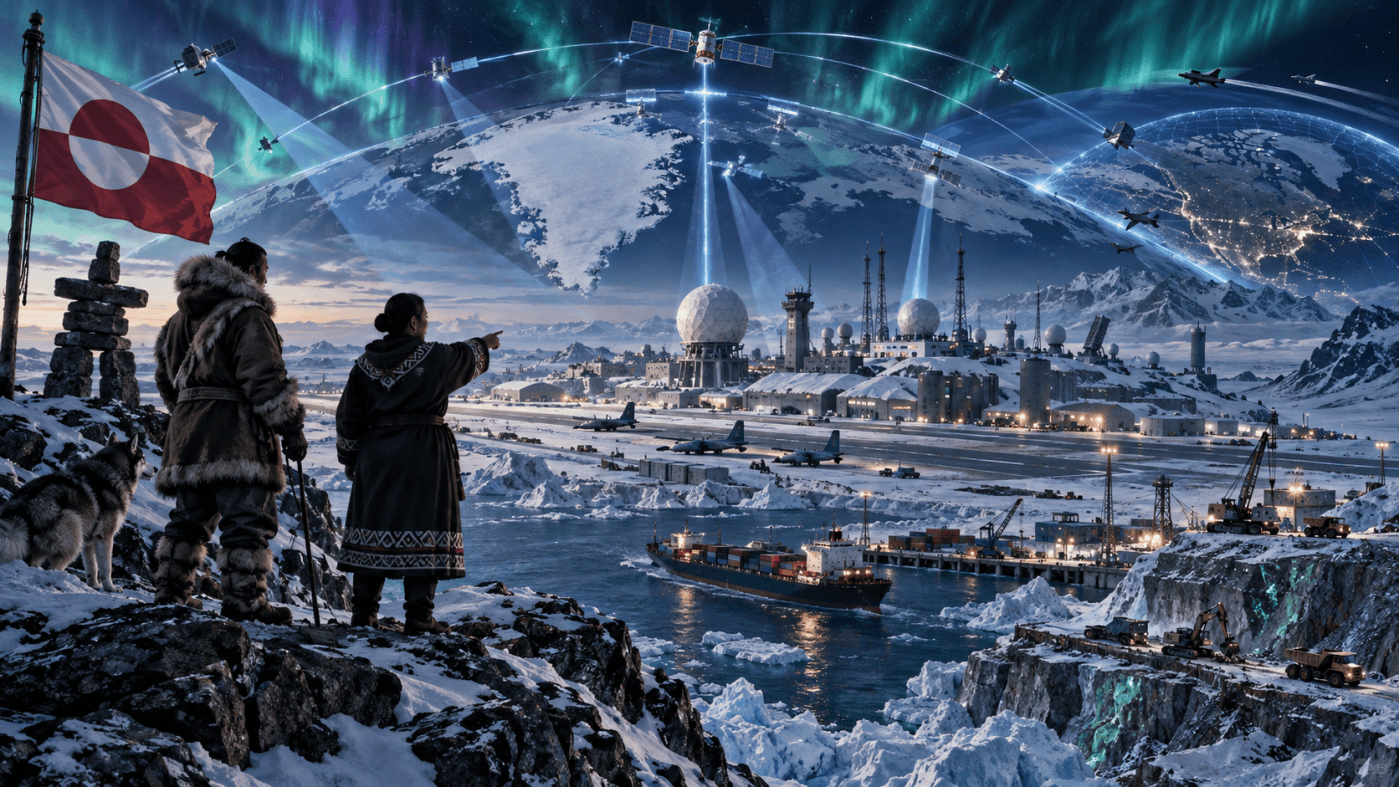
The BBC presents Washington’s new Greenland agreement as the settlement of Donald Trump’s annexation threats, but the real struggle runs deeper than who owns the island on paper. Greenland has fought for a direct voice over its territory even as the United States works to harden the Arctic flank of the American Pole through bases, missile warning, space systems, investment controls and strategic denial. That makes Greenland’s growing national agency inseparable from the New Cold War architecture being built against China, Russia and the wider multipolar opening. The contradiction is brutal and concrete: Greenland is trying to build the material capacity for self-determination through relationships that can simultaneously narrow the choices that self-determination is supposed to make possible.
Prince Kapone | Weaponized Information | September 21, 2026
The Government Missing From Its Own Headline
On September 18, BBC News reporter Oliver O’Connell published “US and Denmark reach deal” over Greenland’s security. The article reports Donald Trump’s claim that Washington has secured “permanent control over security, and all other needs,” Denmark’s insistence that sovereignty remains intact, and Greenlandic Prime Minister Jens-Frederik Nielsen’s endorsement of an agreement he says protects Greenland’s interests. It also contains a rather important limitation: nobody reading the story can inspect the agreement because its text hasn’t been released.
The framing problem begins before the first paragraph. The headline gives agency to two governments: the United States and Denmark reach a deal over Greenland. Greenland becomes the place being discussed rather than one of the governments doing the discussing. Yet the official announcement identifies Greenland, Denmark and the United States as the three governments expected to sign. That doesn’t erase the enormous difference in power among them. It does mean Greenland is more than scenery in somebody else’s negotiation.
The article’s source hierarchy reinforces the headline. Trump gets the language that defines the event: “permanent control,” “no cost,” “express written approval,” the power to do “what is necessary.” Secretary of State Marco Rubio gets to call it a “historic deal” that permanently resolves Washington’s security concerns. Denmark answers with sovereignty and territorial integrity. Nielsen appears later to affirm Greenland’s interests. Washington supplies the verbs, Denmark supplies the reassurance, and Greenland—the country whose territory is at issue—gets considerably less room to define what has actually been negotiated.
The chronology does similar work. The story begins with Trump’s months of threats to “take” Greenland and moves naturally toward an agreement presented as their resolution. The crisis becomes a Trump story: he made the demand, allies objected, negotiations followed, a compromise emerged. The BBC briefly mentions Greenland’s strategic location and mineral wealth, but the larger relationship disappears into background. That leaves the reader with the effect while the conditions that made the confrontation possible remain outside the frame.
Most revealing is the article’s own caveat. Trump speaks as though a permanent settlement already exists. The three governments say they expect to sign it, with parliamentary procedures still to follow. The BBC reports both propositions but lets the stronger presidential language carry the story. Before “permanent control” can explain Greenland, somebody has to establish what has actually changed, which powers remain unsettled, and why those powers were being renegotiated in the first place.
Access Was Old; the Terms Are Changing
The BBC makes Trump’s announcement sound like the moment Washington finally got into Greenland. That history starts far too late. Greenland’s own 2024 foreign-policy strategy says the United States has maintained a military presence there for more than eighty years and identifies Pituffik Space Base as central to U.S. security. The 1951 defense framework long ago established American military access. Whatever the September agreement changes, access itself isn’t the new development.
What sits at Pituffik today also matters. The U.S. Space Force describes the base as part of the military network that provides missile warning and tracking for North American defense. Another Space Force unit there connects polar-orbiting satellites to a global command network, accelerating intelligence, surveillance, reconnaissance and missile-warning data for U.S. and allied forces. The military’s own description is blunt: Pituffik helps provide operational advantage across contested space and military environments. Greenland is already wired into a defense system extending far beyond the island.
Greenland’s constitutional position makes the current negotiations more complicated than the BBC’s U.S.-Denmark shorthand suggests. The Self-Government Act recognizes Greenlanders as a people with a right to self-determination, and independence would mean Greenland assuming sovereignty over its territory. Under the present arrangement, Copenhagen still holds constitutional responsibility for defense and security. Agreements of particular importance to Greenland, however, require Greenlandic involvement. The result is a system in which Greenland exercises substantial self-government while some of the powers most directly tied to military sovereignty remain shared or retained within the Danish Realm.
Greenland had already decided that arrangement needed changing before Trump’s latest campaign. Its 2024 strategy committed Nuuk to seeking a defense framework in which Greenland becomes a party and receives greater benefit from the relationship. Nuuk wasn’t simply dragged into a conversation Washington invented this year. Greenland had already demanded a larger voice in military decisions rooted in agreements made long before it possessed meaningful control over its own foreign affairs.
But that demand wasn’t a blank check for militarization. The same strategy supports continued defense cooperation with the United States while calling for the Arctic to remain a region of low tension. It says Greenland generally opposes increased military presence and prefers installations away from civilian communities where possible. That tension sits directly beneath an agreement now promoted in the language of stronger Arctic security while the scale and location of any expanded military footprint remain unsettled publicly.
Washington’s own Arctic strategy explains why “security” now reaches well beyond bases. The Defense Department says China is seeking greater Arctic access, resources and influence, while growing Russia-China cooperation is changing the regional threat environment. The same strategy calls for stronger surveillance, allied military integration and U.S. presence across the Arctic. That official framework helps explain why investment, infrastructure, technology and resource projects increasingly get treated as security questions alongside aircraft, radar and troops.
Greenland’s room to maneuver also rests on an economic base that remains materially constrained. Statistics Greenland records DKK 4.324 billion in block grants in 2024. Greenland’s government has therefore spent years trying to widen domestic revenue, investment and productive capacity. Political self-government exists alongside a fiscal structure in which Danish transfers still carry enormous weight.
Critical minerals enter that problem as a future development strategy, not as the economy Greenland already has. The government’s 2025–2029 mineral strategy says mining employed only about 100 full-time workers in its cited baseline, roughly 0.4 percent of total employment. The government nevertheless sees a larger mineral sector as one route toward a broader revenue base and greater financial independence. The deposits matter because of what they could become, not because Greenland is already one giant rare-earth pit waiting for Washington to claim it.
Greenland was also building its own machinery to police foreign capital before the September deal. A proposed investment-screening law covers defense, critical technology, infrastructure, minerals, hydropower and other sensitive sectors. The proposal places approval authority with Naalakkersuisut, which could condition or reject covered investments. That matters because Trump now describes the new agreement as giving Washington approval power over adversary investment. Until the agreement itself is public, the relationship between those claims and Greenland’s own regulatory authority remains unresolved.
The fight over Pituffik shows why promises that security cooperation will “benefit Greenland” have to be followed all the way down to wages, contracts and ownership. Inatsisartut has already pressed for greater employment and skills benefits from the defense relationship. SIK has challenged periods when local workers and apprentices failed to receive the opportunities promised around base activity. A contract can carry a Greenlandic address while the harder questions remain: who owns, who works, who trains, who collects the profit and who gets left with the consequences.
That is the terrain underneath the BBC’s tidy sequence of threats followed by compromise. Washington already had access. Greenland already wanted a larger formal role. The U.S. military was already treating the Arctic as a strategic front involving space systems, missile warning, China, Russia and alliance infrastructure. Greenland was simultaneously trying to gain more control over investment, development and the economic returns generated on its territory. The September agreement enters all of those unfinished relationships at once. What remains unsettled is not Greenland’s strategic importance, but what becomes more durable now, who gets to decide, and whose material power grows when the new terms take hold.
A Seat at the Table Inside the Arctic Wall
The easiest way to misunderstand Greenland is to imagine sovereignty as a light switch. Either a country controls itself or somebody else does. Either Washington owns the territory or it doesn’t. Either Greenland sits at the table or it’s being carved up on top of it. Real national liberation has never worked that neatly. Political authority grows inside material relations inherited from the order a people is trying to outgrow, and those relations don’t disappear because a parliament, treaty or flag acquires a new name.
Greenland has fought its way from colonial administration toward greater self-government, international standing and authority over its own future. Entering the defense relationship as a more direct political actor is part of that movement. Treating Greenland as a helpless prop would reproduce the same colonial habit the BBC slips into when it turns three governments into a deal between two. But a seat at the table doesn’t tell us who built the table, who controls the electricity running through the room or whose machinery sits outside the door.
The larger architecture is the American Pole. As U.S. command over the world faces greater resistance from a more multipolar international order, Washington has been trying to harden the strategic space closest to the imperial core: military infrastructure, continental defense, supply chains, technology, resources and the routes connecting them. Fortress America is the defensive face of that recalibration. Greenland is part of its northern wall. Pituffik’s radar, missile-warning and space systems don’t defend Greenland in isolation; they plug the island into a military network built around North American defense and U.S. force projection.
That’s what gives the September deal a meaning larger than Trump’s obsession with buying real estate. Washington doesn’t need to plant fifty stars over Nuuk to secure what matters militarily. Territory can remain legally Greenlandic while bases, airspace, radar, infrastructure and investment rules operate through durable arrangements shaped around a wider strategic system. Empire has always possessed more instruments than annexation. Sometimes it takes the colony. Sometimes it leases the harbor. Sometimes it builds the radar, screens the investment, integrates the airspace and calls the result partnership.
The New Cold War gives this consolidation its present urgency. Washington’s own Arctic strategy now treats China’s search for Arctic access, resources and influence, along with deeper Russia-China cooperation, as part of the threat environment. The issue is therefore bigger than whether Chinese troops ever appear in Greenland. Military bases, ports, communications systems, minerals, energy, investment and technology all become terrain in a struggle over who can establish durable relationships inside the Arctic. Multipolarity widens the number of possible partners available to smaller countries. Fortress America tries to narrow that field where Washington considers the stakes strategic.
Greenland sits inside that confrontation without being reducible to a pawn in it. Its government is trying to use the island’s growing strategic value to build national capacity of its own. Military activity can generate contracts, employment and infrastructure. Mineral development can enlarge the revenue base. Foreign capital can finance productive forces Greenland doesn’t possess internally. Greater participation in defense negotiations can turn decisions once made over Greenland into decisions Greenland helps make. The same relations that bind Greenland to larger powers can also provide resources with which Greenland loosens older dependencies. There’s the contradiction. Greenlandic self-determination is developing through and against external strategic dependence.
The trap is that dependency can change landlords without disappearing. Reducing reliance on Danish transfers through outside investment creates room in one direction while potentially surrendering it in another. Greater military participation can bring contracts, skills and political recognition while embedding strategic territory more deeply inside Washington’s continental-defense system. Investment screening can strengthen Greenlandic regulatory authority while the universe of acceptable investors becomes increasingly filtered through alliance security. Political capacity expands, but the material roads along which it expands can already have gates on them.
Class runs straight through this national problem. A Greenlandic address on a company registration doesn’t automatically tell us who owns the capital, who controls the workplace or where the surplus goes. A military contract can produce Greenlandic wages and taxes while profits travel through Danish or American ownership. A mine can widen public revenue while roads, ports, power systems and exports remain tied to outside finance. National control over economic space and transformation of the property relations inside that space are different achievements. Workers feel that distinction in paychecks, apprenticeships and hiring long before diplomats put it into communiqués.
This is why the American Pole can’t be understood as a map Washington simply draws over passive territory. It is built through existing states, alliances, corporations, contracts and negotiated dependencies. Smaller nations bargain inside it. They extract concessions from it. They sometimes use its contradictions to enlarge their room to maneuver. Yet the structure has an asymmetry. Greenland needs capital, markets, technology and security relationships far more than the United States needs Greenlandic capital or Greenlandic military protection. Washington needs the island’s geography. Greenland has to reproduce an entire society.
The BBC’s Trump-centered storyline makes the deeper process disappear. Trump threatens to take Greenland. Denmark objects. Greenland asserts itself. Everyone negotiates. A security agreement emerges. Crisis managed. But Trump didn’t invent Greenland’s military geography, its fiscal constraints, its struggle for productive development or the New Cold War pressure turning Arctic infrastructure into contested strategic ground. He made those contradictions louder.
The September agreement therefore sits at two scales at once. Inside Greenland, it tests whether growing political agency produces greater material command over land, capital, work and infrastructure. At the world-system level, it helps harden an Arctic wall inside the American Pole at the moment Washington is trying to contain the strategic room opened by China’s rise and a broader multipolar transition. Those processes meet in the same bases, contracts, investment rules and development choices.
Greenland has fought its way into rooms where decisions about its territory were once made without it. That is a real historical advance. The harder struggle begins when sitting at the table is no longer enough and the question becomes who commands the architecture around it.
The Institutions That Still Have a Say
The agreement won’t implement itself. Whatever survives signature and parliamentary procedure still has to pass through institutions where “security” becomes land, jobs, contracts, investment and public authority. That’s where solidarity with Greenlandic self-determination becomes concrete: defend the institutions through which Greenlanders can force military expansion and foreign capital to answer to people living on the land.
The first pressure point is Inatsisartut. Its Foreign and Security Policy Committee can question Naalakkersuisut and scrutinize policy within its field, while the parliament itself has already pressed for greater Greenlandic benefits from the defense relationship. The leverage is political authorization and oversight. The tactic is sustained parliamentary questioning, disclosure and legislative scrutiny of whatever military, investment and implementation powers the agreement creates. The material purpose is simple: keep decisions over Greenlandic territory from disappearing into executive agreements negotiated beyond public reach.
Labor has another lever. SIK has already challenged failures to deliver local jobs and apprenticeships at Pituffik and maintains organized membership there. Military spending can be made to reproduce Greenlandic livelihoods only if workers organize around hiring, training, wages and conditions instead of accepting “economic benefit” as a promise printed in somebody else’s contract. The union’s leverage sits where the base actually operates: in the labor without which the machinery doesn’t run.
Inuit self-determination also has an international front. The Inuit Circumpolar Council has insisted that Inuit peoples must participate in decisions affecting their homelands and that Greenlanders determine Greenland’s political future. Its leverage is political legitimacy across the Arctic and access to international institutions. Public advocacy there can keep the Arctic from being discussed as an empty military corridor between great powers while the people who live across it are reduced to strategic scenery.
Then there’s the ground itself. In Narsarsuaq, Kommune Kujalleq has said it can’t settle the community’s future while possible military use remains unresolved. Municipal planning and land-use authority give local government leverage over how strategic infrastructure collides with homes, airports, businesses and public services. The tactic is to force those consequences into planning decisions before military necessity turns them into faits accomplis.
None of these institutions has to share WI’s analysis of the American Pole or the New Cold War for their struggles to matter. They operate at the pressure points where that larger Arctic buildout becomes material. Parliament can expose and condition authority. Unions can fight over who works and who benefits. Inuit institutions can defend political agency. Municipalities can contest what happens to land and communities. As Washington hardens the Arctic wall, that is the measure that matters: whether Greenland’s growing political voice gains enough material force to shape the bases, contracts, investment and infrastructure being built around it.
 Weaponized Information
Leave a comment