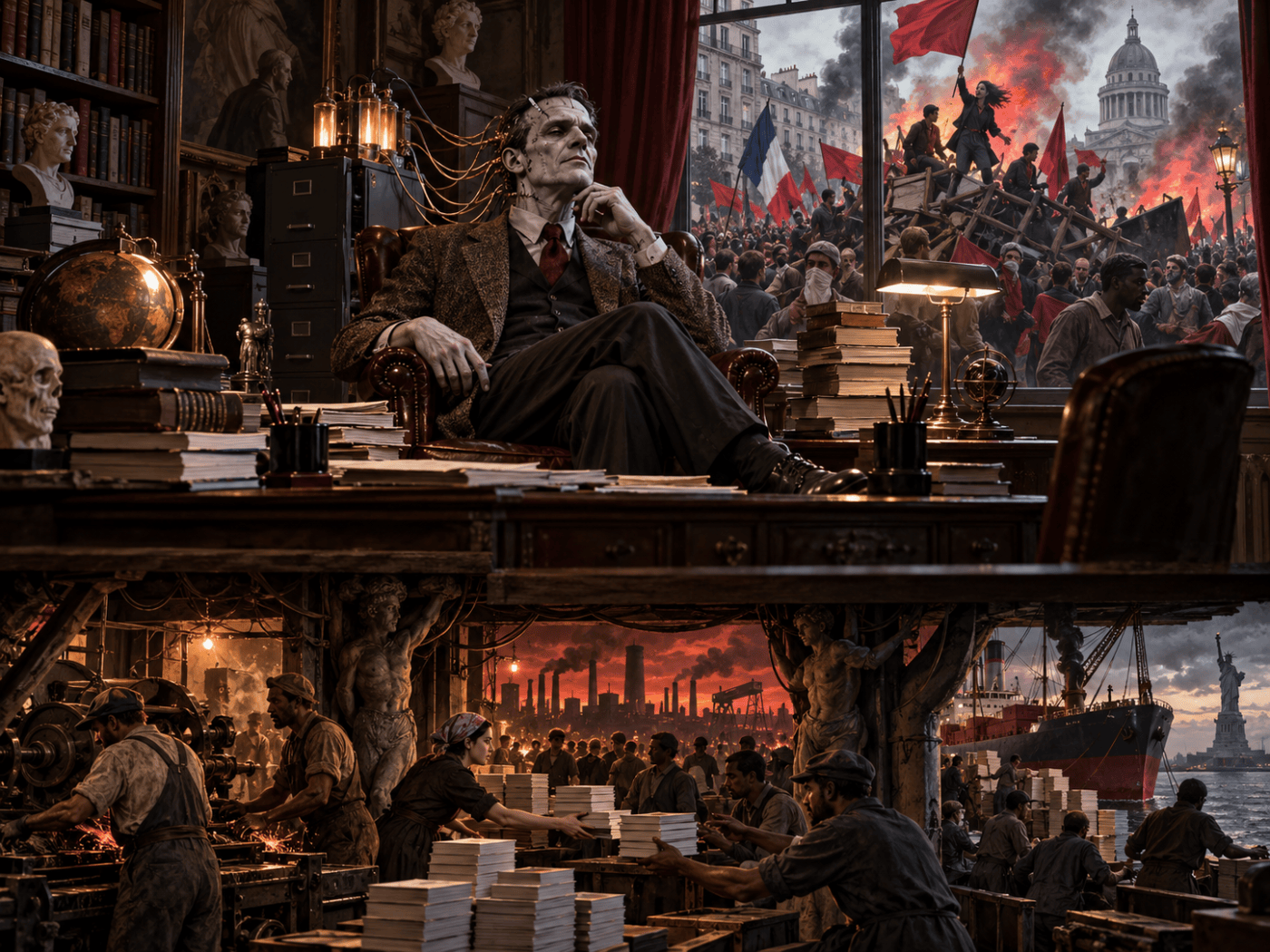
Requiem for French Theory is strongest when it stops treating ideas as free-floating philosophy and follows the institutions that selected, translated, financed, professionalized and reproduced them across the Atlantic. But French Theory endured not simply because imperial institutions found parts of it useful, but because Foucault, Derrida, Deleuze and others confronted real contradictions of power, subjectivity, language and modern capitalist life that Marxists can’t dismiss without disarming themselves. The history of 1968, identity politics and Western Marxism shows how genuine discoveries and victories produced through struggle can be detached from the forces that made them, converted into professional currency, and returned as radical culture without revolutionary command. The task, then, isn’t another funeral for inconvenient thinkers: it is to recover whatever survives materialist criticism, reconnect knowledge to class and anti-imperialist struggle, and build the revolutionary means of intellectual production capable of keeping theory in the hands of those who can change the world.
Prince Kapone | Weaponized Information | Weaponized Intellects Book Review | September 7, 2026
I. A Monster Born Abroad
The first corpse in Requiem for French Theory is a category. Before Aymeric Monville and Gabriel Rockhill can bury French Theory, they have to establish that the thing commonly presented under that name was never quite what its passport claimed. Foucault wasn’t Derrida. Derrida wasn’t Deleuze. Deleuze wasn’t Lacan. Althusser remained a communist while others moved through very different political trajectories. They fought over Marx, Hegel, psychoanalysis, structure, language, history, desire and politics. They weren’t sitting in some Paris café writing minutes for the Central Committee of Postmodernism. Yet across the Atlantic this unruly collection of thinkers acquired a shared identity, a recognizable vocabulary, an academic market and eventually the prestige of an intellectual epoch. The strange fact from which Monville and Rockhill begin is therefore the right one: French Theory had to be made.
Monville puts the problem sharply. What later appeared as a philosophical school was, in France, a “heterogeneous body of work” that acquired its peculiar coherence only once it crossed the Atlantic (p. 38). A few pages later he drives the point home: French Theory was a “finished product assembled in the United States from French raw materials” (p. 41). That sentence does more work than a hundred denunciations of postmodernism. It shifts the object of investigation away from the familiar bourgeois fairy tale of autonomous genius, where ideas supposedly float from brilliant skull to brilliant skull until the best ones naturally conquer the marketplace. Monville asks us to look instead at production. Somebody selected the raw material. Somebody grouped thinkers who hadn’t constituted themselves as a unified school. Somebody translated books, organized conferences, built curricula, reviewed texts, hired professors and taught generations of graduate students that these particular French writers belonged to one historical formation.
Rockhill gives the same argument its more precise formulation when he calls French Theory a “transatlantic cultural product” (p. 42). The Atlantic matters because the crossing didn’t merely transport ideas; it altered their social existence. Independent histories of the phenomenon reinforce that point. François Cusset’s history of French Theory traces the peculiar American reconstruction through universities, literary criticism and political culture. Michele Lamont’s study of Derrida’s reception likewise shows that Derrida’s American success depended on intellectual intermediaries who translated more than language: prestigious critics situated his work inside the conflicts and needs of U.S. literary studies, giving it a meaning and status specific to the American academic field. The text traveled. Its social function didn’t simply arrive packed inside the suitcase.
John Bellamy Foster’s introduction notes that the 1966 Johns Hopkins symposium “was to be universally designated as the point of origin” of what later became known as French Theory (p. 9). That doesn’t mean four days in Baltimore magically created an intellectual epoch. It means the meeting lets us watch a larger process take institutional form. The conference brought Derrida, Lacan, Barthes, Goldmann, Todorov and others into an American university at a moment when structuralism was barely established in the United States. Gregory Jones-Katz’s archival reconstruction follows the networks through which deconstruction subsequently took root. Encounter became seminar; seminar became publication; publication became citation; citation became curriculum; curriculum produced another generation of intellectual labor.
Once that process becomes visible, one of bourgeois intellectual history’s favorite mystifications begins to crack. A canon likes to erase the labor that produced it. By the time an undergraduate encounters “French Theory” in a course catalogue, the selection has already hardened into common sense. The names seem naturally related because the syllabus says they’re related. Their prominence begins to look like proof of inherent intellectual superiority because less-canonized currents and thinkers are harder to see from inside the finished arrangement. The commodity has reached the shelf, nicely packaged, and the factory has disappeared from the label.
But Monville and Rockhill are strongest precisely when they refuse the equally stupid opposite conclusion. If French Theory was socially constructed, it doesn’t follow that the individual thinkers were puppets whose sentences can be deduced mechanically from the institutions through which they later circulated. Rockhill explicitly rejects that vulgar determinism. The history has to grasp what he calls the “dialectical play of forces” between subjective agency and material determination (p. 42). Thinkers act. They invent. They argue. They change their minds. They respond to movements and wars and prisons and political defeats. Institutions don’t climb inside their skulls and pull philosophical levers. But intellectuals also don’t choose the entire material world in which their ideas become books, careers, departments, reputations and international currencies.
That distinction is decisive because the critique otherwise collapses into the same idealism it claims to oppose. A conspiracy theory still grants ideas a magical independence from social relations; it merely replaces the heroic philosopher with a heroic manipulator hiding behind the curtain. Materialism asks the harder question: how does independently produced intellectual work enter institutions with their own resources, political histories and class locations, and how does circulation through those institutions change what survives, what becomes central and what falls out of view?
This is why the phrase French Theory already contains a contradiction. Its unity is real because decades of publishing, teaching, criticism and institutional reproduction made it real. But that unity was historically produced. The American assemblage became capable of acting back upon its components: Derrida could become “deconstruction,” Foucault “power,” Deleuze “difference,” while the conflicts among them, the political conjunctures that shaped them and the portions of their work inconvenient to later uses could recede. Reception became production.
That process also explains why the review can’t simply conduct a firing squad of proper names. If the monster was assembled, then its political character can’t be read automatically from any single limb. The work of Foucault has to be distinguished from Foucauldianism; Derrida from the American institution of deconstruction; Althusser from what later academies chose to remember as Althusser. The same thinker can contain real discoveries, serious errors, political contradictions and several different historical afterlives. A materialist criticism has to follow those transformations instead of assigning eternal ideological essences.
Monville and Rockhill have therefore moved the argument onto much more dangerous ground than the usual academic quarrel over whether Derrida correctly read this paragraph or Foucault misunderstood that archive. Once French Theory is recognized as something historically assembled, intellectual prestige itself becomes a material problem. The question is no longer merely why certain French thinkers wrote what they wrote. It is why, from a much larger field of possible ideas, these particular fragments acquired such extraordinary international mobility, why American institutions found them worth reproducing, and how a collection of antagonistic thinkers became a common language of radical thought.
A monster born abroad still needs a body, a workshop and the power that keeps the lights on. Ideas can cross an ocean under their own names. They can’t build the bridge themselves.
II. The Machine That Gives It Life
If French Theory had to be assembled, then the next question is material: who had the money, institutions, presses, classrooms, foundations and international networks capable of assembling it? Here Requiem for French Theory leaves the comfortable territory of intellectual biography and walks into the political economy of knowledge. Rockhill’s strongest formulation comes on page 49, where he tells us to examine “an entire framework for the production, circulation, and consumption of culture.” Ideas don’t become world-historical forces merely by being clever. They need institutions capable of moving them through space, language, class and generations.
Rockhill’s Preface gives the method a useful discipline. He describes his own break with the intellectual world that formed him as a process of “engaging in a process of empirical verification” (p. 29): checking claims, reading original sources, testing quotations, and refusing to let prestige substitute for evidence. That standard has to govern the institutional argument too. A foundation grant proves a material relationship. It doesn’t prove that the funder dictated every conclusion produced inside the institution. A university can build the road without deciding every destination. If we collapse money into command, we don’t get materialism. We get a puppet show with invoices.
The 1966 Johns Hopkins conference makes the real mechanism visible. Archival work shows that the organizers consciously sought to build what their proposal called a “vital bridge” between European structuralism and American intellectual life. The conference project received Ford Foundation support, brought major European theorists into an elite U.S. university, and generated continuing seminars and publications after the original gathering ended. The transmission was planned. What isn’t established is that Ford officers financed Hopkins because somebody had ordered them to destroy Marxism. Lucien Goldmann, a dialectical Marxist openly hostile to much of structuralism, stood inside the same conference. Derrida then used the occasion to unsettle assumptions within structuralism itself. Institutions can construct a field of encounter without scripting every proposition uttered inside it.
Rockhill himself gives us the better formulation. French Theory was, he writes, “at least in part, a product of U.S. cultural imperialism” (p. 48). The qualification matters. At least in part leaves room for European political crisis, disciplinary struggle, movement pressure, intellectual agency and genuine theoretical discovery. It also refuses the equally childish fantasy that the U.S. academy floated above the Cold War like some philosophical Switzerland. The institutions through which theory moved had histories, funders and political purposes.
The Ford Foundation’s role in postwar French intellectual life reached far beyond one Baltimore conference. French archival records show Ford providing major support for Fernand Braudel’s Maison des Sciences de l’Homme, including an initial million-dollar commitment. Former Ford officer Francis Sutton later described the foundation’s European objective in broader political terms: strengthening French social science belonged to strengthening France inside Western Europe and the Atlantic community. Ford wasn’t handing Braudel a list of acceptable historical conclusions. It was helping build the material infrastructure of an Atlantic intellectual world at the same moment Washington was consolidating its military, financial and ideological predominance over Western Europe.
That broader setting matters because the cultural Cold War was no paranoid invention discovered years later by people with corkboards and red string. The CIA’s own history acknowledges that the Congress for Cultural Freedom formed part of a covert strategy to cultivate the non-Communist left and contest communist influence among European intellectuals. The operation financed journals, conferences, cultural networks and intellectual exchange while hiding the Agency’s role because an openly CIA-branded literary magazine would, naturally enough, have somewhat diminished its rebellious charm.
Ford money later intersected directly with that machinery. The foundation’s own 1966 annual report records $1.5 million in general support for the Congress for Cultural Freedom. Ford and the CIA weren’t one institution wearing different hats. They didn’t need to be. Philanthropy, universities, cultural organizations and state power occupied overlapping territory inside the Cold War struggle over intellectual life. Interests could converge without everyone receiving the same memorandum.
The sharpest evidence of political compatibility comes from Washington itself. In its 1985 assessment France: Defection of the Leftist Intellectuals, the CIA openly welcomed the decline of Marxist influence in French intellectual life. Its analysts credited structuralism and the Annales school with helping break Marxist dominance in the social sciences and regarded the wider growth of anti-Marxist and anti-Soviet thought as favorable to U.S. interests. That document tells us something important and bounded: imperial intelligence recognized these intellectual changes as politically useful. It doesn’t tell us that Langley created Lévi-Strauss, authored Foucault or slipped Derrida his vocabulary under a café table.
The distinction between use and authorship is where the analysis becomes genuinely materialist. A ruling class doesn’t need to manufacture every idea that benefits it. Capitalism didn’t invent every religious doctrine that blessed property, every nationalist story that justified conquest or every theory later used to reconcile people to exploitation. Powerful institutions can select from ideas already circulating, reward some, neglect others, build durable structures around useful tendencies and allow intellectual workers considerable room to act inside the terrain those institutions have helped shape.
Universities perform part of that work without functioning as ministries. They hire and fire. They determine what counts as a discipline. They control credentials, journals, graduate programs and professional careers. Publishers decide what gets translated. Reviewers create reputations. Foundations finance centers and research programs. Departments turn texts into syllabi. A concept repeated across twenty years of graduate training begins to appear not historically victorious but intellectually inevitable. The scaffolding disappears behind the finished building.
None of this gives dominant institutions absolute command. Their power lies in unequal capacity: the ability to finance, translate, employ, publish, credential and preserve at a scale most oppositional institutions can’t match. That asymmetry structures the terrain without deciding every battle fought on it. The theoretical content still has to be read, tested and located in the struggles that produced it.
The machine, then, isn’t a secret committee manufacturing philosophers to order. It is more durable than that: a network of institutions rooted in a capitalist and imperial order, capable of giving some ideas translation, mobility, prestige, professional reproduction and a long institutional life. But even the most powerful machinery can only reproduce material that somebody has produced. To understand why these particular fragments survived the crossing, we have to stop looking at the machinery for a moment and examine the organs themselves.
III. Why These Organs Could Live
A machine can circulate an idea. It can’t explain why anyone wanted the idea in the first place. That is where every crude theory of ideological manipulation falls apart. Foucault, Derrida, Deleuze, Lacan and the structuralists didn’t conquer large sections of the humanities because foundation officers hypnotized several generations of graduate students. Their work entered real intellectual crises and answered real questions. Some answers were partial, some distorted, some brilliant, some politically disastrous. But there were problems there to be solved.
Rockhill is most on point when he identifies how French Theory organized those problems. One of the most important tensions is what he describes as the polarity between “structure and event” (p. 56). Structuralism had already broken with the bourgeois habit of explaining society through sovereign individuals floating above history. Language, kinship, myth and institutions could be understood as relations whose logic exceeded individual consciousness. That was no small advance. The trouble came when structure hardened against historical motion, while later celebrations of rupture, event and difference could break transformation loose from the structures being transformed.
Rockhill argues that this opposition helped produce a theoretical world in which permanence and rupture stare at one another across a philosophical trench. Derrida’s aporia can then appear, in Rockhill’s phrase, as dialectics “at a standstill” (p. 56): contradiction recognized but deprived of historical development. The argument deserves attention because it gets past the usual conservative complaint that French theorists made everything too complicated. Complexity isn’t the crime. The question is whether the categories can explain how one social relation becomes another.
But the problems these theorists confronted were real. The old certainties of European intellectual life had been battered by fascism, world war, colonial revolt, psychoanalysis, socialist revolution and the collapse of European empires. The bourgeois individual—the rational little proprietor strolling freely through philosophy—looked increasingly ridiculous beside concentration camps, colonial armies, advertising systems, psychiatric institutions and mass bureaucracies. Many Marxist traditions in the imperial core also had unresolved questions about how domination entered daily life, institutions, sexuality, language and consciousness. Nobody needed the Ford Foundation to invent those contradictions.
Foucault’s work drew force from precisely this terrain. His histories of madness, medicine, prisons and disciplinary institutions asked how power operated through practices that didn’t look like a policeman swinging a club or a capitalist handing out wages. His later prison work wasn’t confined to the lecture hall. Through the Groupe d’information sur les prisons, Foucault and his collaborators worked with prisoners, circulated testimony, investigated prison conditions and helped turn the prison itself into an object of political struggle. The group also developed contacts with militant currents beyond France, including Black prison radicalism in the United States, particularly through its engagement with George Jackson and the Attica uprising. The point isn’t to baptize Foucault as a revolutionary Marxist after the fact. It is to recognize that his theory encountered material realities older Marxist practice had not always investigated with equal precision.
This helps explain some of the later reach of Discipline and Punish. A prison is obviously a class institution, but “the ruling class built prisons” doesn’t exhaust what happens inside them. Bodies are counted, classified, watched, timed, isolated, examined and trained. Knowledge becomes part of coercion. The medical file, psychological diagnosis, architectural plan and disciplinary timetable matter because domination has technique. Foucault was right to insist that power lives in those techniques. Where his framework becomes vulnerable is when the technique begins to swallow the social order that gave it historical purpose—when discipline becomes so omnipresent that capital, empire and class rule risk appearing as merely some power relations among many.
The same problem appears differently with Deleuze and Guattari. Whatever else one thinks of Anti-Oedipus, it didn’t arrive from another planet bearing instructions to forget capitalism. It wrestled with capitalism, psychoanalysis, desire and the wreckage of 1968. The question they posed was serious: why do exploited people sometimes desire social arrangements that reproduce their exploitation? How does domination enter desire rather than merely confront desire from outside? Marxists who answer that question only by saying “false consciousness” have explained almost nothing. A ruling order survives not merely because workers are lied to but because social life produces habits, pleasures, fears, ambitions and identities that can tie people emotionally to the relations dominating them.
American literary studies had problems of its own. New Criticism had exhausted much of its intellectual authority. Departments wanted methods capable of saying more about language, meaning, authorship and interpretation. Derrida entered a field already searching for new tools in its internal struggles. Michele Lamont’s study of Derrida’s U.S. reception shows how American scholars actively reconstructed his work rather than simply importing it intact. The institutional market mattered, but there was demand because existing methods no longer satisfied the people working inside the field.
There is a class lesson here, but it is subtler than saying professors like obscure books. Intellectual labor under capitalism still confronts real objects. Historians can discover facts. Psychiatrists can expose institutions. Literary critics can reveal ideology. Philosophers can identify contradictions. A university salary doesn’t render every proposition false any more than a factory wage renders every machine defective. What class society shapes is the field in which discoveries are selected, rewarded, generalized and disconnected from other relations.
This is where historical materialism has to be stronger than resentment. It is easy to mock a vocabulary of discourse, difference, desire, undecidability and subjectivity. Sometimes the mockery is richly deserved. But ridicule can become an alibi for intellectual laziness. If a theory became powerful because it named something millions could recognize, revolutionaries gain nothing by pretending the thing wasn’t there. The better question is what relation the theory revealed, what relation it abstracted away, and how that partial truth changed once institutions made the partiality into a worldview.
A useless theory would be easy to bury. French Theory endured because parts of it grasped real features of modern domination: the prison, the clinic, the psychiatric ward, the sign, the body, the bureaucratic classification, the production of subjects, the instability of language, the political life of desire. Those discoveries gave the theory genuine use before they gave it prestige.
But a fragment doesn’t explain its own place in the whole. A truth separated from the social relations that produce it can acquire a political life very different from the one its author intended. That is where the theoretical organs begin to acquire another kind of value—not simply because they illuminate reality, but because history itself can attach revolutionary prestige to them. In France, that history had a date: 1968.
IV. The Stolen Heart of 1968
If French Theory eventually acquired the aura of revolt, May 1968 supplied much of the electricity. But the historical image that survived in the universities is strangely inverted. Posters, cobblestones, barricades, liberated desire, forbidden slogans: all of that remained. The working class somehow disappeared. Monville cuts through the mythology with the fact that should’ve made abstraction impossible: roughly ten million workers struck during the crisis, producing what he calls “the biggest strike in French history” (p. 64). Contemporary U.S. diplomatic reporting counted around eight million workers already on strike by May 21, with factories occupied and transportation paralyzed. Whatever else May became in memory, its material center wasn’t a graduate seminar. France stopped because workers stopped it.
That simple fact changes the whole picture. A strike on that scale isn’t cultural rebellion floating above production. It is social power becoming visible. Machines sit idle. Goods stop moving. Managers discover that their authority depends upon workers continuing to obey it. The normal appearance of capitalist society—that capital employs labor and commands production—briefly flips over and reveals the underlying relation. The owners own the factories, but ownership produces nothing by itself. The people who work them can stop the country.
Even “the French working class,” however, can become another abstraction if we leave empire outside the factory gates. At Renault-Billancourt, one of the symbolic centers of the strike, about one-third were foreign workers among roughly 21,000 employees. Algerian, Portuguese, Spanish and other migrant workers formed part of the industrial proletariat whose labor had powered postwar French accumulation. France’s factories were already tied to colonial and postcolonial histories of labor migration. The worker confronting Renault management wasn’t always some mythical native-born Frenchman defending an equally mythical national economy. He might have come from a society France had colonized, occupied or economically subordinated.
This must be emphasized because Monville sometimes frames the surrounding political crisis through the conflict between Charles de Gaulle’s France and U.S. Atlantic power. That contradiction was real. De Gaulle had pulled France out of NATO’s integrated military command, pursued an independent nuclear force, criticized aspects of Washington’s Vietnam policy and repeatedly irritated U.S. officials with his insistence on French strategic autonomy. American diplomatic records from the crisis make Washington’s frustration unmistakable. But strategic autonomy from Washington wasn’t the same thing as anti-imperialism. France remained an imperial power with colonial and neocolonial interests of its own. A state can resent being ordered around by a stronger empire while still ordering weaker nations around itself. There is no mystery there. Imperialists have been quarreling over rank since empires were invented.
The distinction becomes concrete in Africa. After Guinea voted for immediate independence in 1958, French authorities withdrew personnel, equipment and support in an effort U.S. officials themselves understood as a warning to other African territories considering the same road. A State Department memorandum recorded France’s attempt to make Guinea an example. France wanted freedom of action against Washington while restricting freedom of action for Africans. That is capitalist national autonomy, not anti-colonial sovereignty. Any account of May that casts Gaullist France principally as a victim of American domination therefore turns a secondary contradiction inside the imperial system into the whole story.
Monville is more careful when he turns to the explosive claim that Washington might have had a hand in destabilizing de Gaulle. “There is no proof of the direct involvement of the U.S.-American services,” he writes on page 76. That sentence has to stay exactly where he put it: between hypothesis and fact. Washington certainly had reasons to dislike de Gaulle’s independence. U.S. officials also hoped the crisis might weaken his ability to frustrate American policy. But the documentary record inspected for this review doesn’t establish that the CIA engineered May. In fact, contemporary officials said they wanted the crisis stabilized. Their self-description isn’t holy writ, but neither can an unproved covert operation be promoted to fact because it fits neatly into the theory. Materialism doesn’t give us permission to invent the missing document.
The irony is that no intelligence conspiracy is needed to expose the deeper historical theft. The working class actually did what later radical philosophy became famous for imagining. Workers ruptured ordinary social relations. They occupied productive space. They challenged hierarchy. Students and youth widened the rupture. Migrants entered the struggle. Existing communist institutions, unions, revolutionary groups and unaffiliated workers fought over where the movement should go. The crisis was eventually politically contained, negotiated and absorbed without overturning ownership or state power.
Monville captures one side of the settlement through Michel Clouscard’s wicked formula: “Everything is allowed, but nothing is possible” (p. 67). The line names a real contradiction in the post-1968 order. Cultural prohibition weakened. Consumer society expanded. New forms of sexuality, personal freedom and expressive individualism became more socially legitimate. Capitalism proved capable of absorbing substantial cultural liberalization without surrendering wage labor, private accumulation or imperial power. Yesterday’s scandal could become tomorrow’s market segment.
Yet the political legacy of 1968 couldn’t be reduced to consumer permissiveness. Feminism, gay liberation, antiracist movements, prison struggles, autonomous worker organization and new critiques of hierarchy forced open terrain that deserved to stay open. The contradiction wasn’t freedom versus class struggle. It was whether those emancipatory breakthroughs would develop into a deeper attack on the social relations producing domination or become separated from the revolutionary crisis that had made their expansion possible.
Here Rockhill introduces one of the book’s sharpest concepts: “historical commodity fetishism” (p. 72). Marx’s commodity fetish hides the labor and social relations that produced the commodity behind the finished object appearing on the market. Something similar happened to 1968. The historical labor that produced the revolt—the strikes, occupations, organizations, arguments, risks and collective power of millions—receded. What remained available for circulation was the image of revolt. Radicality became detachable from the social forces that had produced it.
The afterlife of Foucault makes the contradiction especially clear. Foucault wasn’t in Paris during the May uprising; his post in Tunisia kept him outside the central events. He became more directly militant afterward, including through Vincennes and later prison struggles. That doesn’t make his politics fraudulent. Quite the opposite: it shows that the conjuncture helped transform him. But later academic memory could invert the causal order. Instead of May transforming intellectuals, the intellectuals became the people through whom May itself was remembered. The event produced political energy; theory inherited the aura.
The same retrospective process could turn thinkers who disagreed profoundly with one another into philosophical representatives of a common rebellion. “French Theory” then appeared to have authored the revolt whose prestige helped create French Theory’s later international value. Workers vanish from the photograph. The theorists remain in the caption. History gets the kind of editing normally reserved for advertising.
This is why Rockhill’s claim that the association between French Theory and progressive politics can become a “category mistake” (p. 68) has real force, though it needs precision. The mistake isn’t that Foucault, Deleuze or others had nothing radical to say. The previous movement already established that some of their work contained genuine critical discoveries and, in cases, genuine militant engagement. The mistake comes when the political meaning of mass struggle is transferred wholesale onto an intellectual commodity. Radical language becomes proof of revolutionary function. Transgression substitutes for organized power. Suspicion of authority becomes identical with the capacity to overthrow the social relations that continuously regenerate authority.
Once revolutionary prestige becomes detachable in this way, capitalism doesn’t have to extinguish it. It can circulate it. A university can teach rebellion. A publisher can sell transgression. A foundation can finance critique. None of these facts automatically renders the critique false. They reveal a new contradiction: victories and insights produced through struggle can survive while the institutions reproducing them change their political relation to the struggle that made them possible.
The stolen heart of 1968 was therefore not rebellion itself. The rebellion belonged to workers, students, migrants, militants and all the contradictory forces that entered the crisis. What was stolen was the appearance that radical meaning could be preserved intact after being separated from the collective capacity that had produced it. Once that separation became possible, liberation could enter the institution without the institution surrendering command.
V. When Liberation Becomes a Profession
The ruling order doesn’t survive every rebellion by crushing it. Sometimes it survives by conceding something real, building an office around the concession, hiring professionals to administer it, and eventually teaching a new generation that the office was where liberation came from in the first place. That process is harder to analyze than repression because the gains aren’t imaginary. Women win access to institutions that excluded them. Black people force open universities, newsrooms and professions. Gay and lesbian movements tear holes through laws and social prohibitions. The oppressed fight, and the world changes. The contradiction begins afterward: what happens when a victory produced by struggle from below enters institutions whose property, command and class structure remain intact?
Rockhill is better on this question than a careless reading of his attack on “identity politics” would suggest. He explicitly warns against abandoning struggles around race, gender and sexuality (p. 95), and on page 92 he preserves the causal sequence any materialist account has to keep straight: incorporation became possible because oppressed people had already fought and won. Capital didn’t generously invent feminism so corporations could diversify themselves fifty years later. Black people didn’t wait for a foundation officer to explain racism to them. Queer people didn’t discover oppression in a graduate seminar. The movements came first. Their pressure forced institutions to move.
This matters because the history of the term identity politics itself cuts against any lazy equation of identity with bourgeois fragmentation. The Combahee River Collective, whose 1977 statement gave the phrase one of its most influential formulations, was a Black feminist socialist organization. Its members argued that racism, sexism, heterosexual oppression and class exploitation were intertwined. They declared themselves socialists, opposed capitalism and imperialism, rejected the idea that Black women’s liberation required political separation from Black men, and insisted that their particular social position revealed relations more universal language could miss. Whatever one ultimately thinks of the category, this wasn’t a politics telling workers to forget class and celebrate representation. It arose from Black women trying to understand why class struggle that ignored patriarchy and antiracist struggle that ignored gender could both leave them standing at the back of the room.
That history creates a serious problem for any critique that treats “identity politics” as though it sprang fully formed from Foucault, Derrida or the nonprofit conference circuit. It didn’t. French Theory didn’t manufacture feminism, Black liberation, gay liberation or the revolt against institutional racism. Those struggles developed out of material relations older than the theoretical vocabularies later attached to them. The stronger question is how ideas and demands produced inside insurgent movements changed when they entered institutions capable of recognizing difference without surrendering ownership or command.
The history of women’s studies gives us a concrete example. The Ford Foundation itself recounts how foundations helped turn feminist victories into an academic field. Between 1972 and 1975, Ford financed scores of women’s-studies projects and then moved toward consolidating the field through university research centers and institutional support. Feminist scholarship gained resources, legitimacy, jobs and a foothold inside universities that had long treated women’s lives as intellectually secondary.
Those were victories. It would be politically stupid to pretend otherwise. Scholarship on rape, reproductive control, wage discrimination and unpaid labor didn’t become false because foundations eventually wrote checks. The issue isn’t contamination by money. It is what institutionalization changes in the social organization of struggle.
A movement survives through organizers, meetings, political education, strikes, demonstrations, newspapers, mutual aid, confrontation and mass participation. An academic field survives through budgets, tenure lines, conferences, publications, grants, professional associations and administrative recognition. The second form can preserve knowledge generated by the first. It can also change the incentives surrounding that knowledge. Problems that can become research programs acquire institutional durability. Language that can enter law and administration becomes professionally useful. Demands requiring confrontation with property and state power are harder to absorb because satisfying them would attack the conditions the institution itself reproduces.
The nonprofit world creates a similar contradiction. Women-of-color organizers associated with INCITE! later developed the concept of the nonprofit industrial complex to describe how radical movements could be redirected through foundations, professional staff, grant cycles and service organizations. Again, the point wasn’t that everyone working at a nonprofit had sold their soul for dental insurance. It was structural. Organizations dependent on grant-makers confront different pressures from organizations dependent on an organized mass base. A foundation can withdraw funding much faster than a militant constituency can withdraw historical necessity.
This is where Rockhill’s criticism of institutionalized identity politics finds firmer ground. Once movements force open institutions, capital can accommodate changes in who administers accumulation without surrendering accumulation itself. A corporation can diversify its board while exploiting a multiracial workforce. A university can teach decolonial vocabulary while sitting on property accumulated through dispossession. An imperial state can praise women’s advancement while bombing women abroad. Representation can advance while the relations of exploitation, ownership and imperial command remain standing.
But the causal chain has to remain honest. French Theory didn’t simply create this politics. Poststructuralist languages of discourse, subjectivity, difference and representation sometimes became highly compatible with professionalized forms of struggle because they offered sophisticated tools for discussing power inside culture and institutions. Yet the material transformation moved through a much larger process: movement victories, university expansion, foundation money, litigation, nonprofit growth and professional careers. Theory entered that process as one mediation among others.
The distinction matters because otherwise revolutionary criticism commits its own act of historical theft. If we tell the story badly, Black women disappear from the creation of Black feminist theory and return only as consumers of white French philosophy. Feminists stop being historical actors who forced institutions to change and become dupes captured by foundations. Gay and lesbian liberation becomes an academic fashion rather than a struggle fought in workplaces, streets, families, bars, prisons and law. A critique supposedly restoring materialism then manages to erase the people who materially produced the history. That’s one hell of a method.
The real contradiction is harder and more useful. Liberation can win something without winning everything. A movement can force open a university without abolishing the class society that owns it. An oppressed group can gain representation while exploitation survives. New knowledge can become institutionalized and thereby protected from disappearance while simultaneously being separated from the organizations and revolutionary horizons that produced it. Incorporation works precisely because it incorporates something real.
The question, then, isn’t whether feminism, Black liberation, queer struggle or the analysis of difference should be thrown overboard in the name of class. Rockhill himself rejects that road. The question is whether these struggles remain connected to the material relations producing differentiated oppression—and to the collective power capable of transforming them—or become professional specialties circulating inside institutions that have learned how to manage difference without surrendering command.
VI. Cut the Stitches
By this point Monville and Rockhill have spent a good deal of time digging French Theory’s grave. Then, just before the coffin closes, Monville does something much more interesting: he reaches for a scalpel. “French Theory is like Frankenstein,” he writes on page 96. The metaphor changes the argument. Frankenstein’s creature isn’t one substance. It is an assemblage. The political problem therefore can’t be settled by declaring every piece of the body dead because the finished creature wandered somewhere ugly. If the monster was stitched together historically, criticism has to cut the stitches and examine what was joined, what changed in the joining, and what remains worth saving.
This is where Requiem for French Theory becomes much stronger than its title suggests. “Structuralism is always partly scientific,” Monville writes on page 97. That is no small concession. Structuralism’s insistence that social phenomena possess relations and patterns exceeding individual consciousness broke with a great deal of bourgeois common sense. Kinship, language, myth and institutions don’t simply arise from millions of sovereign individuals choosing whatever strikes their fancy before breakfast. Human beings inherit structures they didn’t design. They act inside them, reproduce them, resist them and sometimes transform them. Historical materialism has no reason to be frightened by that insight.
The problem begins when structure stops moving. Relations become systems reproducing themselves. Contradiction freezes into difference. Transformation arrives from somewhere outside the structure as an “event,” rupture or inexplicable break. Rockhill had already identified the problem in the separation of structure from event. Dialectical materialism doesn’t need to deny structure in order to escape it. It asks how structures were produced, what contradictions reproduce them, which social forces sustain them, and under what conditions those same contradictions begin tearing them apart. Structure becomes historical relation.
Monville gives Roland Barthes similar treatment. Mythologies, he says, is “virtually pro-Marxist” (p. 98). And why shouldn’t it be useful? Barthes could take the most ordinary commodity, advertisement, photograph or cultural ritual and reveal the ideology hiding beneath its innocent surface. Bourgeois society loves to present its own historical products as nature. The market becomes human nature. Private property becomes common sense. Empire becomes civilization. The boss becomes an entrepreneur. Barthes understood something fundamental about the production of that innocence. A Marxist criticism that refuses the insight because the author’s later trajectory fails some purity test would be disarming itself out of spite.
Derrida presents a harder case because the tool and the limitation grow from the same operation. Deconstruction can expose contradictions hidden inside conceptual oppositions that present themselves as stable: civilized and barbarian, rational and irrational, normal and abnormal, center and margin. The dominant term often depends upon what it excludes. That is useful against ruling-class language, which regularly launders violence through immaculate distinctions. “Humanitarian war” works better when nobody asks why the humanitarian always seems to own the bomber.
But exposing instability isn’t yet explaining history. A contradiction inside a text doesn’t automatically disclose the social relation that produced it, and unsettling an opposition doesn’t show what material force can overcome the relation it expresses. Rockhill’s criticism that Derridean contradiction can become dialectics “at a standstill” lands here. The knife opens the category but doesn’t tell us who built the operating table, who owns the hospital, who is lying on it, or how the whole bloody arrangement might be changed.
Lacan poses the problem differently. Psychoanalysis matters because capitalism doesn’t confront ready-made human subjects from the outside. People are formed inside families, schools, workplaces, languages, fantasies and prohibitions. Marxism becomes crude whenever it imagines that announcing the objective interests of a class automatically explains how actual people experience the world. The revolutionary task is to recover what psychoanalysis can tell us about subject formation without letting the unconscious become a kingdom whose borders capital somehow respects.
Deleuze likewise refuses easy disposal. His attention to becoming, multiplicity and desire emerged from genuine theoretical problems. But becoming loses revolutionary force when it loses determination. Everything flows, everything escapes, everything deterritorializes—and somehow the landlord still wants the rent on the first of the month. Capital itself is tremendously mobile. It dissolves traditions, uproots populations and reorganizes desire whenever profit requires it. A politics of flux becomes revolutionary only when it can explain which class commands the movement and who pays for it.
Then comes Althusser, who makes any blanket funeral nearly impossible. Monville acknowledges him as a Marxist who made “significant contributions” (p. 103). Rockhill remains critical of his theoretical formation and later uses, but Althusser can’t honestly be folded into the same political category as straightforward anticommunism. His insistence that ideology is materially reproduced through institutions, his critique of humanist readings of Marx, his attempt to distinguish levels of social determination and his battles inside communist theory all belong to Marxism’s own twentieth-century struggle with itself. Some of those interventions created serious problems. Some sharpened questions Marxists still have to answer. The only way to know the difference is to analyze them.
And that is precisely Monville’s strongest methodological statement: “the best criticism is always dialectical” (p. 101). Rockhill follows on page 102 by acknowledging that French Theory contains elements that can be appropriated by dialectical and historical materialism. Here the book stops behaving like a prosecutor and starts behaving like a revolutionary theorist. Dialectical criticism doesn’t ask whether a tradition is mostly bad and therefore disposable. It asks what truth the tradition grasped, what contradiction allowed it to grasp that truth, where its categories stop explaining, and what larger framework can preserve the discovery while overcoming the limitation.
Marx did this constantly. He didn’t defeat political economy by pretending Adam Smith and David Ricardo were idiots. He took their greatest discoveries seriously enough to show where bourgeois categories broke under the weight of the social relations they were trying to explain. Lenin didn’t answer imperialist theories of monopoly by refusing to read bourgeois economists. Revolutionary thought advances through appropriation, criticism and transformation. It doesn’t become stronger by voluntarily donating every useful concept to another tradition.
That is the standard French Theory deserves. Foucault’s attention to discipline can be brought back into the history of class rule, colonialism and counterinsurgency. Barthes’s demystification of everyday ideology can be returned to commodity society. Psychoanalysis can be grounded in social reproduction. Deleuzian desire can be forced to confront accumulation and property. Derridean instability can be driven beyond textual undecidability toward the historical contradictions that make ruling concepts unstable in the first place. Structuralism can keep structure and recover history.
None of this means baptizing every French theorist into Marxism after death. It means refusing to let ideological opposition become an excuse for intellectual surrender. A revolutionary movement needs every analytical weapon that can survive the test of reality. If a thinker from another tradition discovers something true, the truth doesn’t become their private property. We take it.
Rockhill eventually describes Marxism itself as a science that is “thoroughly fallibilistic” (p. 105). That statement carries consequences larger than the immediate argument. A fallibilistic Marxism can’t protect itself by decree. It has to learn. It has to admit when another tradition saw something it missed. It has to distinguish error from uselessness, institutional appropriation from intellectual nullity. Otherwise historical materialism becomes exactly what its enemies say it is: a catechism frightened of evidence.
Once the stitches are cut, French Theory no longer appears as one ideological corpse but as a contradictory pile of discoveries, evasions, brilliant fragments, political dead ends and concepts capable of different uses under different social relations. The problem was never simply what organs went into the monster. It was who assembled them, how the body was made to move, and what political life the finished creature acquired.
But that raises a problem Monville and Rockhill can’t avoid. If theories change as they pass through institutions, Marxism has no immunity certificate. It too can be translated, professionalized, canonized, commodified and separated from the class struggle whose name it carries. The scalpel has cut through French Theory. Now it has to turn toward Marxism.
VII. Marxism in the Same Laboratory
The scalpel can’t stop at French Theory. If institutions can select, translate, professionalize and politically transform ideas, then Marxism enters the same laboratory. There is no red exemption card taped to the door. A theory can quote Marx, invoke class struggle, publish handsome editions of Lenin and still acquire a social function very different from the revolutionary movement that produced those names. Rockhill understands this. In Part II, he turns from French Theory toward the different material histories through which Marxisms developed inside imperial centers, anticolonial struggles and socialist construction. Marxism forged under blockade, war, land reform and the problem of holding state power doesn’t confront the same world as Marxism produced mainly through universities and journals.
That distinction becomes especially sharp when Rockhill contrasts a theory’s academic “exchange-value” with its “use-value for the struggles of workers” (p. 124). A book can become enormously valuable inside the intellectual market because it is cited, assigned, translated, debated and attached to professional prestige. None of that tells us whether it increases the capacity of working people to understand the social order, organize against it, build institutions, seize political initiative or transform property relations. The commodity form can swallow Marxism too. The beard stays on the cover. The revolution quietly leaves through the back door.
There is a powerful truth here. Anyone who has spent time around the professional left has seen Marx converted into cultural capital. Knowing the right theorists becomes a credential. Radical vocabulary becomes distinction. One learns to say dialectical with exquisite sophistication while displaying considerably less interest in the workers cleaning the building after the lecture. Capital is perfectly capable of tolerating Marx as an object of specialization. A dead revolutionary who generates conferences is much easier to manage than living workers who shut down a port.
Rockhill calls some of this “compatible Marxianism” (p. 136): forms of Marxist language whose institutional existence no longer presents a material socialist alternative to capital. The category is useful, but only if we refuse to turn it into another blacklist. “Western Marxism” was never one political species. Sartre supported Algerian independence and the FLN, opposed French colonialism and later helped organize the Russell Tribunal against U.S. war crimes in Vietnam. Marcuse moved through U.S. wartime and Cold War research institutions while becoming a major theoretical reference for the New Left; archival work on those Cold War research networks shows real institutional entanglement without reducing his thought to a memo from above. Lefebvre remained preoccupied with alienation, everyday life, capitalism and revolution. Their contradictions require analysis. They can’t be dissolved into the postal address of the university where they happened to work.
Althusser makes the problem impossible to dodge. If the simple thesis were that the imperial intellectual field rewards only Marxism already stripped of revolutionary content, his extraordinary Anglophone circulation would be difficult to explain. Althusser wasn’t shy about communism. He remained inside the French Communist Party and described philosophy as a weapon in proletarian class struggle. New Left Review published his “Philosophy as a Revolutionary Weapon” and debated his work precisely as an intervention into Marxist politics. New Left Books—later Verso—was founded in 1970 as a radical publishing project and deliberately brought Althusser, Lefebvre, Mandel, Sartre, Lukács and other Marxists into English-language circulation. The publisher’s own history makes that political origin plain.
This matters because it breaks the picture of one giant bourgeois machine controlling every theoretical conveyor belt. The imperial core contained counter-hegemonic institutions operating inside the same society but answering to different political projects. Radical journals translated texts dominant institutions had neglected. Socialist and communist publishers circulated theory according to other priorities. Movements built schools, newspapers, study groups, presses and political-education programs. The field remained unequal—Ford possessed resources New Left Books could only dream about—but it was contested. Capitalist class power structured the terrain without abolishing the enemy from it.
That is the deeper lesson of Althusser’s anomaly. Institutional reproduction matters, but we have to ask which institution, tied to which social forces, reproducing theory for what political use. A copy of For Marx assigned inside a graduate seminar and the same book studied by militants trying to understand ideology may be physically identical commodities while entering completely different political relations. The text has no magical essence determining every later use. Political function emerges from the relation among the text, the institution and actual struggle.
This is also where Rockhill’s positive argument about anti-imperialist Marxism and actually existing socialism has to be read on its own terms. In pp. 137–143, he treats socialist practice not as a decorative example but as the historical terrain on which dialectical and historical materialism is tested. Revolutions in China, Cuba, Vietnam and elsewhere confronted problems no seminar could simulate: land, literacy, industrialization, war, sanctions, planning, bureaucracy, class alliance, state construction and the danger of restoration. Theory entered the furnace of consequence. An error in a journal article might cost a citation. An error in revolutionary strategy could cost a country.
But practice doesn’t confer infallibility. Rockhill’s stronger formulation is that actually existing socialism is a “practical process of learning” (pp. 138–139). That is exactly right. The revolutionary use-value of Marxism lies not in declaring every socialist state correct by definition but in treating collective practice as a terrain where theory is tested, contradicted, revised and sometimes defeated. A Marxism that can’t learn from socialist failure is no more scientific than a liberalism that explains every capitalist catastrophe as somebody else’s fault.
The contrast with academic exchange-value therefore has to remain dialectical. Universities can preserve texts movements might otherwise lose. Scholars can recover archives, clarify concepts, translate forgotten works and expose bourgeois mythology. A revolutionary press can also become doctrinaire, sectarian or stupid. Institutional opposition to capital doesn’t automatically generate truth. What matters is whether a theory remains connected to material investigation and collective practice strongly enough that reality can correct it.
Clouscard remains useful here as a bounded anomaly. His critique of post-1968 consumer capitalism and the ideology of desire spoke directly to terrain later dominated by more internationally celebrated theorists, yet his work barely entered the Anglophone world. That marginality is real; its cause is not yet proven. Translation markets, political affiliation, publisher networks, style and ideological compatibility may all have mattered. We can’t turn obscurity into proof of suppression simply because the conclusion would be satisfying.
The same discipline should govern Rockhill’s category of “compatible Marxianism.” The useful question isn’t whether a Marxist teaches at Columbia, publishes with a prestigious press or writes in a vocabulary fashionable among graduate students. The question is what political horizon the work makes visible. Does it treat capitalism as a total social relation capable of being overcome, or as an eternal background against which endless critique takes place? Does it engage imperialism as a material system or reduce it to discourse? Does it clarify organization, state power, ownership and revolutionary strategy, or become suspicious precisely when oppressed people begin constructing the institutions through which they might actually rule?
Those are harder questions than checking the acknowledgments page for foundation money. They are also more Marxist.
Rockhill’s distinction between exchange-value and use-value becomes most powerful when freed from the temptation to sort intellectuals into pure and contaminated camps. Theory acquires different value in different social relations. Bourgeois institutions can turn revolutionary concepts into professional currency. Revolutionary organizations can recover those concepts and return them to struggle. A university can domesticate Marx; a worker study group can weaponize a passage first encountered in the university. Class struggle moves through intellectual life rather than politely stopping at the library door.
The practical conclusion is bigger than French Theory and bigger than the academy. If the ruling class possesses foundations, universities, media systems, publishers, research institutes and enormous resources for reproducing its intellectual world, revolutionaries can’t answer merely by producing better arguments and hoping truth wins the talent show. They need institutions capable of preserving memory, training cadre, translating neglected traditions, investigating reality, circulating analysis and subjecting theory to the criticism of organized struggle.
The decisive question is therefore no longer simply which Marxism is compatible with the existing order. It is who possesses the means through which Marxism itself can remain a living weapon instead of becoming another beautiful object behind glass.
VIII. Theory Needs Its Own Means of Production
By the end of Requiem for French Theory, the argument has travelled well beyond Foucault, Derrida and the strange American creature assembled from their names. Rockhill closes by describing dialectical and historical materialism as a “collective, practical science of liberation” (p. 146). The word collective matters as much as science. Knowledge capable of confronting capital can’t survive as the private possession of brilliant individuals. It has to be produced, criticized, preserved and circulated by people organized to transform the world.
This is the political conclusion hiding inside the book’s intellectual history. The ruling class doesn’t merely possess ideas. It possesses means for reproducing them. Universities train intellectual labor. Foundations finance research. Publishers decide what travels. Media institutions decide what reaches millions. Archives preserve some histories while others disappear. None of these institutions needs perfect control. Their accumulated power lies in making some knowledge durable, prestigious and everywhere available while other knowledge survives because somebody translates it after work, prints it on a cheap press or carries it from one struggle into another.
The revolutionary answer can’t be to spend eternity shocked that bourgeois institutions behave like bourgeois institutions. If theory has material conditions of reproduction, revolutionary theory needs material means of reproduction of its own: presses, political schools, research collectives, archives, media and international networks rooted in struggles that have something more at stake than citations. The exact form will differ by place and movement. The principle doesn’t.
That independence still doesn’t guarantee truth. A revolutionary organization can become doctrinaire just as easily as a university department can become fashionable. That is why Rockhill’s insistence on Marxism as fallibilistic matters. Revolutionary institutions must be capable not only of preserving a line but of correcting it. Practice has to answer theory. Defeats have to teach. Socialist construction has to be studied as a living process of advance, contradiction, failure and renewed struggle rather than polished into scripture.
The alternative is a Marxism that survives mainly as intellectual property. It can become enormously sophisticated while losing the capacity to command anything outside a bibliography. Capital has little reason to fear a revolutionary tradition whose primary battlefield is the seminar room, provided everyone remembers to submit the essay by midnight. The problem isn’t difficult books. Revolutionaries should read everything useful. The problem begins when knowledge stops moving toward organization and becomes an end in itself.
Here the history of French Theory becomes a warning wider than the authors sometimes make it. A genuine insight can be severed from the historical struggle that produced its question. A theory can keep its radical vocabulary while changing political function. A movement’s victories can enter professional institutions and return as expertise. Marxism can suffer the same fate. No doctrine carries immunity from commodification merely because the word class appears in the index.
But the book leaves us with something more useful than a funeral. The intellectual field was never occupied by one army. Workers, colonized peoples and revolutionary movements have repeatedly built institutions of thought because struggle forced them to understand what ruling knowledge couldn’t—or wouldn’t—explain. That fact turns the question away from which theorist deserves admission to the revolutionary canon and toward who possesses the means to produce, test, preserve and circulate revolutionary knowledge in the first place.
That is the extension Requiem for French Theory demands. The struggle over knowledge belongs inside the struggle over property and power. Whoever commands the means through which a society remembers its past, names its present and imagines its future possesses extraordinary political power long before the first barricade appears.
So cut open French Theory. Recover what survives the test of reality. Throw away what can’t. Do the same to Western Marxism. Do the same to every doctrine we inherit, including our own. Then build something capable of carrying what remains back into the hands of people who can use it.
A revolutionary theory locked safely inside the academy is only another exhibit. The task is to return the weapon to the struggle—and make sure the struggle owns the factory that produces the next one.


Leave a Reply