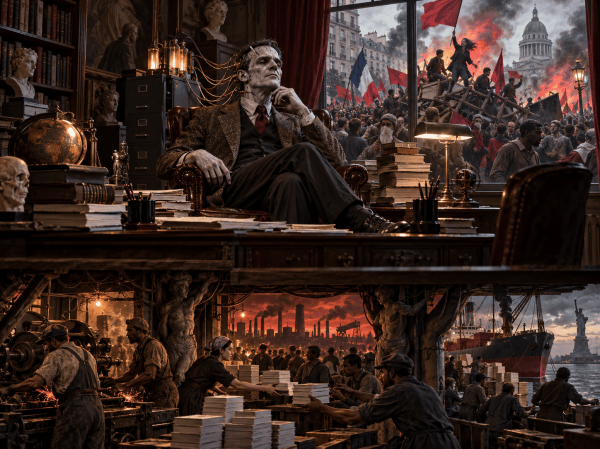
Requiem for French Theory asks a question academia prefers to leave buried: how did a heterogeneous group of French thinkers become a unified radical canon in the United States? Monville and Rockhill trace the foundations, universities, publishers and Cold War institutions that helped make French Theory travel, but the deeper story is more dialectical than conspiracy. Foucault, Derrida, Deleuze and others confronted real contradictions and produced genuine insights even as their work was selectively reproduced, professionalized and detached from mass struggle. The lesson reaches Marxism itself: revolutionary theory needs more than correct ideas. It needs its own means of intellectual production.
The Corpse Got Tenure: French Theory’s American Afterlife