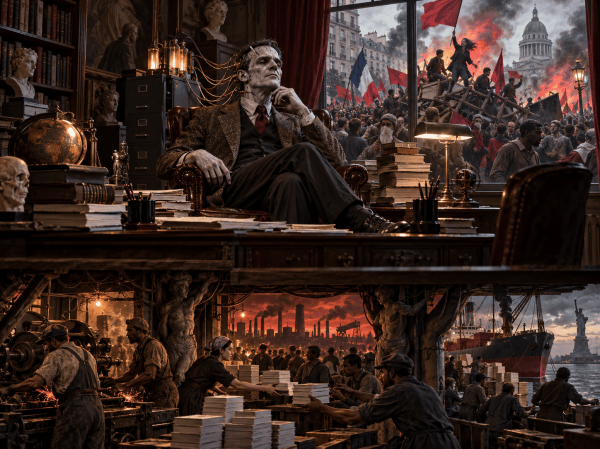
Requiem for French Theory asks a question academia prefers to leave buried: how did a heterogeneous group of French thinkers become a unified radical canon in the United States? Monville and Rockhill trace the foundations, universities, publishers and Cold War institutions that helped make French Theory travel, but the deeper story is more dialectical than conspiracy. Foucault, Derrida, Deleuze and others confronted real contradictions and produced genuine insights even as their work was selectively reproduced, professionalized and detached from mass struggle. The lesson reaches Marxism itself: revolutionary theory needs more than correct ideas. It needs its own means of intellectual production.
Marx and Engels Against Their Own Ghosts: The German Ideology and the Fight to Keep Materialism Inside History
Marx and Engels' The German Ideology brutally uncovers the egregious folly of detaching philosophy from material conditions. They weaponize critiques of German idealists, exposing how revolutionary thought that ignores the tangible, lived experiences of class struggle morphs into mere ideology. Highlighting the perils of alienation, they assert that human powers can unwittingly turn oppressive when subjected to capitalist structures. Moreover, they admonish socialists who, by elevating abstract ideas above real movements, dilute the revolutionary essence of their theories. In a world increasingly interlinked yet profoundly unequal, their insistence on rooting ideas in concrete history remains a clarion call for genuine transformation against ideological hauntings.