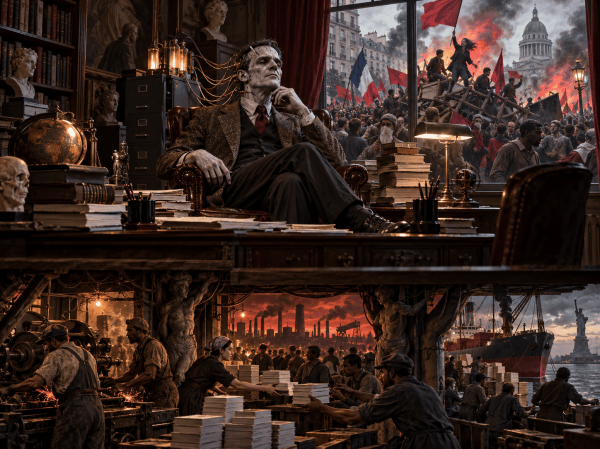
Requiem for French Theory asks a question academia prefers to leave buried: how did a heterogeneous group of French thinkers become a unified radical canon in the United States? Monville and Rockhill trace the foundations, universities, publishers and Cold War institutions that helped make French Theory travel, but the deeper story is more dialectical than conspiracy. Foucault, Derrida, Deleuze and others confronted real contradictions and produced genuine insights even as their work was selectively reproduced, professionalized and detached from mass struggle. The lesson reaches Marxism itself: revolutionary theory needs more than correct ideas. It needs its own means of intellectual production.
The Mercy Department: How USAID Laundered Empire Through the NGO-Industrial Complex
USAID did not simply deliver humanitarian aid—it institutionalized a model of empire that fused relief, civil society, media, governance, and development into the machinery of U.S. foreign policy. Excavating an NPR interview with former USAID Administrator Samantha Power, this essay exposes how liberal narratives of compassion obscure the agency's role inside the broader NGO-industrial complex. Drawing on anti-imperialist scholarship and Global South perspectives, it argues that the real choice is not between aid and no aid, but between imperial dependency and sovereign development. The struggle ahead is to defend the people harmed by aid cuts while dismantling the donor architecture that transforms solidarity into supervision.
No Kings: Liberal Rituals, Imperial Power, and the Crisis of American Legitimacy
How the ruling class staged a mass protest to save the presidency—not dismantle it—and why a real “No Kings” movement must break the throne, not defend it.By Prince Kapone | Weaponized Information | October 22, 2025Rituals for a Throne: How “No Kings” Became a Crown-Saving CeremonyThey told the country a stirring tale: on October 18,... Continue Reading →