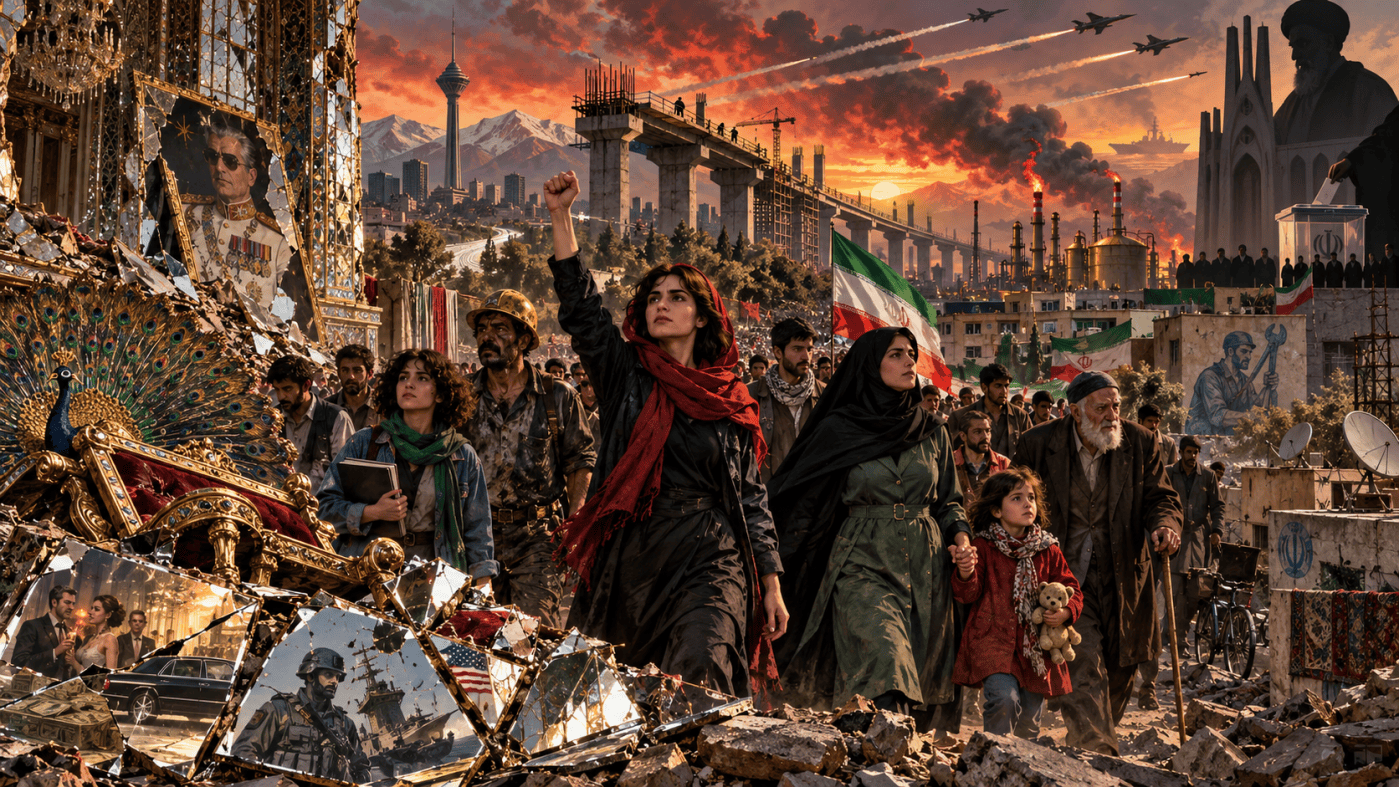
Robin Wright’s The Last Great Revolution sees an Iran transformed by revolution but keeps trying to force that transformation toward a liberal ending history never delivered. The revolution shattered the Shah’s imperial-dependent order, survived invasion and siege, reorganized property, expanded education, health, women’s participation and cultural capacity, yet concentrated decisive authority over production, law, coercion and constitutional power in institutions ordinary people did not fully command. From workers’ shoras and peasant land struggles to Khatami, Woman, Life, Freedom, sanctions, the JCPOA and the 2026 U.S.-Israeli war, the same contradiction keeps returning in new forms: Iranian sovereignty expanded while popular sovereignty remained unfinished. Wright went looking for the “last great revolution”; what her own evidence reveals is something far more dangerous—a revolution still fighting over who gets to wield the power it unleashed.
Prince Kapone | Weaponized Information| Weaponized Intellects Book Review | September 6, 2026
I. The Mirror and the Monarchy
Robin Wright begins The Last Great Revolution with an admission more useful than half the libraries Washington has produced on Iran. When she first arrived in 1973, the country seemed reassuringly familiar. Americans advised ministries, trained the military, worked the oil fields and filled Tehran’s hotels. Western fashions were visible, English-speaking officials were easy to find, and the Shah presided over a capital whose boulevards carried the names of Roosevelt, Eisenhower, Churchill and Queen Elizabeth. For the foreign visitor, Iran looked comfortable because imperial power had arranged the furniture in a familiar way. Wright later recalls an Iranian journalist explaining the illusion with brutal simplicity: “You thought he was good because you could see a reflection of yourself in him” (The Last Great Revolution, p. xii). The mirror was polished. The social order behind it was another matter.
Wright’s book begins stronger here than the usual fairy tale about 1979. The Iranian Revolution wasn’t a medieval mob suddenly waking from an Islamic slumber to attack “modernity.” It grew out of a twentieth-century struggle over sovereignty: who would rule Iran, who would command its oil, who would determine its development, and whether Iranians themselves possessed the right to choose the political and social order under which they would live. Wright reaches backward through the Constitutional Revolution and Mohammad Mossadeq before arriving at Khomeini. Her decisive sentence comes almost quietly: “With attempts at evolutionary change repeatedly blocked, revolution became the alternative route to empowerment” (p. 11). That gets closer to the historical bone than her later language of modernization and democratic recovery.
The blockage wasn’t imaginary. Mossadeq’s government nationalized the Anglo-Iranian Oil Company and tried to break Britain’s extraordinary grip over the petroleum on which modern imperial power increasingly depended. Britain answered with economic warfare and covert efforts to remove him. Declassified records now leave little mystery about what followed: British officials approached Washington about overthrowing Mossadeq, and the Eisenhower administration ultimately authorized the covert operation that helped destroy his government in August 1953. The declassified U.S. record doesn’t support the bedtime story in which Iranians simply tired of an eccentric nationalist and begged the Shah to come home. Foreign power intervened in an internal Iranian struggle, restored the monarch and demonstrated in practice how much Iranian self-determination was worth when it collided with imperial property.
But 1953 can’t become another magic date that explains everything afterward. Washington didn’t manufacture the Iranian Revolution twenty-six years in advance, and Iranians were never pieces on somebody else’s chessboard. The coup mattered because of what followed it. The restored monarchy accumulated oil revenue, weapons, bureaucracy and police power while driving a spectacular transformation of Iranian society. The Shah’s celebrated modernization didn’t preserve an old feudal Iran. It helped tear that Iran apart. Land reform weakened old landlord relations. Industrialization expanded factories and wage labor. State employment grew. Universities produced new educated strata. Rural people poured into cities. Merchants, contractors, professionals, civil servants, workers and students occupied a social world increasingly unlike the one the monarchy had inherited.
The ruling class called this progress, which was true as far as it went. Roads were built. Schools expanded. Factories multiplied. Petroleum money poured through the state. But development under dependent capitalism carries its own contradictions. It creates workers, professionals, students, technicians and urban populations whose social capacities grow faster than the political arrangements designed to contain them. By 1976 almost half the population lived in urban areas, compared with barely a fifth early in the century, while the state itself had become one of the largest employers in urban Iran. The changing class structure brought new social forces into national life without giving them equivalent power over the direction of that life. The Shah modernized Iran and then seemed surprised when modern Iranians developed opinions about who ought to run it. History can be terribly rude to men who mistake development for obedience.
Wright catches the contradiction in Chapter Six when she writes that “progress actually spurred discontent” (p. 198). The phrase is right, but “progress” is too polite. The monarchy was producing a new social formation under conditions of political dependency. Capitalist development broke older relations, concentrated wealth, moved populations, enlarged the state, created factories and schools and generated expectations that royal authoritarianism couldn’t absorb indefinitely. The problem wasn’t that Iranian society had changed too little. It was that the society beneath the throne had changed far more rapidly than a monarchy resting on repression, foreign backing and political exclusion could safely accommodate.
That contradiction sharpened because the monarchy increasingly denied independent channels through which these transformed social forces could contest power. The old National Front had been broken. Communist organization faced repression. Independent unions operated under severe constraint. Political life was eventually compressed into the Shah’s Rastakhiz Party, as though the cure for social contradiction were to announce that everybody already agreed. The political closure accompanying this transformation left fewer legal routes through which the emerging classes and strata could press their demands. SAVAK supplied the less philosophical version of the same argument. The result wasn’t stability but accumulated pressure: millions had been drawn into a transformed economy and national life while the state insisted that sovereignty still flowed downward from the Peacock Throne.
Workers were among the social forces this transformation produced, and their later role matters precisely because Wright doesn’t give it enough weight. Petroleum workers didn’t overthrow the Shah alone, but their position gave them a weapon different from speeches, sermons or demonstrations. They could stop the commodity that financed the state. Research on the oil-worker strikes shows tens of thousands entering struggle as the revolutionary crisis deepened. Their power came from more than anger. It came from where they stood inside production. When oil stopped moving, the monarchy’s crisis stopped being only political theater and entered the material bloodstream of the state.
But the revolution that broke the throne was never merely a workers’ revolt waiting to become something else. Islam was not decorative language pasted over a fundamentally secular uprising. Religious networks, mosques, clerical institutions and Islamic political thought had become mass vehicles through which millions understood oppression, sacrifice, justice and national independence. Khomeini’s authority did not descend from nowhere after the Shah fled; it had been built through years of confrontation with monarchy and foreign domination. Bazaar merchants moved money and organization. Students and intellectuals sharpened the ideological assault. Women entered revolutionary public life in enormous numbers. Workers struck at production itself. Different classes and political currents converged, but political Islam was one of the revolution’s deepest organizing languages and sources of popular legitimacy.
That matters because the monarchy’s collapse can’t be explained as religion defeating modernity, nor can the Islamic character of the revolution be treated as evidence that Iranians somehow wandered away from their own emancipation. Iran was, and remains, a majority-Muslim society with its own political traditions, religious institutions and historical memory. Self-determination means more than the right to choose leaders acceptable to Washington. It includes the right of a people to construct political institutions from their own history, including an Islamic government if that is the form produced through their revolutionary struggle. No empire gets to declare sovereignty valid only when the resulting constitution resembles its own.
The Shah’s development program had helped create workers, students, professionals, urban populations and political expectations that made his order increasingly difficult to reproduce, while dictatorship and imperial dependency made gradual resolution harder and harder to imagine. Iran didn’t revolt because it remained trapped in the past. It revolted because a transformed society refused to remain subordinate—to a monarch at home or to the imperial architecture standing behind him.
By the time the throne cracked, the revolution had accumulated something far more dangerous than opposition: millions of people who had discovered that they could reclaim national history with their own hands. The victory of 1979 was therefore not merely the destruction of a monarchy. It opened a sovereign constituent moment in which Iranians themselves would decide what kind of state would replace it, through political languages and institutions rooted in their own society rather than dictated from London or Washington. The anti-Shah coalition had not settled every question of class, property or constitutional power. But one question had been answered decisively: Iran would no longer be ruled as an appendage of somebody else’s order. The struggle now moved inward—not over whether Iranians had the right to build an Islamic Republic, but over how the revolutionary power they had won would be organized, defended and exercised.
II. When Everybody Had Power and Nobody Yet Ruled
The Shah’s departure solved the one question on which the revolution could agree. It immediately exposed all the others. Robin Wright compresses the decisive struggle into a sharp sentence: “That was the moment Iran’s future was formally hijacked by the clergy” (The Last Great Revolution, p. 14). The line tells us more about the limits of her framework than about the revolution itself. Revolutions aren’t luggage sitting unattended at a train station, waiting for the quickest faction to grab the handle and run. What opened in 1979 was a struggle among forces that had possessed very different kinds of power while overthrowing the monarchy and now faced the infinitely harder problem of turning revolutionary sovereignty into a functioning state.
Workers had already demonstrated one form of that power. The oil strikes helped choke the economic lifeline of the monarchy. Once the old managerial authority collapsed, workers in factories and other workplaces formed shoras that in some cases did considerably more than complain to management. Asef Bayat’s near-contemporaneous factory research found councils intervening in hiring, firing, purchasing, sales, accounts and production itself. In workplaces abandoned by owners or managers, workers sometimes stepped directly into administration. The revolution had crossed an extraordinary threshold. People who had previously sold their labor under somebody else’s command had begun asking whether those who produced might also possess the right to decide.
But that power was uneven. There was no nationwide federation of shoras capable of coordinating petroleum, transport, food, banking, defense and public administration as one alternative state. Councils differed sharply from factory to factory. Some were influenced by left organizations, some by Islamic currents, some by workers with little interest in anybody’s ideological blueprint. Their strength at the point of production didn’t automatically solve the problem of governing a country of tens of millions. It would be romantic nonsense to turn real worker initiative into the fantasy of a fully formed workers’ republic that had only to push Islam aside and take possession of the state.
The countryside produced its own revolutionary openings. With the authority of landlords and the old state shaken, peasants occupied land and in some regions organized councils that challenged existing property and local authority. The agrarian struggle became especially sharp where land, class and national questions overlapped, including in Turkman-Sahra and Kurdistan. The revolution had broken open questions of property and local power before any national settlement had fully answered them. Who owned the soil, who governed the locality, who carried weapons and how much authority Tehran would exercise over the periphery were being fought over on the ground.
But political Islam was not another faction wandering into the revolution after the serious work had been done. Mosques, clerical networks, religious associations and Islamic political thought had helped organize mass opposition to the Shah. Khomeini possessed enormous authority because millions of Iranians understood the struggle against monarchy, foreign domination and social injustice through an Islamic revolutionary language. Wright’s “hijacking” metaphor misses that mass social fact. The Islamic character of the state that emerged cannot be treated as though a secular revolution had been stolen from its natural destination.
Nor did the doctrine of Islamic government appear from nowhere after victory. Nearly a decade earlier, in his 1970 Najaf lectures later published as Islamic Government, Khomeini had argued that qualified jurists possessed the authority and obligation to establish government according to Islamic law. He wrote explicitly of the faqih assuming governmental and administrative responsibility. The doctrine existed before 1979. Iranians who rallied behind Khomeini were not simply being surprised afterward by the discovery that he believed Islam had political consequences.
That doesn’t mean every feature of the later constitutional order had already been fixed. During the revolutionary struggle Khomeini used broader formulations, and the anti-Shah coalition contained constitutionalists, nationalists, Islamic leftists, communists, bazaar merchants, students, workers, clerics and millions whose agreement about the future extended no further than the conviction that monarchy and foreign tutelage had to end. Even after victory, an early constitutional draft did not yet contain the mature structure of velayat-e faqih that later emerged. The Islamic Republic was therefore neither a secret blueprint unfolded mechanically nor an accidental clerical seizure. It was forged through mass struggle, constitutional conflict and the effort to give institutional form to a revolution in which Islam had already become one of the principal languages of popular sovereignty.
The Assembly of Experts became one of the decisive arenas in that process. Wright describes a political order in which parliament existed alongside the Guardian Council, the regular military alongside the Revolutionary Guards and Basij, elected officials alongside clerical and revolutionary institutions, and the president within a broader constitutional structure ultimately headed by the Leader (p. 16). Her description is useful. Her implied hierarchy of legitimacy is not. The existence of authority outside an elected presidency does not by itself prove that popular sovereignty has been cancelled. Every state distributes constitutional power through institutions that do not derive their authority from the same mechanism. Iran’s question was what revolutionary and Islamic principles those institutions would embody, how they would relate to one another, and whether they could preserve the sovereignty the revolution had just won.
The constitution gave that settlement a distinctly Iranian revolutionary form. Article 6 declared that national affairs would be administered through elections and public opinion. Article 7 identified councils as “decision-making and administrative organs.” Later provisions established elected local councils and contemplated councils inside productive and agricultural units. At the same time, Article 5 placed leadership in the faqih, while the Guardian Council received authority to review legislation and supervise elections. The constitutional settlement therefore did not simply place “democracy” on one side and “theocracy” on the other. It institutionalized multiple sources of revolutionary authority: popular election, councils, Islamic jurisprudence, revolutionary leadership and national state power.
The contradiction was not that Iran had failed to reproduce a Western parliamentary model. The Iranian people had no obligation to make Westminster, Washington or Paris the measure of their sovereignty. The harder question was how these different sources of authority would be coordinated, how far each would reach and whether the state could defend the revolution without suffocating the mass energies that had made it possible.
That is where Wright’s language of “hijacking” finally breaks down. The Islamic Republic was not simply a clerical obstruction standing between the Iranian people and some more authentic liberal future. It was one historical form through which a majority-Muslim society attempted to institutionalize anti-monarchical, anti-imperialist and Islamic revolutionary sovereignty. That form contained real internal struggles—over property, class, councils, regional authority, political participation and the scope of juridical power—but those struggles took place inside a sovereign revolutionary order, not outside it.
And that order needed governing capacity. Somebody had to coordinate the national economy, confront armed organizations, administer ministries, determine law, command an army and keep food and fuel moving. Revolutionary enthusiasm could destroy the old state; it couldn’t by itself organize a petroleum economy or defend thousands of kilometers of border. The need for concentrated authority was not evidence that the revolution had betrayed itself. It was one of the material requirements of surviving as an independent state.
There were still many centers of revolutionary initiative. Workers exercised authority inside production. Peasants challenged ownership on the land. Neighborhood committees organized local life. Revolutionary organizations carried armed power. Clerical networks possessed ideological reach and organization. Bazaar forces commanded money and commercial infrastructure. Millions of ordinary Iranians had acquired the political experience of forcing a monarch off his throne. The revolutionary question was no longer whether these powers existed. It was how they would be organized within a national state capable of preserving independence, coordinating development and preventing the return of the old order.
History would soon make that problem brutally concrete. Armed rivals were already contesting the new republic. The embassy crisis would fuse the memory of 1953 with an immediate struggle over foreign intervention and domestic power. Beyond Iran’s western frontier, Saddam Hussein was preparing a war that would test whether the revolution could survive at all. The Islamic Republic was about to discover that sovereign development required more than overthrowing the Shah. It required a state strong enough to prevent Iran from being forced back under somebody else’s command.
III. A State Built in the Fire
A revolution can overthrow a government in weeks and spend years learning how to survive without it. Iran entered that contradiction almost immediately. The monarchy was gone, but there was no empty administrative shell waiting patiently for the victors. Ministries had to function. Borders had to be defended. Oil had to move. Food had to reach cities. Rival armed organizations had to be confronted or incorporated. A state capable of defending the revolution had to be built while the revolution was still tearing through the old one. Wright catches the material problem directly when she describes the first republic: “The revolutionaries who came to power knew virtually nothing about running a state. A lot was improvised” (The Last Great Revolution, p. 13). What she doesn’t fully follow is that revolutionary sovereignty becomes real only when a people can organize institutions strong enough to prevent the old order—or the foreign powers behind it—from returning.
The first great crisis fused foreign danger with internal struggle. When the Shah entered the United States in October 1979, Iranian students seized the U.S. Embassy the following month. Wright sometimes reaches for “xenophobia” to describe the atmosphere, but her own history makes that word almost useless. Iranians had watched Washington help restore the Shah in 1953. Fear of another intervention wasn’t a hallucination produced by revolutionary fever. It had a date and an archive. The embassy crisis can’t be understood outside that memory.
But memory alone doesn’t explain what the crisis did. The seizure altered the balance of power inside Iran. The provisional government collapsed. Liberal-nationalist forces lost ground. Revolutionary institutions aligned with Khomeini gained authority. Historical reconstruction of the hostage crisis therefore reveals a double movement: a real fear rooted in imperial intervention became, at the same time, a force consolidating institutions committed to preventing another externally backed restoration. Those developments weren’t opposites. They belonged to the same struggle over whether the revolution would possess the state power necessary to defend the sovereignty it had just won.
Then the crisis became war.
In September 1980 Saddam Hussein’s Iraq invaded Iran, seizing territory and striking a country whose armed forces had already been shaken by revolution, purges, desertion and institutional breakdown. Wright calls this one of the first republic’s “toughest challenges” and writes that “Iran’s physical survival was suddenly precarious” (p. 13). This wasn’t a metaphorical security problem. The new republic faced military defeat before it had finished building the institutions supposed to govern it. Whether revolutionary sovereignty would survive became a question of steel, fuel, organization and blood.
The invasion created an enormous demand for centralized capacity. The state had to mobilize troops, rebuild military command, ration goods, allocate foreign exchange, redirect production, support displaced populations and care for families of the dead and wounded. The Revolutionary Guards and Basij expanded through this necessity. So did welfare institutions, veterans’ networks and the administrative reach of the republic. Research on the post-revolutionary welfare state shows that the war helped lock revolutionary organizations and inherited bureaucracies together into a new system of social provision. The Islamic Republic didn’t survive merely because it could wield coercion. It survived because it could mobilize people, organize social reproduction, defend territory and turn revolutionary commitment into durable governing capacity under conditions that could’ve broken the country apart.
That capacity mattered politically as well as materially. The war became a durable reservoir of revolutionary legitimacy. Years later, Wright encounters that memory at the cemetery of the war dead, where one Iranian tells her, “This revolution is still something to fight for” (p. 231). The sentence can’t be dismissed as manufactured ideology. Families had lived through invasion, bombardment, chemical warfare and death. Whatever disagreements existed over prices, bureaucracy, culture or political institutions, defense of the country had become fused for millions with defense of the revolution that made Iran sovereign enough to resist.
Iraq also drew substantial outside support as the war developed. The Persian Gulf monarchies provided Baghdad major financial assistance; France became a leading supplier of advanced weapons; the Soviet Union resumed its role as Iraq’s largest arms supplier, while Syria and Libya backed Iran and Israel also supplied Tehran. The broader wartime alignments were messy, opportunistic and anything but a neat two-bloc morality play. Washington’s position hardened increasingly toward Baghdad as Iranian forces recovered, and declassified U.S. records show American officials knew Iraq was using chemical weapons while continuing policies that aided Saddam’s war effort. The declassified U.S. record makes that part of the story impossible to bury beneath the word neutrality.
The chronology still matters. Iran had driven Iraqi forces from most occupied Iranian territory by 1982. Tehran then chose to carry the war into Iraq and pursue broader aims. That decision can be debated on its own historical grounds without falsifying who began the war. Iraq launched the invasion. Iran later chose to continue the conflict beyond the recovery of most occupied territory. Serious analysis requires holding both facts at once.
The same discipline is necessary when dealing with internal violence. The Islamic Republic faced real armed enemies. The Mojahedin-e Khalq moved into open confrontation with the state in 1981 and carried out assassinations that killed senior officials, including Mohammad Beheshti, President Mohammad-Ali Rajai and Prime Minister Mohammad-Javad Bahonar. Regional conflicts in Kurdistan and Turkman-Sahra likewise became armed struggles over local authority, land and the authority of the new state. The revolutionary opposition was neither peaceful nor politically uniform. A revolutionary government facing assassination, separatist conflict and invasion had a real obligation to defend the state its people had created.
That doesn’t mean every political current opposed to the government belonged to one counterrevolutionary camp or that every coercive act can be explained by national defense. The Tudeh Party followed a fundamentally different path from the MEK. It initially supported the Islamic Republic and its anti-imperialist orientation before its leadership was arrested and the organization destroyed in the early 1980s. Different political forces posed different kinds of challenges, and collapsing them into one category hides more history than it explains.
The contradiction became starkest in 1988. After years of war, and after the MEK launched an armed incursion from Iraq, Iranian authorities executed thousands of political prisoners. Many had already been tried and were serving sentences. The exact total remains uncertain; the mass executions do not. Significantly, the objection didn’t come only from enemies of the revolution. Ayatollah Montazeri, then Khomeini’s designated successor, protested the killings from inside the revolutionary leadership itself. His objections and the underlying execution order were later preserved in his memoirs and published as part of the 1988 documentary record. The existence of that internal protest matters because it shows that argument over revolutionary legality, security and punishment was not simply imposed on Iran from outside. It existed within the Islamic Republic itself.
Wright’s fever metaphor fails badly here. A fever breaks and the body returns to health. Revolutions don’t work that way. Institutions built during emergency acquire personnel, budgets, command structures, property, memory and social constituencies. The Guards that defended the country didn’t evaporate when the front quieted. Welfare institutions didn’t pack themselves away. Revolutionary courts didn’t vanish once the immediate emergency passed. Nor should the persistence of those institutions be treated automatically as evidence of democratic failure. A sovereign revolutionary state requires continuity, defense capacity and institutional memory. The real question is how institutions created under emergency become normalized, governed and integrated into the long-term development of the republic.
Iran couldn’t have defended itself through a decentralized carnival of good intentions. The revolutionary councils and parties had never developed a coherent national system capable of replacing the state. Somebody had to coordinate an army, a petroleum industry, public distribution and a country under invasion. Concentrated authority was not an unfortunate deviation from sovereignty; under those conditions it was one of sovereignty’s material requirements. The historical question is not whether Iran should have remained permanently dispersed and institutionally weak. It is how revolutionary authority, popular participation and national defense were combined inside a state determined not to be recolonized or returned to monarchical dependency.
The Islamic Republic came out of the 1980s alive. That was no small achievement. It survived invasion, assassination, internal fragmentation, diplomatic isolation and a war whose international environment increasingly favored Baghdad. More than survival was at stake. Iran demonstrated that a revolution in the Global South could break with a U.S.-backed monarchy, construct an independent political order rooted in its own religious and historical traditions, and defend that order against military assault without returning to imperial tutelage.
That achievement did not settle every social question the revolution had raised. It made those questions possible to pursue on sovereign terrain. Iran now possessed a state strong enough to defend the revolution, reconstruct the country and determine its own development. The next question was no longer whether Iran had the right to govern itself. That had been answered in blood. The harder question was what social order this sovereign state would build, how property and surplus would be organized, and how the promise made in the name of the mostazafin would be carried from wartime survival into reconstruction.
IV. Who Owned the Revolution?
Once the guns quieted, the revolution confronted a question no constitution could answer with pious language alone: who actually owned what had been won? Iran had broken the Pahlavi state, confiscated the property of sections of the old ruling class, nationalized banks and major industries, expanded the public sector and proclaimed itself the defender of the mostazafin—the oppressed and dispossessed. These were not cosmetic changes. They transferred commanding economic resources away from a monarchy and bourgeoisie deeply entangled with foreign capital and placed much of Iran’s strategic economy under national control. But nationalization isn’t the same thing as socialization. A factory can pass from a private capitalist to a sovereign revolutionary state without thereby passing into direct worker administration. The distinction matters precisely because both changes are real: breaking imperial-dependent ownership is a revolutionary achievement, while producer control poses a further question about how that sovereignty is exercised inside the economy.
For a brief period after 1979, that second possibility wasn’t theoretical. Workers’ councils intervened directly in factories. Peasants occupied land. The collapse of the monarchy fractured old property relations before the new state had fully decided what would replace them. Research based on Iranian census and class data finds that the revolution seriously disrupted capitalist relations during its first decade. Capital fled. Large property was confiscated. Private investment contracted. State and parastatal ownership expanded. Petty commodity production grew. The old bourgeois configuration didn’t simply change its flag and carry on as before. The class structure itself was shaken.
But shaking capitalism isn’t abolishing it. The revolution never consolidated worker command over production into a durable national system. The shoras lost much of their early authority. Private property remained constitutionally protected. Small and medium commerce survived. The state became a massive economic actor, but workers didn’t thereby become the direct collective administrators of the state economy. None of this reduces nationalization to a bookkeeping maneuver. Public control over oil, banking, infrastructure and strategic industry gave Iran material capacities for independent development that the Pahlavi order had subordinated to monarchy and imperial alliance. The unresolved question was whether sovereign economic command would also become progressively socialized among the producers themselves. Otherwise we’re left with the bourgeois economist’s idiot seesaw: more state equals socialism, more market equals capitalism, and history apparently consists of moving the little wooden block back and forth.
The agrarian struggle showed the contradiction with unusual clarity. After the Shah fell, peasants occupied land in several regions, forcing redistribution onto the revolutionary agenda. A radical reform measure followed in 1980, but implementation collided almost immediately with large landowners and conservative clerics who defended established property rights through Islamic jurisprudence. Khomeini eventually suspended the original measure. Peasant occupations nevertheless forced partial redistribution, while the agrarian order remained unequal. The struggle didn’t pit secular economics against religion. It ran directly through Islamic political institutions themselves: one current invoked Islam to defend redistribution and the poor; another invoked it to defend property against state encroachment. Islam was not the absence of class politics. It was one of the languages through which class politics was fought.
The same conflict moved into the national legislature. The Guardian Council repeatedly challenged laws involving land, foreign trade, labor protections, collective bargaining and other economic questions on the grounds that they violated legitimate private property or contractual rights. The constitutional struggle therefore carried a class content Wright only intermittently catches. Islamic jurisprudence wasn’t floating above the economy like incense. Revolutionary institutions were arguing through it about the legitimate limits of property, the authority of the state, the claims of labor and the social obligations of an Islamic order created in the name of the oppressed.
This was one reason Khomeini’s conception of governmental authority expanded in the late 1980s. Conservative jurists were using Islamic review to obstruct legislation favored by the Islamic left and much of parliament. The resulting deadlock helped produce the Expediency Council and a stronger doctrine of the state’s authority to override narrower juridical objections when preservation of the Islamic order required it. The irony is worth dwelling on. The strengthening of revolutionary state authority—often flattened from outside into a story of simple clerical conservatism—could be used against clerical defenses of private property and in favor of the state’s ability to regulate the economy in the public interest. Iran’s ruling order was Islamic. It wasn’t economically of one mind.
The revolutionary foundations made the new property order even more distinctive. The bonyads inherited vast confiscated assets while carrying welfare obligations toward families of martyrs, veterans, the poor and other constituencies created or transformed by the revolution. They weren’t ordinary ministries, but neither were they ordinary private corporations. They combined economic resources, social provision and revolutionary legitimacy in institutions partially outside the ordinary ministerial chain. Tehran University sociologist Ali A. Saeidi describes these foundations as para-governmental organizations whose resources strengthened religious and social authority while operating through distinctive mechanisms of accountability.
Wright senses their importance but reaches for the familiar claim that the foundations may have controlled something like 40 percent of Iran’s economy. That number shouldn’t carry the argument. The available evidence is too opaque to treat any tidy percentage as solid. The institutional form matters more. Property seized from the old ruling order did not simply return to the same private hands. It was reorganized through foundations that financed welfare, veterans’ support, charitable provision and economic activity while remaining outside direct producer administration. Revolutionary confiscation therefore changed both ownership and the social uses to which portions of property were put, even though it didn’t establish worker control over those assets.
Then came Rafsanjani.
Wright presents the postwar turn as a shift from revolutionary deconstruction toward pragmatic reconstruction. She isn’t wrong about the change. Eight years of war had devastated infrastructure, exhausted investment and imposed enormous reconstruction needs on a country still confronting isolation and external pressure. Iran needed housing, industry, employment, transportation and renewed production. But “pragmatism” can make distribution disappear if we aren’t careful. Wright herself notes that the government began talking about “shock therapy” and belt-tightening while policies associated with reconstruction placed new pressures on the very mostazafin whose defense had formed part of the revolution’s social legitimacy (The Last Great Revolution, p. 22).
The postwar turn reopened space for markets, privatization, foreign investment and new accumulation. Yet even here the usual state-versus-market story collapses on contact with Iran. Assets didn’t simply move from ministries into a clean private capitalist sector. They moved through banks, pension funds, foundations, cooperatives, semi-public firms and later military-linked contractors. Kevan Harris describes the resulting structure as a “subcontractor state”: an economy where formal privatization expanded without producing the liberal fantasy of an autonomous market standing peacefully outside politics.
Capitalist accumulation was reconstituted, but through institutions the revolution had transformed and created, and inside a state that continued to preserve national command over strategic sectors.
That is the part Wright’s phrase “all over the map” can’t explain. Near the end of the book she concedes that Iran developed relatively definite political and social models but that on economic policy it “ended up all over the map” (p. 283). The confusion is real at the level of doctrine. Islamic factions defended contradictory programs. The state nationalized and later privatized. It subsidized the poor while opening new routes for accumulation. It protected private property while maintaining an enormous public and parastatal sector. Beneath that doctrinal disorder, however, a material pattern emerged. The old Pahlavi bourgeois order had been broken. The strategic economy was no longer organized as an appendage of the Shah’s alliance with imperial capital. Worker and peasant organs did not become the sovereign administrators of production. State, cooperative, parastatal and private forms developed together inside a revolutionary state determined to retain economic independence.
That is not socialism. It is also not a simple restoration of the capitalism overthrown in 1979.
The distinction matters. The revolution shattered the old royal-commercial bloc, nationalized commanding sectors, expanded public provision and built institutions through which Iran could direct development despite war, sanctions and exclusion from Western-controlled finance. Capitalist relations persisted and later expanded through private, commercial and hybrid forms, creating their own inequalities, interests and pressures. But they operated on a terrain fundamentally reorganized by a sovereign revolutionary state whose strategic orientation could not be reduced to the requirements of private capital.
The socialist question therefore remains, but it has to be posed correctly. The issue isn’t whether Iran failed because it didn’t instantly transfer every enterprise to worker councils, nor whether state ownership automatically makes a society socialist. The question is how the enormous productive resources brought under national command can serve social need, reduce exploitation, deepen economic independence and progressively enlarge the effective participation of the people who produce the country’s wealth. Sovereign development is not the opposite of that struggle. It is the terrain on which Iran became capable of waging it without an imperial power deciding the outcome from outside.
By the 1990s, the revolution had therefore produced a contradictory but historically new economic order. Capital survived. Markets survived. Private accumulation survived. But the comprador monarchy did not. Iran possessed a national state with commanding economic institutions, a large public and parastatal sector, extensive welfare obligations and the capacity to determine development priorities against enormous external pressure. Capital is perfectly capable of changing uniforms, but neither should every uniform be mistaken for the old regime underneath.
And those institutions were doing more than accumulating property. Schools, clinics, rural development and welfare networks were extending education, health and public capacity far beyond the old order’s reach. The revolution had secured economic sovereignty more completely than it had socialized economic administration. But in building an independent state capable of development, it was also transforming the people who would continue arguing over what that development was for.
V. The Revolution Made New People
Property wasn’t the only thing the revolution reorganized. It also changed the people living inside the new order. Schools spread. Clinics reached villages the monarchy had barely touched. Women entered universities and professions in growing numbers. Family size collapsed. Public health improved. Millions who had once stood farther from the institutions of national life were drawn closer to them. Robin Wright sees this more clearly than she sees the class structure underneath it. Her strongest chapters are strongest for precisely that reason: she watches the revolution expand human capacities on a scale that the old order never achieved.
Nowhere is that transformation sharper than among women. Wright writes that the revolution’s deepest social legacy “may be most enduring among women,” then immediately adds: “That’s not, of course, what the clerics intended” (The Last Great Revolution, p. 138). The line contains a real contradiction, but Wright frames it too narrowly. The Islamic Republic did roll back important elements of the Pahlavi-era Family Protection Laws, impose compulsory hijab and reorganize family and public life around Islamic social norms. Those policies materially affected women’s legal and personal autonomy and should be judged concretely. But it does not follow that the Islamic character of Iranian society itself represents women’s unfreedom, or that liberation can be measured by how closely Iran resembles the social order of Europe or the United States.
The opposite fairy tale is just as useless. Iranian women did not disappear behind the veil until Westernized reformers taught them freedom. Women had already won important gains before 1979—in education, suffrage, professional life and family law—and those gains belong to the history. Yet the Islamic Republic extended mass schooling, public health and social infrastructure far beyond many of the urban and class boundaries of Pahlavi modernization. Women from religious, working-class, rural and provincial families could enter public institutions on a scale the monarchy’s development model had never produced. The revolution did not simply inherit women’s advancement. It changed its social base.
Post-revolutionary education expanded enormously. Girls’ enrollment rose toward parity with boys, and female literacy increased sharply, including in rural areas. The history of post-revolutionary education records women entering medicine, engineering and other professional fields in growing numbers. That development cannot be dismissed as an accidental liberal residue inside an otherwise Islamic state. Revolutionary institutions built the schools, trained the teachers, expanded rural access and created social conditions in which millions of families—including conservative and religious families—could send daughters into higher education and professional life.
That produced its own contradictions. A woman could become a physician, engineer or professor while still living under family and personal-status laws that gave men and women different legal rights and obligations. Iranian women themselves argued over those questions from different religious, political and class positions. Some challenged particular laws through Islamic jurisprudence. Some demanded broader reform. Others defended an Islamic social order while insisting that Islam itself required greater justice for women. The struggle did not divide neatly into enlightened secular women on one side and backward religion on the other. It unfolded inside Iranian society and inside Islam itself.
Wright catches something deeper when she writes, “The truth is that he needed women—first to make his revolution and then to sustain it” (p. 151). That is much stronger than portraying women as accidental beneficiaries of policy. Women had marched against the Shah, organized revolutionary networks, sustained households during the war, worked in hospitals and public institutions, entered schools and professions, voted, campaigned and argued over the direction of the republic. The revolution did not merely act upon women. Iranian women were among the people who made, defended and reproduced it.
Education, however, wasn’t the same thing as economic power. Women’s labor-force participation fell after the revolution before gradually recovering, while unemployment and occupational segregation remained significant. The employment record shows a society in which women could acquire high levels of education without entering paid production at the same rate as men. That gap matters. The question is not whether Iranian women conform to a Western model of emancipation, but whether the enormous capabilities produced by education and public health are matched by meaningful opportunities to participate in economic, scientific, political and social life.
The same process appears in the revolution’s dramatic demographic turn. In the first years after 1979, the new order embraced pronatalist assumptions and dismantled much of the previous family-planning apparatus. A decade later, confronted by rapid population growth, strained services and the material demands of postwar reconstruction, it reversed course sharply. Wright writes that “Sober practicality had begun to replace frenzied emotions as the basis of policy” (p. 161). Her language again suggests that revolutionary Islam had to mature into secular common sense. The actual history is more interesting.
Clerical authorities approved contraception. Health workers distributed it. Rural clinics carried reproductive services into communities the old state had never adequately reached. The post-revolutionary family-planning program helped drive a remarkably rapid demographic transition. Wright finds doctors openly describing contraception as something that “liberates sex life,” while women tell her that reproductive control gives them greater ability to participate in society and “decid[e] things for ourselves” (pp. 170–72).
The transformation did not happen because Iran became less Islamic. It happened through Islamic jurisprudence, clerical authorization, state planning, rural health infrastructure, women’s education and changing family conditions. Religious authority adapted policy to material reality without abandoning the Islamic character of the state. That matters because Wright’s modernization framework repeatedly mistakes social transformation for movement away from Islam. Iran demonstrates the opposite possibility: a Muslim society can modernize public health, expand women’s education and transform family life through institutions rooted in its own religious and revolutionary order.
Nor did the state create every part of the demographic transition from above. Fertility had already begun to fall before the full national program took effect. Urbanization, women’s education, changing marriage patterns, better child survival and broader development were already altering family behavior. Revolutionary policy accelerated and organized those tendencies. State institutions and social transformation acted on one another.
The welfare state belongs to the same process. Research on the Islamic Republic’s social institutions shows how schools, clinics, veterans’ programs, rural development and welfare networks embedded the revolutionary state deeply in ordinary life. These programs built legitimacy and administrative reach, but that is not the same thing as saying they merely purchased obedience. They enlarged the material capacities of the population itself—literacy, health, professional training, mobility and participation. Sovereign development was becoming embodied in human beings.
Women make that achievement especially visible. The revolution helped create generations of highly educated Iranian women who became physicians, scientists, teachers, filmmakers, parliamentarians, athletes, lawyers, mothers, workers and political actors. They did not all agree about Islam, hijab, family law, the state or the meaning of the revolution. Why should they? Popular sovereignty does not require political uniformity. What matters is that the revolution expanded the social terrain on which Iranian women themselves could fight those arguments rather than having Washington, Paris or an NGO industry decide in advance what their emancipation must look like.
That is the part Wright’s liberal trajectory cannot quite absorb. She sees women acquiring new capacities and assumes those capacities must eventually push Iran away from the Islamic Republic. But there is no law of history that says an educated Muslim woman must become a secular liberal, any more than education requires an Iranian worker to desire a Western economic order. New capacities create new possibilities for participation, argument and struggle. They do not dictate the ideological destination.
The people produced by twenty years of revolutionary transformation were no longer the people who had entered the streets in 1979. They had more education, better health, greater public experience, deeper institutional knowledge and new expectations about work, family, religion and national life. That was not evidence that the revolution had failed to contain the people it created. It was evidence that the revolution had succeeded in developing them. The next struggle would therefore not be over whether Iran had to abandon Islam in order to become modern, but over how a sovereign Islamic society would continually interpret itself—its religion, its culture, its art and the limits of public argument. As one Iranian cultural official would put it in Wright’s next battlefield: “Nobody can close the sky.”
VI. Nobody Can Close the Sky
The revolution had reorganized property, institutions, schools, clinics and family life. It also reorganized the field in which Iranians argued about meaning. That was inevitable. Every political order carries a culture, a morality and some conception of the good life. The Shah had promoted monarchy, royal nationalism, Western cultural prestige and an image of modernization increasingly detached from the religious and popular traditions of much of the country. The Islamic Republic answered with another project: revolution, martyrdom, Islam, moral reconstruction, national dignity and resistance to Western domination. But a sovereign culture is not a museum exhibit. It lives because people inside it continue arguing over what it means. Robin Wright captures that problem in one of the best lines in the book. After authorities failed to stop satellite dishes from spreading across Tehran, cultural official Ezzatollah Yazdi tells her simply: “Nobody can close the sky” (p. 89).
The sentence reaches far beyond satellite television. The Islamic Republic could regulate publishing, film, broadcasting and public culture according to its constitutional and Islamic commitments. Those institutions could also become sites of restriction, bureaucratic overreach and conflict. But neither fact means Iran faced a simple choice between state control and Western-style cultural freedom. The revolution had produced a more educated population, a national film industry, journals, universities and generations of intellectuals capable of debating Islam, art, politics and the revolution itself. Cultural struggle was not proof that Iranian society was escaping its Islamic character. It was evidence that an Islamic revolutionary society had become intellectually dense enough to argue over its own meaning.
Wright is especially useful when she refuses to reduce Iranian cinema to a morality play about heroic artists fighting stupid censors. Filmmakers themselves tell her that the revolution forced Iranian culture inward, away from imitation. Director Mojtaba Raie says the revolution “made us focus on ourselves and our values,” while another formulation follows: “Some limitations aren’t all bad. They’ve forced us to be more original” (pp. 126–27). That does not turn every restriction into artistic virtue. It does reveal something Wright’s modernization framework has trouble absorbing: cultural independence can generate creative possibilities that dependency had previously smothered.
Post-revolutionary Iranian cinema grew from several processes at once. Its roots reached back into the pre-1979 New Wave and institutions such as the Kānūn film program. After the revolution, however, the state reorganized production, sharply restricted foreign imports, funded domestic filmmaking and constructed institutions such as the Farabi Cinema Foundation while regulating content according to the new order’s cultural standards. The resulting cinematic order protected Iranian filmmakers from some of Hollywood’s commercial domination, created a domestic infrastructure for production and simultaneously imposed boundaries that artists continually negotiated.
Those forces cannot be collapsed into a single liberal verdict. Protection from foreign commercial cinema gave Iranian production room to breathe. State financing created possibilities for filmmakers who could never have competed on equal terms with the American entertainment machine. Cultural regulation narrowed some subjects and forms; filmmakers answered with implication, allegory, symbolism and visual invention. The result was neither artistic freedom bestowed by the market nor creativity accidentally produced by repression. It was a national cinema developing inside a sovereign cultural project and struggling continually over that project’s boundaries.
That is why Mehrjui’s observation that excluding much American commercial cinema helped Iranian artistic film survive deserves to be taken seriously. Capital does not enter culture as a neutral guest. Multinational distribution, financing and exhibition decide which images flood screens, which tastes become profitable and which national industries are pushed toward the margins. State cultural regulation operates through a different mechanism and can certainly become restrictive. But treating Hollywood penetration as freedom and national cultural protection as oppression is simply imperial common sense wearing an arts degree.
The literary field carried the same tension. Writers organized against censorship and demanded wider freedom of publication. One petition declared that their priority was to remove obstacles to “freedom of thought, expression and publication” (p. 92). That demand did not necessarily amount to a rejection of the Islamic Republic or of Islamic culture. It was part of an argument over how much intellectual space a revolutionary society should permit inside the order it had created. The state had helped build a literate, politically saturated population. That population was going to argue. No serious revolution can educate millions of people and then expect intellectual life to freeze at the moment of victory.
The argument went directly into Islam itself. Wright makes Abdolkarim Soroush central to what she calls an “Islamic Reformation.” The analogy imports too much European history into an Iranian struggle that does not need Luther as an interpreter. Soroush’s importance lies precisely in the fact that his argument emerged inside the Islamic Republic and took Islam seriously as a living intellectual tradition. If genuine faith requires belief rather than compulsion, he argued, then the believer must possess the freedom through which belief has meaning. “It’s a contradiction to be free in order to believe—and then afterwards to abolish that freedom” (p. 41). Wright also records him insisting that “no personality and no fatwa should be above criticism” (p. 55).
Those arguments do not prove that Islam must retreat before liberal modernity. They demonstrate that political Islam contains its own disputes over knowledge, authority, interpretation and the relationship between faith and government. Soroush distinguishes divine religion from human understanding of religion and argues that interpretation changes as human knowledge develops. His critique of clerical power therefore belongs to an Iranian Islamic debate over how religious authority should function inside a modern revolutionary state. Whether one agrees with him or not, the argument is indigenous to the society Wright too often imagines moving away from Islam.
Mohsen Kadivar pressed the dispute further into Shi‘i jurisprudence. Writing as a Muslim scholar rather than an emissary from secular Europe, he challenged particular claims made for absolute and appointed velayat-e faqih. His jurisprudential critique contested one interpretation of Islamic government through another. That distinction matters. Debate over the scope of the faqih is not proof that Islamic government itself lacks legitimacy. It is evidence that the Islamic Republic contains competing understandings of how Islamic authority should be organized.
Wright repeatedly reads those arguments as signs that Iran is becoming less religious and therefore more modern. Her own evidence points in another direction. Iranian cinema became more internationally important without becoming culturally American. Women entered universities without ceasing to be Muslim. Religious intellectuals challenged state doctrines through Islamic argument rather than abandoning Islam. Writers demanded more room inside a society still deeply marked by the revolution. Iran was not necessarily secularizing. It was producing a more complex Islamic modernity on sovereign ground.
“Nobody can close the sky” therefore names something larger than a fight over censorship. No state can finally dictate every interpretation of the culture it helps sustain, but neither does cultural plurality require surrendering national or religious identity to the world market. Iranian filmmakers, writers and Muslim intellectuals used institutions, education and cultural space created or protected by the revolutionary order to argue over what that order should become. Their disagreement was not evidence that the revolution had lost its right to exist. It was part of the life of the revolution itself.
By the late 1990s, that cultural and intellectual dynamism had entered formal politics. Millions of Iranians could argue differently about Islam, law, culture and the future while remaining citizens of an Islamic Republic whose revolutionary legitimacy many still accepted. The next question was therefore not whether Iran would finally choose “democracy” over Islam. It was how competing currents inside the republic would use elections, constitutional institutions and revolutionary authority to struggle over the direction of the same sovereign state. Khatami would become the test.
VII. Votes and Revolutionary Authority
By the time Mohammad Khatami won the presidency in 1997, the social transformations Wright had spent most of her book tracing were arriving in formal politics. Women had entered schools and professions in unprecedented numbers. Students had grown up inside the Islamic Republic rather than under the Shah. Journalists, filmmakers and religious intellectuals had widened the boundaries of public argument. Millions of voters wanted administrative reform, wider cultural space, stronger legal protections and a different relationship among the institutions of the republic. Wright correctly sees that Khatami didn’t manufacture this constituency. “Leadership increasingly came from the streets, not mosques or political offices,” she writes (The Last Great Revolution, p. 26). Reform was one political expression of capacities the revolution itself had helped create.
The vote was real. So was the mandate. Khatami won overwhelmingly, and reformist forces subsequently advanced through municipal elections and parliament. But that mandate existed inside an Islamic constitutional order whose sources of authority had never been reduced to presidential election alone. The Leader, Guardian Council, judiciary, Majles, presidency, Assembly of Experts and other institutions possessed different functions rooted in the settlement created after 1979. Wright repeatedly treats this distribution of authority as though elected institutions represented the people while the rest represented an alien power standing over them. That is too easy. The Iranian Revolution had not fought to reproduce a liberal parliamentary state with Islamic decorations. It had constructed a republic in which popular election, Islamic jurisprudence, revolutionary guardianship and constitutional law were all claimed as forms of legitimate authority.
Here Wright finally reaches the word that matters most. “Power” was pivotal, she writes, and the struggle had become one of “power held by a new revolutionary elite against real empowerment of the people” (pp. 253–54). She sees an important conflict but organizes it through the wrong opposition. The question was not simply whether elected power could defeat unelected power. It was how different institutions deriving legitimacy from different parts of the revolution would relate to one another, and how a system built to defend both popular participation and the Islamic character of the state would resolve disagreement between them.
Khatami’s presidency made that tension visible. Reformists could win elections, introduce legislation, appoint officials and build newspapers. The Guardian Council could review legislation and candidate eligibility according to constitutional and Islamic criteria. The judiciary possessed its own authority. The Leader exercised powers defined by the constitutional order rather than delegated by the president. None of this means elections were decorative. It means the presidency was never designed to command the whole republic. Khatami had won one kind of political authority, not every kind.
The struggle sharpened once reformists won control of the Sixth Majles. Parliament attempted to expand press freedom, strengthen presidential authority and narrow some forms of supervisory control over political competition. Khamenei intervened against proposed press-law reform. The judiciary closed reformist publications and prosecuted journalists. The Guardian Council repeatedly rejected legislation and, before the 2004 parliamentary election, initially disqualified roughly 3,600 of about 8,200 candidates. A contemporary MERIP analysis records the scale of the confrontation, including more than one hundred publication closures and the Council’s rejection of 111 of 295 laws passed by the reform-dominated parliament.
Those facts deserve analysis. They do not become self-explanatory merely by attaching the words “unelected” and “elected” to opposing institutions. The Guardian Council did not appear in 2000 as an emergency invention to stop Khatami. It belonged to the constitutional structure established by the revolution. Reformists knew that structure when they entered elections and sought to change the balance within it. The real dispute was therefore constitutional and political: how broadly supervisory institutions should exercise their authority, how much room elected institutions should possess to redirect policy, and where the boundaries of the Islamic Republic’s revolutionary settlement should lie.
That distinction also changes how we understand popular sovereignty. A vote is one form of popular power, not its entire content. Iran’s people had exercised sovereignty through revolution before they exercised it through presidential elections. They had defended the republic through war, participated through mosques, neighborhood organizations, councils, mass mobilization, parliament, presidential elections and other institutions created after 1979. To reduce all of that to whether the president could override the Guardian Council would quietly substitute liberal majoritarianism for the actual history of Iranian political participation.
Nor were the reformists themselves simply avatars of “the people” confronting a monolithic state. Khatami’s coalition contained different class interests, political strategies and ideological currents. Leading reformists often celebrated civil society while remaining wary of social movements they could not direct. Kaveh Ehsani’s near-contemporaneous analysis argues that reformist leaders feared autonomous mass mobilization and relied heavily on electoral institutions. That strategic choice mattered because political power in a revolutionary republic had never existed only at the ballot box.
The 1999 student protests exposed the problem sharply. After the newspaper Salam was closed, students entered the streets and were met with police and vigilante violence. The unrest widened as frustration accumulated around the pace and limits of reform. Wright records students struggling openly with Khatami’s unwillingness to transform presidential legitimacy into a direct confrontation with other institutions of the state (pp. 268–70). But Khatami’s restraint cannot simply be read as cowardice before “unelected power.” He was president of the Islamic Republic, not leader of an opposition movement seeking to overthrow its constitutional order. The contradiction lay precisely there: a reform movement had won office inside a revolutionary state whose basic structure many reformists still claimed to defend.
Wright records student leader Heshmatollah Tabarzadi warning, “We may be the last generation that believes in peaceful recourse” (p. 270). The sentence captures real frustration, but it should not be converted into a prophecy that legitimate politics ended wherever reformist demands encountered constitutional limits. Political struggle continued because the republic itself continued. Iranians kept voting, organizing, debating, contesting laws and arguing over Islam, social justice and foreign policy. Reform had not exhausted political life merely because one reform strategy had reached its limits.
This is where Wright’s Brinton-inspired language of revolutionary “convalescence” breaks down. Khatami was not the healthy stage reached after Iran recovered from an ideological illness. Nor was his failure proof that the revolution had failed to become democratic enough. He represented one current inside an Islamic revolutionary order arguing over how that order should develop. The conflict involved electoral mandates, constitutional guardianship, social organization, class interests, Islamic interpretation and the memory of a revolution still confronting external pressure. No single institution contained “the people” in purified form.
The lesson therefore cuts in a different direction than Wright imagines. Elections mattered precisely because the Islamic Republic had institutionalized them. Guardianship mattered because the revolution had also institutionalized a mechanism intended to preserve the Islamic and constitutional character of the state. The question was never which one was secretly legitimate and which one was counterfeit. It was how their relationship could remain politically responsive without dissolving the revolutionary order that gave both their meaning.
Wright had discovered something larger than a reform movement, but smaller than the liberal transition she hoped to see. Iranian society had accumulated enormous capacities to participate, argue, organize, create and vote within a sovereign Islamic Republic. Those capacities generated pressure for reinterpretation and reform without necessarily pointing beyond the revolution itself. Khatami did not prove that Iran was naturally becoming liberal, and the limits of his presidency did not prove that popular sovereignty had been extinguished. They showed that the Iranian Revolution was still doing what living revolutions do: fighting internally over how the power it had won should be exercised.
VIII. Great Revolution, Liberal Ending
Robin Wright ends The Last Great Revolution with an insight stronger than the philosophy of history wrapped around it. Looking back across twenty years, she recognizes independence as one of the revolution’s clearest achievements and identifies a series of “revolutions within the revolution” that transformed women, culture, religion and political expectation (The Last Great Revolution, p. 288). Where she goes wrong is in assigning those transformations a predetermined destination. For Wright, Iran becomes more successful as it becomes “more modern and less theocratic,” as though the revolution’s deepest social achievements were valuable chiefly because they might eventually dissolve the Islamic political order that produced many of them. Her own evidence tells a different story: Iran modernized, educated, industrialized, argued, voted and developed while remaining stubbornly Iranian, Islamic and sovereign.
Start with the word last. Wright arranges modern revolution into a tidy genealogy: France gives the world liberal equality, Russia socialism, Iran political Islam, and much of the rest becomes adaptation. History refuses the filing cabinet. China’s own revolutionary history stresses how its communists developed rural revolutionary bases and a path fitted to Chinese conditions. Cuba built victory through its own revolutionary strategy. Vietnam fused Marxism-Leninism, workers’ and patriotic movements, mass mobilization and national liberation. Revolutionary innovation has never belonged to Europe alone. Iran remains a great revolution without requiring the twentieth century to surrender its medals.
And great it was. The revolution destroyed a monarchy deeply integrated into U.S. imperial strategy, ended an order Washington had already restored through intervention in 1953, nationalized commanding resources, constructed an independent Islamic Republic and built institutions capable of surviving invasion, sanctions, covert pressure, economic warfare and military attack. Wright understood something fundamental when she wrote, “Iranians are, always, Iranians first” (p. 219). Iranian society was never politically or nationally seamless—Kurdish, Turkmen and other struggles exposed real internal questions of land, local authority and national belonging—but 1979 nevertheless returned the decisive question of Iran’s development to Iran itself.
That achievement was not merely “national sovereignty” floating above the people. It was organized popular power. Millions overthrew the Shah. Workers shut down oil production. Women marched. Religious networks mobilized entire communities. Soldiers defected. Bazaaris financed resistance. Ordinary people then defended the new republic through invasion and eight years of war. The Islamic Republic that emerged from this process was not an alien shell sitting on top of an otherwise authentic revolution. It was one historically specific form through which Iranian mass politics, Shi‘i political thought, anti-imperialism and national sovereignty became state power.
The years after Wright’s book therefore cannot be read as a long test of whether Iran would finally escape its revolution. The disputed 2009 presidential election produced mass demonstrations, institutional crisis and real allegations of abuse. Iranian reporting documented complaints of police misconduct and the investigation and closure of Kahrizak prison. State institutions rejected opposition claims of electoral fraud and emphasized foreign attempts to exploit the confrontation; opposition currents disputed the official result and the conduct of the state. The significance of 2009 lies precisely in the fact that these conflicts unfolded inside a political order both sides claimed some relationship to. Iran was not choosing between “democracy” and Islam. Iranians were fighting over legitimacy, procedure, authority and the future direction of their own republic.
The nuclear struggle revealed another dimension of sovereignty. The 2015 JCPOA was not Iran finally moving toward Western approval. It was negotiated de-escalation after years of sanctions had imposed enormous costs on Iranian society. Iran accepted nuclear limits and verification in exchange for sanctions relief. Washington then unilaterally abandoned the agreement in 2018 and restored sanctions despite repeated international verification of Iranian compliance. China’s JCPOA record lays out the sequence plainly. Iran could negotiate in good faith and still discover that the dollar-centered financial order gave Washington the power to punish countries and companies for respecting an agreement Washington itself had broken. Empire had changed instruments, not disappeared.
The class burden of that pressure surfaced repeatedly. The 2019 fuel protests erupted after the government raised gasoline prices while lower-income households were already being battered by inflation and currency depreciation under renewed U.S. sanctions. Late in 2025 and into January 2026, merchants and other Iranians again protested collapsing currency values, inflation and the difficulty of ordinary economic life. Even Iranian state reporting acknowledged legitimate economic grievances while alleging that foreign intelligence services later exploited parts of the unrest. There is no contradiction in saying both things. Sanctions are economic warfare against an entire country; a sovereign government still makes choices about how the burden of that warfare is distributed. Defending Iran against imperialism does not require pretending class struggle disappears inside Iran.
The same discipline is necessary for 2022. Jina Amini was a young Kurdish woman from Saqqez, and the slogan that traveled across Iran after her death—Jin, Jiyan, Azadî, Woman, Life, Freedom—came through a Kurdish women’s revolutionary tradition. Kurdish feminist voices insisted that gender, national and class contradictions could not simply be torn apart. Those grievances were Iranian realities, not inventions from abroad. But neither did they emerge in a political vacuum. The National Endowment for Democracy’s own Iran impact report boasts of decades spent financing Iranian “pro-democracy” networks, media and advocacy oriented toward “democratic transition.” Iranian intelligence agencies alleged a more direct CIA, Mossad and allied role in portions of the unrest. Those state allegations remain claims requiring evidence. But Washington’s organized regime-change infrastructure is not a conspiracy theory when Washington publishes the receipts itself. Empire does not need to invent a contradiction before trying to weaponize it.
The 2024 presidential election demonstrated again how misleading the Western shorthand can be. Masoud Pezeshkian argued in televised debate that sanctions were damaging Iran and supported renewed engagement around the JCPOA and FATF; Saeed Jalili answered that Washington had already demonstrated the danger of dependence on agreements it could simply abandon and argued for reducing Iran’s vulnerability to sanctions. The Iranian debate itself revealed more than “moderates versus hardliners.” Both currents were debating how a sovereign Islamic state should maneuver inside a hostile world economy. Pezeshkian won the presidency within a constitutional system in which elected office, Islamic jurisprudence and revolutionary guardianship all possess defined authority. That was not a failure of Iran to become a Western republic. It was Iranian politics taking place inside an Iranian constitutional order.
Then 2026 tore the liberal convalescence story to pieces. On February 28, the United States and Israel launched military strikes against Iran. China publicly identified the attackers and condemned the assault as a violation of Iranian sovereignty and territorial integrity. Its official response leaves no need to bury the sequence beneath the fog of “U.S.-Iran tensions.” The attack came first. Iran retaliated. Nearly half a century after Washington lost the Shah, the central imperial problem remained what it had been in 1979: Iran still insisted on existing outside U.S. command.
The opening assault also killed Ayatollah Ali Khamenei, yet the state did not collapse and the institution of revolutionary leadership did not evaporate with the individual who occupied it. The Assembly of Experts elected Mojtaba Khamenei as the republic’s third Supreme Leader, a succession reported through Iranian media. Wright expected social modernization gradually to hollow Islamic guardianship out. Instead, the constitutional order reproduced itself under direct foreign attack. The people Wright imagined steadily outgrowing the revolution inhabited a state whose institutions had survived invasion, sanctions, internal struggles and now the assassination of its highest official.
That endurance is not proof that every policy of the Islamic Republic has been correct, nor does revolutionary solidarity require pretending that every internal contradiction has been resolved. Iran remains a class society. Workers struggle over wages and economic power. Women argue over law, social norms and political participation. Competing Islamic currents dispute jurisprudence and authority. Elections produce real political contests. Bureaucracies develop interests of their own. None of these facts cancel the revolutionary character of 1979 or the legitimacy of the Islamic state that emerged from it. They are contradictions within a sovereign revolutionary process whose future belongs to the Iranian people themselves.
That is why Wright’s “revolutions within the revolution” remains useful only after its liberal destination is discarded. The revolution did not merely produce forces destined to supersede the Islamic Republic. It produced an increasingly educated, healthy, politically experienced and nationally confident population capable of developing that republic through argument and struggle. National sovereignty and popular power are not opposites here. Iran’s ability to resist imperial command is itself one of the greatest organized expressions of the popular capacity created in 1979.
The unfinished task lies elsewhere: in deepening sovereign development, reducing exploitation and inequality, expanding the effective participation of workers and ordinary people, continually interpreting the Islamic constitutional order through Iranian struggle, and defending all of it against an imperial system that has never accepted Iran’s right to choose its own path. That is an unfinished revolution in the only serious sense of the term—not a revolution waiting to become liberal, but a living revolution whose achievements have to be reproduced, defended and carried forward by every generation.
Wright went looking for the last great revolution. What she actually found was a revolution that refused to end where liberal history told it to.


Leave a Reply