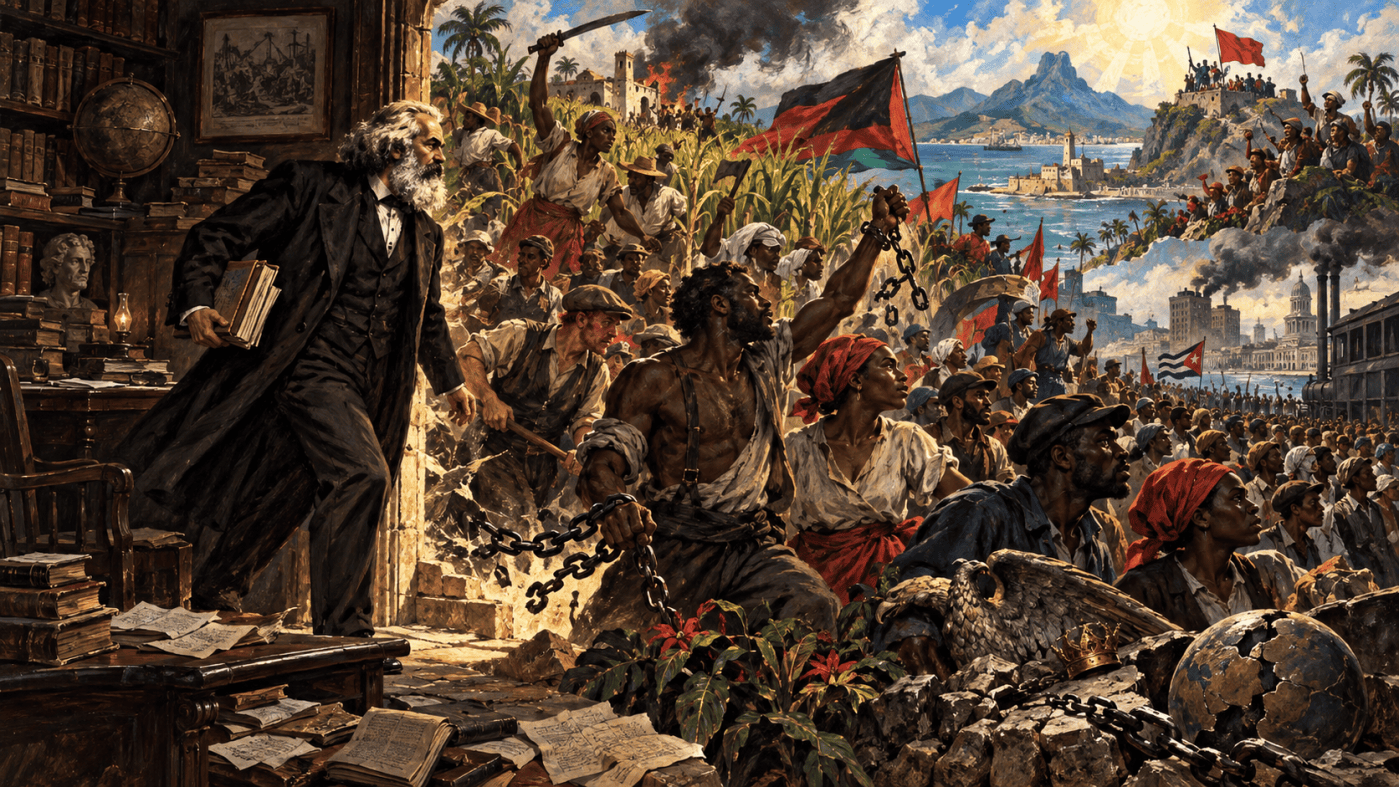
August Nimtz’s Black Marxism: A Marxist Critique recovers a Marx whose historical materialism was transformed by colonial revolt, national liberation, Black emancipation, and the political failures of workers inside the ruling nations. Against Cedric Robinson, Nimtz shows that Marxism and the Black radical tradition were never sealed civilizations, yet Malcolm X, SNCC, Ireland, and Grenada reveal that genuine internationalism sometimes requires the oppressed to organize autonomously before they can unite as equals. Cuba provides the hardest material test: socialist revolution shattered major foundations of racial inequality, but history survived in housing, wealth, migration, social institutions, and inherited advantage, proving that race can outlive one property form precisely because racial domination has already become material life. Nimtz’s method therefore outruns his formula—the proletariat possesses a revolutionary possibility rooted in its relation to capitalist property, but no class becomes universal until struggle teaches it to break with empire, racial domination, national privilege, and every inherited relation standing between exploited people and their collective power.
Prince Kapone | Weaponized Information | Weaponized Intellects Book Review | September 5, 2026
I. The Marx Who Had to Leave the Library
August Nimtz tells us exactly what kind of Marx he wants before he tells us what he thinks Cedric Robinson got wrong. His “not-so-hidden agenda,” he writes in the Preface to Black Marxism: A Marxist Critique, has been to “liberate Marx from the embrace of philosophers and theorists” and return him “into the world of politics.” That sentence carries more weight than it first appears to. Nimtz isn’t simply complaining about academics turning Marx into another dead European whose books can be safely debated after the seminar adjourns. He’s establishing the test that governs his entire argument: a revolutionary theory has to explain people moving through history, making alliances, breaking them, discovering enemies, misidentifying friends, taking power, losing power, and changing their own consciousness through struggle. Marx matters because Marx entered that world. If Marxism can’t survive there, no amount of theoretical sophistication can save it.
That is also why Nimtz begins Chapter 1 with his own life. He explicitly asks the reader to compare his political formation with Robinson’s, arguing that their different experiences “likely account” for “two different political trajectories” and, with them, different readings of the political world. Biography here isn’t mere decoration. Nimtz is making a materialist claim about consciousness: people don’t arrive at political theory outside history. They are formed through institutions, movements, class relations, victories, defeats, and the contradictions they actually encounter. The question is whether his own history can bear the explanatory weight he places on it.
New Orleans taught him the race question before anybody handed him a theory of it. Jim Crow divided schools, political rights, public institutions, neighborhoods, and everyday existence, but the city also carried a complicated social history that refused the clean racial binaries imposed elsewhere in the South. Nimtz remembers learning early that “if skin color was real, race was an invention”. He didn’t mean racial domination was imaginary. Quite the opposite. A social classification didn’t need biological truth to determine who attended which school, who could register to vote, who entered which union, or whose life the state considered expendable. Race had already become material because institutions made it so.
Those same institutions also brought Nimtz into contact with class organization. His mother and father were trade-union activists. His maternal grandmother was an NAACP activist and domestic worker. As a teenager he watched Black Communist and trade-union activist Jack O’Dell face interrogation before a Senate anti-communist committee chaired by Mississippi segregationist James Eastland. Nimtz recalls the juvenile conclusion almost tenderly: if the racists hated the communists this badly, “there must be something good about the Reds”. The theory came later. The social antagonism arrived first.
That distinction runs through the strongest parts of Nimtz’s political autobiography. “Trade union consciousness, inherently a class question, informed my political formation from both sides of the household,” he writes in Chapter 1. Yet nothing in the surrounding history suggests that class consciousness arrived by erasing racial oppression. His family encountered class through the segregated labor movement, through struggles for Black voting rights, through white supremacy inside public institutions, and through organized Black workers fighting both employers and Jim Crow. The categories weren’t sitting in separate boxes waiting for some future theorist to decide which deserved first billing. They were already colliding in the lives of working people.
Africa forced the contradiction further. Nimtz went to Tanzania in 1969 as a Black nationalist and Pan-Africanist. He left seventeen months later looking for communism. What changed him wasn’t an argument that African liberation had been unnecessary. It was seeing what national independence hadn’t abolished. “A new ruling class in Black skin now had agency to call the shots,” he writes, “and it performed as ruling classes had always done”. Fanon’s “national bourgeoisie” stopped being a phrase on a page and became a social relation Nimtz could watch forming around him. Black political sovereignty had broken colonial rule without automatically eliminating class power. The color of the officials had changed. The problem of who controlled wealth, institutions, and the direction of society hadn’t disappeared.
This is where Nimtz’s autobiography becomes more than autobiography. He is already building his case against any theory that treats racial or national identity as a finished revolutionary program. Shared oppression can create a common historical struggle; it can’t guarantee that every class produced inside that struggle wants the same social future. Tanzania didn’t teach Nimtz to stop caring about African liberation. It taught him that liberation itself produces new contradictions once the flag comes down and somebody has to decide who controls land, production, the state, and the surplus.
Then Minnesota gave him the problem that would haunt the rest of the book: “Whither the white proletariat?”. Nimtz had already passed through a period of what he calls “sectarian Black nationalism.” Now he encountered white radicals outside the university—the kind who had spent decades in communist organization, gone to prison, worked industrial jobs, and treated international politics as working-class business. Earlier, during a summer in an Indiana steel mill, an older white worker had already given him a small lesson in shop-floor solidarity by stopping the young college student from working himself half to death to impress the boss: “Look, son, we don’t work that hard around here; slow down”. Years later, encounters with white revolutionary workers turned the possibility of defection from an abstraction into something Nimtz could see in actual people.
That experience doesn’t settle the white-worker question. It makes racial fatalism harder to defend. Nothing automatic produced the communist workers Nimtz met. Organization did. Historical experience did. Parties, strikes, internationalism, political education, defeat, and decades of struggle did. The white worker who identifies with the ruling order and the white worker who becomes a communist may stand under the same boss while developing radically different political commitments. Nimtz’s encounters therefore establish a possibility that the rest of the book still has to prove historically: proletarian position can create revolutionary potential, but only struggle can tell us what workers actually become.
That is the real strength of Nimtz’s opening move. Before he ever puts Cedric Robinson in the dock, he gives us a Marxism in motion. New Orleans makes race concrete. Black trade unionism makes class concrete. Tanzania breaks the illusion that national identity abolishes class antagonism. Industrial labor breaks the illusion that racial division makes solidarity impossible. Revolutionary organization breaks the illusion that workers arrive politically finished. Nimtz’s Marx has to leave the library because history keeps changing the questions.
And once that standard has been established, nobody gets exempted from it—not Robinson, not Black nationalism, not the white proletariat, and eventually not Nimtz himself. A theory claiming to explain the Black radical tradition has to survive the revolutions, defeats, alliances, class divisions, and political transformations through which Black radicalism actually moved. That is where Black Marxism stops being merely a book Nimtz dislikes and becomes the first real target of the method he has spent a lifetime constructing.
II. The Black Radical Tradition Meets Its Materialist
Nimtz doesn’t enter Black Marxism pretending Cedric Robinson is an idiot. That matters. His original 1985 review calls Robinson’s book “the most informed and sophisticated defense of the nationalist position”, an acknowledgment that keeps the dispute from becoming the old polemical trick of beating up a weaker opponent than the one actually standing there. Robinson knew Marxism, knew the class argument, and knew enough of its history to attack it at the foundations. Nimtz’s objection is that Robinson turns the different histories that produced European Marxism and Black revolt into a political separation that the historical record can’t sustain.
Nimtz summarizes Robinson’s thesis this way: historical materialism is “a uniquely European ideology,” bounded not only by place but by nineteenth-century time, carrying the intellectual and racial assumptions of the society that produced Marx and Engels. On Nimtz’s reconstruction, Marx and Engels failed to explain racism’s persistence, exaggerated capitalism’s progressive role, overestimated the European proletariat’s ability to escape racial ideology, and couldn’t adequately grasp the nationalism of oppressed peoples. The Black radical tradition, rooted in African historical experience, therefore possesses a different revolutionary outlook. Robinson’s Du Bois, C. L. R. James, and Richard Wright pass through Marxism, but their Marxist “apprenticeships” prove “significant but ultimately unsatisfactory.” The implication runs deeper than the claim that Marxists sometimes failed Black struggle. Marxism’s European formation supposedly limits what it can know.
Robinson’s original argument deserves more respect than the cheap contemporary version in which somebody finds one ugly nineteenth-century sentence, stamps EUROCENTRIC across Marx’s forehead, and knocks off early for lunch. He traces racial differentiation into European history before mature capitalism and argues that capitalism developed through a social order already fractured by distinctions of peoplehood, status, religion, region, and conquest. Capital didn’t encounter an undifferentiated humanity and invent every hierarchy from scratch because cheaper labor suddenly sounded useful. It inherited a divided world and reorganized those divisions through production, slavery, conquest, and expansion.
There is also a historical distinction that Nimtz’s forty-year engagement allows us to see more clearly than his 1985 review could. Robinson’s later formulation hardened. In the 2000 Preface, he charged that Marx had effectively consigned “race, gender, culture, and history to the dustbin,” a much more sweeping indictment than the most defensible version of the original 1983 argument. The distinction matters. Nimtz’s first review confronted the earlier book; his 2026 collection is also fighting a later Robinson who made the opposition between Marx’s theoretical world and the histories of slaves, peasants, women, and racialized peoples considerably sharper.
Nimtz therefore has real grounds for attack, but his accusation that Robinsons’ “method is that of an idealist” still needs tightening. Robinson doesn’t simply ignore slavery, colonialism, production, or material history. His argument tries to explain why capitalism never meets people as interchangeable workers waiting patiently for the wage relation to tell them who they are. Capital enters societies already shaped by landholding, conquest, religion, language, law, status, forced labor, and inherited political distinctions. Any historical materialism worth a damn has to explain what capitalism does with those inheritances rather than announcing that class has arrived and history may now begin.
The stronger version of Nimtz’s criticism lies in the machinery connecting one social order to another. Robinson can tell us that racial differentiation precedes capitalism. He is less precise about how those inherited distinctions become capitalist property, unequal wages, segregated occupations, colonial taxation, land seizure, citizenship law, migration controls, and state coercion. An illuminating history of Robinson’s argument captures the tension: racialism is historically produced in his account, yet “Western civilization” sometimes carries so much causal weight across radically different social systems that the concrete transformations connecting them grow thin.
That is the material problem inside Nimtz’s charge of idealism. Survival itself needs explanation. A medieval religious distinction, plantation slavery, colonial forced labor, Jim Crow citizenship, and racialized housing wealth can belong to one long history without being one unchanged relation. Somebody still has to show who owns the land, who controls labor, what the state enforces, what material advantage follows, which class reproduces it, and how the relation changes when the mode of production changes. Without those connecting links, “civilization” can become an elegant name for the very process still waiting to be explained.
Nimtz’s invocation of Walter Rodney cuts especially hard because Rodney wrecks the comfortable choice between Marxism and Black historical specificity. In Chapter 2, Nimtz points to How Europe Underdeveloped Africa as obvious evidence that an African revolutionary could consciously wield historical materialism against colonial domination without surrendering African history to a European script. Rodney didn’t need Marxism to tell him Africa had no history until capital arrived. He used Marxism to reconstruct how European accumulation, African class formation, colonial rule, forced labor, trade, land, and imperial violence entered one historical process. Robinson asks the necessary question of what capitalism inherits. Rodney shows what happens when the answer is forced through the concrete relations of exploitation and power.
The same difficulty appears inside Robinson’s exemplary Black radicals. Nimtz notes that Du Bois and James don’t behave obediently enough for the thesis assigned to them. Du Bois died a member of the Communist Party. James could break with Trotsky on the Soviet Union, reject particular forms of Leninist organization, and still consider himself a Marxist. “James clearly did not regard Marxism to be irrelevant to Black liberation,” Nimtz concludes. His broader point is important: criticism of the Communist Party, Stalinism, Soviet policy, Trotskyism, or a particular Marxist organization cannot simply be converted into proof that Black radicalism had to escape historical materialism itself.
But Nimtz’s distinction carries its own danger. If every Marxist failure is automatically expelled from “authentic Marxism,” the tradition becomes just as difficult to test historically as the theory he accuses Robinson of protecting. Stalinism, social democracy, Trotskyism, Communist Party practice, Leninism, and Marx himself aren’t interchangeable. They have to be distinguished. Yet their failures also have to be explained rather than washed out of Marxist history whenever they become inconvenient. A method that demands Robinson answer to political reality has to make Marxists answer to it too.
Robinson’s strongest challenge therefore remains standing, but in a more precise form. Marxism was born in a particular European history. It carried some of that history’s assumptions. The question is whether those origins permanently fixed its horizon. If Marx and Engels could only fit Ireland, India, Russia, peasants, colonial revolt, and Black emancipation into categories already completed in Western Europe, Robinson’s indictment has real force. If those struggles changed the categories themselves, then the birthplace of historical materialism stops being a prison. The issue is no longer whether Marxism came from Europe. It is whether the world beyond Europe could force Marxism—and Marx himself—to become something larger than where it began.
III. Marx Carried Europe Into the World—Then the World Fought Back
Nimtz answers Robinson’s Eurocentrism charge with a sentence meant to settle the matter: Marx and Engels were revolutionaries who “viewed the entire globe as their theater of operations”. He piles up the evidence. In The German Ideology, communism already appears as a “world-historical” process. Engels’s draft for what became the Communist Manifesto answers the question of whether revolution can occur in one country alone with an emphatic “No.” Marx and Engels follow revolt in China, colonial wars, the transformation of world trade, the American Civil War, Ireland, and eventually Russia. Western Europe, Nimtz argues, was never the sealed intellectual universe Robinson needs it to be.
There’s real force in that argument, but looking at the whole world isn’t the same thing as looking at it without Europe sitting at the center. A world map can still be drawn from the imperial capital. Marx’s 1853 writing on India proves the point without requiring us to manufacture a cleaner Marx than history gave us. He condemns British brutality and greed while still assigning colonial destruction a contradictory historical role: Britain is smashing old Indian social relations while laying what he then calls the material foundations of “Western society in Asia.” The colonizer appears as a butcher carrying, almost despite himself, the instruments of historical development. That isn’t Robinson putting words in Marx’s mouth. Marx wrote it.
Nimtz doesn’t need to bleach passages like that out of the record. His stronger defense lies in what happened afterward. Marx’s greatness wasn’t that he walked into political life carrying a worldview miraculously purified of nineteenth-century Europe. It was that the struggles of people outside Europe forced him to revise assumptions he had carried with him. Historical materialism proved itself not because Marx got everything right on the first try, but because the method could turn back against the limits of its own starting point.
India makes the movement visible. Four years after the 1853 article, rebellion tore through British rule. Marx’s emphasis changed with it. In his 1857 analysis, British torture appears as an “organic institution” of colonial government, and imperial violence becomes part of the explanation for insurgent violence. The colonized move into the causal chain. They aren’t simply populations upon whom world history acts while Europe does the acting. Their resistance begins acting upon history itself—and upon Marx’s understanding of it.
Nimtz is strongest when he follows this shift in revolutionary geography. After the defeats of 1848–49, Marx and Engels increasingly stopped treating Western Europe as if productive development automatically entitled it to political leadership of the world revolution. Marx began to see Europe as only one part of a much larger historical field whose direction could be altered by struggles elsewhere. The productive power of Britain, France, or Germany still mattered. What changed was the assumption that the most industrially advanced society must also provide the first revolutionary breakthrough.
Russia blows that old developmental map apart. Nimtz makes it the center of Chapter 3 for good reason. Marx studied Russian intensely because Russian revolutionaries had forced a problem onto him that couldn’t be solved by mechanically repeating England. Did Russia’s rural commune have to be destroyed by capitalist development before socialism became thinkable, or could communal property become part of another historical road?
Marx’s answer is devastating to any theory that turns his history of English capitalism into a universal staircase every people must climb. Responding to Russian revolutionaries, he explicitly warned against converting his account of Western European capitalist development into a law “imposed by fate on all peoples.” In the Zasulich drafts, he went further. Russia’s communal property might become a starting point for a different development if revolution defeated the forces already dissolving it. “To save the Russian commune,” Nimtz quotes Marx, “a Russian revolution is needed”.
That single movement does more damage to the crude Eurocentric-Marx thesis than a hundred declarations about Marx’s good intentions. The important fact isn’t simply that Russia lies partly outside Western Europe. Tsarist Russia was an overwhelmingly peasant empire whose social relations bore little resemblance to industrial England. Yet by the early 1880s Marx and Engels could describe Russia as a “vanguard of revolutionary action”. The most advanced capitalist country was no longer automatically the most advanced political force. Revolution could begin where contradictions became explosive, not where a textbook sequence said history was most mature.
Nimtz draws an enormous conclusion from this: Marx and Engels could become “programmatically at home in an overwhelmingly peasant country”. He’s basically right, but the phrase can make their development sound smoother than it was. They became more at home there because history forced them to learn. Peasant communal property, colonial rebellion, national liberation, and revolutionary initiative from the East weren’t merely examples confirming a completed doctrine. They pressed against the doctrine until parts of it moved.
That matters because Robinson’s strongest case depends on turning Marxism’s European birth certificate into its permanent political nationality. The record won’t cooperate. Marx really did carry developmental assumptions that treated European capitalist transformation as historically progressive in ways that could slide toward colonial apologetics. He also revised those assumptions as colonized peoples fought back, as revolution erupted outside the expected centers, and as social formations refused to march through history in the prescribed order.
The later development doesn’t retroactively cleanse every earlier judgment, and it doesn’t mean Marx completed some final, comprehensive theory of colonialism. It does something more important. It defeats the static claim that Eurocentrism formed an unbreakable horizon around his method. By the end, the thinker who once wrote about colonial destruction as a brutal carrier of historical progress was warning readers not to turn Western Europe’s road into universal fate.
Nimtz therefore wins the argument at the point where he stops defending Marx as a man who was always already correct and starts showing us a Marx whose theory could be transformed by struggles it hadn’t originally mastered. Historical materialism survives because it can learn from history, not because history politely confirms it.
But breaking the compulsory Western road creates another problem Marx could no longer avoid. Revolution might begin outside the imperial center, yet millions of workers remained inside it. Those workers could be exploited by capital while identifying politically with the nations doing the conquering. Once Marx confronted that contradiction, the supposedly universal proletariat split open along the lines of empire, nationality, and race.
IV. The White Skin and the Ruling Nation
Nimtz puts one of Marx’s most famous sentences at the center of his answer to the claim that Marxism can’t comprehend race: “Labor cannot emancipate itself in the white skin where in the black it is branded”. The line matters because Marx isn’t asking white workers to become morally nicer. He’s describing a political relation inside the working class itself. Slavery gives one section of labor a legally enforced status beneath another, and that domination doesn’t remain sealed inside the plantation. It enters wages, parties, elections, migration, state power, and the consciousness of workers who may have no slaves and very little property of their own. Nimtz pushes the point further when he writes that “Racial slavery was the key obstacle to proletarian consciousness”. The word key is his hierarchy of causation, not something the evidence automatically settles. What the history clearly does establish is that slavery and racial domination materially fractured proletarian politics.
Nimtz’s strongest proof comes through Marx’s analysis of English and Irish workers. Marx writes that the English worker sees the Irish worker as a competitor who lowers his standard of life. But he doesn’t stop at the labor market. The English worker also regards himself as a member of the “ruling nation” and therefore looks upon the Irish worker with the contempt through which imperial rule reproduces itself below. Marx then makes the comparison explicit: “The Irishman sees the Negro as a dangerous competitor.” His 1870 letter doesn’t describe prejudice as some irrational fog floating above class relations. English rule over Ireland drives migration; migration sharpens labor competition; ruling-class institutions cultivate national antagonism; workers begin defending political distinctions that weaken their own collective power.
The old race-versus-class argument starts coming apart right there. Marx isn’t choosing between economic exploitation and national oppression. He is showing one operating through the other. The English worker’s wage relation gives him a material antagonism with capital. Imperial domination gives him another political relation: membership, however subordinate, in the conquering nation. Both determinations are real. One doesn’t cancel the other. The employer still exploits him; the imperial order still offers him a position above the Irish worker. The ruling class doesn’t need to abolish the class contradiction. It needs to organize that contradiction so the worker experiences part of his social position through superiority over somebody else.
Nimtz is strongest here because this Marx bears little resemblance to the caricature of a theorist who expects workers to discover universal brotherhood once somebody explains surplus value. Marx’s English worker can know perfectly well that he is a worker. He can strike his boss, resent the landlord, complain about wages, and still become a political weapon against Irish liberation. Economic conflict has not yet become revolutionary class consciousness. The class exists materially before it becomes capable of acting politically for itself, and the space between those two conditions can be filled with nationalism, racism, religion, imperial pride, and every other ideological commodity the ruling class knows how to sell.
The American Civil War gave Marx the same contradiction in a more brutal form. Slavery didn’t simply divide Black slaves from white capitalists. It organized the political world of millions of nonslaveholding whites whose own material position remained far beneath the planter class. Marx watched the war move toward emancipation because preservation of the Union could no longer be separated from destruction of the slave system. Enslaved Black people helped force that transformation themselves through escape, refusal of labor, intelligence, entry into Union lines, and military service once enlistment opened. The scholarship on Black self-emancipation confirms the causal force Du Bois later described as a “general strike”: enslaved people destabilized Confederate labor and property while federal policy and military power increasingly turned that movement into organized emancipation.
That reciprocal movement is decisive. The Union state didn’t simply descend from above and free a passive population. Nor did enslaved people abolish slavery independently of the armies and state power that eventually destroyed the Confederacy. Black resistance weakened the slave system, pressed the Union toward emancipation, expanded Black military participation, and helped alter the balance of the war. Federal emancipation and Union victory then enlarged the field in which self-emancipation could become irreversible. Race and class, state power and popular agency, worked through one another.
That is what gives Marx’s formulation its force. “Labor cannot emancipate itself” while Black labor remains branded because slavery sets a political floor beneath the entire laboring population. It creates a population whose coerced status can be used to discipline others while teaching free workers to defend the distinction that weakens them. White workers don’t escape exploitation by standing above enslaved workers. They acquire a relative position inside an order still ruled by property. The advantage can be real and politically consequential without making white labor cease to be labor.
Nimtz uses this against theories that write the white proletariat out of revolutionary politics altogether. His argument isn’t that white workers have historically behaved well. The Marx he cites says the opposite. White workers can become active carriers of racial and national domination. What Nimtz rejects is the leap from historical incorporation to permanent political destiny. If ruling classes have to reproduce racial antagonism, if parties and newspapers have to cultivate it, if workers have to be taught to identify with the ruling nation, then the relation is historical. What history makes, struggle can potentially unmake.
Potentially is doing important work there. Nimtz sometimes presses the proletarian interest so hard that the political problem can look nearly solved in advance: workers must abolish private property to emancipate themselves, so their deepest material interest supposedly points toward solidarity. Marx’s own evidence is less comforting. The English worker’s objective interest in unity with the Irish worker doesn’t stop him from acting against it. The white American worker’s exploitation doesn’t prevent racial domination from becoming part of his political identity. Structural interest creates ground on which solidarity can be organized. It doesn’t manufacture the organization, consciousness, or courage required to realize it.
This is also why Nimtz’s use of the Black national question becomes more interesting than a generic demand for interracial unity. He invokes the Marxist tradition that defended Black self-determination against white-worker chauvinism rather than treating national demands as distractions from class struggle. The point wasn’t to abandon class politics. It was to recognize that the working class could not become politically united by pretending the unequal national relation had already disappeared. A white worker who refuses the oppressed nation’s right to determine its own future is not practicing a higher class consciousness. He is carrying the ruling nation into the labor movement.
Nimtz has therefore recovered something more dangerous than a Marx who merely “talked about race.” He has recovered a Marx for whom class itself can be politically fractured by empire and national oppression. The obstacle isn’t simply prejudice lodged inside individual heads. It is a social order that gives different groups of workers different relations to citizenship, territory, migration, legal status, state violence, and national power, then teaches them to read those differences as natural interests.
Once the class is understood that way, shouting “workers of the world, unite” won’t do the organizing for us. Unity has to be built across unequal historical positions, and those positions can’t be wished away in the name of the universal. The worker of the ruling nation and the worker of the oppressed nation may share an enemy in capital while confronting each other through a relation created by conquest. Genuine internationalism therefore has to solve a harder problem: how can people made unequal by history organize together without carrying that inequality into the very organization meant to abolish it?
V. Unity Between Equals
Nimtz treats SNCC’s 1966 decision to remove its remaining white members as a political break with the interracial tradition that had shaped abolitionism, labor struggle, and the modern freedom movement. In Chapter 1 he says the decision “complemented” SNCC’s turn toward Black Power and helped give what he calls a “race sectarian posture” wider authority. He connects that turn directly to his own political development: at Indiana University, he voted with a Black graduate organization to exclude members involved in interracial relationships. Looking back, Nimtz calls his own position “sectarian Black nationalism” and places SNCC’s move inside the same retreat. The judgment follows naturally from the question haunting his book: if white workers possess revolutionary potential, a politics that excludes them by race can look like it has closed the door before history gets a chance to test what they might become.
But Nimtz compresses a harder organizational problem into the language of exclusion. The surviving SNCC record shows that the December 1966 decision emerged from years of struggle over who controlled the movement, what white liberal support had actually delivered, and where white militants could do useful political work. The vote itself hardly resembled a unanimous declaration of racial separation: nineteen voted for removing white staff, eighteen against, and twenty-four abstained. It came after the Mississippi Freedom Democratic Party had been humiliated by the national Democratic Party, after organizers had watched white liberal institutions praise Black courage while refusing to surrender political control, and after years in which Black organizers carried the physical burden of confronting Southern terror.
That history doesn’t make every SNCC conclusion correct. It changes the contradiction. SNCC’s turn toward Black Power wasn’t merely asking whether white people could be decent allies. It was asking whether a people fighting racial domination could develop political power while remaining organizationally dependent on members of the dominant group. An organization can be interracial in membership while reproducing unequal authority inside itself; it can also be nationally autonomous while building alliances outside itself. Treating the second form as automatically less revolutionary mistakes organizational integration for political equality.
Malcolm X exposes the same weakness in Nimtz’s framing. Nimtz is right that Malcolm was moving away from the racial theology of the Nation of Islam. He describes Malcolm’s post-Mecca development as a “rethinking of his race-exclusionary stance” and argues that Malcolm’s assassination cut that “revisionist trajectory” short. That movement was real. Malcolm stopped treating whiteness as a biological sentence, internationalized the Black struggle, deepened his attack on capitalism and imperialism, and became increasingly willing to work with people whose politics aligned with liberation regardless of their skin. But he didn’t conclude that Black people should dissolve their independent organization into an interracial structure.
The OAAU program makes the distinction plain. White supporters could aid the struggle, challenge racism, and organize against white supremacy in their own communities. They couldn’t become members of the Organization of Afro-American Unity. Malcolm’s political development therefore wasn’t a straight road from separation to integration. He was separating racial essentialism from Black political autonomy. One had to go; the other remained necessary because Black people still confronted a specific structure of racial and national domination that no declaration of universal brotherhood had abolished.
The Marxist tradition Nimtz is defending actually pushes beyond his own shorthand here. The Irish question had already forced Marx and Engels to confront almost the same organizational problem. Section IV established the political relation: English workers could remain proletarians while acting as members of the “ruling nation.” Engels then had to face the organizational consequence. When Irish members of the First International resisted being placed under British organizational authority, he didn’t tell them to suppress the national contradiction in the name of class unity. He defended their right to organize separately.
In his 1872 intervention, Engels argued that the Irish were a conquered people and that forcing Irish sections under an English federal council would reproduce the national relation the International claimed to oppose. Demanding that Irish workers simply “sink national differences” while English workers retained organizational command would place domination under what he called the “cloak of Internationalism.” Genuine internationalism required the Irish to participate as equals, which under the existing relation meant preserving their own national organization inside the common movement. That clarification cuts deep. Separate organization is not automatically the opposite of internationalism. Under conditions of national domination, subordination can be the real enemy of internationalism.
The material test is whether autonomous organization increases an oppressed population’s capacity to determine its own political line, build leadership, identify its demands, and negotiate alliance without surrendering those powers. If it does, autonomy can become a mediation toward deeper unity. If it hardens into the claim that people of different origins possess permanently incompatible political interests, it turns into the racial essentialism Nimtz correctly attacks. The line cannot be drawn by skin color alone. It has to be drawn through the actual relation of power.
This distinction also recovers what was revolutionary in Nimtz’s own experience without accepting every conclusion he draws from it. He worked inside Black nationalist formations as an open Marxist. The Socialist Workers Party’s support for Black self-determination mattered to him precisely because it demonstrated that class politics didn’t require denying a specifically Black political struggle. In Chapter 2 he praises the Marxist position that self-determination doesn’t “lead away from the class basis” of struggle. That formulation contains the answer his critique of SNCC sometimes obscures. The national question doesn’t disappear once class enters the room. Class politics has to pass through the national relation and transform it.
In Malcolm’s and SNCC’s circumstances, that also produced a practical division of revolutionary labor. If white supremacy was being reproduced politically among white workers and white communities, then white radicals had work to do there rather than proving their anti-racism by occupying leadership space inside Black organizations. Malcolm understood that. SNCC increasingly moved toward it. Marx and Engels had already recognized the principle in Ireland: the worker of the oppressor nation bears a particular responsibility to break with the privileges and political assumptions of that nation. Solidarity isn’t measured by how close the white radical can stand to the oppressed. It is measured by what power he helps destroy on his own side of the relation.
Nimtz’s demand for multinational working-class unity therefore survives, but on tougher terms than simple inclusion. The oppressed don’t enter revolutionary unity by surrendering the organizational capacity they built because domination made such capacity necessary. The worker of the ruling nation doesn’t become an internationalist merely by accepting them into his organization. Both sides have to transform the unequal relation that shaped them before the alliance can become what it claims to be.
Maurice Bishop’s later appeal for close alliance between Black struggle and the white working-class movement now takes on a different meaning. Read superficially, it can sound like a verdict against Black autonomy. Read through Ireland, Malcolm, and SNCC, it says something harder: revolutionary forces with their own organization, leadership, and political project can build alliance across race because they meet one another as forces capable of acting, not as dependents waiting to be absorbed. Bishop wasn’t preaching integration from the imperial center. He was speaking as the leader of a Black Caribbean revolution that had already seized state power.
That changes the scale of the problem. Autonomy and internationalism can coexist in principle. The harder test is whether they survive when revolution leaves the meeting hall, takes hold of a government, confronts property, mobilizes workers and farmers, faces U.S. imperial power, and begins deciding who will actually rule.
VI. The Revolution Robinson Couldn’t Fit
Nimtz saves his hardest charge against Cedric Robinson for Grenada. In Chapter 5 he calls the revolution led by Maurice Bishop and the New Jewel Movement “the most authentic Black proletarian revolution to date.” He goes further: Grenada was the “apotheosis of the diasporic Black revolutionary tradition,” unfolding between 1979 and 1983 at almost exactly the moment Robinson was writing Black Marxism. For Nimtz, that coincidence turns omission into indictment. A book claiming to reconstruct the making of the Black radical tradition somehow passes over a Black Caribbean revolution that overthrew dictatorship, aligned itself with Cuba and anti-imperialist struggle, mobilized workers and farmers, and openly moved toward socialism. Grenada isn’t a decorative example in Nimtz’s argument. It is the revolution he thinks Robinson’s framework couldn’t hold.
That judgment carries real force because Bishop himself refuses the political separation on which Nimtz believes Robinson depends. Nimtz ended his original review with Bishop’s call for the Black movement in the United States to build “the firmest and closest links with the white working-class movement” so that “all progressive forces get together and wage a consistent fight against the real enemy”. Bishop’s 1980 interview makes the class content clearer. He wasn’t preaching interracial fellowship as a moral virtue. Grenada confronted the United States as the dominant imperial power in the Caribbean, and Bishop saw workers inside that imperial center as a force capable of obstructing imperialism from within. Black revolutionary sovereignty and proletarian internationalism weren’t competing loyalties. They were different fronts against the same power.
Grenada therefore gives Nimtz something stronger than another quotation from Marx. Bishop was speaking as the leader of a revolution that had already seized state power. The New Jewel Movement overthrew Eric Gairy’s government in March 1979, tied Grenada closely to Cuba and other anti-imperialist forces, expanded literacy, health care, public investment and cooperative development, and built new forms of popular participation while pushing the country toward socialist-oriented transformation. Contemporary and retrospective Caribbean histories describe a revolutionary government that broke with the old neo-colonial political order without pretending it could reconstruct the whole economy overnight.
That is a serious problem for any account in which Black radicalism and Marxism belong to essentially separate historical worlds. But Nimtz asks Grenada to prove something stronger when he calls it a “proletarian revolution.” Proletarian in what sense?
The island’s social structure won’t allow a lazy answer. Grenada wasn’t Manchester with palm trees. Industrial wage workers didn’t form the overwhelming majority of society, and the NJM wasn’t socially composed of factory workers marching directly from the shop floor into government. Don Rojas, Bishop’s press secretary and a participant in the revolution, later described Grenadian society and much of the movement itself as heavily petty-bourgeois in social composition. What mattered, in his account, was the attempt to move politically beyond that origin by directing the revolutionary state toward workers, farmers, poor people, anti-imperialism, and socialist development. His 1984 assessment describes Grenada as passing through a national-democratic and anti-imperialist stage toward socialism, not as a society in which capitalist property had already disappeared.
That distinction sharpens Nimtz instead of simply refuting him. If “proletarian revolution” means an industrial proletarian majority directly imposing a completed socialist property system, Grenada doesn’t fit. If it means a revolutionary bloc taking state power and using it to expand the power of workers and farmers, weaken imperial dependence, enlarge public and cooperative control, and move property relations away from capitalist rule, then the term becomes politically defensible—but only after the relation has been demonstrated. The label can’t do the analysis for us.
The property record makes the same point. The People’s Revolutionary Government enlarged the state sector, social provision, cooperatives, and public investment, but Grenada remained a mixed economy in which private production and enterprise still operated. Political power had moved farther and faster than the underlying transformation of property. That gap wasn’t proof that nothing revolutionary had happened. It was the contradiction of transition itself: a revolutionary government trying to change the direction of society while still working inside productive relations, class structures, and economic dependencies inherited from the old order.
Grenada therefore forces a distinction Nimtz needs but doesn’t always spell out: a revolution’s class character can’t be read from population percentages, but it can’t be inferred from revolutionary rhetoric either. We have to ask who exercises state power, which classes organize through the new institutions, what happens to land and production, who controls investment and surplus, whether workers and farmers gain real decision-making power, and which direction the transition is moving. “Proletarian” has to name a relation of power, not function as a certificate of ideological good standing.
Then comes 1983, where Nimtz’s language becomes less precise. He describes Grenada as having been “overthrown by a Stalinist counterrevolution”. The NJM leadership crisis certainly destroyed the revolutionary bloc from within: Bishop’s detention, the factional struggle, mass mobilization demanding his release, the killings at Fort Rupert, and the collapse of political authority shattered the alliance that had held the process together. The United States then invaded Grenada and terminated what remained of the revolutionary order. Those were connected historical stages, but they weren’t one undifferentiated operation, and the evidence doesn’t justify pretending they were.
Rojas’s account is more useful than the label. He doesn’t describe a faction with a coherent capitalist-restoration program overthrowing a socialist Bishop. He describes a leadership struggle in which factional maneuver, command from above, organizational dogmatism, and contempt for the political judgment of the masses overtook the revolution’s popular base. Grenada had been building forms of popular participation while failing to resolve how effective power operated inside the revolutionary party itself. When that contradiction exploded, party authority substituted itself for mass legitimacy. Workers and ordinary supporters didn’t quietly accept Bishop’s removal; they mobilized to free him. Whatever one calls the factional line ideologically, its political effect was catastrophic: it broke the revolutionary alliance, shattered the government’s legitimacy, and left Grenada exposed when Washington moved in.
Nimtz also reaches beyond what the evidence can carry when he moves from Robinson’s omission to Robinson’s motive. “Rather than recognize facts that challenge his idealist worldview,” Nimtz writes, “Robinson chose to erase them”. The absence does matter. Grenada really was a major Black revolutionary process unfolding while Black Marxism was being completed, and its combination of Black liberation, Marxism, state power, and internationalism cuts directly against any neat separation between Marxism and the Black radical tradition. But omission establishes omission. It doesn’t give us access to Robinson’s intentions. Nimtz doesn’t need a charge of psychological bad faith to win the stronger political argument.
Grenada already proves plenty. It shows that Black revolutionary politics can develop through Marxism rather than outside it. It shows that oppressed-national sovereignty can coexist with international working-class alliance. It shows that revolutionary leadership can’t be identified mechanically with the demographic composition of a society. And its collapse shows that seizing state power doesn’t settle the contradiction between revolutionary leadership and the political power of the masses. Those lessons are harder, more material, and more useful than simply declaring the case closed because Bishop carried the correct ideological label.
But Grenada leaves Nimtz’s largest material claim unresolved. If proletarian political power matters because it can attack the property relations beneath social inequality, then revolution should leave measurable marks on racial hierarchy itself. Grenada lasted too briefly and changed too little of its inherited economy to settle that question. Cuba had decades, a deeper assault on capitalist property, and the same plantation-slavery inheritance. There the argument that class transformation can remake race has to face history at full scale.
VII. What the Revolution Changed—and What History Left Behind
Nimtz makes his largest theoretical claim in Chapter 4 when he moves from Marx’s analysis of race to the material foundation beneath racial inequality. “Private property,” he argues, is the basis of social inequality, and the proletariat occupies a unique position because it “has a class interest in the abolition of private property.” Cuba becomes the historical test. A society built through conquest, plantation slavery, racial hierarchy, U.S. domination, and capitalist property undergoes a socialist revolution that attacks the ownership structure itself. Nimtz’s verdict is almost triumphant: “what a difference a proletarian revolution makes”. If race moved according to some autonomous law detached from property and class power, the revolutionary transformation of Cuban society should not have altered racial life so dramatically. It did.
The scale of that change has to be taken seriously. The Revolution attacked racial discrimination and exclusion across employment, education, public life, housing, health care, and access to social institutions, while universal social provision sharply reduced the power of private wealth to decide who received schooling, medicine, work, and basic security. Afro-Cubans, disproportionately concentrated among the poor before 1959, gained materially from precisely those measures that weakened inherited wealth and market access as gatekeepers to social life. Later work on racial restratification begins from those gains rather than pretending revolutionary Cuba merely repainted the old hierarchy.
That evidence gives Nimtz a serious weapon. Capitalist property wasn’t some unrelated economic system sitting underneath a separate cultural problem called racism. Private wealth and ownership shaped housing, businesses, inherited assets, schooling opportunities, employment, and access to social institutions through different mechanisms. The old racial order reproduced itself through those material channels. When the Revolution expropriated major capital, universalized social provision, and weakened inherited wealth as the main gatekeeper to education, health care, employment, and social security, it struck racial inequality at some of its deepest supports.
Nimtz’s own discussion is more careful than a crude “socialism solved race” formula. He acknowledges that when Cuba later reopened wider space for private property and market activity, racialized and antisocial behavior reappeared, though “by no means to the degree” found in the United States. That qualification matters because it shows the empirical argument is already more dialectical than his most compressed theoretical sentence. The contradiction lies inside the chapter itself. Cuba proves how profoundly class and property transformation can change racial relations, while the persistence and reappearance of inequality refuse to let property become a magic solvent.
Then Nimtz gives us the line that has to carry the full weight of his theory: “A theory about race that doesn’t begin with a theory about class is an ideology”. The sentence lands hard because it names a real danger. A theory of race that refuses property, labor, accumulation, and class power will miss much of the machinery through which racial inequality reproduces itself. But Cuba won’t let that insight harden into a predetermined order of explanation. The stronger problem is not whether class matters first in the abstract. It is how earlier systems of domination have already become material life.
The strongest complication comes from scholarship Nimtz himself helped edit and translate. In Race in Cuba, Esteban Morales Domínguez insists that the achievements of 1959 were enormous while rejecting the idea that racism could simply be declared finished once socialist property relations had been established. Racial inequality and discrimination survived in transformed conditions and therefore required conscious political struggle. The point doesn’t weaken the Revolution’s material achievements. It explains why those achievements weren’t the end of the question.
Centuries of slavery don’t leave behind only ideas. They leave wealth in particular families, people concentrated in particular neighborhoods and occupations, unequal access to schooling, different migration histories, different social networks, different housing conditions, and accumulated advantages that can survive the legal abolition of the institutions that originally produced them. A revolution can destroy the planter as a class without making every consequence of plantation society vanish on the same afternoon.
Cuba’s post-Soviet crisis makes the relation painfully clear. The Revolution had compressed many of the channels through which inherited inequality could reproduce itself. Then the Special Period shattered the island’s economic security, and the state opened wider space for tourism, self-employment, remittances, foreign currency, and limited private accumulation. Old differences suddenly gained new economic force. Families with relatives abroad could receive dollars. Families with desirable housing could turn it into income. People better positioned for tourism and private enterprise gained earnings far beyond ordinary state wages. Because prerevolutionary migration, housing, wealth, and family resources had themselves been racially unequal, the reopened market didn’t begin from an empty starting line. Research on Cuba’s later social stratification found those inequalities reappearing along racial lines.
The old race-versus-class debate finally starts breaking under the weight of this history. Race didn’t survive because it possessed some mystical independence from material life. It survived because previous racial domination had already become material life. Slavery, segregation, unequal migration, property ownership, housing, and occupational hierarchy had deposited themselves across generations. When socialist policy suppressed many of the mechanisms through which those deposits could compound, racial inequality narrowed dramatically. When market relations reopened channels of unequal accumulation, some of those older deposits began producing new differences again. Race, in other words, has historical memory.
That memory isn’t metaphysical. It lives in houses, inheritances, neighborhoods, passports, family connections, education, jobs, accumulated assets, and access to markets. The past remains active because people inherit a material world shaped by struggles that happened before they were born. Capital doesn’t need to invent racial difference from scratch every generation. It can seize inequalities already sedimented in the social terrain and turn them back into opportunities for unequal accumulation.
This strengthens Nimtz’s materialism while breaking the rigid hierarchy contained in his slogan. A theory of race that refuses class, property, labor, and accumulation will miss the machinery through which racial domination reproduces itself. But a theory that announces “class first” before reconstructing slavery, colonial rule, land, migration, citizenship, and inherited property can miss how those very relations helped constitute the classes it later treats as the starting point. The order has to come from history, not from a hierarchy of categories decided beforehand.
Nimtz’s broader proposition about proletarian emancipation also survives, but in a more demanding form. The proletariat’s struggle against capitalist property can open a social transformation broad enough to attack institutions reproducing racial inequality on a scale liberal reform rarely touches. Cuba demonstrates that with unusual force. Yet abolishing capitalist ownership doesn’t give a revolutionary government permission to stop studying race. The new society inherits people already placed differently by the old one. Unless socialist construction consciously transforms those inherited differences, yesterday’s hierarchy can become tomorrow’s unequal starting position.
Cuba therefore doesn’t refute Nimtz. It forces his argument to grow. His strongest formulation shouldn’t be that race theory must begin with class. It should be that racial domination has to be reconstructed materially all the way down—and that reconstruction may lead through class exploitation, slavery, colonial conquest, property, nation, state power, migration, or several of them at once. Revolution can transform those relations because they are historical. Revolution has to keep transforming them because history doesn’t disappear when the decree is signed.
That leaves Nimtz’s final claim—the unique revolutionary role of the proletariat—in a much harder position. If structural location alone doesn’t produce racial solidarity, if workers can belong politically to a ruling nation, if oppressed peoples may need autonomous organization before alliance becomes equal, and if even socialist property transformation inherits contradictions the old order spent centuries making, then universal emancipation can’t be guaranteed by class position alone. A class capable of ending exploitation still has to become politically capable of confronting the whole history through which the people composing that class were made.
VIII. No Class Is Born Universal
Nimtz ends where his whole political argument has been heading: revolutionary agency. Robinson’s “racial capitalism,” he writes in Chapter 5, may offer an opening for criticizing capitalism, but opposition by itself settles nothing. “It’s not enough to be against capitalism: more important, what are you for and how do you achieve it?” Then comes the proposition carrying the weight of the book: “Only the working class, to repeat for the umpteenth time, has an inherent class interest in ending capitalism,” because proletarian emancipation requires the abolition of private property. After everything Nimtz has dragged through the argument—slavery, nationalism, colonialism, Black Power, Marx, Du Bois, Malcolm, Grenada, Cuba—the claim finally reaches its proper level. The proletariat isn’t revolutionary because workers are morally superior or because they suffer more than everybody else. Its revolutionary possibility arises from a material contradiction: workers can’t abolish their exploitation as a class while preserving the property relation that continuously recreates them as wage labor.
That distinction must be defended. Racial identity doesn’t contain a socialist program. Neither does national oppression, poverty, marginalization, or suffering. A Black capitalist remains a capitalist. A national bourgeoisie can overthrow colonial administration and inherit its banks, estates, police, and labor relations. An oppressed people can contain antagonistic class interests. Nimtz is right to insist that revolutionary politics has to answer the question of property and power, not simply identify who has been wronged. His sarcastic “just ask Barack Obama” lands because representation at the summit of an imperial state doesn’t abolish the relations governing the people represented.
But inherent is where the argument gets difficult. A structural interest isn’t yet a political capacity. Nimtz’s own book has spent hundreds of pages demonstrating the distance between them. His recurring question—“Whither the white proletariat?”—would make no sense if wage labor automatically generated revolutionary consciousness. Workers can strike the boss and defend empire in the same political life. They can understand exploitation at work and still accept racial hierarchy, national chauvinism, or somebody else’s deportation as the price of their own security. Capital gives workers a common antagonist; it doesn’t hand them a finished understanding of the world.
Nimtz’s own contemporary evidence proves the danger of moving too quickly from economic pressure to class consciousness. He calls the November 2024 election a “telling display” of “the proletarian factor” and argues that “Millions voted as workers for the first time, and not as Blacks,” because “pocketbook issues” displaced the Democratic Party’s old racial hold on Black voters. Something real did move. The 2024 voter data registered cross-racial shifts toward Trump among voters without college degrees and among sections of Black and Latino voters. But “noncollege” isn’t another word for proletarian, and a vote motivated by prices or wages isn’t automatically an act of class consciousness. Union-household voters didn’t simply reproduce the political movement of the broader noncollege electorate. Organization mediated how workers interpreted the same economic pressure. A worker can vote against the Democrats because rent, groceries, and wages hurt and still vote for a billionaire promising tariffs, deportations, police power, and restored national greatness. Economic grievance has entered politics. That doesn’t tell us which class politics has won.
This is why Nimtz’s better question remains “what are you for and how do you achieve it?” The answer introduces everything structural position can’t supply by itself: organization, political education, independent institutions, leadership, alliances, strategy, mass participation, and the accumulated ability to govern. The revolutionary class has to be made politically. No class is born knowing how to rule.
That also changes what proletarian universality means. Workers don’t become universal by asking every oppressed people to translate its history into a wage dispute. The actual working class was itself made through slavery, conquest, migration, racial hierarchy, national oppression, land seizure, and uneven citizenship. Those relations didn’t arrive from outside to distract workers from their “real” class condition. They helped produce the workers who now have to organize together. Universality therefore has to be built by transforming the concrete relations that keep different sections of labor unequal.
That is the higher determination produced by the struggles Nimtz reconstructs. Oppressed peoples may need their own organizations to acquire enough political capacity to enter an alliance as equals. Revolutionary movements may seize state power before they have transformed all inherited property relations. Socialist transformation may break some of the strongest material supports of racial inequality while leaving older inequalities lodged in housing, wealth, geography, institutions, and social consciousness. None of this makes class irrelevant. It tells us what becoming a revolutionary class actually requires.
The same standard has to govern the word leadership. A party calling itself proletarian doesn’t settle the matter any more than a politician calling himself working class does. Proletarian leadership has to appear materially: in whose organizations shape policy, who controls property and investment, who decides the use of social surplus, whose knowledge enters planning, whether workers and allied oppressed peoples can remove leaders, change decisions, and exercise effective power over the institutions reproducing everyday life. Revolutionary universality becomes real when the exploited can govern, not when somebody governs in their name.
This is where Nimtz’s method becomes stronger than his hardest formula. His great contribution isn’t proving that Marx possessed a finished answer to race that everybody else was too foolish to notice. It is recovering a Marx whose politics changed when history contradicted him. Colonial revolt changed what counted as revolutionary agency. Ireland exposed the ruling nation inside the working class. Russia shattered the compulsory Western road. Black emancipation exposed the racial fracture inside labor. Grenada forced the distinction between social composition and political class leadership. Cuba showed how deeply property transformation can remake racial inequality—and how stubbornly history can survive inside new material conditions.
Nimtz is therefore right where the political stakes are highest against Robinson. Black radicalism doesn’t become more revolutionary by escaping Marxism into a classless racial metaphysics. But historical materialism loses its own weapon if class becomes another metaphysical substance—eternally revolutionary before workers have organized, broken with ruling-nation privilege, built alliances with oppressed peoples, seized effective power, and learned how to reproduce society on another basis.
Proletarian universality is a historical possibility produced through struggle, not a crown awarded automatically by sociology. The weapon in Nimtz’s book is the method he uses at his best: bring the category into history and make it fight for its life. Keep what explains the world. Break what doesn’t. Follow oppressed peoples when their struggle reveals relations the theory hadn’t yet learned to see. Build unity without demanding submission. Attack property without pretending property exhausts history. And never mistake revolutionary potential for revolutionary power.
The real Marx doesn’t need protection from history. He needs descendants willing to do what he did when history proved him incomplete: learn, revise, organize, and keep moving until the exploited and oppressed possess not merely a theory of liberation, but the power to make it real.


Leave a Reply