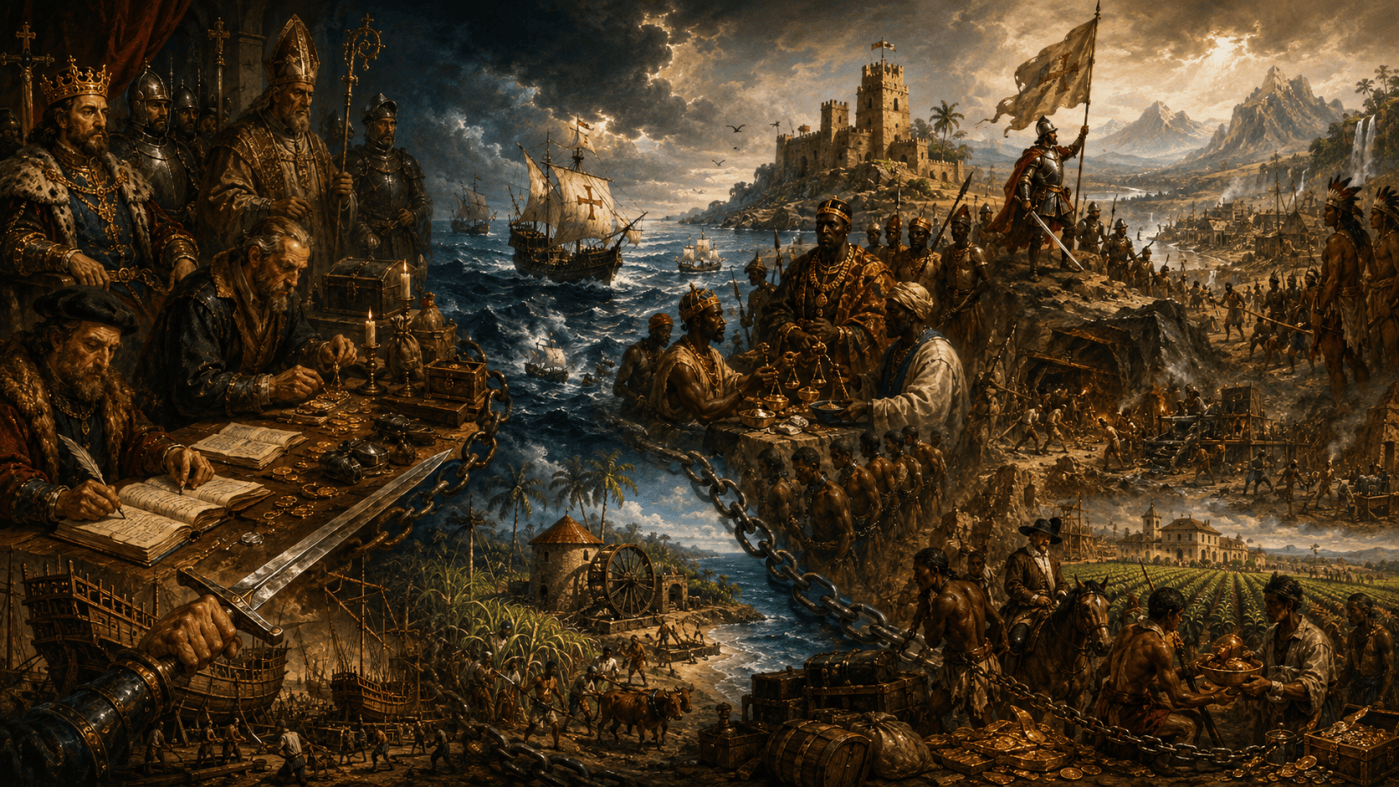
Atlantic conquest did more than steal wealth: it linked armed states, merchant capital, dispossessed land, enslaved labor, and global markets into a new structure of accumulation. 1492 didn’t create capitalism, but it radically enlarged the world in which Europe’s old ruling classes could reproduce themselves through forces that would eventually transform the order they were trying to preserve.
Prince Kapone | Weaponized Information | September 4, 2026
Conquest Costs Money
Before conquest can steal anything, somebody has to pay for the conquest. Ships need timber, rope, sails, iron, food, crews, pilots, soldiers, horses, weapons, warehouses, docks, repairs, and months of provisions before the first captive is sold or the first acre is seized. Armies don’t march on divine providence, and caravels don’t float on royal ambition. The problem confronting the Portuguese and Castilian crowns in the fifteenth century was brutally material: rulers could covet ports, trade routes, gold, land, captives, and glory, but wanting wealth overseas didn’t put enough wealth in the treasury to go seize it. European expansion began inside that contradiction. Conquest promised resources that conquest itself first required.
Portugal’s seizure of Ceuta in 1415 makes the problem impossible to hide. Later imperial mythology can turn the capture of the North African city into the clean opening shot of Portuguese expansion, as though the kingdom had discovered a profitable staircase and simply started climbing. The surviving fiscal history is much uglier. Ceuta had to be garrisoned, supplied, repaired, defended, and fed from across the Strait. Research from the University of Porto reconstructs an enclave whose maintenance imposed substantial and recurring burdens on the Portuguese Crown. The city couldn’t reliably feed itself. Military occupation required ships and logistical networks running back to Portugal. Contemporary critics could therefore treat Ceuta less like a golden goose than a hole in the royal purse.
Immediate profitability wasn’t the only thing keeping the occupation alive. The monarchy pursued dynastic prestige, strategic position, Christian warfare, and political authority. Nobles pursued service, rank, patronage, offices, and the chance to convert military achievement into property and honor. University of Porto research on the Portuguese nobility at Ceuta shows that participation was itself socially differentiated. Some great magnates had little reason to spend years bleeding in North Africa, while younger sons and lesser nobles could see the frontier as a ladder. A dangerous post on the African shore might be a bad investment for the treasury and a damn good career move for an aristocrat who needed a patron, an office, or a name worth inheriting.
That distinction matters because conquest wasn’t a modern corporation required to post a quarterly return. Different classes could accept the same war for different reasons. A king might value jurisdiction and dynastic standing. A younger noble might value the military service that could open a royal office or estate. A merchant might value privileged access to trade. A churchman might value conversion, ecclesiastical expansion, or crusading war. Their purposes weren’t identical, and eventually those differences would produce conflicts of their own. For the moment, conquest offered each of them a possible reward at somebody else’s expense.
Religion entered this material arrangement as more than decorative language pasted over greed. Crusading conviction, aristocratic reproduction, royal power, and material acquisition could reinforce one another. Christian warfare supplied a language through which conquest became legitimate service, and that legitimacy could be converted into money. During the Granada War of 1482–1492, revenues from the Bull of Crusade became an important extraordinary resource for Ferdinand and Isabella. Research on crusade finance in Andalusia shows religious mobilization entering the fiscal organization of war. Salvation entered the ledger. The believer paid; the monarchy collected; soldiers marched.
The Church could define an enemy, authorize sacred struggle, organize contributions, and help turn religious obligation into military capacity. The cross didn’t merely ride beside the sword. Under particular conditions it helped buy the sword, feed the man carrying it, and legitimate whatever property changed hands after victory. Ideology operated materially because institutions could turn belief into taxes, legal permissions, mobilized bodies, and enforceable claims.
Royal finance also has to be stripped of its own fairy tale. “The Crown paid” sounds as though kings and queens personally generated grain, timber, iron, rope, ships, and silver by willing them into existence. Their resources came from taxes, rents, customs, ecclesiastical revenues, municipal obligations, compulsory services, loans, and plunder from war. Somebody worked before the monarch spent. Somebody surrendered part of a harvest, cargo, wage, herd, or commercial payment before that value reappeared on the other side of the ledger as “royal” money.
The worker in the shipyard, the sailor under contract, the peasant from whose production taxes were taken, the town compelled to furnish resources, the merchant advancing credit, the noble seeking reward, the priest raising crusade revenue, and the monarch issuing commands weren’t performing the same social role or expecting the same return. The Crown concentrated these unequal contributions into a political capacity that none of those actors controlled equally. What later appeared on a map as a kingdom moving into Africa had already begun as a class relation at home.
That political concentration helps explain why royal expansion could continue even when a particular possession drained money. The monarchy didn’t need every campaign to pay for itself immediately. It needed enough resources to sustain compulsion and violence while distributing enough possible rewards to keep useful classes attached to the project. The problem was that taxation, religious revenue, and aristocratic service could only stretch so far. The farther conquest moved from the Crown’s existing fiscal base, the more money, food, ships, and supplies had to be assembled before any new wealth came back.
Ceuta exposed the contradiction in its simplest form. Rulers wanted expansion because expansion promised new revenues, routes, territory, offices, and prestige. Yet the resources supposedly waiting beyond the frontier couldn’t finance the expedition until somebody reached them. That gap between present cost and future appropriation is where merchant capital became indispensable. The sword could open territory, but first somebody had to finance the hand holding it.
Credit Gives the Sword a Longer Reach
An overseas campaign concentrated expenses before it produced returns. Hulls had to be built before cargo could be sold. Crews had to eat before another coast appeared. Forts had to be supplied before customs could be collected behind their walls. A monarch could command subjects, call nobles to service, impose taxes, and grant offices, but royal command wasn’t an inexhaustible sack of liquid money. Expansion produced a timing problem: the political power capable of taking future wealth needed money in the present.
Genoa matters here for reasons much larger than the argument over Christopher Columbus’s birthplace. By the fifteenth century, Genoese merchants worked through commercial and financial networks stretching across the Mediterranean, Iberia, North Africa, and increasingly Atlantic Europe. They had accumulated centuries of experience moving money across political jurisdictions, extending credit, organizing maritime trade, financing rulers, and turning fiscal claims into financial instruments. The official archival record of the Casa di San Giorgio, founded in 1407, shows an institution created to administer Genoa’s public debt that also operated banking functions, collected taxes pledged against public borrowing, and at times administered territories transferred to it by the republic. Merchant wealth was already threaded through the fiscal machinery of political power.
That history matters because merchant capital possessed something territorial rulers needed: mobility. A noble estate was fixed to land. Royal revenue depended heavily on politically defined jurisdictions. Merchant money could cross them. Credit could move resources from where wealth had already accumulated toward an expedition whose returns existed only as a promise. Commercial correspondence connected ports. Merchant families carried information about prices, shipping, borrowers, insurers, commodities, and political risks across a geography larger than any single Crown administered directly.
But mobile money had its own limit. A ledger couldn’t compel a foreign population to recognize a new ruler, defend a monopoly against armed rivals, or turn somebody else’s land into an enforceable title. Credit could finance a ship; credit alone couldn’t make the people at the destination obey the people aboard it. A ledger can record ownership; it can’t make the dispossessed obey it. Merchants needed courts, charters, soldiers, governors, forts, and warships behind the claim.
The monarchy confronted the opposite problem. Political authority could declare war, grant monopoly privileges, assign property, punish smugglers, and authorize conquest. It couldn’t instantly turn those commands into ships, provisions, commercial information, bullion, or distribution networks. Ambitious maritime projects required concentrated wealth and logistical connections that ordinary revenue couldn’t always furnish quickly enough. Merchant capital therefore entered openings inside dynastic power rather than simply replacing that power from outside. The merchant needed the king’s sword; the king needed the merchant’s purse.
Portuguese Atlantic expansion intensified this relationship. Genoese merchants had already established themselves deeply in Iberian commerce, while Portuguese rulers increasingly offered access to Atlantic ports, royal protection, monopoly privileges, island production, and commerce along the African coast. Mobile commercial capital could attach itself to a territorial power whose ships and soldiers opened opportunities unavailable through contract alone. The monarchy, in turn, could draw upon merchants whose wealth and networks reached farther than the royal treasury.
This wasn’t yet the modern capitalist corporation fused to a modern nation-state. It was a historically earlier and more contradictory alliance. Dynastic monarchy, aristocratic privilege, municipal rights, merchant wealth, royal monopoly, and private credit overlapped because each solved problems the others couldn’t solve alone. Atlantic expansion gave those relations new territory on which to fuse.
Merchant capital remained merchant capital precisely because it could profit without reorganizing every society it touched around capitalist production. A merchant could buy from peasants, slaveholders, tributary systems, guild producers, landlords, royal monopolies, or African merchants and sell elsewhere for more money. Commercial accumulation could feed on old property relations rather than abolish them. Money circulated through late-medieval society without waiting for feudal relations to disappear first.
The historical actors themselves made any clean relay from “feudal lord” to “capitalist merchant” ridiculous. Nobles could invest. Merchants could acquire land, office, and status. Monarchs could borrow. Creditors could collect state revenues. Commercial families could marry into ruling elites. A military entrepreneur could become a landlord. A landlord could speculate in commerce. Atlantic expansion multiplied the places where these interests overlapped because every new fort, voyage, island estate, monopoly, cargo, and conquered population opened another possible claim to profit, rent, jurisdiction, or privilege.
The alliance contained conflict from the beginning. A creditor expected repayment. A merchant expected access. A noble expected reward. A ruler expected jurisdiction and revenue. None of them possessed the future wealth when the agreement was made. Charters, loans, privileges, and contracts helped postpone the fight by assigning claims against a future that hadn’t yet been conquered.
Credit thereby did something historically important. It converted expected appropriation into present capacity. A ruler didn’t need every maravedí already sitting in the treasury if somebody believed a future voyage, monopoly, tax stream, cargo, or conquest could make good on the obligation. Political claims over tomorrow’s wealth could mobilize resources today.
Yet the promise still had to meet something solid. Credit could bridge the gap between expenditure and gain. It couldn’t manufacture the gain itself. Once ships sailed and soldiers landed, somebody still had to produce the wealth that settled the account. In the Canary Islands, the answer became horrifyingly concrete: the conquered themselves could be made to pay.
The Conquered Pay for the Conquest
The conquest of the Canaries unfolded unevenly across more than a century, through private lordships, Castilian royal campaigns, merchant finance, negotiated submission, Indigenous resistance, slave raiding, settlement, and renewed warfare. There was no single Canary conquest copied from island to island. By the late fifteenth century, however, especially in the royal conquests of La Palma and Tenerife, the relation between warfare and accumulation had become unusually visible. Research on Canary conquest finance shows that expected proceeds from conquest entered the financing of conquest itself.
The Crown possessed a traditional claim to the quinto real, a fifth of booty. In the Canaries that booty could include livestock and captured Indigenous people sold into slavery. Ferdinand and Isabella could assign or relinquish portions of expected royal proceeds to men organizing campaigns. A future royal claim on conquered wealth thereby became a present inducement to raise men, ships, provisions, and money. Political authority authorized seizure; military entrepreneurs carried it out; the defeated population helped settle the account.
The polite commercial word “risk” hides what that arrangement meant. A financier risked money. A conqueror risked investment, reputation, or life. A Guanche faced the loss of freedom, land, family, and political existence. Those weren’t equivalent stakes in a shared enterprise. What one side called the return on risk was produced by destroying the security of the other. Captivity therefore became more than battlefield cruelty. A prisoner could acquire an exchange value. Human beings could be transported, sold, transferred, or counted among the spoils from which royal and private claims were satisfied. The conqueror no longer saw only an enemy who had to be defeated. He could also see inventory.
That gave slave capturing an economic function beyond the immediate military campaign. A captive could be transformed into money. The money could settle obligations, reward participants, support settlement, or help finance additional operations. Violence produced a portable asset precisely because political and commercial institutions recognized the conqueror’s claim to sell another human being.
Indigenous resistance directly altered that economics. Guanche societies fought, withdrew, regrouped, disrupted Spanish plans, and forced conquerors to spend more provisions, money, and lives translating Crown claims into actual control. Resistance widened the distance between sovereignty on parchment and sovereignty on the ground. A royal declaration might cost almost nothing to write; making it real could cost years of fighting.
The stronger the resistance, the more expensive the campaign became. That meant the people Europeans hoped to turn into booty were also actors capable of destroying the expected return. Resistance could consume supplies, delay settlement, kill soldiers, reduce the number of captives available for sale, and force financiers or political authorities to commit additional resources. Expropriation was never simply the conqueror deciding to take. It had to be imposed upon people capable of fighting back.
Alonso Fernández de Lugo operated inside that political economy as a Crown-authorized conqueror who had to mobilize resources for campaigns whose rewards depended on success. The larger Canary structure matters more than turning one commander into the entire system: military leadership, private resources, royal claims to booty, slave sales, commercial relationships, and future property rewards became materially connected because victory could return value to those who had helped finance or organize the war.
Merchant capital entered this circuit not because Genoese or other financiers secretly controlled the monarchy, but because conquest created claims that could become commercially profitable. Credit could help equip violence. Violence could seize captives, livestock, land, and water. Successful seizure could satisfy debts or generate new opportunities for trade. Commerce discovered that armed political power could open fields unavailable to contract alone; rulers discovered that merchant liquidity could carry armed power farther than existing revenue allowed.
Ruling classes had looted defeated populations for thousands of years. The specific development here was that expected expropriation could enter the organization of the campaign before victory occurred. Future booty could justify present borrowing. Royal claims could be assigned to encourage private participation. Captives could be sold into markets extending beyond the island. Military success could therefore help reproduce part of the resources that had made military success possible.
The sequence bent back upon itself. Present wealth financed violence. Successful violence yielded captives, livestock, and other booty. Those proceeds rewarded or repaid the forces behind the campaign. The resulting resources could support further conquest, settlement, or accumulation.
Nothing about that loop was foreordained. Expeditions failed. Occupations drained treasuries. Indigenous peoples resisted. Creditors could lose money. Rulers could change priorities. Wars could consume more than they produced. What appeared was a tendency: where organized violence successfully created salable or taxable wealth, the conquered could be forced to cover part of the cost of continued domination.
Booty still had a limit. Livestock could be divided. Captives could be sold. Money could disappear into debt payment, consumption, or another campaign. A durable colonial order required something that couldn’t simply be carried away after victory.
Military conquest therefore began changing its object. The question was no longer only what could be taken from the conquered, but who would command the conquered territory afterward. In the Canaries, land and critically scarce water could be distributed to conquerors, settlers, creditors, and other participants in the new order. A campaign reward could become control over the conditions from which future wealth would be produced. A raid seizes things. A colonial order decides who will own the ground beneath them.
Property Comes After the Sword
Property gave conquest a longer life than booty. A captive could be sold once. A herd could be divided. Gold could disappear into a creditor’s purse. Land and water could yield season after season—provided political authority first decided whose claim would now count. The sword could seize territory. Property law made the seizure reproduce itself after the soldiers went home.
The Canaries weren’t vacant land waiting for Europeans to discover ownership. Indigenous societies already inhabited, governed, worked, named, and used the islands. Castilian victory changed the political power capable of recognizing or destroying those claims. Research on the Canary conquest economy shows booty, enslavement, settlement, fiscal privilege, and distribution of conquered resources developing inside the same colonial process. Military victory could now harden into title.
Water makes the relation especially clear. On an island, soil without irrigation can amount to a dry patch of damn near nothing. Control over water determined which land could support intensive agriculture and who could turn a wartime reward into recurring income. Conquest therefore redistributed more than territory in the abstract. It redistributed material access to production.
The post-conquest repartimiento of land and water helped organize this new order. Here repartimiento means the distribution of conquered property and resources, not the later labor-draft institutions that would carry the same name elsewhere. Conquerors, settlers, investors, and politically favored participants could receive claims that converted military service, capital, or proximity to power into productive property. A battlefield hierarchy hardened into a social hierarchy.
The soldier could eventually leave the battlefield. The deed remained. The irrigation channel still directed water. A one-time act of violence became a recurring property relation because courts, officials, settlers, and armed authority recognized the conqueror’s title over the claim of the people dispossessed by the conquest. Domination acquired an administrative afterlife.
That property wasn’t yet a landscape of perfectly modern bourgeois parcels. Colonial possession remained entangled with Crown grants, municipal jurisdiction, seigneurial privilege, settlement obligations, and negotiated rights. The monarchy didn’t divide conquered territory into some pristine market of legally equal landowners. It installed a hierarchy of “legitimate” possession underneath royal sovereignty. Older forms of rank and newer commercial interests could occupy the same estate because the property order itself embodied the transition.
Granada reveals the same underlying movement through a different history. Castilian conquest encountered a Nasrid kingdom already organized through agriculture, urban property, religious endowments, taxation, irrigation, commercial production, and institutions capable of collecting surplus. The conquerors didn’t have to destroy every mechanism that produced wealth. Research on Granada’s fiscal inheritance shows the Crown taking over revenues with Nasrid roots, including the agüela, hábices, and a heavily taxed silk economy. Conquest captured productive and fiscal machinery that could be redirected toward new rulers.
The hábices make that transfer brutally concrete. These pious endowments had supported mosques, religious figures, charitable work, and public infrastructure. After conquest and the general conversions of 1500–1501, the Crown confiscated the properties and divided control among itself, Christian institutions, municipal authorities, and selected beneficiaries. Historical research on the transfer of the hábices documents the shift in property command directly. The land remained. The rents remained. The political and religious institutions entitled to receive them changed.
The Crown likewise inherited revenue streams formerly claimed by Nasrid authority and kept collecting them. It preserved or revived mechanisms for taxing the silk economy. It redirected religious property after destroying the institutional world that had controlled it. This wasn’t indiscriminate destruction. The new rulers preserved productive mechanisms they could use and changed the hand collecting the surplus.
That distinction between destruction and appropriation matters. Conquest doesn’t simply erase the social formation it defeats; as Samir Amin showed more broadly, domination can preserve and subordinate existing productive relations when they remain useful for extracting surplus. Granada made the logic concrete: the Spanish had no reason to destroy irrigation that could still water fields or silk production that could still be taxed. Political conquest could preserve part of the productive world beneath it while radically changing who commanded the land, rents, revenues, and legal claims it produced.
This makes nonsense of the old civilizing story in which Europeans carried property into worlds supposedly lacking it. Conquerors repeatedly encountered existing systems of possession, production, tribute, religion, and jurisdiction, subordinated them, and redirected part of what they produced. Later, the conqueror could describe the new title as improvement, as though the deed had somehow created the earth printed beneath its legal description.
The Canaries and Granada were different societies, and neither provided a simple blueprint for what would later happen in the Americas. Their political institutions, labor relations, religions, and property systems differed sharply. What conquest gave the victors in both cases was the power to reorder existing claims: to preserve some, confiscate others, redirect revenues, redistribute property, and determine who would control the surplus afterward.
Property also solved a problem inherited from the financing of conquest. Instead of rewarding participants only from a finite pile of booty, rulers could grant access to something capable of yielding surplus repeatedly. Land could grow crops. Water could sustain fields. Tax claims could bite again next year. Military victory could be converted into a stream of rents and production.
But the deed concealed a stubborn fact. Land doesn’t plant itself. Water doesn’t cut cane. A title to a field produces no sugar, wheat, wine, rent, or tribute unless somebody clears, plants, harvests, carries, grinds, builds, repairs, or delivers. The rulers could redistribute the earth they had seized. They still needed people to make it pay.
Property Is Worthless Without Labor
The owner could possess the field, irrigation rights, mill, and title. None of them performed the work. Somebody still had to clear the ground, plant, weed, cut, haul, grind, boil, build, repair, sail, and load. Once conquest had converted territory into property, possession produced a labor problem: who would work, under what conditions, and for whose benefit?
Madeira exposed that contradiction before Columbus stumbled across the Atlantic. Portuguese settlement turned the island into a major fifteenth-century sugar zone, and archaeological and historical research on Atlantic sugar production traces commercially successful cultivation and processing there from the second half of the century. Madeira wasn’t a finished blueprint for the Caribbean plantation either, but it brought together elements that would travel and develop across the Atlantic: land and water rights, mills, foreign capital, coerced labor, and production for European markets. The later plantation complex didn’t materialize from nowhere. Some of its material and social components were already being assembled east of the Atlantic.
Sugar imposed demands that simple possession couldn’t meet. Because cane had to be cut and processed within a narrow window, cultivation, harvesting, transport, milling, and boiling had to be coordinated around the crop’s own perishability. Madeira’s levadas carried water both to cane fields and to the mills and sugar works that processed the harvest, while ships connected the finished commodity to distant markets. The estate was becoming more than a piece of conquered land: it joined land, water, machinery, labor, and circulation into a single productive chain.
The commodity began dictating the rhythm. Once cane was cut, the clock ran against spoilage. The worker had to move because the crop wouldn’t wait for exhaustion, illness, hunger, or family life. Owning the estate therefore meant little unless the owner could command labor with enough regularity to keep production moving at the pace imposed by the commodity.
This was a different problem from merely possessing land. A seigneurial landlord might extract rent from producers who already possessed customary access to the means of subsistence. Export sugar demanded concentrated coordination. The crop had to be cultivated on schedule, cut on schedule, moved on schedule, crushed on schedule, boiled on schedule, and shipped into circuits of exchange. Property owners therefore needed not only land but a labor relation capable of forcing people into the productive rhythm.
Madeira brought together relations that had appeared separately elsewhere. Merchant capital could finance equipment and circulation. Political authority could guarantee claims to land and water. Maritime networks linked an island estate to distant buyers. Productive property could yield recurring commercial returns. But the whole arrangement stalled without people whose work could be subordinated to it.
African enslavement was already becoming one answer to that demand. Portuguese slave raiding and trading predated Columbus by decades. Research on the early Portuguese slave trade traces capture, commerce through places such as Arguin, and the movement of enslaved Africans into Portugal and Atlantic island economies. Long before the massive American plantation systems matured, Africans were being violently detached from their societies and inserted into expanding circuits of labor and exchange.
The Atlantic changed what captivity could become. African societies themselves contained varied forms of slavery, pawnship, war captivity, and dependency before Portuguese expansion. Those relations were historically specific and often brutal, but they existed inside political and kinship orders of their own. European-controlled maritime transport increasingly allowed a captive to be removed far beyond the society in which that status had originated. Distance attacked kinship, political protection, customary rights, local knowledge, and the possibility of reintegration.
The ship could therefore do more than transport a worker. It could tear labor out of one social world and deposit the captive inside another property order. A person seized or purchased in one political zone could be carried hundreds or thousands of miles to a place where the buyer’s law, language, armed authority, and property rights replaced the institutions from which the captive had been removed.
That displacement increased the slaveholder’s command. Slavery attacked capacities owners found inconvenient: the ability to leave, negotiate terms, control one’s movement, maintain family integrity, or refuse a command without the owner’s legally recognized power standing behind punishment. This shouldn’t be confused with some fantasy in which other dependent workers were free and equal. Peasants, servants, sailors, tenants, and wage earners lived under their own forms of necessity and domination. Slavery marked a distinct relation because the owner’s claim extended to the person and could be enforced through sale, confinement, punishment, forced movement, and family separation.
Chains didn’t have to rattle every minute for force to govern the workday. The threat of sale, punishment, confinement, or separation stood behind the owner’s command. Violence moved from the exceptional moment of capture into the ordinary organization of production.
Sugar didn’t inherently require slavery; cane has no politics. The ruling class chose labor regimes. Where merchants and landowners could obtain captives through expanding Atlantic networks, enslavement offered a way to command intensive labor without surrendering meaningful control over mobility or production. Violence wasn’t an accidental moral stain on an otherwise neutral commodity system. It was built into one available method of organizing the work.
Merchant capital could participate in that relation without the plantation already representing a fully developed capitalist mode of production. Money financed ships, mills, commodities, and captives. Slaveholders commanded production through property in persons. Merchants realized gains through circulation. Money could move through the sequence captive → labor → commodity → sale → more money while older forms of political privilege, monopoly, and ownership remained intact.
That distinction is essential. Merchant capital was already capital, but its existence didn’t mean capitalist production had become dominant wherever the merchant traded. Commerce could attach itself to slaveholding estates, peasant production, seigneurial rents, tributary systems, and royal monopolies. The Atlantic was bringing merchant accumulation, slaveholding production, colonial property, and state power into tighter contact without making them identical.
Calling this simply “trade” drains the blood out of the word. Buying and selling occurred, but the commodity being bought could be a human being whose ability to refuse the transaction had already been annihilated. The buyer and seller met as property owners because somebody else had first been converted into property.
These circuits crossed Europe as well as the islands. Enslaved Africans were present in Portugal and Spain before the American slave system reached maturity. Atlantic captivity already connected ports, households, farms, workshops, islands, and commercial markets. Colonial violence wasn’t located only somewhere far offshore while Europe remained socially untouched. Actual people in chains moved into European cities and households as well as Atlantic productive zones.
Chronology matters because later history can make earlier relations look more complete than they were. Madeira wasn’t already São Tomé, Barbados, Jamaica, or Saint-Domingue. Its fifteenth-century sugar economy brought export agriculture, mills, capital, Atlantic commerce, and coerced labor into an important early combination. São Tomé’s intensive slave-sugar system expanded principally after 1492, with major sugar production developing in the early sixteenth century. The gigantic American plantation complexes came later still.
No single finished plantation model was invented once and photocopied across the ocean. Land differed. Water differed. Political authority differed. Labor supplies differed. Resistance differed. Markets changed. Technologies moved. People carried practices from one zone to another and modified them under new conditions. Atlantic history developed through transfers and transformations, not a blueprint.
That distinction produces the next contradiction. From the standpoint of merchants and slaveholders seeking workers, Africa could increasingly appear as a source of captives. But the ships approaching the African coast weren’t entering a warehouse of available labor. They were entering societies with rulers, merchants, producers, armies, goldfields, trade routes, rivalries, laws, and their own forms of bondage and freedom. The plantation owner’s demand for labor explains why European merchants wanted captives. It doesn’t explain Africa.
Africa Cannot Be Reduced to Labor
From the deck of a Portuguese ship, the coast could be reduced to cargo: gold here, captives there, ivory farther down. From the shore, the world looked different. European merchants were entering political economies whose rulers commanded territory, whose merchants already moved commodities across enormous distances, and whose producers supplied networks operating long before Lisbon sent armed caravels down the coast. Africa wasn’t waiting to be plugged into Europe. Portuguese merchants had to bargain, raid, purchase, fortify, negotiate, and maneuver their way into systems they didn’t command.
The Akan goldfields make the relation especially clear. Gold from the region Europeans later called the Gold Coast already traveled through inland networks tied to Wangara and Mande-Dyula commerce and the wider economies of West Africa. Ivor Wilks’s reconstruction of the struggle for Akan trade shows the Portuguese confronting a market already organized around powerful African producers and intermediaries. They weren’t opening commerce where none existed. They were trying to redirect part of an existing gold trade toward Atlantic shipping.
Oceanic transport gave Portuguese merchants a new route, not sovereignty over the societies at the other end. They could offer metals, textiles, horses, and other goods. They could use Crown monopolies against European rivals. They could fortify a coastal position where local political relations allowed it. They couldn’t order distant Akan producers to send gold south simply because Portugal had reached the coast by sea.
Elmina demonstrates the ambition and the limit. Portugal built São Jorge da Mina in 1482 to anchor access to gold and protect its commercial position. A stone fort armed with cannon was obviously more than a market stall. It concentrated weapons, storage, royal authority, merchants, and maritime logistics behind walls. Yet establishing the fort required negotiation with the local ruler remembered in Portuguese sources as Caramansa, or Kwamin Ansa. Research from the University of Ghana reconstructs a European foothold built inside an African political and commercial world rather than sovereignty imposed over the entire hinterland.
A fort can dominate the patch of ground covered by its cannon without ruling the routes feeding its warehouses. African authorities and merchants could negotiate access, redirect trade, restrict movement, play foreign traders against one another, or refuse terms. Portuguese merchants remained dependent upon African-controlled production, inland routes, commercial intermediaries, and political authority even while armed shipping and fortified positions increased their leverage.
This difference between commercial presence and territorial sovereignty matters because later European empire can make every early fort look like the first brick of inevitable continental conquest. In the fifteenth century, the outcome wasn’t settled. Portuguese maritime power was growing, but it confronted African states whose authority over inland production and trade could force Europeans to bargain.
The relationship was violent without yet being nineteenth-century colonial rule pushed backward in time. Portuguese raids, slave taking, armed monopoly claims, and religiously sanctioned ambitions inflicted real domination where Portuguese force could reach. A warship capable of terrorizing one coastal settlement could still remain incapable of dictating the political economy of a powerful inland polity. Maritime coercion and territorial command weren’t the same thing.
The slave trade shows how badly the later Atlantic map can distort this earlier period. Looking backward from the mature plantation complex, the geography seems obvious: Africa supplied slaves, America consumed them, Europe took the profit. In the fifteenth and early sixteenth centuries, movement was less linear. Research from the University of Ghana documents Portuguese merchants carrying enslaved Africans between African regions, including toward Akan gold-producing areas.
That fact forces a harder analysis. African societies contained forms of slavery and dependency before Europeans arrived. African rulers and merchants sometimes bought and sold captives. Some profited materially. Some resisted slave raiders or Portuguese demands. Some changed their policies as wars, markets, and political alliances changed. None of this needs to be romanticized.
But those earlier African forms of bondage weren’t simply the later racialized plantation slavery of the Americas waiting for Europeans to enlarge the order. In different societies, dependent people could occupy different positions in kinship, political membership, property, marriage, and inheritance. Atlantic commerce increasingly changed the scale, routes, destinations, and social meaning of captivity by moving people beyond the institutions in which their previous status had existed.
Maritime transport widened the market for human beings. A captive purchased or seized in one region could be moved hundreds or thousands of miles into another legal and political order, where kinship claims, customary protections, and familiar routes of escape carried far less force. Demand could now be transmitted between distant productive zones through ships controlled by merchants seeking profit. The ocean widened the market for human beings before America made that market monstrous.
African participation therefore has to be understood through actual class and political relations. A ruler selling captives occupied a different position from the captive being sold. A merchant profiting from the transaction occupied a different position from a farmer whose village became vulnerable to raiding. A state capable of regulating European access occupied a different position from a coastal community exposed to armed seizure. “Africans sold Africans” flattens all of those antagonisms into a racial category that none of the historical actors used as a unified political subject.
The more important question is how the expanding Atlantic altered the incentives and scale of the trade. European-controlled ocean transport opened distant markets. Plantation and mining development increased demand in particular zones. Merchant networks could carry that demand back toward places where captives might be purchased or seized. African wars, political rivalries, class relations, and existing bondage systems remained causal, but they now operated inside an expanding commercial geography partly organized by demands generated elsewhere.
Gold remained central to Portuguese strategy. European merchants wanted bullion already moving through African commercial worlds because gold could support monetary circulation, royal revenue, trade, and further expansion. Portuguese merchants could carry enslaved workers toward African gold production while carrying gold outward toward Europe. Labor and bullion moved through intersecting circuits that make nonsense of any picture in which Africa existed as one undifferentiated reservoir of workers.
Merchant capital thrived on differences between places. It could profit by buying in one political order and selling in another without directly reorganizing production at either end. Gold could come from African relations of production. Sugar could come from an Atlantic estate worked by captives. European peasants could produce another commodity under entirely different property relations. The merchant’s immediate power lay in circulation—connecting differences and taking profit from the movement.
That power had a limit. Commerce could skim, redirect, finance, and transport, but it couldn’t guarantee territorial command. Portugal could build Elmina and still depend upon African trade beyond its walls. It could raid one coast and negotiate on another. It could carry captives across the sea without possessing the societies from which they came.
On particular conquered islands, Europeans could reorganize land and production more directly than they could across many continental African polities, but even the islands followed different paths. Canary territorial conquest, Madeira’s sugar economy, and São Tomé’s later slave-sugar expansion weren’t one template reproduced at different addresses. They were connected formations in which settlement, property, labor, commerce, and political command developed differently.
Then the western voyage of 1492 enlarged the territorial problem beyond anything those island formations had contained. Europeans would enter another world of sovereign peoples carrying accumulated experience in maritime commerce, war finance, island colonization, slavery, property redistribution, and religious conquest. What followed wouldn’t repeat Africa or the Canaries. It would change the scale on which all of them interacted.
1492 Opens the Largest Frontier
By 1492, European rulers and merchants had learned how far ships, credit, cannon, charters, and commercial ambition could carry them—and where they still failed. Across much of Africa, commerce entered political worlds Europeans didn’t command. Atlantic islands offered tighter territorial control but limited land. The westward voyage opened a colonial frontier of an entirely different scale in which Castile would try to turn geographical contact into claims over territory, people, labor, jurisdiction, and wealth.
The political intention existed before the first landing. The official Spanish archival record preserves the Capitulations of Santa Fe, signed April 17, 1492. Ferdinand and Isabella promised Columbus hereditary admiralty, vice-regal and gubernatorial authority in lands he might acquire, a tenth share in specified gains, and the option to finance part of future ventures in return for a corresponding share. Before Castile possessed the territories, its rulers were already assigning jurisdiction, office, inheritance, and profit over them. The map hadn’t been filled in, but ruling-class claims were already being divided.
The contract condensed the historical transition. Hereditary office belonged to a world of rank and privilege. Governorship delegated Crown jurisdiction. Commercial shares tied conquest to profit. Investment rights connected private resources to future expeditions. The same document could promise lordship, political authority, and commercial participation because these relations already overlapped in practice. No tidy wall separated aristocratic privilege from merchant calculation.
Those claims collided immediately with inhabited political worlds. Hispaniola wasn’t an unoccupied commodity frontier. Its Indigenous population lived within territories governed by hereditary caciques whose authority was tied to communities and ancestral lands. Research on Hispaniola’s contested conquest reconstructs cacicazgos such as Maguana and Xaragua and the armed conflicts that accompanied Spanish settlement. Castilian sovereignty began as a foreign claim. The people living there hadn’t granted it.
That distinction exposes what “discovery” hides. Europeans did gain sustained geographical knowledge of lands previously outside their direct experience. That part is true. But knowing that land exists and possessing jurisdiction over the people living there are two entirely different things. The historical violence begins when knowledge of location becomes a claim of sovereignty.
Europeans didn’t merely see. They named, claimed, occupied, fortified, taxed, compelled, distributed, mapped, and eventually sold property in conquered lands. Geography entered the property system.
Closing the gap between royal title and actual command required war, alliances, settlements, provisions, tribute, administrators, forts, armed patrols, and repeated campaigns against resistance. Indigenous political power had to be attacked, negotiated with, divided, appropriated, or subordinated. The colony wasn’t created when the ships arrived. It had to be imposed afterward.
Two years later, the Treaty of Tordesillas projected this claim-making power across a geography neither monarchy actually controlled. Castile and Portugal drew a line dividing spheres of expansion through territories whose inhabitants had never recognized either Crown. The treaty didn’t prove European sovereignty. It demonstrated how far European claims could outrun European possession. The parchment moved faster than the army.
America nevertheless transformed the horizon because of scale. The Canaries had shown how military conquest could become property. Madeira had shown how land, mills, shipping, and export agriculture could be coordinated around commodities. African commerce had shown both the profits of long-distance exchange and the limits imposed by sovereign political systems Europeans didn’t command. Across the Atlantic lay societies and territories on a scale that dwarfed the island worlds.
That didn’t mean Europeans encountered one homogeneous “America.” Caribbean islands, Mesoamerican states, Andean empires, smaller political communities, agricultural societies, tribute systems, and mobile peoples differed radically. What changed from the European ruling-class standpoint was the possible scale of appropriation: immense quantities of land, agricultural production, tribute, political office, mineral wealth, labor, and commercial monopoly could now become objects of conquest.
A small island estate could enrich a family. A conquered American polity could sustain entire layers of colonial administration, church property, tribute rights, municipalities, estates, mines, military commands, commercial monopolies, and shipping. The problem was no longer merely whether one voyage returned a profitable cargo. Conquest could create recurring claims over whole social systems.
Hispaniola supplies the first concrete bridge from conquest to colonial production. Spanish rule moved through Indigenous communities that already possessed agriculture, political authority, and systems of tribute. Colonial extraction pushed into gold mining and other labor demands while warfare, forced movement, hunger, disease, and social disruption devastated the population. A history of sixteenth-century Hispaniola traces an economy moving through gold extraction, exploitation of Indigenous labor, growing African slavery, and sugar production.
The development matters because colonial rule didn’t encounter labor as an empty problem. Indigenous societies already produced food, organized work, maintained settlements, governed territory, and in some cases collected tribute. The conqueror could attempt to subordinate those capacities rather than invent them. Existing productive and political institutions could be selectively preserved because colonial rulers wanted the surplus they made possible.
Conquest thereby became administration. Looting a settlement and leaving is one kind of violence. Building a colony means deciding who pays tribute, who works, which authorities remain useful, which are destroyed, who settles disputes, where people may live, who owns land, and who commands the surplus after the harvest or mine output appears.
This produced a destructive contradiction. Colonists needed Indigenous communities productive enough to yield food, tribute, gold, and labor while the violence used to dominate those communities undermined their capacity to reproduce themselves. Extraction needed workers. Conquest killed, displaced, starved, terrorized, and destabilized them. The same process that created colonial labor claims could destroy the people expected to meet them.
African slavery entered this crisis through circuits already developing before 1492. It didn’t suddenly become the universal solution the moment Columbus landed. Indigenous labor remained central across enormous parts of the Spanish colonial world, while African enslavement expanded unevenly according to region, production, demographics, political authority, and the profitability of importing captives.
In the Caribbean and other tropical productive zones, mining and then sugar generated particularly strong early demand. Over the sixteenth century and beyond, mines and plantations widened that demand further. Indigenous tribute, forced labor, African slavery, wage labor, household dependency, and other forms could exist beside one another rather than replacing one another in some neat evolutionary sequence.
What the American conquest did was enlarge the labor frontier together with the territorial frontier. European rulers and property holders now had to govern populations whose legal positions differed and whose labor they wanted to command in different ways. Who could be enslaved? Who owed tribute? Who could own land? Who could inherit? Who counted as a royal subject? Who could move? Whose community carried collective obligations? Whose body could be sold? The seizure of territory had produced the need to organize status.
Domination Becomes Inheritable
Territory could be conquered in a campaign. A colonial labor order had to be reproduced every day and across generations. Rulers therefore needed more than soldiers and deeds. They needed classifications that attached consequences to people: who could own, work, inherit, marry, move, hold office, claim protection, owe tribute, or be legally enslaved. Property had reorganized land. Colonial rule increasingly reorganized social status.
Iberia already supplied a dense repertoire of unequal classifications. Christian and Muslim, Christian and Jew, noble and commoner, free and enslaved, legitimate and illegitimate, subject and foreigner all carried different legal and social meanings. These categories weren’t race in the later Atlantic sense, but they accustomed ruling institutions to governing populations through inherited and juridically enforced distinctions.
One fifteenth-century development became especially important because it made ancestry capable of surviving conversion as a basis for exclusion. The 1449 Toledo statute barred conversos of Jewish ancestry from offices and privileges on genealogical grounds. Conversion no longer guaranteed escape from inherited suspicion.
Christian universalism now contained a contradiction of its own. The faith promised conversion; blood-purity doctrine could tell the convert that ancestry remained politically legible anyway. Belief changed, lineage stayed on trial. A social distinction that had supposedly been resolved through conversion could reappear through genealogy.
That history fed later racial formation without providing a straight road to Black plantation slavery. Iberian blood-purity statutes, older slavery, religious hierarchy, conquest law, and inherited status supplied materials colonial societies would recombine under different pressures. Indigenous peoples, Africans, Jews, Muslims, conversos, free people, slaves, tributaries, and settlers occupied different relations. Modern racial categories hadn’t already been manufactured in 1492 and packed into Columbus’s hold.
The Americas changed the problem because colonial rulers confronted populations they wanted to exploit and govern differently. Indigenous communities retained collective identities, authorities, land claims, tributary obligations, and capacities for resistance. Africans entered colonial societies as enslaved and free people under changing conditions. European settlers themselves differed by rank, property, legal status, and political authority.
Courts, slaveholders, missionaries, municipal governments, settlers, and Crown officials fought over these classifications because the categories carried material consequences. A legal word could determine whether somebody owed tribute, could be sold, could own property, could claim wages, could carry weapons, could hold office, could petition a court, could inherit an estate, or could move without permission.
Prejudice gained force when institutions attached consequences to it. A belief about ancestry becomes more than an insult when a court denies office because of it. A claim about origin becomes more than folklore when a slave market treats it as evidence of enslavability. A social category becomes materially powerful when property, law, parish records, taxation, marriage, inheritance, and labor obligations reproduce it.
Race therefore developed through struggles over labor, property, jurisdiction, religion, ancestry, and belonging—not as a bad idea floating above economic life. The categories helped rulers and property holders answer practical questions about who could be commanded and on what terms.
Indigenous status shows how contested the process remained. Colonists wanted labor and tribute. Crown officials wanted revenue and ultimate sovereignty. Missionaries sometimes opposed particular forms of enslavement while participating in a larger colonial order. Indigenous communities fought militarily, negotiated, fled, maintained communal institutions, and used colonial law when it offered leverage.
The Crown’s increasing insistence that Indigenous peoples belonged within royal jurisdiction limited some settler claims to outright ownership of Indigenous persons while preserving other forms of domination. Royal protection could therefore operate as a weapon against colonial lords without becoming liberation for the colonized. The same Crown that restricted one form of private enslavement could still demand tribute, authorize labor drafts, redistribute land, and defend colonial sovereignty.
The African relation hardened differently. The research on blood purity and race describes the Africanization of slavery as a contingent process extending through the sixteenth and seventeenth centuries. As legal restrictions narrowed some forms of Indigenous enslavement while Atlantic merchants delivered growing numbers of Africans into mines, plantations, households, workshops, and urban labor, African origin became increasingly associated with legally enslavable status.
The market then helped reproduce the association it was helping create. Slaveholders demanded captives. Merchants supplied Africans. Colonial officials recorded populations. Courts adjudicated status. Everyday social practice learned to interpret African origin and Blackness through a labor relation increasingly organized around ownership. What developed historically could later masquerade as natural difference. The racial category appeared to explain the labor condition after the labor order had spent generations producing the category.
Hereditary status deepened the relation. Across Spanish American colonial classifications, enslaved status generally followed the mother. Research on colonial labor classifications shows ancestry, legitimacy, and inherited status becoming entangled and contested. For slaveholders, hereditary slavery meant a property claim could reach beyond the worker alive today toward children born into the same condition.
That transformation matters because a slave system dependent entirely on new capture has to keep purchasing its workforce from somewhere else. Hereditary status allows part of the laboring population to be reproduced within the colony itself. The ruling class wasn’t claiming only today’s labor. It was trying to own tomorrow’s worker before that worker was born.
Gender enters here because social reproduction itself became part of property and class relations. Research on women in the Canaries documents women as settlers, workers, landholders, widows managing property, enslaved people, and slaveholders. Colonial society depended not only on productive labor in fields and workshops but on households, marriage, inheritance, childbirth, domestic work, and the reproduction of populations.
Those relations carried opposite meanings according to class and status. A property-owning woman’s marriage could consolidate estates and transmit wealth. A widow could manage productive property. An enslaved woman’s children could become claims within another person’s estate. Indigenous and African women could be incorporated into colonial households through forms of dependency and domination that helped reproduce the settler society itself. Social reproduction wasn’t behind the economy. It was one of the places where property relations became flesh.
Nor did legal categories ever achieve perfect control. Enslaved and free Black people petitioned, negotiated, moved, sought manumission, made claims to wages and freedom, and used whatever openings colonial law afforded. Indigenous peoples fought, fled, litigated, negotiated, preserved communal institutions, and exploited conflicts between colonial authorities. Status was imposed through power, but people forced its boundaries to remain politically contested.
The resulting complexity helps explain colonial institutions’ obsession with documentation. Actual human life refused to stay inside simple boxes. Free Africans existed beside enslaved Africans. Indigenous nobles could occupy different legal positions from Indigenous commoners. Mixed families complicated lineage rules. Manumission changed status. Conversion changed some rights but not others. Officials responded by producing ever finer distinctions because domination required knowing which rights and obligations attached to whom.
Repeated classification could nevertheless make historical domination look biological. If ancestry affects freedom, work, property, office, marriage, and inheritance for generations, inequality can later be presented as proof that the categories were natural all along. The social relation manufactures the appearance of biological destiny. History gets laundered into blood.
These classifications stabilized extraction while creating another political problem. Conquerors, encomenderos, slaveholders, and settlers who controlled land, tribute, labor, households, and local offices accumulated power of their own. The Crown had relied upon such agents because it couldn’t govern an oceanic empire directly. Now those agents wanted their rewards to become permanent and hereditary too. The monarchy needed colonial rulers powerful enough to command the conquered—and weak enough to remain subjects themselves.
The Crown Creates Agents It Has to Restrain
Empire expanded through delegation because the monarchy couldn’t personally occupy every valley, collect every tribute payment, supervise every labor draft, defend every settlement, or crush every revolt across an ocean. Conquerors, settlers, merchants, municipal officials, priests, governors, encomenderos, and military commanders carried royal authority into places where the Crown’s own administrative reach was thin. Distance made them indispensable. Their success made them dangerous.
Conquistadors crossed the Atlantic expecting reward. Military service existed inside a political culture where service to the Crown could create claims to mercedes—offices, privileges, revenues, land, or other favors. Research on conquistador claims in Yucatán shows families treating service as an inherited right to petition for royal compensation. The conqueror didn’t imagine himself as a salaried employee of an impersonal state. He believed the king owed him.
America inflated the possible size of that debt. A man involved in subordinating large Indigenous populations could imagine tribute, hereditary status, land, offices, and family wealth on a scale no ordinary military salary could match. The more conquest enlarged Crown sovereignty, the more conquerors demanded pieces of the conquered surplus as their payment.
The encomienda became one way to manage that demand. It granted colonists rights to receive tribute and, during parts of its history, personal services from designated Indigenous communities while the monarchy asserted that those communities remained under royal jurisdiction. The distinction is stated directly in El Colegio de México’s research: encomenderos could receive tribute and service, but the Crown denied them jurisdiction over Indigenous vassals.
The legal distinction hid a naked political struggle. If an encomendero converted tribute rights into unrestricted hereditary sovereignty over the people producing them, the monarchy would be manufacturing little rival lordships throughout its colonies. The king needed colonial elites capable of compelling extraction. He didn’t need them becoming kings.
The bargain that financed expansion now turned against its author. During conquest, promises of future reward mobilized men and private resources. After victory, those promises became claims against royal power. Conquistadors could point to battles fought and territories subordinated. The Crown could point to the charter that gave those victories legal standing. Both claimed authorship over conquest, and both wanted the surplus it produced.
Nor did the colonial elite fit comfortably inside a modern division between aristocrat and businessman. One man could command soldiers, hold land, receive Indigenous tribute, seek noble status, occupy public office, sell agricultural products, advance money, and participate in commerce. José Miranda’s work, preserved through UNAM’s historical institute, captured the mixed character of encomienda society: seigneurial aspirations and commercial calculation could coexist inside the same colonial institution.
A man could collect tribute like a lord and calculate returns like an entrepreneur without suffering an identity crisis over which social system he represented. The contradiction existed in the social relation, not inside his head.
That fusion is central to understanding the transition. Atlantic expansion didn’t simply pit feudal nobles against capitalist merchants and wait for history to pick a winner. Military service could become tribute rights. Tribute could become money. Money could buy land or office. Merchants could acquire estates and rank. Noble families could enter commercial ventures. Colonial expansion allowed old status and new accumulation to reinforce one another before their contradictions became decisive.
The monarchy ruling this process wasn’t a modern centralized nation-state issuing perfect commands from Madrid. Iberian empire operated through overlapping jurisdictions, municipalities, noble privileges, churches, governors, commercial interests, colonial corporations, local elites, and negotiated rights. Research on the early Iberian empires emphasizes this politically plural character. The Crown expanded partly by giving other actors privileges worth paying, settling, administering, and fighting for.
Delegation extended royal power beyond what the monarchy could directly finance. A settler who defended a frontier saved the Crown some military expense. An encomendero collecting tribute reduced the need for a vast salaried bureaucracy. A governor administered territory in the king’s name. A church institution helped organize settlement and social discipline. Empire could expand because the Crown allowed intermediaries to extract enough wealth to make ruling on its behalf worthwhile.
That was cheap government only if we ignore who paid the bill. Indigenous communities paid through tribute, compulsory labor, dispossession, and lost sovereignty. Enslaved Africans paid through labor extracted under ownership. Settlers and military entrepreneurs sometimes advanced resources of their own, but they did so expecting the conquered society to furnish the eventual reward. The monarchy externalized part of the cost of empire onto colonial agents, and those agents externalized it downward onto the people they dominated.
The Crown therefore had to cultivate and restrain the same class. Too little reward weakened the incentive to conquer, settle, and defend the colony. Too much hereditary jurisdiction threatened royal sovereignty. Colonial politics repeatedly turned on where the encomendero’s right to extract ended and the king’s right to command began.
Yucatán makes the rentier side of that contradiction especially clear. The regional colonization studied by Gabriela Solís Robleda developed a particularly strong seigneurial and rent-based character, making inherited claims to royal reward central to settler reproduction. Conquistador families sought to transform remembered military service into durable rights over the colonial surplus.
This matters because colonial wealth could reproduce forms of power that remained aristocratic, dynastic, and rent-seeking even while the people receiving that wealth participated in a widening commercial world. A family might turn tribute into land, office, luxury consumption, debt payment, trade, investment, or inherited social standing. Nothing in the existence of colonial wealth forced every recipient to transform production around capitalist accumulation.
The same was true for the Crown. American revenue could fund war, patronage, administration, debt service, imported goods, further expansion, and dynastic competition. Silver has no revolutionary consciousness. It goes where property, power, markets, and class relations send it.
That produces the anomaly the next stage has to explain. Spain and Portugal helped open immense colonial fields of accumulation. Their empires drew tribute, commodities, labor, precious metals, and taxes across oceans. Their merchants and rulers stood near the center of an expanding Atlantic economy. Yet the deepest early transformation toward capitalist production would center elsewhere in Europe. Colonial wealth had changed the world. It hadn’t predetermined what every class would do with it.
The Same Atlantic, Different Class Orders
The Iberian anomaly breaks the simplest theory of capitalist origins. Spain and Portugal moved early into Atlantic conquest, commanded colonial revenues, participated in slave trading, extracted tribute, and gained access to extraordinary flows of precious metals and commodities. If capitalism were just accumulated commercial wealth plus enough colonial plunder, Lisbon and Castile should’ve become the unquestioned centers of capitalist production. They didn’t.
Wealth, merchant capital, and capitalist production therefore have to be distinguished without pretending they lived in separate worlds. Merchant capital was already capital: money advanced through trade, credit, and circulation in pursuit of more money. It could finance rulers, ships, commodities, loans, and colonial ventures and return enlarged. What merchant capital couldn’t accomplish by circulation alone was the general reorganization of production around capitalist social-property relations.
A merchant could accumulate through commodities produced by peasants, slaves, artisans, landlords, tributary communities, guild producers, or royal monopolies. He didn’t need every producer to become a wage worker before making a profit. Merchant capital could grow fat on social relations it hadn’t itself revolutionized. It could even benefit from their preservation when they reliably supplied commodities for circulation.
The Marxist debate associated with Robert Brenner and Ellen Meiksins Wood gives this problem its sharpest edge. Brenner’s work on the agrarian roots of capitalism argues that expanding trade produced different results because landlords and producers confronted different property relations. Where producers retained substantial nonmarket access to the conditions of subsistence, greater commerce could enrich rulers, landlords, and merchants without forcing production itself into competitive transformation.
Where access to land and survival became increasingly dependent upon the market, the pressure changed. Landlords, tenants, and producers confronted stronger incentives to cut costs, increase productivity, accumulate, compete, and reorganize production. The same expanding commerce could therefore deepen rentier relations in one formation and accelerate capitalist transformation in another.
The distinction is material. A chest of silver can pay soldiers, service debt, purchase imported cloth, enlarge an estate, fund luxury consumption, build a ship, finance trade, or enter productive investment. The metal doesn’t choose. The class structure does.
Iberian empire could strengthen the old ruling order while expanding forces that exceeded it. Crowns used colonial revenues for war, debt, patronage, administration, and dynastic competition. Nobles could convert colonial wealth into estates, offices, status, or consumption. Encomenderos extracted tribute and labor. Merchants profited from monopoly and circulation. Commercial wealth could increase dramatically without capitalist production becoming socially dominant.
This is the essay’s central contradiction in its clearest form. Late-medieval and early-modern ruling classes reached outward to reproduce dynasty, privilege, rent, jurisdiction, and political command. Overseas expansion gave them new offices, taxes, estates, commodities, captives, markets, and monopoly rights. The means they used to strengthen the old order simultaneously widened finance, monetary circulation, shipping, commodity exchange, colonial production, and intercontinental dependence on a scale that old order had never contained.
The old world fed itself through mechanisms that were making the world around it less old. Colonial conquest therefore belongs inside the history of capitalist development without functioning as a magic key that explains everything. England’s agrarian transformations weren’t created by Spanish silver or Caribbean sugar. They also didn’t occur inside a sealed English countryside while conquest, slavery, overseas markets, and global monetary flows happened in another historical universe. The world was already too connected for that.
Research on the Iberian imperial economy argues that the later growth of competing European powers was aided by their penetration, from around 1600, into markets where Spain and Portugal had borne major costs of imperial protection and control, alongside the enlarged money supply generated through Iberian expansion. Dutch and English merchants increasingly entered commercial fields their rivals had helped build. The irony is savage. Iberian rulers spent fortunes fighting for global command, and competitors learned how to make money inside the world their enemies had helped construct.
Those competitors didn’t enter a blank market. Iberian conquest had already helped establish fortified routes, colonial ports, protected commercial zones, bullion flows, slave circuits, plantation commodities, administrative structures, and demand extending across oceans. England and the Netherlands could participate in, attack, capture, redirect, or undercut pieces of an expanding system whose construction had already consumed enormous Iberian resources.
But the same external opportunity entered different domestic class relations. A wider market might let one aristocracy collect more rent while pushing another formation toward competitive leasing and productivity. Colonial commodities could support elite consumption in one place and commercial reinvestment somewhere else. Silver could fund a dynasty, settle a merchant account, purchase Asian goods, finance public debt, or support shipping. External expansion changed the field of possibility; social-property relations determined how classes fought over and reproduced themselves inside that field.
This is where primitive accumulation has to be rescued from the cartoon version of itself. Marx’s treatment of so-called primitive accumulation doesn’t describe capitalism as the reward received by merchants who stole enough treasure and eventually bought factories. It centers expropriation: historical processes that concentrated property while separating producers from independent access to the conditions of production.
Colonial conquest, slavery, state violence, taxation, monopoly, public debt, and dispossession mattered because they enlarged the power and resources entering those transformations. Loot could become merchant capital. Colonial revenue could strengthen states. Enslaved labor could generate commodities entering capitalist markets. Public debt could bind financiers and governments together. Overseas demand could transform opportunities available to domestic producers.
None of this means stolen wealth had one predetermined destination. Colonial surplus could become aristocratic consumption, dynastic warfare, rentier property, commercial capital, debt service, infrastructure, or productive investment. Its historical effect depended upon the class relations through which it moved.
The world economy that followed was therefore increasingly integrated without becoming socially uniform. An Akan gold producer, Canary sugar estate, Castilian landlord, American encomendero, Genoese creditor, Dutch merchant, enslaved plantation worker, and English tenant farmer could become connected through circulation while remaining embedded in radically different property and labor relations.
Commodity exchange joined unlike societies before capitalist production dominated all of them. That heterogeneity became part of capitalist expansion rather than an obstacle capitalism first had to erase. Merchants and later capitalist firms could profit from goods produced through slavery, tenancy, peasant production, tribute, and wage labor. Manufacturers could process raw materials produced by enslaved workers an ocean away. States could tax commerce connecting all of them.
Capitalist production didn’t require every producer on earth to enter the same labor contract before accumulation could subordinate increasingly large parts of the world. Capital could articulate with relations it hadn’t created and profit from them while transforming the larger system around them.
Colonial conquest therefore acted as a differential input. It seized land, compelled labor, enlarged commodity frontiers, mobilized bullion, expanded shipping, created markets, strengthened states, and concentrated wealth. One ruling order could use those resources to reinforce rent and hereditary privilege while another formation increasingly subjected production itself to market competition and accumulation. The same Atlantic produced different social outcomes because the Atlantic didn’t erase the class structures through which its wealth moved.
By the seventeenth century, the commercial world Portuguese and Spanish expansion had helped enlarge was becoming larger than Portuguese and Spanish command. Merchant networks, slave systems, colonial markets, public debts, shipping routes, financial institutions, and rival states now interacted through structures no single Crown possessed. Portugal and Spain had helped enlarge the field. Other classes and states would fight to inherit it.
What Was Actually Born?
1492 wasn’t the birth certificate of capitalism. It marked a decisive enlargement of a contradiction already developing inside Europe’s ruling order: monarchs, nobles, merchants, financiers, conquerors, and property holders increasingly reproduced their power through forms of commerce, credit, conquest, coerced labor, colonial property, and commodity circulation that strengthened the existing order while changing the material basis beneath it.
The historical breakthrough was therefore larger than Columbus and more precise than “discovery.” European rulers gained a growing capacity to connect armed sovereignty, merchant capital, expropriated land, coerced labor, fiscal extraction, and long-distance commerce across widening stretches of the planet. No single relation was new by itself. Slavery was old. Merchant trade was old. Conquest was old. Taxation, debt, landed privilege, and long-distance commerce were old. Their Atlantic recombination changed the scale on which they could reinforce and transform one another.
What emerged was an expanding Atlantic structure of accumulation linking radically different societies without making them identical. African merchants could bargain inside African political orders while European merchants sought their gold. Indigenous communities could remain productive while colonial rulers redirected tribute upward. Enslaved workers could produce commodities entering commercial circuits controlled elsewhere. European financiers could advance money against political claims. Crowns could borrow, grant, tax, conquer, and delegate.
The connections tightened while the social relations at each end remained uneven. That unevenness wasn’t a temporary flaw waiting for one pure capitalist model to replace it. It became one of the conditions through which the larger system expanded.
The same ocean could connect a slave plantation, an African gold market, a peasant farm, a royal tax office, a merchant house, and a capitalist workshop without turning them into the same social relation. What mattered was that value, commodities, labor, credit, and political power increasingly moved between them.
That also explains why colonial accumulation produced no single European future. Spain and Portugal could use empire to strengthen dynastic power, rent, office, aristocratic privilege, and merchant wealth even as the wider Atlantic multiplied markets, finance, shipping, public borrowing, and monetary circulation. Other European formations entered those circuits through different property relations and pushed capitalist production farther.
The same ocean connected them; it didn’t make their class structures the same. Race and slavery developed inside this world rather than outside its supposedly modern core. Colonial rulers and property owners progressively made ancestry carry consequences for work, freedom, property, inheritance, and political belonging. African enslavement hardened historically as Atlantic demand expanded. Indigenous peoples, Africans, and other subordinated populations resisted the categories imposed upon them. What later presented itself as natural hierarchy had been manufactured through conquest, labor discipline, law, property, religion, and reproduction.
The states commanding this expansion weren’t omnipotent machines either. Crowns bargained with creditors, nobles, municipalities, churches, merchants, soldiers, governors, and colonists because they lacked the resources to rule distant territories alone. Delegation extended royal reach while creating colonial elites the monarchy had to restrain. State power expanded through relations that remained fractured and contested.
Nor did the people being conquered disappear as historical actors simply because European archives preferred to record European decisions. Guanche resistance raised the cost of Canary conquest. African rulers forced Portuguese merchants to negotiate inside commercial systems Europeans hadn’t created. Indigenous peoples fought settlement and colonial labor demands. Enslaved Africans fled, rebelled, negotiated, petitioned, and built lives inside and against the institutions claiming ownership over them.
Resistance couldn’t erase the immense structural inequality created by conquest, but it changed what rulers could impose, how much domination cost, which institutions survived, and what forms colonial authority had to adopt. Every apparent system contained people fighting over how it actually worked.
That is why the harmless phrase “Age of Discovery” conceals so much. Europeans unquestionably discovered things they hadn’t known. What changed the world wasn’t the knowledge alone. It was the growing power attached to that knowledge: the ability to turn a coastline into a claim, victory into property, property into command over labor, labor into commodities, commodities into money, and money back into political and commercial capacity.
Conquest could now reproduce more than booty. Successful violence could create recurring rents, taxes, estates, mines, plantations, monopolies, and markets. Merchant capital could finance political expansion; political expansion could open new fields for merchant capital. Colonial property could generate commodities; commodities could finance states and merchants; those resources could support further expansion.
But the cycle never belonged to one class alone and never produced one identical outcome. Monarchs wanted jurisdiction. Nobles wanted rents and hereditary standing. Merchants wanted circulation and profit. Colonial elites wanted permanent control over land and labor. Workers, captives, peasants, Indigenous peoples, and enslaved Africans bore the labor and violence that made those ambitions material while resisting the conditions imposed upon them.
Europe’s old ruling classes reached outward because they wanted more ways to remain what they already were. That was the contradiction they couldn’t freeze in place. They seized new worlds to strengthen crowns, estates, churches, merchant houses, and inherited privilege. In doing so, they enlarged commerce, finance, commodity production, expropriation, and intercontinental dependence beyond the social world that had launched the expansion. They didn’t simply make themselves richer. They helped build the material world in which their own kind of power would eventually cease to be enough.


Leave a Reply