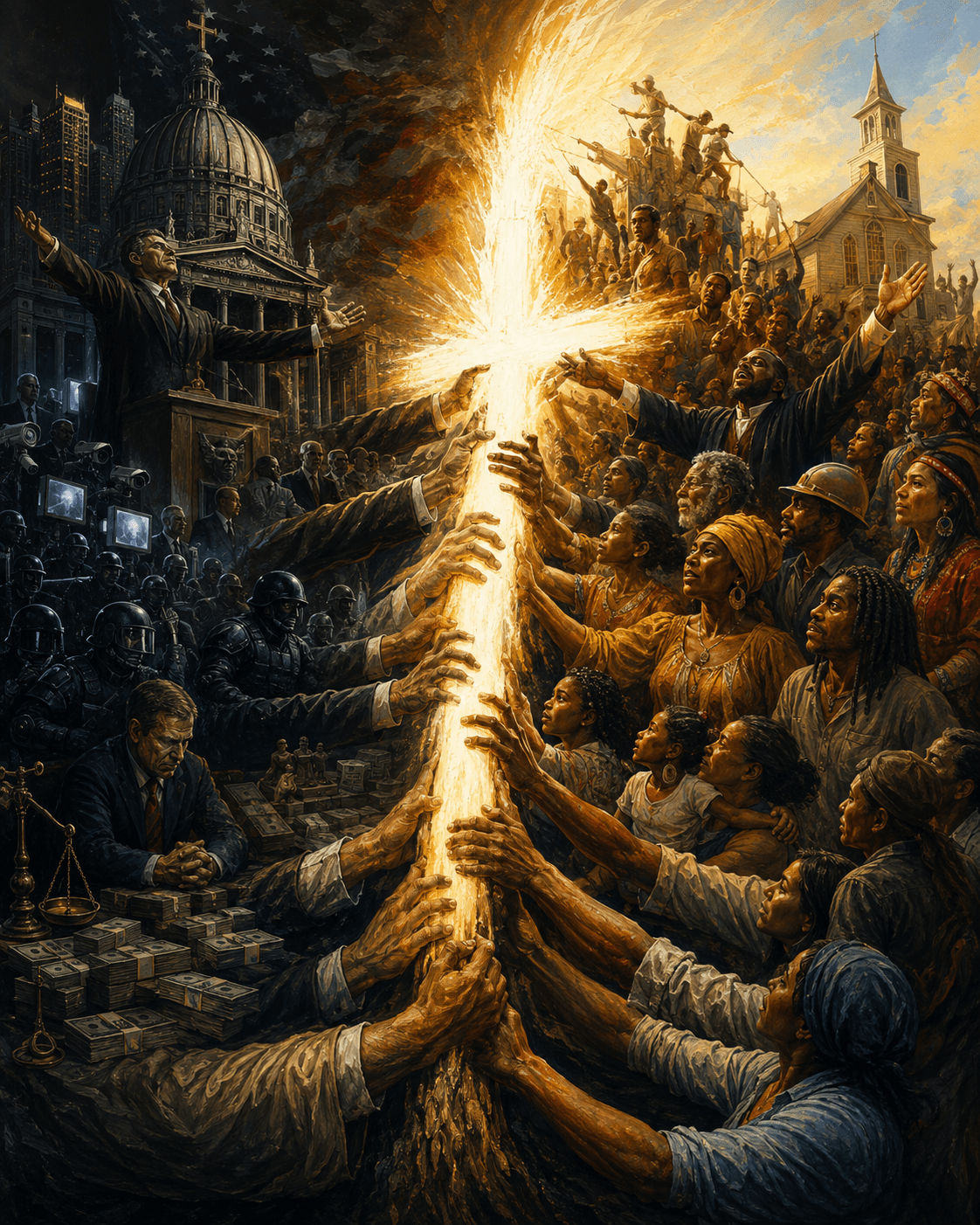
From the settler mission and slaveholding church to the hidden worship of the enslaved, Black abolitionism, and Indigenous Christian resistance, American Christianity was divided from the beginning between a faith that sanctified domination and a faith seized from below to condemn it. That Christianity of the oppressed built real institutions—from Black mutual aid and freedom churches to labor struggle, anti-imperialist Christianity, the Black freedom movement, sanctuary, and poor people’s organizing—even as emancipation repeatedly transformed the relations against which it fought. The modern Christian Right gained its present advantage not because reaction owns the Gospel, but because it became more successful at integrating churches, money, media, law, political organization, and state power into a machinery capable of reproducing its Christianity across generations. For revolutionaries, the conclusion is neither to declare Jesus a socialist nor to surrender believers to reaction, but to struggle on the religious terrain itself—recovering the liberation-Christian lineage, organizing from the contradictions of working life, and fighting to win Christian working people toward socialist consciousness and power.
Prince Kapone | Weaponized Information | August 20, 2026
Who Gave the Right the Church?
One of the stranger features of the present American religious crisis is that some of the loudest warnings about Christian nationalism are coming from people outside Christianity. Rep. Jared Huffman, a self-described nonbeliever and founder of the Congressional Freethought Caucus, has made confronting Christian nationalism a central political argument. His concern is hardly imaginary. The current administration has given Christian grievance a place inside executive power, including the Task Force to Eradicate Anti-Christian Bias, while a dense conservative religious apparatus now connects churches, media, legal organizations, policy institutions, donors, and government personnel. From the surface, the battle lines seem obvious: Christian politics on one side, secular democracy on the other.
But the surface is already lying about the history. Christian nationalism does not speak for American Christianity by numerical consent. PRRI’s 2025 American Values Atlas found Christian-nationalist adherence concentrated unevenly across denominations and regions rather than constituting a uniform Christian bloc. Christians themselves have organized against it. Christians Against Christian Nationalism explicitly rejects the merger of Christian identity with political authority, while PRRI’s 2026 research on local anti-Christian-nationalist chapters found believers attempting to contest the movement inside congregations and communities. The Right therefore does not possess Christianity because every Christian handed it over. It possesses something more politically useful: the power to make its own historical interpretation of Christianity appear like Christianity without qualification.
Liberal opposition often reinforces that illusion without intending to. When the argument is reduced to church-state separation, representation for nonbelievers, and protection of secular institutions, the constitutional question is real but the historical question disappears. The conflict becomes too much religion versus properly limited religion. Christian nationalism is then allowed to present itself as the Christian side of the dispute, while its opponents occupy secular ground and debate how firmly religion should be kept away from government. The Right gets the sanctuary; liberalism negotiates the zoning ordinance.
Weaponized Information has treated religion differently: as a contested social terrain embedded in family, grief, community, identity, moral formation, and political belonging. That matters because millions of people do not encounter Christianity first as a constitutional abstraction. They encounter it through congregations, parents, funerals, marriages, poverty, addiction, mutual aid, fear, hope, and the stories through which communities explain themselves. Whoever organizes that terrain gains more than votes. They gain a language through which people interpret suffering, authority, enemies, obligation, and the world they believe ought to exist.
The real question, then, is not why Christianity suddenly became political. American Christianity has been political from the beginning because it developed inside political relations. What requires explanation is why one Christianity now speaks so confidently in the language of nation, hierarchy, restoration, property, and state power while another Christian history—formed among people fighting bondage, conquest, racial domination, exploitation, and empire—has been pushed so far from popular memory that it can sound almost foreign when recovered. To understand who gave the Right the church, we have to go back before the Religious Right, before the culture wars, before even the modern industrial order—to the land that was taken, the people who were enslaved, and the first Christians who discovered that the Bible looked very different depending on which side of the whip you were standing.
The Bible in the Master’s House
The first great American struggle over Christianity did not begin in a seminary. It began inside conquest. European settlement brought churches, missionaries, schools, land claims, racial classifications, and political authority into the same expanding colonial world. Christianity could appear as the religion of civilization precisely because the people defining civilization also controlled the institutions deciding who would possess the land and who would be governed upon it. The contradiction becomes visible in the life of Samson Occom, the Mohegan Christian minister whose preaching and transatlantic fundraising helped sustain Eleazar Wheelock’s project for Native education. As Wheelock’s project increasingly redirected its resources toward educating Anglo-American men, Occom broke with the institution whose expansion his own Native Christian labor had helped finance. The theological problem was inseparable from the material one: a mission supposedly created for Indigenous people could accumulate resources through Indigenous Christianity while leaving settler authority over the institution intact.
William Apess pushed that contradiction further. A Pequot Methodist minister, Apess did not ask white Christians merely to become more humane toward Native people. He attacked the racial and political relations beneath their benevolence. In An Indian’s Looking-Glass for the White Man, Christian equality before God becomes an indictment of white racial domination rather than a sermon about private prejudice. During the Mashpee struggle, the issue became even more concrete: Native people contested outside control over their community, resources, government, and religious life. Apess’s later Eulogy on King Philip went after the sacred history holding the whole arrangement together. Metacomet, whom settler memory had turned into an enemy of civilization, was recast as a leader defending his people against conquest. The colonizer’s providential history was forced to answer to the colonized.
Racial slavery sharpened the contradiction until there was nowhere for religious neutrality to hide. Christianity in the slaveholding order was preached through institutions resting upon ownership of human beings. Enslaved people were instructed from above about obedience while the master retained the whip, the sale ledger, the plantation, and the legal power to separate families. But enslaved Christians did not simply receive the master’s theology intact. Research on the religious world surrounding Harriet Tubman describes the clandestine “hidden church” through which enslaved African Americans created religious practices beyond direct white supervision, adapted Christianity to their own conditions, and prayed in ways that refused permanent bondage as God’s order. Here the contradiction was not Christianity versus atheism. It was Christianity interpreted from opposite positions inside the same material relation.
The master approached Scripture as an owner. The enslaved Christian approached it as property made flesh by law. One could search the Bible for obedience; the other could hear deliverance. One inhabited a social order whose continuation depended upon making ownership appear legitimate. The other inhabited the body being owned. That difference does not mechanically determine theology—enslaved people were no more politically identical than any other population—but it creates the historical standpoint from which slaveholding Christianity could become intolerable. The question ceased to be whether the master was sufficiently charitable. It became whether the master had any divine right to remain master at all.
That transformation helps explain why religious authority among the enslaved terrified the slave order. Nat Turner’s 1831 revolt emerged from an intensely biblical and prophetic religious world, though the surviving foundational account must be handled carefully because Turner’s testimony reaches us through Thomas R. Gray’s mediated Confessions. What matters here is not constructing a polished theology for Turner after the fact. His significance is that an enslaved preacher claimed religious agency for himself and acted upon his interpretation of bondage rather than waiting for white Christianity to pronounce slavery sinful. The theological subject had moved from the pulpit authorized by the slave society to the enslaved person judging that society.
This is the original fracture beneath the later argument over Christian nationalism. Christianity was never simply a pure doctrine brought into an otherwise secular system of domination and occasionally misused by hypocrites. It was institutionally embedded in conquest and slavery, and therefore became one of the languages through which those relations were fought over. Settler institutions could make possession look like mission. Slaveholding churches could make domination sound like order. Yet Indigenous and enslaved Christians could seize Christian universality, judgment, Exodus, and freedom from those same institutions and turn them back against the social relations demanding their submission.
That is where the homegrown lineage of liberation Christianity begins: not when comfortable Christians discover the suffering of others, but when people living under vicious oppression and exploitation cease accepting somebody else’s interpretation of God. Once that happens, however, interpretation alone is not enough. A people can reject the master’s Christianity and still remain without the institutions, networks, money, print, leadership, and collective organization necessary to break the master’s power. The next historical movement begins when the enslaved and the free Black community stop appearing merely as Christians demanding recognition and begin building a Christianity capable of organizing emancipation itself.
When the Slave Became the Theologian
Religious rebellion became historically dangerous when the oppressed began building institutions capable of carrying it. The Black freedom struggle against slavery did not develop only through sermons condemning bondage. In Philadelphia, Richard Allen, Absalom Jones, and other free Black people created the Free African Society in 1787 as an organized system of mutual aid for sickness, widows, children, education, apprenticeship, and community welfare. Black Christians were creating means to reproduce social life outside complete dependence upon white institutions. African Methodism carried that autonomy further. The AME tradition developed as what its historians have described as a “freedom church,” joining religious independence to abolition, Black self-determination, Underground Railroad activity, education, and eventually political rights. Before the modern Christian Right had a radio station, a law school, or a mailing list, Black Christianity had already discovered that control over the pulpit meant little without control over the institutions surrounding it.
David Walker gave that institutional independence a ferocious political voice. His 1829 Appeal did not petition white Christianity to become consistent with its own ideals while Black people waited patiently for the answer. Walker turned Christian judgment directly against slavery, white supremacy, colonization, government, and the churches that made peace with them. The difference was decisive. The enslaved and free Black population no longer appeared as the object through which white Christians proved their compassion. Black people became interpreters of Christianity, judges of Christian America, and agents whose freedom did not depend upon the moral maturation of the master.
Henry Highland Garnet sharpened the distinction between sympathy and self-emancipation. In his 1843 “Address to the Slaves of the United States,” Garnet deliberately turned away from appeals directed primarily toward free society and addressed enslaved people themselves as participants in their own liberation. That position was contested even within Black abolitionism. Frederick Douglass opposed adoption of the address at the Black convention where Garnet presented it, reflecting real strategic divisions over resistance, insurrection, moral suasion, and the costs imposed upon the enslaved. The existence of that dispute matters. The Christianity of the oppressed was never a single immaculate line marching through history. Once oppressed people became political subjects, they also acquired the right to disagree about how freedom could actually be won.
Douglass nevertheless supplied perhaps the clearest theological formulation of the fracture itself. In the appendix to his 1845 Narrative, he distinguished the Christianity of Christ from the slaveholding Christianity practiced in the United States. His indictment did not stop at Southern hypocrisy. Northern churches that maintained fellowship with slaveholders also participated in the religious reproduction of slavery. Christianity of Empire therefore required more than a cruel overseer waving Scripture over a plantation. It depended upon respectable institutions capable of converting a material crime into a tolerable religious relationship.
Turner’s revolt carries that newly claimed religious agency into the harder problem of political power. Breaking the master’s authority in consciousness was one thing; building a force capable of breaking the social order that authority protected was another. Insurrection could tear open the fiction that slavery rested on consent or divine obedience, but a revolt, however explosive, could not by itself solve the problem of reproducing liberation after the moment of rupture. Black resistance therefore had to develop ways for consciousness to travel farther than a single preacher, for leadership to survive beyond a single confrontation, for people to communicate outside white supervision, sustain one another materially, preserve political memory, and turn individual escapes from bondage into collective roads toward freedom. Turner stands at one pole of that development: the concentrated eruption of a people refusing to remain governable on the master’s terms. Around and beyond that rupture, free Black communities, independent churches, mutual-aid societies, conventions, abolitionist print networks, and clandestine routes were beginning to answer the deeper organizational question. They were turning Black religious autonomy into something the slave order had even greater reason to fear: a capacity that could outlive the moment, circulate from person to person, reproduce leadership, and make liberation itself increasingly organized.
Harriet Tubman shows another route from faith into material liberation. Her religious life grew within the Black religious world forged under slavery, but its historical force appears most clearly in what she did with it. After escaping bondage, Tubman returned repeatedly into slave territory, leading roughly seventy people to freedom across about thirteen missions while helping others escape through information and clandestine networks. Faith here traveled through kinship, trust, secrecy, movement across territory, shelter, intelligence, and the practical reproduction of freedom. The Gospel became dangerous because it acquired logistics.
John Brown entered this world from another social location. His Christian abolitionism was radical enough that he understood slavery as an evil requiring destruction rather than gradual moral improvement, and his seizure of Harpers Ferry sought weapons for a broader revolt against the slave system. But placing Brown at the beginning would reproduce the very paternal history this tradition overturns. Walker, Black churches, Turner, Garnet, Douglass, Tubman, and generations of enslaved resistance were already there. Brown even republished Garnet’s address. His importance lies precisely in becoming a white Christian defector into a liberation struggle whose historical subject he was not. Solidarity could become revolutionary, but it did not create the oppressed people whose struggle made solidarity necessary.
This history therefore forces a correction to any account that imagines liberation Christianity as prophetic speech without machinery. Black Christians built mutual aid, congregations, denominations, schools, print networks, political conventions, underground routes, leadership structures, and communities capable of preserving memory and reproducing struggle. The difference between progressive Christianity and a People’s Church begins here. The first can condemn an injustice. The second emerges when people living under the relation become its interpreters, organizers, and antagonists.
And they did not simply lose. Slavery was destroyed. That victory does not belong to Christian abolitionists alone, nor does emancipation redeem the contradictions of every force involved in the Civil War. But the legal relation around which this Christian struggle had formed was actually broken. The question facing liberation Christianity after emancipation was therefore no longer how to abolish the master’s ownership of the slave. It was what freedom would mean when the plantation order had been shattered but land, racial power, labor exploitation, political counterrevolution, and the expanding American state remained. The slave had become the theologian, the organizer, and the maker of institutions. Now the battlefield itself was about to change.
Freedom Changed the Battlefield
Emancipation did not end the struggle between the two Christianities. It changed what they were fighting over. Once human beings could no longer legally be owned as chattel, Black religious institutions confronted a different question: what could freedom mean without the material and political capacity to defend it? African Methodism moved directly into that contradiction. AME expansion during and after the Civil War joined evangelization to education and the political rights of freedpeople. The church that slavery had forced Black people to build apart from white authority could now become infrastructure for life after slavery. Freedom required schools, leadership, organization, memory, and institutions capable of surviving beyond the moment of emancipation.
But destroying slavery did not dissolve the racial order that slavery had produced. The contradiction was reorganized through the struggles that followed emancipation: over citizenship, political power, racial caste, labor, and the institutions through which Black people could exercise freedom. Christianity therefore encountered a social world in which the old master-slave relation had been broken while domination survived in altered forms. The Gospel could no longer be divided only around whether one human being had the right to own another. It now confronted the harder question of what Christianity meant inside a society where legal freedom could coexist with racial subordination and profound inequalities of property and power.
Industrial capitalism widened the terrain again. Walter Rauschenbusch’s Social Gospel confronted an industrial order of wages, insecure work, strikes, concentrated ownership, and recurring economic crisis. His importance lies in recognizing that poverty could not be reduced to defective individual morality when workers had been separated from control of the instruments of production, depended upon wages to live, and bore the insecurity generated by the industrial system itself. But the Social Gospel also exposed a contradiction that would follow progressive Christianity for generations. Federal Council clergy could publicly defend better wages and working conditions while simultaneously claiming the authority to interpret the interests of workers for them, displacing the labor movement’s capacity to speak and act in its own name. Reform could become ministry to labor rather than power exercised by labor. Christian social service could relieve suffering, provide education and meeting space, and preach brotherhood while leaving control in clerical hands—and, in its more conservative development, even counterpose Christian cooperation between employer and worker to independent union power. Compassion and liberation were not the same thing.
Black Christian politics entered industrial society carrying a different inheritance. The Black church had already been forced by slavery and racial exclusion to become more than a devotional institution. It possessed traditions of mutual aid, independent organization, political leadership, and collective survival that could now be brought into new struggles over labor and citizenship. The emerging Black Social Gospel consequently developed within a population facing both capitalist exploitation and racial domination. Its internationalist currents also began recognizing that the color line was not confined to the United States. Black religious leaders such as AME bishop Alexander Walters opposed American expansion in the Philippines and connected the treatment of colonized Filipinos to the racial order confronting Black people at home. The contradiction had crossed the shoreline.
That development matters because U.S. imperial expansion generated another division inside Christian politics. American power could present overseas conquest through the language of civilization, uplift, and mission. Yet Christian dissenters also turned religious judgment against the imperial project. During the Philippine-American War, Protestant ministers from several denominations organized opposition to imperial policy, circulated religious arguments against conquest, and protested atrocities committed in the Philippines. Christianity therefore appeared on both sides of the imperial relation much as it had under slavery: as moral authorization for an unequal order and as a language through which that order could be condemned.
Missionary Christianity itself contained the contradiction. William Henry Sheppard entered the Congo Free State as an African American Presbyterian missionary, inside an institution historically entangled with the wider civilizing assumptions of Western expansion. Yet the material reality he encountered drove in another direction. Sheppard witnessed villages subjected to violence and coercion under the Congo rubber regime and became an internationally known witness against its abuses. Mission could carry the assumptions of empire into colonized territory, but the missionary standing before the consequences of extraction could also become an accuser of the colonial system. The institution did not determine the political conclusion mechanically. The contradiction had to be lived.
The historical movement is therefore larger than a sequence of Christian reform campaigns. Slavery had produced a Christianity of the master and a Christianity from bondage. Emancipation shattered that particular legal relation, but racial oppression, unequal property, wage labor, colonial rule, and imperial expansion gave the old religious contradiction new material content. A Christianity organized around order could continue moving with the dominant society as the form of domination changed. A Christianity reconstructed from below had to learn each new terrain: from slave labor to wage labor, from racial bondage to political exclusion, from the plantation to industrial capitalism, from settler possession to overseas empire.
That is why the liberation-Christian tradition cannot be understood as one fixed theology passed intact from generation to generation. Its continuity lies in a recurring act of historical judgment: when the social order changes form, people subjected to its power return to the faith and ask again what Christianity means from where they stand. By the twentieth century, those accumulated struggles were beginning to converge inside Black Christian political life. The question was no longer only whether Christianity could oppose racism, exploitation, or empire separately. The next struggle would ask whether one religious movement could begin to see them as connected parts of the same world.
From the Black Church to the World
By the middle of the twentieth century, Black Christianity had accumulated something the earlier liberation currents possessed only in fragments: churches rooted in oppressed communities, nationally recognized clergy, movement organizations, economic networks, political education, and an international horizon. Howard Thurman helped widen that horizon before the Southern movement reached its greatest strength: his 1935–36 pilgrimage to India brought him into direct encounter with Mohandas Gandhi and the developing practice of nonviolent resistance. His theology then carried that encounter into a distinctly Black Christian problem. In Jesus and the Disinherited, Thurman approached Jesus from the standpoint of people living with their “backs against the wall,” treating the Gospel as addressed to the poor, dispossessed, and oppressed rather than interpreting Christ from the standpoint of those administering social power. James Lawson then carried years of study and experience with nonviolent struggle in India into the Southern movement, where Martin Luther King Jr. encouraged him to bring that accumulated knowledge directly into organizing. Anticolonial experience abroad was not being imported as an ornament. It entered the actual formation of organizers confronting racial power at home.
The Black church gave that political formation somewhere to live. Congregations provided meeting space, trusted leadership, communication networks, money, social legitimacy, and communities already tied together by worship, family, grief, mutual care, and racial experience. The Southern Christian Leadership Conference could therefore draw upon institutions that existed before the campaign and would remain after the demonstration. But the decisive development came when religious organization moved beyond protest against segregation and began touching the economic relations beneath everyday Black life. Through Operation Breadbasket, churches gathered information on employment, coordinated selective buying campaigns, negotiated with businesses, and used organized Black consumer power to force demands over jobs and advancement. Moral authority acquired an economic lever.
That distinction matters. A church could condemn racism while leaving the employer untouched. Breadbasket connected the sanctuary to the marketplace and made Black congregational organization consequential to firms whose profits depended upon the people sitting in the pews. The struggle was no longer only over whether a lunch counter would serve a Black customer. It was also over who would be employed, who would advance, who controlled economic opportunity, and whether Black purchasing power could be organized collectively rather than dispersed individually. The church became politically stronger when it could move people from prayer into coordinated material action.
King’s own development followed the widening contradiction. His opposition to colonialism did not suddenly appear when Vietnam became impossible to ignore. In a 1954 sermon, before Montgomery, King was already condemning colonialism and imperialism alongside segregation and criticizing the church for accommodating the old order. What changed in the following decade was that these relations became increasingly connected through struggle. The movement had confronted racial law. Economic campaigns exposed the limits of legal equality without jobs and income. Urban poverty widened the social field. War revealed where the state could find money when destruction rather than human need was declared necessary.
By 1967, those lines were converging openly. In “Beyond Vietnam,” King placed Vietnamese peasants, American poverty, militarism, and Christian responsibility inside the same political and moral frame. The significance was larger than the fact that a famous minister opposed a war. King refused the national border as the final boundary of Christian solidarity. If Vietnamese people were being subjected to overwhelming American military power, their suffering could not be rendered morally irrelevant simply because the violence was committed in the name of the United States. Christianity organized around the oppressed therefore began to collide directly with Christianity organized around the sacred nation.
The Poor People’s Campaign pushed the same development inward. Its effort to bring Black people together with Indigenous people, Puerto Ricans, Mexican Americans, and poor whites around employment, income, housing, education, and economic security moved beyond a politics organized around one racial grievance or one legal barrier. The poor were being asked to recognize one another across divisions the existing order continually reproduced. Race remained concrete. So did dispossession, citizenship, and national oppression. But the movement was reaching toward a wider question: whether people differently oppressed inside the same society could become a political force against the structures keeping them poor.
This was the strongest twentieth-century approach toward what Weaponized Information has called a People’s Church. The distinction from progressive Christianity becomes material here. Progressive clergy can denounce injustice. Liberation Christianity interprets the Gospel from the historical position of people living under domination. A People’s Church begins when those people possess institutions through which they can organize themselves, exercise leverage, educate one another, and act upon the relations producing their condition. Breadbasket supplied economic pressure. SCLC supplied movement organization. Congregations supplied social infrastructure. The Poor People’s Campaign sought a broader poor people’s bloc. Antiwar Christianity broke the moral enclosure of the nation. For a brief historical moment, these capacities were beginning to point toward one another.
James Cone’s Black liberation theology emerged from the concrete collision between Black Christian faith, white supremacy, the civil-rights struggle, and Black Power rather than from theological speculation standing above that history. Cone himself later argued that Black religion had been formed by Black people’s social existence and that enslaved people appropriated biblical stories according to their historical need, living religion concretely in history rather than debating it as an abstraction. His theology therefore gave conceptual form to a contradiction Black Christian life had already been living for generations: the Christian Gospel could not plausibly proclaim liberation while remaining detached from the actual struggle of Black people against the social relations denying their freedom. Cone later described Black spirituality itself as born in the struggle for justice, where holiness became inseparable from the power to change existing social arrangements. But the strength of that breakthrough also reveals the limit of theology by itself. A doctrine can clarify the historical standpoint from which Christianity must be interpreted; it cannot substitute for the organizations, material leverage, leadership, and collective power capable of transforming the relations being interpreted.
That was the unresolved edge of the convergence. Black prophetic Christianity had demonstrated that churches could become movement infrastructure, that religious authority could reinforce economic struggle, that racial liberation could open toward poor people’s politics, and that Christian solidarity could cross the border of empire. Yet these capacities did not consolidate into one durable national formation capable of reproducing that synthesis across generations. The question that follows is therefore no longer whether liberation Christianity ever possessed organization or political power. It plainly did. The harder question is why the Christianity aligned with hierarchy, property, nation, and restoration eventually became better at binding its institutions together—and why, by the present, it could make its own partial Christianity look like the whole faith.
Empire Learned to Organize the Faith
The contemporary advantage of the Christian Right was not created by discovering a more politically potent Gospel. It was accumulated historically. Long before the Religious Right emerged as an identifiable national political coalition in the late 1970s, conservative evangelicals and fundamentalists had spent decades constructing churches, colleges, voluntary societies, and other institutions capable of reproducing a distinct religious world beyond the election cycle. Those institutions preserved leadership, political memory, relationships, and constituencies from one struggle to the next. As conservative Christianity moved more directly into national politics, wealthy Christian donor networks helped finance political advocacy, media, electoral mobilization, and legal organizations. The important development was cumulative: religious conviction was acquiring durable machinery through which it could be converted into organized political capacity.
The legal field shows one way that machinery stores power. Alliance Defending Freedom was founded in 1994 by Christian leaders seeking to consolidate legal strategy and has since developed litigation, legislative advocacy, church and ministry alliances, attorney networks, and programs for training future Christian lawyers. A courtroom defeat does not therefore have to disappear when the ruling is issued. The struggle can leave behind trained attorneys, legal arguments, fundraising networks, organizational relationships, and another generation prepared for the next case. What appears publicly as a sequence of isolated controversies becomes, from inside the institution, an accumulation of experience and capacity.
Project 2025 shows the same process at the threshold of state power. The project joined policy development to personnel recruitment, training, and preparation for executive administration. Its significance lies in the mediation between ideology and government. Religious-right organizations participating in a wider conservative coalition did not have to stop at persuading voters or lobbying whoever happened to win office. The coalition was explicitly built around producing policy, identifying personnel, preparing them to govern, and developing an agenda for the opening period of a new administration. The sanctuary does not magically become the state. Lawyers, personnel pipelines, policy documents, organizational alliances, donor resources, and appointments bridge the distance.
Media extends that political formation into ordinary time. The National Religious Broadcasters connects Christian communication across broadcast, cable, satellite, and digital platforms, allowing political interpretation to circulate through everyday religious life rather than arriving only during campaigns. Family conflict, schools, immigration, elections, national decline, gender, war, and public morality can consequently be narrated inside a shared religious vocabulary over and over again. Ideology becomes common sense less because somebody won one argument than because trusted institutions keep teaching people how apparently separate events belong to the same story.
None of this means donors, lawyers, pastors, broadcasters, and political professionals manufacture millions of believers from nothing. Christian nationalism has genuine popular constituencies with fears, convictions, grievances, hopes, and theological commitments of their own. That is precisely why institutional power matters. Organization does not invent the raw material of consciousness; it selects, connects, amplifies, and gives political direction to contradictions people already experience. A grievance about a school, anxiety about family, resentment over social change, religious conviction, and insecurity about the nation’s future can remain disconnected experiences—or institutions can bind them into a coherent explanation of who is responsible, what has been lost, and what power must be restored.
The contrast with liberation Christianity therefore cannot be the old story of an organized Right confronting an institutionless Left. The history already reconstructed makes that impossible. Black churches built denominations, schools, mutual-aid systems, political networks, and movement infrastructure. Sanctuary created coordinated religious resistance across congregations. Faith in Action organizes through congregations as bases for leadership and collective action. The Freedom Church of the Poor and the Poor People’s Campaign connect religious formation to poor-led organizing against poverty, racism, militarism, ecological devastation, and Christian nationalism. Liberation Christianity accumulated institutions of its own.
The asymmetry lies elsewhere. Those capacities have often remained concentrated within particular denominations, racial communities, local organizing traditions, antiwar movements, sanctuary networks, theological centers, labor alliances, or poor people’s organizations. Conservative Christianity became more successful at carrying political capacity across institutional boundaries and preserving it between conjunctures. Money raised in one fight could finance another institution; lawyers trained in one controversy could enter the next; media could keep constituencies politically activated between elections; policy organizations could preserve programs until personnel capable of implementing them entered government. The achievement was not simply organization. It was reproduction across functions and across time.
That is the more precise meaning of asymmetrical religious accumulation. Liberation Christianity possessed organization, historical memory, leadership, and moments of formidable popular power. The contemporary Christian Right gained an advantage because more of its capacities became mutually reinforcing and politically transferable, allowing temporary campaigns to leave behind permanent infrastructure. The resulting imbalance can then masquerade as theology: the Christianity with greater capacity to reproduce itself publicly begins to sound like Christianity without qualification.
Yet institutional predominance does not abolish the contradictions inside the people those institutions organize. The same Christian nationalism that interprets the world through nation, family, moral order, and cultural restoration reaches believers who also return from church to wages, debt, rent, workplace discipline, union struggles, racial hierarchy, migration, incarceration, and downward mobility. History has already established that another Christianity exists. The unresolved question is what happens when religious interpretation collides again with material life—and whether revolutionaries intend to be present when it does.
The Gospel Is Not the Program
The strategic question becomes concrete wherever the Christian leaves church and returns to the rest of life. The same believer who hears a sermon about family, nation, morality, or divine order may spend Monday taking orders from a supervisor, bargaining over wages, paying rent, carrying debt, caring for relatives, navigating racial hierarchy, or watching a workplace reorganized over their head. Religious consciousness does not float above those relations. It enters them, interprets them, and is changed by them. That is why the revolutionary question is not whether Christians possess the correct theology before they can enter struggle. It is which political explanation can connect the world they worship in to the world they work in.
The contemporary evidence shows that connection is already contradictory. A 2026 study of Christian nationalism and organized labor found that its economic politics change significantly with socioeconomic position: among lower-income and self-described lower-class respondents, stronger Christian-nationalist identification was associated with less hostility toward unions, while among wealthier respondents it moved more clearly toward anti-labor attitudes. That does not reveal an army of secret socialists hiding in conservative churches. It reveals something more useful: religious-national ideology does not erase class location. A worker can absorb a reactionary story about the nation while learning something very different when the boss cuts hours, disciplines the shop, or confronts collective organization.
Nor can that contradiction be reduced to one denomination. Lower-income Americans are spread across evangelical Protestant, historically Black Protestant, Catholic, mainline Protestant, and other religious traditions. “Working-class Christian” therefore names a social location only crudely unless we ask what kind of work, what racial formation, what congregation, what region, what relationship to ownership, and what organizational experience lie underneath it. The same caution applies to the middle strata. A teacher, small proprietor, public employee, manager, indebted professional, and downwardly mobile technician may all be called middle class while occupying sharply different relations to labor and capital.
This is why the workplace may prove as important as the denomination. Millions of American workers remain union members, with organization especially concentrated in the public sector and particular occupational fields. The religious worker who experiences collective bargaining, strike preparation, workplace discipline, or solidarity encounters a form of social power that no sermon can fully substitute for. Church can provide community, memory, moral language, and belonging; organized labor can make exploitation visible through confrontation with the employer. Where those experiences meet, a religious-class contradiction can become politically productive. But it can also resolve toward reaction, resignation, or narrow economic bargaining. Nothing about material hardship automatically manufactures socialist consciousness.
That is precisely why socialism cannot be smuggled into Christianity by declaring Jesus a Marxist two thousand years ahead of schedule. Liberation Christianity and socialism overlap where both confront domination, poverty, racial oppression, war, dispossession, and the degradation of human beings. They are still different intellectual and political traditions. Christianity can condemn the rich while leaving the ownership of productive property theoretically unexplained. It can defend the poor without identifying how wages, profit, accumulation, landlordism, finance, and state power reproduce poverty. Historical materialism contributes that missing analysis. It explains why the same misery returns after the charity drive is over.
But Marxism can commit the opposite stupidity if it approaches religious people as defective secularists awaiting correction. The liberation-Christian tradition reconstructed throughout this history was not produced because radicals taught oppressed Christians to use revolutionary vocabulary. It emerged because enslaved people, Indigenous people, Black communities, workers, antiwar Christians, and poor people struggled within concrete relations and interpreted their faith from inside that struggle. A revolutionary socialist movement entering this terrain has to begin the same way: not by manipulating belief, but by organizing around the relations people actually live.
That makes formations such as the Freedom Church of the Poor important less as templates to copy than as evidence of the principle. Poor people can become theological and political interpreters of their own conditions rather than the objects of somebody else’s ministry. The socialist task is to push that self-activity further: from hunger toward the ownership relations producing deprivation; from racist injury toward the institutions reproducing racialized power; from war toward the political economy of empire; from workplace grievance toward class organization and social ownership.
The terrain is therefore neither naturally ours nor naturally theirs. The present evidence does not tell us which denomination, race, occupation, region, or religious subculture will move first or furthest toward socialism. It tells us where to look: wherever faith encounters exploitation strongly enough that the story preached from above no longer fits the life being lived below. The final question is whether revolutionaries will recognize that contradiction as a field of struggle—or continue surrendering millions of believers to people who have spent generations learning how to organize it.
Take Back the Terrain
The argument returns, finally, to the present. Christian nationalism can appear to own political Christianity only if the history of the Christianity that fought slavery, settler domination, racial caste, exploitation, colonialism, and imperial war is pushed to the margins. Frederick Douglass had already exposed the fraud in the nineteenth century when he separated the Christianity of Christ from the slaveholding Christianity of America. The contradiction survived because the social order survived in transformed forms. The master’s theology changed clothes as the relations of domination changed beneath it.
But the opposite tradition survived too. It survived wherever oppressed people stopped waiting for religious authority to liberate them and began interpreting faith through their own struggle. That is the significance of Jean-Bertrand Aristide’s People’s Church: faith becomes politically dangerous when those kept beneath the table cease asking for a kinder seat and organize the power to move the table itself. The historical lineage reconstructed here—from enslaved and Indigenous Christians through abolition, Black church institution-building, labor struggle, anti-imperial Christianity, the Black freedom movement, sanctuary, and poor people’s organizing—shows that such a possibility is neither foreign to Christianity nor invented for the present emergency.
What does not yet exist is a consolidated socialist Christian subject capable of matching the institutional power accumulated by reaction. History offers no demographic shortcut to one. Workers do not become socialist because they pray. Poor people do not become revolutionary because they suffer. Christians living inside exploitation, debt, racial domination, incarceration, migration, or downward mobility can move toward solidarity or toward somebody else’s scapegoat. That unresolved contradiction is the terrain itself.
Revolutionaries should therefore stop treating the church, the Bible, and Christian working people as property already deeded to the Right. Contesting that terrain does not mean Christianizing socialism or disguising Marx behind Scripture. It means organizing where people actually live, recovering the liberationist memory reaction has every reason to bury, and fighting over who gets to explain their suffering. Christianity of Empire tells people that hierarchy is order and that salvation lies in restoring the world above them. Christianity of the Oppressed has repeatedly begun with another proposition: Pharaoh is not God. The revolutionary task is to carry that break from moral judgment into organized struggle against the relations that keep producing Pharaohs.


Leave a comment