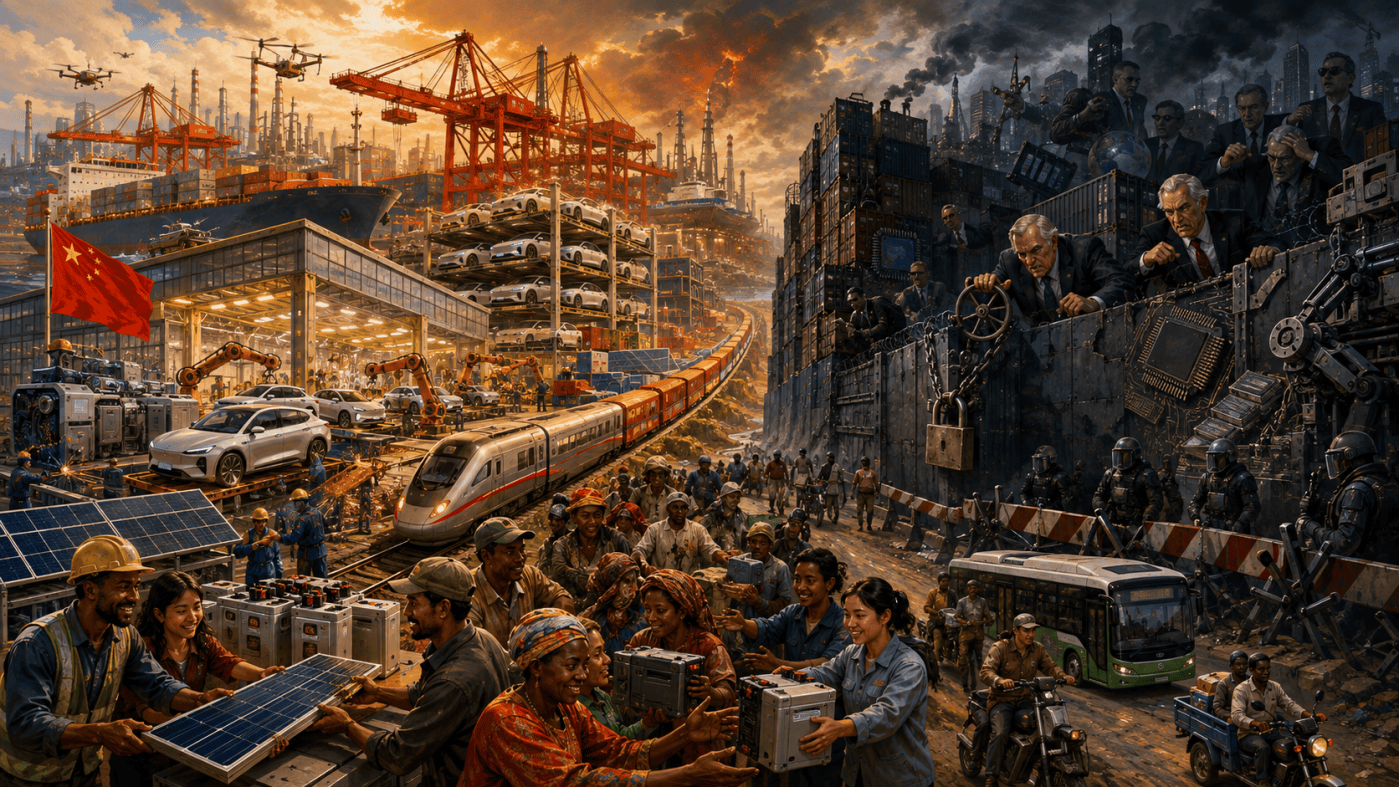
The Economist turns China’s industrial success into an indictment, conceding its efficiency while declaring state-directed competition illegitimate the moment it threatens Western command. Beneath the accusation lies a more uneven reality: genuine sectoral imbalances and weak domestic demand alongside productive machinery, renewable technologies and industrial capacity increasingly reaching the Global South. The struggle is not over whether governments shape production, but over which nations are permitted to possess productive abundance and which must remain dependent markets, cheap-labor platforms and technological clients. The answer is neither free-trade surrender nor denial of China’s contradictions, but political education, working-class organization and international cooperation against the tariffs, embargoes and military pressure used to preserve monopoly scarcity.
Prince Kapone | Weaponized Information | August 5, 2026
When Competition Becomes a Crime
On August 3, 2026, The Economist published “China won’t apologise for overcapacity”, an unsigned editorial examination of China’s refusal to accept the latest accusation leveled against its industrial development. The magazine presents China’s Ministry of Commerce paper as a mixture of legitimate argument and official dishonesty: rigorous when it questions the slippery definition of excess capacity, but disingenuous whenever it challenges the political assumptions packed inside the charge. China may be efficient, innovative and fiercely competitive, the article concedes. Its real offense is that the state helped make it so.
The framing begins before the economic argument has even entered the room. China’s use of the phrase “so-called overcapacity” is placed beside its rejection of Western accusations concerning human rights and freedom of speech. The association performs its work quietly. Before readers encounter China’s evidence, they are encouraged to hear the familiar voice of an evasive authoritarian government dismissing another self-evident truth. The well is poisoned first; the statistics may drink later.
The article then makes a series of intelligent concessions. There is no universally accepted definition of overcapacity. Idle factories exist in Europe and the United States. Export strength alone does not prove that production is excessive. Chinese manufacturers have cut costs, improved quality and lowered the global price of renewable technology. These admissions lend the piece an air of hard-headed fairness. But each concession is enclosed within a larger accusation: Chinese industrial success cannot be treated as ordinary competition because it emerged through public investment, procurement rules, technological planning and the pursuit of national self-reliance.
Here the language splits neatly along geopolitical lines. Chinese subsidies are distortions; American subsidies are industrial renewal. Chinese procurement is coercion; European local-content policy is resilience. Chinese technological independence is an attempt to dominate the world; Western export controls are an understandable effort to secure supply chains. The same state tools change moral character as they cross a border. In Beijing they belong to a menacing “Leninist developmental state.” In Washington and Brussels they arrive freshly baptized as strategy.
The article’s source hierarchy reinforces the verdict. China’s commerce ministry is described as insincere, denialist and triumphalist, while Western governments, economists and the Rhodium Group appear as sober judges standing above the dispute. The issue is therefore settled before the evidence is reconstructed: China’s industrial policy is the problem, and Western restrictions are the regrettable cure.
This is the ideological labor performed by the overcapacity narrative. It translates tariffs, technology controls, discriminatory procurement and industrial containment into defenses of fair competition. China is permitted to manufacture for the world so long as it remains cheap, subordinate and technologically dependent. Once it begins setting the pace, competition itself becomes the crime.
The Industrial Record Beneath the Accusation
China’s Ministry of Commerce did not answer the overcapacity charge with a slogan alone. Its full position paper begins from a basic empirical problem: there is no internationally accepted definition or uniform statistical threshold for determining industrial overcapacity. The paper separately examines productive capacity, subsidies, trade balances, market competition and domestic demand rather than treating them as interchangeable evidence of the same offense. High output does not automatically establish surplus production, exports do not by themselves prove that domestic demand has collapsed, and state support must be assessed through specific measures and effects rather than invoked as a magic phrase capable of settling every dispute.
China’s own statistics show a divided industrial landscape rather than one vast warehouse of unwanted goods. In the fourth quarter of 2025, manufacturing capacity utilization stood at 75.2%. Automobile manufacturing operated at 76%, electrical machinery at 75%, and computers and communications equipment at 79.7%. The sharpest weakness appeared elsewhere: non-metallic mineral products operated at only 61.1%. There are sectors carrying unused plant and others operating at much higher levels. The figures show substantial variation among industrial sectors.
Electric vehicles provide a genuine case of production outrunning immediate home-market absorption. China produced roughly 16 million electric cars in 2025, around 20% more than domestic demand, and exported more than 2.5 million. Shipbuilding presents a different picture: Chinese yards supplied 56.1% of global shipbuilding output in 2025, received 69% of new orders and held 66.8% of the worldwide order book. One sector shows production exceeding immediate domestic absorption; another shows worldwide demand flowing toward an industrial system with unmatched scale and delivery capacity.
Beijing does not deny that the domestic economy contains a demand problem. China’s 2026 economic program explicitly identifies an “imbalance between strong supply and weak demand”. The announced response includes an income-growth plan, higher earnings for low-income groups, improved remuneration and social-security systems, a 100-billion-yuan fiscal-financial coordination fund and 250 billion yuan in consumer trade-in support. These measures are intended to increase purchasing power and enlarge domestic consumption rather than reduce the problem to factory closures or externally imposed production cuts.
Chinese exports also cannot be reduced to finished products displacing foreign industry. Between 2012 and 2024, China exported more than $30 billion in textile machinery to developing countries, alongside sewing machines, industrial machine tools and other productive equipment. Vietnam, Pakistan and Bangladesh expanded textile manufacturing and exports during the same period. A significant portion of Chinese trade therefore supplies machinery through which other countries enlarge their own industrial base.
The legal terrain is narrower than the political rhetoric. The WTO Agreement on Subsidies and Countervailing Measures prohibits defined export and local-content subsidies. Other subsidies become actionable only when they are specific and produce demonstrable adverse effects, while countervailing duties require findings of subsidization, injury and causal connection. State support, unused capacity, high output and a trade surplus are not interchangeable legal violations. The European Union’s duties on Chinese battery electric vehicles remain under unresolved WTO dispute proceedings, with no final adjudication yet determining whether the investigation and measures complied with those rules.
Nor are tariffs, subsidies, procurement and industrial coordination peculiar to China. The United States trade representative now describes tariffs, subsidies and state involvement as foundations of American industrial development, while acknowledging that later policymakers abandoned domestic production under the turn toward free trade. The European Commission’s proposed Industrial Accelerator Act establishes European-origin or low-carbon requirements in public procurement and public-support programs. Washington has meanwhile opened “structural excess capacity” investigations against 16 economies, including China, the European Union, Japan, India, South Korea, Mexico and several Southeast Asian states.
The present conflict rests on a longer history. China entered the twentieth century after the Opium Wars, unequal treaties, foreign concessions and external commercial privileges had reduced much of the country to a semi-colonial condition. Japanese invasion then inflicted further destruction between 1931 and 1945. After the People’s Republic was founded in 1949, the country rebuilt from a weak industrial base under conditions of external blockade. Industrial independence and technological self-reliance emerged from that material history, not from a sudden twenty-first-century desire to offend Western economists.
That history now meets a world in which industrial policy has returned almost everywhere. Subsidies, public finance, procurement rules and sectoral targeting have expanded across the major economies. At the same time, the United States has restricted 24 categories of semiconductor-manufacturing equipment, three types of production software and high-bandwidth memory, added 140 entities to restricted lists and identified China’s technological indigenization as a target of the controls.
Chinese production is also increasingly tied to demand outside the wealthy Western core. By 2024, nearly half of China’s exports of electric vehicles, batteries and solar panels were going to the Global South, where Chinese renewable-energy equipment was often available at substantial discounts compared with American and European products. This trade grew from a global manufacturing structure built over decades, during which labor-, energy- and pollution-intensive production moved toward the Global South while finance, branding, design and intellectual property remained concentrated in the imperial core. China now accounts for roughly 30% of global manufacturing output. That is the industrial terrain beneath the accusation.
The Warehouses Are Full Because the Pockets Are Empty
The Economist calls it overcapacity, as though China’s factories had multiplied like weeds beyond the boundaries of reason. But factories do not become “excessive” because they can produce more steel, ships, vehicles, machinery or solar equipment than yesterday. They become excessive only in relation to a market that cannot absorb what has been produced at a profitable price. The contradiction is therefore not between human need and productive abundance. It is between the immense productive forces accumulated inside China and the narrower field of purchasing power through which those forces must pass. The warehouse is full because the pockets are empty, and bourgeois economics responds by putting the warehouse on trial.
This is the first truth buried beneath the propaganda. China does possess genuine sectoral imbalances. Production has outrun immediate domestic demand in electric vehicles, while parts of the older industrial base operate far below their potential. But this is not an economy uniformly drowning in unwanted goods. Capacity is uneven, demand is uneven and development itself is uneven. Some sectors carry idle machinery; others command the majority of global orders. The label “overcapacity” takes this contradictory terrain, flattens it into a single accusation and then presents the accusation as a scientific measurement.
A materialist analysis asks a different question: excessive for whom? There is no shortage of human need in the world. There is no planetary surplus of affordable transportation, renewable energy, industrial machinery or modern infrastructure. What exists is a shortage of money in the hands of the people who need them and a surplus of property claims in the hands of those who do not. Capitalism forever produces this obscene tableau: full warehouses facing hungry crowds, idle machines facing exhausted workers, abundance guarded like contraband because the people cannot present the proper tribute at the cash register.
China’s own recognition of “strong supply and weak demand” exposes the real pressure point. Its factories can produce more than its domestic market presently absorbs, while the state proposes to expand incomes, remuneration, social protection and consumption. The contradiction lies between productive capacity and the social distribution of purchasing power. There are two possible directions concealed inside this struggle. Production can be cut down to the dimensions of the existing market, or the people’s claim upon the social product can be enlarged. One direction sacrifices the factory to the ledger. The other attempts to make the ledger answer to the factory and the people whose labor keeps it alive.
The imperial powers prefer the first solution—but only for China. They do not demand that their own subsidies, procurement systems and industrial programs be dismantled in the name of market purity. Washington reaches for tariffs and public support with one hand while pointing an accusing finger at Beijing with the other. Brussels writes European production requirements into public policy while lamenting the death of neutral competition. Apparently the invisible hand of the market now carries a customs stamp, a procurement contract and a semiconductor blacklist.
The comedy would be harmless if it were not backed by economic force. The United States restricts the machinery, software and memory technologies required for advanced production, then describes China’s pursuit of technological self-reliance as proof of sinister intent. Europe protects its industrial base, while Chinese protection becomes evidence of congenital dishonesty. The legal language of subsidies, injury and fair competition becomes camouflage for a simpler material struggle: the old industrial powers are attempting to determine which states may climb the ladder of technological development after they themselves have reached the roof.
This struggle did not begin in a conference room in Brussels. China’s drive for industrial independence grew from the hard school of semi-colonial subordination, foreign privilege, invasion, fragmentation and blockade. A country whose ports, commerce and development were once placed beneath foreign command does not encounter dependence as an innocent arrangement between equal traders. Dependence arrives with a gunboat at the harbor, a concession carved from the map and a foreign clerk counting the customs revenue. Self-reliance, in this history, is not a slogan pasted onto economic policy. It is the scar tissue of national survival.
The present industrial conflict also carries the contradictions of the globalization that preceded it. Western capital shifted labor-intensive, energy-intensive and pollution-intensive production toward China and the broader Global South while keeping finance, branding, design and intellectual property close to home. The smoke went south; the patents stayed north. The long shifts belonged to the worker; the fattest columns in the ledger belonged to the shareholder. This was celebrated as efficiency when China occupied the lower floors of the industrial building and passed the profits upstairs.
But production changes those who carry it out. A society that manufactures at enormous scale accumulates skill, infrastructure, coordination and technical command. The workshop does not remain a workshop forever. The hands hired to assemble another man’s machine eventually learn how the machine works, how its parts move across continents and how the whole factory might operate without the absentee owner standing above it. The historical joke now tormenting Western capital is that the very search for cheap production helped create an industrial center capable of acting beyond the subordinate role assigned to it.
The Economist recognizes Chinese efficiency, industrial clusters and intense competition, but treats the state coordination behind them as the disqualifying evidence. Here the class character of the argument becomes plain. Capital has no objection to planning. Every multinational plans investment, supply, labor, pricing and production across years and continents. Western states plan tariffs, procurement, subsidies and technological denial. What they cannot tolerate is planning organized beyond their command and directed toward the industrial ascent of a country they had expected to remain a permanent supplier of cheap labor.
Nor does Chinese productive power terminate at China’s borders. Machinery exported to developing countries enlarges their own manufacturing capabilities. Electric vehicles, batteries and solar equipment reach the Global South at prices below those demanded by Western producers. For countries long trapped between commodity dependence and technological exclusion, the question is concrete: must industrialization and ecological transition remain luxury goods sold through the tollbooths of Western finance and intellectual property, or can productive capacity circulate on terms that widen access?
That possibility does not abolish contradiction. Cheap imports can pressure local producers. Great industrial scale can create new dependencies. Production governed without sufficient popular consumption can reproduce imbalance. Nothing in the material world becomes emancipatory merely because it carries a Chinese shipping label. But neither can these contradictions be understood through the injured pride of corporations that once treated the Global South as a quarry, a plantation and a discount labor hall.
The real content of “overcapacity” is therefore an imperial theory of permitted development. The wealthy core may possess strategic reserves, subsidized factories, protected markets and technological monopolies. The rest of the world may possess only enough industry to service those arrangements. When a former semi-colonial nation acquires the capacity to build ships, machinery, vehicles and energy systems at world scale, abundance itself is reclassified as aggression. The colonial overseer has traded his riding crop for an economic white paper, but his complaint remains the same: the workers have produced more than they were authorized to own.
Historical materialism strips away the etiquette. The dispute is not between a pure market and a distorting state. It is a conflict between competing systems of organized production inside a world still structured by imperial hierarchy. It is a conflict between productive forces that have spread beyond the old centers of command and relations of power determined to drag them back. It is a conflict between the social possibilities contained in abundance and the monopoly order that requires scarcity to remain profitable.
The real story is not that China produces too much. It is that the world economy distributes too little, too unequally and under the command of those who would rather idle a factory than surrender a monopoly. China’s contradiction must be resolved by bringing social demand into line with productive capacity, not by allowing foreign bailiffs to close the workshop. Humanity does not suffer from too many useful things. It suffers from a system in which the people who make them are forever told they cannot afford them—and in which nations that learn to make them without imperial permission are accused of breaking the rules.
Build Capacity, Break the Chokehold
Solidarity with China in this struggle does not require pretending that every factory is perfectly calibrated or that every sectoral imbalance is imaginary. It means defending China’s right to resolve those contradictions through higher household purchasing power, stronger social provision, planned adjustment and public regulation—not through tariffs, embargoes and production limits dictated from Washington or Brussels. The issue is not whether productive capacity should be governed. It is whether it will be governed by the needs of working people or disciplined by the states defending monopoly scarcity.
The first task is political education. The Qiao Collective maintains anti-New Cold War reading lists, translations, lectures and educational resources that can help organizers confront the mythology surrounding Chinese development without borrowing their facts from the same corporate press manufacturing the threat. Its work is produced through volunteer labor, and its public support statement says it has no sponsors or outside institutional funding and relies on voluntary individual contributions. These materials should be studied, adapted and circulated through union halls, community spaces, classrooms and independent media—not consumed as another stream of internet commentary.
The economic offensive must also be connected to the military encirclement surrounding it. The ANSWER Coalition has organized education and resistance against the expanding U.S. military buildup in the Asia-Pacific, while its funding statement rejects corporate and government money and identifies activists and individual supporters as the coalition’s financial base. Tariffs, semiconductor controls, military alliances and war exercises belong to the same architecture of pressure. They should not be separated into isolated policy debates.
Organizers can build local teach-ins that place Chinese, American and European industrial-policy documents side by side, exposing how the same subsidies and procurement tools are renamed according to who uses them. Labor educators and independent journalists should construct public trackers covering WTO disputes, Section 301 measures, semiconductor restrictions, tariffs and local-content rules, translating technical proceedings into language workers can use. Unions should reject demands that workers choose between neoliberal deindustrialization and anti-China economic war, advancing instead publicly owned, unionized and ecologically planned production linked to technological cooperation with China and the Global South.
The political warning is simple. Do not answer imperial propaganda with free-trade sermons, and do not defend China by denying every contradiction inside its development. Both roads abandon the working class. The struggle is over who owns productive power, who receives its gains and whether abundance will be organized through cooperation or fenced behind sanctions, patents and military force. The empire calls Chinese capacity excessive because it has always considered the productive independence of the oppressed to be more than enough.
 Weaponized Information
Leave a comment