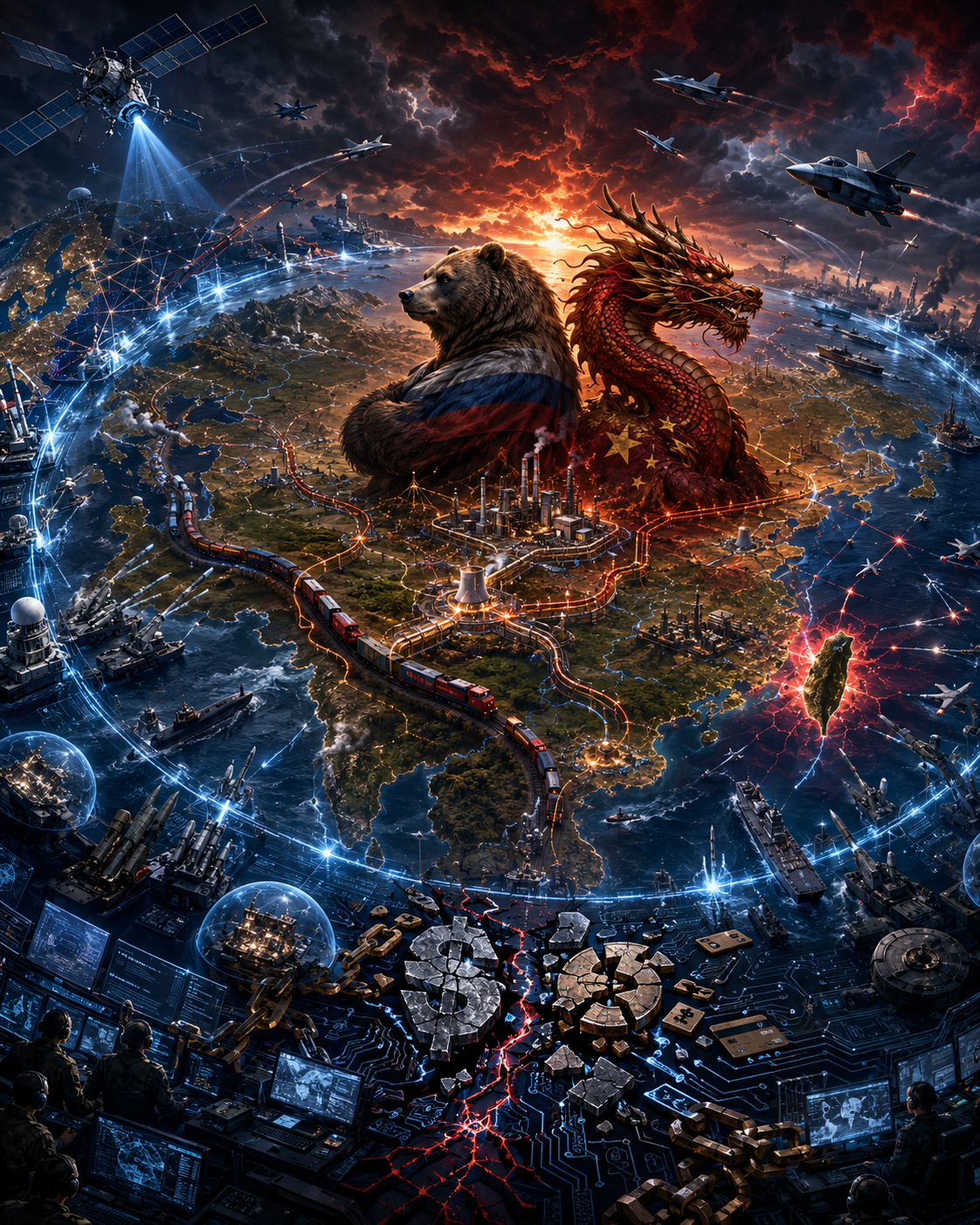
DER SPIEGEL packages public military cooperation, leaked proposals and Western intelligence claims inside an “axis of evil” morality tale whose verdict arrives before its evidence. Beneath that propaganda stands a material Russia–China partnership forged through treaty relations, complementary trade, sanctions pressure, NATO expansion and the unfinished history of Western intervention around Taiwan. The real danger is not an inexplicable conspiracy against an innocent West, but an imperial system whose pursuit of permanent military superiority produces the very counter-alliance it then cites to justify further escalation. Breaking the march toward a two-front great-power war requires independent working-class organization against sanctions, rearmament, space weaponization and the conversion of public wealth into instruments of planetary destruction.
Prince Kapone | Weaponized Information
August 5, 2026
The Headline Has Already Declared the Verdict
“The New Axis of Evil: DER SPIEGEL Investigation Reveals Deep Military Cooperation between Russia and China” arrives with its judgment nailed above the courthouse door. Published on July 9, 2026, and assembled by a ten-person reporting team, the investigation claims to expose confidential Russian-Chinese cooperation involving drone warfare, battlefield communications, anti-satellite measures and the development of advanced missile defenses. The article offers leaked presentations, meeting records, participant lists, travel patterns and claims attributed to European intelligence services. Some of this points toward a substantial and expanding military relationship. But before the reader can examine what has actually been established, the headline has already converted cooperation into conspiracy and strategic planning into metaphysical wickedness.
“Axis of evil” is not analysis. It is a political branding iron, reheated from the arsenal of the Bush administration and pressed against whichever states Washington and its allies have selected for punishment. The phrase performs its work before the first document is introduced. Russia and China are not merely states pursuing military interests; they are cast as a single malignant organism. Their motives require no history because evil, by definition, needs no explanation. Once this vocabulary is accepted, sanctions become hygiene, military expansion becomes prevention and every Western weapons contract can be sold as another reluctant investment in civilization.
The article then compresses several different levels of evidence into one seamless threat narrative. Publicly acknowledged military exercises sit beside confidential discussions. Proposed research sits beside systems said to be operational. Travel records sit beside anonymous intelligence claims. Plans to investigate a capability are narrated in the same breath as proof that the capability already exists. Even where the investigation admits that the later development of a reported missile-defense project cannot be reconstructed, the uncertainty disappears beneath the cumulative force of the story. Suspicion becomes intention; intention becomes capacity; capacity becomes an approaching attack.
The hierarchy of voices completes the operation. German officials, Western military experts and unnamed intelligence services are positioned as interpreters of reality. Their conclusions do not merely accompany the documents; they tell the reader how the documents are supposed to feel. China’s denial is held until late in the article, after the prosecution has delivered most of its case. Russia’s failure to respond is left hanging in the air as though silence itself were another leaked file. This is how propaganda can preserve the appearance of professional reporting: opposing statements are technically included, but the structure has already decided which voices possess knowledge and which exist only to be disbelieved.
What remains outside the frame is just as important as what appears within it. The investigation begins with Russian and Chinese responses while withholding the chain of actions to which they claim to be responding. Western military alliances, sanctions, missile systems, forward deployments and the incorporation of private communications infrastructure into modern warfare hover beyond the article’s borders. The result is a world in which the West simply exists, armed to the teeth but innocent of motion, while its adversaries mysteriously awaken each morning plotting how to “break” its superiority. The purpose is not to deny that Russia and China cooperate. The purpose is to prevent the reader from asking what kind of world made that cooperation increasingly rational—and whose power depends upon ensuring that question is never asked.
The Treaty, the Trade and the Guns Around Them
The cooperation between Russia and China is neither imaginary nor reducible to the secret files assembled by DER SPIEGEL. Their armed forces have conducted recurring exercises for more than a decade, including the Joint Sea-2026 naval exercise launched near Qingdao on July 6. When that drill concluded, China’s Defense Ministry identified it as the twelfth exercise in a series beginning in 2012. That public record establishes sustained operational coordination. It does not, by itself, establish that every system discussed in a confidential presentation was subsequently built, deployed or placed under a joint command.
The legal foundation of the relationship is equally public. Vladimir Putin and Xi Jinping agreed in May 2026 to extend the Treaty of Good-Neighborliness and Friendly Cooperation, first signed in 2001. The treaty authorizes military and military-technology cooperation, requires consultations when either state believes that its security is threatened and prohibits either party from joining an alliance or bloc that compromises the sovereignty, security or territorial integrity of the other. It also states that their military cooperation is not directed against third countries. What it does not contain is an automatic obligation to enter a war on the other’s behalf, a permanent combined command or a supranational military authority.
That institutional distinction matters because NATO is not merely a collection of governments that sometimes exercise together. Its standing military structure includes a Military Committee, International Military Staff and two strategic commands responsible for planning operations, transforming forces and integrating national units placed at the alliance’s disposal. Its members are bound by collective defense under Article 5. Russia and China have built a deep strategic partnership with regular military contact, but they have not reproduced NATO’s treaty obligation, permanent command machinery or integrated force structure.
The security environment surrounding that partnership did not descend from the heavens in February 2022. During the negotiations over German reunification, Western leaders gave Soviet officials a series of political assurances concerning the eastward reach of NATO. Declassified American, Soviet, German, British and French records preserve James Baker’s “not one inch eastward” formulation and similar assurances from European leaders. These commitments were never converted into a treaty banning future enlargement, but they formed part of the political settlement through which Moscow accepted German unification inside NATO. The alliance later expanded across Central and Eastern Europe and into former Soviet territory.
China’s confrontation around Taiwan carries an even older historical wound. Taiwan’s present status emerged from the unresolved Chinese Civil War, not from a dispute newly manufactured by Beijing. In late 1949 and early 1950, U.S. officials expected Communist forces to cross the strait and defeat Chiang Kai-shek’s government. After the Korean War began, Washington sent the Seventh Fleet into the Taiwan Strait, forcing the civil war into an externally maintained stalemate and tying the island’s future to American military power. The United States subsequently signed a defense treaty with Chiang’s government and considered the use of nuclear weapons during the first Taiwan Strait crisis.
That intervention has grown into a wider regional military architecture. The Pentagon identifies Japan, South Korea, Australia, the Philippines and Thailand as U.S. treaty allies, supported by roughly 120 annual exercises with regional allies and partners, expanded force rotations and the AUKUS military partnership. NATO now strengthens its own cooperation with Australia, Japan, South Korea and New Zealand through defense-minister meetings, military consultations, cyber cooperation, artificial-intelligence projects, interoperability programs and shared assessments of Russia and China. Europe and Asia were therefore being joined inside the Western alliance system before their alleged merger was discovered in a Russian-Chinese conference room.
The economic relationship has developed along equally material lines. Bilateral trade reached $227.9 billion in 2025, keeping China as Russia’s largest trading partner for a sixteenth consecutive year. Russia supplies energy, minerals and agricultural products; China supplies automobiles, machinery, household appliances and a growing volume of electrical and high-technology goods. Chinese components are also used in Russian industrial products, while joint research and production are expanding beyond the simple exchange of raw materials for finished goods. The relationship is unequal in scale, but its complementarity is concrete: Russian resources and strategic depth meet Chinese manufacturing, electronics, capital goods and markets.
Sanctions have accelerated the construction of financial channels capable of carrying that trade. The U.S. Treasury has targeted Russia-China clearing arrangements for payments involving sensitive goods and warned that foreign financial institutions facilitating transactions for designated Russian entities can face mandatory secondary sanctions. The coercion therefore reaches beyond Russia itself. It attempts to govern which companies, banks and sovereign states may trade with it, and under what currency and payment infrastructure.
The larger military setting was made explicit one day before the SPIEGEL investigation appeared. NATO’s Ankara Summit Declaration announced more than $50 billion in new procurements and committed the alliance to nuclear, conventional and missile-defense systems supported by space and cyber assets, deep precision strike, uncrewed weapons, artificial intelligence and an interoperable transatlantic warfighting cloud. The accompanying Defense Industry Forum joined government officials, military planners, weapons manufacturers, investors and technology firms around expanded production, joint procurement and the removal of barriers to intra-alliance arms trade. Russia and China are deepening their cooperation inside a world already organized by military blocs, forward alliances, sanctions enforcement and the industrial preparation for larger wars.
The Empire Discovers Resistance and Calls It Evil
The cooperation between Russia and China is not a hallucination manufactured by Western intelligence, nor is it the mystical conspiracy promised by the phrase “axis of evil.” It is a material relationship developing between two states whose economic strengths, military capacities and strategic vulnerabilities increasingly fit together under pressure. Russia brings energy, minerals, territory, military experience and an established defense-industrial base. China brings manufacturing depth, machinery, electronics, markets and technological capacity. Their relationship is uneven, contradictory and governed by state interests, but it is not irrational. It is what states do when the dominant power attempts to isolate one, contain the other and discipline every institution through which they might cooperate.
The propaganda begins by removing this pressure from the picture. NATO expansion becomes a neutral feature of the landscape. U.S. treaty alliances surrounding China become ordinary geography. Sanctions become an administrative response rather than an attempt to determine who may trade, which banks may process payments and which currencies may circulate outside Western supervision. The military integration of Europe and the Indo-Pacific becomes defensive coordination. Only the response is treated as motion. The empire moves troops, extends alliances, builds commands, links continents, expands missile defenses and recruits private technology into its war machinery; then, when the states placed beneath that pressure begin coordinating, the empire recoils in theatrical astonishment.
This reversal is the ideological center of the story. Russia and China are not accused merely of possessing weapons or conducting exercises. They are accused of attempting to break Western superiority, as though permanent Western superiority were a natural entitlement rather than a political arrangement maintained through force. The crime is not simply cooperation. The crime is the development of enough sovereign capacity to place limits on imperial freedom of action.
That is why the distinction between the Russia-China partnership and NATO matters. The distinction does not make the partnership harmless, revolutionary or free of danger. It reveals what the “axis” metaphor is designed to conceal. NATO is a formal war alliance with collective-defense obligations, standing command institutions and military forces integrated across national boundaries. Russia and China maintain consultations, exercises, trade and military-technical cooperation without an automatic obligation to fight one another’s wars or a permanent combined command. To collapse these different structures into a single category is not analytical carelessness. It is policy preparation. Once every form of coordination outside Western control is declared equivalent to NATO, NATO’s own expansion can be presented as merely keeping pace with an enemy system it helped call into existence.
The same inversion governs the treatment of Taiwan. The conflict is presented as a future act of Chinese aggression toward an island floating outside history. The unresolved civil war, the intervention of the Seventh Fleet and the long conversion of the strait into a frontier of American power disappear. What remains is a familiar imperial picture: the United States may insert itself into another nation’s unfinished history for generations, but the nation compelled to live with the consequences becomes the aggressor for refusing to accept the arrangement as permanent.
The anti-Starlink discussion exposes another layer of the emerging order. Communications infrastructure owned by private capital has been absorbed into reconnaissance, command, drone operations and the organization of the battlefield. The corporation enters war under the innocent costume of innovation. Its satellites become indispensable military infrastructure, yet the system continues to be narrated as though it were merely a commercial service passing overhead. When adversaries explore how to jam it, penetrate it or construct alternatives, their response is isolated from the original militarization of the platform. Western monopoly technology is permitted to become a weapon without being named as one; resistance to that weapon is then offered as proof of barbarism.
This is technofascism at the international level: the fusion of state coercion, military command, private communications systems, artificial intelligence, financial surveillance and industrial planning into one apparatus of power. The corporation no longer sells tools to the state from the outside. It becomes part of the state’s strategic nervous system. Investors, arms manufacturers, software firms, military planners and governments are assembled into the same war economy, while the public is told that this machinery is merely defending peace from the sinister coordination of others.
The sanctions architecture performs a parallel function in economic life. Washington does not limit itself to refusing trade with Russia. It threatens foreign banks and companies for facilitating transactions beyond the boundaries of U.S. permission. The dollar system, payment networks and access to Western markets become instruments for governing relations between third countries. Russia-China trade in energy, machinery, vehicles, electronics and agricultural goods therefore carries significance beyond its commercial value. Every transaction settled outside the channels vulnerable to Western seizure or exclusion weakens the empire’s ability to turn financial centrality into political command.
This does not mean that multipolarity is socialism, nor that every rival of the United States represents the interests of the global working class. Russia and China remain states with their own class structures, national priorities and internal contradictions. Their partnership does not abolish exploitation, and military power does not become emancipatory merely because it is pointed away from Washington. But the weakening of a single imperial center’s power to sanction, surround, invade and economically suffocate the rest of humanity creates political space that monopoly command would otherwise close. The struggle for multipolarity is therefore not the completed liberation of the oppressed; it is a battlefield on which liberation becomes more possible.
The real danger revealed by the article is not that two uniquely wicked nations have discovered military cooperation. It is that the imperial order is reorganizing the world into interlocking theaters of confrontation while presenting every countermove as evidence that further escalation was necessary all along. Europe and Asia are being fused through alliances, sanctions, arms production, cyber systems, space infrastructure and preparations for deep-strike warfare. Russia and China are responding by joining their economic and security capacities more closely. Each escalation becomes the justification for the next, and the workers expected to finance, manufacture and die in these wars are offered a children’s morality tale about good nations and evil axes.
The phrase “axis of evil” is thus less a description of Russia and China than a confession of imperial anxiety. A power accustomed to writing the rules has encountered states capable of refusing some of them. A system accustomed to surrounding others has discovered that the surrounded may coordinate. An empire accustomed to calling its domination order now confronts resistance to that domination—and, unable to admit the history that produced it, reaches once again for the vocabulary of evil.
Break the War Machine Where We Stand
The answer to an approaching confrontation between nuclear powers is not to cheer for one military camp from the safety of a screen. Nor is it to hide behind the liberal prayer that wiser rulers will eventually calm themselves. The people who manufacture the weapons, move the cargo, maintain the infrastructure, pay the taxes and surrender their children to these wars possess the power that polite appeals lack. Our first responsibility is therefore to confront the war machinery rooted in our own workplaces, governments and ruling class.
The United Electrical, Radio and Machine Workers of America has adopted a pro-worker foreign-policy program demanding de-escalation with China, a negotiated conclusion to the war in Ukraine, an end to weapons in space and the redirection of military spending toward housing, transportation, health care, education and renewable infrastructure. It calls upon workers to build political education, mass action and strike power against militarism—not merely vote every few years for whichever butcher promises to bomb more responsibly. This line carries weight because UE describes itself as funded by membership dues, governed through open financial records and accountable to its rank and file, not to the same corporate class feasting upon the war budget.
Union locals should introduce resolutions against escalation with China and Russia, hold member-to-member workshops on sanctions and military spending, and demand guaranteed wages, retraining and education for every worker transferred out of weapons production. No worker should be blackmailed into defending permanent war because the landlord still wants rent. A just conversion program must make the arms contractor—not the machinist, electrician, driver or warehouse worker—pay the cost of demilitarization.
The Veterans For Peace China Working Group offers another front. It develops speakers, articles, position papers, webinars and public forums aimed at exposing the causes and costs of war, restraining U.S. intervention and opposing the arms race. Its member-approved dues and convention structure, together with its published financial reports and tax filings, provides a transparent basis for organized collaboration.
Veterans, workers, students and community organizers can jointly hold teach-ins placing the Russia-China treaty, NATO’s military expansion, the unresolved history of Taiwan and the sanctions regime before the public. They can organize delegations to elected officials, confront weapons manufacturers at their offices and shareholder meetings, oppose deployments and arms transfers that sharpen the Taiwan confrontation, and challenge secondary sanctions that attempt to dictate relations between sovereign countries.
But the movement must remain independent. Anti-imperialism cannot become worship of powerful states, just as internationalism cannot be reduced to foundation-funded peace branding and symbolic protest. Our task is to build working-class power capable of interrupting production, transportation, financing and political consent for war. The rulers have already connected the battlefields. The people must now connect the resistance.
 Weaponized Information
Leave a comment