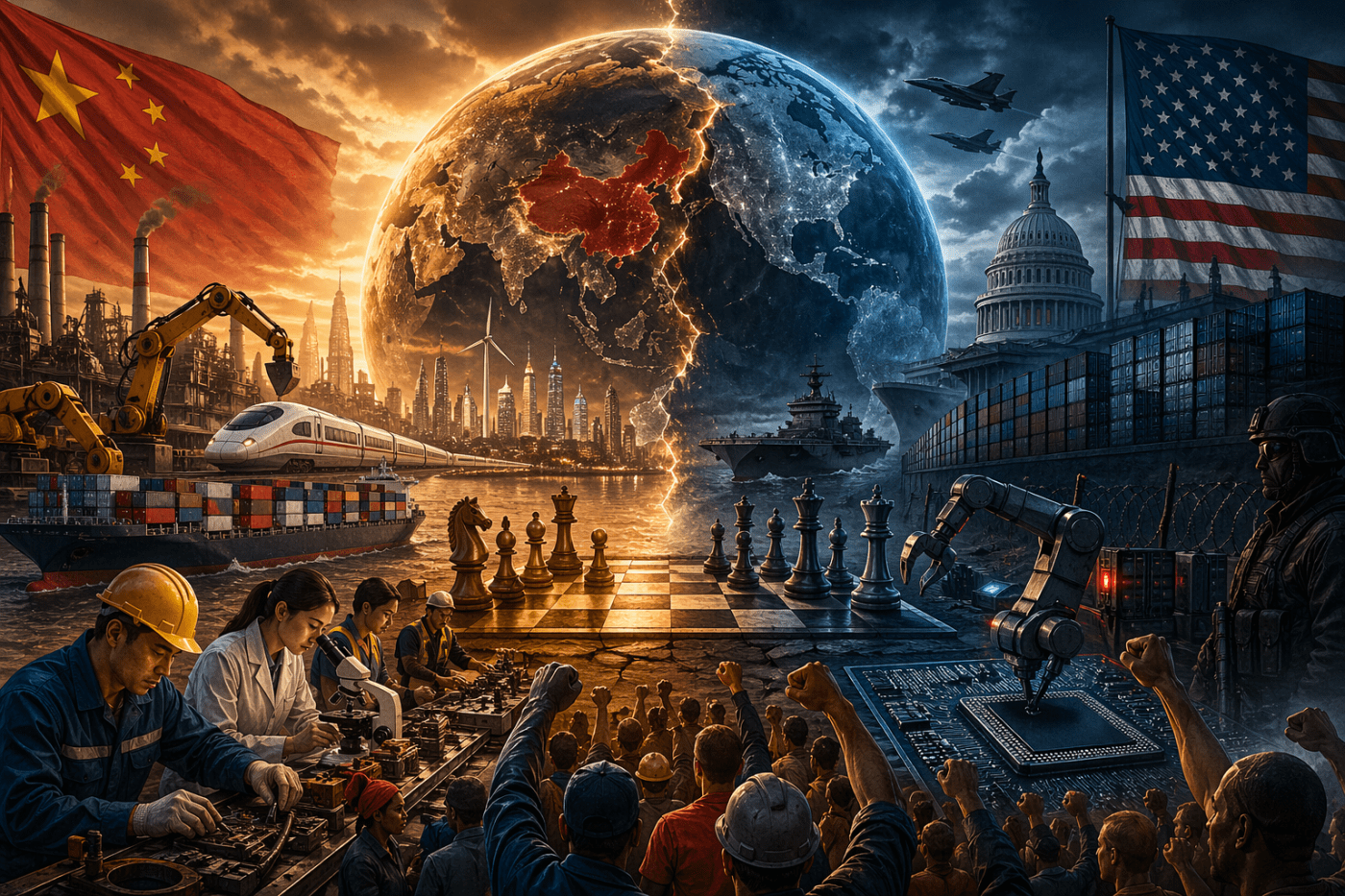
An emerging “consensus” around industrial policy masks a deeper ideological project disciplining development within the boundaries of global capital. The material reality reveals a world defined by subsidy wars, coercion, and uneven development, where state intervention is already reshaping the global economy. China stands at the center of this contradiction as a socialist-led state navigating global capitalism while disrupting imperial hierarchy. The struggle now moves from policy debate to the ground, where workers must contest who controls development and for whose benefit.
By Prince Kapone | Weaponized Information | April 20, 2026
The Respectable Return of the State
“Consensus shifting on China-style industrial policy”, published by Asia Times on April 20, 2026 and written by Noah Smith, arrives clothed in the sober language of economic maturity. Its surface argument is plain enough: the old neoliberal taboo against industrial policy is fading; the IMF and the World Bank have softened; developing countries may be better off luring foreign capital than trying to build their own national champions; and rich countries, meanwhile, are already practicing industrial policy in the sacred name of AI. Smith wants the reader to feel that a grown-up conversation is finally taking place after years of ideological foolishness, as if the priesthood of orthodox economics has at last discovered the wheel and would now like applause for admitting it rolls. But the real function of the article is not merely to say that industrial policy exists. It is to sort the acceptable from the dangerous forms of state intervention, to bless certain uses of power while warning against others, and to do so with the smiling calm of a man explaining to the poor why some forms of planning are prudent and others are uncivilized.
The platform matters here. On its own, Asia Times describes itself as an English-language digital publication founded in 1995 as an antidote to mainstream Western media, insists upon its independence and objectivity, and openly locates part of its value in delivering geopolitical and geo-economic analysis useful for investors, managers, and “savvy readers.” It is also explicit that it is owned by Asia Times Holdings Limited, a Hong Kong company. That does not make the publication a mere corporate puppet, but it does place it firmly inside the transnational policy-and-market information ecosystem where ideas are valued not simply because they are true, but because they help elites navigate risk, opportunity, and strategic repositioning. Smith’s own positioning fits this environment nicely. On his Noahpinion page, he presents himself as a former economics PhD student, former assistant finance professor, former Bloomberg Opinion columnist, and now full-time blogger who approaches the world “from an econ angle.” He identifies as a “pretty standard center-left liberal,” a self-described techno-optimist, and someone who wants the United States and its allies to resist “illiberal powers abroad.” So the class voice here is not that of a worker, planner, or militant intellectual of the common people. It is the voice of a liberal policy interpreter trying to update orthodoxy without surrendering its command post.
That is why the propaganda mechanics of the piece are so important. First, it relies heavily on appeal to authority: IMF papers, World Bank reports, and canonized development economists are marshaled like polite witnesses for the prosecution, giving the impression that history itself has now certified the author’s judgment. Second, it performs policy laundering through narrative framing: industrial policy is presented not as a question of class power, national sovereignty, or geopolitical struggle, but as a neutral menu of techniques awaiting competent administration. Third, the article uses card stacking by arranging the comparison so that FDI-led development appears practical, replicable, and sane, while China’s state-led path appears haunted by excess, distortion, and looming financial ugliness. Fourth, it practices omission with real discipline, refusing to foreground the coercive environment of export controls, subsidy wars, technology blockades, and strategic containment that shapes the entire policy terrain. And fifth, it executes a clean little bait and switch: China is acknowledged as proof that industrial policy can produce formidable results, only to be repackaged as a warning about what happens when state direction becomes too ambitious, too sovereign, too large to be comfortably supervised by the liberal mind. In this way the article does not reject industrial policy. It domesticates it. It says yes to the return of the state, but only a state that knows its place.
What the article presents as sober analysis begins to unravel the moment we step outside its carefully managed frame. The language of consensus, prudence, and policy refinement cannot hold once we ask a more basic question: what is actually happening in the world that makes such a “shift” necessary? To answer that, we have to leave the realm of opinion and enter the terrain of material reality—institutions, policies, coercive pressures, and the concrete structure of the global economy itself. Only there can we see not what is said about industrial policy, but what is being done in its name, and under what conditions.
The Facts They Admit, The Reality They Conceal
The article concedes just enough to remain credible, but even these admissions point to a deeper transformation than it is willing to acknowledge. The IMF’s 2019 working paper openly recognized the “return” of industrial policy, identifying state intervention, export orientation, and competitive discipline as recurring features of successful development. What was once condemned as distortion is now quietly recognized as necessity. This is not a minor adjustment in doctrine—it is a reversal forced by material reality. The same shift appears elsewhere. The World Bank’s 2026 report formally situates industrial policy within the core development toolkit, no longer treating it as deviation but as complement to infrastructure, education, and macroeconomic management. And this is not theoretical. The Bank’s own data shows low-income countries targeting an average of 13 industries, demonstrating that state-led sectoral planning is already widespread practice across the Global South.
The scale of this shift becomes clearer when placed alongside the behavior of the most powerful states. OECD data shows global industrial subsidies surpassing $108 billion in 2023, revealing not a cautious reintroduction but a full-scale escalation of state intervention. At the center of this escalation stands the United States itself. The 2025 AI Action Plan explicitly links export controls, regulatory restructuring, and domestic industrial buildout, making clear that industrial policy is now embedded within geopolitical competition. What the article frames as emerging consensus is, in fact, an already active restructuring of global capitalism driven by rivalry, insecurity, and strategic necessity.
Yet even this partial picture collapses once we examine what has been systematically excluded. The most fundamental omission is historical. Chinese state history explicitly identifies 1949 as the end of a “semi-colonial, semi-feudal” order defined by unequal treaties and foreign domination. This is not symbolic language—it is the material starting point of China’s development trajectory. Industrial policy in China cannot be understood apart from this rupture with external control. It emerges not as a technocratic choice, but as a response to sovereignty injury. That foundation is absent from the article, yet it is precisely what explains why China treats industry, finance, and technology as matters of national survival rather than optional policy instruments.
The scale of China’s development is also stripped of context. China’s industrial output reached 40.5 trillion yuan in 2024, maintaining its position as the world’s largest manufacturing economy for fifteen consecutive years. This is not marginal success—it is structural transformation on a civilizational scale. Beneath that output lies institutional architecture. China maintains control over 96 central state-owned enterprise groups, anchoring strategic sectors under public authority. At the financial level, the state continues to intervene directly. China issued 500 billion yuan in special treasury bonds to recapitalize major state banks, with 165 billion yuan already deployed in early 2025. These are not isolated measures—they demonstrate a system in which finance is subordinated to long-term development strategy rather than left to private accumulation alone.
Equally absent is the coercive environment in which this system operates. The United States has tightened export controls, targeting China’s semiconductor and advanced manufacturing capacity while simultaneously reinforcing restrictions on AI-related technologies. These are not minor regulatory adjustments—they are instruments of strategic containment. The logic is made explicit at the highest level. The U.S. AI strategy calls for stronger export enforcement and countering Chinese influence in global governance institutions. Industrial policy in this context is inseparable from geopolitical struggle. It is shaped by external pressure as much as internal planning.
The article’s treatment of foreign direct investment is equally detached from material conditions. UNCTAD reports that global FDI fell by 11% in 2024 to $1.5 trillion, while flows to the least developed countries amounted to just $37 billion—roughly 2% of the global total. These flows are highly concentrated and volatile, undermining the notion that FDI offers a stable and universal development pathway. Capital moves according to profitability, not according to the needs of national development. Any strategy built upon it inherits that instability.
China’s current policy direction further exposes the limits of the article’s framework. The country’s 15th Five-Year Plan emphasizes technological self-reliance, breakthroughs in core technologies, and expansion of domestic demand, while its 2026 fiscal program allocates nearly 1.3 trillion yuan to science and technology alongside massive social and consumption-oriented spending. These priorities reveal a dual orientation: strengthening internal capacity while stabilizing domestic demand. This is not simply export-led growth, nor blind market integration. It is coordinated development shaped by both internal needs and external pressures.
Placed within the broader global system, the contradictions sharpen further. The IMF now openly acknowledge industrial policy, while subsidy competition intensifies among major economies. At the same time, China continues to operate within a “socialist market economy” framework in which the state guides overall development, and U.S. policy continues to expand export controls and technological restrictions. The result is not convergence but divergence: different systems pursuing industrial strategy under radically different conditions and with fundamentally different objectives.
The historical dimension completes the picture. China’s development logic remains anchored in the memory of foreign domination and national fragmentation, while present policy continues to reflect that legacy through its emphasis on sovereignty, control, and long-term planning. At the same time, global investment patterns remain uneven and unstable, reinforcing dependency for those who rely on external capital. These dynamics situate industrial policy not as a neutral technical question, but as a central terrain of global restructuring—where states struggle over who will control production, technology, and the direction of development itself.
Laid out in full, these facts no longer resemble a neutral policy debate. They reveal a system in motion—one defined by competition, constraint, and uneven power, where industrial policy is not chosen freely but forged within the pressures of history and geopolitics. The question, then, is no longer what policies are being adopted, but how to understand their meaning. What appears as a technical discussion begins to take shape as a struggle over sovereignty, development, and control within a changing world order. To grasp that meaning, we must move from description to analysis, from facts to the structure that binds them together.
Industrial Policy as a Battlefield, Not a Toolkit
What presents itself in the article as a quiet “consensus shift” is not the maturation of economic thought, but the visible cracking of a system that can no longer sustain its own myths. Industrial policy did not return because economists rediscovered its virtues like archaeologists brushing dust off an ancient artifact. It returned because the material foundations of neoliberalism—cheap labor, unchallenged U.S. dominance, and frictionless global integration—have fractured under the weight of their own contradictions. What is being described as intellectual evolution is in fact systemic crisis forcing adaptation. The language changes only after the structure begins to fail.
But crisis does not produce clarity on its own. It produces struggle over meaning. The institutions that once disciplined entire continents for daring to plan their economies now speak the language of “strategic intervention,” yet they do so with careful restraint. They do not abandon hierarchy—they reorganize it. Industrial policy is no longer banned; it is stratified. In the imperial core, it is recast as technological sovereignty, national security, and innovation policy. In the Global South, it is permitted only in diluted form—channeled into attracting foreign capital, integrating into global value chains, and avoiding any development path that might threaten existing power structures. The same term circulates across the system, but it carries different permissions depending on who speaks it.
This is the terrain on which China must be understood—not as an abstract “model” to imitate or reject, but as a historically produced formation that disrupts the neat categories liberal analysis depends on. China emerges from anti-imperialist rupture, from a century of subordination that shattered its internal coherence and subordinated its development to external powers. The revolution did not simply change a government; it reconstituted the state as an instrument of national survival and development. What followed was not a straight line to socialism in its purest theoretical form, nor a simple restoration of capitalism. It was a process of navigating necessity: building industry, consolidating sovereignty, and engaging a hostile world system without surrendering the commanding heights of the economy.
That process generates contradiction, not purity. China participates in global markets, competes in exports, and operates within structures of uneven exchange. At the same time, it retains a political architecture that allows the state to direct accumulation, control strategic sectors, and pursue long-term planning beyond the immediate logic of private profit. These are not cosmetic differences. They represent a fundamentally different configuration of power within the economy. The contradiction is not a flaw to be dismissed; it is the condition of existence for a socialist-oriented state operating inside a capitalist world system.
The article attempts to neutralize this contradiction by isolating outcomes from their conditions. It points to overcapacity, debt risks, and subsidy distortions as if they exist in a vacuum, detached from the strategic choices that produced China’s industrial scale and technological advancement. It acknowledges success only to reframe it as caution. In doing so, it performs a familiar ideological maneuver: extract the results, discard the structure, and then warn others against reproducing what made those results possible. It is a lesson designed not to be learned.
The deeper question is not whether industrial policy “works” in the abstract, but who controls it and to what end. Industrial policy is not a neutral instrument; it is a condensation of class power and geopolitical position. In the hands of imperial states, it becomes a tool for preserving dominance—locking in technological advantage, controlling supply chains, and enforcing dependency. In the hands of states emerging from colonial or semi-colonial conditions, it becomes a means of survival—an attempt to build the material base necessary for sovereignty. These are not equivalent uses of the same tool. They are opposing expressions of struggle within a single world system.
Multipolarity emerges from this struggle not as a finished alternative, but as an opening. The erosion of unipolar dominance creates space for different development paths, different alignments, and different experiments in statecraft. China’s rise is central to this process, not because it offers a perfect model, but because it disrupts the inevitability of imperial hierarchy. It weakens the monopoly of power that once dictated the terms of development for the rest of the world. But disruption is not liberation. The same processes that open space also generate new tensions, new dependencies, and new forms of uneven development.
What the article ultimately performs is not analysis but instruction. It teaches elites how to navigate this shifting terrain without challenging its underlying structure. It says: yes, the state may return—but only in forms that do not threaten the hierarchy of global capital. It allows industrial policy, but only as long as it does not become a vehicle for genuine sovereignty. It praises development, but only when it remains compatible with existing power relations. In this sense, the “consensus shift” is less a break from the past than a recalibration of control.
The real line of division, then, is not between those who accept or reject industrial policy, but between those who see it as a technical adjustment and those who recognize it as a battlefield. The question is not whether states will intervene—they already do. The question is who commands that intervention, whose interests it serves, and whether it can be used to break the cycle of dependency that has defined the global order for generations. Until that question is faced directly, every discussion of industrial policy will remain what this article ultimately is: a carefully managed conversation about change that refuses to name the struggle driving it.
From Policy Debate to Struggle on the Ground
If industrial policy is not a neutral tool but a terrain of struggle, then the question of what is to be done cannot be answered at the level of ministries and white papers alone. It must be answered in the factories, in the ports, in the logistics corridors, and in the lives of the workers whose labor is reorganized each time a state redraws its development strategy. The same global restructuring that has returned the state to economic management has also intensified the pressures placed on labor—through wage suppression, precarious employment, export discipline, and the constant threat of relocation. Any serious response must therefore begin from below, from the material conditions of the working class within these shifting industrial regimes.
The first task is political clarity. The mythology of “free markets” has collapsed, but it has been replaced with something more deceptive: the illusion that all state intervention serves the same purpose. It does not. Workers and organizers must expose the double standard at the heart of the system—where industrial policy is celebrated in the imperial core as national security and innovation, while in the Global South it is constrained, redirected, or discouraged in favor of dependence on foreign capital. This contradiction must be made visible in workplaces, unions, and community organizations, linking abstract policy debates to concrete realities of exploitation and uneven development.
Second, there must be organized resistance to the coercive structures that shape development itself. Campaigns that challenge sanctions, export controls, and economic warfare are not abstract geopolitical gestures—they are defenses of the material conditions necessary for sovereign development. CODEPINK’s “China Is Not Our Enemy” campaign provides a platform opposing militarization and anti-China escalation, while the Black Alliance for Peace organizes against U.S. militarism and the global war economy. These efforts matter because they confront the external pressures that distort development paths and reinforce global hierarchy.
Third, workers must organize across borders within the very supply chains that industrial policy seeks to restructure. Export-oriented development relies on fragmented labor forces—garment workers in one country, logistics workers in another, tech assemblers in a third—each isolated from the others despite participating in the same system of production. Building solidarity across these nodes transforms industrial policy from a top-down directive into a contested space shaped by collective action. This means strengthening independent unions, coordinating labor struggles internationally, and refusing the race to the bottom that global capital depends on.
Finally, there must be a positive program: the demand for development that serves social needs rather than external accumulation. This includes pushing for state investment in public goods, demanding accountability in how industrial funds are deployed, and insisting that technological advancement translate into improved living conditions rather than intensified exploitation. It also means supporting paths of South–South cooperation and coordination that reduce dependence on imperial centers while maintaining a critical awareness of the contradictions that remain within all state-led development models.
The return of industrial policy has opened a new phase in the global struggle over production and power. But policy alone will not determine its outcome. That outcome will be shaped by the balance of forces—by whether workers remain objects of development or become its subjects. The terrain has shifted. The task now is to organize within it.


Leave a Reply