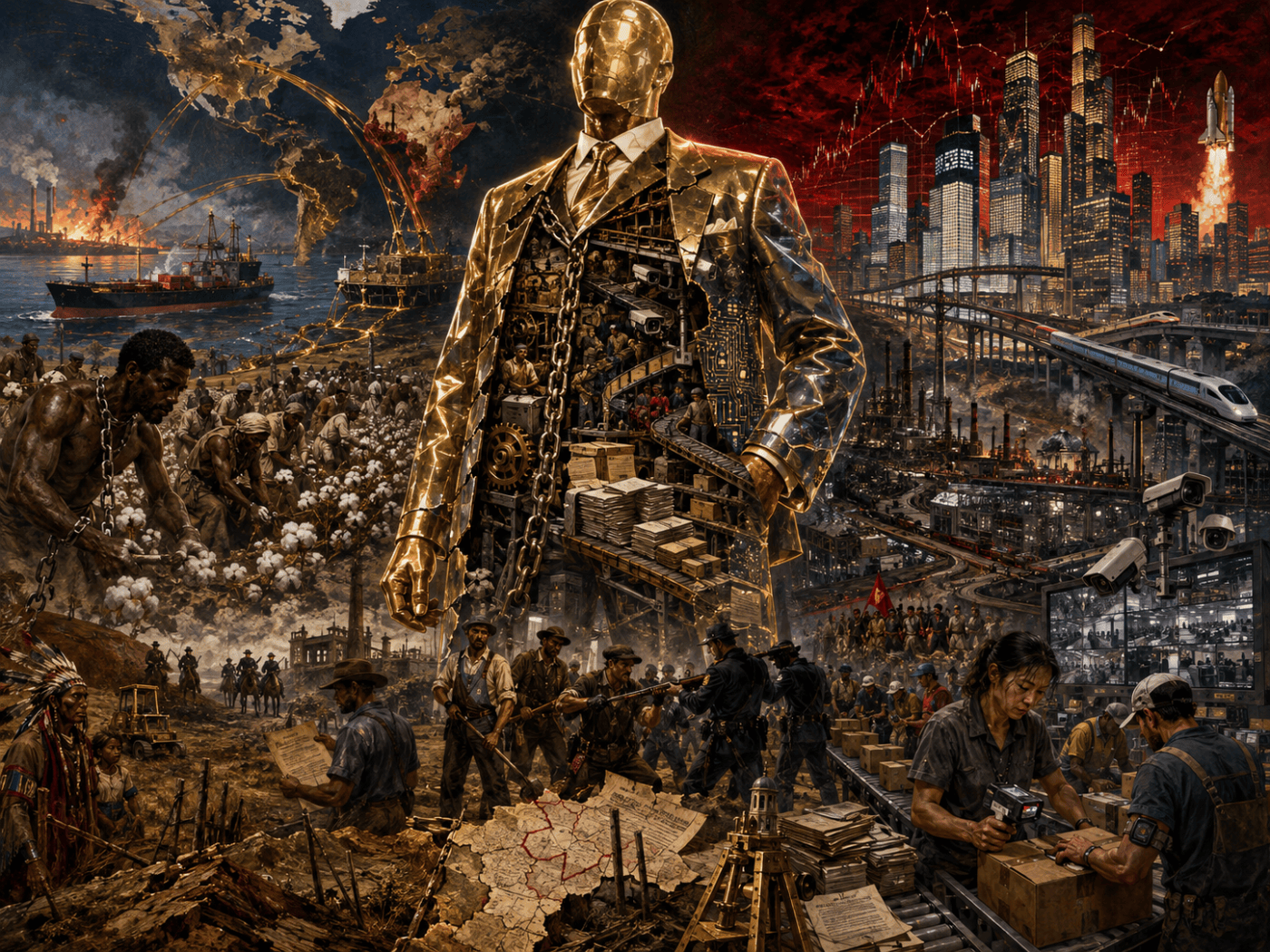
The Wall Street Journal turns the billionaire into a one-man civilization, erasing the workers, public institutions and conquered peoples beneath every celebrated fortune. Beneath its fairy tale of peaceful innovation lies an economy built through enslaved labor, Indigenous land theft, Black dispossession, union-breaking, financial extraction and the unequal appropriation of the Global South. The real divide is not between creators and resentful socialists, but between the many who collectively produce social wealth and the minority whose property claims grant them command over it. The answer is to carry the wealth question onto the shop floor, organize workers against technological and financial domination, and fight for collective control over the abundance humanity already creates.
Prince Kapone | Weaponized Information | August 4, 2026
The Billionaire as a One-Man Civilization
John Steele Gordon’s “A Brief History of Wealth Creation” begins with Rome, where wealth was amassed by conquest, plunder and slavery, and ends in the United States, where wealth supposedly springs from innovation like water from a mountain. The ancient ruler steals; the American capitalist creates. It is a charming little division of historical labor, especially for those whose fortunes depend upon nobody examining the books too closely.
Gordon marches the reader through steam engines, railroads, sewing machines, petroleum, steel, computers, Walmart, Amazon and SpaceX. At each station, history is reduced to the biography of a proprietor. James Watt creates industrial power. Rockefeller creates cheap illumination. Carnegie creates steel. Bezos creates modern retail. Musk creates access to space. Workers appear mainly as beneficiaries who receive cheaper commodities or jobs. Public institutions barely appear at all. The owner stands in for the engineers, machinists, miners, warehouse workers, scientists, transport workers, public researchers and generations of accumulated knowledge without which no industrial empire could turn a single gear.
The column’s central trick is its separation of “wealth creation” from “wealth aggregation.” Gordon confines conquest and slavery to Rome, allowing American capitalism to enter history with clean hands and a patent application. The rising threshold for admission to the Forbes 400 is then presented as proof that society has become richer because billionaires have become spectacularly richer. No distinction is made between productive investment and the rising market value of existing shares, between technological advance and ownership of the corporation that commercializes it, or between useful capital formation and the private concentration of claims over socially produced wealth.
Having built this artificial world, Gordon poisons the well against anyone inclined to question it. Socialists, he tells us, cannot distinguish creation from aggregation. Their criticism of concentrated property is not an argument about labor, ownership or power; it is simply ideology obstructing common sense. The charge performs the same function as the rest of the column: it prevents the decisive question from being asked. Who actually creates the wealth, and by what authority does a tiny ownership class command its use?
The ideological purpose is not merely to praise invention. It is to fuse invention with capitalist ownership until taxing a billionaire appears equivalent to dismantling a factory. Gordon’s history converts social production into private virtue and private property into a public service. The capitalist does not merely own the machine. In this mythology, he becomes the machine, the worker, the scientist and civilization itself.
The Ledger Beneath the Fortune
The American property system did not emerge on untouched land populated by independent producers freely exchanging the fruits of their labor. Its earliest markets were built around two legally manufactured commodities: expropriated Indigenous territory and enslaved human beings. Colonial and early-republic institutions developed rules of ownership, jurisdiction, valuation and enforcement through the seizure of Native land and the conversion of African captives and their descendants into transferable property. Conquest and slavery were not activities conducted outside the economy before production could begin. They established the property relations upon which production, credit and accumulation proceeded.
The unpaid labor extracted under slavery alone represents an enormous portion of the wealth omitted from Gordon’s account. Using land- and market-price methods, Black political economists have estimated the cost of slavery within the United States at approximately $12 trillion to $13 trillion in 2018 dollars. Wage-based calculations produce still larger estimates, even before incorporating the losses imposed through Jim Crow, discriminatory employment, exclusion from public programs and the destruction of Black property after emancipation.
Emancipation did not end the transfer of Black wealth. Black farmers had acquired more than 16 million acres by 1910, but more than 90 percent of that land had been lost by 1997. The conservative value of the lost agricultural property reaches roughly $326 billion. Racial terror, discriminatory lending, exclusion from federal benefits, forced partition sales, eminent domain and unequal taxation worked together to transfer land from Black families into white and corporate ownership.
Indigenous dispossession also supplied capital to institutions later presented as monuments of national progress. The Morrill Act transferred approximately 10.7 million acres taken from nearly 250 Indigenous nations, bands and communities through more than 160 violence-backed land cessions. Those lands raised endowment capital for 52 universities. The federal government paid less than $400,000 to extinguish Indigenous title and paid nothing for more than one-quarter of the parcels.
Industrial fortunes were likewise shaped by organized conflict over wages, hours and control of production. At Homestead in 1892, Henry Clay Frick proposed a 22 percent wage reduction, locked union workers out, fortified the steelworks and hired Pinkerton agents who fired upon workers and townspeople. State militia intervention reopened the plant, broke the strike and destroyed the union. Frick’s fortune therefore cannot be separated from the coercive defeat of the workers whose labor operated the mills.
The same conflict remains embedded in the digital economy. Amazon inherited just-in-time logistics developed through automobile manufacturing and Walmart, then combined those systems with handheld tracking, automated productivity warnings, intensive quotas, measurement of “time off task” and algorithmic termination. The celebrated reduction in distribution costs rests upon a labor regime in which software monitors, evaluates and disciplines workers throughout the working day.
Ownership also produces unequal returns even before wages and working conditions are considered. A Marxian analysis of Survey of Consumer Finances data from 1989 through 2022 found that working-class households received average asset returns 2.5 percentage points lower than non-working-class households. Beginning with the same amount of wealth, that gap would leave the average non-working-class household approximately three times wealthier in less than fifty years.
Nor do rising corporate profits automatically become new factories, technologies or productive employment. S&P 500 corporations spent a record $923 billion on stock repurchases in 2022, and the 50 largest repurchasers accounted for 68 percent of all S&P 500 buybacks in 2021. These distributions redirect corporate resources away from employee compensation and productive capabilities while increasing the realized gains of executives and large shareholders who sell into the repurchase market.
The wealth recorded within the United States also rests upon transfers extending across the world economy. Unequal exchange moved commodities valued at $2.2 trillion in Northern prices from the Global South to the Global North in the most recent year examined, while the cumulative drain between 1960 and 2018 reached $62 trillion in constant 2011 dollars. A separate material-footprint analysis found that in 2015 the North net-appropriated 12 billion tons of raw materials, 822 million hectares of land, 21 exajoules of energy and 188 million person-years of labor from the South. Valued at Northern prices, the transfer amounted to $10.8 trillion—approximately one-quarter of Northern GDP that year.
The Machine Behind the Miracle
The real history of American wealth does not divide neatly between an ancient world that stole and a modern world that created. That division is itself part of the mythology. Capitalism creates new productive powers, but it does so through social relations that determine who labors, who owns, who commands and who receives the surplus. Creation and appropriation are not opposites. They are joined inside the same process.
American property did not begin with an industrious individual standing before an empty continent, equipped only with talent and determination. It began with human beings converted into property and Indigenous territory converted into alienable land. Enslaved people and expropriated land became market commodities around which law, credit, jurisdiction and organized violence developed. The republic’s celebrated system of private property was not established after conquest had ended. It was constructed through conquest. It was not purified of slavery before beginning its great industrial ascent. It carried slavery’s accumulated wealth, legal machinery and racial hierarchy into everything that followed.
This is why the unpaid labor stolen under slavery cannot be treated as an unfortunate moral preface to the real economic story. It was part of the real economic story. So was the later destruction of Black landed wealth. Black families acquired land and then confronted a coordinated structure of violence, discriminatory credit, exclusion from public assistance, manipulated taxation and forced sales. The forms changed, but the movement of value remained recognizable: Black labor created property, and racial power transferred much of that property elsewhere. The robbery no longer required a slave auction because banks, courts, tax systems and land law could perform the work with cleaner hands.
The Morrill Act followed the same underlying logic on a continental scale. Indigenous land, taken through violence-backed cessions, was transformed into the financial foundation of institutions later presented as products of national enlightenment. The university, like the factory and the plantation, could appear as a monument to progress only after the people whose land financed it had been removed from the picture. The trick was not merely to seize the land. It was to erase the seizure from the story of what the land subsequently made possible.
Industrial capitalism carried this union of production and coercion onto the factory floor. Henry Clay Frick did not become wealthy merely because steel became useful or because mills became more efficient. His fortune was defended through wage reduction, lockout, armed force and state intervention against organized workers. The capitalist’s power did not arise only from possessing better machinery. It arose from possessing the legal authority to close the gates, hire armed men, summon state power and determine who would control the labor process. The machine increased productivity; class power decided who would benefit.
The digital warehouse has not abolished this relationship. It has automated portions of it. Amazon’s logistics system intensifies older methods of controlling labor through continuous measurement, electronic tracking, quotas, automated warnings and algorithmic termination. The supervisor is no longer required to stand over every shoulder because the device in the worker’s hand, the scanner at the station and the software measuring inactivity can carry managerial discipline through the entire working day. Technology appears as efficiency from the standpoint of ownership because the exhaustion, surveillance and disposability of the worker are treated as costs to be minimized rather than human conditions to be transformed.
The same class relation continues after wages are paid. Working-class households receive lower returns on the assets they manage to acquire, while those already positioned within the ownership class accumulate at higher rates. Wealth therefore reproduces itself unevenly even when two households begin with the same amount. The issue is not simply that some people save more carefully or invest more wisely. The structure of ownership itself rewards those who possess the kinds of assets, access and security associated with class position. Capital does not merely accumulate. It accumulates differentially.
Nor does the accumulation of corporate wealth guarantee productive reinvestment. Vast sums can be used to repurchase shares, increase stock prices and distribute gains to executives and large shareholders rather than expand employment, improve compensation or develop productive capacity. The billionaire’s fortune may rise because the corporation has created something useful, but it may also rise because corporate resources have been redirected toward the valuation of existing ownership claims. Balance-sheet wealth expands while the productive base, the workforce and the communities sustaining the enterprise receive little corresponding benefit.
The national mythology finally breaks apart when the world economy enters the frame. American and Northern wealth cannot be understood as a self-contained reward for domestic innovation when immense quantities of labor, land, energy and raw materials flow from the Global South through unequal exchange. The cheap commodity appearing on the shelf and the profitable corporation appearing on the stock exchange are connected to a world system in which resources and labor are priced through unequal power. The North receives more material and labor than it returns in equivalent value. What appears as superior productivity at one end of the chain frequently contains undercompensated work, extracted resources and surrendered ecological capacity at the other.
The billionaire, then, is not a one-man civilization. He is the personification of a social relation. Behind the individual fortune stands a vast architecture of workers, stolen land, accumulated knowledge, state power, racial hierarchy, financial privilege and international extraction. The founder may make decisions, take risks or introduce useful changes, but the fortune attributed to him represents command over capacities created by many others. Capitalist ideology converts that command into personal authorship.
The actual distinction is not between those who create wealth and those who resent it. It is between social wealth and private power. Social wealth consists of labor, knowledge, land, infrastructure, productive technique and the material capacity to reproduce life. Private wealth consists of enforceable claims over that common product. Under capitalism, society creates the abundance while the ownership class acquires the authority to decide its purpose.
That is the history Gordon’s fable cannot tell. It would have to admit that the great productive achievements of modern life are real while the property relations governing them remain exploitative. It would have to acknowledge that technological development can expand wealth while racial dispossession continues, workers are disciplined more intensely, corporate resources are financialized and the Global South is drained of labor and materials. Above all, it would have to concede that socialism does not confuse creation with aggregation. Socialism exposes the system that allows a minority to aggregate what humanity creates.
Take the Wealth Question to the Shop Floor
The answer to billionaire mythology is not envy, charity or a better public-relations department for the rich. It is organization. Workers must defend science, productive development and technological capacity while fighting the property relations that convert those collective achievements into concentrated wealth, surveillance, insecurity and unilateral managerial power.
The immediate terrain is the workplace. The United Electrical, Radio and Machine Workers of America helps workers build rank-and-file-controlled unions through representative organizing committees rather than staff-managed campaigns imposed from above. Its structure rests upon member dues, open financial accounting and elected convention authority. The Industrial Workers of the World likewise organizes through income-scaled dues and member governance, providing workers across industries with a vehicle for direct organization outside the foundation-funded advocacy circuit.
The first practical task is to investigate the employer before confronting it. Workers can map the company’s owners, investors, subsidiaries, public contracts, tax abatements, subsidies, customers, labor practices and technological systems. UE’s organizing model emphasizes building a representative committee and researching the employer as part of preparing collective demands. This transforms “wealth creation” from an abstraction into a material ledger: who supplied the labor, who absorbed the risk, which public resources supported the enterprise and who captured the gains.
Technology must also become a bargaining question before it becomes a termination notice. Workers should demand enforceable rights over artificial intelligence, electronic surveillance, production quotas, retraining, staffing, layoffs, working hours and the distribution of productivity gains. UE members at Johns Hopkins used collective organization and contract enforcement to force the removal of AI-enabled surveillance cameras installed without union approval. That struggle offers a concrete lesson: management’s technology is not politically neutral once it enters the labor process.
This work must extend beyond the shop floor into union halls, classrooms and community spaces. Political education should begin with one simple question: Who created this wealth? Put enslaved laborers, Indigenous nations, Black farmers, immigrant workers, industrial workers, warehouse workers, public researchers and Global South producers back into the history from which billionaire propaganda removes them. Then connect that history to present demands over ownership, wages, working conditions and control of technology.
Do not surrender this struggle to billionaire philanthropy, ethical consumerism, celebrity outrage or foundation-managed campaigns against “inequality.” The objective is not to produce more benevolent owners. It is to build the organized power of workers and dispossessed communities so that the people who create social wealth can determine what it is for.
 Weaponized Information
Leave a comment