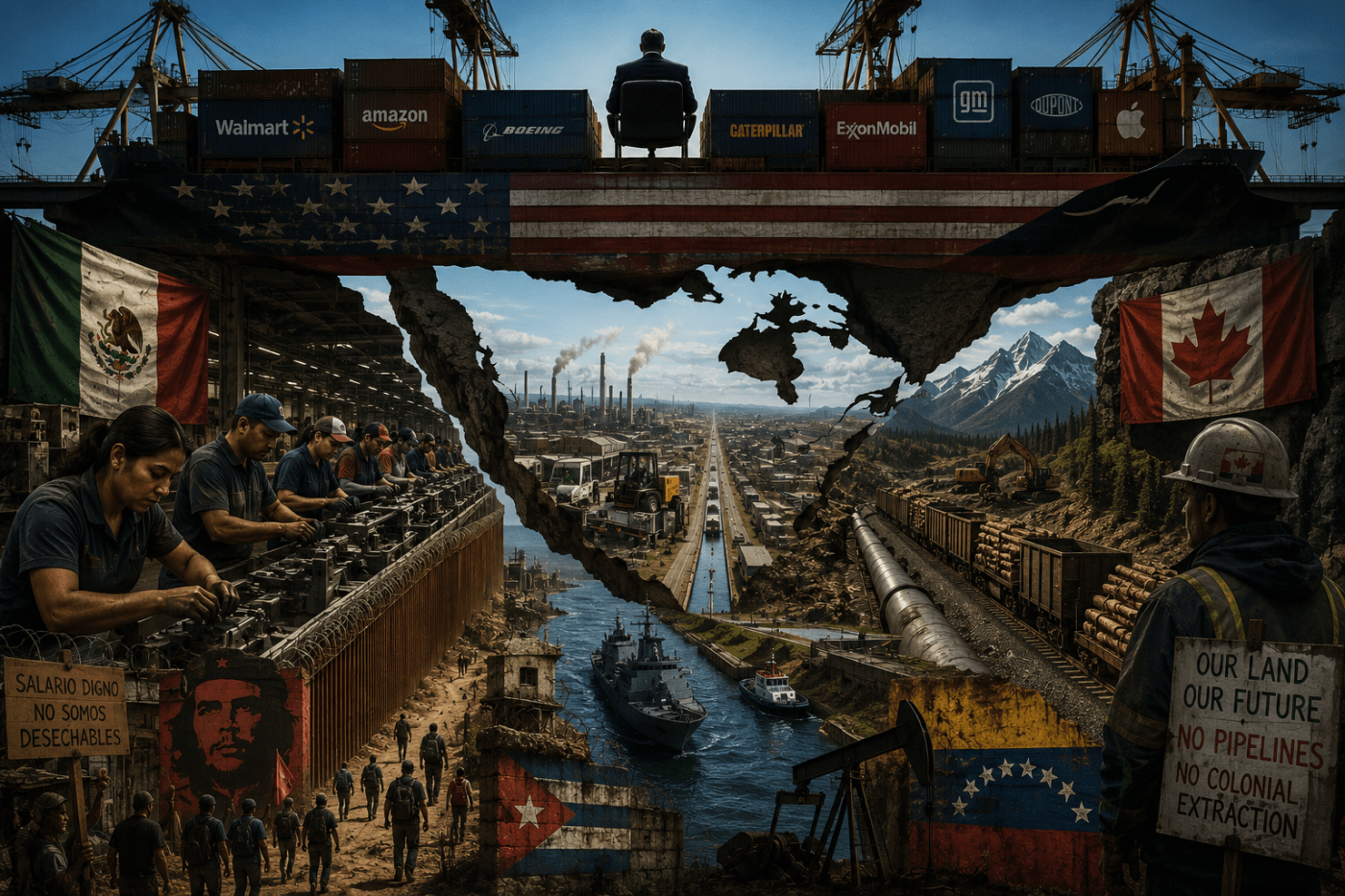
NBC frames Trump’s refusal to renew USMCA as another episode of trade instability, but the real story is the recalibration of North America under U.S. command. The buried facts show that Washington is not abandoning integration; it is using the review mechanism, tariffs, rules of origin, China exclusion, and security doctrine to tighten control over Mexico, Canada, and the continent’s productive base. From the shop floor to the Arctic, from Panama to Cuba, from Mexican labor to Canadian resources, the American Pole is being assembled through trade law, coercion, and imperial pressure. The task is not to save the old trade regime, but to build a continental front from below against Fortress America.
Prince Kapone | Weaponized Information | July 1, 2026
The Trade Story That Hides the Power Story
NBC News enters the USMCA fight through the language of shock. In “Trump refuses to renew USMCA trade pact, toppling one of the last pillars of stability in global trade,” Steve Kopack reports that the Trump administration has declined to renew the North American trade agreement in its current form, choosing instead to pursue amendments and possible bilateral negotiations with Mexico and Canada. The article presents the decision as a dramatic reversal by a president who once celebrated the agreement as “the best and most important trade deal ever made by the USA.” That contradiction is real enough on the surface. But surface contradiction is the cheapest coin in American political journalism. The deeper question is not whether Trump contradicted Trump. The deeper question is why the United States is once again placing the machinery of North American production on the negotiating table.
The article wants the reader to experience the story as instability. One more pillar of global trade has been shaken. One more agreement has been thrown into uncertainty. One more arena of commerce has been dragged into Trump’s tariff storm. But “stability” is not an innocent word. A plantation can be stable. A prison can be stable. A sweatshop supply chain can be stable. The question is always: stability for whom, built on whose labor, enforced by whose state, and organized for whose profit? NBC never asks that question. It treats the agreement’s stability as a public good because the article’s political imagination never leaves the boardroom. Trade becomes stable when capital can plan. Production becomes stable when corporations can calculate. Workers, migrants, border communities, and dominated neighbors are reduced to background scenery inside a drama about markets searching for certainty.
That is why the article’s language matters. Washington’s move is softened through the polite vocabulary of administration: “joint review,” “modernizing,” “rebalancing,” “amendments,” “periodic reviews.” These are not false words, but they are laundering words. They take a coercive political struggle over continental production and run it through the dry cleaner of technocracy. What comes back looks clean enough for television. The United States is not described as disciplining Mexico and Canada through market access, tariff pressure, and asymmetrical bargaining power. It is merely “reviewing” a deal. It is not reorganizing supply chains, labor regimes, energy policy, automotive rules, ports, mines, farms, and factories under sharper American command. It is “modernizing” trade. Empire rarely announces itself as empire. It arrives as paperwork.
The authorities chosen to explain this paperwork tell us what kind of story NBC is permitted to tell. Anonymous senior Trump officials define the administration’s reasoning. The Brookings Institution supplies respectable policy weight. The American Automotive Policy Council and the Business Roundtable speak as guardians of regional economic sense. These institutions are not floating above the conflict. They are part of the world being defended, adjusted, and renegotiated. Their authority narrows the field before the reader notices the fence. The worker appears only as an implied cost. Mexico appears mainly as a negotiating object. Canada appears as a stable partner wounded by Washington’s bad manners. The continent appears as a management problem for state officials and corporate planners.
This is card stacking with a corporate smile. NBC gives the reader facts, but the deck has already been arranged. We hear about trade deficits, tariff exemptions, business uncertainty, Canadian retaliation, automotive complaints, and intraregional trade growth. We do not hear from the workers who build the cars, move the freight, staff the warehouses, pick the crops, mine the minerals, or live along the corridors of extraction and transport. We do not hear from Mexican labor, Indigenous nations, anti-imperialist economists, or Global South institutions capable of naming the relationship between trade, sovereignty, and imperial command. We are given enough information to follow the dispute, but not enough to understand the system producing it. That is the genius of monopoly media: it does not have to hide every fact. It only has to organize the facts so the wrong conclusion feels natural.
The administration’s trade-deficit explanation performs the same trick. The deficit rises, therefore the agreement failed; the agreement failed, therefore Washington must renegotiate; Washington renegotiates, therefore it is restoring balance. The causal chain is simple, clean, and convenient. It is also a mystification. A trade deficit is not a cause. It is an accounting result produced by industrial structure, corporate strategy, currency relations, investment patterns, supply-chain design, and the unequal position of states inside the world economy. By letting the deficit stand as the heart of the matter, the article allows Washington to turn a complex restructuring of continental production into a morality play about imbalance. The empire points to the ledger and asks the public not to look at the machinery behind it.
That is what makes this article useful propaganda. It is not crude. It does not need to scream about enemies or fabricate a fantasy world. It does something quieter and more disciplined. It lets the reader see Trump’s contradiction while hiding the continuity of American strategy. It turns continental command into trade management, coercion into review, corporate preference into regional stability, and class power into common sense. The real story is not that Trump has suddenly betrayed his own agreement. The real story is that the United States is preserving North American integration by threatening it, renegotiating it, and tightening its terms under the pressure of imperial decline.
The Facts NBC Scattered Outside the Frame
The basic facts are simple. The United States did not in fact terminate the USMCA on July 1. The U.S. Trade Representative announced that Washington did not agree to renew the agreement in its current form, while also stating that the agreement remains in force as talks continue. USMCA itself built this moment into the treaty. Article 34.7 created the six-year review and sixteen-year sunset structure. Article 34.6 separately governs withdrawal with six months’ written notice. So this was not immediate withdrawal. It was non-renewal through review. The treaty still lives, but Washington has placed its future under pressure.
NBC reports that the administration wants amendments and may pursue separate bilateral deals with Mexico and Canada. That part is true. It also reports the White House explanation: trade deficits with both countries rose, the agreement modernized trade but failed to “rebalance” it, and the United States now wants new terms. The article notes that Canada defended the deal, that Mexico remained in talks with Washington, that intraregional trade has grown, and that business groups want certainty. Those are useful facts. But they are not enough facts. They tell the reader what the official fight looks like from the surface of the corporate boardroom. They do not explain the machinery under the floor.
The first buried fact is that the review mechanism itself is a weapon. Washington did not need to formally withdraw in order to increase leverage. USTR announced that the United States did not agree to renew USMCA in its current form, while the agreement remains in force. Once Washington refused renewal, the agreement entered the pressure chamber built into Article 34.7, which requires annual reviews if the parties do not confirm extension. That is not a technicality. White & Case explains that a refusal to approve renewal triggers further review meetings until the dissenting party’s concerns are addressed or the agreement expires. The agreement remains useful to Washington because USMCA governs the integrated North American trade framework that replaced NAFTA. But the refusal to renew keeps Mexico and Canada negotiating under the shadow of expiration: Reuters reports that the U.S. decision starts a ten-year countdown toward possible termination unless the three countries agree on changes.
The second buried fact is that the Trump regime had already prepared this trade posture. Its 2025 tariff policy tied imports from Canada and Mexico to national security, border control, fentanyl, and economic sovereignty. This is not old free trade. It is trade fused with policing. The same policy architecture stated that USMCA-compliant goods from Canada and Mexico would continue receiving zero percent tariffs, while non-compliant goods would face higher tariffs. That is the constraint USMCA places on the new regime. The agreement gives Washington integration, but it limits tariff discretion over goods that meet the rules. For a government trying to turn tariffs into permanent instruments of command, that is a problem.
The third buried fact is that the review is about production, not paperwork. Reuters reported that U.S. demands include stricter automotive rules of origin and efforts to prevent non-members, especially China, from benefiting through the pact. That one sentence opens the door to the real story. Washington is not simply asking whether trade is balanced. It is asking who gets to enter North American supply chains, whose parts count, whose factories qualify, whose capital is acceptable, and whether Mexico and Canada will help fence China out of the continental production system.
Mexico is the pressure point because Mexico is where labor, industry, migration, sovereignty, and China containment meet. ECLAC describes Mexico as a long-standing nearshoring platform for the U.S. economy, with present opportunities in semiconductors, electric vehicles, pharmaceutical ingredients, lithium, infrastructure, skilled labor, and domestic capability-building. That is why the fight over rules of origin matters. Mexico can either use this moment to develop its own productive capacity, or it can be locked more tightly into the lower floors of a U.S.-commanded industrial structure. Arturo Huerta G. argues that the United States and Canada are pressuring Mexico not to import from or accept investment from China, which would force Mexico toward deeper dependence on North American suppliers and reduce its strategic room for maneuver.
The pressure on Mexico is not limited to trade. Reuters reported that the United States designated Mexican cartels as terrorist organizations and generated Mexican concern over unilateral U.S. military action. Tariffs, fentanyl, migration, cartel designations, surveillance, and trade review belong to the same method. Washington approaches Mexico as market, border, labor reservoir, industrial platform, and security frontier. When one handle does not open the door, another one is tried.
Canada sits in the same structure from a different position. Trump publicly suggested using “economic force” to make Canada the 51st state, and Canadian leaders rejected the threat. That absurdity is not separate from the trade fight. It reveals the hierarchy beneath the polite language of partnership. Canada is not only a market. Its Arctic policy links northern sovereignty, defence, security, and North American Arctic strategy. Canada is resource base, market, military geography, Arctic corridor, and northern flank. The empire looks north and sees not friendship, but terrain.
The larger global context is what ECLAC calls an era of weaponized interdependence. Trade, technology, tariffs, value chains, and market access are no longer treated even formally as neutral exchange. They are instruments of state power. This is the world in which USMCA is being reviewed. The United States is not returning to old free trade, and it is not simply retreating into isolation. It is building a security-managed continental production regime. Tariffs remain ready. Rules of origin are tightened. China-linked production is policed. Mexico’s options are narrowed. Canada is held close. The continent is reorganized as strategic depth.
The same pattern is visible across the hemisphere. Trump said the United States would not allow China to take over the Panama Canal, while a BlackRock-led consortium moved to acquire CK Hutchison’s Panama port stakes under pressure over Chinese influence. Cuba remains under siege, with AP reporting intensified U.S. sanctions and energy restrictions worsening fuel shortages, blackouts, transportation disruption, and public-service breakdowns. People’s Dispatch describes the Shield of the Americas as a U.S.-led hemispheric military coordination project, while Just Security links it to a new “Trump Corollary” to the Monroe Doctrine organized around migration, cartel violence, and blocking non-hemispheric competitors from strategic assets.
This is the terrain NBC leaves outside the article. USMCA non-renewal is not an isolated trade dispute. It belongs to a larger imperial recalibration already visible in tariff discipline, China exclusion, pressure on Mexican sovereignty, coercion toward Canada, Arctic positioning, Panama chokepoint politics, Cuba’s siege, and hemispheric security coordination. WI has described this wider project as Fortress America and the consolidation of the American Pole: the attempt to lock down labor, resources, logistics, ports, oil, migration corridors, and security regimes as U.S. global hegemony weakens. The trade agreement remains on paper. The political content is being rewritten. The continent is being reorganized for command.
Fortress America Is a Continent Turned Into a Weapon
USMCA is not dying. It is being drafted into the American war plan. That is the sentence NBC cannot write, because to write it would be to admit that trade policy has become a battlefield and the continent is being reorganized like a guarded warehouse for a declining empire. The drama is not Trump chaos. The drama is ruling-class strategy under imperial crisis. The empire built the machine, found the old settings too loose, and now wants to tighten every bolt.
That is what this review is. Not withdrawal. Not abandonment. Not some sudden fit from the orange landlord of Mar-a-Lago. Washington kept the agreement alive and put a knife to its renewal. That is a different kind of power. It tells Mexico and Canada: keep producing, keep shipping, keep integrating, but do it under sharper command. The factory floor stays open. The bosses just changed the locks.
This is Fortress America. Not a wall. Not a bunker. Not some cartoon of isolationism where the United States hides from the world with canned beans and border patrol fantasies. Fortress America is a continent turned into a weapon. Mexico becomes the workshop. Canada becomes the resource shed and Arctic flank. Panama becomes the canal checkpoint. Cuba becomes the punished example. Venezuela becomes the oil ledger. The United States stands in the middle like a tired old overseer with new drones, new tariffs, and the same old appetite.
The American Pole is not being built with speeches alone. It is being built through rules of origin, tariff threats, border policing, cartel designations, Arctic strategy, port control, sanctions, blockades, investment screens, and supply-chain discipline. The documents look boring because empire learned long ago that paperwork can do what cannons used to do. A customs rule here. A tariff exemption there. A security designation across the border. A port stake in Panama. A blockade around Cuba. A “review process” in North America. Add it up and the map begins to look less like trade and more like command.
The old free-trade gospel promised open markets and shared prosperity. What it delivered was a continent of uneven wages, broken towns, crowded border crossings, poisoned corridors, fat shareholders, and workers taught to hate the people suffering beside them. Now even that gospel is being revised. The empire no longer trusts the market to serve empire automatically. Too much has shifted. China rose. Supply chains escaped easy command. The multipolar world kicked open doors that Washington wanted locked. So the United States keeps integration, but arms it. The market now travels with a cop. The supply chain now carries a blacklist. The trade deal now comes with a security briefing.
The trade deficit is the cheap magic trick. They wave the ledger and expect workers to gasp. Look, they say, imbalance. Look, they say, injury. Look, they say, America is being robbed. But who built the system? Who moved production across borders? Who hunted low wages, tax breaks, weak enforcement, and cheaper inputs? Who wrote the rules and then cried when the numbers embarrassed them? The same ruling class that made the mess now wants applause for arriving with a broom. Marx would have called this what it is: the arsonist selling fire insurance at the scene of the blaze.
Mexico is where the contradiction bleeds through the paper. Washington wants Mexico close, but not free. Industrial, but not sovereign. Developed, but not independent. Useful, but not disobedient. The empire wants Mexican workers, Mexican factories, Mexican logistics, Mexican minerals, Mexican proximity, and Mexican territory as a buffer against migration and China. But it does not want Mexico deciding its own development path. It does not want Mexico using Chinese capital, Chinese technology, or Chinese trade to widen its options. It wants Mexico inside the North American machine, with the door locked from the outside.
That is not partnership. That is assignment. A sovereign country develops its own capacity. An assigned country is told where to stand in somebody else’s supply chain. Assemble here. Ship there. Police this border. Absorb this pressure. Keep wages attractive. Keep China out. Keep migrants contained. Keep energy policy acceptable. Smile for the photo. Call it cooperation.
The narco-terror language is part of the same operation. It gives Washington a security key to Mexico’s front door. When trade pressure is not enough, there is fentanyl. When fentanyl is not enough, there are cartel designations. When cartel designations are not enough, there is talk of unilateral action. The empire loves a flexible vocabulary. Yesterday it was communism. Today it is narcoterrorism. Tomorrow it will be whatever word gives the Pentagon, Treasury, Homeland Security, and Wall Street another route into someone else’s sovereignty.
Canada gets the velvet glove, but the hand is the same. The threat to use economic force against Canada sounded ridiculous because polite society still pretends imperialism must speak in complete sentences. But the meaning was clear. Canada is not just a neighbor in this structure. It is timber, oil, minerals, markets, Arctic routes, military depth, and northern geography. The empire looks at Canada and sees a warehouse with snow on the roof. It looks at the Arctic and sees a chokepoint with melting ice. It looks at partnership and thinks possession.
This is why the Panama, Cuba, Venezuela, and Arctic pieces belong in the same picture. The United States is trying to lock down the hemisphere as its global grip weakens. Panama is about chokepoints and China. Cuba is about punishment for defiance. Venezuela is about oil and sovereignty under a gun. Canada is about resources and northern access. Mexico is about labor, production, migration, and border discipline. USMCA is about tying the productive heart of the continent to this wider imperial architecture. These are not separate stories. They are rooms in the same fortress.
And who pays for this fortress? Workers do. Always. The Mexican worker paid in low wages and stolen sovereignty. The U.S. worker paid in plant closures, nationalist poison, and bosses who used Mexico as a threat across the bargaining table. The Canadian worker paid in insecurity dressed up as stability. Migrant workers paid with fear. Indigenous peoples paid with land treated as corridor, mine, pipeline, port, and sacrifice zone. The ruling class took a continent of people and turned them into inputs.
Capital sees one North America. Workers are handed three flags and told to fight. That is the trick. The same corporation crosses the border like water. The same supply chain stretches from plant to port to rail yard to warehouse. The same investors collect from every side. But workers are chopped into national pieces. U.S. workers are told the Mexican worker is the enemy. Mexican workers are told foreign investment is salvation. Canadian workers are told not to rock the boat. The boat, of course, is owned by the people drilling holes in it.
Fortress America needs that division. It cannot function if workers see the whole map. It needs racism, nationalism, border panic, cartel panic, China panic, migrant panic, and trade panic. It needs every worker staring at another worker instead of the owner. It needs the U.S. worker angry at Mexico, the Mexican worker dependent on U.S. capital, the Canadian worker afraid of disruption, the migrant worker afraid of deportation, and the Indigenous nation buried under jurisdictional theft. Then it calls the arrangement competitive.
No, comrade. Competitive is what they call the knife fight after they lock workers in the room. Efficient is what they call the meat grinder after they oil the blade. Stability is what they call the silence after people are too exhausted to scream.
The USMCA review exposes the new trade regime in its raw form. Tariffs discipline neighbors. Rules of origin police the supply chain. China exclusion fences the perimeter. Narco-terror doctrine pressures Mexico. Economic threats discipline Canada. Arctic strategy secures the northern flank. Panama guards the canal routes. Cuba is strangled for refusing to kneel. Venezuela is treated like an oil field with a flag attached. The Shield of the Americas gives the whole thing a military spine. This is not chaos. This is order — imperial order — rebuilt under crisis.
That is why NBC’s stability frame is so obscene. Stability for whom? Stability for Business Roundtable spreadsheets? Stability for auto executives who want predictable margins? Stability for the polite men who say “rules-based order” while sharpening the rules into weapons? From below, the system was never stable. Ask the worker at the border. Ask the family in the blackout. Ask the auto worker watching the plant move. Ask the Mexican worker building the car for a fraction of the wage. Ask the Indigenous nation whose land becomes infrastructure. Ask the Cuban child living under sanctions. Ask the Venezuelan family watching sovereignty priced in barrels.
The real story is not that USMCA may die. The real story is that North American integration is being reborn as Fortress America. The United States is not ripping up the map. It is redrawing the command lines. It is not abandoning the continent. It is tightening its grip around it. The American Pole is being assembled through trade law, tariffs, security doctrine, oil pressure, Arctic routes, canal politics, border militarization, and labor discipline. The treaty is only one document. The project is the continent.
Against the Fortress, Build the Continental Front from Below
The answer to Fortress America cannot be nostalgia for the old trade regime. NAFTA was not liberation with a customs form. USMCA was not worker power because it learned to say “labor rights” in a nicer accent. The answer is also not the cheap nationalist carnival that tells U.S. workers to blame Mexican workers, Canadian workers, Chinese workers, or migrants for a system designed by capital and enforced by the state. The answer begins where the article refuses to look: with workers across the continent recognizing that they face the same machine, even when the machine speaks to them in different flags.
That means building political education where workers already are: union halls, break rooms, ports, warehouses, rail yards, auto plants, schools, tenant meetings, churches, livestreams, newsletters, group chats, and shop-floor conversations. Labor Notes describes itself as a media and organizing project for union activists trying to put the movement back in the labor movement, and its practical emphasis on member-run unions, workshops, conferences, and aggressive organizing strategies makes it useful terrain for this fight. The point is not to turn USMCA into a specialist debate for trade lawyers. The point is to explain it in the language of wages, schedules, plant closures, border discipline, migration fear, supply-chain blackmail, and bosses who use one worker against another like a crowbar.
The labor tools that exist should be used, but nobody should mistake a tool for power. The USMCA Rapid Response Labor Mechanism provides facility-specific enforcement for workers’ rights of free association and collective bargaining between the United States and Mexico. Workers and unions have already tested that terrain. The AFL-CIO, SEIU, SNITIS, and Public Citizen announced the first USMCA Rapid Response Mechanism complaint over Tridonex workers in Matamoros, where workers faced firings and harassment while trying to organize with an independent Mexican union. Rethink Trade has also produced a 2025 report evaluating Rapid Response Labor Mechanism outcomes and the 2026 USMCA review. Use the mechanism where it helps workers organize. Do not worship it. A complaint can open a door. Only organized workers can walk through it and hold the room.
The strategic task is cross-border worker coordination. Auto workers, steelworkers, warehouse workers, agricultural workers, rail workers, port workers, truckers, miners, teachers, service workers, and migrant workers need political education that names the whole system. The boss sees one continent. The investor sees one continent. The Pentagon sees one continent. The trade lawyer sees one continent. Only workers are told to see three nations and a thousand divisions. Every union local and worker committee serious about this moment should be asking: where does our workplace sit in the continental chain, who profits from the wage gap, who is being blamed, who is being deported, who is being disciplined, and where are the workers on the other side of the border facing the same employer or the same supplier network?
The anti-imperialist side of this fight matters just as much. The trade regime cannot be separated from the security regime. The same strategy that pressures Mexico through tariffs and narco-terror language also pressures Cuba through sanctions, Venezuela through oil and regime control, Panama through canal politics, and the hemisphere through military coordination. Black Alliance for Peace identifies itself as a Black-led anti-war and anti-imperialist formation, and its donation page states that it is fiscally sponsored by Community Movement Builders. That kind of formation is important because it refuses to separate the domestic police state from the imperial war state. The border, the blockade, the tariff, the sanction, the port deal, the drone, and the factory floor are not separate moral issues. They are parts of the same imperial machine.
Concrete action begins with refusing the false choices. Reject liberal nostalgia for a “stable” trade order that was stable mainly for capital. Reject America First protectionism that turns worker anger into chauvinism. Build teach-ins on USMCA as Fortress America. Circulate explainers on rules of origin, tariffs, China exclusion, Mexico’s industrial sovereignty, Canada’s Arctic role, Cuba’s blockade, Panama’s canal politics, and the labor split across North America. Pressure unions to develop cross-border relationships with independent worker formations in Mexico and Canada. Push labor bodies to oppose military action against Mexico, sanctions against Cuba, seizure politics against Venezuela, and any hemispheric security plan that turns the Americas into a U.S. command zone.
The slogan cannot be “save USMCA.” It cannot be “bring the jobs home” if home means another cage for somebody else. The line has to be sharper: no continental trade regime built on cheap labor, border terror, China panic, sanctions, and imperial command; no nationalist poison against workers across the border; no liberal defense of corporate stability; no anti-China hysteria dressed up as worker protection; no Monroe Doctrine with a union label. Against Fortress America, build the continental front from below: worker to worker, port to plant, border town to factory town, anti-war formation to union hall, migrant family to Indigenous nation, until the people who built the machine learn how to stop it, turn it, and take it back.


Leave a comment