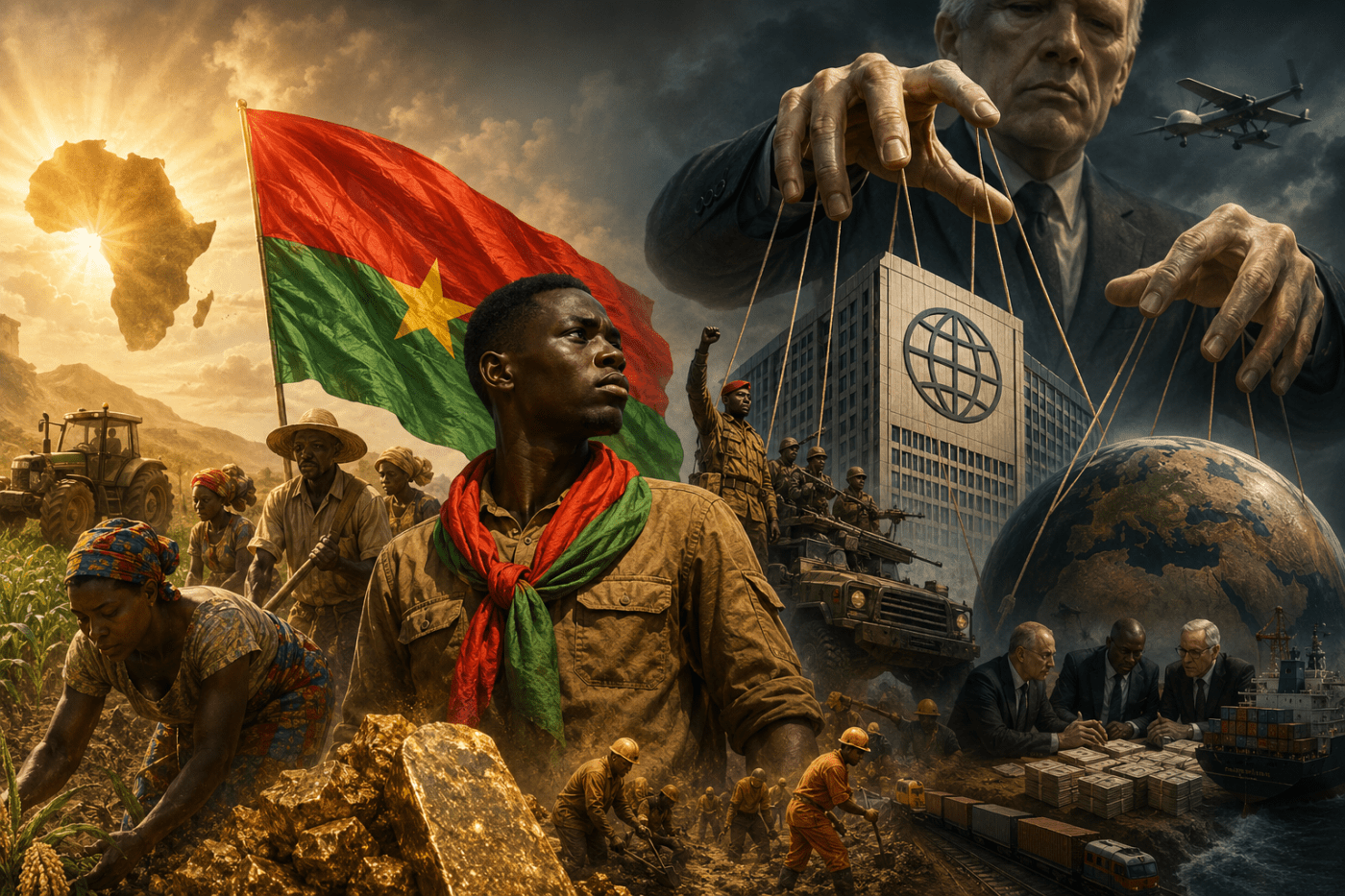
The World Bank’s latest report on Burkina Faso presents a familiar story of growth, resilience, and reform, but its language conceals the political assumptions and imperial interests embedded within the neoliberal development paradigm. Beneath the optimistic macroeconomic indicators lies a very different reality: a country pursuing food sovereignty, resource nationalism, and regional integration through the Alliance of Sahel States while confronting the unfinished legacy of colonialism and the Bretton Woods order. This essay reconstructs the factual terrain buried beneath the report, situating Burkina Faso’s trajectory within the wider struggle over reparations, multipolarity, and the New Cold War as the United States recalibrates its strategy toward Africa. In the end, the real question is not whether Burkina Faso can satisfy the World Bank’s definition of development, but whether Africa will finally escape a system that still demands obedience from the very continent it spent centuries plundering.
Prince Kapone | Weaponized Information | July 2, 2026
The World Bank Teaches the Robber’s Language of Reform
The World Bank’s June 30, 2026 press release on Burkina Faso does not read like propaganda if propaganda is imagined only as a flag, a scream, a threat, or a villain with horns drawn in red ink. It reads like a spreadsheet wearing a clean shirt. It praises Burkina Faso’s 2025 growth, celebrates falling inflation, applauds fiscal consolidation, credits agriculture, services, mining, and the new Mining Code, then gently instructs the country to deepen “structural reforms” so that “resilience” can become jobs and opportunity. This is how the imperial accountant speaks after the soldier has packed his bags and the old colonial administrator has changed offices. The tone is calm because the command is already built into the vocabulary.
The main device here is policy laundering. The report takes a political program and washes it through the language of technical necessity. Digital payments to businesses, interconnected tax bases, simplified tax compliance, digital land records, serviced industrial zones, labor-market platforms, and “business environment” reforms are presented as neutral steps on the road to development. But there is no neutral road. Every road has an owner, a toll booth, a police checkpoint, and a destination. The World Bank does not say: let Burkina Faso decide whether development means public ownership, food sovereignty, resource control, regional planning, reparations, or protection from imperial extraction. It says reform, and by reform it means the familiar package: fiscal discipline, market legibility, investor confidence, formalized extraction, and a state trained to make itself readable to capital.
The second device is begging the question. The whole document assumes the truth of the neoliberal paradigm before the reader has even entered the room. It assumes that fiscal sustainability, business climate reform, digital tax administration, and labor-market integration are the natural path from growth to opportunity. It does not prove this. It does not confront the historical record of the World Bank and IMF in Africa. It does not ask whether the same institutions that supervised structural adjustment, austerity, privatization, and debt discipline should be trusted to define African development now. The conclusion is already smuggled into the premise. Burkina Faso needs reform because reform is what Burkina Faso needs. Very scientific. Very objective. The priesthood has spoken, and the altar is a macroeconomic dashboard.
The third device is narrative framing. The report tells a simple story: resilience appeared, reforms must follow, jobs will come. That story is clean because all the blood has been scrubbed from the floor. Burkina Faso appears as an economy facing “persistent security challenges,” not as a country moving through a wider struggle over sovereignty, resources, French influence, regional alignment, and the right to determine its own development path. The word “resilience” does heavy ideological labor here. It praises the people for surviving, while refusing to name the system they have been forced to survive. It turns endurance under pressure into a policy opportunity for the very development regime that helped build the pressure.
The fourth device is source hierarchy. Only certain voices are allowed to count. The World Bank speaks. Its country manager speaks. Macroeconomic indicators speak. Policy recommendations speak. But the Burkinabè worker does not speak. The farmer does not speak. The miner does not speak. The displaced family does not speak. The revolutionary state’s own development priorities do not speak in their own language. The Alliance of Sahel States does not speak. Pan-African reparations politics does not speak. In this hierarchy, knowledge flows downward from Washington’s development institutions to Africa’s supposedly incomplete states. The report does not merely offer analysis; it performs authority.
The fifth device is controlling the message. The report does not need to denounce reparations, anti-imperialism, French neocolonialism, structural adjustment, debt dependency, AFRICOM, resource sovereignty, or the Sahel’s regional realignment. It simply refuses to admit them into the conversation. The permitted vocabulary is growth, inflation, deficit, productivity, employment, gender gaps, urbanization, informality, investment, and reform. The forbidden vocabulary is theft, empire, extraction, occupation, dependency, plunder, sovereignty, and repair. That is not an accident. It is the discipline of the discourse itself.
Finally, the report relies on political code words. “Inclusive growth,” “productive jobs,” “economic opportunities,” “fiscal sustainability,” “business environment,” “formalization,” and “women’s economic participation” sound harmless, even benevolent. But inside the Bretton Woods dictionary, these words carry a long institutional memory. They are not just descriptions. They are instructions. They tell governments how to tax, how to spend, how to regulate, how to open, how to record land, how to discipline labor, how to present resources to investors, and how to call all of this development. The World Bank’s trick is not that it lies in every sentence. The trick is that it builds a world where the most important truths cannot be spoken at all.
The Facts Buried Under the Language of Resilience
The World Bank’s own numbers are the visible surface of the story. Burkina Faso’s economy grew by an estimated 5.3 percent in 2025, up from 4.8 percent in 2024. Inflation fell below zero, moving from 4.2 percent in 2024 to -0.5 percent in 2025. The fiscal deficit narrowed from 5.8 percent of GDP in 2024 to 1.8 percent in 2025. The report attributes this movement to agriculture, services, mining, the formalization of artisanal and semi-mechanized mining, and the new Mining Code, then recommends digital payments, tax-base interconnection, tax-compliance simplification, digital land records, serviced industrial zones, labor-intensive public works, and women’s labor-market participation. These are the facts the report wants us to see. But facts become propaganda when they are arranged to conceal the structure that gives them meaning.
The agricultural story is not simply a matter of good weather blessing a passive economy. Burkina Faso launched a 2023–2025 agropastoral and fisheries offensive projected at CFA592 billion, or roughly $981 million, to push toward food sovereignty across rice, corn, potatoes, wheat, fish, meat, poultry, and mango production. The state did not merely wait for rainfall and then receive congratulations from Washington’s development priesthood. It organized a production campaign around the material question of feeding the people. That matters because a food-sovereignty offensive is not the same thing as “agricultural performance.” One names a national development priority. The other drains politics from production and hands the vocabulary back to the technocrat.
The mining story is even sharper. Burkina Faso’s new Mining Code, adopted in July 2024, increased state control and domestic participation through local investment requirements, stronger regulatory oversight, local processing obligations, and tougher penalties for overproduction and violations. In June 2025, the state completed the transfer of five gold mining assets to the state-owned miner, finalizing a process begun the previous year to increase control over mineral resources. The government has also moved to nationalize more foreign-owned industrial mines, build state capacity through SOPAMIB, and increase the share of gold revenue retained by the country. So when the World Bank praises mining expansion and “formalization,” it is naming the sector while avoiding the fight inside the sector: who owns the mines, who refines the gold, who receives the revenue, and who decides whether the earth beneath Burkina Faso becomes national wealth or another export channel for foreign accumulation.
The same erasure appears around security and regional politics. Burkina Faso’s economy is not moving in a vacuum. In 2023, Burkina Faso ordered French troops to leave the country after mass pressure against France’s military presence. Burkina Faso, Mali, and Niger then consolidated the Alliance of Sahel States after the Niger crisis, when ECOWAS threatened military intervention and the Sahel states answered with mutual defense. On January 29, 2025, the three countries formally exited ECOWAS and introduced their own biometric passports. The AES has since moved toward confederal integration, security coordination, and practical regional institutions outside the old ECOWAS framework. A World Bank report that treats Burkina Faso as an isolated reform case cannot explain this. It can only manage the appearance of neutrality by removing the regional break from view.
The historical creditor-debtor relationship is also inverted. The World Bank speaks of fiscal sustainability as if Africa’s fiscal condition fell from the sky. But the African continent is carrying a debt burden shaped by colonial extraction, unequal exchange, structural adjustment, currency dependency, commodity subordination, and the long discipline of external creditors. African countries face hundreds of billions in external obligations while debt service drains resources that could otherwise fund agriculture, industry, health, housing, education, infrastructure, and public employment. At the same time, the African Union has placed reparatory justice on the continental agenda: the AU adopted 2025 as the theme year for “Justice for Africans and People of African Descent through Reparations”, and the African Commission welcomed the declaration of an AU Decade on Reparations from 2026 to 2036. This is not symbolic background. It changes the frame of the whole discussion. Africa is not merely a debtor before the Bretton Woods system. The Bretton Woods system belongs to a world order that is debtor before Africa.
The U.S. command layer makes the World Bank’s report even less innocent. Washington’s Africa policy has shifted into a harder commercial and strategic posture. In 2025, U.S. officials described the new line as “trade, not aid”, with ambassadors judged by business deals and U.S. support for infrastructure such as the Lobito rail corridor tied to critical minerals and routes that bypass Chinese-controlled channels. AFRICOM’s 2026 posture statement frames Africa as a theater where China uses critical minerals, infrastructure, and maritime assets to build leverage. The U.S. Development Finance Corporation openly describes investments in African transport and mineral corridors as part of countering China’s dominance over critical mineral supply chains. The State Department’s 2026 Critical Minerals Ministerial launched FORGE as a successor to the Minerals Security Partnership, placing mineral trade, investment, and allied supply chains inside a U.S.-led geopolitical framework.
This is the larger context in which the World Bank arrives with its clean vocabulary of reform. Burkina Faso is part of a Sahelian realignment that combines food-sovereignty drives, resource-sovereignty measures, anti-French military rupture, regional confederal experiments, and new partnerships outside the old Western monopoly. Washington is answering Africa’s multipolar recalibration with minerals diplomacy, development finance, military doctrine, commercial pressure, and Bretton Woods discipline. The World Bank report is therefore not just an economic update. It is one document inside an imperial division of labor: the military command names China and Russia as threats, the finance arm reorganizes supply chains, the diplomats chase mineral deals, and the development bank teaches African states to call submission “opportunity.”
The Development Report as Imperial Counterinsurgency
The real story is not that Burkina Faso grew by 5.3 percent and now needs the World Bank to teach it discipline. The real story is that Burkina Faso is trying to wrest pieces of its national life back from the machinery that has long treated African land, labor, gold, food, debt, and state power as objects of external command. The World Bank looks at that movement and translates it into the language of reform because reform is the language empire uses when open colonial rule becomes politically expensive.
Food sovereignty becomes “agricultural performance.” Resource control becomes “formalization.” State ownership becomes a footnote under mining growth. Fiscal recovery becomes an argument for deeper technocratic supervision. Regional rupture becomes invisible. Anti-French struggle disappears. U.S. mineral strategy disappears. AFRICOM disappears. The New Cold War disappears. This is not a mistake. This is the ideological work of the report. It strips Burkina Faso’s development of sovereignty, strips sovereignty of struggle, strips struggle of enemies, and then presents the remaining numbers as proof that the old development managers should remain in charge.
But Burkina Faso is not simply managing an economy. It is fighting over the commanding heights of its own survival. Food is not just a sector. It is the difference between a people who can feed themselves and a people forced into dependency. Gold is not just an export. It is condensed labor, land, state power, and international bargaining strength. Taxation is not just administration. It is the question of whether the state can mobilize resources for a national project or merely make itself legible to creditors and investors. Regional integration is not just diplomacy. It is the attempt to build a zone of collective defense against the old colonial leash dressed up as partnership, aid, peacekeeping, and market access.
The World Bank cannot tell that story because its own worldview is on trial inside that story. The report wants Burkina Faso to appear as a patient: resilient, improving, still fragile, still in need of expert supervision. But the patient has started questioning the doctor, and that is the scandal. The country is not only asking how to grow. It is asking who owns the growth, who directs it, who captures the surplus, who secures the territory, who controls the minerals, who feeds the people, and who has the right to define development in the first place.
This is where the Sahel becomes dangerous to the imperial imagination. The AES process breaks the loneliness imposed on each African state by the neocolonial order. One country alone can be sanctioned, isolated, starved of credit, threatened through regional bodies, disciplined through currency dependency, and lectured by development banks. But a regional bloc built around sovereignty begins to disturb the arrangement. It points toward common security, common institutions, common bargaining power, and a shared refusal to let France, ECOWAS pressure, U.S. military doctrine, or Bretton Woods policy scripts define the horizon of African possibility.
That is why the U.S. command layer matters. Washington is not looking at Africa with humanitarian eyes. It is looking at minerals, corridors, ports, military access, supply chains, diplomatic alignment, and Chinese and Russian influence. The language has hardened into “trade, not aid,” but the class content is older than the slogan. The empire wants access without responsibility, resources without reparations, partnership without equality, and development without sovereignty. The World Bank supplies the soft glove. AFRICOM supplies the fist. Development finance supplies the pipeline. Mineral diplomacy supplies the map. Together they form the architecture of imperial recalibration.
Burkina Faso’s significance is therefore not reducible to GDP growth or deficit reduction. Those numbers matter, but they do not speak for themselves. They become meaningful only inside the contradiction now unfolding across West Africa: the contradiction between imperial management and sovereign development. On one side stands the old order of fiscal discipline, debt service, foreign mining control, military dependency, export corridors, structural adjustment, and policy obedience. On the other side stands an unfinished and contested project of food sovereignty, resource capture, regional coordination, national planning, and multipolar maneuver.
The World Bank wants to drag the second side back into the first. That is the function of its vocabulary. “Resilience” praises the people for surviving the damage while refusing to indict the system that produced the damage. “Opportunity” turns a sovereignty struggle into an investment pitch. “Fiscal sustainability” disciplines a poor country’s budget while the imperial core sits on centuries of stolen African wealth. “Formalization” sounds clean until one asks whether formalization serves public ownership and national development or simply makes labor, land, and minerals easier for capital to count, tax, price, and penetrate.
The deepest inversion is the debt question. The World Bank speaks as if Africa must justify itself before creditors. But Africa is not the historical debtor in this relationship. Africa was robbed, enslaved, partitioned, colonized, underdeveloped, structurally adjusted, militarized, and then told to balance its books. The same world system that extracted wealth from African bodies and soil now arrives with spreadsheets to explain fiscal responsibility. That is not development expertise. That is the thief returning as an accountant.
So the report must be read as counterinsurgency in economic form. Not counterinsurgency only as soldiers, drones, bases, and intelligence networks, but counterinsurgency as the policing of imagination. It tells African states what questions are legitimate. It tells readers what counts as progress. It tells workers that development means employment inside a structure they do not control. It tells women that liberation means deeper labor-market incorporation while leaving land, finance, production, and ownership under the same order. It tells the displaced that stability comes through reform, not through the defeat of the forces that made displacement normal.
The truth buried under the report is simple and explosive: Burkina Faso’s future will not be decided by macroeconomic praise from the World Bank. It will be decided by the struggle over sovereignty. Either the country’s growth becomes another mechanism for disciplining the state, securing mineral access, managing labor, and integrating the Sahel into U.S.-led imperial recalibration; or it becomes part of a broader African project to reclaim food, gold, security, planning, regional power, and historical repair. That is the contradiction. Everything else is bookkeeping.
Turn the Development Report Into a Weapon Against Empire
The answer to a World Bank report is not a better World Bank report. The answer is organized political education, anti-imperialist solidarity, reparations struggle, debt abolition, demilitarization, and a disciplined refusal to let imperial institutions define African development. Every time the World Bank or IMF releases an economic update on Africa, it should be treated as an enemy intelligence document. Pull out the data. Decode the assumptions. Identify the class project. Ask who owns the land, the mines, the banks, the roads, the ports, the railways, the tax systems, and the development vocabulary itself. Then turn the whole thing back against the system that produced it.
For readers inside the United States, the first task is to attack the imperial command layer from home. The Black Alliance for Peace’s U.S. Out of Africa campaign names AFRICOM as an instrument for imposing U.S. control over African land, resources, labor, and political life, and its U.S. Out of Africa Network gives people a concrete formation through which to organize against that machinery. That work matters because the World Bank’s language of “opportunity” does not float separately from U.S. military doctrine, mineral corridors, security partnerships, sanctions pressure, and diplomatic coercion. The spreadsheet and the drone are not enemies. They are co-workers.
The reparations front must also be sharpened. N’COBRA was founded to broaden support for the long-standing reparations movement, with individual members, organizational affiliates, and chapters across the United States and beyond. That struggle must not be reduced to symbolic apologies, corporate diversity programs, museum statements, or liberal guilt rituals. Reparations means material transfer. Reparations means debt cancellation. Reparations means stolen wealth returned. Reparations means the end of the imperial right to supervise African budgets after centuries of extracting African life. The World Bank wants Africa to explain its deficit. Africa should demand an accounting of the theft.
The Pan-African and internationalist lane is just as necessary. The All-African People’s Revolutionary Party continues to organize around Pan-African unity, anti-imperialism, and the global struggle against neocolonial domination. The International People’s Assembly describes itself as a network of more than 200 people’s organizations, social movements, political parties, and trade unions, giving anti-imperialist forces a wider field for coordination against militarism, debt domination, sanctions, neoliberal restructuring, and the new scramble for minerals. These formations are not substitutes for African self-determination. They are vehicles for solidarity with it, especially for people living inside the imperial core whose governments, banks, armies, corporations, and development agencies sit on Africa’s chest.
The practical tasks are clear. Build study groups that read World Bank and IMF documents against African history, structural adjustment, French neocolonialism, U.S. military policy, debt service, mineral extraction, and reparations. Pressure local unions, student groups, churches, tenant formations, Black organizations, and anti-war coalitions to take up AFRICOM, African debt cancellation, and reparations as working-class issues. Track every U.S. mineral deal, military exercise, embassy statement, development-finance project, and Bretton Woods recommendation as part of one imperial system. Defend the right of Burkina Faso, the AES, and all African nations to pursue food sovereignty, resource sovereignty, public ownership, regional integration, and development planning without being threatened, isolated, sanctioned, invaded, or lectured.
And above all, reject the NGO trap. The empire loves African suffering when it can be converted into grant proposals, branding campaigns, humanitarian white papers, and donor-managed civil society projects. It hates African sovereignty because sovereignty raises the forbidden question: who owns the wealth? That is the question every World Bank report is designed not to answer. So we answer it for them. The gold belongs to the people. The land belongs to the people. The food system belongs to the people. The future belongs to the people. And the bill for five centuries of robbery belongs to the imperial core.


Leave a comment