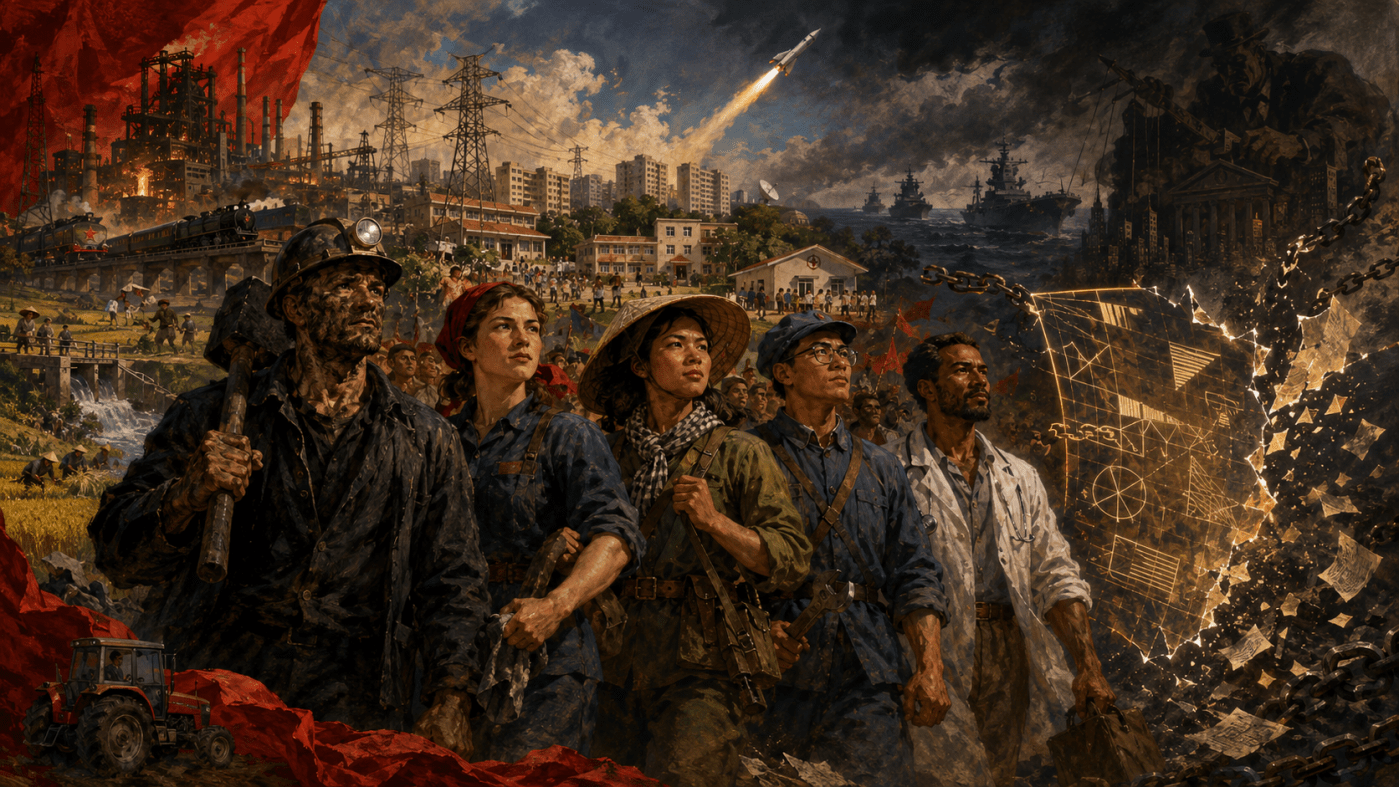
Bhaskar Sunkara invokes the courage of revolutionary workers and colonized peoples while treating the administrative planning systems they built as failed formations whose defining mechanisms must be superseded. This polemic subjects his proposed market socialism to the same historical tests imposed upon the Soviet Union, China, Cuba, and Vietnam, showing that worker-run firms, public banks, and competitive markets do not abolish planning, class conflict, imperial pressure, or the struggle over investment. The record reveals neither a flawless socialist past nor a neutral market future, but a continuing battle over who controls the state, finance, land, strategic property, social surplus, and the conditions of human life. Revolutionary history must be studied critically as the indispensable archive of socialism in power—not stripped for inspiring imagery while hypothetical models claim superiority from the safety of never having existed.
Prince Kapone | Weaponized Information | June 17, 2026
Preface: Socialism Cannot Inherit the Empire Intact
This essay was sharpened through theoretical and editorial exchanges with Carlos Martinez, co-editor of Friends of Socialist China, whose work on the continuities of the Chinese Revolution has helped clarify a question many Western socialists prefer to dodge: socialism cannot be measured by the percentage of an economy that passes through private hands while ignoring who commands the state, land, finance, strategic industry, political organization, and the direction of development. His comments pushed this essay away from easy formulas and toward the harder terrain where Marxism belongs: class power, state power, imperialism, and historical conditions.
That is where Bhaskar Sunkara’s argument becomes most revealing. His hypothetical socialism after capitalism is easiest to imagine in the very countries whose wealth, infrastructure, financial stability, technical capacity, and consumption patterns were accumulated within an imperial world system. His model assumes a society already capable of removing basic necessities from the market, financing universal services, maintaining public investment banks, protecting workers through industrial restructuring, and allowing unsuccessful firms to close without condemning whole populations to ruin. That is not a small assumption tucked beneath the institutional design. It is almost the whole historical problem.
These conditions exist most fully in the imperial core. Britain, the United States, France, Germany, and the other wealthy capitalist states possess accumulated machinery, universities, transport systems, administrative institutions, scientific establishments, and enormous reserves of social knowledge. Generations of workers built those factories, railways, hospitals, schools, ports, power systems, laboratories, and cities. Their labor is real. No anti-imperialist analysis gains anything by pretending metropolitan development was created by plunder alone, as though the workers who built the ports and drove the trains were decorative extras in their own history.
But neither did these capacities arise inside sealed national borders through the superior thrift, genius, and table manners of the ruling classes. Their accumulation was shaped by colonial conquest, enslaved labor, unequal exchange, control over global finance, privileged access to raw materials, technological monopoly, military force, and the systematic transfer of value from the colonized world into the metropolitan center. Cheap commodities did not simply appear on Northern shelves. Cheap energy did not descend from heaven. Minerals, food, clothing, electronics, and industrial inputs moved through a world division of labor in which some nations controlled credit, shipping, currency, technology, and military power while others supplied land, resources, labor, and blood. Walter Rodney’s classic account of how Europe developed itself through the underdevelopment of Africa remains indispensable because it exposes development and underdevelopment as connected outcomes of the same world system, not separate national personalities.
Workers in the imperial core do not command this system, and many receive little of its spoils. They remain exploited by capital and divided internally by race, citizenship, region, incarceration, unemployment, and dispossession. Yet their social reproduction occurs within national economies whose currencies, supply chains, military power, and access to global value remain structurally privileged. A worker can be exploited at home while living inside a country whose ruling class extracts advantages abroad. Those two realities do not cancel one another. They form part of the same international class order.
This creates a problem metropolitan socialism often avoids. A worker-governed firm in the imperial core may be democratic inside its own walls while purchasing minerals, garments, agricultural goods, or electronic components produced through superexploitation elsewhere. A public bank may direct national investment while the nation’s prosperity continues to depend upon unequal trade, financial privilege, military protection, and restricted development abroad. Universal health care, public housing, and generous social provision would enormously improve the lives of Northern workers. But if their material foundation remained embedded in an international system that kept Southern labor cheap and Southern economies subordinate, domestic socialization would not yet amount to global emancipation.
The private capitalist may have been removed from the domestic enterprise while the imperial relation remains buried inside the supply chain. The exploitation has not disappeared. It has been moved beyond the national field of vision. The worker board votes; the cobalt still comes from a world market organized by violence, debt, and bargaining weakness. The public bank invests; the currency privilege remains. The supermarket is socialized; the plantation relation has merely learned to speak through contracts.
Socialism therefore cannot be judged only by the property relations visible within one country. A society might replace shareholders with worker boards, socialize investment, and expand public provision while continuing to occupy a privileged position within the world economy. Such a transformation would be a major working-class victory. It would weaken domestic capital and improve millions of lives. But it could also become, in effect, a more democratic distribution of the imperial dividend.
This is the geographical limit hidden inside Sunkara’s model. His institutions appear most practical where capitalism and imperialism have already assembled the productive foundations upon which they could operate. Yet genuine socialism cannot preserve imperialism, because imperialism is not an unfortunate foreign-policy attachment to capitalism. It is one of the principal mechanisms through which wealth, technology, finance, raw materials, labor, and consumption are organized on a world scale. Nkrumah understood this clearly when he described neocolonialism as the condition in which a formally independent state could retain the outward symbols of sovereignty while its economic life remained directed from outside.
Abolishing that system would not reduce the imperial nations to nothing. Their workers, skills, infrastructure, and productive capacities would remain. But their existing economic structure could not remain untouched. Consumption patterns, military-industrial sectors, financial privileges, long supply chains, and access to artificially cheap goods would have to be transformed. The problem would no longer be simply how to distribute metropolitan abundance more fairly. It would be how to reconstruct the material basis of life without relying upon domination abroad.
An anti-imperialist socialist transition in the Global North would therefore require more than transferring corporations to their employees and placing finance under public authority. It would require rebuilding productive capacity after decades of deindustrialization, restoring technical education, training millions of workers, converting military production, shortening vulnerable supply chains, and accepting that some commodities would cost more once their prices no longer concealed brutal labor conditions and ecological devastation elsewhere. It would also require reparative relations with the Global South: debt cancellation, technology transfer, climate obligations, sovereign development finance, and trade organized around mutual development rather than unequal advantage.
The imperial working class cannot inherit the empire’s consumption standards untouched and name the result internationalism. The transformation of property at home must be joined to the transformation of relations between nations. Otherwise socialism becomes a better contract for the workers inside the fortress while the fortress remains standing.
This changes what we mean by abundance. Metropolitan socialism often begins with the supermarket, hospital, railway, university, power grid, and modern industrial system already in place, then asks who should govern them and how their benefits should be universalized. The revolutionary traditions of the colonized world began from a harsher question: how can a people acquire the power to feed itself, produce medicine, educate engineers, control credit, generate energy, create industry, connect its territory, and survive economic attack?
One tradition begins from accumulated capacity and asks who should govern it. The other begins from dispossession and asks how capacity can be constructed at all. Sunkara’s model largely begins after this second question has already been answered. What it leaves insufficiently examined is that imperialism helped answer it for the metropolitan countries by preventing it from being answered elsewhere.
That is why China matters so much to this essay. China does not fit the neat Western opposition between planning and markets, nor the liberal fantasy that development began when the market was allowed to perform its little miracle. The Chinese Revolution created the state, land regime, public industry, human capacity, infrastructure, and sovereignty through which later reform could occur. Markets entered through a socialist state, not over its corpse. The relevant question is not whether markets exist. It is whether they command the state or are made subordinate to a political project that retains control over finance, land, strategic property, and national development.
That is also why the Great Leap, Soviet stagnation, Yugoslav self-management, Cuban blockade, Vietnamese reform, and Third World theories of delinking cannot be treated as side questions. They are the terrain on which socialism stopped being a promise and became construction. Construction is where errors become material, where bureaucracy acquires an office, where scarcity becomes an enemy with teeth, where imperialism enters through the bank transfer and the shipping insurance form, and where the working class discovers that taking power is not the same thing as already knowing how to govern every contradiction power contains.
The argument of this essay therefore extends beyond whether markets can be used under socialism or whether planning encountered real institutional limits. The deeper question is where the material preconditions of any socialist model came from, whose labor produced them, whose development was blocked in the process, and whether a proposed socialism can abolish that international relation rather than merely redistribute its domestic rewards.
Genuine socialism in the imperial core must be anti-imperialist, reparative, developmental, and internationalist from the beginning. Otherwise it risks socializing the benefits of empire while leaving the machinery of empire intact. Sunkara’s socialism appears most feasible where its preconditions were accumulated through imperialism. But once imperialism is abolished, those preconditions can no longer be treated as a permanent inheritance. They must be consciously rebuilt upon another foundation.
That is the problem beneath the problem. The hypothetical model does not merely stand outside the history of socialism. It stands upon a material comfort produced by the very world system that socialism must overturn.
The Miners Supply the Confidence; Jacobin Supplies the Verdict
Bhaskar Sunkara begins with an image worth lingering over. He recalls Welsh miners buried with The Communist Manifesto, Vietnamese peasants who believed an empire could be defeated, and the “world-historic confidence” they embodied. There is something real in that image, something our defeated age has almost forgotten how to recognize. These were people whom the ruling classes had assigned a simple role: dig the coal, harvest the rice, carry the rifle, bury the dead, and leave history to gentlemen. But through unions, parties, liberation movements, and revolutionary struggle, they stepped out of the place prepared for them. They did not wait for history to invite them in. They forced the door open. They were not history’s casualties. They were its authors.
Sunkara is right to mourn the disappearance of that confidence. A Left trained to call every retreat maturity and every defeat realism eventually becomes realistic about nothing except its own impotence. Socialism once meant more than a kinder tax schedule, a public option, or a red flag draped over the same machinery of exploitation. It meant working people could conquer power, break the rule of property, reorganize production, and build a society where the right to eat, heal, learn, travel, and live did not depend upon surviving the daily auction of the labor market. Confidence was not optimism with revolutionary branding. It was the knowledge, hammered out through organization and struggle, that the people who make society can also become capable of governing it.
That ambition is present in Sunkara’s argument, and it should be said plainly. Capitalism, he insists, was historically produced and can therefore be historically surpassed; socialism must abolish market dependence, extend democracy into economic life, and protect food, housing, care, education, and the basic conditions of survival from the verdict of purchasing power. Socialism cannot stop after collecting taxes from the capitalist class while leaving that class in possession of the factories, banks, land, machinery, and power to decide which town receives investment and which is sentenced to rot. Nor does Sunkara imagine that capital will surrender because socialists have drafted an elegant proposal and placed it before the board. His discussion of the defeated Meidner Plan recognizes that patient organization, reform, and a long war of position must eventually collide with the property and political power of the owners. These are serious socialist commitments, not radical perfume sprayed over a moderate program.
Then comes the verdict. “Both historic models of twentieth-century socialism”—Soviet-style planning and social democracy—were not merely “besieged and defeated”; they “failed.” The shift in language does a great deal of political work. Siege describes what an enemy does to you. Defeat describes the result of a struggle between contending forces. Failure relocates the main cause inside the project itself. Invasion, blockade, sabotage, inherited poverty, military encirclement, capital flight, and counterrevolution may remain somewhere in the picture, but they are pushed toward the frame. The socialist institutions move to the center. Empire becomes the weather. Revolution becomes the diagnosis.
This is not a word game. A besieged society can make grave mistakes without those mistakes proving that the society’s basic project was impossible. A defeated movement can possess real strengths while losing to more powerful enemies. But once “failure” becomes the master category, every contradiction is recruited into the prosecution. Shortage becomes the truth of planning. Bureaucracy becomes the truth of public ownership. Repression becomes the truth of revolutionary power. The institutions built under hunger, war, sabotage, scarcity, and external attack are judged as though they had been tested inside a clean laboratory and found wanting. The dirt of history is wiped from the instruments after the experiment.
Sunkara’s criticism of Soviet planning is not foolish, and it should not be answered foolishly. A continental economy created enormous coordination problems. Ministries attempted to align millions of products, inputs, farms, factories, shops, transport routes, and delivery schedules across vast distances. Managers bargained for easier targets, concealed capacity, hoarded labor and materials, and inflated results. Workers learned that heroic production today might become an impossible quota tomorrow. Measures of gross output rewarded tonnes, totals, and volume even when users needed quality, durability, or goods that actually fit together. Weak enterprises could not simply be closed without throwing people out of work and tearing holes through supply chains. Innovation slowed, consumer information traveled badly, and reports climbing the administrative ladder often arrived scrubbed of the reality known on the factory floor.
These were real contradictions. They cannot be exorcised by shouting “anti-communism” at every empty shelf or broken machine. But Sunkara converts them from the problems of a particular administrative formation into the natural limits of planning itself. Administrative planning, he writes, was not simply difficult but “impossible,” while its defects were “coded into the structure” itself. The historical form becomes the universal essence. The issue is no longer whether Soviet institutions failed to develop enough truthful feedback, democratic correction, flexibility, or popular control. The conclusion has already outrun the evidence: conscious coordination of a complex economy has met its natural boundary. Planning enters the room already wearing the defendant’s chains.
In its place, Sunkara proposes a socialism that keeps exchange while abolishing the capitalist’s command over it. The central infrastructures of life would be removed from commodification, while the broader economy would consist of democratically governed enterprises responding to prices, competing for customers, earning profits, distributing possible dividends, and receiving investment through public banks holding productive assets in common. Wage floors would prevent competition from driving whole sectors into misery. Enterprises would possess room to experiment and make decisions. Inefficient firms could fail. Yet no absentee shareholder would sit above the workers collecting tribute by virtue of title alone. The broader Jacobin argument sharpens the same position through the declarations that socialism has a future while central planning does not and that market socialism can organize competition without preserving a capitalist class.
This proposal contains substantial socialist content. It is not neoliberalism dressed for May Day. Abolishing absentee shareholders would smash a central institution of capitalist power. Socializing finance would take from private owners the authority to decide where society’s accumulated labor is invested and which communities are left to die. Universal provision would weaken the labor market’s ability to discipline workers through hunger, illness, debt, and eviction. Worker government inside enterprises would be a real democratic advance, not a public-relations committee called together after management has already made the decision. Sunkara’s model deserves material investigation, not the ritual denunciation of those who believe repeating yesterday’s formulas is the same thing as thinking.
But it deserves the same rude examination imposed upon every socialist system that has entered history. Here the historical division of labor is grotesquely uneven. Revolutionary workers and colonized peoples supply the courage, the songs, the sacrifice, the martyrs, the legitimacy, and the grandeur. Their states, parties, planning institutions, land struggles, public industries, and transformations of property appear mainly as warnings nailed beside the road to a more presentable socialism. Their confidence is inherited. Their construction is disowned.
Historical socialism arrives carrying every contradiction of power. Hypothetical socialism enjoys the excellent administrative record of never having governed anything. Sunkara calls his proposal a provisional sketch, and that qualification is fair. But a sketch cannot claim immunity from gravity. Worker-governed firms must still confront commodity pressure, conflicts over investment, inherited inequalities among enterprises and regions, and the danger that economic advantage hardens into political power. Public banks must still confront bureaucracy, competing social demands, and the question of who governs the governors. Any socialist transition must still survive capital flight, counterrevolution, sabotage, and imperial coercion. The possessing classes have never respected the provisional character of a revolution.
That is the central double standard. Real socialism must answer for every shortage, every bureaucrat, every failed harvest, every bad shoe, every broken machine, every prison, every contradiction produced under conditions of war, backwardness, siege, sabotage, and scarcity. Imaginary socialism answers only to its own design. It has not yet faced a capital strike. It has not yet defended a currency. It has not yet fed a city under blockade. It has not yet reorganized agriculture, trained engineers, held together a federation, confronted a coup plot, resisted invasion, or decided whether a failing enterprise is an accounting unit or the economic spine of a working-class town. It has never governed, so it has never erred. What an enviable record.
The governing question is therefore exact. Has Sunkara demonstrated that conscious socialist coordination is inherently impossible? Or has he taken the contradictions of one administrative formation, stripped them from the conditions in which they developed, and promoted them into a universal law, while granting his preferred alternative exemption from equivalent tests? To answer that question, the calculation and knowledge arguments must be taken at their strongest and forced to say precisely what they disprove—and what they do not.
When the Nail Factory Became a Theory of History
The nail-factory story has done more ideological work than most factories ever performed in production. A planner rewards output by the number of nails, so the factory fills the warehouse with useless little pins. The target changes to weight, and the factory answers with a handful of iron clubs too large to hammer into anything. Sunkara repeats the joke because it catches a real contradiction: people respond to the standard by which they are judged, and a stupid target can organize stupidity on an industrial scale. But the anecdote is made to carry a much larger verdict. A failure of measurement becomes a theory of history. A problem of institutional design becomes a death certificate for planning. The joke walks into the room as comedy and leaves as bourgeois political economy with a red lapel pin.
Ludwig von Mises made the serious version of the argument. Once machinery, land, raw materials, and other means of production ceased to exchange between independent private owners, he claimed, genuine market prices for capital goods could no longer emerge, leaving planners without a monetary basis for comparing alternative uses. The same tonne of steel might become a railway track, a tractor, a bridge girder, or a machine tool. Counting the steel tells us how much exists. It does not, by itself, tell us what society gives up when one use is chosen over another. Mises was not complaining that the paperwork would be excessive. He was asking how social ownership could calculate opportunity cost without a market in the means of production.
Hayek came at the problem from another direction. Knowledge does not gather itself neatly at headquarters and wait to be filed. It lives in the hands and habits of machinists, farmers, nurses, engineers, warehouse workers, shopkeepers, drivers, and households. Much of it is fleeting and practical: a machine sitting idle, a substitute part in the next district, a road washed out, a skill no personnel form records, a sudden shift in what people need. Hayek called this “knowledge of the particular circumstances of time and place”. Prices, he argued, compress pieces of that scattered knowledge into signals that allow adjustment without every fact first marching through a ministry. Mises asked how planners could value competing uses without capital-goods markets. Hayek asked how any center could know what only millions of people know in fragments. Both arguments deserve better than being reduced to a joke about too many forms.
The Soviet economy gave these criticisms a body. Enterprises bargained for easier targets, hid productive reserves, hoarded labor and materials, and avoided innovations that might interrupt the plan. Measures of gross output rewarded tonnes and totals when users needed lighter machines, durable parts, and goods that actually fit together. Managers expected that important enterprises would be rescued because closure threatened employment, cities, supply chains, and strategic production; Kornai later called this the soft budget constraint. Alec Nove’s criticism could not be brushed aside as Wall Street scripture because it came from within socialist argument itself: information, motivation, and material resources all had to be brought together, while multiplying orders could produce fresh contradictions rather than resolve the old ones.
The strongest concession must be made without shuffling our feet. No center can know every local fact. No ministry can foresee every broken bearing, missed train, improvised substitute, altered preference, crop disease, or new method discovered on the shop floor. A hierarchy that punishes bad news will be fed good lies, no matter how powerful its computers become. When the worker knows the target is absurd, the manager knows the report is fiction, and each official survives by pleasing the official above, faster communication merely allows falsehood to travel at revolutionary speed. Denying this does not defend planning. It defends administrative deafness.
Yet the limits of central knowledge do not crown the market king. Capitalist corporations already plan production, staffing, inventories, investment, distribution, and logistics on a massive scale; Amazon’s own researchers describe multi-echelon inventory systems for buying and placement across a vast distribution network. Capitalist governments plan currency, procurement, roads, ports, military production, industrial subsidies, bailouts, and strategic technology; the U.S. Treasury describes TARP as a state program created to stabilize the financial system after Congress authorized hundreds of billions of dollars in rescue authority, while the National Science Foundation describes the CHIPS and Science Act as a public investment program for semiconductor and scientific capacity. Markets themselves do not descend from nature like rainfall. They require property law, money, courts, contracts, police, public infrastructure, and a state prepared to defend all of it. The real question is not plan or no plan. The real questions are: planning at what level, over which sectors, for whose purpose, with what information, under whose control, and through what institutions of correction?
The European calculation debate also carried a hidden inheritance. It generally assumed that the society under discussion already possessed factories, power grids, railways, banks, engineers, administrators, and an integrated internal market. The socialist revolutions of the colonial and semicolonial world confronted a more primitive and more brutal problem: how to build the national economy whose allocation European theorists were already arguing about. Nkrumah understood that planning was the principal means through which an underdeveloped continent could create industry, infrastructure, banking, power, and coordinated development. Lê Duẩn described the Vietnamese task as transforming a backward agricultural economy into a balanced and modern productive structure. Amin later insisted that external exchange had to serve internally chosen development rather than the inherited commands of “comparative advantage”.
Here lies the difference between allocating what already exists and transforming what history has left behind. Revolutionary states had to build steel mills, electric grids, fertilizer plants, railways, technical schools, public banks, food systems, ports, machine shops, and connections between regions colonialism had linked mainly to carry raw materials outward. The market might report, with perfect numerical sobriety, that exporting cocoa, copper, bananas, oil, sugar, or cheap labor was profitable today. It could not make the political decision to escape that sentence tomorrow. Telling an underdeveloped nation to obey existing prices until it becomes developed is like telling a prisoner to study the architecture of the cell until he discovers the exit.
Planning theory did not remain frozen in 1920, waiting to be buried by the nail joke. Kantorovich showed that scarce labor, machinery, and materials could be compared through linear optimization and “resolving multipliers” that expressed opportunity costs within a defined planning problem. Leontief’s input-output analysis mapped the dependence of one sector upon another. A railway program requires steel, electricity, cement, machinery, fuel, and labor; expansion in one branch may choke another if the connections are not understood. These methods did not manufacture omniscience. They gave planners better ways to see the consequences of a decision before the shortage arrived swinging a hammer.
But mathematics cannot appoint its own purpose. A formula may discover the least costly method of building a million homes. It cannot decide whether those homes should outrank luxury towers, military spending, or another shopping district for people who already have three places to sleep. Input-output tables rely upon classifications, technical coefficients, inventories, and data that may already be old by the time the ink dries. Kantorovich can help society decide how to allocate steel once society has chosen what it intends to build. He cannot tell society what deserves to be built. That decision belongs to politics, class power, and human need.
Chile’s Project Cybersyn tried to confront the knowledge problem without placing the entire economy beneath one electronic bureaucrat. Allende’s government connected nationalized enterprises through a telex network, statistical monitoring, and rapid exception reports designed to identify urgent breakdowns. During the 1972 truck owners’ strike, the network helped officials track operating vehicles, blocked routes, fuel, and essential supplies. National priorities could receive information from below without every workshop waiting for a command from the capital. Yet Medina’s fuller account shows that the system remained incomplete, its indicators reflected political choices, and its relation to worker power was never fully resolved. It could help the government see through the fog. It could not stop the generals from bombing the presidential palace.
Modern computation reduces burdens that earlier economists treated as nearly fatal. Sparse matrices, digital inventories, networked logistics, and iterative methods can generate increasingly accurate solutions without calculating the entire economy in one divine act. Cockshott and Cottrell describe iterative input-output methods that exploit the fact that most goods are not direct inputs into most other goods. That matters. It does not turn a computer into the collective wisdom of the working class. Machines require data. Data arrive through institutions. Institutions contain people with knowledge, interests, fears, ambitions, and power. Algorithms process the goals they are given. They do not decide which goals belong to humanity.
Cold War propaganda flattened this developing argument into an exhibition of household appliances. At the American National Exhibition in Moscow, refrigerators, automobiles, televisions, and a model suburban kitchen became the closing statement for capitalism. The empire behind the cheap raw materials disappeared. So did the worker who could not afford the goods, the racial order beneath American prosperity, and the immense state planning behind military and industrial power. Mathematical economics had created tools useful to markets and planning alike, but public common sense absorbed a simpler catechism: prices represented ordinary intelligence, while planning had to prove itself omniscient before breakfast.
Che Guevara pushed the debate beneath technique and into social relations. Planning, for Che, was not merely a cleverer way to distribute steel and sugar. It formed part of the struggle to transform the human relations inherited from capitalism. His Budgetary Finance System treated major state enterprises as parts of one social economy rather than as separate commodity owners competing against one another. Che warned that capitalism binds people through the “invisible umbilical cord” of the law of value. Socialist construction therefore had to develop new institutions and new social motivations together. Costs still had to be counted. Efficiency still mattered. But profitability did not acquire the right to sit on the throne simply because the factory deed had been transferred to the state.
Joseph Ball makes a related anti-revisionist argument, though his conclusion that capitalism was restored in the Soviet Union soon after 1953 remains contested, and his view that Chinese socialism ended in 1976 reflects a stricter Maoist framework than this essay adopts. His most useful distinction is between using prices for accounting and allowing profitability to regulate production. Prices may help compare costs and evaluate enterprise performance without determining how the means of production are allocated. But once investment flows mainly toward expected profit, Ball argues, commodity categories stop serving the plan and begin governing it. The strength of his challenge survives even where his historical chronology is disputed: are numbers tools used by society, or has society placed the numbers in command and baptized their rule as economic necessity?
A modern socialist plan would resemble neither an all-knowing ministry nor a market wearing a public-sector badge. Democratic institutions would establish national priorities and protect basic needs, labor rights, ecological limits, regional equality, and long-term development. Public finance would direct investment beyond the narrow horizon of immediate return. Regional and sectoral bodies would coordinate infrastructure and productive capacity. Enterprises would retain initiative over local methods within social boundaries. Input-output models, accounting prices, selected markets, consumer information, digital inventories, and iterative calculations would provide different forms of feedback. Workers and communities would need the power to expose false reports, challenge managers, contest priorities, and compel revision. No single office would perform every task. The people, through their institutions, would decide which tasks could be decentralized, which required national coordination, and which must never be surrendered to profit.
Planning, understood this way, is the organized work of setting priorities, coordinating interdependence, distributing authority, gathering information, discovering error, and correcting course. It uses prices without kneeling before them, computers without mistaking them for a class, and expertise without silencing the workers whose knowledge keeps the factory alive. It guarantees no paradise. It establishes something more modest and more dangerous to the ruling class: humanity’s choices are wider than blind market command on one side and a clerk assigning every nail on the other.
And that returns us to Sunkara’s alternative. Once public banks decide where the social surplus will go, planning has not disappeared. It has moved into finance. Once worker-governed firms buy, sell, compete, pursue profits, and face failure, commodity pressure has not disappeared either. The next question is what those forces continue to do after the absentee capitalist has been shown the factory gate.
The Boss Leaves the Factory; the Law of Value Remains at Work
Sunkara’s alternative should be allowed to stand at full height before it is tested. Health care, education, transport, energy, telecommunications, housing, and the foundations of survival would be protected from the market, while productive firms would be governed by their workers rather than by outside shareholders. Enterprises would buy and sell, respond to prices, compete for customers, earn surpluses, and distribute part of those surpluses among their members. Wage floors would prevent whole occupations from being driven into poverty. Firms would possess real autonomy, yet productive wealth would be held socially and investment supplied through public banks rather than private capital markets. Enterprises that repeatedly failed to use resources well could be closed, while more productive ones expanded.
There is real socialist substance here. Removing the absentee shareholder would break one of capitalism’s central institutions: the right of a person who does no work in the enterprise to command it and collect its surplus because a title deed says so. Worker government inside the firm would give producers authority over decisions now handed down by owners and managers. Socialized finance would strip private banks and investment funds of their power to decide which industry grows, which town decays, and which technological future receives money. Universal provision would weaken the labor market’s most reliable weapon—the knowledge that losing a job can also mean losing medicine, housing, food, and education. This is not ordinary capitalism with a cooperative logo pasted over the executive suite.
But three different things are being pressed together here, and they are not the same thing. One is private capitalist ownership: the enterprise belongs to shareholders who command labor and appropriate the surplus. Another is control by the workers presently employed in a particular enterprise. The third is social ownership: productive wealth belongs, in a material and political sense, to the working class and society as a whole. Worker control answers who governs the workplace. It does not by itself answer who governs the division of society’s labor among workplaces.
The workers in one successful firm may govern themselves democratically and still possess interests that diverge from workers trying to enter it, consumers needing lower prices, peasants requiring affordable machinery, public services competing for skilled labor, poorer regions seeking investment, and future generations inheriting the ecological consequences. A modern engineering cooperative may begin with advanced equipment, established customers, patents, skilled personnel, and access to transport. Another firm may inherit broken machinery in a region starved of investment for generations. Workers in the stronger enterprise may reasonably wish to retain more of the surplus they produce, restrict new membership when additional workers would reduce each member’s dividend, favor machinery that raises income per worker, and resist transfers to enterprises or regions they consider less productive. They have not secretly become monocled capitalists. They are responding to the conditions under which their collective livelihood has been organized.
This is where the law of value enters—not as a magic phrase to end the argument, but as an everyday pressure. Where firms must sell commodities, win customers, cover costs, obtain credit, compete with other producers, and reproduce themselves through revenue, they are compelled to compare labor costs, reduce production time, protect market share, and pursue activities that can be sold profitably. The enterprise that continually produces above the socially prevailing cost loses customers and credit. The firm that cannot realize its output in the market cannot pay its workers, however democratic its meetings may be. Competition can discipline worker collectives without an individual capitalist issuing the order. The boss has been shown the gate, but the social relation he embodied has not yet surrendered the lease.
This does not mean that every price is capitalist, that every exchange restores the bourgeoisie, or that the existence of markets settles the class character of a society. Prices can be used for accounting, comparison, consumer feedback, and limited exchange. Markets existed before capitalism, and socialist states have used them under different forms of political command. The decisive question is which relation governs the whole. Are markets tools operating inside consciously established social priorities, or must public priorities continuously bend themselves to the commercial survival of autonomous firms? Are profits one indicator among others, or do they decide which forms of labor, which regions, and which needs receive the means to develop?
Che’s warning becomes sharper when applied to democratic firms competing against one another. The issue is no longer simply whether workers possess a voice inside the enterprise, but what material interests the enterprise teaches them to defend. Che opposed organizing socialist production around the separate financial success of individual enterprises because the interests of one workplace could come into conflict with the priorities of the whole society. A workforce whose income, security, and future investment depend upon its firm outperforming others may be pushed to retain its surplus, restrict membership, resist transfers, and regard neighboring workers chiefly as competitors. Workplace democracy organized under those pressures can cultivate a collective egoism: solidarity within the factory walls, competition beyond them. The committee may be elected, the managers removable, and the surplus distributed among the workers, yet the enterprise can still be compelled to defend its commercial position against poorer firms, neglected regions, and needs carrying little purchasing power. The workers have not become capitalists in disguise. They have been placed in institutions that train them to guard one fragment of social property rather than govern the whole in common.
Ball brings the same issue down to the allocation of machinery, credit, and labor among enterprises. He argues that worker ownership confined to the individual workplace leaves producers confronting social need through the unequal and atomized medium of market demand. The cooperative making agricultural equipment does not receive the needs of poor peasants as a direct social instruction; it receives whatever purchasing power those peasants can assemble. The prosperous firm does not encounter an abandoned region as a national obligation; it encounters a destination offering weak returns. This is why enterprise democracy cannot substitute for social planning. Workers should govern production inside the factory, but the factory cannot be permitted to govern its relation to society according to its own commercial interest alone. Otherwise each workplace becomes a little republic of producers whose borders are policed by revenue, and collective ownership dissolves into competition among its fragments.
Walter Rodney offers the necessary political interruption. Examining Tanzania’s proclaimed movement toward socialism, he refused to infer class power from official language, public title, or cooperative form. The material question was how the state served, in whose hands it rested, and what followed from its policies. The same test applies here. Who controls investment? Who appoints and removes management? Who disposes of the surplus? Which organizations allow workers outside the prosperous firm, peasants, consumers, and neglected regions to impose their claims? Social ownership cannot be established by grammar. Calling an asset “social” does not tell us which social forces govern it.
Firm failure brings these abstractions down to earth. Sunkara is correct that socialism cannot preserve every obsolete process, subsidize incompetence forever, or treat restructuring as a capitalist invention. But a firm is not merely a column in an accounting ledger. It is workers, machinery, apprenticeships, suppliers, accumulated technical knowledge, municipal revenue, nearby housing, and sometimes the economic spine of an entire town. Closing an accounting unit is one thing. Discarding the people and productive capacity attached to it is another.
If a coal mine must close for ecological reasons, the miners cannot be ordered to finance humanity’s future with their own ruin. If a machine plant is badly managed but strategically necessary, its temporary losses do not settle whether it should disappear. A socialist restructuring would require income guarantees, retraining, technological conversion, modernization, merger, regional reinvestment, and the planned movement of equipment and labor toward new work. The obsolete product may need to die. The worker does not. Price signals can indicate that a firm is losing money. They cannot decide what society owes to the human beings whose lives have been built around it.
Sunkara recognizes that leaving investment inside individual firms would generate severe inequalities. Capital-rich enterprises would attract workers and accumulate advantages while labor-intensive sectors and public services lost staff. His solution is to separate workplace governance from investment control and place productive assets under public financial institutions. Public banks would allocate capital on behalf of society while worker-governed firms retained operational autonomy. This is the strongest part of his answer—and the point at which the announced disappearance of planning becomes difficult to maintain.
Which region receives the new rail works? Which industry receives patient finance through ten years of weak returns? Does credit build luxury housing where rents are high or public housing where need is greatest? Who finances ecological conversion before it becomes profitable? Which enterprises are modernized, merged, converted, or closed? Who governs the banks, and through what institutions can workers, consumers, regions, and communities contest their decisions? Socializing finance does not abolish planning. It relocates planning to the institutions that direct society’s surplus.
Yugoslavia brought these contradictions out of the seminar room. Its system combined social ownership, worker self-management, enterprise autonomy, and substantial reliance upon markets. It was not a fraudulent experiment. Workers gained meaningful participation, knowledge of enterprise affairs, experience in collective decision-making, and a stronger sense of power within production. For decades, the system achieved development and appeared to offer a road distinct from both private capitalism and Soviet administrative command.
Yet the experience also showed that democratic control within firms did not automatically produce coordination among them. A World Bank study found that self-management could strengthen participation, cooperation, enterprise knowledge, and workers’ sense of power, while firms also resisted mergers or new hiring when membership meant sharing income and often favored immediate earnings, employment security, and workplace improvements over long-term investment elsewhere. Richer enterprises and regions possessed advantages poorer ones could not manufacture through enthusiasm. Banks became entangled with their enterprise and regional founders. Foreign debt, unemployment, inflation, and uneven development placed increasing strain upon federal coordination. By the 1980s, the debt crisis had become severe enough that a U.S. intelligence assessment described Yugoslavia’s financial crisis as rooted in debt, foreign-exchange pressure, and the need to satisfy Western creditors. The cooperative workshop could not solve a balance-of-payments trap by holding a better meeting.
Worker self-management did not single-handedly destroy Yugoslavia. Constitutional fragmentation, national antagonisms, foreign debt, international pressure, political decay, uneven historical development, and imperialist intervention all belonged to the crisis. Nor was every Yugoslav problem proof against workplace democracy. The narrower lesson is harder to dismiss: enterprise democracy did not eliminate the need for national investment planning, regional equalization, employment policy, and political coordination across firms. Democracy at the point of production was necessary. It was not a complete political economy.
And the story did not end as an internal seminar on self-management. The breakup of Yugoslavia unfolded through wars, secessions, external recognition struggles, sanctions, and finally direct military intervention against the Federal Republic of Yugoslavia. NATO itself records that Operation Allied Force began in March 1999 as an air campaign against the Federal Republic of Yugoslavia, while the International Criminal Tribunal for the former Yugoslavia notes that NATO conducted its bombing campaign from 24 March to 9 June 1999. Whatever one thinks of the competing nationalisms and crimes that tore the federation apart, no honest balance sheet can treat Yugoslavia’s destruction as the quiet market correction of a self-managed economy. The imperialist war entered the ledger with bombs, not footnotes.
Defenders of Sunkara’s model can answer that progressive taxation, equalization funds, regulation, social insurance, employment guarantees, and democratic public banking would prevent these pressures from hardening into a new class order. That is a serious answer. It is also an admission of the central point. The market does not remain socialist by virtue of good intentions. It must be surrounded, restrained, redirected, and sometimes overruled by organized social power. The model’s viability depends less upon the market disciplining the plan than upon the working class possessing institutions capable of disciplining the market.
Sunkara’s precise national combination of universal provision, worker-governed firms, public banks, competitive exchange, and democratic state authority has not undergone the integrated tests imposed upon the systems it claims to supersede. That fact does not invalidate it. It denies it the privilege of arriving without contradictions. The Soviet Union receives no absolution because its property was public, and market categories should grant no conviction in advance. The achievements, coercion, bureaucracy, reforms, and stagnation of historical socialism must now be separated historically rather than packed into the lazy conclusion that planning failed.
The System That Moved Mountains and Could No Longer Hear the Factory Floor
The Soviet economy did not begin with blast furnaces, power stations, laboratories, railways, and trained engineers waiting politely for the Bolsheviks to administer them. The revolution inherited a vast, mostly agrarian country already torn apart by world war, followed by revolution, civil war, foreign intervention, famine, and the collapse of production and transport. Economic historians Andrei Markevich and Mark Harrison found that the Civil War produced an economic catastrophe whose losses were not fully repaired even after the New Economic Policy restored a measure of stability. Capital was scarce, technical expertise limited, and the countryside still carried much of the country on its back. These conditions establish the magnitude of the task. They do not excuse every policy adopted in its name.
That distinction matters because the word “failure” has been made to perform the work of an entire history. Did the Soviet system fail to industrialize? Did it fail to coordinate large projects, educate technical workers, create employment, defend the country, and reconstruct after invasion? Could the institutions built for rapid mobilization later adapt to a mature economy requiring quality, innovation, maintenance, variety, and truthful feedback? Did workers possess effective control over the apparatus administering social property? Why did the Union finally dissolve? These are separate questions. A system may answer one with an achievement and another with a disaster. To compress them all into the phrase “planning failed” is not explanation. It is a refusal to explain.
On the question of transformation, the record is not modest. Robert Allen concludes that from 1928 to 1970 the Soviet Union was arguably the world’s second most successful economy after Japan when measured as a process of catch-up growth. Public investment concentrated scarce resources upon machinery, energy, construction, transport, and the industries required to reproduce them. Steel required coal, power, railways, machine tools, engineers, and workers able to read technical instructions; each branch had to supply the next or become its bottleneck. Urbanization and industrial employment drew millions from an impoverished countryside into a new productive structure. A vast educational system expanded alongside this transformation because factories cannot be operated by decree alone. The World Bank’s own historical assessment acknowledged that Soviet general, vocational, and technical education significantly contributed to the country’s modernization, even as narrow specialization later became a weakness in a more complex economy.
This was coordinated development, not a collection of accidental factories. Energy made industry possible. Industry supplied machinery. Transport tied together regions whose economic lives had previously been separated by distance and poverty. Schools and technical institutes created the labor capable of operating what public investment built. Planning did not coordinate every sector equally well, but a system capable of organizing this transformation cannot honestly be described as incapable of complex coordination. The queue is admitted as evidence. The power station, school, laboratory, and relocated factory are dismissed as scenery.
The transformation was inseparable from coercion, and socialism gains nothing by hiding that fact behind the smokestacks. But collectivization also cannot be flattened into the Cold War cartoon of a state attacking an undifferentiated countryside for no material reason except bureaucratic appetite. The grain question was real. The kulak question was real. The need to feed growing cities, supply industry, and break the power of rural accumulation was real. Scholarship on Soviet collectivization notes that sections of the village poor, the bednota, provided a source of support for Soviet rural policy in the 1920s and during the first phase of collectivization, while Lynne Viola’s study of the “twenty-five-thousanders” shows that the worker detachments sent into the countryside were not simply dragooned functionaries but often willing recruits in a campaign they understood as socialist construction. There was a social base. There was class struggle. There was also violence, administrative frenzy, forced requisition, mass displacement, famine, and the destruction of peasants who were not all kulaks because some official needed a kulak before lunch.
That hard balance becomes clearer when collectivization is understood not as a policy file but as a second civil war in the countryside. In Stalin: History and Critique of a Black Legend, Domenico Losurdo argues that the Stalin-era Soviet Union cannot be understood through the flat category of totalitarian uniformity. It was a society dragged from one state of exception to another, from one civil war to another, with collectivization tearing through villages, families, political loyalties, religious attachments, and class positions. That does not make the violence disappear. It gives the violence a social terrain. The countryside was not a passive surface upon which the state wrote policy. It was an active battlefield where the old order still possessed grain, animals, village prestige, specialist authority, and the power to make the revolution appear foreign inside its own villages.
The Siberian case gives that general argument frozen ground and human faces. WI’s review of James Hughes’ Stalinism in a Russian Province reconstructs a countryside where grain was not simply absent but withheld; where kulaks operated less as colorful folklore than as rural bosses of land, livestock, credit, and social influence; where middle peasants maneuvered between fear, interest, survival, and calculation; and where poor peasants often lacked the strength to impose their own needs without state-backed pressure. The village assembly, the skhod, still commanded loyalty. Local specialists could ridicule Party activists with the authority of the man who knew the cow, the soil, and the machine. Rural Soviets could exist on paper while kulak influence remained bone-deep in the life of the village.
This is the part liberal historiography and much of the Western left cannot stomach. A revolution does not arrive in the countryside as pure moral intention meeting innocent soil. It arrives among classes, memories, hierarchies, debts, barns, kinship networks, hoards, priests, specialists, resentments, and fears. In Siberia, the Party’s authority was often paper while the old village order still possessed the power to decide whether grain moved, whether a meeting listened, whether a poor peasant spoke, and whether the state’s instruction meant anything after the activist left the room. To say the Soviet state “coerced the peasantry” is true as far as it goes. But it does not go far enough. The upper layers of the peasantry also coerced the state, the city, the rural poor, and the future by holding food, animals, and local authority as private bargaining weapons against industrialization.
That is why Stalin’s intervention in Dizzy with Success matters historically. The article did not abandon collectivization or retreat into liberal tenderness for rural property. It attacked the bureaucratic intoxication produced by early advances: forced enrollment, paper collectives, threats against peasants, disregard for regional conditions, and attempts to leap from the artel toward the commune before the material and political conditions existed. Stalin insisted that collectivization had to rest on the active support of the main mass of the peasantry and that the agricultural artel—not the fully communized commune—was the main form at that stage. In the artel, the principal means of production were socialized, while household plots, dwellings, some dairy cattle, small livestock, poultry, and personal gardens remained outside full socialization. This was not capitalist restoration. It was an admission, inside the revolutionary process itself, that socialism could not be built by pretending the peasantry, the grain problem, local conditions, and inherited market relations had already vanished.
The so-called U-Turn was therefore not simply confession or collapse. It was correction after an explosive advance, a retreat that exposed both the danger of bureaucratic command and the changed balance of rural power. Hughes’ is useful here because he catches the motion: when collectivization rates dropped after March 1930 and peasants exited many collectives, they did not return to the same countryside that had existed under the uneasy NEP truce. The kulak pole had been shaken. The old village elite no longer set the social temperature everywhere. Middle peasants could retreat from a rushed and distorted collective without necessarily restoring the old order. Poor peasants could begin to speak with a confidence previously blocked by wealth, fear, and inherited deference. The revolution had not solved the countryside. It had altered the terrain on which the countryside would be fought over.
The later kolkhoz settlement deepened this contradiction rather than erasing it. The Second Kolkhoz Charter entrenched collective farming while also codifying household plots, membership rules, maternity benefits, and regulated forms of peasant life inside the collective structure. A study of Soviet private farming notes that private farming within Soviet agriculture was strictly defined by the kolkhoz model charter and land-use regulations, with household plots and livestock limits legally bounded inside the collective and state farm system. In other words, the Soviet state did not simply replace every market relation with command. It narrowed, subordinated, reorganized, legalized, and politically bounded certain subsidiary forms within a new property structure. The issue was never “market or no market” in the abstract. The issue was which class power governed the market, how far exchange could be tolerated, and whether peasant production served private accumulation against the plan or was confined inside socialist construction.
That is the dialectical heart of the matter. Rapid industrialization required transferring surplus from agriculture to industry, but agriculture was divided by class. Soviet policy did not treat “the peasantry” as one mass. It aimed to break kulak and upper-peasant command over grain, livestock, labor, credit, and local authority, while drawing poor and middle peasants into collective production, machinery access, and protection from rural bosses. The violence of the transition cannot be reduced to state action alone. Kulak resistance included grain withholding, hoarding, arson, sabotage, livestock destruction, and the wrecking of collective resources—acts that deepened shortages, destroyed draft power, intensified disruption, and helped produce famine conditions. Allen’s summary account of Soviet growth emphasizes central investment, heavy industry, employment creation, and soft budgets, while his fuller argument in Farm to Factory shows that collectivization was not the simple economic catastrophe of Cold War mythology. Agricultural output collapsed, then recovered by the late 1930s and rose modestly above its 1928 level. Its decisive role lay in transforming the class and institutional relation between countryside and city: mobilizing rural surplus, accelerating rural-urban migration, weakening the rural bourgeois pole, and creating the collective scale without which mechanization was constrained by scattered small-plot production. Allen’s NEP counterfactual suggests higher agricultural output was possible under continued NEP-style institutions, but output alone does not answer the socialist question. The issue is whether petty-bourgeois small commodity agriculture could remain compatible with rapid socialist industrialization, planned mechanization, and a rural order no longer governed by household accumulation and the grain market.
The Nazi invasion then subjected Soviet coordination to a test no seminar model could reproduce. German armies seized or cut off territories containing immense shares of the population, agriculture, mines, factories, and transport network. Under bombardment and retreat, the state moved more than fifteen hundred large industrial enterprises eastward, together with machinery, skilled workers, and essential production. Equipment was unloaded beyond the Urals and sometimes put back into operation before permanent walls had been built around it. The same society rebuilt shattered cities, restored production, and sustained an enormous defense burden after the war. In 1957 it launched Sputnik, the first artificial satellite, an achievement requiring the coordination of metallurgy, electronics, fuel chemistry, precision engineering, mathematics, education, and industrial production.
A system that moved factories across a continent, rebuilt after Nazi invasion, and launched the first satellite is declared incapable of coordination because it also produced bad shoes. Apparently rockets were simple. Consumer footwear revealed the metaphysical limit. But Sputnik is no defense of a bad shoe, and the bad shoe is no refutation of Sputnik. Wartime mobilization strengthened central command because emergency demanded rapid concentration of resources. The danger was that institutions forged under invasion could survive the emergency more easily than the democratic habits suppressed by it. External attack shaped Soviet development profoundly. It did not manufacture every lie told to a ministry or every order workers were forbidden to question.
Nor was there one unchanging mechanism called “the Soviet planning system.” The New Economic Policy combined public control of commanding sectors with markets, peasant production, and enterprise calculation. The industrialization drives established material balances, compulsory targets, administrative allocation, and priority investment on a new scale. Collectivization itself passed through assault, retreat, correction, codification, household plots, collective obligations, and bounded subsidiary production. Postwar reconstruction preserved much of that machinery. Khrushchev later replaced many centralized industrial ministries with regional economic councils in an effort to confront bureaucratic inertia and bring management closer to production. The Kosygin reforms then restored ministries while widening enterprise autonomy and increasing the role of sales, profits, and financial incentives; one study of Soviet pricing and technological choice notes that the 1965 reforms made profit a major success indicator for industrial firms while providing material incentives to enterprise management. Later reforms adjusted indicators, contracts, prices, and managerial discretion again. Perestroika loosened central control further through measures such as the 1987 state-enterprise reform, which expanded enterprise autonomy while leaving unresolved limits in planning and state control. Objectives changed, profit criteria changed, information channels changed, and the balance between central obligation and enterprise autonomy changed. Soviet planning was a history of institutions, conflicts, retreats, coercions, corrections, and reforms—not one iron contraption operating unchanged from 1928 to 1991.
The economy itself had also changed. Early development could mobilize underemployed rural labor, construct basic industries, copy or import established technologies, and increase production by expanding the scale of the system. That does not make industrialization simple; it makes its central developmental problem different. By the late 1960s, much of the surplus labor had been absorbed. Growth now depended increasingly upon productivity, maintenance, technological diffusion, better design, flexible supply, energy conservation, higher quality, and closer attention to users. Allen argues that the exhaustion of surplus labor required a new investment strategy, while disastrous investment choices and the diversion of scientific and technical resources toward the military increasingly starved civilian innovation. Institutions effective at mobilizing labor, concrete, and steel did not automatically learn how to manage the economy they had created.
Here the criticisms made by Nove cut deeply. Priority planning could concentrate resources effectively where objectives were clear and politically protected. But most economic activity could not be granted the same priority. Delayed construction, mismatched supplies, poor quality, shortages, weak user influence, and reluctance to introduce innovations that endangered current targets persisted as the economy became more varied and technically demanding. Managers concealed capacity because today’s exceptional performance could become tomorrow’s compulsory norm. Enterprises hoarded workers and inputs because deliveries were uncertain. An improved pipe that used less metal could register statistically as reduced output. The plan rewarded the indicator, and the indicator disciplined the manager.
Bureaucracy was not simply the result of lazy officials losing their revolutionary virtue. It grew from material conditions: scarcity, administrative scale, technical specialization, war, concentrated authority, jurisdictional struggle, and the weakness of working people’s control over the institutions acting in their name. Ministries defended budgets and domains. Managers negotiated targets and padded requests. Officials who reported failure risked punishment, while those who dressed failure as success might obtain more resources. Information moved upward through a system that often rewarded reassurance and penalized contradiction. A plan cannot coordinate what its authorities are forbidden to know.
Workers possessed knowledge no ministry could manufacture. They knew which machine failed, which target distorted production, which component arrived unusable, and which manager falsified the report. Yet they lacked sufficient independent power to force that knowledge into decisions. Consumer complaints likewise did not reliably redirect production. The Soviet bureaucracy did not privately own industry in the ordinary capitalist sense. The factories, banks, land, and infrastructure had been removed from private capitalist accumulation. The contradiction lay between social ownership and the political separation of those administering it from those in whose name it was held. Legal public property survived while effective popular government over that property weakened.
The soft budget exposes the same contradiction across different periods. In a labor-surplus economy, state credit and guaranteed employment could mobilize workers whom a profitability test would have left idle. Allen finds that this contributed substantially to early accumulation. In a mature, fully employed economy, however, expected rescue could encourage enterprises to demand excess labor, materials, and credit while postponing necessary restructuring. Kornai’s broader analysis shows that a budget becomes soft when a supporting institution repeatedly covers deficits rather than allowing persistent losses to halt activity. But rescue was not irrational in every case. Closing a major plant could break supply chains and devastate a city. The problem was not simply that the state intervened. It was that institutions often could not distinguish strategic protection from administrative inertia—or restructure the enterprise while protecting the workers.
Joseph Ball introduces a causal challenge that the standard stagnation story usually neglects. He argues that earlier Soviet planning substantially allocated producer goods administratively, using prices and profit indicators without allowing profitability alone to determine investment. Ball reconstructs a system in which subsidies absorbed the high initial costs of strategically important new machinery, while later temporary-price and profitability reforms could make older products safer and more lucrative than genuine innovation. Managers learned to decorate existing products, claim novelty, and obtain favorable prices without undertaking disruptive technological change.
Ball is most useful when he forces the question of regulation: are prices tools inside the plan, or has profitability begun to command the plan? Administrative allocation continued, reforms were uneven, and pre-1953 institutions already contained serious contradictions. But his evidence raises a question that cannot be dismissed by repeating the word “planning.” Did stagnation reveal the exhaustion of conscious coordination, or did repeated attempts to graft profitability and commodity regulation onto bureaucratic administration weaken strategic planning without creating coherent market discipline? An enterprise might still receive compulsory targets, assigned suppliers, and administrative protection while also being judged by sales and profits. It was ordered to serve two regulators and mastered neither.
The major explanations therefore belong in dialogue rather than separate ideological camps. Allen emphasizes the exhaustion of surplus labor, failed investment strategy, and the military diversion of research and development. Nove emphasizes information, quality, shortage, incentives, and the difficulty of coordinating growing complexity. Kornai explains how expected rescue shaped enterprise demands and weakened cost discipline. Ball argues that market-oriented reform undermined earlier innovation mechanisms and expanded commodity pressures without establishing a functioning market. These causes can reinforce one another. A mature economy faced new demands while its institutions transmitted contradictory instructions: fulfill the assigned plan, protect the enterprise’s profit, expect rescue if necessary, avoid political risk, and never allow bad news to travel too far upward.
Stagnation was therefore neither an eternal law revealed in 1917 nor an illusion invented by anticommunists. Productivity slowed. Civilian innovation diffused unevenly. Consumer dissatisfaction deepened. Administrative rigidity protected existing arrangements. Political ossification made correction harder, while conflicting reforms further weakened coherence. Economic stagnation interacted with national tensions, declining legitimacy, bureaucratic interests, elite decisions, and a political leadership that loosened the old mechanisms before constructing institutions capable of replacing them. Dissolution was a historical outcome, not a prophecy hidden inside the first Five-Year Plan.
The market restoration that followed supplied no innocent counterfactual. The former socialist region experienced a severe mortality reversal amid unemployment, collapsing institutions, widening inequality, insecurity, stress, and alcohol-related death. Giovanni Andrea Cornia estimates roughly ten million excess deaths across the former communist countries during the 1990s. Scholars dispute the precise causal role of mass privatization, and Earle and Gehlbach found that the statistical association between privatization and mortality was not robust across alternative measurements and specifications. That caution matters. The point is not to assign every death to one reform. It is to reject the fairy tale in which the market waited outside Soviet history carrying prosperity without cost.
The Soviet verdict must therefore hold together what propaganda tears apart. Planning coordinated industrial transformation, education, strategic science, employment, wartime evacuation, and reconstruction on an immense scale. It did not allocate every good well or adapt every institution successfully. Collectivization, famine, repression, and the weakening of worker power gravely deformed the socialist project, but collectivization also belonged to an actual class struggle over grain, rural surplus, kulak power, peasant differentiation, household production, bounded markets, state survival, and the desperate requirements of industrial defense in a hostile world. Administrative rule obstructed truthful feedback. Mature institutions became rigid. Market-oriented reforms did not automatically restore dynamism and often multiplied the signals enterprises were expected to obey. The Soviet record demolishes the claim that planning was impossible. It does not declare every Soviet planning form worthy of resurrection.
The question inherited by China was therefore not whether to choose a pure plan or a pure market. It was how to preserve sovereignty, public control over strategic investment, and the developmental capacities built by revolution while correcting bureaucratic rigidity and introducing flexibility, decentralization, prices, and exchange—without allowing those mechanisms to rise from servants into masters.
The Market Entered Through a Socialist State
The market did not enter China by stepping over the corpse of a defeated revolution. It entered through a state created by that revolution, across land redistributed by it, through banks and industries built by it, and into a population whose health, literacy, technical capacity, and political expectations had already been transformed. In 1949, China emerged from a century of foreign concessions, unequal treaties, landlord domination, Japanese occupation, civil war, and the dismemberment of national sovereignty. Much of the countryside was desperately poor. Modern industry was narrow, coastal, and unevenly distributed. The revolution did not inherit a sleeping capitalist economy waiting only for the alarm clock of prices. It inherited a country whose old ruling classes and foreign masters had prevented balanced national development.
Land reform was the first great material rupture. William Hinton called China’s agrarian reform the most massive, thorough, and successful expropriation and transfer of productive property in world history. That was not metaphor. It was a class fact written into the land itself. The landlord-gentry order was destroyed as a ruling force, nearly half of China’s cultivated land was confiscated and redistributed, poor peasants and landless laborers received plots of their own, and roughly twenty million people from landlord families were reduced from rent-collecting dominance to ordinary cultivation. Reform did not merely adjust inequality. It shattered the social machinery through which rent, debt, grain, marriage, office, and local authority had disciplined the countryside.
That transfer did not by itself create modern agriculture. It did something more basic and more explosive: it destroyed the class that had lived from the labor of others and put land into the hands of those who worked it. Maurice Meisner, no romantic defender of Maoism, still recognized the scale of the transformation: land reform eliminated the gentry as a social class, increased agricultural output between 1950 and 1952, and removed the old parasitic layer whose economic function had been to collect rent rather than produce. The peasant who had once bent over another man’s field now stood on land won through revolution. That was the foundation upon which mutual-aid teams, cooperatives, communes, rural infrastructure, and socialist state formation could be built.
Nationalization and socialist transformation created public industry. Schools, clinics, irrigation works, transport networks, research institutes, and technical training spread into territories that the old order had treated mainly as sources of rent, grain, taxes, and soldiers. By the late Mao period, China possessed an independent industrial base, a far healthier and more literate population, an organized national state, and the capacity to mobilize investment beyond the short reach of private profit. These achievements were uneven and paid for through severe sacrifice, particularly by the peasantry. But reform did not begin at year zero. Deng inherited a revolution’s accumulated machinery.
Mao-era planning was not one frozen command system copied whole from Moscow. The First Five-Year Plan leaned heavily upon centralized allocation, Soviet assistance, large industrial projects, and the rapid expansion of heavy industry. Yet Chinese leaders soon searched for a form of coordination suited to a vast peasant country where capital was scarce, regions were uneven, imperial pressure was constant, and the state could not build everything from Beijing. In On the Ten Major Relationships, Mao wrestled with the balance between heavy industry and agriculture, coast and interior, central authority and local initiative, state institutions and units of production. He criticized the lopsided neglect of agriculture and light industry not because heavy industry no longer mattered, but because industrialization could not be built forever upon an exhausted countryside and empty shops.
This was a theory of dialectical coordination: large and small industry, central direction and local experimentation, national priorities and mass initiative. Local workshops could repair farm tools, small plants could serve regions ignored by central ministries, and communes could mobilize labor for roads, reservoirs, drainage, irrigation, schools, clinics, rural industry, and sideline production. Mass mobilization was not fantasy. For a poor and blockaded country, it was one of the few resources available in abundance. But decentralization carried no automatic democracy. A village cadre might organize a dam no remote planner would ever imagine. The same cadre could also exaggerate a harvest and enforce procurement with intimate knowledge of every family’s granary.
The Great Leap Forward emerged from this contradiction. China needed to accelerate industrialization, expand irrigation and fertilizer, mobilize rural labor, develop local industry, and narrow the gulf between town and countryside without waiting generations for capital accumulation. The campaign was not born from irrational contempt for material limits. It was an attempt to break those limits through collective labor, socialist organization, and rural initiative. Its danger lay in the passage of mass initiative through an apparatus marked by careerism, commandism, weak feedback, uneven technical capacity, and bureaucratic fear of reporting failure.
That apparatus converted too much revolutionary energy into administrative theater. Local and provincial cadres competed to announce extraordinary harvests. Propaganda organs amplified impossible yields. Higher levels acted on paper grain as though it could feed human beings. Procurement rose against fictitious abundance while rural scarcity deepened. Research on the internal reporting system has found that official competition, inflated yield claims, and information distortion contributed to excessive procurement during the famine. The problem was not simply that the center lacked information. It was that information itself was being produced through the incentives, fears, and factional pressures of the hierarchy.
The food crisis came from interaction, not monocausality. Severe natural disasters, technical weakness, low mechanization, limited fertilizer, crop failure, the worsening break with the Soviet Union, inflated reporting, excessive procurement, misdirected labor, and bureaucratic suppression of correction converged into catastrophe. The demographic toll remains contested because records, methods, baselines, and definitions differ sharply, but the suffering was real. What fails is the anti-communist cartoon that turns a complex national crisis into a simple morality play about Mao’s will.
Mao bore responsibility as chairman, as a central advocate of the Leap, and as the leading revolutionary authority of the Party. But communist responsibility is not bourgeois confession. It does not mean gathering every false report, every inflated target, every coercive requisition, every propaganda fantasy, every natural disaster, every first-line administrative failure, and every local crime into one man’s name. Even the 1981 Party resolution, hostile to much of Mao’s later course, acknowledged that from late 1958 to the early stage of Lushan, Mao and the Central Committee were already rectifying recognized errors by opposing peasant expropriation, warning against skipping stages, opposing equalitarianism, stressing commodity production, observing the law of value, and restoring balance in economic planning. Mao’s own Lushan speech attacked the “communist wind” of seizing brigade and team property. He defended communes, but he did not defend theft in the name of communes.
The Great Leap therefore does not prove that society cannot consciously direct development. It proves that socialist planning requires truthful reporting, mass supervision, technical seriousness, class clarity, and the organized power of workers and peasants to discipline the officials acting in their name. Peasants must possess the power to report an empty granary before officials requisition its imaginary contents. Local cadres must be able to admit failure without ending their careers. Specialists must be heard without acquiring a monopoly over political judgment. Mass enthusiasm must be protected from bureaucratic inflation, not extinguished by technocratic contempt. Criticism is not a luxury to be introduced after production has succeeded. It is one of the means by which production is prevented from becoming theater.
The Mao period must be judged through that whole contradiction. Its failures were real, but so were its achievements: land redistribution, the destruction of landlord power, rural collectivization, public industry, basic healthcare, mass literacy, women’s social advance, irrigation, rural infrastructure, small-scale industry, national sovereignty, and the formation of a state capable of directing accumulation beyond private profit. The point is not to canonize every campaign. The point is to understand that Deng’s reforms did not rescue China from a void. They operated upon a country already transformed by revolution.
The reforms beginning after 1978 responded to real problems. Rural incentives had weakened in many places. Enterprises were hemmed in by rigid controls. Consumer production lagged behind popular expectations. Price structures often concealed scarcity rather than resolving it. China needed foreign exchange, advanced machinery, modern management, and wider access to technology. Household production, greater enterprise autonomy, price reform, township and village industry, foreign trade, and carefully managed foreign investment brought genuine gains. Goods became more varied. Local experimentation increased. Agricultural output rose. Technology entered more rapidly. An analysis that cannot acknowledge these changes is not Marxist firmness. It is nostalgia protecting itself from evidence.
But the liberal rescue story turns the chronology upside down. It imagines that the communes were dissolved, prices were liberated, foreign investors arrived, and development began. Zhun Xu’s study of decollectivization shows a more complicated countryside. Early agricultural growth drew heavily upon fertilizer plants, irrigation networks, improved seeds, water-control systems, and other capacities constructed during the collective period, while higher procurement prices also improved peasant incentives. The household system mattered, but it did not manufacture these inputs after being announced. Nor was decollectivization everywhere a spontaneous peasant uprising against collective farming. Rural conditions varied enormously; some collectives were dysfunctional and unpopular, while others remained productive or retained considerable support.
Reform was therefore continuity and rupture moving together. The Communist Party retained state power. The country preserved national planning institutions, public banks, strategic industries, collective and state landownership, industrial infrastructure, and the authority to set terms for foreign capital. At the same time, communes were dismantled, commodity exchange expanded, private businesses multiplied, managers acquired greater authority, and millions of rural people entered a migrant labor system that supplied cheap labor to the new industrial economy. Inequality widened between coast and interior, city and countryside, managers and workers. Public enterprises themselves were pushed toward commercial measures, restructuring, layoffs, and profit discipline.
Deng expressed the reformist wager with unusual clarity: “Planning and the market are both means of developing the productive forces”. The statement cut through the superstition that a price is inherently capitalist while an administrative order is inherently socialist. But the formula did not solve the class question. An instrument does not decide who holds it, what it builds, or whom it injures. The real test was whether the expansion of markets would strengthen the material foundations of socialism under political command or create social forces capable of converting wealth into command over the state.
China did not follow the road taken through Eastern Europe and the former Soviet Union. It did not auction strategic industry to oligarchs, liquidate the public banking system, privatize the land, or dissolve the governing party before asking the market to restore order. Urban land remained state-owned and rural land collectively owned, even as transferable use rights and property development created powerful commercial interests. The constitutional structure now defines public ownership as the mainstay, the state sector as the leading force, private business as an important component of the socialist market economy, and urban and rural land as state and collective property respectively. Constitutional language cannot settle the real balance of class forces, but the property structure it describes is not a decorative difference.
The contemporary system is held together through interacting levers rather than one pure form. State enterprises anchor energy, railways, telecommunications, petroleum, aerospace, defense, heavy equipment, and other strategic fields. As of the current SASAC directory, the central government directly supervises ninety-six major state-owned enterprise groups, while many more public enterprises operate under provincial and municipal authorities. These enterprises compete, seek revenue, issue shares, and sometimes behave with the narrowness of commercial corporations. Yet they also carry state assignments involving infrastructure, national security, technological upgrading, emergency supply, regional development, and industrial strategy.
Finance gives the state another commanding lever. The IMF’s 2025 assessment describes China’s financial system as bank-centered, largely government-controlled, and only partially exposed to global finance. Five state-owned global systemically important banks and one other large bank accounted for approximately 42 percent of banking-system assets, while most financial institutions were directly or indirectly majority state-owned. This does not mean that every loan follows a socialist priority or that financial risk has disappeared. Property speculation, local-government debt, uneven credit access, and commercial pressure are major contradictions. It means that the power to create and direct credit has not been surrendered wholesale to a private financial class.
National plans operate through this property and financial structure. The Fourteenth Five-Year Plan was written not merely to forecast growth but to define strategic intentions and guide and regulate the behavior of market actors. It coordinates infrastructure, industrial technology, regional development, public services, energy transition, agriculture, and scientific capacity. Private firms supply employment, consumer goods, exports, innovation, and tax revenue. Local governments compete for investment. State firms pursue both commercial and strategic missions. Banks respond to risk and profitability while also receiving policy direction. The result is not a tidy equilibrium. It is an institutional struggle conducted inside the economy every day.
The 2024 reform resolution makes the tension official. It calls for the market to play a “decisive role” in allocating resources while the government better performs its role; it promises equal market access for different ownership forms while directing state capital toward national security, the economic lifelines, public welfare, emergency capacity, and strategic emerging industries. Private firms are encouraged, financed, and invited into major national projects. State capital is simultaneously reorganized around strategic command. The policy does not abolish the contradiction between public purpose and accumulation. It attempts to govern it.
On this basis, China remains a socialist state. Its ruling party is communist; its constitutional order assigns a leading role to public ownership; strategic finance, land, infrastructure, and core industries remain under public authority; and the state retains the capacity to discipline, redirect, or restrict private capital in the name of national goals. China’s private sector is enormous: official 2025 reporting states that private enterprises contribute more than 50 percent of tax revenue, more than 60 percent of GDP, over 70 percent of technological innovation achievements, and more than 80 percent of urban employment. This is not a footnote. It is a major social force. But a large bourgeoisie is not the same thing as a ruling bourgeoisie. Private capital has legal recognition, investment space, and social weight; it does not possess constitutional sovereignty as an independent political class. The Constitution defines China as a socialist state under the people’s democratic dictatorship, led by the working class and based on the worker-peasant alliance under Communist Party leadership, and forbids any organization or individual from undermining the socialist system. The bourgeoisie is large, wealthy, socially influential, and capable of exerting pressure. It has not secured sovereign control over the armed state, the banking system, the land regime, political organization, or the overall direction of national development. Its position is powerful but subordinate—not harmless, not imaginary, and not the ruling command of the system.
That judgment cannot end with the strength of the state. The more difficult question is the strength of working people within it. Chinese law provides real institutional forms: worker congresses are designated as the basic form of democratic management in state enterprises; trade unions are authorized to participate in workplace decisions, collective contracts, labor disputes, safety investigations, and consultations over wages and employment. Party organizations inside public enterprises possess influence over political direction and management, while employee representatives may sit on boards and supervisory bodies. These channels are not fictitious simply because they operate differently from Western unions.
But their legal existence does not tell us how much power workers exercise when a plant restructures, a manager conceals information, a private employer violates labor law, or a local government depends upon investment and land revenue. Official unions carry a dual responsibility: represent workers while supporting the broader priorities of the state and enterprise. Worker congresses may deliberate over immediate interests without possessing decisive authority over investment or executive appointments. Party committees can discipline managers and private owners, but they may also transmit decisions downward rather than organize workers upward. Lin Chun’s critical socialist analysis insists that China’s revolutionary institutions contain both democratic and bureaucratic tendencies. The decisive matter is which tendency acquires material force.
The state may be able to discipline a technology billionaire while workers remain too weakly organized to discipline the officials and managers acting in socialism’s name. A government may stop capital flight, direct credit, or prevent foreign ownership of strategic assets while a migrant worker still lacks equal access to urban services and bargaining power at the point of production. National sovereignty and class power are connected, but they are not interchangeable. The endurance of socialism depends not only upon whether the Party-state can command capital, but whether workers and peasants can obtain information, contest restructuring, expose corruption, shape management, and influence the priorities for which public power is used.
Meanwhile, the pressures generated by market expansion are not confined to private companies. Wage labor, competitive contracting, profit realization, property development, regional rivalry, and dependence upon commercial revenue operate across public and private boundaries. Local governments may chase land income. State enterprises may press workers for commercial performance. Private accumulation can purchase expertise, cultural influence, and access. Prosperous regions can pull further ahead of poorer ones. The state can bound and redirect these forces through credit, ownership, taxation, regulation, Party discipline, social provision, and national planning. It cannot abolish their effects by naming the economy socialist.
China’s achievement lies precisely in refusing to hand these pressures the keys to the state. Its danger lies in allowing them to reshape the institutions meant to contain them. Socialist direction is therefore not secured once and for all by the Constitution, the flag, or the ownership register. It must be reproduced through policy, property, organization, ideological struggle, material equality, and the participation of working people. Markets can remain subordinate only when the power subordinating them is enforceable—and when that power remains answerable to the class in whose name it acts.
Sunkara’s proposal contains institutions that resemble parts of this lived Chinese arrangement: public direction of investment, decommodified provision, autonomous enterprises, prices, competition, and political limits upon accumulation. What disappears from his design is the historical machinery that brought such elements into one system: revolution, land struggle, national liberation, public ownership, industrial construction, a disciplined party-state, and decades of conflict over the direction of reform. The point is not that his model is China in democratic-socialist clothing. It is that the combination he presents as an institutional design has existed only through concrete struggles over state power and property.
China offers no finished diagram for socialism. It establishes something more useful. Plan and market are not two sealed civilizations separated by an iron wall. They can coexist, penetrate one another, and be assigned different functions. But the combination is never classless. It produces winners, pressures, institutions, and political dangers. Whether markets remain instruments or acquire command depends upon who controls land, finance, strategic property, investment, the armed state, and political organization—and whether the people who labor possess enough organized power to govern those who govern in their name.
The question must now move outward. China’s choices, like those of every revolutionary state, were not made inside a national laboratory. They were made within a world economy built through colonial plunder, technological monopoly, unequal exchange, sanctions, war, and dependence. To understand why socialist states planned, traded, opened, protected, borrowed, and sometimes retreated, we must confront the system of underdevelopment they were trying to escape.
Underdevelopment Is Not the Background; It Is the Battlefield
Sunkara’s model gives us firms, banks, prices, wages, dividends, incentives, competition, and public services. It gives us a desirable arrangement after capitalism has somehow already been pushed aside. What it does not give us, except in passing, is the world through which any such arrangement would have to fight its way into existence: blockades, sanctions, coups, sabotage, capital flight, technological denial, debt discipline, military encirclement, comprador elites, foreign exchange shortages, and the stubborn fact that most socialist revolutions did not inherit the mature productive systems of the imperial core. They inherited wreckage. They inherited countries made poor by design.
The revolutions of Africa, Asia, Latin America, and the Caribbean did not seize economies that were merely poor. They inherited economies that had been deliberately bent toward the enrichment of someone else. Railways ran from mines and plantations to the port, not between the regions where ordinary people lived. Banks financed exports and merchant houses, not village irrigation or national industry. The colony sold copper, cotton, cocoa, sugar, coffee, oil, and human labor, then bought back machinery, medicine, and finished goods at prices fixed elsewhere. Colonialism did not neglect development. It developed extraction with remarkable efficiency. Underdevelopment was the condition produced at the other end.
Formal independence did not automatically break this structure. Kwame Nkrumah described a state that possessed a flag, an anthem, a seat at the United Nations, and all the outward furniture of sovereignty while its currency, banking, trade, investment, and political policy remained directed from outside. A government might nationalize a mine yet still depend upon a foreign bank for credit, a foreign company for machinery, a foreign currency for settlement, and a foreign buyer for the mineral. The legal title had changed hands. The chain of dependence had merely learned the manners of diplomacy.
For Nkrumah, economic sovereignty therefore required more than replacing European officials with African ones. It required institutions capable of directing accumulation: public control over credit and natural resources, industrial planning, infrastructure, technical education, and authority over the terms on which foreign capital entered. It also required scale. The borders drawn by colonial powers had divided river systems, mineral belts, markets, energy resources, and transport networks into small states unable to finance large industry or bargain effectively with multinational capital. His proposal for continental banking, coordinated transport, common energy development, industrial specialization, and an all-African planning machinery was not Pan-African decoration. It was an answer to the material weakness produced by fragmentation.
Samir Amin gave this struggle a name that has often been misunderstood: delinking. He did not propose that poorer countries seal their borders, refuse foreign technology, and admire their poverty in splendid isolation. Delinking meant refusing to subordinate national development to the demands of accumulation on a world scale. A country could trade, borrow selectively, import machinery, recruit technical knowledge, and enter regional agreements. The issue was whether those external relations served a popular development strategy or whether the national economy was reorganized whenever foreign creditors, export markets, and transnational firms demanded it.
Institutionally, this meant that food policy could not be sacrificed because export crops earned more foreign exchange this season. Credit had to build productive capacity rather than finance luxury imports and capital flight. Technology had to be selected according to employment, maintenance, social need, and the country’s ability to master it—not merely purchased as an expensive badge of modernity. Regional markets could give small countries room to develop industries that no fragmented national market could sustain alone. Self-reliance meant widening the field in which a people could make choices. It did not mean pretending that every machine, mineral, medicine, and scientific skill already existed within the border.
Nyerere approached the same problem from the soil of Tanzania. The Arusha Declaration tied self-reliance to public control of the major means of production, rural development, leadership discipline, and the mobilization of the people’s own labor and resources. Its target was the colonial habit of waiting for foreign investors to decide whether the nation deserved a railway, a factory, or a school. A government that built its program around pleasing donors and attracting outside capital would soon discover that the donor had acquired a vote in every national decision—usually the decisive one.
But Walter Rodney refused to turn self-reliance into a holy phrase. Tanzania had nationalized important property and broken with the complacent versions of “African socialism” that left imperial capital untouched. Yet foreign firms, bureaucratic privilege, class differentiation, and the limited power of workers and peasants continued to shape the actual movement of the state. Ujamaa could not be judged only by the declared morality of its leaders. The question was whether rural producers gained real control over production, whether workers could influence management, and whether state officials were becoming servants of a popular transformation or intermediaries between the people and foreign capital.
This was not an argument against Nyerere’s project so much as an argument inside it. Self-reliance without productive transformation could become the fair distribution of scarcity. Nationalization without mass power could place foreign-owned assets beneath a domestic administrative class. Rural mobilization without machinery, transport, agronomy, and reliable institutions could demand heroism from peasants while leaving the inherited structure intact. The working people had to supply labor and knowledge, but the state also had to convert national surplus into the tools that made their labor more productive.
Amílcar Cabral located the danger even closer to the revolutionary leadership. National liberation could drive out the colonial flag while leaving behind a local elite eager to occupy the offices, salaries, commercial links, and social distance of the departed rulers. His demand that the revolutionary petty bourgeoisie commit “class suicide” was not a request for personal modesty. It meant breaking materially with the possibility of becoming a new exploiting stratum. Cadres had to bind their fate to peasants and workers, submit to political education and criticism, and build new relations of production rather than inherit the colonial state as a furnished residence.
FRELIMO confronted this problem in Mozambique with almost no reserve of trained personnel, machinery, integrated industry, or national administration. Portuguese colonialism had produced underemployment, regional separation, migrant labor, and an economy tied to the needs of settlers and neighboring capitalist states. Machel treated planning as a process of building a nation that colonialism had deliberately prevented from existing. Agriculture had to feed towns and provide inputs for industry; industry had to supply tools for agriculture; education had to produce the technicians needed by both. Through production councils, workers were drawn into discussing output, workplace problems, discipline, and the direction of reconstruction. Participation was not simply permission to applaud the plan. It was meant to turn scattered experience into national capacity.
Sankara faced the same trap from another direction. Burkina Faso could not finance development freely because debt converted yesterday’s colonial domination into today’s repayment schedule. “Those who lend us money are those who colonized us,” he told African leaders, urging a united refusal rather than the heroic bankruptcy of one isolated country. His government pushed food production, vaccination, literacy, reforestation, domestic textiles, women’s emancipation, and popular mobilization because dependence entered everyday life through imported grain, imported clothing, foreign loans, and the exclusion of half the population from national development.
Machel and Sankara understood that people treated as surplus by colonial economies had to become conscious builders of the new society. But neither enthusiasm nor administrative courage could manufacture tractors, pharmaceuticals, engineers, or foreign exchange out of speeches. Mass participation could release knowledge, labor, initiative, and accountability that the colonial state had buried. It could not suspend material constraint. Self-reliance was strongest when it combined popular mobilization with technology, disciplined investment, regional cooperation, and institutions capable of learning from failure. Otherwise sacrifice threatened to become a permanent economic sector reserved for the poor.
The revolutionary state emerged from this history as an instrument of construction as well as defense. It had to control the central bank and payments system, direct scarce credit, prevent capital flight, secure ports and energy networks, expropriate strategic property, train cadres, and protect production from sabotage. It had to decide whether limited foreign exchange purchased medicine, factory equipment, fertilizer, or luxury goods for an aspiring elite. These were not managerial details to be settled after the revolution. They were the terrain on which independence either acquired material substance or returned to ceremony.
Yet the concentration of developmental power created its own danger. The officials directing credit, trade, licenses, land, and investment could begin to treat their administrative position as a new form of property. Cabral’s cadre problem, Rodney’s class analysis, and Amin’s warning about the crystallization of a new ruling stratum all meet here. The state had to gather enough authority to break the inherited structure of dependence while rooting enough authority among workers and peasants to prevent the builders of development from becoming its private beneficiaries. Production councils, peasant organizations, women’s movements, unions, local assemblies, criticism, transparent accounts, and the removal of corrupt cadres were therefore parts of economic construction, not ornaments hung around it.
Imperial power fought these projects through the structure of everyday reproduction. Shu Guang Zhang’s archival history shows how the United States and its allies used embargo, frozen assets, machinery restrictions, financial pressure, and technology denial against the early People’s Republic of China. Western exclusion pushed China toward Soviet credit, equipment, specialists, and industrial assistance. When the Sino-Soviet alliance ruptured, that necessary dependence became a fresh vulnerability: projects lost engineers, machinery, replacement parts, and secure channels of technical exchange. Self-reliance was not born from a national dislike of foreigners. It was imposed by the political conditions under which access could be withdrawn.
Cuba reveals how this coercion operates even without a naval cordon surrounding every harbor. The United Nations Secretary-General’s 2025 report documents obstacles involving international payments, foreign banks, shipping, insurance, investment, medical supplies, spare parts, technology, and the extraterritorial deterrence of third-country firms. A medicine may be formally exempt while the bank refuses the transfer. A machine may be legally purchasable while the manufacturer fears losing access to the United States. A shipment may exist while no insurer wishes to touch it. The blockade enters the factory and hospital through thousands of private calculations made under public threat.
Vietnam supplies a different lesson. Market reform did not follow the overthrow of the revolutionary state but national liberation, reunification, reconstruction, and years of administrative difficulty. The constitutional order continued to define a socialist-oriented economy with multiple forms of ownership, state direction, and a leading public sector, while trade, private production, foreign investment, and commodity relations expanded. The result has included rapid productive growth and major social gains: the World Bank reports that Vietnam’s life expectancy rose from 70.5 years in 1990 to 74.5 years in 2023, infant mortality fell sharply, and national health insurance covered 93 percent of the population in 2023, while UNDP placed Vietnam in the high human-development category in its 2025 report. This was not a market reform floating above history. It was reform under revolutionary state continuity. It created room to maneuver; it did not abolish inequality, labor exploitation, regional disparity, ecological strain, or new forms of external dependence.
None of this converts foreign pressure into an all-purpose pardon. Embargo did not write every false production report in China. Blockade does not explain every Cuban administrative failure. War does not justify every coercive measure. Debt cannot account for every privilege acquired by a national bureaucracy. Internal errors and external constraint do not take turns in history; they interact. Imperialism narrows the available choices, raises their cost, and punishes failure. Domestic institutions determine how those pressures are understood, distributed, resisted, or multiplied.
The Third World Marxist tradition did not speak with one voice. Nkrumah stressed continental scale and sovereign institutions. Nyerere placed unusual weight upon rural cooperation and ethical leadership. Rodney demanded sharper class analysis. Cabral concentrated on productive transformation and the social character of revolutionary cadres. Machel worked to join planning with organized participation. Sankara attacked debt, dependency, and patriarchal exclusion. Amin theorized the subordination of external relations to national-popular priorities. They differed over markets, collectivization, political organization, incentives, and the pace of transformation. What united them was the field of struggle: scarce surplus, peasant majorities, foreign control, administrative danger, technological weakness, and the necessity of turning formal independence into the power to decide.
Once this history is restored, price can no longer present itself as an innocent messenger arriving from nowhere. The price of imported machinery contains technological monopoly. The interest rate contains creditor power. The export price contains the bargaining weakness of the producer. The cost of shipping may contain sanctions and military command over trade routes. The market records these relations with admirable precision and then calls the result rational. The next question is therefore not whether markets calculate, but what they count, whose needs appear in their arithmetic, and what material tests tell us whether an economy is moving toward socialist direction.
The Market Counts Money; Socialism Must Decide What Counts
Prices can tell us something real. They can reveal that copper has become scarce, warehouses are filling, fuel costs have risen, a component is missing, or buyers have shifted toward another product. A society that refuses to hear such signals may continue producing what people no longer want while neglecting what they cannot find. But the information arrives already stamped by the existing distribution of income and property. The question is not whether prices speak. It is who can make themselves heard through them, what conditions produced the message, and what power converts that message into an investment decision.
A market does not record need in the abstract. It records effective demand: need armed with enough money to become a customer. A family may desperately require a home yet remain invisible to a developer because it cannot carry the rent or qualify for a mortgage. A sick person may need treatment that offers no profitable reimbursement. A community may require flood defenses, elder care, clean water, repaired schools, or public transit without possessing an employer prepared to purchase the necessary labor. The need is material. Its market presence depends upon purchasing power. Hunger without money is not demand. It is background noise to the cash register.
This distinction is visible in the ordinary outcomes of the world economy. The FAO estimated that about 673 million people experienced hunger in 2024, while roughly 2.3 billion faced moderate or severe food insecurity. Meanwhile, UNEP estimated that 1.05 billion tonnes of food were wasted at the retail, food-service, and household levels in 2022—more than one billion meals each day. The wasted meal cannot simply be lifted from a distant bin and carried intact to every hungry household. Storage, transport, income, war, land, infrastructure, and political power stand between abundance and access. That is precisely the point. Production and deprivation can coexist because the system does not distribute food according to hunger. It distributes food through property, money, logistics, and power.
The same contradiction appears in labor and housing. The ILO calculated that the global jobs gap reached 402 million people in 2024, including the unemployed, discouraged workers, and people who wanted work but were temporarily unavailable. At the same time, societies face enormous unmet needs for teachers, nurses, builders, care workers, public transport, ecological restoration, and infrastructure. Not every available worker possesses every required skill, but training itself is a social investment. Human capacity remains idle because socially necessary work does not automatically arrive with a profitable payer.
Construction cranes, luxury towers, empty investment properties, overcrowded settlements, and homeless families can occupy the same city without violating market logic. UN-Habitat reported in 2025 that more than 2.8 billion people experienced some form of inadequate housing, including over 1.1 billion living in informal settlements or slums and more than 300 million experiencing homelessness. Capital flows toward land and buildings expected to yield the strongest return. It does not ask first where shelter is most desperately required. The housing crisis is therefore not simply too few bricks. It is a system deciding where bricks, land, credit, and labor become profitable enough to move.
Ownership shapes the supply before any customer reaches the counter. Investors decide which technologies receive laboratories, which medicines receive trials, which neighborhoods receive grocery stores, which regions receive factories, and which resources remain underground. A private owner may restrict production to preserve prices, abandon a community whose returns have fallen, or develop an addictive product more aggressively than an essential medicine for poor patients. Pollution can remain cheap when its costs are pushed onto workers, nearby residents, or future generations. The price may accurately describe the transaction while excluding half its consequences. The market can calculate the cost of poison very precisely while pretending the poisoned river is someone else’s accounting problem.
None of this proves that every public agency acts rationally or that every administrative decision serves human need. A ministry can waste materials, protect an incompetent manager, suppress complaints, or build what officials want rather than what people require. A badly designed universal service can be inaccessible, rigid, and humiliating. Capitalist deprivation does not absolve socialist institutions of their own contradictions. It establishes a narrower but decisive truth: market allocation cannot present its routine outcomes as the natural definition of economic reason.
Capitalism itself abandons market discipline whenever the survival of powerful institutions is judged too important to leave to the market. During the 2008 financial crisis, Congress authorized $700 billion for the Troubled Asset Relief Program, through which Treasury ultimately disbursed $443.5 billion to stabilize banks, credit markets, the auto industry, AIG, and housing programs. Public authority assumed extraordinary risk because financial collapse threatened the wider economy. Yet rescue did not generally place the financial system under permanent democratic ownership. The revealing questions are not whether intervention occurred, but whose institutions were declared indispensable, who retained authority afterward, and whose losses were treated as personal responsibility.
The real divide, then, is not between economies that plan and economies that do not. Large corporations organize years of investment, logistics, research, staffing, and production internally. Capitalist states direct infrastructure, defense, credit, subsidies, procurement, and emergency rescue. Socialist societies have used exchange, enterprise initiative, accounting prices, and markets. The decisive issue is the hierarchy among these mechanisms: whether social priorities govern markets or whether social priorities must justify themselves before profitability.
A socialist direction first requires political power capable of preventing concentrated wealth from vetoing public decisions. If large owners can move capital abroad, purchase legislators, control credit, monopolize communication, and punish an elected government by withholding investment, formal democracy operates beneath an economic throne. But state authority alone does not settle the matter. Workers and communities must possess institutions through which they can inspect decisions, challenge managers, contest closures, expose corruption, and remove officials who convert public office into private privilege. Otherwise the state may restrain one group of owners while creating administrators answerable mainly to themselves.
The ownership of strategic foundations determines what that political power can actually do. Finance, land, energy, transport, communications, natural resources, and core industry are not ordinary goods. They shape the possibilities open to every other sector. When they are governed primarily as assets for accumulation, society must bargain with their owners for permission to develop. When they are socially controlled, credit and surplus can be directed toward infrastructure, regional equality, ecological repair, public services, and industries whose value appears over decades rather than in the next quarterly return.
That control must extend from property to investment. A nationalized railway cannot fulfill a social mission if every expansion still depends upon commercial return. A public bank does little for poorer regions if it copies the lending standards of private finance. Socialist investment asks not only which project repays fastest, but which enlarges society’s productive powers, relieves dependence, protects the environment, and raises the capacity of working people to govern their lives. This requires national coordination, but also regional and local knowledge capable of correcting priorities from below.
Decommodification gives that system a human floor. Health care, education, housing, food security, transport, energy, and care must cease to function solely as rewards for successful participation in the labor market. Removing survival from the constant threat of unemployment changes the balance of power inside the workplace: a worker who cannot be disciplined through medical ruin or eviction can resist more effectively. Yet rights written on paper require material capacity. A society cannot distribute medicines it cannot produce or obtain, promise housing without construction, or guarantee electricity without generation and grids.
Productive capacity therefore belongs inside the definition of socialist direction. The question is not only how existing goods are divided but whether the inherited economy is being transformed so that basic needs can be met securely. That means developing agriculture, industry, science, energy, medicine, transport, housing, and technical education while reducing ecological destruction. It also means sovereignty: the ability to withstand capital flight, currency attack, sanctions, technology denial, and foreign ownership of the institutions upon which national life depends. A social promise that can be cancelled by a distant bank remains hostage to someone else’s balance sheet.
These powers can pull against one another. A strong state without organized supervision from below may bury contradiction beneath administrative obedience. Social ownership without authority over credit may leave public firms chasing the same commercial imperatives as private ones. Universal provision without productive development may become an increasingly bitter division of shortage. National sovereignty without working-class power may enrich a domestic ruling bloc. Popular participation without institutions capable of controlling capital may be brave, democratic, and defeated. No single form carries socialism inside it like a hidden substance.
Modern socialist coordination must therefore be strategic rather than all-seeing, multilevel rather than lodged in one office, and open to revision rather than embalmed in the first target. National institutions should establish developmental, social, and ecological priorities. Regions, enterprises, workers, consumers, and communities must supply information and possess real means of contesting decisions. Prices can assist where they reveal costs, bottlenecks, and changing demand. They cannot decide whether a hospital outranks a casino, whether a forest should survive, or whether a declining industrial town deserves renewal rather than abandonment.
Markets become subordinate only through enforceable arrangements. Public finance must govern long-term investment. Strategic sectors must remain under social authority. Basic provision must weaken the power of the labor market over survival. Differences among enterprises and regions must be contained through taxation, transfers, common investment, and national development. Private wealth must not purchase political sovereignty. Ecological rules and social rights must be able to overturn profitable outcomes. When production is restructured, workers and communities must receive protection, retraining, investment, and a future—not merely notice that the figures have spoken.
The revolutionary traditions of the Third World widened this framework beyond the factory and welfare state. Socialist rationality also meant securing food, technology, finance, regional cooperation, and freedom from external command. It meant constructing productive capacity where colonialism had built extraction, and mobilizing people whose knowledge had been excluded from official development. Those traditions differed sharply over markets, collectivization, parties, incentives, and state forms. They converged on one material lesson: a people cannot govern its social surplus while the decisive conditions of its reproduction remain under foreign or private command.
The useful question is therefore no longer whether an economy contains a plan or a market. What historical structure did it inherit? What capacities did it build? Who controls credit and investment? Which necessities have been removed from dependence upon income? Which classes can command the state? Can working people uncover error and force correction? Can the country defend its decisions against economic coercion? Do market relations remain bounded instruments, or have they become the authority before which every social purpose must kneel? The final question is where a class acquires the confidence and organization to hold all these institutions to their declared purpose.
Confidence Became History When the People Became Power
The Welsh miners buried with The Communist Manifesto and the Vietnamese peasants who faced an empire did not possess confidence because they believed history moved automatically toward justice. They knew too much about hunger, defeat, prison, war, and betrayal for such innocence. Nor did they possess a flawless blueprint for the society to come. Their confidence rested upon something harder and more material: they had organized themselves into a force capable of changing what had once appeared permanent.
A miner alone could be dismissed, blacklisted, or starved back into obedience. Organized with other miners, he could stop production and confront the owners of the pit. A peasant alone could be taxed, dispossessed, bombed, or buried without ever entering the history books. Organized through movements, parties, liberation armies, councils, unions, and revolutionary institutions, peasants and workers could defeat landlords, colonial administrations, comprador regimes, and armies armed by the richest states on earth. People believed they could act upon history because they had built instruments through which millions could act together. Confidence was not a mood. It was power becoming conscious of itself.
The history produced by that power must be faced without incense. Soviet planning developed grave rigidities. Socialist states generated bureaucracy, coercion, repression, and preventable suffering. Public property did not automatically place workers in command of the institutions administering it. Markets can transmit useful information and may serve real functions during a transition. No completed model has been handed down from the mountaintop, and future socialism will require forms of coordination, participation, accountability, and correction that earlier revolutions did not fully achieve.
But these failures do not erase what working and colonized peoples proved when they entered government, transformed property, and attempted to direct the social surplus. They broke landlord power, defeated colonial rule, built industry where empire had built extraction, expanded health and education, organized reconstruction, defended national sovereignty, and subjected investment to purposes other than private enrichment. Their institutions were contradictory because the societies they inherited were contradictory, because their enemies did not disappear, and because revolutionary power itself created new dangers. None of this turns every defeat into an external conspiracy or every error into an unavoidable necessity. It does prevent defeat, degeneration, restoration, and collapse from being bundled together as proof that the original project was impossible.
Sunkara’s proposal deserves serious consideration on the same material ground. Removing private shareholders, placing investment under public authority, expanding universal provision, and giving workers control over their workplaces would alter the balance of class power profoundly. His criticism identifies real weaknesses in administrative planning. What it does not establish is that conscious social coordination has reached an absolute limit, or that competition can remain politically subordinate merely because the firms competing are democratically governed. His model has not yet confronted, as a unified system, the pressures that bore down upon historical revolutions: sabotage, capital flight, scarcity, bureaucratic consolidation, regional inequality, imperial coercion, and the struggle over who actually governs social property.
The revolutions of the twentieth century should therefore be approached neither as sacred texts nor as criminal exhibits prepared for the prosecution. They form the only vast archive left by socialism exercising power: organizing production, defending territory, educating millions, administering scarcity, committing errors, creating new institutions, and discovering contradictions that theory alone could never have anticipated. To learn from that archive is not to repeat it. It is to refuse the conceit that socialism becomes more democratic, humane, or intelligent by forgetting every moment when working people possessed enough power to make mistakes of historical scale.
The miners and peasants cannot be preserved merely as images of courage while the institutions through which they acted are dismissed as unfortunate debris. Their courage and their construction arose from the same struggle. They became makers of history not because they remained morally pure outside power, but because they built the organization necessary to enter power and tried to bend inherited institutions toward human need.
That is the difference Jacobin’s argument never finally resolves. Socialism that entered history left achievements, contradictions, mistakes, enemies, and ruins. Socialism protected from history has left only a promise. A promise may be worth debating. It is not yet evidence. The workers and peasants of the twentieth century did not fight, starve, build, study, organize, and die so that comfortable theorists could inherit their vocabulary and bury their victories. A socialism that exists only where revolution has never been attempted is not the future. It is an alibi.
Bibliography
Target Texts and the Jacobin Debate
Chibber, Vivek. Interview by Cale Brooks. “How Socialism in the 21st Century Could Work.” Jacobin, May 10, 2026.
Chibber, Vivek, and Melissa Naschek. “Socialism Has a Future. Central Planning Doesn’t.” Jacobin, May 2026.
Sunkara, Bhaskar. “We Need a Socialism After Capitalism.” Jacobin, April 24, 2026.
Planning, Calculation, Markets, and Socialist Political Economy
Amazon Science. “The Evolution of Amazon’s Inventory Planning System.” October 1, 2021.
Ball, Joseph. “The Need for Planning: The Restoration of Capitalism in the Soviet Union in the 1950s and the Decline of the Soviet Economy.” Cultural Logic, 2010.
Cockshott, W. Paul, and Allin Cottrell. Towards a New Socialism. Nottingham: Spokesman Books, 1993.
Guevara, Ernesto Che. Che Guevara Reader: Writings on Politics and Revolution. Edited by David Deutschmann. Melbourne and New York: Ocean Press.
Guevara, Ernesto Che. “Socialism and Man in Cuba.” 1965.
Hayek, Friedrich A. “The Use of Knowledge in Society.” American Economic Review 35, no. 4 (1945): 519–530.
Kantorovich, Leonid V. Mathematical Methods of Organizing and Planning Production. Originally published 1939.
Kornai, János, Eric Maskin, and Gérard Roland. “Understanding the Soft Budget Constraint.” Journal of Economic Literature 41, no. 4 (2003): 1095–1136. PDF edition.
Leontief, Wassily. Input-Output Economics. 2nd ed. New York: Oxford University Press, 1986.
Medina, Eden. Cybernetic Revolutionaries: Technology and Politics in Allende’s Chile. Cambridge, MA: MIT Press, 2011.
Medina, Eden. “Project Cybersyn: Chile’s Radical Experiment in Cybernetic Socialism.” MIT Press Reader, September 11, 2023.
Mises, Ludwig von. “Economic Calculation in the Socialist Commonwealth.” Originally published 1920. English translation published 1935.
National Science Foundation. “CHIPS and Science.”
Nove, Alec. “Problems and Prospects of the Soviet Economy.” New Left Review I/119 (January–February 1980).
Smithsonian Institution. “American National Exhibition in Moscow, 1959: Selling the American Way.” Smithsonian Libraries and Archives.
The Soviet Union, Collectivization, Yugoslavia, and Capitalist Restoration
Allen, Robert C. “The Rise and Decline of the Soviet Economy.” Canadian Journal of Economics 34, no. 4 (2001): 859–881.
Blumenthal, Irene, and Charles Benson. Educational Reform in the Soviet Union: Implications for Developing Countries. World Bank Staff Working Paper no. 288. Washington, DC: World Bank, 1978.
Central Intelligence Agency. Yugoslavia: Key Questions and Answers on the Debt Crisis. CIA Reading Room.
Central Intelligence Agency. “‘Restructuring’ the Soviet Workplace: The New State Enterprise Law.” SOV 87-1003, May 13, 1987.
Cornia, Giovanni Andrea. “The Mortality Crisis in Transition Economies.” IZA World of Labor, 2016.
Earle, John S., and Scott Gehlbach. “‘Mass Privatisation and the Post-Communist Mortality Crisis’: Is There Really a Relationship?” UCL School of Slavonic and East European Studies Economics Working Paper no. 105, 2010.
Estrin, Saul. “Yugoslavia: The Case of Self-Managing Market Socialism.” Journal of Economic Perspectives 5, no. 4 (1991): 187–194.
Fitzpatrick, Sheila. “The Question of Social Support for Collectivization.” Russian History 37, no. 2 (2010): 153–177.
Hughes, James. Stalinism in a Russian Province: Collectivization and Dekulakization in Siberia. London: Palgrave Macmillan, 1996.
International Criminal Tribunal for the former Yugoslavia. “Final Report to the Prosecutor by the Committee Established to Review the NATO Bombing Campaign Against the Federal Republic of Yugoslavia.”
Jarvesoo, Elmar. “Private Enterprise in Soviet Agriculture in the 1970’s.” Journal of the Northeastern Agricultural Economics Council 3, no. 1 (May 1974): 48–64.
Kapone, Prince. “Stalinism in a Siberian Province: Class War, Collectivization, and the Birth of a New Rural Order.” Weaponized Information, November 23, 2025.
Losurdo, Domenico. Stalin: History and Critique of a Black Legend. Afterword by Luciano Canfora. Translated and introduced by Henry Hakamäki and Salvatore Engel-Di Mauro. Iskra Books, 2023. Originally published in Italian as Stalin: Storia e critica di una leggenda nera. Rome: Carocci Editore, 2008.
Manove, Michael. “Soviet Pricing, Profits and Technological Choice.” The Review of Economic Studies 43, no. 3 (October 1976): 413–421.
Markevich, Andrei, and Mark Harrison. “Great War, Civil War, and Recovery: Russia’s National Income, 1913 to 1928.” Journal of Economic History 71, no. 3 (2011): 672–703.
Michigan State University. “Wartime Evacuation.” Seventeen Moments in Soviet History.
Michigan State University. “Reform of Economic Administration.” Seventeen Moments in Soviet History.
Michigan State University. “The Second Kolkhoz Charter.” Seventeen Moments in Soviet History.
Second Congress of the Kolkhoz Shock Workers. “Kolkhoz Statute.” February 17, 1935. Confirmed by the Council of People’s Commissars of the U.S.S.R. and the Central Committee of the Party. Original source: Izvestiia, February 18, 1935.
National Aeronautics and Space Administration. “Sputnik and the Dawn of the Space Age.” NASA History.
North Atlantic Treaty Organization. “Kosovo Air Campaign (March–June 1999).” NATO.
Stalin, J. V. “Dizzy with Success: Concerning Questions of the Collective-Farm Movement.” Pravda, no. 60, March 2, 1930. Reprinted in Works, vol. 12. Moscow: Foreign Languages Publishing House, 1955.
Viola, Lynne. The Best Sons of the Fatherland: Workers in the Vanguard of Soviet Collectivization. New York: Oxford University Press, 1987.
Yusuf, Shahid. Understanding Self-Management in Yugoslavia. Domestic Finance Studies no. 44. Washington, DC: World Bank, 1977.
China: Revolution, Planning, Reform, and Class Struggle
Central Committee of the Communist Party of China. “Resolution of the Central Committee of the Communist Party of China on Further Deepening Reform Comprehensively to Advance Chinese Modernization.” Adopted July 18, 2024.
Central Committee of the Communist Party of China. “Resolution on Certain Questions in the History of Our Party Since the Founding of the People’s Republic of China.” Adopted June 27, 1981.
Deng Xiaoping. “Planning and the Market Are Both Means of Developing the Productive Forces.” February 6, 1987.
Fan, Ziying, Wei Xiong, and Li-An Zhou. “Information Distortion in Hierarchical Organizations: A Study of China’s Great Famine.” Working paper, 2016.
Gao, Mobo C. F. The Battle for China’s Past: Mao and the Cultural Revolution. London: Pluto Press, 2008.
Han, Dongping. The Unknown Cultural Revolution: Life and Change in a Chinese Village. New York: Monthly Review Press, 2008.
International Monetary Fund. People’s Republic of China: Financial System Stability Assessment. Washington, DC: International Monetary Fund, 2025.
Li, Minqi. The Rise of China and the Demise of the Capitalist World-Economy. London: Pluto Press, 2008.
Lin, Chun. Revolution and Counterrevolution in China: The Paradoxes of Chinese Struggle. London and New York: Verso, 2021.
Lin, Chun. The Transformation of Chinese Socialism. Durham, NC: Duke University Press, 2006.
Mao Zedong. “On the Ten Major Relationships.” April 25, 1956.
Mao Zedong. “Speech at the Lushan Conference.” July 23, 1959.
Meisner, Maurice. Mao’s China and After: A History of the People’s Republic. 3rd ed. New York: Free Press, 1999.
National Development and Reform Commission. Outline of the People’s Republic of China 14th Five-Year Plan for National Economic and Social Development and Long-Range Objectives for 2035. Beijing, 2021.
People’s Republic of China. “Constitution of the People’s Republic of China.” Official English text.
People’s Republic of China. “Trade Union Law of the People’s Republic of China.” Official English text.
People’s Republic of China, Ministry of Justice. “How Rule of Law Is Further Empowering China’s Private Economy.” May 8, 2025.
People’s Republic of China, Ministry of Justice. “Law Adopted to Promote Private Economy.” May 7, 2025.
State-Owned Assets Supervision and Administration Commission of the State Council. “Directory of Central State-Owned Enterprises.”
Xu, Zhun. From Commune to Capitalism: How China’s Peasants Lost Collective Farming and Gained Urban Poverty. New York: Monthly Review Press, 2018.
Yang, Songlin. Telling the Truth: China’s Great Leap Forward, Household Registration, and the Famine Death Tally. Singapore: Palgrave Macmillan, 2021.
Zhang, Shu Guang. Economic Cold War: America’s Embargo against China and the Sino-Soviet Alliance, 1949–1963. Washington, DC: Woodrow Wilson Center Press; Stanford, CA: Stanford University Press, 2001.
Third World Marxism, National Liberation, and Socialist Development
Amin, Samir. “A Note on the Concept of Delinking.” 1984.
Cabral, Amílcar. “The Weapon of Theory.” Address to the First Tricontinental Conference of the Peoples of Asia, Africa, and Latin America, Havana, January 1966.
Lê Duẩn. “On the Socialist Revolution in Vietnam, Volume I, Chapter One.” 1965.
Machel, Samora. “Interview with President Machel.” Interview concerning socialist construction, production councils, and worker participation in Mozambique.
Nkrumah, Kwame. Africa Must Unite. London: Heinemann, 1963.
Nkrumah, Kwame. Neo-Colonialism: The Last Stage of Imperialism. London: Thomas Nelson and Sons, 1965.
Nkrumah, Kwame. “Chapter Two.” In Neo-Colonialism: The Last Stage of Imperialism. 1965.
Nyerere, Julius K. “The Arusha Declaration: Socialism and Self-Reliance.” February 5, 1967.
Rodney, Walter. “Class Contradictions in Tanzania.”
Sankara, Thomas. “A United Front Against Debt.” Address to the Organization of African Unity, Addis Ababa, July 29, 1987.
Cuba, Vietnam, Blockade, and Sovereign Reform
Socialist Republic of Vietnam. Constitution of the Socialist Republic of Vietnam. Adopted November 28, 2013.
United Nations Development Programme. “Viet Nam Stands Out in Human Development amid Global Slowdown, Says UNDP.” 2025.
United Nations Secretary-General. Necessity of Ending the Economic, Commercial and Financial Embargo Imposed by the United States of America against Cuba. Report A/80/83. New York: United Nations, 2025.
World Bank Group. “Viet Nam.” Country overview.
Capitalism, Effective Demand, Social Need, and Public Rescue
Food and Agriculture Organization of the United Nations, International Fund for Agricultural Development, UNICEF, World Food Programme, and World Health Organization. “Global Hunger Declines, but Rises in Africa and Western Asia: UN Report.” 2025.
International Labour Organization. “Economic Recovery Is Losing Steam, New ILO Report Says.” 2025.
United Nations Environment Programme. “World Squanders over One Billion Meals a Day, UN Report Finds.” March 27, 2024.
United Nations Human Settlements Programme. “UN-Habitat Assembly Opens with Urgent Global Call to Action on Housing.” May 29, 2025.
United States Department of the Treasury. “Troubled Asset Relief Program.”
United States Department of the Treasury. “About the Troubled Asset Relief Program.”
[1]: https://www.marxists.org/reference/archive/stalin/works/1930/03/02.htm “Dizzy with Success”


Leave a comment