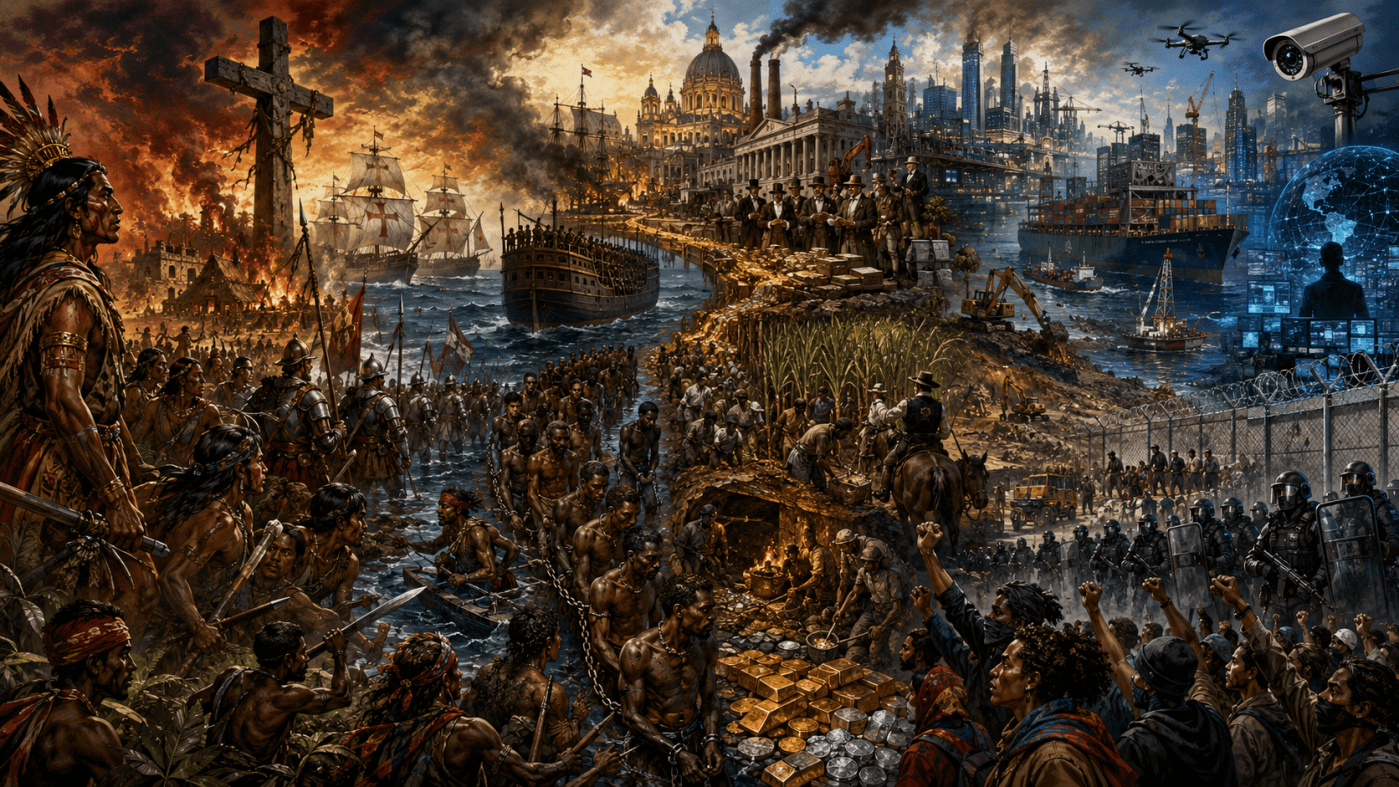
Before Europe crowned itself the author of history, the world was already awake — Africa, Asia, and the Americas were building, trading, farming, thinking, governing, and creating without waiting for permission from Lisbon, London, Paris, or Madrid. But Europe learned the Atlantic method before Columbus reached the Caribbean: raid Africa, seize the islands, fortify the trade, grow the sugar, enslave the laborer, bless the violence, and call the crime civilization. From Indigenous genocide and African enslavement to colonial underdevelopment, neocolonial debt, neoliberal democracy, hyper-imperialism abroad, and technofascism at home, the modern world system was built by conquering living worlds and then stealing the memory of the conquest. This essay is not a museum tour through atrocity; it is a map of the system that must be broken if the future is to be returned to the people who produce it.
By Prince Kapone | Weaponized Information | June 2, 2026
The World Was Already Awake
The first lie of empire is always a creation story. Before the gun, before the chain, before the plantation ledger, before the treaty written in one language and broken in another, comes the myth. The myth says Europe found an empty world. It says history began when the European arrived, panting from the deck of his ship, clutching a cross in one hand and a bill of sale in the other. It says the peoples of Africa, Asia, and the Americas were waiting in darkness for Europe to bring light, as if the sun itself had been manufactured in Lisbon, London, Paris, or Madrid.
They call it “discovery,” which is a very polite word for arriving somewhere already inhabited and then behaving like a thief with a flag. They call it “exploration,” as if curiosity required soldiers, priests, cannons, slave ships, and royal charters. They call it the “Age of Discovery,” because “the Age of Conquest, Kidnapping, Genocide, and World-Theft” would make the schoolchildren ask too many useful questions. But the world was not discovered by Europe. The world was already awake.
Long before Europe became the self-appointed narrator of human history, the peoples of the world had built cities, cultivated land, organized trade, studied the stars, developed mathematics, governed territories, sailed oceans, forged metal, raised temples, debated philosophy, created music, domesticated crops, healed bodies, buried their dead with ceremony, educated their children, and told stories about the origin and purpose of life. There were worlds before the so-called New World. There were systems before the European world-system. There was history before Europe learned to call its violence civilization.
The older Afro-Eurasian world was not a scattered collection of isolated villages waiting for a Portuguese sailor to make it meaningful. It was a vast, interconnected, multicentered field of human activity. China, India, Southeast Asia, the Islamic world, East Africa, Central Asia, the Mediterranean, and parts of Europe were linked by trade routes, caravan paths, port cities, credit systems, religious networks, scholarly exchanges, and political rivalries. Goods moved. Ideas moved. People moved. Technologies moved. Stories moved. The world breathed through many lungs.
Europe was not the brain of this older world. Europe was one region within it, and for much of the period before its rise to global dominance, not the most advanced region either. This is the part that offends the imperial ego. The European bourgeoisie likes to imagine itself as the original author of motion, the inventor of movement, the first creature to put one foot in front of the other without falling into a swamp. But Europe entered circuits that already existed. It learned from others. It borrowed. It copied. It purchased. It translated. It envied. Then, when the conditions shifted, it armed itself, seized the routes, broke older circuits, and later wrote the history books as if it had created the world it had actually conquered.
This matters because the mythology of capitalism depends on Europe appearing as the natural center of human progress. If Europe was always ahead, then conquest becomes the expansion of progress. If Europe was always rational and the rest of the world stagnant, then colonialism becomes a regrettable but necessary modernization project. If Europe alone possessed history, then the destruction of other peoples can be presented as their entrance into history rather than their violent interruption by an armed outsider. That is not history. That is empire writing its own alibi.
The world before European hegemony was uneven, contradictory, and full of its own class relations, state formations, wars, hierarchies, and internal struggles. We do not need to romanticize it. Romanticism is just colonialism’s sentimental cousin; both refuse to deal with real people in motion. The point is not that Africa, Asia, or the Americas were perfect gardens before Europe arrived with the serpent of capital. The point is that these societies were alive. They were developing according to their own internal logics, ecological conditions, social contradictions, and struggles over land, labor, authority, belief, and surplus. They were not waiting rooms for European domination.
Africa, the original home of humanity, had produced forms of social organization, agriculture, ironworking, long-distance trade, urban centers, kingdoms, stateless societies, artistic traditions, scientific knowledge, and philosophical systems before Europe began its Atlantic rampage. African societies were uneven, like every human society, but unevenness is not absence. Some regions developed large centralized states; others developed federated, communal, pastoral, agricultural, commercial, or mixed forms of social life. Development did not require Europe’s permission. African peoples were working through the relationship between human beings and nature, between production and social organization, between community and authority, long before the European merchant discovered that human beings could be turned into cargo.
The same must be said of the Americas. The hemisphere was not empty. It was not a wilderness in the colonial sense of the word. It was full of nations, cities, villages, farms, roads, ceremonial centers, irrigation systems, fishing cultures, forest management, agricultural science, astronomy, art, trade, diplomacy, and war. What Europeans called wilderness was often a carefully managed landscape whose order they could not recognize because they mistook their own ignorance for evidence of other people’s primitiveness. The colonizer looks at a world he does not understand and calls it empty. Then he empties it by force and says, “See, it was empty all along.”
Tenochtitlan alone should have shattered the European fantasy. Here was a city built in the middle of a lake, joined to the mainland by causeways, supplied by aqueducts, organized through markets, gardens, canals, public works, and systems of governance that stunned the Spanish invaders who first saw it. Men from Europe, accustomed to cities that stank of sewage and disease, found themselves looking at a metropolis of water, stone, commerce, engineering, and beauty. They saw markets larger and more orderly than any they knew. They saw roads and canals filled with movement. They saw gardens, temples, houses, public spaces, and an urban life that did not ask Europe for validation. Then they destroyed it.
That is the relationship between colonial myth and colonial practice. First, the colonizer denies the civilization of the people he intends to rob. Then, when their civilization stands before him too magnificent to deny, he destroys it and later claims there was nothing there. The ruins become proof of the lie the conqueror told before he made the ruins.
History has to be fought over like land because it is the territory of memory. Whoever controls the story controls the map of what people believe is possible. If Europe created the world, then the rest of humanity must be grateful pupils. If Europe discovered the world, then the peoples it conquered become background scenery in Europe’s adventure. If Europe developed itself by genius alone, then the colonized are told to imitate the thief who stole from them. But if Europe rose by conquering worlds already alive, then the whole moral structure of imperial civilization begins to rot in public.
The older world was not waiting for capitalism. It was not waiting for the slave ship, the plantation, the mine, the mission, the reservation, the chartered company, the colonial school, the gunboat, the debt collector, or the development expert with soft hands and hard conditions. Europe did not arrive as the bearer of universal history. It arrived as one force among many, then became dominant through a particular historical combination: maritime expansion, military violence, merchant capital, religious conquest, state formation, class struggle, and the systematic theft of land and labor across continents.
To say this clearly is not to deny European development. Europe did develop. The question is how. The ruling-class version says Europe developed because it was uniquely rational, uniquely free, uniquely scientific, uniquely restless, uniquely blessed by God, geography, or the invisible hand — that ghostly little pickpocket who always seems to work in favor of the property owner. But the real historical question is not whether Europe developed. The question is what Europe had to break, seize, drain, enslave, and erase in order to develop in the way that it did.
Once that question is asked, the museum glass cracks. The explorer becomes a conqueror. The merchant becomes a trafficker. The missionary becomes an ideological advance guard. The plantation becomes a factory of death. The colony becomes not a backward zone outside capitalism but one of the places where capitalism learned its most important habits: forced labor, racial classification, monopoly, extraction, enclosure, militarized trade, and the conversion of living worlds into dead commodities.
This is why we begin before Columbus. Not because Columbus was unimportant, but because the world he entered was important. If we start with Columbus, we have already accepted the colonizer’s frame. We have already allowed Europe to stand at the doorway of history with a stolen key. We have to begin with the people who were already there: the farmers, fishers, weavers, healers, traders, builders, mothers, children, elders, astronomers, storytellers, rebels, and workers whose worlds were later thrown into the furnace of European expansion.
The modern imperial order depends on a double theft. It steals the material world and then steals the memory of the theft. It takes the land and calls the land empty. It takes the labor and calls the labor primitive. It takes the gold and calls the people poor. It takes the children and calls the survivors uncivilized. It burns the city and later publishes a book explaining that the city never existed.
Against that machinery of forgetting, we insist on a simple beginning: the world was already awake. Africa was awake. Asia was awake. The Americas were awake. The peoples of the world were making history before Europe crowned itself humanity’s schoolmaster. Europe did not bring motion to a motionless planet. Europe entered a world already moving, then fought to bend that motion toward its own accumulation.
But that interruption did not begin in the Caribbean. Before Europe struck the Americas with the full force of conquest, it had already begun testing the Atlantic method on Africa and the islands off its coast. The next step in the story, then, is not Columbus. It is the prelude to Columbus: the African coast, the Atlantic islands, the first sugar plantations, the first fortified trade posts, the first captives, and the early rehearsal of the system that would soon cross the ocean and become a world.
Before Columbus, Europe Practiced on Africa and the Atlantic Islands
The interruption did not begin in the Caribbean. By the time Columbus sailed west, Europe had already been learning the grammar of Atlantic conquest along the African coast and across the nearby islands. The Americas would become the great expansion of the method, but Africa and the Atlantic islands were among its first classrooms. Before the Taíno were marked for tribute, before Hispaniola became a killing field, before sugar remade the Caribbean into a furnace of profit and death, European merchants, monarchs, priests, and soldiers had already begun testing the tools of Atlantic domination: raid the coast, seize the route, settle the island, fortify the trade, bless the violence, grow the sugar, enslave the African, and call the whole obscene experiment civilization.
Europe did not sail west in 1492 as an innocent child of curiosity. It sailed west already trained by the Atlantic. Portugal and Spain had spent the fifteenth century pushing outward through North Africa, the Atlantic islands, and the West African coast. Their motives were not mysterious. They wanted gold. They wanted captives. They wanted routes. They wanted Christian glory over Muslim rivals. They wanted access to African wealth without passing through older commercial networks they did not control. In short, they wanted the world on cheaper terms.
The conquest of Ceuta in 1415 helped open this Atlantic-African turn. From there, Portuguese power looked southward and seaward, hungry for the gold that moved through trans-Saharan routes and African commercial worlds connected to them. The European did not “discover” African wealth. He heard of it, desired it, and then built fleets and forts to redirect it. Here already we see the colonial method in embryo: do not create wealth; capture the routes through which wealth moves. Do not develop production; command the channels by which production is exchanged. Do not enter the world as a participant; enter it as a pirate with a priest and a flag.
The Atlantic was militarized before it was mythologized. Portuguese ships did not simply drift down the African coast in a spirit of geographic wonder. They probed, raided, traded, mapped, attacked, negotiated, and fortified. They were not merely looking for places. They were looking for leverage. They wanted West African gold, African captives, island colonies, sea routes around older commercial powers, and papal blessing for robbery committed in the name of God. The Church, never one to miss a profitable miracle, supplied the paperwork of holiness.
The Canary Islands were among the early laboratories of conquest. Before Europe called the Americas a New World, it practiced old violence on the peoples of the Canaries. There, European colonizers fought, enslaved, converted, and dispossessed Indigenous island peoples. The Canaries revealed a pattern that would later become familiar across the Americas: non-European peoples could be declared inferior, Christianized by force, stripped of land, reduced to labor, and then blamed for resisting the process. The islands were not a footnote before Columbus. They were a rehearsal.
This matters because the Atlantic island became a bridge between older Mediterranean conquest and the coming American catastrophe. The island was small enough to dominate, close enough to manage, fertile enough to exploit, and distant enough from Europe to permit experiments in cruelty without too much moral inconvenience. There, conquest could be condensed. Land, labor, religion, racial thinking, and export production could be tested in a limited theater before being scaled upward. The island colony became capitalism’s early laboratory animal.
Madeira sharpened a different lesson. Unlike the Canaries, Madeira was not a case of European conquest over an Indigenous island population. Its importance lay in what Portuguese settlement made possible: the conversion of an Atlantic island into a plantation-export platform. Once settled, Madeira became a major site of sugar cultivation before the Americas. Sugar was never merely a crop. Sugar was a social order. It required land concentration, capital investment, mills, fuel, transport, discipline, export networks, and a labor force that could be worked with ferocious intensity. Grain could be grown by small settlers. Sugar demanded command.
The sweetness of sugar has always required a bitter social arrangement. Cane does not politely ask to become profit. It has to be cut, crushed, boiled, refined, packed, shipped, insured, financed, and sold. Behind every spoonful stood land control, labor discipline, and commercial calculation. Madeira helped teach Europe that a tropical Atlantic island could become a machine for metropolitan profit if land was reorganized and labor subordinated to export production. The later Caribbean sugar complex did not fall from the sky. It had ancestors.
Those ancestors stood in the Atlantic before 1492: the Canaries as a school of conquest and Indigenous dispossession; Madeira as a school of sugar monoculture; Cape Verde as an Atlantic staging ground; São Tomé as the sharper fusion of plantation production and enslaved African labor. These places were not identical. They did not all follow the same path. But together they formed a chain of experimentation. Europe was learning how to move from raiding to settlement, from settlement to plantation, from plantation to export monopoly, from export monopoly to capital accumulation. The Americas would not invent this logic. They would enlarge it grotesquely.
The human side of the experiment was African captivity. Portuguese slave raiding began before Columbus. Africans were seized and taken to Europe. Markets displayed Black captives as commodities. Europe was learning to look at African life and see cargo. This was not yet the full transatlantic slave system that would later swallow millions into the plantations of the Americas, but the decisive turn had begun. African labor was being detached from African societies and inserted into European accumulation.
At first, that labor was demanded in Portugal, Spain, and the Atlantic islands. The sequence matters. African captives were not first carried across the Atlantic to the mature plantations of Barbados, Jamaica, Saint-Domingue, Brazil, or the American South. Before that later horror, African labor was already being consumed in Iberia and the island colonies. The plantation did not wait for the Americas to exist as a method. The method was already forming on Africa’s doorstep.
This is where Blackness began to be attached more tightly to enslavability in European consciousness. Race did not fall from heaven. It was assembled in the workshop of conquest. Older religious hatred, Christian triumphalism, color symbolism, anti-Muslim warfare, and ideas of heathen inferiority were now being fused with commercial slavery and African captivity. The fully developed racial ideology of the plantation Americas would come later, but its early materials were already being gathered. The European did not simply discover racial difference; he organized difference into a labor system.
Elmina made the structure harder. The Portuguese built a fortified presence on the Gold Coast in the late fifteenth century to secure access to West African gold and coastal trade. At its origin, Elmina should be understood first as a fortress of gold commerce, not as the fully developed slave-trade machine it would later become. But the logic was already clear. A fort is not a handshake. A fort is commerce with teeth. It announces that trade is no longer only exchange; it is exchange under armed supervision. Gold, coastal routes, commercial leverage, and later captives were drawn toward European command through stone, cannon, charter, and crown.
The fortified trading post was one of the great inventions of early capitalist colonialism. It allowed a relatively weak European power to insert itself into existing African systems without conquering whole interiors at once. It could sit on a coast, disrupt older routes, redirect exchange, bargain with some forces, attack others, protect monopoly, and slowly convert horizontal African trade into vertical ties with Europe. The fort was a wedge driven into the side of a living economy.
This verticalization was one of the early signs of underdevelopment in formation. African regions had their own internal and interregional trade connections. Portuguese intervention did not merely add a new partner. It disrupted older circuits and redirected commerce outward. Instead of African communities trading across their own networks on their own terms, more coastal exchange was bent toward European ports, European demand, European profit, and European political leverage. Dependency began not only when Europe took goods, but when it broke the relationships through which African societies related to one another.
This is an old trick of empire. Break the local road and build a road to the port. Break the regional market and build an export corridor. Break the internal craft economy and sell imported manufactures. Break the people’s links to each other and force each link to pass through the metropolis. The colonized are then told they have been connected to the world. In truth, they have been disconnected from themselves.
São Tomé brought the lessons together with terrible clarity. Like Madeira and Cape Verde, São Tomé was not a case of Europeans conquering an existing Indigenous island society. Its significance lay in what the Portuguese made of it: an island colony where sugar cultivation and enslaved African labor were joined before the great Caribbean plantation complex matured. São Tomé demonstrated that a small colonial presence could command land, import enslaved Africans, organize sugar production, and send wealth outward. It was not yet Barbados. It was not yet Saint-Domingue. But it was the bridge.
São Tomé connected slave raiding to plantation production. It showed that African captives could be moved into tropical island agriculture, disciplined under colonial power, and made to produce commodities for European markets. The later plantation world would become larger, more systematized, more racialized, and more monstrous. But the basic elements were already present: controlled land, captive labor, export crop, metropolitan accumulation, religious cover, and armed command.
This is why 1492 cannot be treated as a sudden beginning. Columbus did not sail into the Caribbean carrying only a map and a dream. He carried a world of prior violence with him. He came from an Atlantic shaped by Portuguese slaving, African gold, island sugar, Christian conquest, fortified trade, papal sanction, and the emerging habit of treating non-European peoples as objects to be converted, used, sold, or removed. The Caribbean did not create the colonial mind. It gave that mind a hemisphere.
Columbus himself had moved within this Atlantic-African world before 1492. His own experience connected him to the Portuguese Africa trade, including the Atlantic circuits around West African commerce. He was not untouched by the world of gold, captives, islands, forts, ships, and royal ambition. The fantasy of Columbus as innocent explorer collapses the moment he is placed back into the world that produced him. He did not sail west from innocence. He sailed west from Africa’s shadow.
Nor was Africa passive in this process. Africa was not a shoreline waiting to be acted upon. It was a battlefield of resistance, negotiation, adaptation, and contradiction. African peoples fought Portuguese raids, resisted forts, resisted missionaries, resisted slavers, resisted collaborators, and defended their own social worlds. Some African elites collaborated, traded, and sought advantage under pressure of firearms, rivalries, state interests, and commercial opportunities. But collaboration under the pressure of a world market being reorganized by Europe is not the same as authorship of the system. The engine of Atlantic slavery was European demand and European capitalist expansion.
The old trick is to blame Africans for the slave trade by pointing to African collaborators, as if millions of captives had assembled themselves on beaches in anticipation of European convenience. This argument is a coward’s shelter. It hides the world system behind local intermediaries. Yes, African collaborators existed. Yes, internal African contradictions mattered. Yes, some rulers and merchants became entangled in the trade. But Europe created the transatlantic plantation demand that transformed African captivity into a world-capitalist labor system. Europe armed the routes, financed the voyages, expanded the plantations, controlled the oceanic circuits, and converted African captivity into a central mechanism of accumulation.
Resistance and collaboration developed together because European expansion intensified existing contradictions. It rewarded those who could deliver captives. It punished those who obstructed the trade. It used firearms, goods, alliances, missions, and coastal leverage to pull societies toward a destructive external logic. African development was not naturally moving toward mass export of its own people. It was dragged, bribed, raided, pressured, and distorted into that role.
This is why the pre-Columbian assault on Africa and the Atlantic islands must be placed before the story of 1492. The Atlantic method was not invented after the Americas were reached. It had already been developing through African plunder, island colonization, fortified commerce, plantation monoculture, and slave labor. Europe learned that gold could finance expansion, forts could command trade, islands could be turned into export platforms, sugar could produce fortunes, African labor could be enslaved, Christianity could decorate conquest, and racial categories could help stabilize exploitation.
By 1492, the elements were ready. The Portuguese and Spanish had already participated in a world where conquest, commerce, Christianity, and captivity were merging. The Americas would provide the enormous land base. Africa would provide the coerced labor supply. Europe would provide the ships, guns, capital, theology, and state power. The Atlantic would become the circuit. The plantation would become the institution. Race would become the ideology. Capital would become the beneficiary.
The transition from Africa and the Atlantic islands to America was not accidental. The genocide of Indigenous peoples in the Caribbean and the mainland created a labor crisis from the standpoint of colonial accumulation. Europe answered that crisis by expanding the African slave trade. What had been tested in Portugal, Spain, the Canaries, Cape Verde, Madeira, and São Tomé now moved into the wider American theater. The method scaled upward. The wound became hemispheric.
This does not reduce Africa to a preface to America. It does the opposite. It restores Africa to the center of the making of the modern world. The modern Atlantic order was not born when Europe found America. It was born when Europe began reorganizing Africa, the Atlantic islands, and then the Americas into a single machinery of accumulation. Africa was not peripheral to this story. Africa was the first great target, the first great source of coerced labor, the first great field of European capitalist learning, and one of the central foundations of Europe’s rise.
This is why the phrase “Age of Discovery” is worse than false. It is insulting. Europe was not discovering. It was training. Training itself to raid, enslave, fortify, plant, extract, classify, convert, and lie. By the time Columbus reached the Caribbean, Europe had already begun writing the first chapter of the Atlantic world in African blood. The Americas did not invent Europe’s colonial method; they gave it a hemisphere.
The Crime That Called Itself Discovery
By the time Columbus reached the Caribbean, Europe had already learned that conquest could be organized before it was openly named. The tools had been tested along the African coast and in the Atlantic islands: fortified commerce, slave raiding, sugar production, religious sanction, racial thinking, and island colonization. What changed in 1492 was not the invention of the method. What changed was the scale. The Atlantic experiment crossed into a hemisphere.
Columbus did not open the world. He opened a wound.
The historical weight of his voyage does not rest on the childish claim that he was the first to cross the Atlantic or the first to make contact with the peoples of the Americas. That story survives because empire prefers fairy tales with ships in them. The real significance of 1492 is that it marked the expansion of Europe’s Atlantic method into the Caribbean, where contact quickly became conquest, curiosity became classification, Christian mission became domination, and commercial hunger became mass death.
Columbus is useful to empire because he disguises this transition. Through him, invasion becomes exploration. Theft becomes settlement. Terror becomes adventure. A hemisphere full of nations becomes a “New World,” as if it had been sitting in the dark warehouse of creation waiting for a European inventory clerk to stamp it into existence. The man is less important than the function he performs. He is the smiling mask placed over the first machinery of the modern colonial world.
But history does not begin where the colonizer’s map begins. The peoples of the Caribbean did not become real when Spanish eyes first saw them. Ayiti was not empty. Guanahani was not empty. The islands were inhabited by people with names, languages, relations, memories, gardens, canoes, ceremonies, rivalries, obligations, and futures. Those futures were not lost by accident. They were attacked.
The Caribbean became the first great American laboratory of this attack. There, the invader arrived weak, dependent, hungry, and confused. The Indigenous people received him with forms of hospitality that he interpreted not as generosity but as opportunity. The old colonial drama began: the open hand of the host met the hidden blade of the guest. The European had not come to join a world. He had come to possess it.
Gold became the first fever. Land became the first appetite. Labor became the first demand. Bodies became instruments. Villages became supply zones. Women became targets. Children became disposable. The cross did not restrain the sword; it walked beside it, blessing the edge. The Crown wanted wealth. The Church wanted souls. The soldier wanted plunder. The merchant wanted commodities. The colonizer, that early specialist in multitasking, found a way to call all of this civilization.
On Hispaniola, the system announced itself without shame. Forced labor, tribute demands, mutilation, sexual violence, military terror, enslavement, starvation, despair, and disease combined into one machinery of destruction. The people were not merely dying from invisible microbes moving innocently through the air. They were being driven into conditions where disease became more lethal, hunger became policy, labor became punishment, and social life itself was broken apart.
Pestilence did not sail alone. It came with armored men, royal orders, forced marches, work gangs, attack dogs, priests, whips, mines, and the demand that a people surrender their world or be crushed under the claim of another. Disease was real, devastating, and historically decisive. But to isolate disease from conquest is to turn the crime scene into a weather report. A virus has no ideology. A microbe writes no royal charter. Smallpox does not organize labor drafts, burn villages, feed prisoners to dogs, or draft theological arguments about heathens and savages.
The genocide of Indigenous peoples in the Americas was not a tragic misunderstanding between cultures. It was not a sad but inevitable byproduct of contact. It was not the regrettable cost of progress. It was a structure of action: labor extraction, territorial seizure, religious sanction, racial degradation, sexual domination, military violence, and the calculated destruction of Indigenous capacity to survive as peoples.
The European did not merely kill. He reorganized the conditions of life so that death became normal. That is one of empire’s oldest talents. It creates a world in which the oppressed die from exhaustion, hunger, disease, displacement, and despair, and then says, “We did not kill them. They simply disappeared.” Disappeared — that favorite word of respectable murderers. As if whole nations misplace themselves.
The Caribbean catastrophe was only the beginning. From the islands, the method expanded. It moved into Mexico, Central America, the Andes, the forests, the plains, the missions, the mines, the plantations, the reservations, and the borderlands. Sometimes it wore Spanish armor. Sometimes it wore English wool. Sometimes it spoke French. Sometimes Dutch. Later it spoke the language of republican liberty, manifest destiny, private property, frontier democracy, and American freedom. The accent changed. The structure remained.
What began in 1492 was not merely European arrival in the Americas. It was the birth of a new historical relation on American soil: Europe claiming the right to convert other people’s land into its territory, other people’s labor into its wealth, other people’s gods into demons, other people’s resistance into savagery, and other people’s death into progress.
This is where Columbus becomes more than an individual. Of course, the man himself was greedy, brutal, delusional, and ambitious. But the deeper issue is not the psychology of one sailor. The deeper issue is that Europe made a world out of his crime. Columbus stands at the ceremonial entrance to the colonial order. He is the ribbon-cutting official at the opening of the slaughterhouse.
That is why the fight over Columbus is never simply a fight over a holiday. It is a fight over whether the victims of conquest will be forced to celebrate the beginning of their own destruction. It is a fight over whether children will be taught that colonialism was bravery, Indigenous peoples were obstacles, and Europe’s hunger was humanity’s destiny. The ruling class does not defend Columbus because it loves navigation. It defends Columbus because it needs the origin myth.
Every empire needs a clean beginning. It needs a first chapter without blood on the page. It needs the settler child to inherit innocence and the colonized child to inherit confusion. It needs stolen land to appear found, forced labor to appear necessary, mass death to appear unfortunate, and survivor anger to appear irrational. Columbus performs this work. He is not only a historical figure. He is an ideological device.
That device still functions. The same civilization that tells Indigenous people to “move on” from conquest preserves monuments to the conqueror. The same system that asks the descendants of the enslaved and exterminated to forgive has not returned the land, repaired the theft, dismantled the institutions built from the crime, or stopped committing new versions of it. Forgiveness, in the mouth of the powerful, usually means: “Please stop remembering what we still benefit from.”
There can be no honest discussion of Columbus without discussing the world that followed him: the encomienda, the slave raid, the plantation, the mine, the mission, the fort, the chartered company, the settler colony, the racial code, the imperial school, the police patrol, the border, the reservation, the debt regime, and the development plan. Columbus is not important because he stands alone. He is important because he stands at the beginning of a chain.
That chain bound the Americas to Europe through plunder. It bound Africa to the Americas through kidnapping. It bound labor to land through terror. It bound Christianity to conquest through holy language. It bound race to class through the practical needs of colonial accumulation. It bound memory to power by teaching the descendants of the crime to call the criminal a hero.
This is why 1492 must be understood as the Atlantic rupture in its American form. It did not simply connect worlds. It violently reorganized them. It opened the path toward Indigenous genocide, African enslavement, plantation capitalism, colonial extraction, and European world domination. It brought together stolen land and stolen labor in a new system of accumulation that would eventually help finance the rise of European capitalism and the modern imperial order.
The bourgeois historian looks at this and sees an “encounter.” A very convenient word, encounter. One almost expects tea to have been served. But when one side arrives with swords, crowns, priests, hunger for gold, and a doctrine of divine entitlement, and the other side is soon buried in mass graves, chained in mines, hunted by dogs, or dead from the combined force of disease and forced labor, “encounter” becomes one of those elegant words civilization uses to perfume a corpse.
We should speak plainly. Columbus did not discover America. Europe did not discover America. What Europe discovered was that conquest could be made profitable on a world scale. It discovered that the land of one people could be seized, the labor of another people could be stolen, and the whole arrangement could be sanctified by priests, protected by soldiers, financed by merchants, and narrated by scholars as the forward march of mankind. That is the discovery that matters.
Once Europe made that discovery, the modern world began to take its bloody shape. The Indigenous peoples of the Americas were marked for removal, conversion, exploitation, or death. Africa was marked as the great reservoir of coerced labor. Europe marked itself as master, judge, savior, owner, and historian. The Atlantic became not merely an ocean but a circuit of terror: ships moving bodies, commodities, guns, sugar, gold, silver, tobacco, cotton, doctrine, and death.
The old maps show ships crossing blue water. They do not show the screams below deck, the villages emptied, the women violated, the children orphaned, the elders murdered, the gods insulted, the fields abandoned, the languages broken, the bones beneath the mission, the skulls beneath the plantation, the names erased from the record. That is why we need another map. A people’s map. A map drawn not from the captain’s cabin but from the hold of the ship, the burned village, the stolen field, the mountain mine, the maroon camp, and the memory of those who refused to disappear.
To name 1492 as rupture is not to remain trapped in the past. It is to identify the foundation of the present. The modern world system did not fall from the sky. It was built. It was built through conquest dressed as discovery, genocide dressed as settlement, slavery dressed as commerce, and theft dressed as law. The crime called itself civilization. Then civilization printed textbooks.
Our task is to read the blood beneath the ink.
Stolen Land Needed Stolen Labor
Once the American rupture was opened, conquest had to become organization. Land alone was not enough. A stolen hemisphere does not automatically produce wealth for the thief. Forests do not cut themselves for export. Mines do not empty themselves into royal treasuries. Sugar does not plant, cut, boil, barrel, ship, insure, refine, sell, and sweeten the tea cups of Europe by the grace of God, no matter how many priests are sent to bless the enterprise. Conquest gave Europe access to territory. Capital required labor to make that territory yield commodities.
This is where the two foundational crimes of the Atlantic world fused into one system. Indigenous land was seized, Indigenous societies were shattered, and African people were kidnapped across the ocean to work the stolen ground. The Americas were not built on “opportunity.” They were built on the theft of land from one people and the theft of labor from another. That is the material grammar of the so-called New World.
Indigenous peoples were the first targets of Europe’s labor hunger in the Americas. They were enslaved, taxed, driven into mines, forced into tribute systems, and dragged into work regimes designed to extract gold, food, transport, and service for the conquerors. Their bodies were made to carry the first burdens of the colonial economy. But the same violence that tried to turn them into labor also tore apart the social worlds that sustained them. War, disease, terror, hunger, displacement, and forced work produced catastrophe. The colonial machine devoured the people it first tried to exploit.
Europe responded to this devastation not by questioning the machine, but by feeding it new victims. The problem, from the standpoint of the conqueror, was never that human beings were being destroyed. The problem was that labor supply was being interrupted. The moral universe of the colonizer is a very economical place: death becomes unfortunate only when it slows production.
So Africa was pulled deeper into the furnace. Not as metaphor. Not as background. Not as a sorrowful appendix to the “real” story of European development. Africa became the coerced labor reservoir for the stolen hemisphere. European capitalism, still young and already dripping from the mouth, found in Africa the human material it required for plantation production, mining, shipping, and colonial accumulation.
This was not simple cruelty floating loose in history. It was organized cruelty with a business plan. The Atlantic slave trade became one of the first great logistics systems of capitalism. Ships were built. Ports expanded. Credit was arranged. Insurance policies were written. Guns, textiles, rum, metal goods, and trinkets moved toward the African coast. Human beings were captured, sold, branded, chained, packed into holds, carried through the Middle Passage, auctioned in the Americas, and forced into commodity production. Sugar, tobacco, cotton, coffee, rice, indigo, and other products moved outward. Profits moved upward. Europe called this commerce.
Commerce is a strange word in the mouth of empire. It sounds clean. It wears a coat. It smells faintly of ink and ledgers. But in the Atlantic world, commerce meant villages raided, children stolen, mothers separated, bodies packed into ships, men and women sold under the hammer, fields worked under the lash, and fortunes accumulated in counting houses far from the sound of the whip. The bourgeoisie has always preferred the invoice to the scream. The invoice is easier to frame.
The plantation became the central institution of this new order. It was not a backward relic accidentally attached to capitalism. It was capitalism in one of its most naked forms: land monopolized, labor coerced, production organized for distant markets, violence administered as labor discipline, and surplus converted into metropolitan wealth. The fact that the laborer was enslaved rather than formally free does not place the plantation outside capitalism. It reveals how flexible capitalism has always been when profit is at stake. The system that later wrote hymns to free labor had no difficulty building itself on laborers who were not free enough to own their own bodies.
Here we must be precise. Capitalism did not require freedom in any moral sense. It required command over labor. In Europe, that command increasingly took the form of wage labor, enclosure, poverty, debt, and the market compulsion that tells the worker: sell yourself by the hour or starve with your dignity intact. In the colonies, where land was abundant from the colonizer’s standpoint and labor could flee, resist, or sustain itself outside wage dependence, capital required more direct forms of force. Chains, passes, patrols, branding irons, slave codes, militias, dogs, and terror supplied what the labor market could not yet accomplish on its own.
This is why slavery cannot be treated as capitalism’s opposite. Slavery was one of capitalism’s foundations. The plantation, the ship, the bank, the insurer, the refinery, the textile mill, the merchant house, and the imperial state were not separate moral universes. They were connected organs of one expanding Atlantic body. The sugar island and the English factory belonged to the same historical organism. The slave ship and the bank ledger spoke different languages, but they served the same master.
British capitalism did not rise from thrift, Protestant virtue, parliamentary wisdom, and cups of tea politely stirred by invisible hands. It rose through triangular trade, colonial monopoly, slave-produced commodities, port-city accumulation, maritime insurance, shipbuilding, credit, banking, and the vast commercial web that linked African captivity to Caribbean plantations and European industry. The enslaved African was not outside the story of industrial capitalism. He and she were buried under its foundation.
This is the meaning of the triangular trade. It was not a triangle on a classroom map. It was a circuit of organized dispossession. One side carried goods to purchase captives. One side carried captives into slavery. One side carried slave-produced commodities into European accumulation. The geometry is simple only on paper. In real life, each line of the triangle was a corridor of grief and profit.
The wealth created by this system did not remain on the plantation. It moved. It financed merchants, manufacturers, shipbuilders, bankers, insurers, refiners, and investors. It helped grow ports like Liverpool, Bristol, and London. It stimulated industries that supplied the slave trade and plantation colonies. It generated demand for textiles, iron goods, firearms, chains, rum, barrels, tools, and shipping. It supplied sugar, tobacco, cotton, and other commodities that helped transform consumption, production, and accumulation in Europe. The plantation was not isolated from the factory. It helped make the factory possible.
The same system that converted Indigenous land into colonial property converted African people into capital-bearing bodies. Enslaved Africans were counted as property, mortgaged as assets, insured as cargo, punished as labor, and reproduced as wealth. The capitalist could look at a person and see a machine, a cost, an investment, a risk, a depreciation schedule, a future crop. This is what happens when human beings are dragged fully into the logic of accumulation: the soul disappears from the ledger, and the ledger calls this efficiency.
But the ledger never told the whole truth. It did not record the cosmologies broken, the names stolen, the languages suppressed, the families torn apart, the drums outlawed, the bodies mutilated, the women violated, the children sold, the old people discarded, the maroons hunted, the rebels executed, the prayers whispered, the poisons mixed, the tools broken, the work slowed, the fires set, the uprisings planned, the songs encoded with memory and escape. Capital counted labor. It could not fully count resistance.
The enslaved were not passive instruments of production. They were captive workers in a war over life itself. Every plantation was a battlefield disguised as an estate. Every work gang carried within it the possibility of slowdown, sabotage, flight, conspiracy, revolt, and survival. The enslaved produced wealth under terror, but they also produced cultures of resistance. They made families under conditions designed to destroy family. They made music under conditions designed to reduce them to laboring flesh. They made gods, languages, rebellions, and new peoples in the belly of a system that intended only profit.
This is why the story cannot be told as economic structure alone, though the economic structure must be exposed without mercy. A system of stolen land and stolen labor is also a system of stolen time, stolen kinship, stolen memory, stolen movement, stolen childhood, stolen burial, stolen language, stolen future. The capitalist sees labor-power. The oppressed remember the person. Revolutionary history must restore the person without losing sight of the system that consumed them.
Anti-Black racism hardened inside this system as its ideological armor. The European did not first develop a complete theory of Black inferiority and then, from the purity of racist thought, accidentally stumble into the slave trade. The trade, the plantation, and the demand for permanent degraded labor created the need for a doctrine that could explain why millions of human beings could be kidnapped, sold, worked, raped, beaten, and killed while Christian Europe still imagined itself civilized. Racism became the moral technology that made the crime appear natural.
This does not mean Europe had no earlier forms of hierarchy, religious hatred, color symbolism, conquest ideology, or human degradation. It means modern anti-Black racism took shape as a historical weapon fitted to the needs of Atlantic slavery. It taught the master to see domination as nature. It taught the poor European to see himself as superior even when he owned nothing but his skin and his hunger. It taught the colonized to doubt their own humanity. It taught the world that Africa was fit for chains because Europe had already chained Africa.
That is the dirty little miracle of white supremacy. It converts theft into destiny. It tells the slaveholder that he is not a criminal but a guardian. It tells the settler that he is not a land thief but a pioneer. It tells the worker in the imperial core that he may be exploited, but at least he is not one of them. It turns class rule into racial common sense and makes the oppressed fight one another over crumbs falling from a table built with stolen wood.
The fusion of land theft and labor theft produced the Atlantic foundation of modern capitalism. Indigenous dispossession provided the territorial base. African enslavement supplied the coerced labor force. European merchants moved the commodities. European states protected the system. European churches sanctified it. European philosophers later explained it. European capitalists banked it. European workers were drawn into industries stimulated by it. European civilization then looked in the mirror and congratulated itself on its progress.
Progress, in this story, is a word that should be handled with gloves. The progress of Europe was not simply the unfolding of science and reason. It was the accumulation of stolen life. The sweetness of sugar carried the bitterness of the cane field. The softness of cotton carried the violence of the lash. The elegance of European finance carried the stench of the slave hold. The rise of the factory carried the shadow of the plantation. The modern world was not born clean and later corrupted. It was born in the hold, the mine, the mission, the plantation, the fort, the auction block, the burned village, and the counting house.
To understand this is to understand why the colonial question is not secondary to capitalism. It is not an external question. It is not a moral footnote. It is not a chapter to be added after the “real” economic history has been told. The colonial question is inside the machinery. Capitalism’s Atlantic birth required conquest, racial slavery, Indigenous dispossession, coerced labor, monopoly, state violence, and the transformation of whole peoples into inputs for accumulation.
The Americas, then, were not simply conquered territories. They became a historical apparatus: a land base seized from Indigenous nations, worked by African captives, governed by European law, sanctified by Christian ideology, and integrated into world markets for the enrichment of the emerging capitalist powers. That apparatus did not merely produce commodities. It produced modern race. It produced settler sovereignty. It produced the colonial state. It produced the wealth of Europe. It produced the underdevelopment of Africa. It produced the internal colonies that still live beneath the flags of the republics that came later.
This is why we must refuse every attempt to separate Indigenous genocide from African enslavement. The two crimes are not identical, and each must be studied in its own specificity. But they are structurally joined in the making of the modern Atlantic world. The land had to be taken. The labor had to be forced. The people had to be classified. The violence had to be justified. The memory had to be rewritten. One crime made room for the other, and together they made room for capitalism’s Atlantic ascent.
The ruling class prefers these histories separated, sentimentalized, and safely buried. Indigenous peoples become tragic figures of a vanished frontier. Africans become victims of an unfortunate labor system. Europe becomes the stage on which freedom, industry, and democracy mature. But put the pieces back together and a different picture appears: a world system built by conquest, organized by racial terror, and financed by stolen labor. That picture is not pleasant. Good. History does not exist to comfort the heirs of theft. It exists to clarify the terrain of struggle.
The stolen land needed stolen labor. The stolen labor made the stolen land profitable. The profits helped build European capitalism. The ideology of race held the arrangement together. The state defended it. The church blessed it. The scholar later cleaned it up for publication. And the oppressed, against all of it, survived, resisted, remembered, rebelled, and carried forward the unfinished demand that the world built from their dispossession must be overturned.
Underdevelopment Was Not a Condition — It Was a Sentence
The system built from stolen land and stolen labor did not stop at the plantation edge. Its consequences moved outward through continents and forward through centuries. Africa was not merely robbed of people. It was robbed of developmental possibility. The Caribbean was not merely planted with sugar. It was planted with dependency. The Americas were not merely colonized. They were reorganized as a platform for European accumulation. What appeared in Europe as wealth appeared elsewhere as devastation, distortion, and arrested motion.
This is the meaning of underdevelopment. It is not a polite synonym for poverty. It is not the natural condition of peoples who somehow forgot to become modern. It is not the result of laziness, bad culture, weak morals, tribal backwardness, tropical weather, poor entrepreneurship, corrupt bloodlines, or any of the other bedtime stories empire tells its children before sending them to business school. Underdevelopment is a relationship. It is the condition produced when one people’s capacity to develop is seized, redirected, blocked, drained, and subordinated to the development of another.
The colonized world did not simply “fall behind.” It was pushed, chained, taxed, raided, conscripted, fenced, indebted, and forced into a position where its labor, land, crops, minerals, forests, rivers, ports, and political institutions served external accumulation. Any serious discussion of development must therefore ask: development for whom, by whom, against whom, and at whose expense?
Europe’s development and Africa’s underdevelopment were not two separate stories unfolding on opposite sides of the ocean. They were two sides of the same historical process. The slave trade drained Africa of millions of human beings in the most productive ages of life. It tore people from agriculture, craft production, warfare, state formation, family reproduction, cultural continuity, and local exchange. It militarized societies. It rewarded raiding over production. It strengthened predatory formations and distorted political authority. It turned human capture into a commercial road to power. It did not merely remove labor; it changed the direction of history.
When a continent is forced to export its people under conditions of terror, it is not simply losing population. It is losing farmers, smiths, healers, builders, mothers, fathers, organizers, rebels, herders, sailors, artists, elders, and children who would have become all of these. It is losing the accumulated and future labor through which societies reproduce and transform themselves. The loss cannot be measured only by counting bodies taken. It must also be measured by the roads not built, the crops not cultivated, the technologies not developed, the institutions not strengthened, the movements not born, and the futures not lived.
Colonial conquest carried the distortion further. Europe had already used Africa as a reservoir of captive labor; now it sought more direct command over African land, minerals, crops, routes, and states. Colonialism did not arrive to develop Africa. It arrived to solve European problems. It arrived to secure raw materials, markets, labor, investment outlets, strategic territory, and political domination. The imperial flag did not mark the beginning of civilization. It marked the arrival of the tax collector, the surveyor, the missionary, the soldier, the concession hunter, the labor recruiter, the mine boss, and the schoolmaster of obedience.
Colonialism reorganized African economies around export. That one word, export, carries a whole system inside it. Export means production directed outward. It means crops selected not by the food needs of the people but by the market needs of empire. It means railways that run from mine to port, not village to village. It means roads that connect extraction zones to shipping points, not communities to one another. It means ports designed as mouths through which the continent is made to vomit wealth outward. It means a country can be rich in resources and poor in power because the structure of production points away from the people.
Colonial infrastructure must therefore never be judged like a child counting toys. “But they built railways,” says the empire’s unpaid defense attorney. Yes, and a thief may build a road from your house to his warehouse. That does not make him a public servant. The question is not whether something was built. The question is what it connected, what it extracted, whom it served, whom it disciplined, and where the surplus went. A railway built to carry copper, cotton, cocoa, rubber, diamonds, gold, or troops to the port is not the same as infrastructure built for national integration and popular development.
Colonial schools followed the same logic. They were not designed to produce liberated human beings capable of transforming their societies. They were designed to produce clerks, translators, minor administrators, catechists, loyal intermediaries, and disciplined subjects who could help run the machinery of domination at a discount. The empire has always preferred a native clerk to an expensive foreign one. It is amazing how quickly the civilizing mission discovers budget efficiency when exploitation requires paperwork.
This education did not merely teach reading and arithmetic. It taught hierarchy. It taught the colonized to admire the colonizer’s language, institutions, manners, gods, history, and categories. It trained certain strata to measure their own people by imperial standards and to see escape from the masses as personal success. It produced individuals who knew how to recite Europe but not how to repair the village, defend the land, or break the chain. This was not education as liberation. It was education as pacification.
The same structure appeared across the colonized world, though never in identical form. Latin America after formal independence remained tied to export dependency, foreign merchants, landed oligarchies, debt, British commercial domination, and later U.S. imperial power. India was reorganized through colonial revenue systems, deindustrialization, commercial agriculture, railways, law, famine, taxation, and the drain of wealth. The Middle East was pressured through debt, trade penetration, strategic rivalry, and the blocking of autonomous industrialization. Southeast Asia was inserted through plantations, mines, ports, and colonial labor regimes. The forms differed. The relation repeated.
The colonized world was made to specialize in its own subordination. One territory was pushed toward sugar, another cotton, another cocoa, another coffee, another rubber, another tin, another copper, another guano, another oil, another plantation crop, another mineral vein. The imperial map was not drawn according to the needs of the people. It was drawn according to the appetite of accumulation. The colony was assigned a role, and that role was then called its comparative advantage. There is the genius of bourgeois economics: first empire breaks your legs, then the economist arrives to explain your natural specialization in crawling.
Underdevelopment should therefore not be imagined as simple stagnation. Often the colony grew. Exports rose. Ports expanded. Cities developed. Mines deepened. Plantations spread. Rail lines stretched across the land. Administrative centers appeared. A middle stratum emerged. Money circulated more widely. But growth is not the same as development. A tumor also grows. The question is whether the growth strengthens the collective capacity of the people to control their own conditions of life, or whether it deepens their dependency on external markets, foreign finance, imported machinery, imperial shipping, comprador elites, and prices set elsewhere.
This distinction is fatal to the mythology of imperial progress. Colonialism could produce activity without producing liberation. It could produce roads without national integration, schools without self-determination, wage labor without dignity, cities without sovereignty, exports without food security, and cash income without control over the conditions of production. It could increase the movement of goods while decreasing the people’s power over their own lives. That is underdevelopment in motion.
The colonial state was built to enforce this motion. It was not a neutral state accidentally misused by bad men. It was an instrument for organizing extraction. It mapped land, imposed taxes, codified property, regulated labor, suppressed rebellion, protected concessions, punished refusal, and forced people into cash relations. The hut tax, poll tax, land tax, pass system, labor ordinance, vagrancy law, and colonial court all belonged to the same family. Their purpose was to make the colonized available to capital and obedient to empire.
Taxation was especially important because it forced people into the colonial economy even when they had other means of subsistence. If a people could live from land, kinship, local exchange, pastoral movement, or communal production, they were not sufficiently available to the mine, plantation, settler farm, or colonial labor market. The tax changed that. It demanded money. To get money, people had to sell labor, grow cash crops, enter markets, migrate, or submit. The tax was not merely fiscal policy. It was a whip with a receipt.
This is how colonialism transformed social life. It did not simply sit on top of existing societies. It entered the village, the household, the field, the forest, the pasture, the market, the school, the church, the court, the road, the mine, and the body. It changed what people produced, when they worked, where they moved, which languages carried power, which crops mattered, which chiefs were recognized, which borders were enforced, which knowledge was rewarded, which gods were insulted, and which classes were elevated.
Colonialism also transformed class relations inside colonized societies. It elevated intermediaries, collaborators, merchants, chiefs, landlords, military clients, clerks, mission-educated elites, and comprador strata whose position depended on the colonial order. These groups were not all identical, and some later broke with colonialism under pressure from the masses. But the structure itself tended to produce local agents of external domination.
That is why national liberation can never be reduced to replacing foreign faces with local ones. A flag can change while the structure remains. A parliament can open while the mine is still foreign-owned, the crop is still exported raw, the currency is still vulnerable, the army is still trained by empire, the school still worships Europe, the port still drains the country, and the ruling class still dreams in the language of its former master. The colonial governor may leave, but if the drain remains, colonialism has only changed clothes.
Underdevelopment also shaped consciousness. A people forced into dependency are then told that dependency proves inferiority. The empire first blocks development, then points to the blockage as evidence that the colonized are incapable of development. It steals the grain and lectures the hungry on agricultural efficiency. It destroys industry and lectures the unemployed on productivity. It drains wealth and lectures the poor on saving. It imposes dependency and calls the dependent childish. This is not hypocrisy in the accidental sense. It is ideology performing its assigned labor.
The great violence of colonialism, then, was not only that it extracted wealth. It reorganized the very possibility of development. It narrowed the horizon. It made colonized societies produce what they did not control, consume what they did not make, borrow what they could not repay, study what did not free them, and obey institutions designed against them. It converted living societies into appendages of another people’s accumulation.
Underdevelopment must be understood historically and relationally. It is not a stage through which all societies naturally pass on the way to becoming Europe. The colonized world was not waiting at the bottom of a ladder that Europe had climbed first. Europe kicked away other peoples’ ladders, stole the wood, built a platform for itself, and then invited the victims to admire the view.
Once this is understood, the whole language of development changes. The problem is not how the poor can catch up to the rich by imitating them. The problem is how the exploited can break the relations that made the rich rich and the poor poor. The problem is not backwardness. The problem is subordination. The problem is not lack of integration into the world economy. The problem is integration on terms designed by the enemy.
This is where the history of underdevelopment becomes a weapon for the present. The same patterns remain with new names. Export dependency becomes global value-chain integration. Debt discipline becomes fiscal responsibility. Foreign control becomes investor confidence. Resource theft becomes development partnership. Military occupation becomes security cooperation. Cultural domination becomes capacity building. The vocabulary improves because the crime has hired better public relations.
Beneath the new language, the old structure can still be seen: land turned outward, labor cheapened, resources extracted, states disciplined, local elites rewarded, popular development blocked, and the people told to be grateful for being included in the system that is bleeding them.
Underdevelopment was not Africa’s original condition. It was not Latin America’s destiny. It was not India’s culture. It was not the Middle East’s religion. It was not the Caribbean’s failure. It was the historical sentence imposed by a world system that developed Europe by deforming the development of others. The sentence has been appealed in every slave revolt, every maroon community, every Indigenous uprising, every anti-colonial war, every general strike, every land occupation, every socialist experiment, every sovereign development project, every people’s movement that has dared to say: we were not born to be appendages of empire.
That struggle remains unfinished. But the first step is clarity. The colonized were not underdeveloped because they lacked Europe. They were underdeveloped because Europe arrived, conquered, extracted, distorted, and then called the wound a gift. To heal the wound, the people must not thank the knife. They must remove it.
Capitalism Learned to Speak in Chains
To understand how underdevelopment was produced, we have to look beneath the surface of colonial society. It is not enough to say that Europe conquered, extracted, and drained. That is true, but still incomplete. The deeper question is how colonialism reorganized production itself. What happened to land? What happened to labor? What happened to property? What happened to taxation, rent, crops, debt, markets, tools, and surplus? What happened to the relationship between the people who worked and the conditions that allowed them to live?
This is where many analyses lose their nerve. The liberal looks at the colony and sees tradition. The crude modernizer sees backwardness. The lazy Marxist sometimes sees “feudal remnants” everywhere a factory whistle is not blowing. The bourgeois economist sees peasants and says they are outside capitalism. The development expert sees informal labor and says it has not yet been integrated. Each one, in his own way, mistakes appearance for structure. He looks at the costume and misses the class relation wearing it.
Colonial capitalism did not always look like the factory system of Manchester. Why would it? The colony was not Manchester. It was not built to reproduce the same social form as the metropolis. It was built to serve the metropolis. That meant capitalism could operate through slavery, forced labor, sharecropping, tenancy, debt bondage, migrant labor, cash-crop farming, corvée, indenture, tribute, taxation, and peasant commodity production. The form of labor could vary. The purpose remained: command land and labor, produce commodities, extract surplus, and route that surplus into wider circuits of accumulation.
The plantation already proved the point. A worker did not need to be formally free in order to be part of capitalist accumulation. Enslaved Africans were not outside capitalism because they were chained. The chain was one of the ways capitalism solved its labor problem under colonial conditions. The plantation was not pre-capitalist because the laborer could be bought and sold. The plantation was capitalist because it organized production for the world market, disciplined labor for surplus extraction, and linked land, credit, shipping, insurance, commerce, and metropolitan industry into one system. Capitalism, that great preacher of liberty, learned very early how to speak in chains.
The same principle applies beyond the plantation. In colonial India, the persistence of peasants, tenants, moneylenders, landlords, sharecroppers, and older village forms did not mean that colonialism left the countryside untouched. British rule did not simply sit above an unchanged “traditional” society. It altered land rights, revenue demands, commercial crops, debt relations, legal categories, market dependence, and the power of intermediaries. Existing labor processes could remain visible while their social meaning changed. A cultivator might still hold a plow, but now the crop, the tax, the debt, the price, and the law tied that labor to imperial accumulation.
This is the importance of formal subsumption. Capital does not have to transform every tool, every technique, and every village overnight in order to dominate production. It can first seize command over the conditions around production. It can impose taxes payable in money. It can compel cash-crop cultivation. It can turn land into alienable property. It can make peasants dependent on merchants, creditors, landlords, export markets, and state revenue demands. It can leave the hand hoe in the field while changing the world in which the hand hoe is used.
This is why colonial capitalism is so often misrecognized. The European textbook expects capitalism to arrive wearing a factory coat. But in the colony, capitalism often arrived as a land settlement, a tax bill, a forced crop, a debt contract, a pass law, a concession agreement, a railway tariff, a moneylender’s ledger, a colonial court order, a police baton, or a merchant advance. The machine was not always in the field. Sometimes the machine was the whole system around the field.
Land was central. In many colonized societies, land was not simply an individual commodity to be bought and sold in the capitalist sense. It was embedded in kinship, community, lineage, use rights, political authority, customary obligations, and spiritual relationships. Colonialism attacked this. It mapped land, surveyed land, titled land, taxed land, privatized land, alienated land, enclosed land, and converted land into security for debt. Once land became a commodity, the people’s relationship to their means of life was transformed. The soil itself was made to answer to capital.
Taxation deepened the transformation. A community that had previously reproduced itself through subsistence farming, local exchange, pastoral movement, or communal obligations could now be forced into money relations. The colonial state demanded cash. Cash required sale. Sale required crops, labor migration, wage work, borrowing, or surrender. The tax did not merely raise revenue. It created a population available to capital. It pushed people toward mines, plantations, settler farms, ports, construction gangs, and cash-crop markets. It made hunger a labor recruiter.
Debt performed similar work. The creditor was often as important as the soldier. Merchant advances, moneylender loans, crop liens, mortgage obligations, and tax arrears drew producers deeper into commodity circuits they did not control. Debt made the future payable to someone else. It turned harvests into obligations before they were even grown. It compelled peasants to produce for markets under conditions where prices were set elsewhere, transport was controlled elsewhere, and the surplus vanished upward through layers of intermediaries. Debt was colonialism’s quiet whip.
Rent also changed its character under colonial conditions. The existence of rent does not automatically prove feudalism. A landlord may wear an old title and collect rent in an old language while functioning inside a new system of commodity production, debt, taxation, and accumulation. The outward form may appear inherited; the social relation may already be transformed. Colonial rule often preserved or reinvented landlord power precisely because landlords could serve as instruments for revenue extraction, labor control, and rural discipline.
This is why the phrase “semi-feudal” can become a lazy hiding place if used without care. It can describe real hybrid conditions in some contexts, but it can also conceal the colonial capitalist relation operating beneath older forms. A sharecropper, tenant, bonded laborer, or peasant producer may not look like an industrial proletarian, but that does not mean they are outside capitalism. Capitalism has never been too proud to exploit people in whatever form history makes available. It is a very flexible monster. It can wear a top hat in London, a planter’s hat in Jamaica, a crown in Delhi, a priest’s robe in Mexico, a company seal in Malaya, and a development badge in Africa.
Java’s sugar economy shows how this worked without requiring every village form to disappear overnight. Land, water, seasonal labor, factory processing, peasant obligations, and colonial state power were joined into an export system. The peasants might still return to villages. They might still cultivate food. They might still stand within older relations of dependency, kinship, and local authority. But the sugar complex pulled their labor and land into capitalist commodity production. The village remained, but it was no longer simply what it had been.
Malayan tin mining shows another path. Mining, credit, imported labor, merchant capital, and colonial administration helped produce capitalist relations through resource extraction. British rule did not necessarily create capitalism out of nothing; in some places it consolidated, regulated, expanded, and protected relations already moving toward capitalist production. The colonial state came in as organizer, guarantor, policeman, surveyor, road builder, labor regulator, and protector of accumulation. The state did not float above the economy. It was part of the machinery.
These cases matter because colonial capitalism developed unevenly. It did not impose one uniform model everywhere. The Caribbean plantation was not the Indian village. The Java sugar complex was not the Malay tin mine. The African cash-crop zone was not the Andean hacienda. The Cuban sugar plantation was not the Egyptian cotton field. But unevenness is not proof of non-capitalism. It is proof that capitalism expands through concrete historical conditions, bending existing relations toward accumulation rather than replacing every local form with a copy of the English factory.
Capitalism in the colony was therefore both modern and archaic, not because it was confused, but because it was efficient in its own brutal way. It preserved what could be used. It destroyed what obstructed. It invented what was needed. It could maintain chiefs while emptying their authority of old content. It could preserve peasant production while forcing peasants into world markets. It could abolish one form of slavery while expanding another form of coerced labor. It could preach free trade while enforcing monopoly. It could praise private property after stealing the land. Contradiction was not a flaw in the system. It was one of its operating methods.
The colonial mode of production must therefore be understood as a structured relationship between the local and the imperial. The colony was not a sealed national economy. Its class relations were formed inside a wider world relation. The landlord, merchant, creditor, colonial official, export house, shipping company, mine owner, planter, banker, and metropolitan manufacturer were connected. The surplus did not simply circulate locally. It moved through imperial channels. The colony’s internal class structure was shaped by its external subordination.
This is why formal economic categories can mislead if they are torn from history. A peasant producing a cash crop for export under debt, tax pressure, merchant control, and colonial law is not the same as an independent producer freely entering a neutral market. A wage worker in a colonial mine is not simply the same as a metropolitan wage worker in a national industry. A landlord collecting rent under colonial revenue systems is not simply a feudal lord left over from another age. The relation must be analyzed in its totality.
That totality includes coercion. Capitalism likes to imagine itself as the realm of voluntary exchange. The colony exposes the fraud. The history of colonial capitalism is a history of forced movement, forced labor, forced crops, forced taxes, forced markets, forced borders, forced education, forced religion, forced migration, forced debt, and forced dependency. The “free market” was born with soldiers guarding the door.
This does not mean every social relation under colonialism was directly capitalist in the same way. No serious analysis requires that. Colonial societies contained multiple forms, contradictions, residues, and emergent relations. But the dominant direction was clear: the social formation was reorganized so that production and surplus were subordinated to imperial accumulation. That is the decisive point. The colony was not a museum of pre-capitalist survivals. It was a battlefield where older forms were reworked under the command of capital and empire.
The same method helps us understand the present. Today, millions labor in informal sectors, migrant circuits, prisons, plantations, maquiladoras, mines, gig platforms, family farms, street markets, warehouses, and debt-bound households. Bourgeois economists call some of these people informal, marginal, surplus, traditional, or excluded. But many are not outside capitalism. They are inside it in degraded, precarious, racialized, colonial, and semi-proletarian forms. Capitalism still speaks many languages. Some are digital. Some are financial. Some are still written in hunger.
This is why colonial capitalism must not be mistaken for failed capitalism. It succeeded at what it was designed to do. It did not fail to create balanced development; balanced development was never its purpose. It did not fail to industrialize the colony; in many cases, blocking autonomous industrialization was the point. It did not fail to produce sovereignty; it was designed to prevent sovereignty. It did not fail to integrate colonized peoples into the world economy; it integrated them precisely as subordinated producers, cheap labor, captive markets, raw material zones, and surplus-transfer mechanisms.
To call this “backwardness” is to let capitalism hide behind its own victims. The backwardness was produced. The distortion was organized. The dependency was enforced. The poverty was functional. The apparent archaic forms were often modern instruments of extraction. The peasant with a debt contract, the miner under pass laws, the tenant under revenue pressure, the plantation worker under overseer discipline, the sharecropper under crop lien, the prisoner under forced labor, the migrant under deportation threat — all reveal capitalism’s genius for making unfreedom profitable.
This is one of the central lessons for revolutionary analysis. We cannot identify the proletariat, the peasantry, the colonized, or the exploited only by asking whether they resemble the industrial worker in a European textbook. We have to ask how they are separated from the means of life, how their labor is commanded, how their product is appropriated, how their movement is controlled, how their reproduction is disciplined, how their surplus is transferred, and how the state enforces the arrangement.
Once we ask those questions, the old categories begin to breathe again. The colonized peasant is not a relic. The informal worker is not marginal. The enslaved worker was not outside capitalism. The sharecropper was not merely a survival. The migrant worker is not an exception. The prisoner is not an economic anomaly. These are all forms through which capitalism, especially in its colonial and imperial dimensions, has organized labor when formal freedom is inconvenient or insufficient.
The empire would prefer us to misunderstand this. It wants colonial capitalism to appear as a halfway house between tradition and modernity, because then the solution becomes more capitalism, more markets, more investment, more discipline, more integration, more expert advice from the same class of people who helped design the cage. But if colonial capitalism was already capitalism in colonial form, then the solution cannot be deeper submission to the system. The solution must be rupture with the relation that makes development serve the needs of empire.
This is the political meaning of the mode-of-production question. It is not an academic quarrel over labels. It determines strategy. If the problem is tradition, then the answer is modernization. If the problem is corruption, then the answer is technocratic reform. If the problem is exclusion, then the answer is inclusion. But if the problem is colonial capitalism, then the answer is anti-imperialist transformation of land, labor, production, finance, state power, and international alignment.
Capitalism did not enter the colonized world as a clean factory system. It entered as conquest, tax, debt, plantation, mine, port, school, mission, railway, court, and chain. It preserved old forms when useful, destroyed them when necessary, and invented new ones when profitable. It did not need every worker to be free. It needed every people to be made available. That is the essence of colonial capitalism: the organization of life so that the wealth of the colonized becomes the development of the colonizer.
Once we understand this, we can see why underdevelopment was not merely imposed from above but built into the daily organization of production. The field, the mine, the tax office, the court, the school, the port, the debt ledger, and the police post all became sites where the colonial relation was reproduced. The empire did not only rule territory. It reorganized the laboring day. It reorganized hunger. It reorganized movement. It reorganized the future.
That is why colonial capitalism must be named clearly. Not failed capitalism. Not pre-capitalism. Not the absence of capitalism. Capitalism in colonial form. Capitalism with its liberal mask removed. Capitalism before it learned to speak politely at conferences. Capitalism as the colonized experienced it: armed, racial, hungry, sanctimonious, and always asking the victim to work harder for the privilege of being robbed.
The System Cannot Feed Itself Without Feeding on Others
Once colonial capitalism is understood as a concrete organization of land, labor, tax, debt, coercion, and surplus transfer, the next question becomes unavoidable: why does capitalism keep returning to empire? Why does it need colonies, semi-colonies, debt regimes, cheap labor zones, raw material corridors, plantations, mines, sanctions, military bases, and “open markets” guarded by men with guns? Why does a system that praises competition require monopolies? Why does a system that worships freedom require forced labor, coerced migration, prison labor, and border regimes? Why does a system that claims to be self-regulating need fleets, banks, police, intelligence agencies, development institutions, and the occasional coup to keep the invisible hand from trembling?
The answer is simple enough to frighten the polite economist: capitalism cannot reproduce itself as a closed system. The capitalist dream is a sealed world of buyers and sellers, workers and owners, prices and profits, supply and demand, all moving together like a clean little clock on the professor’s chalkboard. But the real world has never looked like that. Capitalism was born inside a wider human and natural world that it did not create but immediately began to consume. It required land it had not paid for, labor it had not reproduced, food it had not grown, minerals it had not made, markets it had not earned, and states willing to discipline those who resisted. The whole system has always leaned on an outside, even while pretending that outside does not exist.
This outside is not merely geographical. It is social. It is the peasant household, the Indigenous territory, the enslaved body, the colonized village, the informal worker, the migrant camp, the unpaid labor of women, the forest, the river, the mine, the plantation, the commons, the small producer, the peripheral state, the debt-burdened nation, the people whose lives are made cheap so that commodities can be made cheap. Capitalism needs these worlds because its own internal logic produces limits it cannot resolve on fair terms.
The first limit is demand. Capitalism produces commodities for profit, not for human need. Workers produce value, but they do not receive back the full value of what they produce. The capitalist class accumulates, but accumulation itself does not guarantee that goods will be sold profitably. Money can be held back. Investment can stall. Markets can saturate. Factories can stand idle while people remain in need. Hunger can sit outside a warehouse full of food because hunger without money is invisible to the market. The system calls this rational. A starving child might call it something else.
To overcome this weakness, capitalism has historically needed external outlets: colonial markets, military spending, state expenditure, credit expansion, speculative bubbles, and new territories of commodification. It must find buyers, debtors, consumers, captive markets, and new fields into which surplus capital can flow. Empire opens doors that would otherwise remain shut. It breaks local production. It destroys alternative forms of subsistence. It forces people into markets. It makes the world available to capitalist demand.
The second limit is cheapness. Capitalism needs primary commodities at prices that do not rise too much: food, cotton, sugar, tea, coffee, rubber, oil, copper, cobalt, lithium, uranium, timber, grain, and the endless list of materials without which the metropolitan economy becomes a machine without fuel. If the producers of these goods could command fair prices, secure land, control supply, protect their own consumption, and develop on their own terms, the cost structure of capitalism in the core would be shaken. The cheap commodity is therefore not a gift of nature. It is a political achievement of imperialism.
Cheap sugar was not cheap because cane was generous. Cheap cotton was not cheap because the soil volunteered. Cheap coffee was not cheap because mountains love Europeans. Cheap cobalt is not cheap because the earth signs contracts with mining companies. Cheapness is made. It is made by conquest, land theft, forced labor, wage suppression, debt, unequal exchange, comprador states, currency weakness, monopoly buyers, military pressure, and the destruction of the producer’s bargaining power. Every cheap commodity has a biography. Usually that biography includes a grave.
This is why peasants and petty producers matter so much to the history of capitalism. The bourgeoisie likes to imagine them as backward leftovers waiting to be modernized. In reality, they are often the shock absorbers of the world system. They absorb low prices, bad harvests, debt burdens, currency shocks, climate disasters, merchant pressure, state taxes, and imperial demands. Their consumption is compressed so that metropolitan stability can be protected. Their children eat less so that the price of inputs remains favorable to someone else’s industry. Their land is exhausted so that another country’s supermarket shelves look abundant.
The history of imperialism is therefore the history of organized income compression. The colonized producer is forced to supply necessary goods without receiving the social power that should come from supplying them. The worker, peasant, miner, or small farmer produces the material basis of the world economy but remains politically weak, economically vulnerable, and structurally dependent. The imperial core then receives cheap food, cheap raw materials, cheap energy, cheap labor, and cheap ecological destruction, and congratulates itself for efficiency.
This is the secret hidden behind the Western miracle. Europe did not develop merely because it saved more, worked harder, thought better, or prayed with better accounting habits. It developed by gaining command over other people’s resources and other people’s labor. Britain’s rise cannot be separated from the slave plantation, the triangular trade, the drain from India, colonial markets, merchant shipping, and financial command over global flows. The factory did not stand alone. It stood on plantations, colonies, mines, ports, slave ships, and tax systems extending across the world.
The imperial drain is not a metaphor. Wealth moved. It moved from India through colonial trade surpluses and financial mechanisms. It moved from Africa through captive labor, minerals, crops, and forced exchange. It moved from the Caribbean through sugar, slavery, and plantation profits. It moved from Latin America through silver, land, export crops, loans, and foreign control. It moved through banks, bills, shipping houses, insurance firms, colonial budgets, state debts, and merchant networks. The periphery bled into the veins of the core.
This movement of wealth then reappeared in Europe as “capital.” Very respectable word, capital. It does not tell you where it slept last night. It arrives in the account book washed clean of the plantation, the famine, the slave ship, the mine tunnel, the tax collector, and the village emptied by labor recruitment. It presents itself as accumulated virtue. But capital has a memory, even when capitalists do not. Behind every polished bank there is a history of someone else’s dispossession.
Imperialism also protects the value of money. Metropolitan money must command the world’s goods. If the prices of primary commodities rise too sharply, if colonized producers retain too much income, if peripheral countries gain too much sovereignty over supply, if labor becomes too expensive, if resource states coordinate against buyers, the stability of imperial money is threatened. The empire therefore disciplines not only territory but price. It wants the world’s goods without paying the world’s people what those goods are worth.
This is why monetary power and military power travel together. The currency needs the carrier strike group more often than the banker admits. The dollar, the pound before it, the credit system, the trade route, the shipping lane, the commodity exchange, the development loan, the insurance contract, the central bank orthodoxy — all require a world order that keeps producers subordinated and buyers privileged. Money is not merely an economic instrument. Under imperialism, money is command over distant labor.
Capitalism’s dependence on the outside also explains its hatred of self-reliance among the oppressed. A village that feeds itself is a problem. A country that controls its minerals is a problem. A government that protects small farmers is a problem. A region that trades outside imperial channels is a problem. A people that builds public industry, capital controls, food sovereignty, national planning, and South-South cooperation becomes a problem. Not because such people threaten freedom, but because they threaten dependency.
The empire calls this “isolation.” It calls it “statism.” It calls it “market distortion.” It calls it “resource nationalism.” It calls it “authoritarianism.” It has many names for the sin of not wanting to be robbed. But the content is always the same: any attempt by the colonized or formerly colonized to control their own development is treated as an offense against the natural order of profit.
This is also why the petty producer is attacked in the name of efficiency. Small farmers, communal landholders, Indigenous communities, fisherfolk, pastoralists, street vendors, cooperatives, and informal producers are treated as obstacles to modernization. But what the system wants is not simply efficiency. It wants dispossession. It wants land cleared for agribusiness, forests cleared for extraction, rivers cleared for dams, people cleared for mines, seeds cleared for patents, markets cleared for corporations, and states cleared of any obligation to defend the poor.
The attack on petty production is one of the continuing forms of primitive accumulation. Capitalism is often described as if primitive accumulation happened once, long ago, and then the system became civilized, like a pirate who retires into banking and develops table manners. But dispossession never ended. It recurs. It must recur. Land grabs, privatization, debt seizures, evictions, enclosures, patent regimes, resource concessions, austerity, sanctions, and platform monopolies all continue the old work of separating people from the means of life.
This is why capitalism’s outside is constantly being remade. Once a territory is incorporated, new outsides must be found or produced. The commons becomes property. The peasant becomes a labor migrant. The public service becomes a private revenue stream. The seed becomes intellectual property. The household becomes a debt unit. The prisoner becomes a labor source. The forest becomes carbon credit. The child becomes data. The social world is endlessly opened up for accumulation. Capitalism is not satisfied with the market. It must create market dependence where other forms of life still survive.
The colonial world supplied this outside on a planetary scale. It provided markets, labor, land, raw materials, gold, silver, sugar, cotton, spices, rubber, tea, coffee, oil, and strategic geography. It also provided an ideological outside: peoples who could be declared inferior, heathen, backward, savage, lazy, tribal, irrational, feminine, childlike, or dangerous. This ideological degradation made material exploitation appear natural. It taught the colonizer that domination was development and taught the colonized that survival required imitation.
But pain exported does not vanish. It accumulates. It becomes migration, rebellion, famine, ecological crisis, insurgency, state collapse, revolutionary consciousness, and anti-imperialist movements. The outside that capitalism devours is also the outside that returns as resistance. Every system that lives by draining others produces enemies from the wound. Empire creates its own gravediggers not only in the factory, but in the plantation, the mine, the colonized village, the reservation, the refugee camp, the debt-strangled city, and the sanctioned nation.
This is why imperialism is not simply foreign policy. It is the world-form of capitalism. It is the external architecture that allows the system to secure cheapness, absorb surplus, stabilize money, discipline labor, capture markets, and displace crisis. To speak of capitalism without imperialism is to describe a vampire without blood. One may admire the cape, but the creature cannot live on tailoring.
The polite economist wants capitalism without conquest. The liberal historian wants empire without capitalism. The humanitarian imperialist wants development without sovereignty. The social democrat in the core wants welfare without confronting the imperial transfer that helped make welfare possible. Each wants the fruit without the root, the tea without the plantation, the cotton without the slave, the smartphone without the mine, the cheap food without the dispossessed farmer, the currency without the gunboat. History is less accommodating.
The real system is one. Capitalism requires imperialism because it requires command over conditions it cannot generate internally on fair terms. It requires the cheapening of nature and labor. It requires external markets and subordinate producers. It requires a world of people whose needs can be compressed so that accumulation can continue. It requires states willing to discipline their own populations in the name of development, investment, or stability. It requires ideology to make this arrangement appear normal.
Once this is understood, anti-imperialism becomes more than solidarity. It becomes the condition for any serious anti-capitalist politics. A movement that fights exploitation at home while ignoring the imperial structure abroad is trying to prune the branches while watering the root. A movement that wants higher wages in the core while preserving cheap commodities from the periphery is bargaining over the distribution of stolen goods. A movement that speaks of socialism without confronting the global division between core and periphery is building a house on a plantation foundation and calling it new.
The path beyond capitalism must therefore confront the outside that capitalism has always consumed. It must defend peasants, Indigenous peoples, small producers, workers, migrants, prisoners, and colonized nations not as backward leftovers but as central forces in the struggle over the future. It must protect food sovereignty, land rights, public control, ecological repair, capital controls, planning, and international cooperation outside imperial command. It must end the right of the core to cheapen the lives of the majority of humanity.
Capitalism cannot feed itself without feeding on others. That is its secret and its indictment. It needs the world, but it cannot meet the world as an equal. It must dominate, cheapen, classify, extract, and discipline. It must turn living peoples into inputs and living land into inventory. It must make the outside available, then deny that the outside matters.
But capitalism cannot preserve this arrangement through direct colonial rule forever. A world system that depends on the outside must learn new ways to command it when the old colonial forms become too costly, too exposed, or too unstable. That is where the next mutation begins: the flag changes, the anthem changes, the governor leaves, but the drain remains.
The Flag Changed, the Drain Remained
If capitalism depends on an outside to cheapen, drain, and discipline, then the end of formal colonial rule could never, by itself, end the colonial relation. Empire is not sentimental about administrative forms. It does not love the colonial governor for his own sake. It loves the mine, the port, the cheap crop, the obedient army, the favorable treaty, the convertible currency, the export corridor, the comprador elite, the disciplined worker, the hungry peasant, and the state that knows how to say yes in the language of sovereignty.
When direct colonialism became too costly, too unstable, too exposed, or too vulnerable to the fire of national liberation, empire adjusted. It did not surrender its appetite. It changed its utensils. The flag could come down. The anthem could change. The governor’s palace could receive a new occupant with a darker face and a nationalist vocabulary. The map could be repainted in the colors of independence. But if the land remained organized for export, if finance remained externally controlled, if the army remained trained by the old master, if the school still worshiped Europe, if the currency still trembled before foreign banks, if the port still drained the country outward, then the colony had not been abolished. It had been renovated.
This is the central truth of neocolonialism: political independence can coexist with material dependence. The empire learned to rule without always governing. It learned to command without always occupying. It learned that a sovereign flag could fly above an economy still chained to the world market on imperial terms. It learned that the most efficient colonial official is sometimes the one elected by the colonized, provided he understands the limits of his office.
The defeat of direct colonial rule was a real victory. No revolutionary should sneer at the courage of those who fought the colonial army, filled the prison, crossed the border, organized the strike, carried the message, built the party, raised the guerrilla camp, or faced the gallows. But a victory can open a road without completing the journey. Political independence created the possibility of liberation. It did not guarantee it.
The inherited colonial economy was the trap. New states emerged into a world already organized against them. Their borders often reflected colonial convenience rather than historical coherence. Their economies were structured around a narrow range of exports. Their administrative systems had been built for extraction, not popular planning. Their educated strata had often been trained to manage colonial institutions, not transform them. Their currencies, trade routes, infrastructure, credit systems, and technical capacities remained tied to the former colonial powers or to the rising imperial power of the United States.
The postcolonial state therefore began life with a contradiction lodged in its chest. It was formally sovereign but materially constrained. It could pass laws, but not always command the economic conditions necessary to make those laws real. It could speak at the United Nations, but still beg for foreign exchange. It could raise a national flag over the capital, but still export raw materials and import finished goods. It could appoint ministers, but still depend on foreign technicians, foreign loans, foreign shipping, foreign machinery, foreign military equipment, and foreign markets.
This was not accidental weakness. It was inheritance by design. Colonialism did not prepare its subjects for sovereignty. It prepared them for usefulness. The colony had been built as an appendage. The new nation was handed the appendage and told to walk like a full body.
Latin America had already shown the pattern. Formal independence from Spain and Portugal did not produce material sovereignty. The old Iberian empire weakened, but British commerce, finance, shipping, and manufactured goods moved into the opening. Local oligarchies kept land concentrated. Export economies deepened. Foreign loans multiplied. Ports, merchants, banks, and landlords tied republics to external demand. The republic replaced the viceroyalty, but the world market remained the judge. Independence gave the creole elite a state; it did not give the masses land, bread, power, or command over development.
The same contradiction ran through Africa after the great wave of formal decolonization. The colonial power might depart from the ministry, but the economic skeleton remained. Cocoa here, copper there, oil here, groundnuts there, diamonds there, coffee there, uranium there, rubber there. Each country was assigned a role in the imperial division of labor and then lectured about national development by the very powers that had narrowed its options. The colonizer broke the machine, took the tools, trained the operator badly, and then blamed the operator for slow production.
In many places, the new ruling class faced a choice: break the inherited structure or manage it. Some attempted partial breaks through nationalization, planning, land reform, import substitution, public education, health systems, industrial policy, and regional cooperation. Others settled quickly into the role of broker between the people and foreign capital. Still others spoke the language of liberation while preserving the colonial economy under new management. The masses wanted transformation. The comprador wanted commission.
Comprador power is not simply corruption, though corruption often comes with it like flies around meat. The comprador class is a structural formation. It is the local class whose wealth, status, education, military position, administrative role, or commercial power depends on serving external accumulation. It may wear nationalist colors. It may praise the people in speeches. It may rename streets after martyrs. But its real loyalty is revealed by the direction in which surplus flows.
The comprador does not have to hate the nation. Many love the nation as an estate owner loves the estate: as property, inheritance, scenery, and source of revenue. They may sincerely prefer that the people be less poor, provided the people do not demand power. They may support schools, roads, clinics, and reforms, provided the mines remain foreign-linked, the banks remain obedient, the peasants remain quiet, the unions remain manageable, and the army remains available when the poor become impatient.
Neocolonialism works precisely through this class mediation. The foreign power no longer has to administer every district if local elites can administer dependency on its behalf. The multinational corporation no longer has to conquer territory if a ministry can sign the concession. The imperial army no longer has to occupy the capital if officers trained abroad can discipline the masses. The banker no longer has to send troops if the debt schedule can do the marching.
The forms of control multiplied. Trade dependency kept nations tied to raw exports and imported manufactures. Debt tied budgets to creditors. Aid tied policy to donor priorities. Military agreements tied defense to imperial strategy. Educational systems reproduced colonial categories. Media systems taught the people to desire the commodities of the very order that impoverished them. Development institutions arrived with diagrams, consultants, and models that treated imperialism as a weather condition rather than a class relation.
The development expert became the missionary of neocolonialism. He no longer carried a Bible in the old way. He carried a report. He came speaking of efficiency, modernization, capacity building, governance, productivity, transparency, investment climate, and reform. Some of the words were useful in themselves. That is how ideology works best. It uses reasonable words to smuggle unreasonable power. The problem was not that roads, schools, public health, planning, or administration were unimportant. The problem was that the question of who controlled development was buried beneath the language of development.
Development without sovereignty becomes management of dependency. A country can build roads that deepen extraction. It can expand schools that train people to serve foreign capital. It can increase exports while importing hunger. It can attract investment while losing control over land. It can grow its GDP while weakening its people. It can appear modern while remaining structurally subordinated. The statistics smile while the nation bleeds.
Postwar developmentalism opened real contradictions inside this structure. The old colonial order had been shaken by world war, socialist revolution, anti-colonial struggle, the rise of national liberation movements, and the existence of the socialist camp. Newly independent countries had room, however limited, to push for industrialization, planning, public ownership, import substitution, and control over strategic sectors. In Latin America, Asia, Africa, and the Arab world, national-popular projects tried to widen sovereignty through state-led development.
These efforts were not illusions. They built factories, schools, hospitals, dams, roads, universities, public enterprises, unions, and new political expectations. They expanded the imagination of the people. They showed that the state could be more than a colonial policeman. They showed that economic policy was not God’s weather but a battlefield. They showed that the masses could demand bread, land, literacy, health, and dignity not as charity but as rights of a people.
But developmentalism also had limits. Industrialization often depended on imported machinery, foreign exchange from primary exports, foreign technology, external loans, and domestic class compromises. Land reform was frequently incomplete. Peasants remained squeezed. Workers were sometimes disciplined in the name of national progress. Military and bureaucratic strata grew in power. National bourgeois forces often wanted protection from imperial competition without surrendering their own domination over labor. The state could become an instrument of popular development, but it could also become the headquarters of a new class compromise.
This contradiction is important because it prevents cheap slogans. Not every nationalist project is revolutionary. Not every state-led project breaks dependency. Not every anti-colonial government completes national liberation. The question is always class content: who controls the state, who controls land, who controls finance, who controls production, who controls foreign trade, who controls the army, who controls knowledge, and who benefits from the surplus?
The imperial powers understood this better than many radicals. They knew that formal independence could be tolerated if it remained nationalist without becoming socially revolutionary. A flag was acceptable. A speech at Bandung was irritating but survivable. A national airline could be endured. But land reform, socialist planning, workers’ power, peasant mobilization, control over minerals, independent military policy, capital controls, and alignment with anti-imperialist forces — these were treated as threats. Empire can tolerate symbolism. It fears structure.
That is why the postcolonial period became a cemetery of murdered possibilities. Coups, assassinations, destabilization campaigns, sanctions, sabotage, proxy wars, intelligence operations, separatist manipulation, and financial strangulation were used against governments that tried to move from formal sovereignty toward material sovereignty. Patrice Lumumba was not killed because he lacked manners. Salvador Allende was not overthrown because Chile had too much democracy. Kwame Nkrumah was not targeted because Ghana had too many flags. The crime was deeper: they threatened the architecture of dependency.
Neocolonialism was therefore not a peaceful alternative to colonialism. It was colonialism’s updated method. It allowed empire to reduce the costs of direct rule while preserving access to resources, markets, labor, and strategic territory. It made sovereignty conditional. It made independence reversible. It turned the world market into a disciplinary tribunal. It produced nations that could vote, speak, and sign treaties, but whose development remained constrained by forces outside popular control.
The cruel brilliance of neocolonialism is that it makes the victim appear responsible for the cage. When the postcolonial economy fails to overcome inherited dependency, the empire points to corruption, tribalism, incompetence, overpopulation, bad governance, or cultural failure. Some of these phenomena may exist in real forms, but they are treated as origins rather than effects. The structure disappears. History disappears. Imperialism disappears. The colonizer exits the scene of the crime and returns as consultant.
This is how blame is privatized and dependency is naturalized. The people are told that their poverty comes from their own leaders, their own habits, their own excessive demands, their own lack of discipline. The foreign corporation becomes an investor. The creditor becomes a partner. The military adviser becomes a stabilizer. The NGO becomes civil society. The comprador becomes a reformer. The masses become a problem to be managed.
Beneath these disguises, the central question remains unchanged: does the nation control its own development? Not in the ceremonial sense. Not in the diplomatic sense. In the material sense. Does it control its land? Its food system? Its strategic minerals? Its currency? Its banking system? Its trade? Its ports? Its schools? Its media? Its military policy? Its technology? Its public investment? Its relation to other oppressed nations? If not, independence remains incomplete.
Material sovereignty is not a decorative phrase. It is the substance of liberation. It means the power of a people to organize production around human need rather than external accumulation. It means the ability to feed the population before feeding export contracts. It means minerals processed for national and regional development rather than shipped raw for foreign profit. It means education that produces builders, organizers, scientists, artists, and revolutionaries, not merely clerks for the empire. It means finance subordinated to planning, not planning subordinated to finance.
This kind of sovereignty cannot be granted by empire. It has to be built against empire and against the domestic classes tied to it. It requires mass organization, ideological clarity, regional cooperation, control over capital flows, defense against counterrevolution, transformation of land relations, protection of popular consumption, and a state rooted in the working people rather than in the comprador bloc. Without these, independence can become a beautiful flag flying over an economy still on its knees.
The great lesson of the postcolonial period is therefore not that independence failed. It is that independence was unfinished. The first stage removed direct rule in many places. The next stage had to confront the deeper structures: property, production, finance, trade, military dependency, education, and class power. Where that second stage was blocked, betrayed, or defeated, neocolonialism consolidated itself. Where it advanced, imperialism responded with all the tenderness of a bank robber interrupted during prayer.
The flag changed, the drain remained. That sentence captures the tragedy, but not the end of the story. Because the people also remained. The workers remained. The peasants remained. The Indigenous nations remained. The women who carried families through austerity remained. The students remained. The militants, unions, parties, guerrillas, cooperatives, cultural workers, and revolutionary intellectuals remained. The dream of real independence remained because the material basis for struggle remained.
Formal independence opened the door. Neocolonialism tried to chain it half-shut. The next phase would tighten the chain through debt, austerity, privatization, and the dictatorship of creditors. The colonial governor had already left the room. The banker was waiting outside with a new constitution for the economy.
Democracy in the Voting Booth, Dictatorship in the Balance Sheet
Neocolonialism did not stand still. It developed. It learned from rebellion. It adapted to flags, parliaments, constitutions, national anthems, development plans, and liberation speeches. The old colonial relation had to survive in a world where direct empire had become politically expensive and morally exposed. The people had won too much to be ruled only by governors and gunboats. So imperialism shifted the battlefield again. It moved deeper into finance. Debt became one of the great weapons of this new age.
The debt trap did not arrive as a soldier kicking down a door. It arrived as development. It arrived as credit, modernization, infrastructure, stabilization, technical assistance, balance-of-payments support, and responsible economic management. It arrived wearing a suit, carrying charts, and speaking softly about growth projections. The gunboat had not disappeared; it was waiting offshore. But now the banker walked in first.
This was not an accidental turn. The postwar developmental period had opened space for national projects across the formerly colonized world. States built public enterprises, protected domestic industries, subsidized food, expanded education, constructed infrastructure, experimented with planning, and tried, however unevenly, to loosen the grip of old imperial dependency. These projects were often limited and contradictory, but they were not meaningless. They gave the people expectations. They made sovereignty practical. They suggested that the economy could be governed for social purpose rather than foreign appetite. That was the danger.
The imperial system could tolerate a dependent country holding elections. It could tolerate parliaments, party congresses, national flags, and carefully managed development ministries. But it could not tolerate a general movement toward economic sovereignty across the periphery. It could not tolerate capital controls, public ownership, food subsidies, land reform, protected industry, independent trade policy, and state planning if these threatened the command of global finance and the cheapening of the colonized world. A people that controls its own economy is far less useful to empire than a people that only controls its own speeches.
The crisis of the 1970s and the debt crisis of the 1980s provided the opening for counterattack. Global banks had recycled vast pools of money through loans to the Global South. Then interest rates rose, commodity prices shifted, export earnings weakened, and countries found themselves trapped between debt service and social survival. The creditors did not call this a war. They called it adjustment. That is how power speaks when it has learned manners.
Structural adjustment was the name given to this counterrevolution. The phrase sounds technical, like something a mechanic does to an engine. But the engine was society, and the mechanic was holding a knife. Adjustment meant austerity. It meant cutting public spending, privatizing state enterprises, removing subsidies, opening markets, liberalizing trade, weakening labor protections, devaluing currencies, reducing wages, inviting foreign capital, and reorganizing national policy around debt repayment. In plain language, the people were adjusted downward so creditors could be paid upward.
The International Monetary Fund and the World Bank became central institutions of this discipline. They did not need to formally colonize a country to reorganize its budget. They did not need to appoint a governor if loan conditions could dictate policy. They did not need to abolish parliament if parliament could be made to vote inside the boundaries already set by creditors, ratings agencies, central banks, and foreign investors. This was sovereignty under supervision.
The genius of the arrangement was that it preserved the outer shell of democracy while hollowing out its economic content. People could vote, but they could not vote against debt service. They could elect parties, but the parties could not easily elect a different development path. They could change ministers, but not the balance-of-payments constraint. They could replace presidents, but not the power of capital flight. They could debate policy, but only after the most important decisions had been transferred to institutions insulated from popular pressure. This is neoliberal democracy: democracy in the voting booth, dictatorship in the balance sheet.
Under this regime, the people are allowed to choose the administrators of austerity. They may vote for the hand that cuts them, provided the knife remains in the room. If one party cuts with a smile and another with a frown, the creditors call that pluralism. If the people demand a different policy altogether, they are warned about inflation, instability, investor confidence, capital flight, fiscal irresponsibility, and the punishment of markets. The market becomes a second government, unelected and far more powerful than the first.
The language of the period deserves attention because language is part of the weapon. Privatization was called efficiency. Mass layoffs were called rationalization. Cutting food subsidies was called fiscal discipline. Selling public assets was called reform. Opening domestic markets to foreign competition was called integration. Weakening labor was called flexibility. Exposing farmers to global price swings was called modernization. Making the poor pay more for water, transport, health, and education was called cost recovery. The ruling class has always had a remarkable talent for making cruelty sound like housekeeping.
Neoliberalism did not mean the retreat of the state. That is one of its favorite lies. The state did not disappear. It changed sides more openly. It withdrew from feeding the hungry, housing the poor, protecting workers, supporting peasants, and planning national development. But it remained very active in paying creditors, protecting property, disciplining strikes, enforcing contracts, rescuing banks, policing the informal poor, repressing insurgency, and guaranteeing the conditions of accumulation. The welfare state was cut. The creditor state was strengthened.
This is why the phrase “free market” must always be treated with suspicion. Markets under neoliberalism were not free from power. They were organized by power. Trade agreements, loan conditions, central bank rules, investor protections, patent regimes, privatization laws, military pressure, and currency discipline created the terrain on which so-called freedom operated. The chicken farmer, the textile worker, the street vendor, the public teacher, the urban poor, and the landless peasant were not meeting global capital as equals in a marketplace of liberty. They were being thrown into a cage and told the cage was competition.
The social results were predictable because the policy was designed to produce them. Public sectors shrank. Prices rose. Food security weakened. Domestic industry suffered. Unions were attacked. Informal labor expanded. Women carried heavier burdens as public services collapsed and households absorbed the costs. Peasants were pushed into deeper market dependency. Urban poverty grew. Migration increased. States lost planning capacity. National development was subordinated to debt repayment and foreign exchange panic.
Yet the same institutions that imposed these conditions then blamed the victims for the outcome. When adjustment produced poverty, they called for better governance. When privatization produced corruption, they called for more transparency. When liberalization destroyed livelihoods, they called for competitiveness. When austerity produced protest, they called for stability. When the people rebelled, they called the people irresponsible. The arsonist returned as fire inspector.
Latin America became one of the great laboratories of this order. The debt crisis forced governments into agreements that narrowed policy space and deepened dependence on creditors. The military dictatorships and national security states had already smashed unions, murdered radicals, and disciplined popular movements in many countries. Then came the democratic transitions, which often restored elections without restoring sovereignty. The barracks retreated, but the bankers advanced. The generals had done the dirty work; the technocrats came to administer the cleaned-up version.
This does not mean the return of electoral rule was meaningless. For the people who had faced torture chambers, disappearances, military censorship, and open dictatorship, formal democratic space mattered. It allowed movements to organize, speak, publish, contest, and breathe. But the tragedy of neoliberal democracy was that political openings were paired with economic closures. The people regained the vote at the very moment policy was being locked away from them.
Africa faced its own version of the same trap. After decades of colonial extraction and postcolonial constraint, many states entered the neoliberal period already weakened by commodity dependence, debt, drought, war, and external pressure. Structural adjustment cut into public systems that had been among the concrete gains of independence. Universities, hospitals, public employment, food systems, and state enterprises were attacked in the name of fiscal realism. The imperial order first denied countries the conditions for development, then punished them for lacking developed economies.
In the Caribbean, where plantation histories had already created deep dependency, neoliberal discipline intensified old vulnerabilities. Small island economies were told to compete in a global market structured by giants. Tourism, offshore finance, remittances, debt, imports, and external shocks became central features of survival. The old plantation relation did not repeat itself mechanically, but its afterlife remained: narrow production, external dependence, vulnerability to metropolitan demand, and a constant struggle over sovereignty.
Across the Global South, the pattern was not identical, but the direction was clear. The developmental state was cut down. The public sector was demonized. National planning was ridiculed. Protection of domestic industry was condemned. Social spending was treated as waste unless it came packaged as targeted poverty management. Universal rights became safety nets. The people were not to be empowered. They were to be kept barely alive below the threshold of revolt.
This was colonialism without the old colonial vocabulary. The plantation overseer became the fiscal monitor. The imperial governor became the policy adviser. The forced crop became the export strategy. The hut tax became the debt-service obligation. The mission school became the NGO workshop. The colonial report became the country assessment. The empire had traded in its whip for a spreadsheet, but the logic of discipline remained.
The most important achievement of neoliberalism was not simply privatization or austerity. It was the attempted destruction of the idea that society has the right to govern the economy. Neoliberalism taught that markets are natural, public ownership is inefficient, planning is tyranny, workers are costs, peasants are backward, subsidies are distortions, creditors are responsible, and capital must be free. It made democracy stop at the factory gate, the bank door, the trade ministry, the central bank, the port, the mine, and the currency market.
Once economic policy is removed from democratic control, politics becomes theater. Parties fight over gestures while the budget is pre-written. Presidents give speeches while debt service dictates priorities. Ministers announce reform while investors decide the limits of reform. Parliaments debate within a cage. The people are told they are sovereign because they may choose who will explain why nothing else can be done.
This is why the struggle against neoliberalism cannot be reduced to a call for kinder policy. The issue is not merely that austerity is too harsh or privatization too fast. The issue is that neoliberalism is a class project designed to restore the power of finance over society and the power of the imperial core over the periphery. Its purpose is to make the world safe for capital by making life insecure for everyone else.
The debt regime is especially cruel because it turns time itself into a colonial instrument. Future labor is pledged to past borrowing. Children not yet born inherit obligations contracted under conditions they did not choose. Public budgets become tribute schedules. A country’s tomorrow is mortgaged to yesterday’s creditors. The nation is told to tighten its belt, but the belt is around its throat.
This is also why neoliberal democracy breeds political crisis. When people can vote but cannot change the economic structure, frustration accumulates. When parties promise relief but deliver adjustment, legitimacy erodes. When public goods vanish and inequality widens, the social fabric tears. When the left is forced to govern inside creditor discipline, it risks becoming the administrator of its own defeat. When the right exploits anger, it redirects popular suffering toward migrants, minorities, unions, feminists, socialists, Indigenous movements, prisoners, public workers, and other convenient targets. Austerity makes the wound; reaction sells the poison as medicine.
The imperial system understands this crisis and uses it. It presents itself as the guardian of democracy while disciplining any democracy that threatens property. It condemns authoritarianism in enemy states while funding police, militaries, surveillance systems, and lawfare operations in client states. It praises civil society when civil society weakens sovereign governments, but ignores popular will when the people demand nationalization, land reform, debt refusal, or alignment outside imperial command. Democracy, in imperial language, means the right to vote for policies acceptable to capital.
Still, neoliberalism never achieved total victory. The very violence of adjustment produced resistance. Workers struck. Peasants marched. Indigenous movements blocked roads and reclaimed land. Students occupied universities. Women organized against the destruction of social reproduction. Anti-privatization uprisings defended water, electricity, pensions, land, and public services. New political formations emerged from below. The Pink Tide in Latin America, the resurgence of resource nationalism, the struggles against IMF dictates, and the renewed search for regional integration all came from the refusal to accept creditor rule as destiny. The neoliberal order promised that there was no alternative. The people answered by becoming the alternative in motion.
But the lesson of this period is severe. Any project of liberation that leaves finance in command will be strangled. Any democracy that cannot control capital will be blackmailed by capital. Any government that depends on creditor approval will govern under creditor supervision. Any nation that cannot feed itself, finance itself, defend itself, and trade on sovereign terms remains vulnerable to discipline. The ballot is necessary, but it is not sufficient. A people cannot eat a ballot while the grain reserves are priced in dollars and controlled by speculators.
Real democracy must enter the economy. It must enter the bank, the mine, the port, the plantation, the factory, the budget, the trade agreement, the central bank, the school, the hospital, the land registry, the food system, the media, and the military. Otherwise democracy remains a ceremony conducted in the front room while capital owns the house.
Neoliberal democracy was the form empire took when it could no longer rule honestly as empire and did not yet need to rule everywhere openly as dictatorship. It allowed formal political rights while transferring economic command to finance. It preserved the language of citizenship while emptying citizenship of material power. It gave the people elections and gave the creditors the economy.
That arrangement is now cracking. The promises of neoliberalism have rotted. The debt remains. The inequality remains. The dependency remains. The ecological crisis deepens. The old imperial core is losing its uncontested command. The Global South is searching again for sovereignty. And inside the core itself, the methods once imposed abroad are returning home in new forms.
The next stage of the story is therefore not simply neoliberalism. It is what happens when neoliberal democracy can no longer secure consent, when finance refuses reform, when empire faces rivals, when the masses lose faith, and when the ruling class begins to govern both the world and its own domestic population through more open systems of surveillance, coercion, militarization, and ideological war.
When the Colony Comes Home
Neoliberal democracy could hollow out sovereignty for a time, but it could not abolish contradiction. It could discipline the poor, privatize public wealth, sell off national assets, deregulate finance, break unions, humiliate peasants, and hand the economy over to creditors. It could turn the state into a collection agency for capital and still call the arrangement democracy. But it could not make the people stop needing food, land, work, dignity, housing, health, memory, and power. It could not make the nations of the Global South forget that they had been robbed. It could not make the imperial core productive enough to justify its command over the planet. It could not make a dying order young again. So now the old system tightens.
The present phase is not a clean break from the past. It is the mutation of the same colonial-capitalist logic under new historical conditions. The formal colonies are mostly gone. The old developmental promises have been betrayed. Neoliberalism has lost its shine. The United States and its allies no longer rule a world as obedient as the one they imagined after the collapse of the Soviet Union. China has risen. Russia has refused absorption. The Sahel has rebelled against French command. Latin America continues to search for regional sovereignty. West Asia burns against imperial and Zionist domination. BRICS, South-South cooperation, resource nationalism, and multipolar projects have cracked open new strategic space. The imperial response has not been humility. Empire does not attend therapy. It escalates.
Hyper-imperialism is the external enforcement system of this escalation. It is the coordinated use of military alliances, sanctions, debt, currency power, intelligence operations, lawfare, proxy war, media discipline, digital surveillance, supply-chain control, resource capture, and ideological warfare to preserve the command of the U.S.-centered imperial bloc. It is not old colonialism repeated mechanically. It is empire in an age when direct colonial rule is no longer the main instrument, but the need to command the world remains.
The colonial governor has been replaced by a whole architecture. NATO, military bases, AFRICOM, sanctions offices, central banks, credit-rating agencies, development banks, private equity firms, intelligence services, media platforms, arms contractors, logistics corporations, data monopolies, and humanitarian NGOs all operate in different registers of the same world system. Some wear uniforms. Some wear suits. Some wear lanyards and speak gently about democracy. But the function is clear: prevent the majority of humanity from controlling the conditions of its own development.
Sanctions are one of the purest weapons of this phase. They are siege warfare disguised as policy. They do not have to bomb a water plant if they can block the parts needed to repair it. They do not have to invade a hospital if they can choke the currency, shipping, insurance, banking, and medicine supply chains that allow the hospital to function. They do not have to shoot every child if they can make insulin scarce, food expensive, fuel unavailable, and reconstruction impossible. The empire has learned to kill with paperwork.
Lawfare performs similar work. Imperial courts and legal instruments claim universal jurisdiction over the enemies of empire while somehow misplacing their glasses whenever empire commits the crime. Presidents of disobedient nations become “criminals.” Resistance movements become “terrorists.” Sovereign policy becomes “corruption.” Resource nationalism becomes “expropriation.” Elections become illegitimate when the wrong class forces win them. The law, in these hands, is not the opposite of violence. It is violence with stationery.
Debt remains central, but debt now operates alongside a broader machinery of financial warfare. Currency manipulation, reserve seizure, exclusion from payment systems, conditional lending, investment strikes, capital flight, bond-market discipline, and the weaponization of the dollar all serve the same purpose. A nation can be starved not only of food, but of liquidity. It can be made unable to buy what it needs, sell what it produces, insure its ships, process its payments, stabilize its currency, or finance its development. The noose is digital, but the neck is real.
Supply chains have become battlefields. The old colonial port has become the logistics corridor, the semiconductor chokepoint, the undersea cable, the cloud server, the shipping lane, the rare earth mine, the lithium triangle, the cobalt pit, the grain route, the energy pipeline, the satellite network, the digital payment rail. Imperialism has always been about controlling the nodes where land, labor, resources, and circulation meet. What is new is the level of technical integration and the speed with which disruption can be imposed.
This is why resource sovereignty is treated as a threat. When countries insist that lithium, cobalt, oil, uranium, copper, gas, food, water, forests, and data should serve their own people and regional development, the imperial bloc hears an alarm. The problem is not that these countries are “unstable.” The problem is that they may become too stable on their own terms. Stability, in imperial language, means reliable access for capital. Instability means the people may interfere with the theft.
Hyper-imperialism also operates through information war. The colonizer once needed missionaries and schoolbooks to organize consciousness. Now he has platforms, algorithms, think tanks, media cartels, content moderation regimes, intelligence leaks, fact-checking institutions, and professional democracy whisperers. The battlefield of memory has become instantaneous. Narratives are launched like missiles. A government can be delegitimized before its policy is understood. A protest can be branded authentic or foreign-backed depending on who it serves. A massacre can be hidden beneath passive verbs. A coup can be called a transition.
The empire still needs the old ideological categories: civilized and savage, democratic and authoritarian, moderate and extremist, rules-based and rogue, responsible and populist, developed and backward. The vocabulary has changed, but the grammar remains colonial. The West is still the judge. The rest of the world is still the defendant. The courtroom is still built on stolen land.
But the crisis is no longer only external. The methods perfected in the colonies are coming home to the imperial core. As the empire loses its ability to purchase consent through rising living standards, stable employment, cheap credit, imperial superprofits, and the mythology of endless upward mobility, it turns inward with the tools it long used outward. The colony returns as policy.
Technofascism is the domestic reorganization of capitalist rule through the fusion of monopoly finance, platform monopoly, surveillance systems, border regimes, police power, austerity, ideological reaction, and algorithmic governance under conditions of imperial decline. It is not simply fascism with smartphones. It is the form of class rule that emerges when neoliberalism has gutted society, finance refuses redistribution, empire faces global challenge, and the ruling class requires new machinery to manage a population it can no longer fully integrate.
The same state that cannot find money for schools finds money for police technology. The same society that cannot house the poor can track them with remarkable precision. The same politicians who preach fiscal restraint for health care discover endless generosity for prisons, borders, weapons, surveillance contracts, and corporate subsidies. The poor are told to budget better while billionaires receive public infrastructure for private empires. There is always no money for life and unlimited money for control.
Technofascism governs through sorting. It classifies populations by risk, productivity, legality, creditworthiness, employability, threat level, consumer value, political behavior, and proximity to disorder. It turns social problems into data problems and data problems into policing opportunities. It does not ask why people are homeless, hungry, indebted, addicted, angry, unemployed, undocumented, or rebellious. It asks how to predict, contain, redirect, monetize, or neutralize them.
The prison becomes a warehouse for surplus people. The border becomes a militarized labor filter. The welfare office becomes a compliance machine. The school becomes a testing and surveillance site. The workplace becomes an algorithmic speedup regime. The neighborhood becomes a police map. The phone becomes an informant. The platform becomes a censor. The smart city becomes a plantation with better lighting.
This is not science fiction. It is the old colonial logic translated into the language of systems management. The colonized were always studied, mapped, classified, disciplined, and governed as populations to be managed rather than human beings to be freed. Counterinsurgency abroad becomes policing at home. Military occupation becomes urban security. Psychological warfare becomes media strategy. Development pacification becomes nonprofit management. Colonial pass systems become biometric borders and digital IDs. The file becomes the chain’s grandchild.
The internal colonies of the United States know this first because they have always lived where empire practices on its own territory. Black communities, Indigenous nations, migrant workers, prisoners, colonized barrios, poor rural zones, and abandoned urban neighborhoods have long been governed through occupation, extraction, neglect, surveillance, and periodic terror. What appears new to some white workers is old to those who have lived under the domestic empire from the beginning. The shock of the downwardly mobile settler is often the discovery that methods reserved for others are becoming more general.
This does not mean all oppression is identical. It means the imperial core is increasingly unable to maintain the old internal bargain. The wages of whiteness, the welfare-state compromise, the suburban dream, the industrial job, the imperial consumer paradise, the promise that loyalty to empire would secure a decent life — all of this is fraying. The ruling class cannot fully abandon racial hierarchy, because racial hierarchy remains one of its most important domestic tools. But it also cannot protect all those previously incorporated into the imperial bargain. So it offers them enemies instead of security.
Reactionary politics grows in this soil. The worker crushed by debt is told to fear the migrant. The small business owner destroyed by monopoly is told to fear socialism. The unemployed man is told to fear feminism. The parent abandoned by the state is told to fear teachers. The white poor are told that their suffering comes from the colonized, the foreigner, the queer, the communist, the urban Black community, the border crosser, the student, the prisoner, the public worker, the protester. Capital steals the house and then points to the neighbor.
Technofascism feeds on this misdirection. It does not need to solve the crisis. It needs to organize the anger produced by the crisis into forms that protect capital. It offers punishment instead of planning, surveillance instead of social repair, nostalgia instead of transformation, conspiracy instead of class analysis, border walls instead of wages, prisons instead of housing, and national greatness instead of human dignity. It turns the pain of imperial decline into a weapon against the oppressed.
Abroad, hyper-imperialism tries to discipline nations. At home, technofascism tries to discipline populations. The two are not separate. The same corporations profit from war, surveillance, logistics, detention, cloud contracts, data extraction, policing, and border systems. The same ruling class that demands access to foreign minerals demands control over domestic dissent. The same ideology that calls sovereign nations “rogue states” calls rebellious communities “criminal zones.” The same empire that sanctions countries for disobedience cages people for survival.
The digital layer intensifies the relation. Data has become both commodity and command tool. Platforms do not merely host speech; they organize visibility. Algorithms do not merely recommend content; they shape political attention. Cloud infrastructure does not merely store information; it centralizes dependence. Artificial intelligence does not merely automate tasks; it expands the capacity to predict, sort, police, target, and profit from human behavior. Capital no longer wants only the worker’s labor and the consumer’s money. It wants the pattern of life itself.
This is the new enclosure. Earlier capitalism enclosed land. Colonialism enclosed continents. Industrial capitalism enclosed labor-time. Finance enclosed the future through debt. Platform capitalism encloses attention, communication, sociality, movement, memory, and behavior. The commons of human interaction are turned into data fields. The people speak, move, love, search, buy, argue, mourn, and organize; capital harvests the traces. Even alienation has been made productive.
Yet this system is not all-powerful. Its ferocity is a sign of crisis, not confidence. Hyper-imperialism escalates because the old unipolar command is weakening. Technofascism expands because consent is thinning. The ruling class builds more cages because it has fewer answers. It censors more because it persuades less. It watches more because it is trusted less. It militarizes more because its legitimacy is brittle. Every empire at dusk mistakes control for renewal.
The danger is real. A declining empire can be more violent than a confident one. It may try to hold the world through sanctions, proxy wars, nuclear threats, coups, assassinations, technological blockades, and economic strangulation. It may turn inward through repression, deportations, police expansion, prison growth, digital censorship, and reactionary mass mobilization. The old liberal mask does not fall all at once. It slips, returns, cracks, and slips again. Beneath it is the face colonial peoples have known for centuries.
But the opportunity is also real. The return of colonial methods to the core can clarify what the system has always been. The imperial worker who once imagined himself outside empire’s violence may begin to understand that his future is tied to the future of the world majority, not to the fortunes of his own ruling class. The struggle against surveillance at home can connect with the struggle against digital colonialism abroad. The fight against police militarization can connect with the fight against military occupation. The fight against debt, austerity, and privatization can connect with the fight against IMF discipline. The fight against racism can connect with the fight against imperialism at its root.
This is the political meaning of saying the colony comes home. It is not only a warning. It is an opening. The methods of colonial rule are becoming visible as general methods of capitalist rule under crisis. That visibility can produce fear, confusion, and reaction. But it can also produce recognition. The task is to turn recognition into organization.
Hyper-imperialism abroad and technofascism at home are two fronts of one system trying to survive its own decay. One front seeks to keep the Global South cheap, dependent, divided, and obedient. The other seeks to keep the imperial core disciplined, surveilled, distracted, and divided. Both depend on historical amnesia. Both depend on the lie that the system can be reformed by better managers. Both depend on the people forgetting that every right they have was won through struggle and every structure that dominates them was built by human hands and can be dismantled by human hands.
The empire wants us to see these crises separately: foreign policy over there, domestic policy over here; sanctions over there, policing over here; debt over there, austerity over here; occupation over there, surveillance over here. But the system is one. The same order that was born through conquest and slavery now defends itself through financial siege, military encirclement, digital enclosure, racial panic, and algorithmic discipline.
The colony has come home because the empire can no longer keep its violence neatly exported. The methods used to manage the periphery are returning to manage the core. The peoples of the core can either cling to the dying privileges of empire and be disciplined anyway, or break with empire and join the world majority in the struggle for a different future.
That choice is no longer theoretical. It is the central political question of our time.
The Future Must Be Taken Back
If the colony has come home, then memory can no longer remain a ceremony. It cannot be left in museums, classrooms, anniversaries, footnotes, murals, and speeches that end before they become dangerous. Memory that does not organize becomes decoration. Memory that does not clarify power becomes ritual. Memory that does not arm the people becomes another harmless object in the empire’s display case, placed carefully between the apology it never meant and the reform it never intends to make real.
The purpose of remembering conquest, slavery, genocide, colonialism, underdevelopment, neocolonialism, debt discipline, and technofascist control is not to produce guilt as a political lifestyle. Guilt is cheap. The empire can survive guilt. It can sell guilt, package guilt, fund guilt, diversify guilt, and put guilt on a university panel with refreshments afterward. What empire cannot survive is organized memory tied to material struggle.
We study the crime because the crime continues. Not in the same form, not with the same costumes, not always under the same flags, but through the same structure of command: land taken from the people, labor cheapened, resources extracted, economies subordinated, memory falsified, resistance criminalized, and the future mortgaged to those who already stole the past. To remember correctly is to identify the living machinery of the old crime inside the present.
A people who can name the crime can begin to name the criminal. A people who can name the criminal can begin to name the structure. A people who can name the structure can begin to organize against it. That is why the ruling class prefers confusion. It does not fear mourning when mourning remains private. It fears mourning when mourning becomes a school, a union, a party, a blockade, a land occupation, a strike, a people’s assembly, a revolutionary press, a disciplined movement.
The modern world system was built by taking the future away from the majority of humanity. Indigenous peoples were denied the future of their lands. Africans were denied the future of their own development and then forced to build the future of others. Colonized nations were denied the future of sovereign production. Workers were denied the future contained in their own labor. Peasants were denied the future contained in their own soil. Women were denied the future contained in their reproductive, social, and communal labor. The poor were told to wait. The colonized were told to develop. The enslaved were told to obey. The dispossessed were told to be realistic.
Realism, in the mouth of power, usually means accepting the results of someone else’s violence.
We need another realism: the realism of the oppressed who know that no system built on theft will repair itself out of kindness. The realism of the worker who knows the boss does not surrender profit because the sermon was moving. The realism of the peasant who knows land is not returned by moral appeal alone. The realism of the colonized who know that empire signs agreements with one hand and trains assassins with the other. The realism of every people who have learned that liberation is not requested. It is organized.
To redevelop the world, the structures that underdeveloped it must be broken. Development cannot mean deeper insertion into the same world market that produced dependency. It cannot mean waiting for foreign investors to do what colonialism prevented. It cannot mean exporting raw materials forever while importing finished goods, debt, culture, weapons, and advice. It cannot mean building skyscrapers over hungry neighborhoods, data centers over poisoned water, luxury zones beside evicted villages, or military bases beside schools without books.
Development must mean the expansion of a people’s collective capacity to govern life. Land, food, water, housing, labor, health, education, culture, energy, technology, finance, defense, media, and ecological repair must be organized around human need and popular power. A nation is not sovereign because it has a flag. A nation is sovereign when the people can decide what is produced, how it is produced, for whom it is produced, and how the surplus is used.
Material sovereignty begins with land. This is not poetry. It is political economy. A people without control over land are forced to live by permission. Indigenous sovereignty is not a symbolic question, not a matter of land acknowledgments recited before institutions that still occupy the land. It is a question of territory, treaty, jurisdiction, water, food systems, sacred sites, resource control, language, governance, and the right of nations to continue existing as nations. A settler order that refuses Indigenous sovereignty is not postcolonial. It is still in the act.
Material sovereignty also requires reparative justice for African peoples and the descendants of the enslaved. Reparations are not charity. They are not a sentimental payment for sadness. They are a class demand rooted in the theft of labor, life, land, family, skill, culture, development, and accumulated wealth across centuries. The plantation did not merely injure individuals. It produced institutions, fortunes, states, banks, universities, ports, companies, police systems, property regimes, and racial orders. Repair must therefore be structural, not symbolic.
This means land, housing, education, health, debt cancellation, community control, public investment, institutional transformation, prison abolition, and the return of stolen wealth in forms that build collective power. A check alone cannot repair a world system, though the descendants of the stolen are owed far more than checks. Reparations must be tied to liberation, not consumer inclusion. The empire would gladly sell the descendants of the enslaved a commemorative mortgage and call that justice.
For the Global South, redevelopment requires breaking the old export cage. Countries must control strategic resources, process raw materials, build regional industries, protect food systems, defend public sectors, regulate capital flows, expand public ownership, develop science and technology, and deepen South-South cooperation. Sovereignty cannot survive as isolated national pride in a world still organized by imperial finance and military pressure. The answer to colonial dependency is not small flags competing for crumbs, but coordinated blocs of resistance and construction.
Multipolarity matters only if it widens the space for this kind of transformation. A world with more poles but the same capitalist hierarchy merely gives the oppressed a wider selection of creditors. The struggle is not to replace one master with several. The struggle is to create room for peoples and nations to build outside the command of the imperial core. Multipolarity must become a battlefield for material sovereignty, not a diplomatic slogan for regional elites who want a better seat at the banquet while the masses remain in the kitchen.
For the imperial core, especially the United States, the task is different but inseparable. There can be no revolutionary politics in the core that avoids the question of empire. A worker movement that wants better wages while defending imperial privilege is not internationalist. A socialist movement that ignores Indigenous sovereignty and Black liberation is building on stolen ground. A peace movement that opposes war only when the bombs become expensive is not anti-imperialist. A democracy movement that does not challenge police, prisons, borders, surveillance, sanctions, and finance is only asking for a cleaner cage.
The people inside the core must be won away from empire. This is not easy. The empire has fed them myths for generations. It has told them that their poverty comes from migrants, their insecurity from foreign enemies, their loneliness from cultural decay, their declining wages from lazy workers elsewhere, their lack of health care from undeserving neighbors, their fear from criminals rather than capital. It has made them citizens of a machine that consumes the world and then offers them scraps as proof of superiority.
Breaking that spell requires political education rooted in real life. Not academic fog. Not moral scolding. Not slogans tossed like confetti into a hurricane. The people need to understand why rent rises, why wages fall, why debt grows, why schools decay, why police expand, why borders militarize, why jobs disappear, why wars continue, why the planet burns, why the ruling class has money for bombs and prisons but not for insulin and housing. They need to see that their enemy is not the worker across the border, but the system that made borders into labor filters and nations into cages of unequal power.
Anti-imperialism in the core must therefore become practical. It must oppose sanctions as siege warfare. It must oppose military bases and proxy wars. It must defend migrants as workers displaced by the same imperial system that exploits workers at home. It must connect police militarization to imperial counterinsurgency. It must connect prison labor to slavery’s afterlife. It must connect Indigenous land theft to resource extraction. It must connect debt at home to debt abroad. It must connect Big Tech surveillance to digital colonialism. It must connect the supermarket shelf to the plantation, the battery to the mine, the cheap shirt to the garment worker, the pension fund to the weapons contractor.
This is how memory becomes organization. Every commodity has a history. Every institution has a genealogy. Every crisis has a structure. The task is to teach people to see the world not as scattered injustices but as connected relations. Once the worker sees the chain, the worker can decide whether to polish it or break it.
The ruling class will call this divisive. Good. The truth divides the thief from the robbed. It divides the colonizer from the colonized. It divides the comprador from the people. It divides the imperial left from the revolutionary left. It divides those who want a kinder empire from those who want no empire. Unity built on lies is only discipline in another form. Real unity begins with truth and moves toward struggle.
The future will not be given back by the institutions that stole it. It must be taken back through organized people’s power. This means building durable formations: revolutionary media, political education circles, unions, tenants’ organizations, land-defense networks, prisoner-solidarity formations, antiwar committees, mutual aid rooted in struggle, community defense, study groups, parties, international solidarity networks, and cultural institutions that teach the people to recognize themselves as makers of history.
None of this is glamorous in the way social media teaches glamour. It is slow. It is repetitive. It is full of meetings, arguments, mistakes, discipline, correction, study, care, and endurance. The ruling class loves spontaneity when spontaneity burns out. It fears organization because organization remembers. Organization turns anger into strategy. Organization turns grief into continuity. Organization turns isolated courage into collective force.
This essay is not a museum tour through horror. It is a map. We began with the world already awake because the colonizer’s story must be rejected at the root. We traced the Atlantic rehearsal before Columbus because the so-called discovery was already shaped by African plunder and island plantation experiments. We followed conquest into genocide, slavery, underdevelopment, colonial production, neocolonialism, debt rule, and the present fusion of hyper-imperialism abroad with technofascism at home. The conclusion is not despair. The conclusion is duty.
That duty begins with refusing the empire’s story. We do not begin with Columbus. We begin with the people who were already there. We do not begin with the factory. We begin with the plantation, the mine, the slave ship, the village, the commons, the field, the kitchen, the prison, the reservation, and the colonized worker whose labor made the factory possible. We do not begin with development experts. We begin with the people whose development was stolen. We do not begin with the state’s law. We begin with the crime that made the state’s property legal.
From there, we build.
The world does not need to be discovered. It needs to be returned, repaired, defended, and remade. The land must be restored to the people. The labor of the oppressed must serve life, not profit. The wealth stolen from Africa, the Americas, Asia, and the whole colonized world must be converted into repair and reconstruction. The imperial core must be disarmed. The sanctions must be broken. The debt chains must be cut. The prisons and borders of empire must be dismantled. The technologies of surveillance must be brought under popular control. The economy must be planned around need. The future must belong to those who produce it.
This is not utopian. What is utopian is believing that the system that produced genocide, slavery, colonialism, world war, famine, ecological destruction, nuclear terror, debt peonage, and digital enclosure can be managed into decency by better administrators. What is utopian is believing that capitalism can stop needing the world it devours. What is utopian is believing the thief will retire because the victim made a good argument.
Revolutionary realism begins from the opposite premise: the people have made every world that has ever existed, and the people can make another one. The oppressed have survived conquest, the Middle Passage, plantations, missions, reservations, famines, prisons, coups, sanctions, austerity, and surveillance. Survival is not liberation, but survival is evidence. It proves the system has failed to complete its dream of total domination.
The task now is to turn survival into power.
The world was not discovered. It was conquered, enslaved, drained, and lied about. But the lie is cracking. Beneath it are the bones, the ledgers, the songs, the maps, the rebellions, the treaties, the scars, the graves, the harvests, the strikes, the maroon paths, the names they tried to erase, the children who were not supposed to remember, and the peoples who still refuse to disappear.
The future must be taken back from the system that stole it. Not begged for. Not requested. Not politely recommended in the language of policy. Taken back by study, by organization, by solidarity, by struggle, by discipline, by love of the people and hatred of the system that feeds on them. Taken back because history is not finished. Taken back because the dead are not silent when the living know how to listen. Taken back because the world was awake before Europe set it on fire, and it can awaken again beyond the ashes of empire.
Annotated Bibliography
Abu-Lughod, Janet L. Before European Hegemony: The World System A.D. 1250–1350. New York: Oxford University Press, 1989.
Abu-Lughod’s book is essential for breaking the Eurocentric habit of beginning world history with Europe. She reconstructs a sophisticated Afro-Eurasian world system that existed centuries before European global domination, linking China, India, Southeast Asia, the Islamic world, East Africa, Central Asia, the Mediterranean, and parts of Europe through trade, cities, credit, maritime routes, caravan networks, and production zones. Her work shows that Europe did not create global interconnection from nothing. Europe entered an already moving world, learned from it, and later violently restructured it in its own image.
Alavi, Hamza, P. L. Burns, G. R. Knight, P. B. Mayer, and Doug McEachern. Capitalism and Colonial Production. London: Croom Helm, 1982.
This collection is a major contribution to the study of colonial modes of production. Its central value is that it refuses simplistic labels such as “traditional,” “semi-feudal,” or “backward” when describing colonial societies. The authors show that colonial capitalism often operated through peasants, tenants, sharecroppers, debt-bonded laborers, forced labor, and other forms that did not resemble the industrial wage worker of Europe. The book is important because it helps explain colonial capitalism as capitalism in colonial form: a system that reorganized land, labor, taxation, property, rent, commodity production, and surplus extraction for imperial accumulation.
Clarke, John Henrik. Christopher Columbus and the Afrikan Holocaust: Slavery and the Rise of European Capitalism. Brooklyn: A & B Books, 1992.
Clarke’s work is an uncompromising indictment of the Columbus myth. He rejects the language of “discovery” and places Columbus within the broader history of conquest, Indigenous destruction, African enslavement, and the rise of European capitalism. The book is especially valuable for understanding how empire controls memory. Clarke shows that the celebration of Columbus is not innocent historical confusion; it is part of the ideological machinery that turns invasion into discovery, genocide into encounter, slavery into commerce, and resistance into bitterness.
French, Howard W. Born in Blackness: Africa, Africans, and the Making of the Modern World, 1471 to the Second World War. New York: Liveright, 2021.
French restores Africa to the center of modern world history. He demonstrates that Europe’s Atlantic expansion began not with innocent exploration, but with the search for African gold, the seizure and settlement of Atlantic islands, the creation of fortified trading posts, and the early development of slave-labor plantation systems. His treatment of Elmina, São Tomé, Portuguese expansion, African gold, and the pre-Columbian Atlantic world is especially useful for understanding that Columbus did not sail west from innocence. He emerged from an Atlantic-African world already shaped by slaving, fortified commerce, island colonization, sugar production, and European efforts to redirect African wealth into European hands.
Jaffe, Hosea. A History of Africa. With a foreword by Samir Amin. London: Zed Books, 1985; reprint, 2017.
Jaffe offers a compact but provocative Marxist history of Africa, centered on modes of production, colonialism, race, resistance, collaboration, and the long struggle for African emancipation. His work is useful because it treats African history as part of the international class struggle rather than as an isolated regional story. Jaffe also helps clarify how colonialism did not merely conquer Africa externally, but transformed African class relations, political structures, identities, and social formations under the pressure of European capitalist expansion.
Amin, Samir. Foreword to Hosea Jaffe, A History of Africa. London: Zed Books, 1985; reprint, 2017.
Amin’s foreword is an important text in its own right. He rejects the idea that African underdevelopment is simply a form of historical backwardness awaiting modernization. Instead, he frames underdevelopment as the product of Africa’s integration into the world capitalist system as an exploited and dominated periphery. His discussion of unequal development, the early slave trade, the domination of rural producers, and the need to break with the imposed international division of labor gives readers a sharp theoretical bridge between early mercantilism, colonialism, and contemporary dependency.
Nkrumah, Kwame. Neo-Colonialism: The Last Stage of Imperialism. London: Thomas Nelson & Sons, 1965.
Nkrumah’s classic work explains why formal independence does not necessarily mean real liberation. He shows how imperial power can continue to dominate newly independent states through foreign capital, aid, debt, military agreements, local elites, trade dependency, and political pressure. His concept of neocolonialism is indispensable for understanding how the colonial relation survives after the colonial flag comes down. For readers trying to understand why many postcolonial states remained trapped inside imperial structures, Nkrumah remains essential.
Patnaik, Utsa, and Prabhat Patnaik. Capital and Imperialism: Theory, History, and the Present. New York: Monthly Review Press, 2021.
The Patnaiks provide one of the clearest theoretical explanations of why capitalism requires imperialism. They argue that capitalism cannot be understood as a closed system made only of capitalists and workers. It has always depended on an external world of peasants, petty producers, colonies, semi-colonies, cheap primary commodities, labor reserves, external markets, and surplus transfers. Their work is crucial for understanding cheapness as a political achievement of imperialism. Cheap food, cheap minerals, cheap labor, and cheap raw materials are not gifts of nature; they are produced through domination.
Rodney, Walter. How Europe Underdeveloped Africa. London: Bogle-L’Ouverture Publications, 1972.
Rodney’s book remains one of the most important works ever written on colonialism, capitalism, and African underdevelopment. He shows that Africa was not naturally poor or backward, but was underdeveloped through its relationship with Europe. The slave trade, colonial conquest, forced labor, cash-crop production, mining, taxation, colonial education, and surplus extraction all helped build European power while deforming African development. Rodney’s great contribution is his insistence that underdevelopment is a relationship, not a condition. Europe developed through Africa’s underdevelopment, and Africa’s liberation requires a radical break with the system that produced it.
Stannard, David E. American Holocaust: Columbus and the Conquest of the New World. New York: Oxford University Press, 1992.
Stannard provides one of the strongest accounts of the Indigenous genocide of the Americas. He challenges the sanitized idea that Indigenous mass death was simply an unfortunate result of disease. Disease was devastating, but it operated inside conquest, forced labor, war, starvation, displacement, terror, and deliberate destruction. Stannard also reconstructs the complexity of Indigenous societies before conquest, showing that the Americas were not empty wilderness but living worlds of agriculture, cities, trade, ecological knowledge, political organization, and cultural depth. His work is essential for understanding settler colonialism as a structure of elimination.
Stavrianos, L. S. Global Rift: The Third World Comes of Age. New York: William Morrow, 1981.
Stavrianos offers a sweeping history of the Third World as a product of European capitalist expansion. His concept of the “global rift” helps explain how the modern world became divided between metropolitan centers and dependent peripheries. The book traces this process through commercial capitalism, industrial capitalism, monopoly capitalism, colonialism, neocolonialism, and Third World resistance. Stavrianos is especially useful for readers who want to understand the Third World not as a collection of poor countries, but as a historical formation created through conquest, unequal exchange, colonial rule, and anti-colonial struggle.
Weaver, Frederick Stirton. Latin America in the World Economy: Mercantile Colonialism to Global Capitalism. Boulder: Westview Press, 2000.
Weaver provides a clear historical map of Latin America’s place in the world economy, from mercantile colonialism to global capitalism. He explains how Latin American societies were shaped by the interaction between external world-capitalist forces and internal class struggles. His work is especially valuable for understanding formal independence without material sovereignty, export dependency, import substitution, the debt crisis, and neoliberal democracy. Weaver helps readers see Latin America not as a region that simply “failed to develop,” but as a region repeatedly reorganized by changing phases of world capitalism.
Williams, Eric. Capitalism and Slavery. Chapel Hill: University of North Carolina Press, 1944; third edition with foreword by William A. Darity Jr. and introduction by Colin A. Palmer, 2021.
Williams’s classic study demonstrates that slavery and the slave trade were central to the rise of British capitalism. He shows how triangular trade, Caribbean plantation slavery, slave-produced commodities, shipping, insurance, banking, port development, and industrial expansion were connected. Williams also argues that modern anti-Black racism hardened as an ideological justification for a profitable system of enslaved labor. His analysis of abolition is equally important: Britain did not abolish slavery simply because it became moral, but because changing capitalist interests made the old slave system less useful to the dominant fractions of British capital.


Leave a Reply