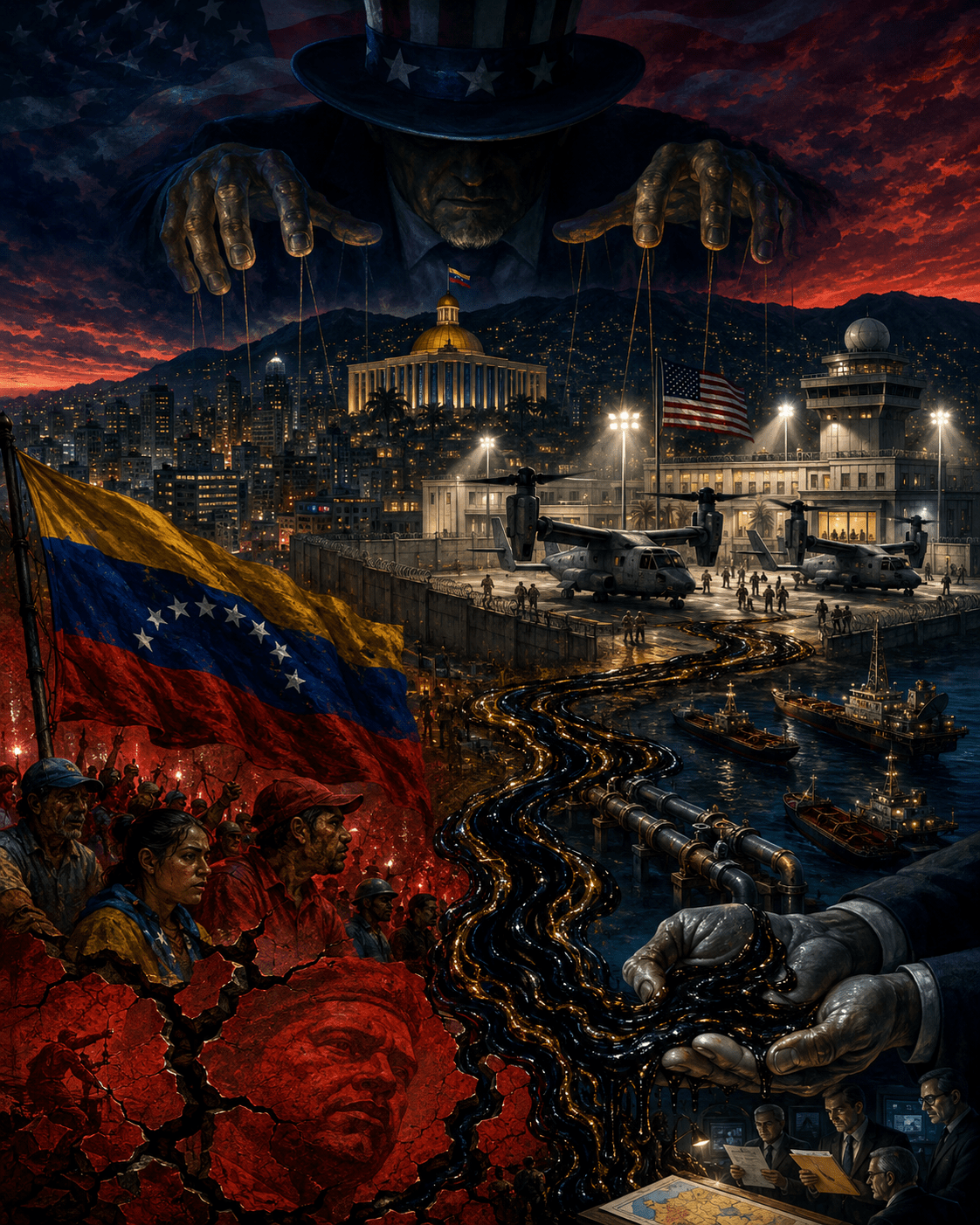
AP wants readers to see Venezuela’s crisis as a drama of loyalists, defectors, betrayals, and old slogans losing force. But beneath that factional theater sits the harder chain: a U.S. military capture, an acting government aligned with Washington, an embassy-centered military presence, oil sales under U.S. supervision, and a sanctions regime converted into a gate of managed reintegration. The article reports the ingredients of domination while refusing to name the dish, turning imperial coercion into policy adjustment and occupation pressure into political transition. This WPE excavates the propaganda frame, reconstructs the suppressed record, and insists that solidarity begins where empire wants silence: no U.S. military rule, no sanctions blackmail, no oil trusteeship, and no normalization of embassy government.
By Prince Kapone | Weaponized Information | June 1, 2026
The Empire Hides the Capture Behind the Crack
The Associated Press article, “Venezuela’s ruling party unity cracks as Delcy Rodríguez shifts Chávez-era policies,” written by Regina Garcia Cano and updated on June 1, 2026, presents itself as a report on the internal weakening of Chavismo after the U.S. military capture of Nicolás Maduro. On the surface, the article is about fracture: old slogans losing force, loyalists turning on one another, former officials speaking out, state television moments becoming awkward, and the acting government of Delcy Rodríguez moving closer to Washington. But the deeper work of the article is accomplished before the reader even notices it. The U.S. operation that seized the sitting Venezuelan president is placed in the background, treated as an accomplished fact, and then almost immediately displaced by the spectacle of Venezuelan disunity. The capture is the earthquake. AP writes about the cracks in the wall.
This is the first and most important operation of the text. It begins with the Chavista slogan, “United, we will win,” a phrase long used to project revolutionary discipline, popular cohesion, and national resistance. AP then turns that slogan against Chavismo. Unity becomes irony. Discipline becomes performance. The coalition that held together through sanctions, migration crisis, elections, street protests, and imperial hostility is reintroduced as a loose collection of “military, ideological and opportunistic hangers-on.” With that phrase, the article does not merely describe a political bloc. It downgrades it. It strips the movement of historical content and reduces it to appetite, loyalty, and survival. The reader is invited to see Chavismo not as a political project under pressure, but as a decaying machine whose internal pieces have finally begun to grind against each other.
AP’s institutional authority gives this framing special power. The outlet presents itself as a global news organization committed to factual reporting, and its style carries the soft force of neutral narration. It does not need to shout. It arranges. It sequences. It selects. The article does not openly celebrate the U.S. capture of Maduro, nor does it openly defend Washington’s growing role in the Venezuelan state. That would be too crude. Instead, it normalizes the capture by refusing to make it the center of investigation. The foreign military operation appears as the condition that allows the article’s real story to begin. The armed intervention becomes background. The factional drama becomes foreground. This is how empire often speaks when it wants force to disappear into procedure.
The article’s sourcing structure reinforces this movement. Its most vivid voices are Chavista dissidents, former officials, exiles, media personalities, and insiders who are now criticizing Rodríguez, questioning the deportation of Alex Saab, condemning the U.S. military drill, or speculating about betrayal. These voices are not invented. Their criticism is real enough within the article’s own terrain. But AP organizes them in a way that makes Venezuelan sovereignty appear primarily as a matter of internal dispute, wounded pride, personal loss, or factional resentment. Mario Silva says decisions are being made in the U.S. Embassy. Elías Jaua warns of occupation and colonial administration. Iris Varela speaks of betrayal. Manuel Caicedo questions the weak campaign to free Maduro and Cilia Flores. Yet the article does not allow these statements to reorganize the frame. They appear as symptoms of Chavista disorientation rather than as claims demanding investigation.
This is source hierarchy at work. The article permits anti-imperialist language to appear, but only inside a structure that contains it. Words like “occupation,” “colonial administration,” and “imperialists” enter the text as quotes from aggrieved Venezuelan actors, not as categories the article itself is willing to examine. AP gives the reader the sound of alarm while withholding the analytical architecture that would make the alarm intelligible. The United States is present throughout the article: in the capture, in the custody, in the oil sales, in the embassy, in the military drill, in the deportation, in the revenue administration. Yet the article’s dramatic tension is directed toward whether Chavismo is cracking, whether Rodríguez is governing freely, whether loyalists are losing their privileges, and whether Maduro was betrayed by someone inside the house.
The omission is not silence in the simple sense. AP does not hide the most explosive facts. It names them. It says Maduro was captured by a U.S. military operation. It says Rodríguez complied with U.S. demands. It says the U.S. military conducted a training exercise in Caracas. It says Marine Corps Osprey aircraft landed at the U.S. Embassy. It says the Trump administration oversees oil sales and administers revenues. The trick is more refined than concealment. The article reports the ingredients of domination while refusing to name the dish. It presents the architecture of foreign control as a series of developments, decisions, controversies, and reactions. The reader is given the pieces but not the structure.
This is also policy laundering. Rodríguez’s removal of ministers, release of political prisoners, oil-sector overhaul, cooperation with U.S. demands, and authorization of U.S. military activity are narrated as shifts in governance. AP places these developments inside the language of transition, pragmatism, and political rupture from Chávez-era policy. The reader is not yet asked to consider whether these acts represent the administrative normalization of a post-capture order. Instead, they are presented as choices made by a new acting president amid internal disagreement. The imperial relation is softened into a policy relationship. Coercion becomes adjustment. Subordination becomes reform.
The divide-and-conquer function is equally clear. Chavismo is narrated less as a historical bloc than as a room full of frightened men and women calculating their survival. The article lingers on loyalty rewarded by food, contracts, bodyguards, salaries, and access. It quotes Andrés Izarra arguing that the fractures are not ideological but rooted in “power, money, positions, and survival.” This may describe real tensions among sections of the Venezuelan political class. But within the article’s architecture, it serves a larger function: it converts the crisis of sovereignty into a morality tale about opportunists devouring one another after the fall of their patron. The empire does not appear as conqueror. It appears as background weather. The Venezuelans are left to appear as the storm debris.
The article’s compression of history does additional work. Decades of U.S.-Venezuela confrontation are reduced to phrases like “traditional antipathy toward the United States,” “economic sanctions,” and “warming relationship.” Such concision is not neutral. It limits how much historical weight the reader is allowed to feel. A long record of hostility is turned into mutual dislike. Sanctions appear as one pressure among many. The “warming relationship” between Rodríguez’s government and Washington is narrated as a diplomatic shift, not as a political condition requiring deeper scrutiny. The text moves quickly because speed is part of the method. If the reader is not allowed to sit with the meaning of the capture, the custody, the embassy drill, and the oil arrangement, then the article can proceed as if the real question is whether Chavismo still knows how to keep its people in line.
AP’s article therefore performs a very specific ideological task. It does not deny U.S. power over Venezuela. It domesticates it. It takes a foreign military capture, an acting government aligned with Washington, an oil sector being reorganized under U.S. supervision, and an embassy-centered military presence in the capital, then repackages the whole scene as a story about the weakening unity of Venezuela’s ruling party. The reader is trained to look at the crack in the movement, not the force pressing against the structure. That is the propaganda operation. The empire is not absent from the article. It is everywhere. It is simply made to appear as background reality rather than the central force shaping the event.
The Facts AP Lets Slip and the History It Refuses to Carry
The article’s own reporting establishes the immediate terrain. The Associated Press states that a U.S. military operation captured then-President Nicolás Maduro in January 2026, after which longtime Chavista loyalists began airing disagreements with the government of acting President Delcy Rodríguez. AP reports that Rodríguez complied with U.S. demands, removed ministers, pushed legislation through the National Assembly to overhaul the oil industry, and released political prisoners. It further reports that the deportation of Alex Saab to face U.S. criminal investigations became one of the flashpoints of internal conflict, and that Rodríguez authorized the U.S. military to conduct a training exercise in Caracas, where two Marine Corps Osprey aircraft landed at the U.S. Embassy.
AP also records the objections raised by figures who had long been associated with the Chavista camp. Mario Silva, formerly a pro-government state television host, questioned the legality of Saab’s deportation and argued that some decisions were being made “in the U.S. Embassy”. Elías Jaua, who served under Chávez and Maduro, called the situation “humiliating” and warned against normalizing what he described as occupation and colonial administration. The article reports that criticism even appeared on state television, when Manuel Caicedo questioned Venezuela’s weak campaign to free Maduro and Cilia Flores from U.S. custody. These are not outside accusations imported into the story. They are facts AP itself places inside the frame.
The most revealing admission appears when AP reports that the Trump administration oversees Venezuelan oil sales and administers revenues as part of a phased plan to “turn” Venezuela around. The article therefore names several concrete elements in the immediate post-capture arrangement: U.S. custody over Maduro and Cilia Flores, U.S. military activity in Caracas, U.S. oversight of oil sales, U.S. administration of revenues, and a Venezuelan acting government complying with U.S. demands.
The legal terrain begins with Venezuela’s own constitutional framework. The Constitution of the Bolivarian Republic of Venezuela states in Article 69 that “extradition of Venezuelans is prohibited”. A legal summary prepared for the Organization of American States likewise identifies the non-extradition of Venezuelan nationals as a principle of Venezuelan constitutional and criminal law. This is the constitutional provision at issue when Silva questions the legality of Saab’s deportation. Whether the Rodríguez government called the handover deportation, removal, cooperation, or legal transfer, the objection raised inside the article rests on a documented constitutional prohibition.
Venezuela’s constitutional framework also matters for the acting presidency itself. Article 234 provides that when the president becomes temporarily unavailable, the executive vice president replaces the president for up to 90 days, extendable by National Assembly resolution for another 90 days. The same article states that if the temporary unavailability continues beyond that period, the National Assembly may decide by majority vote whether the absence should be considered permanent. The AP article refers to Rodríguez as acting president, and Venezuela’s constitutional text supplies the formal framework within which temporary presidential absence and continued authority must be assessed.
The U.S. side of the record shows the speed with which pressure and normalization were joined. On April 1, 2026, the U.S. Treasury’s Office of Foreign Assets Control removed Delcy Rodríguez from the Specially Designated Nationals list. AP separately reported that the Trump administration recognized Rodríguez as Venezuela’s head of state, lifted sanctions against her, and instructed federal prosecutors in Miami to halt investigative efforts into her. These measures show which Venezuelan officials remained under pressure and which officials were incorporated into the new diplomatic and economic arrangement.
The May 23 military drill in Caracas also has a documented record beyond AP’s article. Reuters reported that the exercise was the first U.S. military drill in Venezuela since U.S. forces captured Maduro and Cilia Flores. Reuters further reported that MV-22B Osprey aircraft flew over Caracas and landed near the U.S. Embassy, and that U.S. vessels entered Venezuelan Caribbean waters. Reuters video documentation identified U.S. military personnel inside the embassy, Osprey aircraft landing at the embassy, and protesters holding signs reading “No to the Yankee drill” and “Venezuela demands respect”. The record establishes that U.S. military activity was carried out through the embassy compound in the Venezuelan capital.
The oil terrain is equally concrete. Venezuela remains one of the central prizes of the world energy system because the U.S. Energy Information Administration records that Venezuela had the world’s largest proven crude oil reserves in 2023, approximately 303 billion barrels. EIA further notes that most of Venezuela’s proven oil reserves are extra-heavy crude from the Orinoco Belt. Reuters reported that Venezuela’s oil exports rose to 1.25 million barrels per day in May 2026, with higher shipments to the United States, India, and Europe after eased U.S. sanctions and renewed foreign investment in oil and gas projects. These facts establish the oil terrain behind the article’s discussion of Rodríguez’s policy shift.
The larger coercive baseline did not begin in January 2026. In March 2015, the Obama administration issued Executive Order 13692, declaring that the situation in Venezuela posed an “unusual and extraordinary threat” to the national security and foreign policy of the United States. That emergency framework became one of the legal foundations for escalating U.S. sanctions. In January 2019, the Trump administration recognized Juan Guaidó as Venezuela’s interim president, placing U.S. recognition policy directly inside Venezuela’s internal state conflict. Days later, Reuters reported that Washington imposed sanctions on PDVSA in measures that threatened the company’s ability to fulfill contracts with North American buyers and were linked to pressure against Maduro’s government.
The sanctions system reached into finance, oil, assets, licensing, and state revenue. Congressional Research Service summaries describe Venezuela-related sanctions as including individual sanctions, financial sanctions, oil-sector sanctions, and licensing measures. The United Nations Special Rapporteur on unilateral coercive measures reported after visiting Venezuela that sectoral sanctions on oil, gold, mining, the economic blockade, and the freezing of Central Bank assets had major negative impacts. The same coercive architecture also reached Venezuelan assets abroad, with Reuters reporting in May 2026 that the U.S. Treasury extended a license protecting Venezuela-owned CITGO from creditors through June 19, 2026. By the time AP describes Rodríguez’s government as shifting policy, the Venezuelan state had already spent more than a decade under a U.S. emergency, sanctions, recognition warfare, asset pressure, oil restrictions, and licensing control.
International law provides the broader sovereignty baseline. Article 2(4) of the United Nations Charter prohibits the threat or use of force against the territorial integrity or political independence of any state. The factual record in and around the AP article therefore contains three layers: the immediate post-capture arrangement, the legal and constitutional questions surrounding acting authority and extradition, and the long coercive history through which U.S. policy sought leverage over Venezuelan political power, oil revenue, and state sovereignty.
The Occupation Hiding Inside the Transition
What is being staged as a crisis of Chavista unity is, in reality, a crisis of Venezuelan sovereignty under foreign pressure. AP wants the reader to look at the argument inside the house while stepping over the bootprint on the floor. The factual chain has already been established: a U.S. military operation captured Maduro; Rodríguez assumed acting authority afterward; U.S. pressure was loosened around the new acting authority; U.S. prosecutors were told to stand down around her; U.S. military aircraft landed at the embassy in Caracas; U.S. vessels entered Venezuelan waters; Venezuelan oil sales and revenues were placed under U.S. supervision. These are not separate episodes floating in the air. They are the architecture of a new arrangement.
The chain matters because empire rarely announces itself in the language of empire. It prefers the vocabulary of crisis management, stabilization, legal cooperation, emergency procedure, diplomatic repair, energy recovery, and institutional transition. The gun enters first, then the paperwork arrives to explain why the gun was necessary. The president is removed by force, then the new arrangement is described as a governing adjustment. The oil sector is reorganized, then the reorganization is called reform. Military aircraft land in the capital, then the event is named a training exercise. A Venezuelan national is handed into U.S. jurisdiction, then the act is narrated as cooperation with criminal proceedings. Step by step, domination is translated into administration.
This is why the internal disagreement inside Chavismo cannot be treated as the whole story. The fracture is real, but it is not self-explanatory. A political formation that has spent years under sanctions, recognition warfare, asset pressure, oil restrictions, and external attempts to decide who governs the country does not simply crack because personalities collide. It cracks under pressure. The pressure rewards some forces, punishes others, isolates some actors, incorporates others, and turns survival into a political method. The argument between loyalists and accommodationists is not merely a family quarrel. It is the visible surface of a state being reorganized under coercive conditions.
The deeper rupture is the loss of domestic management over Venezuela’s national conflict. A political struggle that should be resolved by Venezuelan forces, through Venezuelan institutions, on Venezuelan terrain, has been pulled into the machinery of Washington’s pressure system. The opposition’s long invitation to foreign intervention and the government’s increasing treatment of the United States as the decisive negotiating partner both helped move the conflict out of the hands of the Venezuelan people. Once that happens, sovereignty is not only attacked from outside. It is hollowed from within. The national question becomes an item on someone else’s agenda.
Rodríguez’s role sits at the center of this contradiction. The issue is not whether one official is more pragmatic than another, or whether the old Chavista slogans can still command discipline. The issue is that her acting authority emerges in a sequence marked by U.S. capture, U.S. recognition, U.S. sanctions relief, prosecutorial restraint, military contact, and oil supervision. The form may appear constitutional, diplomatic, and administrative. The content is far heavier. A government born under these conditions does not stand on neutral ground. It stands in the shadow of the force that made the transition possible.
The constitutional question sharpens the matter. Venezuela’s framework for presidential absence gives temporary replacement powers to the executive vice president, with time limits and a role for the National Assembly. Venezuela’s constitutional order also prohibits the extradition of Venezuelan nationals. These provisions are not technical footnotes. They reveal the stress points of the current arrangement. If the sitting president is in U.S. custody after a foreign military operation, then acting authority cannot be treated as ordinary succession. If a Venezuelan national is handed into U.S. jurisdiction despite a constitutional prohibition, then legal cooperation becomes something more dangerous: the adaptation of domestic procedure to foreign demand.
Alex Saab’s deportation is therefore not important only because of Saab himself. He becomes the hinge where legal sovereignty, elite survival, and U.S. jurisdiction meet. One does not need to romanticize him to see the significance of the act. The question is what kind of state arrangement permits a Venezuelan national, once protected by the political order around Maduro, to be transferred into the hands of the power that had spent years prosecuting, sanctioning, and strangling that same order. In that moment, the issue is not individual guilt or innocence. The issue is whether the new government is demonstrating its legitimacy upward to Washington rather than downward to the Venezuelan people.
The military drill in Caracas performs the same function on the security terrain. Foreign aircraft over the capital, military personnel operating through the embassy, and U.S. vessels entering Venezuelan waters do not have to become a permanent occupation force to serve an occupation function. Their purpose is also psychological and political. They test what can be endured. They test what can be renamed. They test whether the presence of U.S. military power inside the Venezuelan political field can be treated as a normal feature of the new order. The small size of the protest does not reduce the meaning of the event. It reveals how quickly the abnormal can be pressured into appearing ordinary.
Oil is the material center of the whole arrangement. Venezuela’s oil wealth is not background scenery. It is the prize beneath the constitutional drama, the military drill, the sanctions relief, and the diplomatic normalization. The country holds the largest proven crude oil reserves on earth, and the post-capture period is already marked by export recovery, eased sanctions, renewed foreign investment, and U.S. administration of sales and revenues. That is why the language of “overhauling the oil industry” cannot be read innocently. In a sovereign country, oil reform is a domestic political question. In a country whose president has been kidnapped by a foreign power and whose oil revenues are being administered under that power’s supervision, oil reform becomes a question of national command.
This is coercive tutelage. It is not only military pressure, not only sanctions relief, not only legal cooperation, not only oil supervision. It is the conversion of Venezuela’s state functions into conditional permissions granted under foreign pressure. The state may keep functioning, but only through a channel managed by the power that helped produce the crisis. Revenues may circulate, but under supervision. Officials may be rehabilitated, but under recognition. Political decisions may be made, but inside the shadow of coercion. This is how a republic is pushed toward colonial administration without the occupier needing to rename it a colony.
The old sanctions regime and the new post-capture arrangement are not opposites. They are two phases of the same pressure system. The sanctions weakened the state, restricted its revenue, damaged its economic capacity, and made access to the world market conditional on Washington’s permission. The new arrangement converts that pressure into managed reintegration. The blockade does not simply disappear. It becomes a gate. Those who pass through the gate do so by accepting the terms of the gatekeeper. That is the political economy hidden beneath the polite language of renewed investment and export recovery.
This is imperialist recalibration. It is not the simple replacement of every Venezuelan institution with a foreign administrator. It is more refined than that. It captures decisive nodes inside the existing structure: recognition, sanctions relief, prosecution, military access, oil revenue, export licensing, and elite survival. The flag can remain. The ministries can remain. The National Assembly can remain. The speeches can remain. But the commanding pressure points are moved into a relationship where Washington decides who is punished, who is rehabilitated, which revenues circulate, which officials are pursued, which aircraft land, and which version of sovereignty is allowed to breathe.
AP can tell this story as division because division is the safest way to narrate imperial victory without naming it. If the focus stays on Chavista cracks, then the United States appears as a background actor watching Venezuela collapse under its own contradictions. But the factual chain says otherwise. The fracture is real. The hammer is also real. The real story is not that Chavismo has suddenly discovered disagreement. The real story is that a besieged national project is being pushed from sanctions into supervised reconstruction, from resistance into conditional reintegration, from sovereignty into managed dependency. One fact alone may look like an event. Together, they show the architecture of control.
Solidarity Begins Where the Empire Wants Silence
The task now is to turn the article back against the machinery it tries to protect. AP wants the reader to see Venezuelan division, Chavista decay, elite betrayal, and a government adjusting itself to new realities. The people’s movement must begin from the reality AP cannot fully hide: Maduro was captured by a U.S. military operation, Rodríguez’s government has complied with U.S. demands, the U.S. military has conducted drills over Caracas and through the embassy compound, and Washington now claims a role in overseeing oil sales and administering revenues. That is the chain every serious political education effort must place before the people. Not rumor. Not gossip. Not liberal pity for a “failed state.” The chain.
Begin with political education. In the United States especially, where empire is presented to workers as foreign policy, humanitarian concern, anti-drug enforcement, democracy promotion, or “restoring stability,” organizers must teach the concrete sequence: the capture of a sitting Venezuelan president, the acting authority that followed, the sanctions relief around Rodríguez, the prosecutorial stand-down, the handover of Alex Saab, the embassy-centered military drill, the reopening of oil channels, and the U.S.-administered revenue arrangement. Study groups, union political education committees, community forums, churches, campus organizations, independent media collectives, and neighborhood assemblies should begin with the question Washington does not want asked: what kind of sovereignty exists when a foreign power can capture the president, supervise the oil, determine sanctions relief, and operate military aircraft in the capital?
Tear away the legal fog. Article 2(4) of the United Nations Charter prohibits the threat or use of force against the territorial integrity or political independence of any state. Venezuela’s constitutional order prohibits the extradition of Venezuelan nationals and establishes defined procedures around temporary presidential absence. These are not abstract legal ornaments. They are political weapons in the hands of the people. Every teach-in, article, public statement, and street action should force the issue plainly: no foreign military seizure of a head of state, no embassy government, no constitutional bypass, no extraterritorial prosecution dressed up as justice, no legal vocabulary that converts imperial coercion into procedure.
Name the oil. Venezuela is not under pressure because Washington suddenly discovered concern for constitutional life, democratic virtue, or criminal procedure. Venezuela sits atop the world’s largest proven crude oil reserves, and the post-capture period has already seen oil exports rise after eased sanctions and renewed foreign investment. The people’s line must therefore be simple enough to carry and sharp enough to cut: no oil trusteeship, no sanctions blackmail, no foreign administration of Venezuelan revenues, no conversion of Venezuela’s patrimony into a recovery plan for imperial capital. The empire wants the oil question hidden behind the polite phrase “overhaul the oil industry.” We must drag it back into the daylight.
Draw a hard line against regime-change NGO infrastructure. The National Endowment for Democracy says that Venezuela is among its top ten countries by spending and describes support for what it calls democratic transition, independent media, human rights partners, and civic organizations. Its own annual reporting says NED made more than 1,900 grants across 91 countries totaling $286 million in 2024. U.S. state-linked “civil society” infrastructure is not neutral terrain. It is one of the political instruments through which empire builds pressure, manufactures legitimacy, and selects which Venezuelan voices are amplified for imperial audiences. Any organization, campaign, media platform, or “democracy” project funded through NED, USAID, IRI, Western governments, Ford, Rockefeller, Open Society, or equivalent imperial-state networks must be rejected as a vehicle for anti-imperialist solidarity. The people cannot fight occupation by marching behind the paymasters of occupation.
The anti-imperialist terrain already exists, but it must be approached with discipline rather than blind endorsement. In North America, the Venezuela Solidarity Network states that its basis of unity is to lift U.S. sanctions, oppose interference in Venezuela’s internal affairs, normalize relations without U.S. or Canadian conditions, and defend Venezuelan sovereignty. Its current organizing materials say it aims to serve as a catalyst for solidarity work, exchange ideas, and launch projects and campaigns, including work to free Maduro and Cilia Flores and oppose imperialist attacks on Venezuela. This makes it relevant movement terrain for antiwar and anti-sanctions forces to study, contact, question, and evaluate. But no serious movement should treat any name as a substitute for political verification. Every local committee must check operational activity, political line, funding independence, organizational accountability, and actual connection to the struggle before placing organizational trust anywhere.
In Latin America and the Caribbean, ALBA Movimientos describes itself as a continental platform bringing together more than 400 social and popular organizations from 25 countries around an anticapitalist, anti-imperialist, anticolonial, antiracist, feminist, and socialist project. Its 2026 Venezuela materials framed the crisis around the contradiction of negotiating under fire after the U.S. operation against Maduro. Venezuelanalysis reported that grassroots organizations connected to ALBA Movimientos protested the U.S. military drills in Caracas, while other left organizations also rallied against the violation of Venezuelan sovereignty and warned against the normalization of U.S. military presence. This does not remove the need for verification. It identifies a live popular front of struggle that AP reduces to a small protest and a mood of factional discomfort.
Internationally, the International Peoples’ Assembly launched a March 2026 solidarity mission to Cuba and Venezuela with representatives from movements and parties including Brazil’s MST, the Party for Socialism and Liberation in the United States, the Socialist Party of Zambia, Potere al Popolo, ALBA Movimientos, and the Tricontinental Institute. The mission was reported as engaging social and healthcare centers, meeting movements resisting imperialist intervention, and coordinating aid to Cuba against the blockade. This marks internationalist infrastructure worth studying and connecting to where politically appropriate, not a blank check for uncritical affiliation. Venezuela cannot be defended as an isolated national question. It belongs to the same global front as Cuba, Palestine, Iran, the Sahel, Congo, Puerto Rico, and every other people facing the demand that they surrender their land, labor, resources, and political destiny to the American pole.
The agitation line should be disciplined: U.S. hands off Venezuela; free Maduro and Cilia Flores from U.S. custody; end all unilateral coercive measures; no U.S. military presence in Venezuela; no oil trusteeship; no foreign administration of Venezuelan revenues; no lawfare against Venezuelan sovereignty; no normalization of embassy rule. These demands should not float as slogans detached from fact. They must be tied to the documented record: the January capture, the sanctions architecture, the Saab handover, the constitutional questions, the embassy drill, the oil export recovery under eased sanctions, and the U.S. role in administering revenues. A slogan without a fact becomes noise. A fact without a slogan remains trapped in the archive. The movement needs both.
The immediate work is concrete. Build teach-ins that begin with the AP article and then reconstruct what it buries. Produce short explainers on the sanctions regime and the oil question. Circulate visual timelines showing the movement from sanctions to capture to supervised reconstruction. Pressure unions, antiwar groups, student organizations, churches, and community formations to adopt resolutions against U.S. military action and sanctions on Venezuela. Demand that elected officials oppose U.S. military operations, oppose oil-revenue trusteeship, and oppose extraterritorial prosecution of Venezuelan officials and nationals. Track every Treasury license, every SOUTHCOM movement, every embassy drill, every court proceeding, every oil-sector restructuring measure, and every media article that turns occupation into transition.
This is not a call for sentimental solidarity. Sentiment is too weak for the hour. This is a call for disciplined anti-imperialist work from inside the belly of the beast. The empire is testing whether the people will accept the capture of a president, the military presence of the captor, the legal authority of the captor, and the oil administration of the captor as ordinary developments in the life of another country. Our answer must be organized refusal. We do not accept the new facts of empire as normal. We expose them, teach them, agitate around them, and build the political capacity to make imperial intervention costly at home. Venezuela is not a subplot in Washington’s hemispheric drama. It is a front line in the struggle over whether the nations of the Global South have the right to command their own wealth, defend their own sovereignty, and breathe without the boot of the United States pressed against their throat.


Leave a Reply