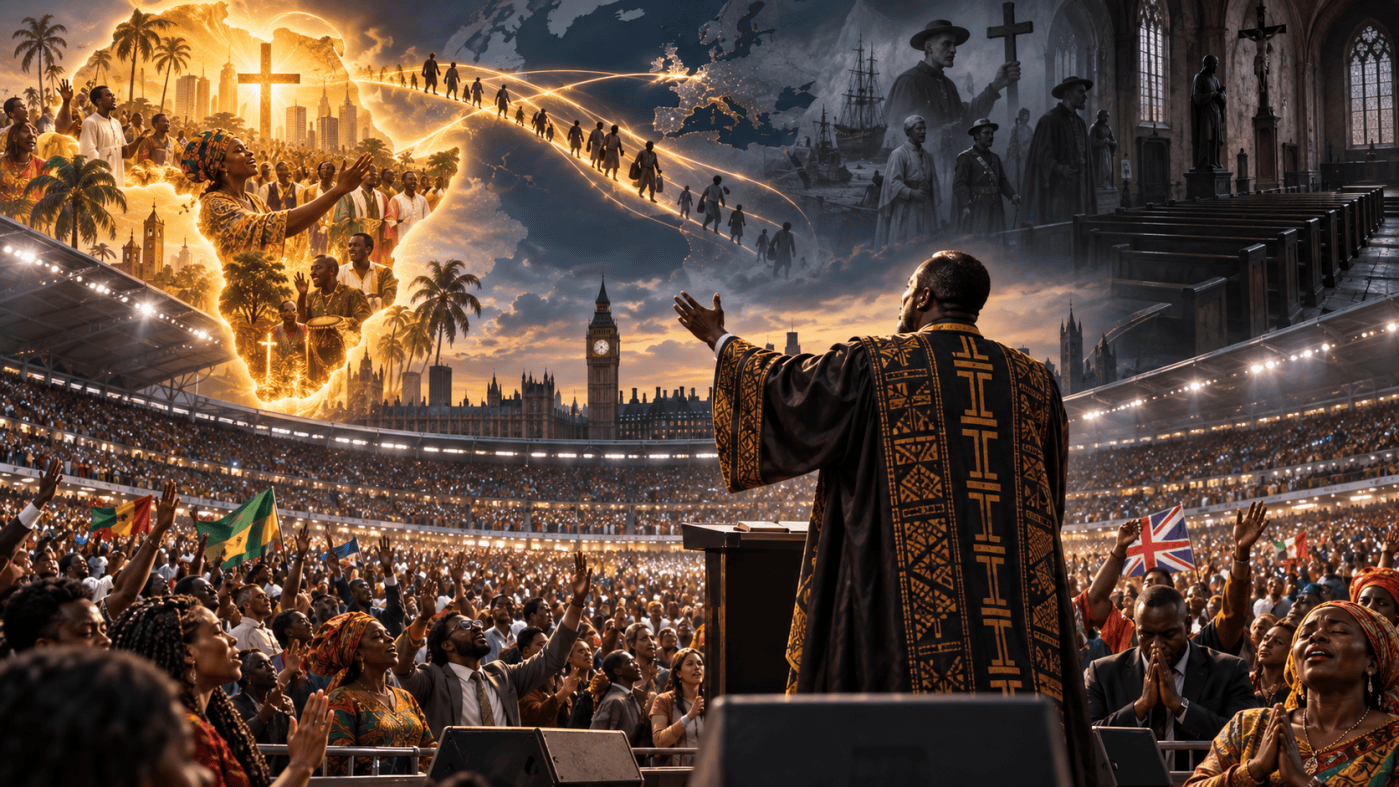
CNN sees African preachers filling Western stadiums and calls it a reversal, but the missionary map began changing long before the flights turned north. Africans were never silent objects of Christian mission: they preached, translated, built churches, and fought European control over institutions their own labor sustained. Today, African-led churches command missionaries, money, property, and transnational networks from Accra to London even while much of their Western growth remains rooted in African migrant communities rather than mass European conversion. The deeper contradiction is now inside the victory itself: Christian command is becoming less European faster than the unequal social relations carried through its institutions are being transformed.
By Prince Kapone | Weaponized Information | September 9, 2026
I. CNN Flips the Missionary Arrow
CNN opens its September 4 story with an image built to carry the whole argument before the argument has even begun. Nigerian pastor Jerry Eze walks into London’s Twickenham Stadium, looks across tens of thousands of empty seats, and wonders whether he has made a terrible mistake. Then the people arrive. The stadium fills. An African preacher stands before a British crowd, and the old missionary picture appears to turn on its head. The article’s governing image is already complete: the continent once treated as Christianity’s mission field has started sending missionaries back toward the imperial center.
CNN’s report contains enough truth to make the image compelling. Eze openly calls himself “a missionary to the West.” Tshepang Basupi of Africa Inland Mission describes Africans traveling as missionaries across Africa, Asia, Europe, and North America. Nigerian missionary organizations now operate internationally. The Christian population of sub-Saharan Africa has grown enormously while Christianity has declined as a share of the population across much of Europe and North America. Eze gives the contradiction its theological slogan: “the fire is leaving the West.” History, apparently, has packed its Bible and changed flights.
But CNN’s own reporting starts cutting holes in that neat little map. Basupi rejects the phrase “reverse mission” because it assumes mission naturally belonged to the West in the first place. Dondo Iorlamen of Nigeria’s CAPRO concedes that African churches abroad are largely growing among migrants rather than among white Western populations. Western missionaries, meanwhile, haven’t disappeared from Africa. CNN even acknowledges that European missionaries often traveled alongside colonial power and that the word missionary still carries the scars of conquest.
Those qualifications should break the original frame apart. Instead, the article keeps returning to the same directional story: Christianity once moved from West to Africa; now African Christianity is becoming strong enough to send it back. That compresses several different historical processes into one dramatic arrow. A growing African Christian population isn’t the same thing as Africans converting Europeans. Migrants building churches abroad isn’t the same thing as Western societies undergoing religious revival. African control of missionary institutions isn’t the same thing as missionaries merely traveling in the opposite direction.
CNN has found a genuine historical rupture. It just begins the history too late. The real question isn’t when Africans started flying north with Bibles. It’s how people once treated as the objects of mission became the people capable of building, financing, and commanding missionary institutions themselves.
II. The Mission Field Was Never Silent
The trouble with CNN’s missionary arrow begins before the first European ship reaches West Africa. Christianity didn’t arrive on the continent as a package stamped in London, Lisbon, or Rome. Christian communities were already rooted in Africa during the religion’s earliest centuries, with long-standing traditions in Egypt, Ethiopia, Eritrea, and the wider northeast. The history of African Christianity is therefore older than the European colonial system that later claimed the right to teach Africans civilization, religion, and just about everything else Europeans had persuaded themselves they invented.
That doesn’t erase the enormous role of later European missions. Portuguese expansion carried Catholic institutions into Kongo and Angola, while nineteenth-century Protestant and Catholic missions spread alongside the widening reach of European commerce and colonial power. Missionaries translated texts, opened schools, built churches, trained clergy, and sometimes entered territories where European states were simultaneously extending political and military command. But Africans were never inert cargo inside this machinery. They translated, preached, taught, organized, converted others, fought over doctrine, and increasingly demanded authority over institutions European missions depended on them to reproduce.
Few lives expose that contradiction more clearly than Samuel Ajayi Crowther. Born in what is now southwestern Nigeria, enslaved as a child, freed by a British naval patrol, and educated in Sierra Leone, Crowther eventually became the first African Anglican bishop. Along the Niger, he recruited African clergy and evangelists and established mission stations across a growing African network. His story destroys the fantasy that Africans only recently graduated from mission field to missionary. Crowther’s Niger mission was already demonstrating African Christian agency generations before anybody coined the phrase “reverse mission.”
But African labor didn’t guarantee African command. Within Crowther’s own CMS struggle, European missionaries removed African personnel and undermined his authority, tightening their grip over institutions Africans had helped build. The fight concerned appointments, education, discipline, money, and control. The contradiction was plain enough: African evangelists were indispensable when extending the mission, but African authority became far more troublesome when it challenged European supervision.
That struggle didn’t disappear with Crowther. African Christians went on building independent and indigenized churches, including movements that grew partly from racial marginalization and resistance to foreign missionary control. The institutional history between colonial mission and today’s African megachurches wasn’t an empty century. It was crowded with fights over who would interpret Christianity, govern its churches, and decide whether African Christians required European overseers at all.
The twenty-first-century numbers show how dramatically the center of gravity has shifted. According to Pew’s global estimates, sub-Saharan Africa contained roughly 697 million Christians in 2020, about 31 percent of the world’s Christian population, overtaking Europe as Christianity’s largest regional population center. But the statistic needs discipline. Christianity’s share of the sub-Saharan African population rose by less than one percentage point during the decade, to about 62 percent. The huge increase came largely through population growth, not a sudden continent-wide conversion wave.
Population alone, however, can’t send missionaries, pay salaries, purchase buildings, or administer churches abroad. Institutions do that. Ghana’s Church of Pentecost offers a clearer picture of what has changed. Its Missions Directorate in Accra coordinates international fields, deploys missionaries, pays salaries, receives reports, and distributes support for church construction. By the end of 2025, the denomination reported operations across more than 200 countries and territories outside Ghana, with 1,690 ministers serving abroad, including 331 missionaries. Those are denominational figures rather than an independent census, but the institutional fact is hard to miss: missionary administration now operates outward from an African capital.
That presence has also hardened into property abroad. The Church of Pentecost’s British charity reported about £12.7 million in annual income for 2024, along with 75 employees, thousands of volunteers, and roughly £23.5 million in assets used for its own activities. In Edinburgh, a congregation of the Redeemed Christian Church of God moved from rented space into a former Church of Scotland building, financed through a mortgage and money raised from its congregation and wider network. In Norwich, Church of Pentecost UK became the new tenant of St Saviour in 2026.
None of this means Britain is suddenly falling to Nigerian and Ghanaian evangelists. Research on the Church of Pentecost in Belgium found its congregations still focused overwhelmingly on internal mission among African migrants, with much weaker success among the Belgian host population. The buildings can change hands faster than the population inside them changes faith. That is the contradiction the missionary-arrow story can’t explain.
III. The Cross Changed Hands
The real reversal isn’t that Africans have suddenly learned how to preach to Europeans. Section II has already buried that fantasy. Africans were evangelizing, translating, teaching, and building Christian institutions while European missions still claimed the authority to supervise the whole process. The contradiction was there from the beginning: the mission depended on African agency while colonial hierarchy resisted African command. Crowther made the problem impossible to hide. If Africans could do the work, why should Europeans keep command? Empire has always admired native initiative right up to the moment native initiative starts demanding the keys.
Africanization was therefore more than changing the face in the pulpit. It became a struggle over the material life of the church: who appoints the clergy, who controls the money, and who decides where the institution goes. Churches have budgets, offices, land, employees, volunteers, property, rules, and hierarchies. Whoever commands those relations possesses more than spiritual influence. This is why an African headquarters directing missionaries abroad marks a deeper change than an African preacher simply boarding a plane. Africans are increasingly capable of reproducing Christianity internationally without waiting for instructions from Europe.
That distinction also changes how we understand migration. Migrants don’t merely carry religion with them as private belief. Their congregations pool resources, provide labor, sustain institutions, and establish permanent footholds abroad. Migration itself becomes part of the machinery through which African Christianity reproduces beyond Africa. What begins as people gathering far from home can harden into an institution able to survive the movement of any one pastor or family.
Once that happens, counting white Europeans in the pews stops being the only measure of what has changed. African-led churches may remain rooted mainly in African migrant communities and still represent a historic redistribution of Christian power. The crucial question is no longer whether every congregation has conquered the neighborhood for Jesus. It is whether Africans possess the organized means to sustain churches, administer resources, send personnel, and reproduce religious authority across borders. Increasingly, they do.
That is the breach in the old order. Europe and North America no longer monopolize the right to imagine themselves as Christianity’s natural headquarters, the places that teach while everyone else receives. The old division of religious labor is cracking. Africans who once worked inside institutions governed from elsewhere can now govern institutions whose reach extends outward from Africa itself.
But the victory produces another contradiction. Changing who commands an institution doesn’t automatically transform every relation inside it. An African-led church still operates through property, donations, paid and unpaid labor, hierarchy, and the economic insecurity surrounding its members. It can provide genuine community while concentrating authority. It can help migrants build stability while those same migrants remain vulnerable outside the church walls. It can gather the resources of ordinary people and then face the same old political question that confronts every institution with money and power: who decides, and whose interests come first?
That contradiction doesn’t diminish African agency. It makes African agency concrete. Liberation has never meant exchanging the nationality of the manager and declaring history finished. The transfer of command matters because command is real power. But what a newly controlled institution does with that power is a second struggle, not an automatic consequence of the first.
This is where CNN’s missionary arrow finally breaks apart. Its picture is almost too tidy: the West once possessed the fire, Africa received it, Africa now burns hotter, and Europeans wait around the ashes for somebody from Lagos or Accra to bring the matches. History is less polite. Christianity moved through conquest, translation, migration, institution-building, resistance, property, labor, and conflict over authority. Africans didn’t simply inherit a finished European religion and mail it back centuries later. They changed it while struggling over who had the right to control what they had helped build.
The weakness of host-population conversion therefore defines the present limit of the reversal rather than disproving it. Christian authority can become less European before Europe becomes more Christian. African institutions can acquire greater international command while the societies around them remain deeply secular. The old center can lose its monopoly before the new centers replace it.
What is emerging, then, is a Christianity with multiple centers of command. That development was produced through a long struggle against the assumption that Europe naturally directs while Africa naturally follows. Yet the social relations carried through these institutions are changing unevenly. Some forms of subordination have been broken. Others survive inside new structures, under new leadership, demanding struggles of their own.
Twickenham matters because of that history. A packed stadium doesn’t prove that Nigeria has spiritually conquered Britain. It shows that an African ministry can now enter London as an organizer rather than an organized object, carrying enough authority and institutional capacity to treat the former missionary center as terrain on which it has every right to act.
The cross has changed hands. The harder struggle begins with what those hands build, whom they serve, and whether the power wrested from the old center will reproduce the old relations or help bury them.
IV. Turn the New Center Toward the People
If African churches now command money, buildings, members, media networks, and missionary institutions across borders, then the political question can’t stop at who holds the microphone. Power is power because it can be organized. The question is what that capacity serves: another clerical hierarchy with a different passport, or the people whose labor, offerings, migration, and community life made the institution possible in the first place.
Across the continent, the All Africa Conference of Churches already offers one arena for pushing that struggle beyond symbolism. Its work on economic justice, migration, gender equality, Pan-Africanism, decolonization, and reparations creates space to fight over what African Christian power should mean in practice. Breaking European command was one historical struggle. Turning African-controlled institutions toward the material needs and political power of ordinary people is another.
That struggle travels with the diaspora. Migrant congregations are built by people navigating immigration systems that can keep families insecure, drain incomes through fees, and make settlement precarious. The Churches’ Commission for Migrants in Europe already trains church advocates to confront migration policy, while Migrant Voice organizes directly against punitive visa costs and settlement barriers. A congregation can therefore become more than a place where people endure migration together. It can become infrastructure for political education, testimony, organizing, and collective pressure against the system producing that insecurity.
But charity has a limit. Food parcels can keep a worker alive through the week; they can’t bargain with the boss on Monday morning. Where migrant congregants face exploitation at work, churches should connect people with worker organization rather than spiritualize what is plainly a wage-and-power problem. The IWGB, rooted in organizing migrant and under-unionized workers, points toward that next step: from helping people survive exploitation to helping them organize against it.
And no missionary reversal gives anyone a blank check over another colonized people. Where African missions enter Indigenous territory, the terms of engagement have to begin with Indigenous political authority, not missionary certainty. The Ka:’yu:’k’t’h’/Che:k’tles7et’h’ First Nations exercise self-government on their own territory. Their society isn’t somebody else’s empty mission field simply because the missionary now arrives from the Global South.
The old missionary order taught Europeans to command and Africans to receive. That hierarchy is cracking. The next measure of victory is harder: whether the power now gathered in African hands is placed under the needs and struggles of the people who built it, or whether history merely changes managers and keeps the old machinery running.


Leave a Reply