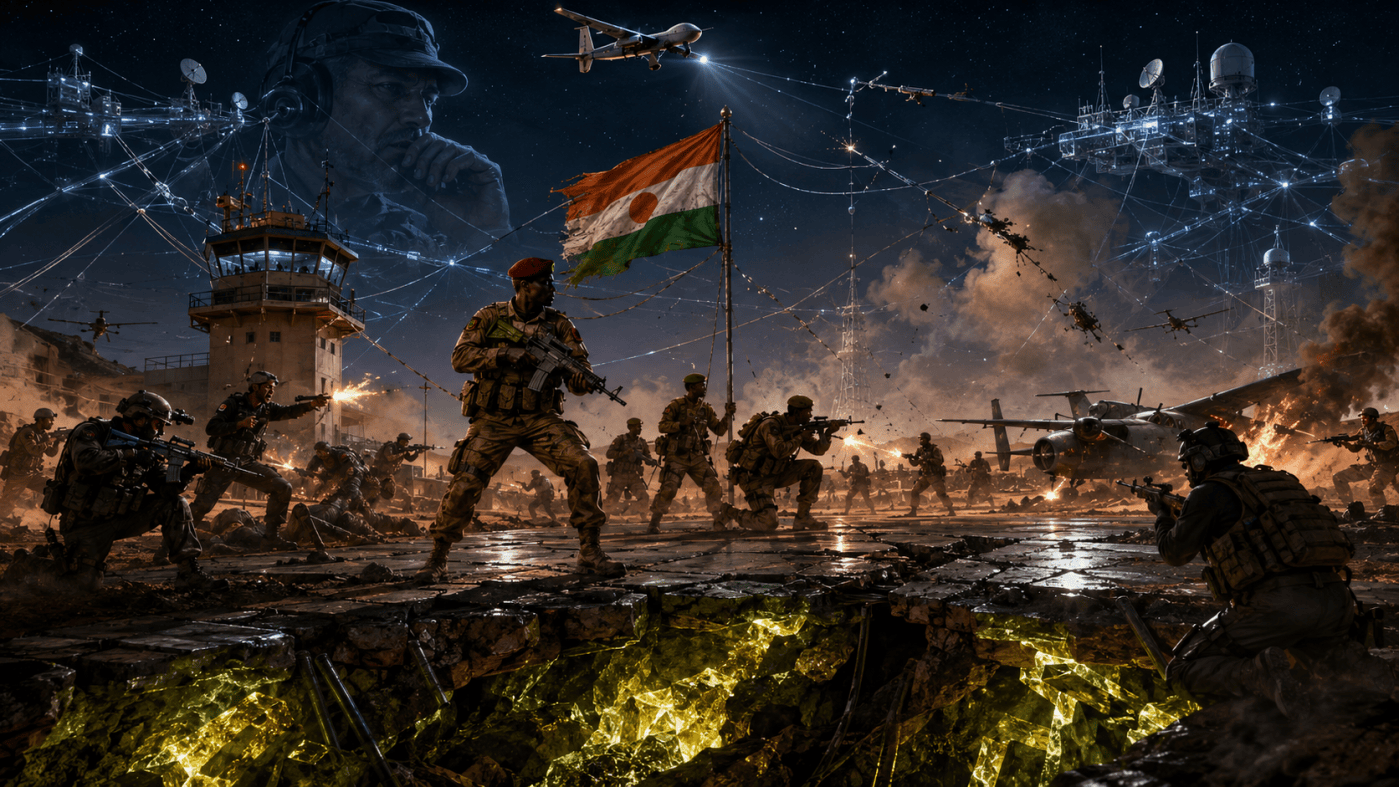
BBC turned the August 29 revolt at Base 101 into a story about a frightening pile of weapons, stripping the arsenal of the military institution, political struggle, and history that gave it meaning. Behind that framing stood a fractured special-operations apparatus, credible testimony of Bazoum-linked and foreign contacts, the expulsion of Western forces, uranium nationalization, and a new security network that helped Niger survive the rupture. The deeper conflict is between Niger’s attempt to reclaim control over its military, resources, and foreign relations and an imperial system learning to preserve domination through smaller footprints, partner forces, economic leverage, and networks that survive after the bases close. Making that rupture durable means fighting AFRICOM and Françafrique where they’re organized while strengthening the Nigerien workers and popular forces capable of turning national sovereignty into power over what the country’s wealth is actually for.
Prince Kapone | Weaponized Information | September 3, 2026
An Arsenal Without a History
On September 3, 2026, BBC News Pidgin published an unsigned report headlined “Niger army see plenty weapons for Base 101 wia mutiny happun, wetin go happun to di sojas afta di coup attempt wey fail.” Its basic facts are dramatic enough: after the August 29 fighting in Niamey, Nigerien authorities said they recovered 34 armed pickups, armored vehicles, hundreds of AK-47 rifles, RPG launchers, machine guns, a mortar, sniper rifles, ammunition and communications equipment from Base 101. The government said soldiers there had detained colleagues, fired on sensitive locations and participated in what state television described as an attempted coup.
The framing begins with where BBC starts the clock. The reader enters after the fighting, through the spectacle of recovered weapons. The headline itself does the work: the army “sees plenty weapons,” as though investigators have stumbled across a mysterious cache whose existence explains the danger. Yet the article also tells us Base 101 is a strategic military airbase near Niamey’s international airport. It never gives the baseline required to interpret its own headline. How much weaponry belonged there, and which military formation commanded it? The inventory is precise. Its meaning is left floating.
The same move works through institutional anonymity. BBC repeatedly gives us “soldiers,” “mutineers” and military personnel, but never tells the reader what formation these men belonged to, what place they occupied inside Niger’s armed forces, or what chain of command broke down. Agency becomes strangely lopsided. The Nigerien state finds weapons, restores control, summons missing soldiers and bans civilians from wearing military uniforms. The rebels fire, flee and disappear. They have actions, but almost no institutional history and virtually no motive.
BBC’s sourcing makes the framing more revealing, not less. Most of the substantive information comes from Niger’s Defence Ministry, Télé Sahel and official military communiqués. BBC doesn’t need to invent a British version of events. It takes Nigerien state facts, strips them of the relations needed to interpret them, and rearranges them into a familiar sequence: disorder, dangerous weapons, restoration of order.
By the end, an armed struggle around strategic sites has become an administrative problem of soldiers returning to duty, surrendering equipment and civilians dressing improperly. The frightening arsenal remains in the reader’s mind while the central question disappears: what organized force commanded that armed power, and what exactly was it trying to seize?
Who Built the Base, Who Wants the Command
The force at the center of the August 29 fighting wasn’t an anonymous crowd of soldiers. Nigerien authorities later identified personnel from the BSR-COS special-operations battalion as participants in the mutiny at Base 101. The same official inventory BBC turned into a spectacle listed 382 AK-47s, 36 RPG-7 launchers, 30 PKM machine guns, heavy weapons, vehicles, ammunition and communications equipment recovered after the fighting. That inventory shows the scale of military matériel concentrated around the mutinous formation and its base. It doesn’t prove that every recovered weapon had been under rebel control, much less that some foreign sponsor secretly delivered an arsenal for August 29.
The fighting itself was deadly. Niger’s Defence Ministry reported that soldiers tried to detain fellow servicemen at Base 101 and fired on sensitive locations around Niamey beginning shortly after midnight. Three members of the Presidential Guard were later buried after being killed in the confrontation. Regional reporting also tied the rupture to disputes over dangerous deployments, military hierarchy and uneven burdens inside the armed forces, although the detailed trigger sequence still rests heavily on anonymous security sourcing. Whatever grievance lit the fuse, the confrontation had moved beyond barracks complaint into an armed fight over who would obey whom inside the state.
Captain Roger Gabriel’s testimony gives the clearest account yet of how the rupture tried to spread. Gabriel, an officer in the 1st Parachute Battalion, said BSR-COS officers contacted him during the fighting and asked his unit to reinforce them at Base 101. He refused after learning that the confrontation wasn’t another jihadist attack but a fight between BSR-COS and the Presidential Guard. Gabriel then described a series of calls and messages involving Bazoum-linked and foreign contacts, including claims that outside military support was being prepared for the rebels. His testimony is credible evidence that forces beyond Base 101 were trying to engage the crisis while the fighting was underway. It doesn’t, by itself, establish who designed the initial mutiny.
The military apparatus around Base 101 also has a history BBC never mentions. During Flintlock 2018, Nigerien special-operations commander Moussa Salaou Barmou worked inside a multinational exercise involving U.S. and other Western special forces. Western governments spent years training and integrating Nigerien special operations into the counterterror system that made Niger a major security partner in the Sahel. Air Base 101 itself later housed U.S. personnel and assets as a U.S. Cooperative Security Location.
Then the order cracked. After the July 2023 overthrow of Mohamed Bazoum, France declared that it wouldn’t recognize the putschists, while ECOWAS imposed sanctions and publicly retained the possible use of force to restore the previous constitutional government. Niger later forced out the French deployment, which Paris itself described as a military disengagement, and the United States completed its withdrawal from Niger in September 2024 after leaving Air Bases 101 and 201.
Washington openly recognizes what it lost. AFRICOM’s 2026 posture statement says U.S. access, basing and overflight in Africa have been dramatically reduced by coups and deteriorating bilateral relations. The same document treats Africa’s resources and strategic geography as U.S. national-security interests and names defense economics and information operations among its tools. France has been equally open about adaptation. In testimony before the French Senate, military leaders described reducing the permanent footprint and visibility of French forces while preserving influence and the ability to deploy through smaller, more flexible arrangements.
Niger’s break with the old order also reached the mine. Eight days before the Base 101 mutiny, the government awarded major uranium exploitation permits to national companies, continuing a transfer of strategic mining assets toward state control after the nationalization of SOMAÏR. The timing establishes the depth of the resource struggle surrounding the state; it doesn’t identify who organized August 29. The older ownership relation was concrete: Orano had held a controlling stake in SOMAÏR before Niger nationalized the company.
That resource struggle has an organized social base. The Confederation of Workers of Niger, bringing together ten union centers, publicly supported Niger’s decision to sell uranium independently on the international market and backed the government’s confrontation with Orano. Whatever contradictions remain inside the military-led state, control over the country’s strategic resources isn’t a quarrel confined to generals and diplomats.
When the rebellion failed, loyal Nigerien forces had help. Russia said Africa Corps personnel assisted Nigerien forces against the anti-government attack. The next day Algeria announced that, at Niger’s request, it had sent four Su-30 fighters and a refueling aircraft to Niamey. The AES backed Niger politically and condemned the destabilization attempt.
Base 101 therefore sat at the intersection of an inherited Western-built security apparatus, a fractured national military, a state stripping away old foreign military access, a live struggle over uranium ownership, and a new set of security relationships capable of supporting Niger when the state came under armed pressure. The government that broke from the old order had survived a revolt inside institutions partly formed by that order—and it did so with help from a different set of external powers.
The Empire Lost the Base, Not the Struggle
The easiest way to misunderstand August 29 is to force it into a choice between two stories: disgruntled Nigerien soldiers revolted for their own reasons, or foreign powers tried to overthrow the government. Imperial rule has never operated only by standing outside a country and shouting orders across a border. It works through armies, officer corps, property, contracts, training systems, political networks and regional institutions built over years. An internal contradiction can be completely real and still become the opening through which an external power moves. The soldiers don’t have to be puppets for the struggle around them to be imperial.
That is what makes Base 101 more than a military address. Niger expelled French and American forces, but it couldn’t expel the history embedded in the state apparatus they had helped shape. The special-operations machinery that became decisive in the mutiny had grown through years of Western counterterror cooperation. Training, doctrine and military relationships survive a political rupture because institutions don’t dissolve when a flag changes over the gate. The new sovereignty project inherited machinery assembled under the old order and then had to use that machinery to defend its break from the system that helped build it.
This is the contradiction BBC’s headline can’t see. Its arsenal looks like a strange object discovered after disorder. In reality, the weapons belonged to the material terrain of an organized military formation whose chain of command had fractured. Once armed command broke, rifles, rockets and vehicles became more than equipment: they became political power in metal form. The struggle was over who could direct organized violence inside the state and what order that violence would defend.
The internal military grievances give that rupture material roots. Dangerous deployments, unequal burdens and command conflicts can produce real resentment inside an army already fighting a brutal war. Those pressures help explain why a breach could open. The rebellion’s attempt to pull other formations into the fight, together with Gabriel’s account of Bazoum-linked and foreign contacts, shows how an internal fracture could be widened into a struggle over state power. The crack was real. So were the hands trying to drive a wedge into it.
The wider struggle had been building since 2023. Niger forced out Western troops, survived sanctions and an openly discussed regional threat of force, and pushed the break into uranium ownership. Those moves transferred pieces of military and economic control away from the old Western-centered arrangement. Whoever decides who owns the mine, who sells the ore, who receives the revenue and which outside power gets access decides how a piece of the country’s labor and natural wealth enters the world economy.
That is the material content hidden inside talk of “influence” and “autonomy.” Under the old arrangement, Western power meant bases, military access, officer relationships and foreign corporate control over strategic resources. Niger’s post-2023 project has tried to move more of those decisions into Nigerien hands and into relationships the state can choose rather than inherit. The fight is over who gets to decide where foreign troops operate, where uranium goes, who controls the revenue and which outside powers can punish Niger for choosing differently.
Imperial retreat therefore becomes imperial recalibration. Large permanent deployments give way to smaller footprints. Direct basing can give way to liaison, training, partner militaries, regional access and forces that can be scaled up when needed. Military pressure merges with economic leverage and information warfare. The empire lost some of the old machinery of domination, so it is rebuilding the machinery in forms that are cheaper, quieter and harder to see.
Niger’s alternative relationships change the balance without finishing the struggle. Russia’s assistance showed that the state no longer depended on the Western-centered security structure it had expelled. Algeria’s rapid deployment showed that support could also come from outside both the Western system and the formal AES bloc. Multiple relationships give Niger room to maneuver because no single external power holds the same exclusive grip over military assistance.
That room is real, but sovereignty remains unfinished when survival still depends on foreign military force. The ability to choose among outside partners is a higher degree of independence than compulsory reliance on one imperial center. Durable sovereignty requires more: armed institutions that remain loyal to the state under pressure, productive and technical capacity that reduces external dependence, and enough popular power to determine what national independence is actually for.
The mine exposes that last contradiction. Organized labor has backed greater Nigerien control over uranium because ownership shapes revenue, investment and who benefits from the wealth workers pull from the ground. That gives resource sovereignty real class content. Yet national ownership by itself doesn’t transfer power to workers. It creates better terrain for struggle over the surplus; it doesn’t settle who rules, who decides investment or who ultimately benefits.
August 29 therefore revealed two unfinished processes at once. The Western-centered order has lost important instruments of domination but is adapting around the loss. Niger has won meaningful room to decide its own security and resource relations but still carries institutions shaped by dependency and still needs outside military support when those institutions fracture. Loyal Nigerien forces defeated the rebellion with direct Russian assistance; Algeria’s subsequent deployment and AES backing widened the shield around the state after the immediate fight.
That is where BBC’s pile of weapons finally changes meaning. The 382 rifles were never the damn story. The story was the struggle over the hands capable of commanding them, the social order that armed force would defend, and whether Niger’s break from imperial domination could survive inside machinery inherited from it. The empire lost the base. The harder struggle is over whether it can still reach the switchboard.
Make the Rupture Harder to Reverse
If Washington is rebuilding its African military position through partner forces, access agreements and smaller footprints, then anti-imperialist organizing in the United States has a concrete target. The U.S. Out of Africa Network, the organizing arm of the Black Alliance for Peace’s Shut Down AFRICOM campaign, already provides that infrastructure. Its current political-education series runs through September 27, 2026, connecting African sovereignty to imperialism and working-class struggle. Building that network and its Shut Down AFRICOM campaign directly raises the domestic political cost of bases, military expansion and renewed U.S. access around Africa.
France presents another leverage point because Paris is deliberately trying to make its remaining military reach less visible. Survie’s current work tracks that attempt to rebuild Françafrique after the Sahelian rupture. Its investigations, local organizing and public pressure can drag the remaining military and corporate machinery into view. An empire that wants fewer uniforms in the photograph should have every liaison structure, military agreement and corporate interest hauled into daylight. Those who want to strengthen that work can support Survie directly.
Inside Niger, sovereignty has to move downward as well as outward. M62 continues organizing around national sovereignty and AES consolidation, while the Confederation of Workers of Niger has backed independent uranium sales and resistance to Orano’s claims. Mining workers organized through SYNTRAMIN have also backed nationalization in struggles where workers cited wage and social-security failures under private ownership.
International solidarity should strengthen the political space in which those Nigerien workers and popular forces can fight, not substitute foreign activists for them or demand silence whenever their interests collide with the state. Defend Niger’s right to determine its resource and security relations without Paris, Washington or Orano holding a veto. Defend, with the same seriousness, the right of Nigerien workers to decide what happens to the wealth their labor produces.
The work is concrete: obstruct the rebuilding of Western military access, expose the networks meant to survive formal withdrawal, defend Nigerien control over strategic resources, and strengthen the organized forces capable of pushing independence beyond the barracks and the ministry. A sovereign break becomes harder to reverse when outside powers lose the machinery to dictate the outcome and the people producing the country’s wealth gain more power to decide where that break goes next.


Leave a Reply