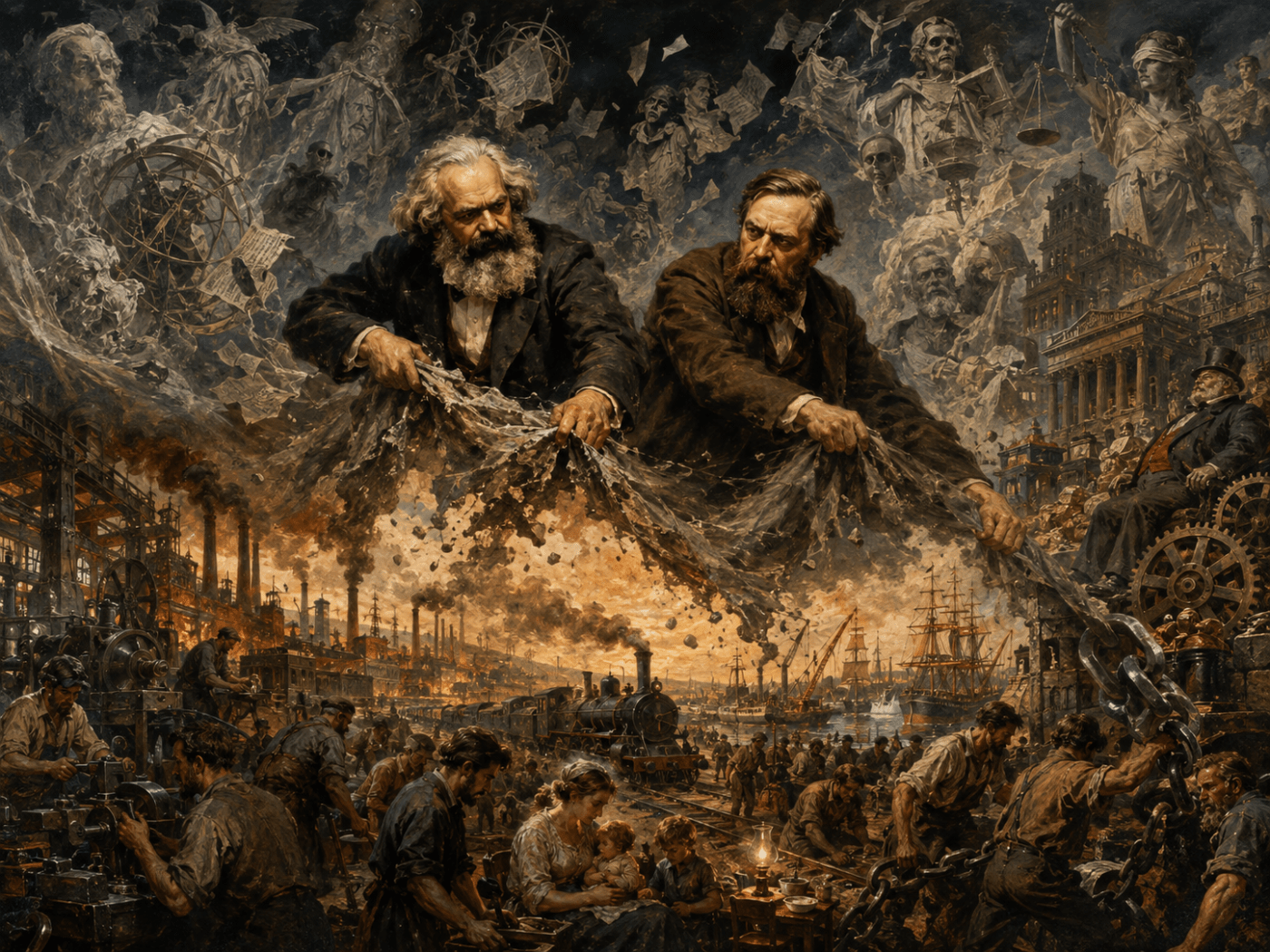
Marx and Engels enter The German Ideology by dragging philosophy out of the clouds and forcing every revolutionary claim back into the material life, labor, reproduction, class relations and practical struggles that give it meaning. From division of labor and private property to the state, money, the world market and bourgeois individuality, they expose how powers collectively produced by human beings can break loose from conscious control and return to rule their own creators. Their merciless campaigns against Bruno Bauer, Max Stirner and the True Socialists then reveal the deeper danger: even criticism, individuality and socialism itself become ideology when theory severs the connecting links between ideas and the real movements that produced them. But the weapon finally has to turn on its makers, because the most revolutionary lesson of Marx and Engels is that historical materialism survives only so long as its own abstractions remain servants of concrete history rather than new ghosts demanding that history obey the formula.
By Prince Kapone | Weaponized Information| Weaponized Intellects Book Reiview | August 22, 2026
The Revolution That Never Left the Head
Marx and Engels open The German Ideology with a joke whose target is considerably larger than the German philosophers they are preparing to roast. Human beings, they write, have allowed “the phantoms of their brains” to get out of their hands. These creations now seem to stand over their creators, issuing commands like little gods manufactured in somebody else’s workshop. The philosophers respond to this strange tyranny exactly as philosophers would: they declare war on the ghosts. The whole German struggle becomes, in Marx and Engels’ phrase, a “philosophic struggle with the shadows of reality.” The sarcasm matters because the error they are attacking is political before it is merely philosophical. If domination exists primarily in ideas, then liberation requires new ideas. Change the consciousness and you change the world. The landlord, the state, property, hierarchy and exploitation can apparently wait outside while the radicals hold the decisive battle upstairs in the human skull.
The Young Hegelians certainly sounded revolutionary. Marx and Engels grant them that much only to drive the knife deeper. They had taken religious criticism and expanded it until law, politics, morality and the state could all be treated as theological problems wearing civilian clothes. The world became one enormous church, and radicalism became the business of exorcising it. But once “conceptions, thoughts, ideas” are granted an “independent existence,” the conclusion follows neatly: these ideas become the real chains binding human beings, and changing consciousness becomes the practical road to emancipation. Marx and Engels answer that such “world-shattering” criticism leaves the existing world remarkably unshattered. The Young Hegelians oppose phrases with other phrases because they never ask the question that would break the spell: what is the connection between German philosophy and German reality, between this criticism and the material world producing the critics themselves?
That is the rupture which gives the manuscript its real force. Marx does not answer idealism by replacing mind with dead matter and telling human beings to sit quietly while circumstances do the driving. In the first of the Theses on Feuerbach, he attacks precisely that passive materialism for failing to grasp reality as “sensuous human activity, practice.” Feuerbach had pulled philosophy back toward earthly human beings, but he still tended to encounter the world as something contemplated. Marx pushes further: the material world people inhabit is also a world they act upon, reproduce and transform. By the third thesis, the point becomes explicit: “circumstances are changed by men.” Material conditions shape human beings, but human beings acting within those conditions alter them in turn. The new materialism therefore begins neither with sovereign consciousness nor with helpless people pushed around by structures. It begins with practical human beings inside relations they did not freely choose but nevertheless reproduce and can transform.
That is why the famous eleventh thesis—“The philosophers have only interpreted the world in various ways; the point is to change it”—is much sharper than the bumper-sticker version it later became. Marx is not sneering at thought as such. He is identifying the limit of thought when interpretation mistakes itself for transformation. A theory becomes revolutionary neither because its vocabulary sounds radical nor because its author despises the old order with unusual enthusiasm. Its truth has to enter practice. Its categories must lead back into the relations people actually reproduce. Otherwise the philosopher can declare the old world dead every morning and still pay rent to it that evening. The target is not thinking. The target is the fantasy that thinking can abolish the material conditions that continually reproduce the object of thought.
Part I brings that argument onto harder ground. Marx and Engels refuse to descend “from heaven to earth.” They begin from “real, active men,” and from there reconstruct the ideological “reflexes and echoes” of their actual life-process. Then comes the line everybody knows and too many people stop thinking about as soon as they quote it: “Life is not determined by consciousness, but consciousness by life.” In context, this is not a command to treat consciousness as irrelevant. It is a demand to explain it. Morality, religion and metaphysics lose the “semblance of independence” not because they evaporate, but because their development can now be traced through the historically changing activity of living people. Marx and Engels are not throwing ideas out of history. They are dragging ideas back into history, where somebody has to produce them, circulate them, institutionalize them and believe them under definite social conditions.
This distinction keeps the materialism here from collapsing into its own stupidity. The same passage insists that history must be understood through the “actual, empirically perceptible process of development under definite conditions.” Once that process is reconstructed, abstractions may help organize the material, but Marx and Engels warn that they “by no means afford a recipe or schema” for cutting history into neat pieces. That warning is already sitting inside the birth certificate of historical materialism. Theory is necessary; abstraction is unavoidable. But the abstraction must remain chained to the concrete history from which it was drawn. The philosopher’s original crime was allowing the product of thought to acquire an independent existence over reality. A materialism that later turned its own categories into self-moving laws would risk repeating the same operation with different nouns.
For now, however, Marx and Engels have only cleared the battlefield. They have shown why a revolution conducted entirely inside consciousness can leave the relations of the old world standing untouched, and why a materialism worthy of revolutionary politics has to contain active human practice within it from the beginning. But that victory creates a harder problem than the one it solves. If people themselves produce their history, why does the world they produce so often confront them as something fixed, external and beyond their control? Why can property, markets, divisions of labour and social institutions appear almost as independent of human beings as the philosophical ghosts Marx and Engels have just chased from the heavens? The answer will require them to leave the head entirely and enter the workshop of social life, where human beings discover that the most dangerous powers ruling them are not always imaginary. Sometimes they are their own collective powers, turned against them.
How Human Powers Become Foreign Powers
Once Marx and Engels have chased history out of the philosopher’s head, they do not send it wandering into some equally mystical thing called “the economy.” They send it somewhere much less glamorous: to the kitchen, the field, the workshop, the bed, the road between settlements—to the ordinary labor of keeping human beings alive. “The first historical act,” they write, is the production of the means by which people satisfy their needs. Before there can be a theology, a constitution, an army, a poem, a strike or a revolution, somebody has to eat. Somebody has to build shelter. Somebody has to make clothing. And this is not a one-time prehistoric inconvenience humanity graduates from on the way to civilization. Material life has to be reproduced “daily and hourly.” History keeps returning to the table because hunger does.
But Marx and Engels immediately make this premise harder than the vulgar materialism later built in their name. Human beings do not merely produce things. They produce life. “The production of life,” they write, occurs both “in labour” and “in procreation.” The relation between people and nature therefore arrives already bound together with the relation among people themselves. Children are born, families form, needs expand, people cooperate, and every act of reproduction enters a social arrangement that existed before the particular individuals now living inside it. This matters because it wrecks the cartoon in which Marx supposedly discovers a factory floor and decides everything else is decoration. The family is already inside the material history. So are reproduction, cooperation and the production of new needs. Marx and Engels have not yet developed these relations with anything like the depth they will give property and class, but they have placed them on the same earthly map.
Cooperation is where the argument begins to turn dangerous. Human beings working together generate a power no isolated human being possesses. Marx and Engels call this the “multiplied productive force” arising from cooperation. There is nothing mysterious about its source. A village can accomplish what a household cannot; a workshop can accomplish what one craftsperson cannot; an increasingly interconnected society can marshal accumulated knowledge, tools and labor across generations. Humanity becomes powerful precisely because nobody produces humanity alone. Yet this growing collective strength contains the contradiction that drives the section: the people whose association creates the power do not necessarily control the association through which it is created.
The hinge is division of labour. As activity becomes divided, people are assigned different functions, different relations to products, different forms of control over the work of others. Marx and Engels make the relation brutally compact: “Division of labour and private property are … identical expressions.” One describes the arrangement from the side of activity; the other from the side of its product. In neither case are they talking about a metaphysical sin called Property descending upon innocent humanity. They are identifying a historically developing relation in which activity and its conditions become unequally distributed. The worker does this. Somebody else controls that. One commands. Another obeys. One possesses the conditions under which another must work. What human beings do together is split apart socially, and the split begins to govern the people inside it.
This is where Marx and Engels give us one of the most important sentences in the whole manuscript. Under divided social activity, “man’s own deed becomes an alien power opposed to him.” Read lazily, it sounds like philosophy again—a melancholy statement about feeling estranged from one’s work. But the next passage shuts that door. The “social power” generated by cooperation appears to individuals “not as their own united power” but as an outside force because their cooperation is not consciously organized by them as a collective. The alienation is therefore not primarily inside the worker’s feelings. It is built into the social relation. People really do confront institutions, property relations and market imperatives they did not personally choose. They really can lose their livelihood because a relation produced through millions of human decisions moves against them. The power is human-made, but that does not make its domination imaginary.
Marx and Engels make the point almost wickedly clear through trade. Exchange is nothing supernatural. It is people exchanging the products of human activity. Yet supply and demand can come to “rule the whole world” like an ancient fate, distributing fortune and ruin, lifting nations and wrecking them, while everybody involved behaves as though the market were weather. Nobody summoned the god. Everybody helped build the temple. This is the material meaning of a social power becoming independent. The relation no longer waits for any particular person’s permission. The capitalist cannot simply ignore competition because he has achieved ideological enlightenment. The worker cannot wish wages upward by discovering the social construction of the wage relation. Human beings reproduce the relation through their activity, but as separated individuals they encounter the accumulated result as necessity.
The scale of that necessity keeps expanding. Marx and Engels write that as individual activity becomes world-historical, people become increasingly subjected to an alien power that “in the last instance, turns out to be the world market.” Again, this is not yet the detailed anatomy of capitalism Marx would later construct. But the insight is already formidable. The world market is not just a very large marketplace. It is the practical interdependence of human beings stretched across territories until the conditions under which one population reproduces its life depend upon production and exchange occurring elsewhere. The greater this connection becomes, the richer the possible human world becomes—and the more absurd it becomes that the people linked by it possess no common control over the relation linking them. The same development that expands the material and intellectual reach of the individual can magnify the alien power standing over the individual.
That is why Marx and Engels do not imagine communism as everybody retreating from complexity into some righteous little village where nobody needs anybody else. Their communist horizon moves in the opposite direction. They speak of the “real intellectual wealth of the individual” depending upon the wealth of that individual’s “real connections.” The problem is not interdependence. Human development requires it. The problem is interdependence without collective mastery—people tied together by the whole accumulated power of social production while the terms of that connection confront them like somebody else’s law. Communism, in this argument, does not abolish the social character of production. It makes that social character conscious. “All-round dependence,” they argue, has to become “control and conscious mastery” of powers born from the action of people upon one another.
But this is also where the manuscript refuses one easy revolutionary fantasy. You cannot vote scarcity out of existence. You cannot philosophize productive capacity into being. Marx and Engels insist that the abolition of this alien power requires practical material premises. Without sufficiently developed productive forces, they warn, “want is merely made general,” and the scramble for necessities reproduces “all the old filthy business.” There is a hard material truth here worth preserving: emancipation cannot consist of equalizing misery. If the social conditions required to feed, house, transport, educate and reproduce the population do not exist, goodwill does not manufacture them. The commune cannot live on slogans any more than the philosopher’s drowning man could survive by abolishing gravity from consciousness.
Yet Marx and Engels do not let material capacity become the hero of history either. Their own summary of the materialist conception says a revolutionary rupture requires not simply productive development but “the formation of a revolutionary mass” capable of revolting against the existing organization of life itself. Circumstances condition what becomes possible, but people organized through struggle have to make possibility historical. That distinction is essential. The factory does not secretly contain socialism in its machinery. The world market does not mechanically mature into communism. Productive development can create capacities and contradictions; it cannot substitute for the political formation of people capable of taking those capacities out of the hands of an alien social order and reorganizing them consciously.
This is the concrete force behind Marx and Engels’ famous refusal to define communism as an ideal society waiting to be installed. “We call communism the real movement which abolishes the present state of things.” The sentence is often quoted as though “real movement” means whatever happens spontaneously must somehow be communist. The surrounding argument says nearly the opposite. The movement has premises. It confronts definite property relations, definite divisions of labour, definite material capacities and an existing world of social interdependence. Its revolutionary content lies in changing the relation through which collective human powers stand above the people who collectively create them. Communism becomes intelligible here not as a dream about perfect human beings but as the struggle to make social power actually social—to bring exchange, production and the conditions of common life under the conscious control of the associated people whose labor already sustains them.
Marx and Engels have now done more than replace ideas with material conditions. They have discovered a deeper problem: domination can be produced by ordinary human activity itself. Nobody needs to invent an invisible hand for social relations to behave like one. People can collectively make a world that none of them, separately, governs. That discovery gives their attack on German philosophy its teeth, because the same mistake can now appear in another form. Once a human activity acquires an independent social existence, it can begin imagining that independence as sovereignty. Bruno Bauer’s “Criticism” does exactly that. The critic ceases to look like one historical actor among others and starts strutting across the page as though criticism itself were making history. Marx and Engels have built the instrument they need to cut that illusion open.
Criticism Cannot Make Its Own History
By the time Marx and Engels convene what they sarcastically call the “Leipzig Council,” the joke has changed targets. They no longer need to prove that human beings live materially before they philosophize. Now they want to see what happens when a particular form of intellectual activity begins mistaking its own social existence for sovereignty over history. Germany, they note, is wrestling with protective tariffs, constitutional questions, banking affairs, railways and even the potato blight, while the philosophical saints prepare for a much holier war. Their battlefield is populated by Criticism, Substance, Man and the Unique. The contrast is not filler between the serious chapters. Marx and Engels are asking why an intellectual stratum can inhabit the same historical moment as these material conflicts and nevertheless imagine that the decisive struggle is taking place almost entirely inside philosophy.
Bruno Bauer gives them the cleanest specimen. In Marx and Engels’ rendering, Bauer can pass through “the changed conditions of 1845” while insisting that criticism “always remained itself and unchanged.” The formulation exposes precisely what they want to attack. If criticism possesses its own essence independent of changing relations, then the critic no longer needs to explain why a particular form of criticism appears at a particular moment, whose activity sustains it, what practical conflicts give it an audience, or why its categories change. Criticism becomes a little state unto itself. History moves around it while it remains pure, judging the movement from above. Bauer has not simply produced the wrong interpretation of events. He has detached an actual human activity from the history that makes the activity possible.
The claim becomes almost magnificent in its inflation. Marx and Engels quote Bauer’s proposition that “criticism and the critics … have guided and made history.” There it is: the division of intellectual labour has promoted itself to commander-in-chief. The critic really does perform work. Arguments can intervene in political struggle; publications can reorganize consciousness; ideas can help people recognize what previously appeared natural. Marx and Engels do not need to deny any of that. Their target is the leap from criticism acts within history to criticism makes history. Once that leap is made, the conditions producing the critic disappear, the conflicts giving criticism its object disappear, and the people whose practical activity constitutes social life become scenery behind the intellectual hero. History becomes the biography of its commentators.
That is why the Bauer polemic contains one of the most useful methodological warnings in the whole manuscript. Marx and Engels catch their opponent “joining together everything and bringing the most diverse things into an apparent causal relation.” Bauer’s immediate trick is almost comical: Marx and Engels had not criticized Stirner in The Holy Family; Moses Hess later did; therefore some grand development of criticism must explain what one could do and the others could not. Marx and Engels point out the rather less celestial cause: Stirner’s book had not yet appeared when they wrote theirs. A missing date demolishes an entire speculative procession.
The political importance of that joke is enormous. Materialist analysis cannot be a machine for arranging true facts beside one another until they look causal. That two events concern the same class, institution or historical crisis does not establish the mechanism connecting them. Nor does baptizing the space between them with a large theoretical word. The “apparent causal relation” has to be replaced by the actual connecting links: sequence, institution, material interest, organization, conflict, transmission, dependency, whatever the concrete case requires. Otherwise materialism merely changes the costume of speculation. Instead of Spirit making history, one can just as easily make “capital,” “technology,” “the state,” or even “class” perform miracles from offstage. The vocabulary becomes red; the causal method remains Bruno Bauer’s.
This is also why Marx and Engels’ relentless mockery of Bauer should not be confused with an argument that intellectual struggle is worthless. They ridicule the strange confidence with which “critical criticism” declares itself “victorious and confident of victory” even when its own formulations concede that it cannot move beyond criticism. The sarcasm lands because the gap is between proclaimed historical power and demonstrated practical power. One can win every battle against an opponent’s category and still leave the relation represented by that category standing. A concept can be demolished in print without a landlord losing an acre, a worker gaining control over production, or a state surrendering an institution. The point is not that thought has no consequences. The point is that its consequences must be historically traced rather than awarded in advance by the thinker.
Bauer therefore becomes more useful to Marx and Engels than his philosophical system might suggest. He gives them a laboratory in which to demonstrate how ideology is produced by separating an activity from the conditions under which people actually perform it. “Criticism” starts as something critics do. Once severed from the critics as definite people living inside definite relations, it can be rewritten as an autonomous force. The human producer vanishes into the product. Then the product returns wearing a crown.
But criticism is still an easy sovereign to dethrone. It is visibly an intellectual occupation performed by actual writers. The next enemy is harder because his claim reaches deeper into bourgeois common sense. Max Stirner does not merely elevate criticism above history. He elevates the individual. The sovereign “Unique” appears to stand before social relations, choosing among them as though the self arrived fully formed before family, property, labour, language and class ever touched it. To answer him, Marx and Engels will have to do more than historicize philosophy. They will have to show that the individual who imagines himself standing alone is already crowded with the lives of other people.
The Individual Is Full of Other People
Max Stirner enters The German Ideology carrying the most radical individual imaginable: the sovereign ego, the “Unique,” stripped of God, morality, society and every abstraction claiming authority over it. Marx and Engels do not answer him by saying the individual is unimportant. They do something more damaging. They ask where this supposedly self-made individual got his language, his needs, his property, his family, his work, his money, his habits and the social conditions that make his particular rebellion imaginable in the first place. Stirner wants to free the individual from abstractions. Marx and Engels want to know what produced both the abstraction and the individual rebelling against it. That shift changes the whole terrain. The individual stops being history’s starting point and becomes one of its products—not a puppet, not a statistic, but a living person whose possibilities have been formed through relations with other living people.
The method first appears again around religion, but the argument has moved beyond the opening attack on philosophy. Marx and Engels insist that religious development always confronts “the material world which each stage of religious development finds in existence.” The significance lies in that last phrase. Christianity, morality, family sanctity or egoistic rebellion cannot be treated as interchangeable ideas floating across centuries. Every ideological form meets a particular world already organized through definite relations. Stirner wants to abolish the holy by refusing its authority over the ego; Marx and Engels insist that the sacred keeps returning so long as the social relations that continually manufacture sacred authority remain standing. The materialist question is no longer merely whether the idea is false. It is why this idea acquires social force here, among these people, under these conditions.
The family makes the problem beautifully concrete. Stirner sees the “holy family” as another conceptual chain upon the individual. Marx and Engels answer that one can knock the holy halo off the family and still come home to the same property relations, the same children, the same household dependencies, the same urban structure, the same material organization of life. They call these relations the family’s “real body” and include among them “the property relation.” The phrase matters because it refuses the easy victory of conceptual abolition. Philosophers in the eighteenth century could tear apart obedience, piety and marital fidelity as sacred ideals, yet the actual family remained because the conditions reproducing it remained. Marx and Engels even point to industry and competition as forces altering those conditions from beneath. The family changes historically not because somebody finally wins the argument over its definition, but because the network of relations that makes a particular family form necessary is changing.
There is an unfinished doorway here that later Marxists would have to walk through. Marx and Engels clearly place family relations inside material history rather than outside it, and they connect those relations to property and the mode of production. But they do not develop social reproduction with the depth they give class, industry or private property. That is a limitation of the manuscript, not a license to pretend the opening is absent. The important discovery is already there: relations reproduced in kitchens, households, marriages and generations can survive the demolition of the ideas used to justify them. If the relation is material, criticism has to reach the relation.
Political liberalism receives the same treatment. Marx and Engels insist that “the key to the criticism of liberalism” lies in the history of the bourgeoisie. That sentence tears the word freedom away from philosophy and sends it back into class history. Liberal freedom is not dismissed because freedom is fake or because Marx secretly prefers obedience. The question is what historically specific form freedom takes once feudal bonds are broken and bourgeois relations become dominant. The worker becomes legally free from the master in the old personal sense, but that freedom arrives inside a world where access to livelihood is governed by property and competition. Freedom therefore has a material content, and that content has a class history.
Marx and Engels sharpen the point in one brutal sentence: “Freedom of Labour is free competition of the workers among themselves.” There is the liberal miracle with the invoice still attached. The worker is free to sell labour-power, free to seek an employer, free from feudal attachment—and also free to compete against other workers who possess the same freedom and the same need to live. Formal independence abolishes one kind of domination while producing another form in which nobody has to own the worker personally because material necessity does the recruiting. This is why Marx and Engels immediately distinguish freeing labour from abolishing the particular alien form labour has assumed. Their communist alternative is not laziness elevated into philosophy. Elsewhere in the same polemic they describe free activity as the “creative manifestation of life” arising from the development of the whole person’s capacities.
The distinction is crucial because it exposes what Stirner cannot see about individuality. If freedom means simply removing every explicit command laid upon the ego, bourgeois society begins to look wonderfully liberated. Nobody orders the isolated individual to worship feudal hierarchy. Nobody has to command a wage-worker to enter competition at sword point each morning. Yet the conditions of survival already stand outside the individual as facts. What looks like freedom from personal domination can coexist with deeper subjection to impersonal relations. Marx and Engels are after precisely this strange bourgeois achievement: the individual becomes formally more independent at the same time that the conditions governing life become increasingly social and increasingly beyond individual control.
Private property makes this visible even in the things themselves. Marx and Engels write that “private property alienates the individuality not only of people but also of things.” Land does not naturally contain rent. A machine does not have profit hidden inside its gears. These characteristics arise from definite social relations. The landlord encounters land principally as rent-bearing property; the capitalist encounters machinery as capital capable of yielding profit. Remove the relation and the soil remains soil, the machine remains a machine. Marx and Engels are not denying material objects. They are distinguishing the physical thing from the social power historically attached to it. A relation among people comes to inhabit an object so completely that the object’s social form begins looking like one of its natural properties.
That is why the critique of private property here reaches beyond legal ownership. Property reorganizes perception itself. Buying and selling become so ordinary that commercial relations can masquerade as human relations in general. The bourgeois individual appears to possess an identity naturally expressed through possession, exchange and competitive independence because bourgeois society has spent centuries making these relations practical facts. Stirner then arrives triumphantly to liberate the ego from abstraction while carrying half the bourgeois world inside his pockets. The “Unique” looks solitary only because the history stuffed inside him has been erased.
Morality suffers a similar fate. Marx and Engels declare that “The Communists do not preach morality at all,” but the line means almost the opposite of nihilism. They refuse to explain conduct through the eternal battle between selfishness and selflessness. Both, they argue, can become necessary forms of individual self-assertion under definite circumstances. The communist task is therefore not to order everyone to become nicer. “Love one another” cannot abolish the conditions that continually reproduce antagonism, scarcity, competition or property. Nor does communism require sacrificing the “private individual” before some sanctified General Interest. Marx and Engels insist instead on finding the material source of the opposition itself. Change the mode of life producing the contradiction and the moral drama loses the social basis that made it appear eternal.
This is where their argument against Stirner becomes much more politically interesting than a defense of “society” against “individualism.” Marx and Engels do not counter the sovereign ego with a sovereign collective. They reject both abstractions. The general interest is itself continuously produced through the activity of particular individuals; it has no mystical history independent of them. The individual, meanwhile, never arrives as a pure ego. People enter relations carrying needs, bodies, inherited productive forces, languages, generations and existing forms of intercourse. Their individuality develops through these relations even when those same relations later constrain them. The opposition between individual and society is therefore not solved by choosing a side. It has to be historically reconstructed.
Near the end of the sprawling Saint Max polemic, Marx and Engels finally state the relation without ornament. Individuals have always “proceeded from themselves,” but never as beings without connections. Their needs connect them through sex, exchange, division of labour and other forms of intercourse. More importantly, it is their own “personal, individual behaviour” toward one another that “created the existing relations and daily reproduces them anew.” This is the materialist answer to Stirner in its strongest form. Society is not a ghost hovering above individuals. It exists through what individuals actually do. Yet because people enter those relations under inherited conditions, the accumulated result of their own interaction can acquire a structure, continuity and power no isolated individual can simply renounce.
From there Marx and Engels draw the conclusion Stirner’s sovereign ego cannot reach: “the history of a single individual cannot possibly be separated from the history of preceding or contemporary individuals.” That does not erase the person. It makes the person historically intelligible. Every individual receives a world already packed with the labor, institutions, languages, productive capacities and relationships of other people. The material question of freedom is therefore not how an imaginary ego can become independent of everybody else. Human beings are already interdependent. The question is whether those relations develop their capacities or stand above them as uncontrollable circumstances.
This is the real revolutionary sting hidden inside several hundred pages of Marx and Engels abusing poor Saint Max. Communism does not have to choose between the individual and the collective because the isolated individual was always a fiction. What must be transformed are the social conditions under which real individuality develops. Association can become a fetter when it confronts people as inherited necessity; association can also become freedom when people gain conscious power over the relations through which they already depend upon one another. Stirner wants the individual liberated from society. Marx and Engels are after something more difficult: a society in which the individual’s social dependence no longer requires the sacrifice of individual development.
But those relations are already stretching far beyond the family, the workshop and the nation. The same individual who appears autonomous inside bourgeois society is increasingly tied by commerce and industry to people never seen, in places never visited, through productive relations no single participant commands. To understand how the social individual becomes genuinely world-historical, Marx and Engels have to widen the map. Behind the philosopher arguing about the sovereign ego stands a world market already knitting humanity together through competition, colonization and industrial power.
The World Market Behind the Philosophers
Marx and Engels widen the map of The German Ideology by following capital out of the guild town and across the sea. Manufacture changes more than the technique of production. It changes the relation between worker and employer, replacing the lingering patriarchal relation of journeyman and master with what they call the “monetary relation between worker and capitalist.” It changes the form of property by expanding movable capital. And it changes the relation among states because trade becomes something nations now fight over through “wars, protective duties and prohibitions.” The economy does not sit beneath politics like a basement beneath a house while kings and ministers conduct a separate history upstairs. Changes in production reorganize class relations, commercial interests, fiscal needs and interstate competition until trade itself acquires “a political significance.”
The geographical leap comes next, and Marx and Engels do not leave colonial expansion outside the story. Manufacture, they write, received an “enormous impetus” from the commerce unleashed by “the discovery of America and the sea-route to the East Indies.” American gold and silver entered European circulation and altered relations among classes; expeditions and “colonisation” widened the field of accumulation; and, “above all,” expanding markets into a “world market” opened a new phase of historical development. Colonization then poured “new fuel” onto commercial rivalry among the European powers. The passage matters because it makes nonsense of the claim that their early material history simply stops at Europe’s shoreline. The emerging capitalist world is already being produced through overseas expansion.
But the opposite exaggeration would be just as lazy. A few paragraphs on colonization do not secretly contain the finished theory of imperialism that Marxists would construct generations later. Marx and Engels show concrete mechanisms: colonial markets, precious-metal circulation, commercial monopolies, tariffs, naval competition, the accumulation of movable capital. They even describe a period in which colonial consumers, Navigation Laws and monopolies help organize the struggle for the opening world market, with competition among nations ultimately settled through wars, especially naval wars. That is real material causality. What the manuscript does not yet reconstruct with comparable depth are the specific relations of racialized labor, plantation accumulation, settler possession, unequal exchange or later finance-capital imperialism. The revolutionary task here is not to congratulate the text for saying the word colonisation, nor to prosecute it for failing to have already written Lenin. It is to preserve what the evidence actually establishes: capitalist development is international and colonial inside Marx and Engels’ historical account from an early stage, even where the theory of colonial domination remains unfinished.
Once big industry enters, the scale changes again. Marx and Engels say it “universalised competition,” established modern means of communication and the world market, subordinated commerce to itself, accelerated circulation and centralized capital. Their language is sweeping because the relation they are identifying is sweeping. Production in one place becomes dependent upon demand elsewhere. The satisfaction of needs in one country comes to depend upon labor, materials and exchange distributed across the world. This is what they mean when they say big industry “produced world history for the first time”: not that the rest of humanity suddenly entered history when Europe industrialized, but that historically separate populations were being bound into a materially interconnected process of reproduction.
And here the manuscript stops looking like a relic and starts reading like a report from the present. By early 2026, roughly 72 percent of global merchandise trade was still moving under most-favoured-nation terms even as tariff actions and preferential agreements multiplied. In other words, the borders are hardening without the material connections disappearing. The seasonally adjusted volume of world merchandise trade still rose 1.9 percent quarter-on-quarter and 3.2 percent year-on-year in the first quarter of 2026, while tariff measures continued reorganizing the trade landscape and geopolitical conflict disrupted shipping and energy markets. At the same time, the US-dollar value of trade in AI-enabling goods jumped more than 40 percent year-on-year. This is not some liberal fairy tale about free trade finally conquering politics. It is the opposite contradiction: the world market grows denser while the political struggle over who controls its routes, technologies, markets and advantages grows sharper. Marx and Engels had already traced international commercial rivalry through wars, protective duties, prohibitions, tariffs, colonial monopolies and state protection. The present only makes the relation harder to miss. Integration and antagonism do not cancel each other; they can deepen together. Capital can bind production across borders more tightly at the very moment states fight more aggressively over the terms of that dependence, and the continued growth and changing composition of world trade show a system being rerouted and contested, not simply dismantled.
This is where their treatment of the state becomes especially useful, because Marx and Engels give us enough to resist two opposite stupidities. The first imagines the state floating above the social order as an independent national brain pursuing timeless “interests.” The second reduces the state to a telephone on the capitalist’s desk. They write that the modern state is the form of organization the bourgeoisie adopts for the “mutual guarantee of their property and interests.” That gives the state a class determination. But they also insist that “the State mediates in the formation of all common institutions.” That gives political power a real institutional function. The ruling class does not have to personally administer every road, court, tax office or regulation for those institutions to reproduce a property order whose conditions exceed any single capitalist. The state generalizes relations that private competitors could not reproduce merely by each minding his own shop.
The historical account itself makes the mediation concrete. Customs duties change function as commerce, money and state finance change. Privileges once inherited from feudal arrangements become sources of government revenue. Colonial monopolies protect manufacture. States impose tariffs and prohibitions in the international competitive struggle. War settles commercial rivalries when treaties and duties do not. Politics is therefore neither decoration pasted onto economics nor a sovereign chess game among states that somehow forgot production exists. It is one of the forms through which developing property relations, fiscal requirements and commercial antagonisms are organized and fought out. Marx and Engels are strongest here precisely because the categories remain attached to mechanisms.
Yet the world market does not spread by making every society the same. Marx and Engels themselves interrupt any neat staircase of history. Development, they write, proceeds from “various localities, tribes, nations, branches of labour,” initially developing apart and only gradually entering relation. More importantly, “the various stages and interests are never completely overcome.” Older interests can remain lodged inside later institutions for centuries. Within the same country, different populations can therefore inhabit profoundly different relations to development; across countries, the unevenness becomes sharper still. Colonies may receive forms transplanted from another historical soil. Conquest may introduce an already developed form of intercourse into conditions different from those that produced it. The world relation unifies without flattening.
Even their account of big industry carries this contradiction inside itself. They write expansively that industry creates common class relations across nations, yet in the very next movement concede that big industry “does not reach the same level of development in all districts of a country.” More industrial countries act upon less industrial ones because the latter are swept into “the universal competitive struggle.” Universality therefore exists as a relation among unequally developed parts, not as the disappearance of unevenness. The capitalist world can become more integrated and more unequal at the same time. Indeed, the universal relation becomes one of the mechanisms through which uneven conditions act upon one another.
The same refusal of smooth progress appears inside production itself. Big industry creates extraordinary productive capacities, brings science directly into production and tears through inherited restrictions. But Marx and Engels say those productive forces receive a “one-sided development” under private property and “became for the majority destructive forces.” There is no automatic hymn to technology here. Productive power measures what society can do; it does not tell us who controls that power, toward what ends it is organized, or what destruction can accompany its development. The contradiction sits inside the relation between collective capacity and its social form.
And this is where the contradiction stops being theoretical and starts burning through the atmosphere. The World Meteorological Organization reports that 2015 through 2025 were the hottest eleven years ever recorded, with 2025 sitting about 1.43°C above the 1850–1900 average; beneath that rising temperature curve, ocean heat content reached the highest level in the 66-year observational record, while extreme heat, torrential rainfall and tropical cyclones tore through societies already bound together by the same global systems of production, transport and exchange. Marx and Engels did not possess an ecological political economy waiting fully formed inside an 1845 manuscript, and there is no reason to forge one for them now. What they did identify was a contradiction sharp enough to survive the journey: productive forces developed under private property can take a one-sided form and become destructive forces for the majority. That distinction cuts straight through the bourgeois religion of progress, where every new capacity is counted as advancement simply because capital has learned how to produce more, move faster, extract deeper or calculate better. The climate crisis is what happens when immense social powers over production and nature remain organized through relations the people collectively creating and suffering them do not consciously command. The factories grow more productive, the logistical networks more sophisticated, the science more precise—and the biosphere still gets handed the bill. The contemporary climate record does not prove Marx and Engels’ political economy by itself; it shows why productive capacity and human progress cannot be treated as synonyms. Their category survives the pressure. The ecological mediation still has to be fought out in history.
Then Marx and Engels make their boldest leap. Looking across the history they have reconstructed, they say that “all collisions in history have their origin” in the contradiction between productive forces and the form of intercourse. It is an enormously powerful abstraction. It is also the point where the manuscript begins to place its own method under pressure. The pages surrounding the sentence have just shown us colonies, conquest, uneven national development, inherited institutions, class conflicts, political struggles, ideological battles and international competition. Marx and Engels even say the contradiction appears through these “subsidiary forms.” The question is not whether the productive-force contradiction is imaginary. Their own history gives it substance. The question is how much explanatory work one abstraction can perform before the concrete mediations start disappearing inside it.
That problem cannot be settled yet. The manuscript itself has already armed both sides of the argument: a recurring contradiction between developed human capacities and inherited social relations, and an insistence that those relations develop unevenly through specific histories that never simply vanish when a newer form becomes dominant. But before Marx and Engels can be put under their own microscope, they make one more turn—and it may be the most politically important one in the entire book. Having spent hundreds of pages dragging philosophers back into material history, they encounter men speaking in the name of socialism who perform the same old trick. They take ideas produced by real communist and working-class movements, cut away the classes, struggles and national conditions that gave those ideas meaning, and return the result to Germany dressed up as philosophy. The ghosts are about to learn how to speak socialist.
When Socialism Becomes German Ideology
After spending hundreds of pages tearing apart philosophers who mistake their abstractions for history, Marx and Engels finally arrive at a more dangerous problem: socialism can commit the same crime. The opening of True Socialism does not accuse the German socialists of having insufficiently radical intentions. It accuses them of misunderstanding where socialist theory came from. They treat French and English communist literature “not as the expression and the product of a real movement” but as theoretical systems generated through thought. That distinction changes everything. Once socialist ideas are separated from the workers, political conflicts, property relations and practical needs that produced them, socialism itself begins floating above history. The slogans remain communist. The method has quietly returned to German philosophy.
Marx and Engels are precise about the mechanism. Even when foreign socialist writers present elaborate systems, those writings still arise from “the practical needs” and conditions of a particular class in a particular country. The True Socialists erase those determinations. They take propositions formed through French and English struggles, detach them from “the real movement” whose consciousness they express, and then reconnect them arbitrarily to Hegel, Feuerbach and the German philosophical inheritance. Theoretical translation becomes ideological transformation. What had been an attempt to think through definite antagonisms now becomes a discourse about Humanity, human essence and the most reasonable form of society. Germany does not merely import socialism; its philosophers wash off the fingerprints of the people who made it.
This is why Marx and Engels’ contempt for “German science” carries more than national sarcasm. The True Socialists boast that the supposedly crude French and English have stumbled into communism empirically, while the Germans possess the philosophical depth required to reveal its truth. One of their writers can even proclaim that communism is French but socialism is German, with France arriving through politics and Germany through metaphysics. Marx and Engels’ answer is devastating because it does not argue that theory is useless. It asks what kind of theory becomes possible once politics and social development are treated as independent realms with self-contained histories. Whether communism takes a political, philosophical or other ideological form, they insist, “depends, of course, upon the whole development of the nation.” The conceptual form has to be explained by the history. The True Socialists reverse the direction: they use philosophy to explain away the history.
The result is socialism emptied of antagonism. The real opposition in bourgeois society is not between two competing ideas of property, one false and one “true.” Marx and Engels write that “the actual property-owners stand on one side and the propertyless communist proletarians on the other.” The sentence is crude only if it is read as a sociological inventory. In context it performs a methodological correction. The True Socialists have taken an antagonism produced through actual property relations and translated it into the philosophical opposition between property and lack of property, only to resolve the contradiction by inventing “true property.” The class relation disappears inside a better adjective. Once that happens, communism can be rendered harmless enough for philanthropic reconciliation because the social force whose interests require abolition of the existing property relation has been philosophically removed from the picture.
Marx and Engels therefore insist that proletarian theoreticians strip away phrases that “dim the realisation of the sharpness of this opposition.” That does not mean every political contradiction can be compressed into property-owner versus proletarian and the analysis declared complete. The entire manuscript has already shown otherwise. State institutions, competition, national development, colonial expansion and forms of ideology all require their own mediation. What the passage demands is more elementary and more severe: a theory claiming practical revolutionary effect cannot dissolve the antagonism that gives the theory its historical necessity. When a class contradiction becomes “Man versus alienation,” the vocabulary may sound broader and more humane while the politics becomes narrower. Everybody can embrace Humanity precisely because nobody has to say whose property, whose labour, whose power, and whose movement are actually colliding.
Karl Grün provides Marx and Engels with an almost perfect specimen. Grün boasts that talking about wages, competition, constitutions and governments is less profound than beginning from the “pure, genuine man” revealed by German philosophy. Marx and Engels hardly need to improve the comedy. There is the whole disease in one sentence: the material relations are dismissed as small matters because philosophy has discovered the Human Being hiding behind them. Grün then wanders through France convinced that French socialists must learn from German science while possessing only a shallow grasp of both French conditions and the German philosophy he claims as his superior weapon. What appears as theoretical universality turns out to be provincial abstraction wearing a world-historical hat.
The problem becomes even clearer when Marx and Engels inspect Grün’s treatment of Saint-Simon. Grün supplies a parade of events—marriage, poverty, clerical employment, attempted suicide, intellectual activity—but substitutes words like “then,” “later” and “now” for explanation. Marx and Engels go back to the omitted material: why Saint-Simon undertook particular activities, what practical aims he pursued, what historical conditions connected one phase of his life to another. The difference is not pedantry. Chronology is not causality. Listing events in sequence does not reconstruct the relation that turns one moment into another. The same criticism applies at the level of political economy when Marx and Engels accuse Grün of “omitting the necessary connecting links,” thereby transforming otherwise recognizable propositions “into pure fantasies.”
That phrase—the necessary connecting links—may be one of the most dangerous weapons in the entire book because it can be turned in every direction, including our own. A revolutionary analysis does not become materialist by placing the words class, capital, imperialism or contradiction between two facts. The relation has to be shown. If a wage cut produces a political realignment, through what institution, organization, pressure or change in consciousness does the movement occur? If a technology intensifies exploitation, through what property relation and labour process? If a state policy serves a class interest, through what political and institutional mediation? Marx and Engels have now moved far beyond simply telling philosophy to look at material life. They are demanding that materialism earn its causal claims.
This is exactly why True Socialism belongs at the center of any serious reading of the full German Ideology. Here Marx and Engels refuse to give revolutionary language diplomatic immunity. Socialist theory can reproduce ideology not because socialism is secretly bourgeois, but because any theory can become detached from the concrete relations that once gave its categories meaning. A concept generated through struggle can continue circulating after its historical connecting links have been cut. It can then acquire a life of its own, complete with authorities, interpreters and guardians who treat mastery of the language as mastery of the world. The earlier philosophers made Spirit autonomous. The True Socialists achieve the same miracle with communism.
The last movement of the chapter drives the point into outright farce. Dr. Georg Kuhlmann arrives as the long-awaited man who will emerge from “the solitude of the spirit” carrying the solution to the age’s contradictions. Marx and Engels answer by pointing to something already inconveniently alive outside the prophet’s head: “the communist movement, which has already gripped all civilised countries.” The joke is cruel because the theory of the Great Revealer requires the actual movement to become an empty shell awaiting its thinker. The working people already organizing, struggling, publishing, associating and confronting existing society must be conceptually demoted so the philosopher can arrive as history’s missing subject.
Marx and Engels do not need to romanticize that movement to make the point. A real movement can be weak, divided, mistaken, immature or defeated. What makes it real is not perfection but historical existence: definite people acting from definite conditions against definite relations. Theory has a role precisely because such movements need investigation, argument, strategy and clarification. But the relationship runs both ways. Theory must learn from the movement it seeks to comprehend, while the movement can use theory to understand relations that immediate experience alone does not reveal. Sever either side and the result degenerates. Practice without analysis can stumble blindly. Theory without material connection begins giving lectures to history.
That reversal brings The German Ideology to the edge of its hardest test. Marx and Engels have now used historical materialism against religion, Criticism, the sovereign ego, liberal freedom, property mystification and finally socialism itself. They have made the absence of connecting links an accusation serious enough to destroy a theory’s claim to materialism. There is nowhere left to hide behind the correct vocabulary. If socialist phrases can become ideology when detached from real historical relations, then Marxist phrases can too. The next question cannot be avoided: when Marx and Engels themselves move from concrete histories toward sweeping propositions about productive forces, forms of intercourse and historical necessity, do those abstractions remain instruments for investigating history—or do some of them begin trying to rule it?
The Materialist Method Must Face Materialism
Marx and Engels spend The German Ideology stripping human creations of the false independence they acquire over their creators. Ideas have to be returned to the lives that produce them. Property has to be returned to relations among people. The state has to be returned to the society whose antagonisms give it substance. Socialist theory has to be returned to the movement that made it necessary. There is only one honest place left for the knife to go: historical materialism itself. Marx and Engels already give us the standard. Abstractions can help organize historical material, but once they detach themselves from “real history” and begin doing the work of investigation in advance, they become precisely the kind of sovereign concepts this book was written to destroy.
That test matters because the manuscript sometimes speaks more strongly than its own method warrants. Marx and Engels describe developing productive forces coming into contradiction with inherited forms of intercourse and write that these contradictions repeatedly erupt through revolution. Yet the history surrounding this proposition is considerably messier than any mechanical formula. Earlier relations survive inside later formations. Different regions develop unevenly. Conquest and colonization transplant social forms onto different historical soil. International competition can import pressures into a country before they have matured internally. Classes have to organize and struggle. States mediate antagonisms politically. The productive-force contradiction is therefore real without becoming a hidden locomotive pulling every society through the same stations. The abstraction is useful only when it sends us back into those mediations rather than replacing them.
Marx himself later sharpened the weapon. In the 1857 Introduction, he writes that “production in general is an abstraction,” but a rational abstraction only insofar as it isolates what different historical forms genuinely share without erasing the determinations that make each form historically specific. He makes the same point about labour: even apparently universal categories become fully intelligible only within the social relations that give the abstraction practical reality. That is the difference between a concept and a catechism. A concept helps us penetrate concrete history. A catechism already knows what history is supposed to say before history opens its mouth.
Which brings us to the sentence that has to face the twentieth century. In 1845 Marx and Engels argued that communism was empirically possible only through the dominant peoples acting “all at once” and simultaneously, because only sufficiently developed productive forces and world intercourse could prevent local communism from being overwhelmed by scarcity and the expanding world market. Read carefully, the passage contains two claims that history would pull apart. One concerns the geography and timing of revolutionary rupture. The other concerns the material difficulty of completing communist transformation inside a world still governed by capital. They did not receive the same historical verdict.
The first was superseded. The Bolsheviks did not wait for Britain, Germany and the other advanced capitalist centers to move together. The Russian Revolution broke through an uneven formation combining concentrated modern industry with agrarian backwardness, war, peasant revolt and an organized revolutionary movement capable of converting crisis into political power. Yet even here we should not manufacture a stupid Marx-versus-Lenin drama: Marx and Engels themselves later entertained the possibility that revolution could erupt in Russia before the West. What October demolished was not historical materialism but the habit of converting one historically conditioned expectation into a timetable for everybody else.
Then the breach widened. In China, a revolutionary alliance rooted among workers and peasants broke landlord power, mobilized an overwhelmingly rural population and built a state capable of directing resources toward national reconstruction from an extraordinarily weak industrial base. In Vietnam, Ho Chi Minh and the communist movement fused national liberation, agrarian struggle, worker-peasant organization and socialist construction rather than waiting for Vietnam to reproduce the social structure of Western Europe. Cuba broke the sequence again. The socialist road was no longer travelling outward from the most developed capitalist societies toward everybody supposedly waiting behind them. The colonized and dependent world had entered revolutionary history on its own terms.
Samir Amin gives that reversal its global meaning. In his reading, the October Revolution became universal not because every revolution copied Russia but because China, Vietnam, Cuba and the anti-colonial revolutions of Africa and Asia shifted the revolutionary center of gravity toward peoples whose underdevelopment was itself bound up with imperial incorporation into the capitalist world system. “Backwardness” could no longer be treated simply as an earlier rung on somebody else’s ladder. Colonialism and imperialism had produced uneven development relationally: productive power concentrated here because land, labour and surplus had been subordinated there. The periphery was not standing outside capitalist modernity waiting to enter. It had been dragged inside on unequal terms.
But history did not simply throw Marx and Engels’ warning into the furnace. It preserved its harder material core. A revolution could seize political power nationally without abolishing the world market internationally. Cuba makes the distinction painfully clear. Che Guevara, wrestling with socialist construction from inside the revolutionary government, could reject commodity domination while still acknowledging that Cuba remained an open economy profoundly affected by foreign trade and therefore had to navigate international markets without allowing their categories to become sovereign over socialist planning. The revolution had broken capitalist political command on the island. It had not magically abolished scarcity, technological dependence, external exchange or an imperial world system capable of turning those dependencies into weapons.
This is where the 1845 proposition has to be superseded rather than merely refuted. Marx and Engels were wrong if their sentence is made into a law requiring the first durable revolutionary rupture to occur simultaneously among the dominant capitalist peoples. The twentieth century settled that question in Petrograd, Beijing, Hanoi and Havana. But they were onto something deeper when they insisted that communism could not be reduced to changing a government while leaving scarcity and alien world-market power untouched. Political rupture and completed social transformation turned out to be different historical moments. The oppressed could seize command before inheriting the productive abundance imagined by nineteenth-century communists. Then came the harder work: building the material basis of a new society while the old world remained outside the gates—and frequently inside them.
That is the terrain Weaponized Information has called siege socialism. It is why Nkrumah’s insistence that the “political kingdom” had to precede Africa’s economic emancipation cuts directly across any mechanical sequence in which productive development quietly matures first and politics arrives afterward to collect the inheritance. Colonial and neocolonial power helped organize the very underdevelopment development policy was supposed to cure. Sovereign political power therefore becomes one of the conditions through which productive capacities can be reorganized at all. Chávez made the same point from another road when he insisted that socialism is only a possibility that must be consciously built through organization, new property relations, popular power and a transformed productive model. Productive forces do not make socialism behind the backs of people. People organized through political power struggle over what those forces will become.
And now the deepest contradiction of The German Ideology returns on socialist terrain. The revolution creates parties, states, planning institutions, armies and administrative structures because collective power requires organization and because siege makes organization a question of survival. But these institutions are themselves human products. They too can harden, separate from the people whose activity created them and begin appearing as powers standing above society. Che’s warning against bureaucratic ossification and Chávez’s insistence that popular power must progressively assume real command are therefore not side debates about administrative style. They carry Marx and Engels’ original problem into socialist construction: how does a people create the concentrated social power necessary to defeat capital without allowing that concentrated power to become alien to its creators? WI’s analysis of Sandismo puts the matter plainly: power is organized people, disciplined institutions and class alliances rooted in material life. The institutions matter because the people need power; the people matter because otherwise the institution begins mistaking itself for the revolution.
That is the verdict history hands back to Marx and Engels. Their method survives precisely because history was allowed to violate one of their expectations. The road to socialism did not begin where nineteenth-century productive development seemed to point most obviously. Imperialism changed the terrain; colonized workers and peasants changed the revolutionary subject; national liberation changed the political form; socialist construction under siege changed the meaning of transition. Yet the deeper problem they discovered remained: human beings must gain conscious command over powers they collectively produce, and no change of flag abolishes that task automatically. Historical materialism is revolutionary only while it remains materialist enough to be corrected by revolution. The moment Marxism tells Russia, China, Vietnam, Cuba—or any future people—that their history must apologize for violating the formula, the ghost has climbed back onto the throne. The answer is not to punish history for insubordination. It is to do what Marx and Engels taught us to do to every other sovereign abstraction: drag the formula back to earth and change it.


Leave a comment