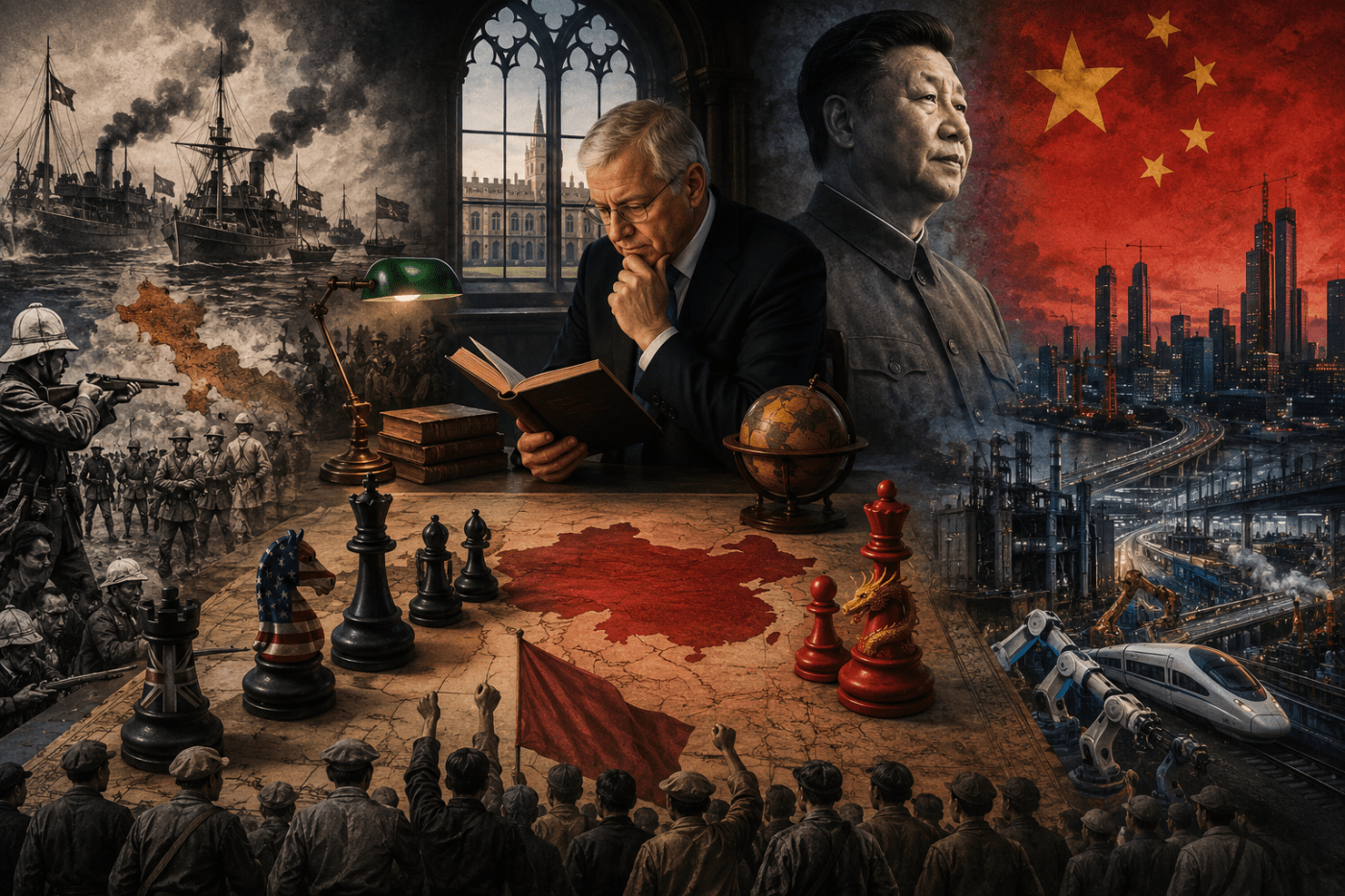
The New York Times manufactures Kevin Rudd as its authorized “China guy,” laundering the standpoint of a Five Eyes statesman through diplomatic prestige, Mandarin fluency and Oxford certification while reducing China to the mysterious intentions of Xi Jinping. The history buried beneath this personality profile reveals a nation invaded, partitioned, occupied and prevented from completing its civil war by the same imperial powers that now describe Chinese sovereignty, development and reunification as aggression. Read through China’s revolutionary and civilizational trajectory, Xi’s politics emerge not as the private obsessions of an all-powerful ruler but as one expression of a collective struggle to preserve socialism, recover productive power and prevent renewed national subordination. What Rudd presents as balanced expertise is therefore ideological intelligence for an empire that must erase its own violence, translate Marxism through its enemies and convert every Chinese achievement into evidence of a coming threat.
By Prince Kapone | Weaponized Information | July 22, 2026
The China Threat Narrative Learns to Speak in Complete Sentences
The New York Times promises to tell its readers “What Xi Jinping Wants.” The title performs the first ideological operation before Ezra Klein or Kevin Rudd has finished clearing his throat. China’s revolution, political system, industrial ascent and confrontation with American power are compressed into the private ambitions of one man. A country of more than a billion people becomes a personality profile. History becomes biography. Socialism becomes psychology. The contradictions of the world system become whatever happens to be moving behind Xi Jinping’s forehead.
This method is useful because personalities can be feared without social relations being understood. A leader can be diagnosed, profiled and placed beneath the lamp while the institutions producing the interview remain comfortably outside the examination room. Klein asks what Xi wants. Nobody asks what the New York Times wants from the answer, what political order Rudd considers natural or why American command enters the discussion as the silent measure against which every Chinese ambition is judged. The interrogators arrive wearing the white coat. Their own condition is presumed healthy.
Rudd is introduced as the guide capable of taking the listener inside Xi’s ideological universe. His proximity to state power appears as expertise without political location. A former Australian prime minister, diplomat and architect of policy within the American alliance system enters the conversation as though he had descended from the heavens carrying neutral knowledge of Marxism in one hand and the Chinese national character in the other. The interview does not examine the institutions that formed his strategic assumptions. It places those assumptions behind glass and labels them realism.
The resulting performance is propaganda for readers who believe propaganda is something shouted by lesser people on inferior television networks. Klein does not rant. Rudd does not foam at the mouth. Nobody pounds the table or mispronounces communism. That is the point. The old imperial panic has completed graduate school. The yellow peril has been house-trained, fitted with a podcast microphone and taught to describe itself as geopolitical analysis.
Marxism receives the full treatment. Rudd presents Xi as a committed Marxist-Leninist who understands history dialectically and considers China to be passing through the primary stage of socialism. But the concepts are introduced only to be stripped of their explanatory power. Historical materialism does not become a method for examining class, production, development or state power. It becomes evidence that Xi possesses a rigid ideological mind. Dialectics is reduced to strategic flexibility in pursuit of predetermined domination. Marxism survives in the interview as an authoritarian personality disorder with footnotes.
This caricature allows Klein and Rudd to enjoy the prestige of taking ideology seriously without ever permitting that ideology to explain anything. They congratulate themselves for moving beyond the crude Western assumption that Chinese leaders are merely cynical opportunists. Xi really believes in Marxism, they insist. Then they reconstruct Marxism as little more than central control, party discipline, surveillance and suspicion. The doctrine is admitted into the courtroom only after the prosecution has already written its confession.
The same operation is performed upon Xi’s biography. His family history, experiences during the Cultural Revolution, ascent through the Party, response to the Soviet collapse and consolidation of authority are assembled into an authoritarian genealogy in which every road leads backward to the same verdict. If Xi encountered disorder, it explains his hunger for control. If he studied ideological collapse, it explains his intolerance. If he emphasizes Party discipline, it proves his rigidity. If he adjusts policy, it proves his tactical cunning. The method is magnificently secure because no conceivable fact could threaten it. Consistency proves fanaticism; flexibility proves deceit.
China’s development enters the interview through the same one-way machine. The conversation acknowledges the extraordinary scale of Chinese industrial planning, technological advancement and productive capacity. But an achievement may appear only long enough to be entered into evidence as a threat. Industrial coordination becomes domination. Technological development becomes control. Long-term planning becomes ideological expansion. A Chinese factory cannot merely produce anything in the Times. It must also reveal a sinister intention.
The propaganda technique depends upon a carefully managed conversion. First, China’s accomplishments are admitted because denying them would make the conversation look unserious. Then those accomplishments are detached from the social purposes they may serve and reorganized around the danger they allegedly pose to the existing order. The interview can therefore sound impressed and alarmed at the same time. Admiration supplies credibility. Fear supplies the conclusion.
Taiwan enters through a similar structure of foreclosed uncertainty. Klein and Rudd speculate over Xi’s calculations, timelines and willingness to use force, repeatedly acknowledging how much remains unknown. Yet every uncertainty bends in the same direction. Perhaps Xi has a deadline. Perhaps he has only a strategic objective. Perhaps he prefers pressure. Perhaps he may eventually choose war. The evidence remains unsettled while the emotional destination never changes.
This is speculation arranged as escalation. The interview does not need to prove that invasion is imminent. It only needs to surround the listener with enough hypothetical danger that military preparation begins to appear prudent before the historical and diplomatic questions have even been admitted. One possibility is narrated with such gravity that it occupies the entire horizon. The absence of certainty becomes another argument for acting as though the worst conclusion were already established.
The trick works because American power is never subjected to equivalent speculation. Klein does not ask whether Washington’s political class might use Taiwan to preserve a declining regional hierarchy. Rudd is not invited to interpret every American weapons decision as evidence of an ideological compulsion toward domination. No personality profile of the United States is assembled from its doctrines, wars, sanctions and alliance demands. China must explain what it wants. American power is permitted simply to exist.
Rudd finally makes the interview’s political horizon visible when he describes the consequences that a Chinese victory over Taiwan would carry for American strategic credibility, allied confidence and “Pax Americana.” The phrase arrives almost politely, as though an imperial peace enforced through hierarchy were merely another neutral feature of the weather. Yet it clarifies why the entire interview has been arranged around the intentions of Xi Jinping. The stability under discussion is not stability in the abstract. It is the durability of an order whose legitimacy the interview assumes rather than argues.
The ideological architecture is therefore remarkably primitive beneath its polished surface. Personalize a social system. Caricature its theory. Convert its achievements into evidence of menace. Treat uncertainty as a reason for escalation. Present the existing imperial order as the natural condition from which only the adversary can deviate. Klein supplies the liberal curiosity. Rudd supplies the strategic authority. The Times supplies the institutional prestige. Together they reproduce the old China threat narrative for an audience that requires its prejudices delivered slowly, thoughtfully and with the proper books visible on the shelf.
The interview’s deepest fraud is not that it discusses Xi Jinping’s ideology. His ideology matters. The fraud lies in presenting ideology as an independent cause after removing the historical relations through which it acquired meaning. What remains is a sealed psychological system: Xi believes, Xi fears, Xi plans, Xi wants. The material world is admitted only when it can be converted into another symptom of the man.
What the interview excludes is therefore not peripheral context. It is the entire history required to understand the subject it pretends to explain. Colonial seizure, revolutionary division, diplomatic agreements, economic interdependence, technological coercion and military architecture are all held outside the frame while Klein and Rudd invite the reader to admire the sophistication of their portrait. Once that buried record enters the room, the portrait begins to crack. The mind of Xi Jinping can no longer carry the weight of the world they have placed upon it.
The History Buried Beneath the Personality Profile
China did not enter the modern world as an aspiring challenger to an innocent international order. It entered through cannon fire, foreign occupation, commercial plunder and the destruction of its sovereign authority. Britain opened the First Opium War in 1839 to force the Chinese state to accept a narcotics trade that transferred silver outward and social ruin inward. The Treaty of Nanjing seized Hong Kong, opened treaty ports and imposed indemnities. The United States followed with the Treaty of Wangxia, its own counterpart to the British settlement, securing extraterritorial privileges and commercial access beneath the guns of another empire.
The settlements imposed after the Opium Wars became the foundation of the treaty-port system. Foreign powers acquired concessions, controlled tariffs, claimed immunity from Chinese law and divided the country into zones of privilege. The Qing state remained formally alive while increasing portions of its territory, commerce and political authority were subordinated to outside command. This was not an unfortunate misunderstanding between civilizations. It was the forcible opening of China to an expanding capitalist world market on terms written by the states that possessed the ships, banks and artillery.
The collapse of the Qing dynasty in 1911 did not end that subordination. The new republic inherited foreign concessions, warlord fragmentation, fiscal weakness and a country whose political sovereignty had already been carved apart. The revolution overthrew the dynasty without establishing effective national unity. Competing armies and regional authorities struggled over the remains while the imperial powers preserved their economic positions and Japan expanded its command across East Asia.
Taiwan had already been severed from China after the First Sino-Japanese War. The Qing government ceded the island and the Penghu archipelago to Japan in 1895. Japanese colonial rule lasted fifty years. Land, labor, infrastructure and agricultural production were reorganized around the needs of the Japanese empire. Taiwan was not created outside Chinese history by the politics of the late twentieth century. Its separation began through colonial conquest.
Japan’s seizure of Manchuria in 1931 and full-scale invasion of China in 1937 carried this dismemberment toward catastrophe. Cities were occupied, industries seized and entire populations subjected to massacre, forced labor, sexual slavery and biological warfare. The Chinese struggle against Japan unfolded alongside the unresolved conflict between the Communist Party of China and Chiang Kai-shek’s Kuomintang government. National survival, social revolution and civil war entered the same historical furnace.
The wartime settlement treated Taiwan as territory taken from China by Japan. The 1943 Cairo Declaration stated that territories Japan had stolen from the Chinese, including Taiwan and the Penghu Islands, were to be restored. The 1945 Potsdam Proclamation incorporated the terms of Cairo, and Japan accepted Potsdam through its instrument of surrender. The postwar Allied order was built around the defeat and removal of Japanese colonial authority, including the disposition of Japan’s former colonies in Korea and Taiwan.
The defeat of Japan did not produce a unified Chinese state. Civil war resumed between the Communist forces and a Kuomintang government weakened by corruption, inflation, military exhaustion and its dependence upon American assistance. The Communist victory rested upon a mass revolutionary struggle built among workers and peasants, a land program that broke landlord power and an army capable of converting social organization into military force. Mao Zedong proclaimed the People’s Republic of China in October 1949. Chiang Kai-shek, sections of the Kuomintang state and approximately two million soldiers and civilians retreated to Taiwan after losing control of the mainland.
The governments in Beijing and Taipei did not initially understand themselves as two settled nations. Each claimed to represent China. The Kuomintang imposed martial law on Taiwan, suppressed communist, socialist and independence forces and maintained the declared objective of retaking the mainland. The Communist Party regarded the flight to Taiwan as the unfinished conclusion of a civil war in which the defeated government survived because a larger foreign power placed itself between the two sides.
That intervention became explicit after the Korean War began in June 1950. Washington had previously prepared to allow the Chinese Civil War to reach its military conclusion. The United States then sent the Seventh Fleet into the Taiwan Strait, preventing the People’s Liberation Army from crossing while also restricting Kuomintang attacks against the mainland. An internal conflict produced by revolution and civil war was frozen by American naval power.
The line across the Strait was maintained through alliance, arms and the threat of direct intervention. Washington signed a mutual defense treaty with the government in Taipei in 1954. Congress passed the Formosa Resolution in 1955, granting the president authority to employ American forces around Taiwan and the offshore islands. The United States armed Chiang’s government while American warships and aircraft operated along the Chinese coast. The separation that later appeared as a permanent geopolitical fact was constructed through this military balance.
The international representation of China nevertheless shifted toward Beijing as the durability of the revolution could no longer be denied. In 1971, United Nations General Assembly Resolution 2758 restored the lawful rights of the People’s Republic of China and recognized its representatives as the only lawful representatives of China at the United Nations. The government in Taipei lost the Chinese seat it had continued to occupy for more than two decades after losing the mainland.
The following year, Washington and Beijing issued the Shanghai Communiqué. The United States acknowledged that Chinese people on both sides of the Strait maintained that there was one China and that Taiwan was part of China. Washington stated that it did not challenge that position and affirmed an interest in a peaceful settlement by the Chinese themselves. The communiqué did not resolve the civil conflict, but it established the diplomatic language through which the United States began withdrawing formal recognition from Taipei while opening relations with Beijing.
Formal normalization followed on January 1, 1979. The United States recognized the government of the People’s Republic as the sole legal government of China, terminated formal diplomatic relations with Taipei and ended the mutual defense treaty. Washington maintained unofficial relations with Taiwan and preserved commercial, political and military connections through domestic legislation. The Taiwan Relations Act, passed only months after normalization, authorized continued arms transfers and declared that American policy would retain the capacity to resist coercion against the island.
The contradiction was written directly into the new arrangement. Washington recognized Beijing, accepted diplomatic relations on the one-China basis and simultaneously built a legal mechanism for arming the government that had survived the civil war in Taiwan. The United States no longer recognized Taipei as the government of China, but neither would it permit the military relation that sustained the separation to disappear.
The 1982 joint communiqué attempted to contain this contradiction. Washington stated that it did not seek a long-term policy of arms sales to Taiwan and intended gradually to reduce their quantity and quality. Beijing reaffirmed a policy of striving for peaceful reunification. Yet American weapons continued to flow. The State Department’s own diplomatic history records that Beijing regarded the Taiwan Relations Act and continuing arms transfers as violations of Chinese sovereignty.
Beijing’s contemporary position remains rooted in this sequence. The People’s Republic identifies Taiwan as part of China, treats reunification as a task left unresolved by foreign intervention and places peaceful reunification as its declared first choice. Its 2022 white paper ties the Taiwan question to the century in which Chinese territory was divided by imperial powers and to the national reconstruction that followed the revolution. It states that peaceful reunification remains the preferred means while refusing to renounce force against external intervention or a formal secession.
The political order governing Taiwan changed substantially after the end of Kuomintang martial law. Elections, new parties and a distinct Taiwanese civic identity transformed the island’s internal life. The government in Taipei no longer pursues the old Kuomintang project of reconquering the mainland, and political forces disagree over whether Taiwan should preserve the existing ambiguity, move toward independence or develop a different relationship with Beijing. None of these changes erased the historical origin of the separation or the military structure that continues to enforce it.
Nor did political separation prevent the formation of a dense cross-Strait economy. Taiwanese firms invested heavily in mainland manufacturing as China became a central site of global production. Supply chains stretched across the Strait through electronics, machinery, chemicals, finance, shipping and consumer goods. Even after efforts to redirect investment elsewhere, official Taiwanese statistics continue to record large volumes of cross-Strait trade and investment. The relationship has been simultaneously divided by state power and integrated through production.
Semiconductors placed this contradiction at the center of the world economy. Taiwan Semiconductor Manufacturing Company became the leading producer of advanced logic chips used in telecommunications, transportation, weapons systems, data centers and artificial intelligence. Its 2025 annual report describes a company manufacturing thousands of products for customers spread across the global economy. Taiwan’s advanced fabrication capacity is not merely a local industrial asset. It occupies a critical position inside an international division of labor linking Taiwanese production to American design firms, Japanese materials, European equipment and Chinese assembly and markets.
Washington has converted its command over decisive points in this network into a weapon against Chinese development. The Commerce Department’s October 2022 controls restricted China’s access to advanced computing chips, semiconductor manufacturing equipment and the labor required to operate or service them. The rules were expanded in 2023, clarified in 2024 and reinforced through controls on additional equipment, software, high-bandwidth memory and Chinese firms. Licensing policy shifted again in 2026, but the governing power remained the same: Washington asserted authority over what advanced technologies could enter China, including products manufactured outside American territory when they depended upon American equipment or intellectual property.
Tariffs and industrial restrictions extended the same contest across electric vehicles, batteries, solar equipment, telecommunications and advanced machinery. China’s climb through the productive hierarchy of the world economy was met not by a neutral market rendering its verdict but by a state-directed campaign to obstruct access to technologies, markets and supply chains. The contest over Taiwan therefore sits inside a broader struggle over who will command the industries upon which twenty-first-century economic and military power depends.
That struggle is backed by an expanding military system. The United States maintains major forces in Japan and South Korea, operates from Guam and the Northern Mariana Islands, rotates troops through Australia and has expanded access to bases in the Philippines. The Pentagon’s own budget documents describe a more distributed and resilient forward posture across the Indo-Pacific. Missile defenses, airfields, ports, fuel storage, intelligence systems and logistics networks are being integrated so that American forces can disperse throughout the region and sustain operations along China’s maritime perimeter.
Japan has been drawn deeper into this structure through joint command coordination, expanded military spending and preparations extending from peacetime surveillance to regional contingencies. The Philippines has granted the United States wider access to military sites, several facing Taiwan and the South China Sea. Australia has been integrated through force rotations, intelligence facilities, submarine cooperation and the wider construction of an allied military-industrial base. Guam is being hardened as both a weapons platform and a logistical center for war across the western Pacific. The Pentagon openly describes the integration of Japan and Australia, the reinforcement of Guam and the expansion of regional partnerships as components of its posture toward China.
This is the historical field upon which the Taiwan question now stands: a territory taken by Japanese colonialism, returned after Japan’s defeat, separated again by civil war, held outside Beijing’s authority through American intervention, economically integrated with the mainland and positioned at the center of a technological and military contest. None of these relations can be reconstructed from the ambitions of one leader. They were built across two centuries by revolution, empire, production, diplomacy and force.
The Real Question Is Not What Xi Wants, but What Empire Refuses to Surrender
Once the history buried by the interview is restored, its central question collapses. China’s confrontation with the United States cannot be explained by treating Xi Jinping’s ideology as the private engine of world history. The conflict did not begin inside one man’s mind. It emerged from the long struggle of a colonized nation to recover political unity, rebuild productive capacity and prevent foreign powers from once again determining the limits of its development.
From the standpoint of the colonized world, the rise of China does not first appear as the arrival of a new danger. It appears as the return of a country that was invaded, partitioned, looted and subordinated by the same imperial powers that now present their own supremacy as the natural condition of international life. The question is not why China remembers humiliation. The question is why the states that inflicted it expect historical amnesia to remain a permanent obligation of their victims.
The Opium Wars established the political economy behind the civilizational language. China was not attacked because it threatened the freedom of other nations. It was attacked because its government resisted the terms upon which European capital sought entry. The gunboat opened the market, the unequal treaty secured the merchant and extraterritorial law protected the foreign exploiter from the sovereignty of the people whose country he entered. What liberal history remembers as the spread of commerce was experienced from below as the forcible separation of a people from control over their ports, tariffs, land and social reproduction.
This is the first contradiction erased by the Times. The capitalist world market did not form through peaceful exchange among equal states. It expanded through conquest, slavery, colonial occupation and the destruction of political barriers to accumulation. Europe and the United States developed through access to labor, resources and markets they did not possess within their own borders. The colonized world paid for this development in land, blood and arrested productive capacity.
China’s revolution was therefore not an ideological deviation from a neutral road to modernity. It was an attempt to break the institutional machinery through which foreign capital, landlords, comprador elites and military power had organized underdevelopment. The revolution unified territory, destroyed the political authority of the landlord class, mobilized the peasantry and constructed a state capable of directing resources toward national reconstruction. Its historical legitimacy cannot be measured by the approval of those whose commercial and strategic privileges it abolished.
The peasantry stands at the center of this history. Liberal accounts reduce peasants to backward populations waiting for the city, the market and the enlightened administrator to drag them into modern life. The Chinese Revolution recognized them as a social force capable of making history. Land reform was not merely a policy adjustment. It was the destruction of a class relation through which landlords appropriated the labor of the rural majority and converted political authority into hereditary economic command. The revolution became national because it entered the village, armed those who had been ruled and transformed the peasant from an object of taxation into a participant in state power.
This is precisely the historical experience that elite Western analysis must render unintelligible. If the Chinese Revolution arose from material conditions, class struggle and anti-colonial resistance, then socialism cannot be dismissed as the mental fixation of a ruler. It becomes a historical answer to problems created by empire, landlordism and dependent development. The political system may then be judged through the contradictions of that struggle rather than through the myth that liberal capitalism arrived without coercion and represents the destination toward which all societies naturally travel.
The division across the Taiwan Strait must be understood within the same field. It was not produced by an eternal conflict between democracy and authoritarianism. Taiwan was seized by Japan, returned after the defeat of the Japanese empire and separated from the mainland through a civil war whose conclusion was blocked by American military intervention. The United States did not discover an independent democratic nation and volunteer to protect it. It preserved a defeated anti-communist state as part of a regional order built to contain revolution in East Asia.
The later democratization of Taiwan transformed the island’s internal political life, but it did not erase the material origin of the separation. Nor did it remove Taiwan from the strategic architecture through which Washington projects force along China’s coast. The rights and aspirations of the Taiwanese people are real. So is the history through which their island was inserted into a military system that no American policymaker would tolerate if constructed by a rival power across the Caribbean or along the Pacific coast of the United States.
The ideological trick is to recognize only one side of this contradiction. Chinese military activity is treated as evidence of aggression because it challenges an existing balance. American military power disappears because it created that balance. The empire’s bases, fleets, alliances and weapons systems become geography. China’s response becomes politics. One side acts. The other merely stands where history allegedly placed it.
But history placed nothing there by itself. The regional order was built. It was built through war, occupation, treaties, bases, client states and the preservation of American naval supremacy. “Pax Americana” names not peace in the universal sense but a hierarchy in which the United States reserves the power to determine which states may unify their territory, which technologies they may acquire, which trade routes they may secure and which political systems will be treated as legitimate.
For the nations of Africa, Asia, Latin America and the Caribbean, this hierarchy is not an abstraction. It is experienced through sanctions, debt, military intervention, unequal exchange, export dependence and the permanent pressure to organize production around the needs of foreign capital. Their raw materials leave cheaply. Manufactured goods return dearly. Their labor produces value that accumulates elsewhere. Their governments are instructed to open markets, privatize social wealth and abandon industrial planning, then blamed for the poverty produced by that submission.
China’s industrial rise ruptures this script because it demonstrates that a formerly colonized nation can use state power, public ownership, planning, technology transfer and disciplined control over finance to move upward through the international division of labor. This does not mean every contradiction within Chinese development has disappeared. It means the country refused the place assigned to it. It would not remain a reservoir of cheap labor, a market for foreign goods or a dependent workshop barred from commanding advanced production.
That refusal explains why Chinese factories, ports, railways, batteries, electric vehicles, telecommunications systems and semiconductor ambitions are so easily converted into security threats. The issue is not simply that China produces. It is that China increasingly produces what the imperial center expected to monopolize. Productive capacity becomes geopolitical power because the states controlling technology, finance and industrial infrastructure possess greater freedom to determine their own future.
From the standpoint of the global working class, the conflict is therefore not between an innocent market and an intrusive Chinese state. The world economy is governed everywhere by state power. Washington protects intellectual property monopolies, subsidizes strategic industries, controls payment systems, directs export restrictions, imposes tariffs, sanctions competitors and mobilizes military force around the commercial interests of its ruling class. It calls Chinese planning political because American planning operates through institutions it has taught the world to mistake for the market.
Export controls expose this deception with unusual clarity. The United States claims authority over technologies manufactured across multiple countries because American firms control decisive patents, software and equipment. It uses this command to obstruct China’s movement into advanced production. The objective is not merely to prevent a specific military application. It is to preserve a technological hierarchy in which the imperial center retains control over the highest-value layers of the world economy while other nations remain dependent upon access it can withdraw.
The worker in a semiconductor plant, the miner extracting cobalt, the peasant displaced for an export plantation and the technician assembling electronics occupy different points within the same international structure. Their labor is connected, but the value they create is distributed through relations of unequal power. The contest over chips, machinery and industrial policy is therefore also a contest over who controls the accumulated intelligence of human labor and who captures the wealth generated by it.
The Times presents Chinese state direction as a danger because it makes visible a political truth that capitalism works hard to conceal: production is always organized by power. The question is never whether planning exists. The question is who plans, for whose benefit and under whose command. Private corporations plan internally. Banks plan through credit. Empires plan through sanctions, standards and military access. The scandal begins only when a socialist state plans in ways that weaken the monopoly of imperial capital.
This does not require romanticizing every Chinese policy or pretending that class contradiction has vanished inside the People’s Republic. Chinese workers still confront exploitation, inequality, regional disparities and the disciplinary pressures of rapid accumulation. The socialist character of the state is not proven by slogans or guaranteed by history. It is fought over through the balance between public direction and private accumulation, social need and profit, national development and the power of capital.
But these contradictions must be understood within the actual historical movement of Chinese society, not filtered through the ideological needs of the American ruling class. The existence of contradiction does not reduce China to another capitalist state competing on equal terms within a neutral system. Its public sector, financial command, land regime, industrial planning and Party authority create capacities that distinguish its development from countries subordinated to private capital and foreign creditors. Those capacities are precisely what make independent national strategy possible.
The central battle is over sovereignty understood materially. Sovereignty is not a flag, anthem or seat at the United Nations. A nation is not sovereign when it must import the machinery required to process its own resources, borrow foreign currency to build essential infrastructure, surrender public assets to obtain credit or seek permission before acquiring advanced technology. Political independence without productive capacity leaves the former colony vulnerable to economic command.
China’s rise matters across the Global South because it expands the visible boundaries of what a postcolonial state may attempt. It demonstrates that poverty is not a cultural inheritance, that technological dependency is not permanent and that the monopoly of advanced production can be challenged. The fear this generates in Washington is dressed as concern for international order because the actual concern cannot be spoken plainly: a world in which formerly colonized nations command industry, finance and technology is a world in which imperial privilege becomes harder to enforce.
This is why the confrontation surrounding Taiwan exceeds the island itself. Taiwan sits at the intersection of unresolved civil war, national sovereignty, advanced production and American military strategy. Its semiconductor industry has become a concentrated expression of the larger struggle over who will control the productive forces of the coming era. The Strait is dangerous not because one leader has become obsessed with a symbolic prize, but because historical claims, military encirclement and technological command have been compressed into one narrow geography.
The real danger is not Chinese memory. It is the refusal of American power to accept limits. Washington insists that China must rise only within an order whose rules preserve American primacy. It may trade, but not displace American industry. It may develop, but not master decisive technologies. It may claim sovereignty, but not where that claim collides with the strategic architecture of the United States. It may become powerful, but only so long as its power remains subordinate.
From the standpoint of empire, this arrangement appears reasonable because empire experiences its privileges as universal interests. From the standpoint of the colonized nation, it appears as the continuation of the old demand in modern form: open your markets, limit your ambitions, accept foreign military power near your territory and trust the states that once divided you to determine how far your sovereignty may extend.
Xi Jinping’s ideology operates inside this contradiction. It did not create it. His emphasis on Party leadership, national unity, industrial power and resistance to foreign domination draws force from a history larger than his biography. The durability of those themes arises because they correspond to material problems that confronted China before he was born and will remain after he is gone. Reducing them to his psychology does not explain China. It protects the listener from having to understand why millions of Chinese people might regard sovereignty, development and national reconstruction as collective historical tasks.
The interview asks what Xi wants because asking what China has survived would reorder the entire moral landscape. Asking what American power is defending would expose the hierarchy concealed beneath the language of stability. Asking what the global working class and colonized nations have at stake would shift the subject from the fears of imperial managers to the unfinished struggle for control over land, labor, technology and national development.
The real story is therefore not the emergence of an ideological ruler threatening a peaceful order. It is the revolt of historical development against an imperial division of the world. A nation once opened by cannon has built the capacity to resist command. A peasantry once treated as inert matter became a revolutionary force. A country assigned to dependency entered the highest levels of industrial production. An empire accustomed to writing the rules now confronts a power it cannot easily discipline.
What Washington calls revisionism is the refusal of the formerly colonized to remain where conquest placed them. What it calls aggression is often the resistance of other states to a military order they did not design. What it calls the defense of peace is the defense of hierarchy. And what the New York Times calls an explanation of Xi Jinping is the ideological labor required to conceal all three.
Stop the Arms, Resist the Bases, Break the War Narrative
The danger exposed by this excavation will not be defeated by discovering a kinder vocabulary for American primacy. “Managed competition” is already producing weapons contracts, export controls, military exercises, racial surveillance and bases pushed deeper into the lands and waters surrounding China. Every new missile is called deterrence until the missiles face one another. Every new base is called stability until the people living beneath its flight paths are ordered to accept poisoned water, seized land and the possibility of becoming the first battlefield in somebody else’s war. The task is not to manage this machinery more elegantly. It is to organize against the machinery before its preparations acquire their own murderous momentum.
The beginnings of that movement already exist. CODEPINK’s China Is Not Our Enemy campaign has built one of the clearest national organizing infrastructures against Washington’s march toward confrontation. It combines political education with action resources, congressional pressure, public events and recurring study spaces designed to break the monopoly exercised by the Pentagon, think tanks and corporate media over how China is understood. Its petition against legislation that further militarizes Taiwan is delivered directly to congressional offices rather than deposited in the digital graveyard where so many petitions go to die. Its campaign resources include calling scripts, toolkits and webinars that can be taken into union halls, classrooms, neighborhood organizations and community meetings without waiting for some national peace bureaucracy to give permission.
That work must be multiplied locally. Every city with a port, military contractor, university research complex, logistics hub or congressional office possesses a point where the New Cold War touches material life. Study groups should not remain literary clubs sealed off from struggle. They should become local China education committees capable of tracing the road from newspaper propaganda to appropriations, from appropriations to weapons contracts, and from weapons contracts to the workers ordered to manufacture and transport the instruments of confrontation. CODEPINK’s biweekly China Is Not Our Enemy book club and its anti-imperialist campaign-action series provide usable models: study the history, dissect the lie, identify the institution carrying it and move people toward a concrete intervention.
Veterans possess a particular responsibility in this struggle because the empire constantly recruits their sacrifice to authenticate its next war. The Veterans For Peace China Working Group monitors government propaganda, supports a pivot toward peace and creates an organizational space for former service members resisting confrontation with China. Veterans For Peace has adopted resolutions demanding an end to U.S. war preparations and provocations aimed at China and opposing the expansion of military blocs across the region. A veteran who can explain what “force posture,” “interoperability” and “strategic access” mean after the press conference ends can puncture the antiseptic language through which preparation for mass death is sold as professional housekeeping.
The work of veterans should reach beyond statements. They can testify at congressional offices when new Taiwan weapons packages appear, speak to military families whose children may be sent into a Pacific inferno, conduct counter-recruitment among young people and expose the distance between the confidence of the war planners and the lives they intend to spend. They can also confront the new McCarthyism accompanying the military buildup. Veterans For Peace has already connected the targeting of Chinese Americans and Black liberation activists to Washington’s expanding use of national-security law. The external enemy and the internal suspect are manufactured together. The fleet moves west while the dragnet spreads at home.
When the danger sharpens into a congressional vote, a provocative military visit or a confrontation at sea, education must become visible disruption. The ANSWER Coalition possesses the practical infrastructure for demonstrations, emergency mobilizations and coordinated public actions that many smaller educational formations lack. Its donations are processed through the Progress Unity Fund, identified as its 501(c)(3) fiscal sponsor, making the sponsorship structure publicly visible rather than hidden behind vague declarations of grassroots authenticity. ANSWER should be pushed to make the struggle against a Pacific war a permanent organizing front, not a subject revived only when the ships are already circling one another.
The movement cannot remain confined to mainland organizations speaking abstractly about peace while people across the Pacific are forced to carry the bases. Guam is not an empty aircraft carrier conveniently parked near Asia. It is the homeland of the CHamoru people, transformed by colonial rule into a military platform whose strategic value is praised in Washington and paid for locally through land seizure, contamination and the threat of war. Prutehi Guåhan is fighting the Air Force’s effort to conduct open burning and detonation of hazardous munitions on a Guam beach without the full environmental review required by law. The struggle has reached the Supreme Court after a federal appeals court allowed the community’s challenge to proceed.
This is what the Pentagon’s polished language conceals. “Readiness” means expired explosives detonated near ancestral land. “Strategic access” means communities fighting to protect beaches and drinking water from the military institution claiming to defend them. The response from the mainland peace movement cannot be to treat Prutehi Guåhan as decorative evidence for somebody else’s analysis. Its statements must be circulated, its litigation supported and its organizers invited into antiwar forums as political subjects capable of explaining what militarization means from the ground beneath it. Every environmental assessment, permit renewal and military construction proposal should be treated as an organizing opening through which residents, Indigenous communities, scientists and antiwar formations can expose the local cost of global command.
The same principle applies in the Philippines, where Washington’s regional architecture is being expanded through military exercises and access agreements. BAYAN continues to demand the removal of U.S. troops and the termination of the Balikatan war exercises, while progressive organizations have protested the expansion of Enhanced Defense Cooperation Agreement sites and the conversion of Philippine territory into a staging ground for conflict with China. During the 2026 exercises, BAYAN connected the resources consumed by large-scale war games to unmet social needs and denounced the environmental and sovereign costs imposed upon the Filipino people.
Solidarity with Philippine resistance means more than reposting photographs after police have already cleared the demonstration. Organizations in the United States can coordinate actions at Philippine consulates and American military facilities during Balikatan, circulate statements from Filipino movements inside unions and community groups, and expose the weapons systems being placed near communities whose consent is treated as an administrative inconvenience. Filipino workers in the diaspora already possess organizations, family networks and political traditions capable of joining the struggle against U.S. basing to the struggle against exploitation at home. The peace movement should enter that relationship as a comrade, not as another American institution arriving to explain Asia to Asians.
The domestic front is equally decisive. The same state depicting China as an all-encompassing foreign danger has repeatedly treated Chinese and Asian scientists, researchers and workers as potential enemies within. This machinery can be defeated when organizations intervene before repression becomes settled policy. In January 2026, a coalition of more than eighty Asian American advocacy organizations secured the removal of language seeking to revive the discredited China Initiative from the House Commerce, Justice and Science appropriations process. The victory followed organized letters, civil-rights pressure and warnings that the program had enabled racial profiling and destructive targeting of Asian American scholars.
That victory supplies a tactical lesson. Repression should be fought while it is still language in a committee report, a proposed appropriation or an agency directive—not only after agents arrive at somebody’s home. University unions, graduate-worker locals, scientific associations and Asian American community organizations should establish rapid-response structures capable of reading appropriations bills, identifying revived China Initiative provisions and flooding congressional offices before the measure hardens into law. Every targeted researcher should have immediate access to legal defense, union representation and a public campaign that refuses the ritual demand that the accused prove loyalty to the state persecuting them.
Taiwan arms sales provide another concrete point of intervention. The Defense Security Cooperation Agency administers the Foreign Military Sales system and publicly announces major proposed transfers. These notices identify the weapons, estimated cost, contractors and stated strategic purpose. Antiwar organizations should monitor them systematically and respond before each sale disappears into administrative normality. One team can translate the weapons notice into plain language. Another can map the contractors and their political contributions. Constituents can pressure members of the House Foreign Affairs and Senate Foreign Relations committees to oppose the transfer. Demonstrations can target the corporation receiving the contract rather than performing another general march through streets where nobody responsible is present.
Labor must be brought into this fight not as an audience applauding moral appeals but as a force situated inside the machinery of confrontation. Port workers move the cargo. Aerospace workers assemble the weapons. University workers conduct research increasingly bound to national-security priorities. Semiconductor workers occupy industries being reorganized around technological warfare. Logistics workers understand the physical pathways hidden beneath strategic maps. Union resolutions should demand opposition to war with China, reject racial profiling of Chinese and Asian workers, require disclosure of military contracts and create political-education programs connecting members with workers across China, Taiwan, the Philippines, Guam, Okinawa and Korea.
This cannot begin with reckless demands that isolated workers refuse work and sacrifice their livelihoods while the institutions of collective support remain undeveloped. The immediate task is organization: make the contracts visible, identify the employers profiting from escalation, educate the membership, build alliances across affected industries and contest the lie that militarized production is the only source of secure employment. Every missile factory exists because public money has been directed there instead of toward rail, housing, hospitals, renewable energy and civilian shipbuilding. Conversion ceases to be an abstraction when workers themselves begin mapping what their skills could produce outside the permanent war economy.
The ideological struggle must also be waged at the speed at which propaganda now travels. The war narrative is reproduced through headlines, algorithmic feeds, congressional clips and maps showing Chinese forces while cropping out American bases. Social-media intervention must therefore become disciplined political work. Each post should connect one historical fact, one present military or economic measure, one contradiction and one action. Place the Shanghai Communiqué beside the latest weapons transfer. Place a map of U.S. bases beside a speech accusing China of encirclement. Place semiconductor restrictions beside sermons about free trade. Place the defeated China Initiative language beside the next politician demanding suspicion of Chinese scientists.
The point is not to win an argument in the comments section against every flag-waving amateur admiral. It is to create a countercurrent strong enough that people encountering the war narrative also encounter organized resistance. China Is Not Our Enemy already maintains a recognizable campaign identity; Veterans For Peace has a working group; ANSWER has mobilizing infrastructure; CHamoru and Filipino movements are fighting the bases where they land; Asian American coalitions have demonstrated that congressional language can be defeated. The pieces exist. They must be connected.
That connection requires political clarity. Opposition to a U.S. war on China does not require pretending that every contradiction within Chinese society has been resolved or that every policy of Beijing is beyond criticism. It requires understanding which state is surrounding which, which military power has planted itself across the Pacific, which government claims the right to deny another country access to advanced technology and which ruling class needs China transformed into an enemy to justify the preservation of its command. Solidarity begins by refusing the empire’s demand that the peoples it targets first prove their perfection.
The immediate program is therefore plain: stop the arms, resist the bases, defeat the racial dragnet, organize the workplaces and break the propaganda monopoly. Sign the petitions, but carry them into congressional offices. Hold the teach-ins, but connect them to a weapons notice, military exercise or appropriations fight. Support anti-base movements, but place their representatives at the center of the platform. Pass union resolutions, but build committees capable of enforcing their meaning. Study China, but study also the institutions preparing Americans to kill Chinese people without ever understanding them.
Pax Americana survives not because it is invincible, but because its commands are fragmented into separate acts that appear too small to constitute a war: one export restriction, one radar installation, one research prosecution, one arms package, one military exercise, one poisoned beach. The movement must reveal the whole by organizing at every part. The map belongs to the people forced to live beneath the bases, the workers ordered to build the weapons and the communities selected for suspicion. Once they begin acting together, deterrence loses its mask. What appeared as the natural order of the Pacific can be recognized for what it is: a political arrangement maintained by force, and therefore an arrangement that organized people can overturn.


Leave a Reply